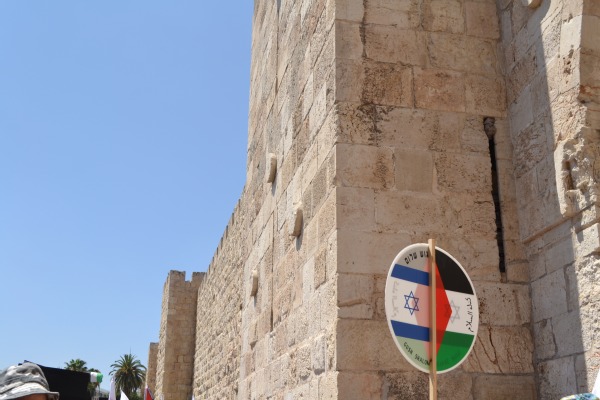
Tent of Nations Told to Stop Working its Own Land – Be Ready to Act!

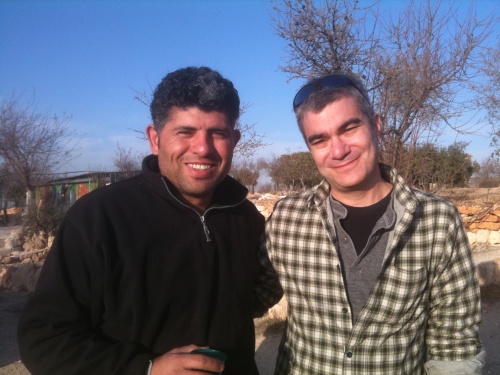
Friends of Tent of Nations has just shared this upsetting letter from Daoud Nasser (above left):

Dear Friends,

Today, the 14th of  February at 1.30 PM and as we were working on our land, specifically in the tree of life orchard, we found on three different places ,  papers with maps signed by the civil administration of Judea and Samaria which is the Israeli military government.

The papers say that we have to stop working  on the land specified on the map, because they declared it as a state land. According to them, this land doesn’t belong to us but it is a state land and we are cultivating it. The papers also say  that if we want to challenge this order, we can appeal against it within 45 days in front of the military representative office.

It is a shock to receive something like that after 21 years of legal battle defending our land and the right to it in front of Israeli courts.

We sent those papers to our attorney in Jerusalem and he is going to appeal against it within the next days.

This is just to inform you about what happened today, please be aware that the situation might get worse, please be prepared in case actions are needed. In the meanwhile, our attorney will appeal against it and we will see what kind of reaction we receive”

We will keep you updated and will inform you about our next steps and how you can help.

Thank you so  much for your support and solidarity. Please keep us in your thoughts and prayers.

Blessings and Salaam.

Readers of my blog should be well acquainted with my friend and personal hero Daoud Nasser. Last year I wrote about Tent of Nations and my visit, together with twenty JRC congregants, with Daoud on his family farm.

This new development is just the latest in a long history of harassment courtesy of the military administration in the West Bank – an institution that provides the shameful “legal” cover for Israel’s outright theft of Palestinian lands. Please stand by – I will forward any further news from Daoud and let you know how you can act on his behalf.

The Media Silence is Deafening – Please Voice Your Support for Khader Adnan

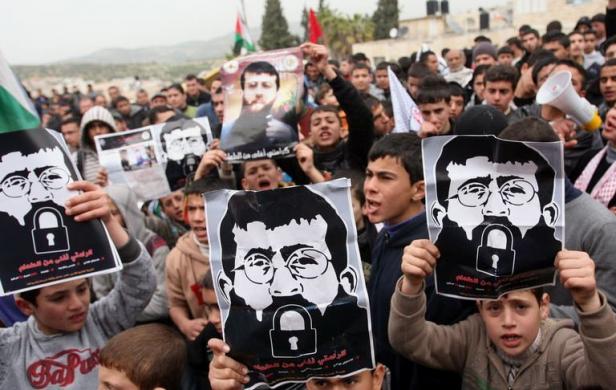
As Palestinian prisoner Khader Adnan enters the 64th day of his hunger strike, Israel’s High Court of Justice has scheduled a petition hearing for this Thursday – this despite the report of an Israeli-accredited doctor who confirmed that Khader Adnan “is in immediate danger of death” and that “a fast in excess of 70 days does not permit survival.”

Meanwhile, the silence of the mainstream media over Khader’s hunger strike has grown deafening to the point of absurdity. As I drank my coffee and opened the Sunday New York Times this morning, I was heartened to see an extensive feature by Isabel Kershner on the impact of Israel’s administrative detention policy on a young Palestinian. Astoundingly, there was only one glancing reference to Khader Adnan’s hunger strike – and she didn’t even bother to refer to him by name.

Peter Hart, activism director for FAIR hit it right on the head in the Huffington Post today:

For years prominent corporate media pundits have told us that the world — and the media — would embrace a dramatic, non-violent Palestinian resistance movement. If only such a movement — perhaps led by a Gandhi-like figure — were to finally emerge, we are told, the media coverage will come, and sympathy from across the world will strengthen support for the Palestinian cause…

But what about someone, right now, resisting Israeli detention practices? Someone whose hunger strike is attracting attention around the world? That is Khader Adnan.

Ironically enough, in an interview with the Jerusalem Post today, Khader’s wife Randa (who is pregnant with their third child) voiced her appreciated for those in the Israeli press who have reported on her husband’s plight:

Randa said that a lot of Israeli journalists had helped her husband’s case by reporting objectively.

“We deal with them in the best way possible.

It’s important that the world knows that we are not against peace and we don’t hate Jews; we only hate the occupation,” she told the Post.

Please join me in signing this petition from Amnesty International that calls upon Israel’s Secretary of Defense to:

  • Immediately release Khader Adnan and other Palestinians held in administrative detention, or immediately charge and try them for internationally recognizable criminal offences in full conformity with international fair trial standards;
  • End the use of administrative detention, which violates the right to a fair trial;
  • Ensure that detainees are treated humanely at all times, and that no detainees are punished for their decision to go on hunger strike.

Hunger Striker Khader Adnan is Near Death

Palestinian hunger striker Khader Adnan is near death.

Adnan, a 33-year-old Palestinian, has been on a hunger strike since December 18 after he was arrested in a nighttime IDF raid on his home in the village of Arraba, Jenin.   Khader has been held without trial and charged, without any evidence presented, of affiliation with Islamic Jihad.

Yesterday, an Israeli military court rejected Khader’s appeal.  In his decision, Judge Moshe Tirosh disregarded Khader’s lawyers’ numerous arguments, including the lack of evidence that Khader Adnan has carried out any activities providing grounds for detention; that administrative detention is used in an arbitrary manner; and that affiliation to a political party is aligned with the right to freedom of expression, assembly and political association.

Judge Tirosh further dismissed Khader’s claim that he was subjected to torture, inhuman and degrading treatment while in custody, adding that only Khader is to blame for his physical health deterioration and that his grave medical condition will not influence the court’s administrative detention decision.

And so Khader remains chained to his hospital bed by Israeli authorities, despite warnings that his death is essentially imminent. Human Rights Watch has called upon Israel to “immediately charge or release” Adnan – a demand Israel stubbornly continues to refuse.

Khader Adnan is but one of thousands of Palestinian prisoners being held in Israel’s practice of arbitrary imprisonment  According to a January 1 report by Addameer, a Palestinian Prisoner Support and Human Rights NGO, there are currently 4417 Palestinians held as political prisoners, 310 of whom are being held in “administrative detention” without trial or formal charge.

In a recent op-ed, Ali Abunimah notes the appalling silence of the international community over Khader Adnan’s hunger strike – and Israel’s egregious practice of administrative detention in the West Bank:

Khader Adnan’s struggle reminds us that nonviolence is not the easy choice. It is often the harder one.

Yet the world is still failing to act. The Palestinian prisoner’s group Addameer undoubtedly spoke for many when it declared that it “holds the international community responsible for not taking action to save Khader’s life.” It demanded “that the European Union, the United Nations and the International Committee of the Red Cross intervene with Israel immediately before it is too late.”

And there has been silence too from prominent voices such Nick Kristof, the New York Times columnist famous for using individual stories to draw attention to human rights abuses around the world. In a 2010 column titled “Waiting for Gandhi,” Kristof scolded Palestinians for not adopting nonviolent tactics.

Of course Kristof was ignoring or simply ignorant of the rich history and present of such popular resistance in Palestine… Last Autumn hundreds of Palestinian prisoners spent weeks on hunger strike against punitive Israeli prison conditions, and many are on hunger strike now in solidarity with Adnan.

But if Kristof and others claim to be “waiting for Gandhi” why haven’t they spoken up for Adnan? After all it was Mahatma Gandhi himself who when repeatedly imprisoned by the British famously used hunger strikes to draw international attention to his people’s cause.

BTW: readers of this blog may remember the heartbreaking post I shared last December by Palestinian businessman Sam Bahour, who described the plight of his dear friend Walid Abu Rass.  Abu Rass, Finance and Administration Manager for Health Work Committees (HRW) – one of the largest community health service providers in the occupied Palestinian territory – was taken from his home in front of his wife and two daughters at 1:30 am on November 22.

Here’s Addameer’s update on Walid’s situation:

Walid’s administrative detention (hearing) took place in two phases. In the first session, the military judge allowed Walid and his lawyer to be present in court with the prosecution. The second session was a closed session, during which Walid and his lawyer were not allowed to be present while the judge read the classified material on which his administrative detention is supposedly based. The judge claimed that this material contains trusted information that Walid is an activist in the Popular Front for the Liberation of Palestine (PFLP) and that administrative detention is the “only way to prevent the danger posed by the detainee.”

When the judge confirmed his administrative detention order on 1 December, Walid’s lawyer filed an appeal, emphasizing that Walid is an employee in a humanitarian institution providing necessary medical services to many individuals and that his detention negatively affects his work and beneficiaries. He noted that Walid’s previous arrests were also all based on classified material and vague reasoning and that there was never any proof or official charges made regarding his alleged PFLP activity. The appeal was rejected by the judge on 15 January 2012.

Addameer believes that Walid’s detention is also connected to his work with the HWC and their support of the prisoners’ hunger strike launched on 27 September. The HWC actively coordinated solidarity events and other support of the prisoners during their 22-day hunger strike. Furthermore, as the hunger strike was initially launched by PFLP members in prison, this affiliation may cast light on why Walid has been accused by the military judge of being active in the PFLP.

Click here to sign a petition urging the International Committee of the Red Cross to take active steps to save Khader Adnan’s life “by applying pressure on the Israeli government to release him.”

Baylor’s “Investigation” of Prof. Marc Ellis – The Plot Thickens

In a post last November, I implored readers to support the cause of Jewish Studies Prof. Marc Ellis, who is currently being investigated by Baylor University’s new Prez Ken Starr in what increasingly looks like an unabashedly political house cleaning. Well, the plot is thickening.

According to this very thorough investigative report in Religion Dispatches, Ken Starr (yes, that Ken Starr) in interested in transforming Baylor into a major player in the Big 12 conference – and attracting major money from conservative Christian sources. Needless to say, a brave and outspoken academic such as Marc Ellis stands in the way of Starr’s grand plans.

The upshot:

“With Ken Starr as the president now, Baylor is really looking to clean house,” one faculty member, who spoke on condition of anonymity, told RD. “Finally they have a president who is accessible to the broader business community and can bring in lots of money.” In his first year at Baylor, Starr raised nearly $35 million of the $100 million 3-year goal he’d set upon arrival…

“I think there is big money behind it,” hypothesized another faculty member. “I don’t think the [local] Jewish community is driving this—like ‘get rid of Ellis and we’ll give you money’—but I do think it would open up possibilities.” Remaking Ellis’ Center for Jewish Studies into a “pro-Israel” center, the faculty member added, could help Baylor attract grants and donations at a national level. “Marc is just in the way.” Given the growing popularity of Christian Zionism in the U.S., it’s just as likely, if not more so, that conservative Christian donations might be easier to elicit with Ellis out of the way.

In the meantime, the Middle East Studies Association has just issued a strongly worded letter of support for Prof. Ellis. If you would like to voice your support as well, click here.

Biblical Myths, Cultural Boundaries and Political Realities: Rachel Havrelock’s Important New Book

I don’t usually review books while I’m reading them, but I’m definitely making an exception in this case.

I’m currently enthralled by and savoring “River Jordan: The Mythology of a Dividing Line,” an amazing new book by by Rachel Havrelock of the University of Illinois at Chicago. Havrelock, an associate professor of Jewish studies and English at UIC is a particularly gifted scholar of the Hebrew Bible, its historical interpretation and contemporary cultural/political relevance. I don’t think I’ve ever read a book that so skillfully maneuvers through the terrain of Biblical scholarship, cultural anthropology, modern history and contemporary politics.

In “River Jordan,” Havrelock investigates what she identifies as five essential “national myths” in the Hebrew Bible and discusses their history, their implications and their uses. Her ideas will certainly surprise those who have internalized more conventional assumptions about Biblical national mythology – and particular the Biblical myths that have been utilized by modern Zionism.  All of this, needless to say, has very real – and profoundly important – implications for envisioning a viable future for contemporary Israel/Palestine.

For an introduction to Havrelock’s work, I strongly recommend watching her presentation in the video interview above.

An excerpt:

There are two maps that have really impacted political life and one of these is the idea from the book of Deuteronomy and related sources of the expansionist idea, of conquest and expelling indigenous others. The other idea, the kind of Priestly idea of a discrete land that ends at the Jordan river, these have participated in a prominent way in modern political thought.

But there are other maps there – and the ones that I talk about in the book, that I try to make available also for political use, are on the one hand are this idea of the Northern Kingdom of Israel where boundaries aren’t fixed lines – they’re open, fluid frontiers and people cross them, they go in and out… But there also is a very potent geographic tradition in the book of Joshua.  In chapters 12 through 21 there are all of these regional maps or “boundary lists” if you will, and they talk about the tribes of Israel ultimately settling and living and they concede to the fact that Israel under Joshua did not expel everyone or exterminate them but rather that they lived alongside them.

And so we see in these traditions in the book of Joshua the coexistence of overlapping claims, the simultaneity of different identities and different peoples and we also really get to a regional model. In chapter 15 of the book of Joshua, there’s even a verse that says “until today, the tribe of Judah and the Jebusites live in Jerusalem.” Jerusalem is divided between them.  So there, right in the Bible, is the idea of a shared Jerusalem which really is much closer to the reality of contemporary Jerusalem – and it has Biblical precedent.

So I would say to those who say wait, Jerusalem must be Judaicized, Palestinians must be run out of their neighborhoods – and the idea that this has to be done in the name of King David, I would tell them to look closer at the text and see how these traditions of coexistence have as much root in the Bible as the military traditions that inspired the early movement and the wars in many ways.

Truthout has also recently published this extended written interview as well.  If all this whets your appetite for more, it’s time to check out her book.  Highly, highly recommended.

War on Iran: Recent Must Reads

A few voices of sanity as the drumbeats for a US and/or Israeli military strike on Iran reach a fever pitch. First, here’s Gary Sick’s smart blog post addressing Ronen Bergman’s egregiously alarmist cover story in the New York Times Magazine last Sunday:

Bergman’s dramatic statement that “I have come to believe that Israel will indeed strike Iran in 2012,” is also nothing new — it simply changes the date. We heard the same thing a year ago from Jeffrey Goldberg of The Atlantic, and two years before that from uber-hawk John Bolton, who confidently predicted that the U.S. and/or Israel would strike Iran before George W. Bush left office.  It is becoming almost an annual ritual.

Why do these false alarms keep going off? Bergman suggests an answer with disarming honesty: “Some have argued that Israel has intentionally exaggerated its assessments to create an atmosphere of fear that would drag Europe into its extensive economic campaign against Iran…” To this, the ubiquitous “senior American official” adds that “It is unclear if the Israelis firmly believe this or are using worst-case estimates to raise greater urgency from the United States.” In other words, Israel benefits by keeping the pot near the boiling point so that no one can ignore the Iran issue, even for a moment.

Tom Englehardt’s op-ed in Al Jazeera English:

The only issue seriously discussed in this country is: How exactly can we do it, or can we do it at all (without causing ourselves irreparably greater harm)? Effectiveness, not legality or morality, is the only measurement. Few in our own little world (and who else matters?) question our right to do so, though obviously the right of any other state to do something similar to us or one of our allies, or to retaliate or even to threaten to retaliate, should we do so, is considered shocking and beyond all norms, beyond every red line when it comes to how nations (except us) should behave.

This mindset, and the acts that have gone with it, have blown what is, at worst, a modest-sized global problem up into an existential threat, a life-and-death matter. Iran as a global monster now nearly fills what screen-space there is for foreign enemies in the present US moment. Yet, despite its enormous energy reserves, it is a shaky regional power, ruled by a faction-ridden set of fundamentalists (but not madmen), the most hardline of whom seem at the moment ascendant (in no small part due to US and Israeli policies). The country has a relatively modest military budget, and no recent history of invading other states. It has been under intense pressure of every sort for years now and the strains are showing. The kind of pressure the US and its allies have been exerting creates the basis for madness – or for terrible miscalculation followed by inevitable tragedy.

And this one is a few weeks old already, but it’s still haunting my dreams: Mark Perry’ deeply disturbing expose for Foreign Policy that describes how Israel recruited members of a terrorist organization to fight their covert war against Iran. If you have any doubt about how reckless Israel has become in its determination to bring down the regime in Iran, please take the time to read this one.

The kicker:

While many of the details of Israel’s involvement with Jundallah are now known, many others still remain a mystery — and are likely to remain so. The CIA memos of the incident have been “blue bordered,” meaning that they were circulated to senior levels of the broader U.S. intelligence community as well as senior State Department officials.

What has become crystal clear, however, is the level of anger among senior intelligence officials about Israel’s actions. “This was stupid and dangerous,” the intelligence official who first told me about the operation said. “Israel is supposed to be working with us, not against us. If they want to shed blood, it would help a lot if it was their blood and not ours. You know, they’re supposed to be a strategic asset. Well, guess what? There are a lot of people now, important people, who just don’t think that’s true.”

Moment of Truth for Liberal Zionism

For the last ten plus years, advocates of a two-state solution in Israel/Palestine have been warning that the “window of opportunity” for a two-state solution is closing fast.

Here’s Jordan’s King Abdullah II using the image in a 2005 speech:

Israelis and Palestinians must take advantage of a “small window of opportunity” for peacemaking, he warned. “If we don’t do it, I think the Middle East will be doomed, unfortunately, to many more decades of violence.”

From a 2007 Boston Globe report:

Secretary of State Condoleezza Rice said yesterday that a “two-state solution” in the Middle East is in jeopardy and described a narrow window of opportunity to push Israel and the Palestinians toward peace.

J Street director Jeremy Ben-Ami, writing in a 2008 Forward op-ed:

The window is closing on a two-state solution, and Israel’s prospects for a second, safer 60 years grow are growing ever dimmer.

And as recently as two weeks ago, Ben-Ami used a different metaphor to underscore the urgency of the latest “moment:”

If this round of talks breaks down yet again – and you’ll be hard-pressed to find a single observer who’ll argue that they won’t – then Israel, like the boater on the river, can briefly revel in having avoided the risk of heading to shore.

But bear in mind that “sitting this one out” isn’t an option. The waterfall is still dead ahead.

As someone who’s invoked the “closing window” more than once myself over the years, I’m quite familiar with this pedagogy. Time is running out for a viable negotiated two-state agreement between Israelis and Palestinians – and thus the future of a Jewish and democratic state. The status quo – namely unrestricted Israeli settlement of the West Bank, coupled with an ever-increasing Palestinian birth rate – simply cannot be sustained.

At a certain point, however, I think it’s fair to pose the challenge: how many times can you repeatedly warn of a last chance before the notion is rendered devoid of all meaning? How long can advocates of a two-state solution invoke the urgency of a fleeting opportunity before admitting that this solution is simply no longer a realistic option any more?

To be sure, with each passing day, the warning of a last chance opportunity appears increasingly toothless. The latest “window of opportunity” occurred earlier this month when it was reported that Israeli Prime Minister Bibi Netanyahu was “mulling gestures to Palestinians to keep the peace talks going.” Barely a week later, we learned that Israeli officials had formally informed the PA of its position that West Bank settlements “must be a part of the Israeli State.”

Such a position, of course, makes a complete mockery of any suggestion of a viable, contiguous Palestinian state. It lays bare the truth that Israel is not really interested in two actual states, but merely the formalization of an inherently inequitable status quo.

The political realities here are stark and undeniable. Israel’s settlement of the West Bank continues with impunity and the US continues to provide its “closest ally” with all the diplomatic cover it needs to do so. Politically speaking, it is no longer possible to invoke windows of opportunity with a straight face. Perhaps the real question before us is not “how many times have we missed these opportunities?” but rather, “did they ever really exist at all?”

So what happens now? It’s reasonable to assume that this paralyzed, inequitable status quo will continue apace into the indeterminate future. Israel will continue to create facts on the West Bank with the tacit permission of the US, creating a conditions that no Palestinian leader could possibly be expected to accept.

Under such circumstances, it is equally reasonable to expect the reality for Palestinians on the ground to grow increasingly oppressive and dire.  As this occurs, their plight and their cause will be more difficult for the world to ignore. Governments, individuals and institutions will increasingly rally to Palestinian requests for support, most prominently the Palestinian civil society call for Boycott, Divestment and Sanctions against Israel.

In turn, Israel’s actions will be increasingly more difficult for its supporters to defend.  As the status quo is allowed to languish, the state of Israel will become further and further isolated from the rest of the world community and more pressure will be brought to bear upon the political elites to fundamentally change their approach to ending this conflict.

While these are certainly sobering and painful prospects, I don’t think they are exaggerated or far-fetched. On the contrary, I believe the burden of proof is on those who believe the same tired approach to the “peace process” will somehow yield results in the future when it has failed repeatedly in the past.

Once we accept that a division into two states is no longer realistically possible, the calculus is sobering, to put it mildly: we will be forced to choose between a patently undemocratic apartheid Jewish state, in which a minority rules over a majority or a civil democracy in which all citizens have equal rights under the law.

For many liberal Zionists, this unbearably painful decision will represent a profound moment of truth. If forced to choose, which will it be? A Jewish state that parcels out its citizens’ rights according to their ethnicity – or a democratic state in which equal rights are enjoyed by all its citizens?

I truly believe this is more than an academic question.  Perhaps it’s time to stop talking about mythic “windows of opportunity” and open a new discussion: what will it take for us to admit that it is finally closed? And what will our options be then?

New Report on Israel’s Abuse of Palestinian Children

I strongly encourage you to read Guardian reporter Harriet Sherwood’s devastating new piece, which investigates allegations of human rights abuse of Palestinian children inside Israel’s Al Jalame prison.

I’m already anticipating the angry comments I invariably get when I share this kind of information. But what else should I do?  As an American Jew, what else am I supposed to do with the news that that Israel – the Jewish state, the “only democracy in the Middle East” and America’s “special ally” – is abducting, abusing and torturing Palestinian children?

I don’t know anything else to do but to bring this information into the light of day, urge you to share it, and encourage you to voice your outrage to your elected leaders.

Here’s the start of the article:

The room is barely wider than the thin, dirty mattress that covers the floor. Behind a low concrete wall is a squat toilet, the stench from which has no escape in the windowless room. The rough concrete walls deter idle leaning; the constant overhead light inhibits sleep. The delivery of food through a low slit in the door is the only way of marking time, dividing day from night.

This is Cell 36, deep within Al Jalame prison in northern Israel. It is one of a handful of cells where Palestinian children are locked in solitary confinement for days or even weeks. One 16-year-old claimed that he had been kept in Cell 36 for 65 days.

The only escape is to the interrogation room where children are shackled, by hands and feet, to a chair while being questioned, sometimes for hours.

Most are accused of throwing stones at soldiers or settlers; some, of flinging molotov cocktails; a few, of more serious offences such as links to militant organisations or using weapons. They are also pumped for information about the activities and sympathies of their classmates, relatives and neighbours.

At the beginning, nearly all deny the accusations. Most say they are threatened; some report physical violence. Verbal abuse – “You’re a dog, a son of a whore” – is common. Many are exhausted from sleep deprivation. Day after day they are fettered to the chair, then returned to solitary confinement. In the end, many sign confessions that they later say were coerced.

These claims and descriptions come from affidavits given by minors to an international human rights organisation and from interviews conducted by the Guardian. Other cells in Al Jalame and Petah Tikva prisons are also used for solitary confinement, but Cell 36 is the one cited most often in these testimonies.

Between 500 and 700 Palestinian children are arrested by Israeli soldiers each year, mostly accused of throwing stones. Since 2008, Defence for Children International (DCI) has collected sworn testimonies from 426 minors detained in Israel’s military justice system…

Human rights organisations say these patterns of treatment – which are corroborated by a separate study, No Minor Matter, conducted by an Israeli group, B’Tselem – violate the international convention on the rights of the child, which Israel has ratified, and the fourth Geneva convention.

Jews/Christians and Israel/Palestine: Rediscovering the Prophetic

Here is the sermon that I delivered yesterday at St. James Episcopal Cathedral in Chicago. If you would like a copy of “Steadfast Hope,” the study guide to which I refer in my remarks, click here.

I am so pleased to be here with you this morning – and so very honored to have been invited to preach to you today. I want to especially thank Dean Joy Rogers for the invitation and to St. James for hosting me so graciously.

I’d also like to thank my very dear friend, Father Cotton Fite of St. Luke’s Episcopal Church in Evanston, who I believe had no small part in making my visit here a reality.  Many members of my congregation have come to know Father Cotton well – in addition to our friendship, he has become something of a mainstay at our Shabbat morning Torah study group.  I value my friendship with Cotton quite deeply – and I’d like to think that our the work might provide a model for a new kind of interfaith action.  Indeed, this very model is at the heart of my message to you this morning.

I’d like to start properly: with this Sunday’s Episcopal lectionary selection from the Hebrew Bible: 1 Samuel, chapter 3:

In an earlier chapter, we’ve already read that Samuel was born under somewhat remarkable circumstances. Before his birth, his mother Hannah had promised to dedicate him to divine service if only God would only bless her with a child.  In chapter 3, the young Samuel is now serving under Eli the priest at the temple in Shiloh.  We’re told that in those days, “the word of the Lord was rare; prophecy was not widespread” – clearly a literary clue that this all about to change.

Samuel is sleeping in the temple, next to the Ark of God. In the middle of the night, God calls out to Samuel, and Samuel, who thinks he hears Eli calling him, runs to the priest, and says “Hineini – Here I am.”  Eli replies, “I didn’t call you – go back to sleep!”  This happens again, and Eli, presumably with even greater exasperation in his voice now, sends Samuel back to bed.

When it happens a third time, Eli finally realizes what is going on. So he instructs Samuel, “If it happens again, say ‘Speak Lord, for Your servant in listening.”  When Samuel is called yet again, he follows Eli’s instructions. God then reveals to Samuel that Eli’s priestly house is about to be punished, due to the corruption of his sons and his unwillingness to rein them in.

The next morning, Eli asks Samuel what God said, adding “please do not hold anything back.”  And so the young Samuel tells Eli everything: “the good, the bad, and the ugly,” if you will.  Painful though it must have been, Eli accepts God’s word as delivered by Samuel.

At the close of the chapter, we learn that Samuel grew up and “the Lord was with him.” As the text puts it, “(God) did not leave any of Samuel’s predictions unfulfilled.” Thus, Samuel quickly gained a reputation through Israel as a trustworthy prophet. He would go on, of course, to be one of the greatest prophets in Israelite history.

Now on the surface of this story, there is sort of a endearing slapstick quality to the young Samuel’s discovery of his prophetic abilities.  Because of this, I think it’s too easy to misunderstand the real source of Samuel’s greatness.  What made Samuel a great prophet?  Was it because he was promised to God by his mother?  Was it because he had the ability to hear God talking to him when no one else could – not even Eli the priest himself?

No, I believe the key to his prophetic greatness lay in what came next. Samuel learned a harsh and painful truth about a very powerful man – a man who also happened to be his spiritual mentor – and he was willing to speak that unvarnished truth to him.  He did not shrink from his prophetic responsibility, although the chances were probably strong that Eli could cast him out for delivering such a message.

This is, after all the essence of being a prophet. A prophet isn’t someone who can tell the future – and a prophet is certainly not special for being chosen to deliver God’s divine message. No, the essence of being a prophet lies in one’s readiness to speak painful, difficult, often public truths to power.

We will soon learn a great deal about the wages of power in the book of Samuel. The Israelites will eventually come to Samuel and tell him they want a king of their own, telling him they want to be “governed like all the other nations.”

Samuel is grieved by this request – like all prophets, he takes it very personally. But God tells him, “Don’t fret. It’s not you they are rejecting, Samuel, it’s me.  They’ve just never understood where the real source of power in the world lies, despite my attempts to demonstrate this to them over and over again.  If they think that putting their faith in military and political power will save them, fine. But they will soon find out where that path will lead them.”

And of course as they come to discover, kingship in Ancient Israel doesn’t go so well for the new nation. It becomes focused on militarism, becomes incorrigibly corrupt, splits in two and eventually gets overrun from within and without. During this period, it is only the prophets who continue to speak the hard truth to power, who rail against the toxic ambitions of Israelite empire, who warn that this path will eventually be their downfall. And so it becomes.

When I asked Dean Joy for some advice on what I should say in my sermon to you today, she advised me to share my own spiritual vision with you, to speak a bit about the values that drive me as a spiritual leader. So I will say that, personally speaking, prophetic religion is my primary spiritual inspiration as a rabbi, as a Jew, and as a human being. I am driven by religion that speaks hard truth to power. By faith that holds unmitigated human power to account.

I fervently believe that when religion advocates the cause of the powerless, when it stands with those who are victimized by the powerful, when religion proclaims that God stands with the oppressed and seeks their liberation –  this is historically when religion has been at its very best.  And conversely, when religion is used to promote empire, when it is used as by the powerful to justify their rule, when it is wedded to militarism, nationalism and political power – this is, tragically, when we witness religion at its worst.

I cannot help but read Jewish tradition with prophetic eyes.  As a Jew, I’ve always been enormously proud of the classic rabbinical response to empire. I believe that the Jewish people have been able to survive even under such large and mighty powers because we’ve clung to a singular sacred vision.  That there is a power even greater. Greater than Pharaoh, greater than Babylon, even greater than the Roman empire that exiled us and dispersed our people throughout the diaspora. It is a quintessentially Jewish vision best summed up by the prophetic line from the book of Zechariah: “Lo b’chayil v’lo b’koach” – “Not by might and not by power, but by my spirit, says the Lord of Hosts.”

And as a 21st century American Jew, I cannot help but view the world through prophetic eyes as well. Painful though it is, if I am to be true to my understanding of my spiritual tradition, I cannot simply look away when I see my own country going down the road to empire, when I see our nation enmeshed in a state of permanent war around the world with economic disparity growing ever larger here at home.

To be sure, these are not issues of concern for the American Jewish community alone.  And in my own interfaith activism, I have been deeply inspired by my clergy colleagues and other people of faith who share this prophetic vision.  For me, this is the most critical aspect of the interfaith relations – the movements that are created when faith traditions come together to hold power to account in a time of unacceptably growing gaps between the wealthy and poor, the privileged and the exploited, the powerful and powerless.

However, in order for this coalition to truly thrive, more specifically, in order for Jews and Christians to truly work together, we are going to have to find new ways to talk to each other.  We must not park our prophetic values at the door whenever our conversations grow difficult.  And one of the most difficult conversations has to do with the issue of Israel and Palestine.

In my opinion, the issue of Israel – Palestine is the one area in which true interfaith cooperation tends to break down. However, if we are to use the prophetic model as a guide for Jewish-Christian relations, then our communities cannot shirk from sharing hard truths with one another.

Just as the Jewish community does not hesitate to hold the Christian church to task for its anti-Semitic oppression of Jews and Jewish communities throughout the centuries, I do not expect the Christian community to shrink from fully speaking its mind on the contemporary issue of Israel – Palestine. We cannot and should not dance around this issue. To my mind, there is simply too much at stake.

This is, needless to say a painful issue for Jews to talk about amongst themselves, let alone with others.  But I would like to emphasize that there is by no means a uniformity of opinion on this issue in our community.  While I have strong feelings about this subject, I do not pretend to speak for my congregation or the Jewish community at large – nor should any Jewish leader.

In this regard, I want to your church to know I am profoundly appreciative of the Episcopal publication of “Steadfast Hope: The Palestinian Quest for Just Peace,” the report that originated in the Presbyterian Church.  I’m glad to know that your church has been studying it together these past few weeks and I’m so happy to be able to join your study session here after our service this morning.

More than the content itself, I am truly inspired by this study guide because it represents an authentically prophetic statement. It is faithful, forthright, and unflinching. Rather than paper over the difficult issues, it shines a light on them. And in the end, these are the places where real dialogue must ultimately start.

I have no doubt that “Steadfast Hope” is being attacked angrily by some in the Jewish community and elsewhere. But that is, of course, the nature of prophetic witness. You don’t shy away from speaking your truth because you’re worried about hurting feelings, you can’t dwell on the prospect of being labeled any number of names, and you shouldn’t allow yourself to be bullied or cowed into silence.  On the contrary, acting prophetically means speaking your truth knowing full well that there will be strong opposition, but with the faith that there will also be those on the other side who are ready to hear your message and ready to work alongside you in your struggle.

So I’d like to suggest carving out a new place for interfaith relations between our respective communities.  Not one that seeks dialogue for dialogue’s sake, nor one that engages in political bartering, but one that finds common cause in prophetic witness.

Indeed, I hold on to this hope for my own community as well – and here I’d like to return to our lectionary chapter once more. If we read this story carefully, we may well discover that Samuel is not the only hero here. There is also Eli the priest – who is able to hear powerful rebuke, along with a prophecy of terrible consequences for his family.

What does he do? He has the wisdom, the humility and the strong sense of self to ask Samuel for the whole truth – and when he hears it he is able to accept it. He is able to hear this difficult, harsh, prophecy and not react with anger or defensiveness – for he knows it comes from a place of truth and righteousness.

I believe that Eli’s response to Samuel’s prophecy provides a powerful model for my own community. While I fervently hope that we find the strength to offer prophetic witness, I also pray that we find the courage to accept it as well. To overcome the fears that keep us from finding true partners in the struggle for liberation in our world.

So let us come together by facing down the glorification of corrupt power. Let us work together to affirm loudly that it is not by might and not by power but by God’s spirit alone that we will create God’s kingdom here on earth.  And let us find a common worship in the God that stands with the oppressed, the marginalized and the vulnerable.

I look forward to working together with you in this sacred work and, once again, I thank you so very much for inviting me to join you in worship this morning.
“Rabbi Outcast:” Important New Book on Rabbi Elmer Berger

Recently finished Jack Ross’ fine biography, “Rabbi Outcast: Elmer Berger and American Jewish Anti-Zionism.” Highly recommended, especially for those unaware of the American Jewish community’s complex historical relationship to Zionism and the Zionist movement.

Rabbi Elmer Berger is not a commonly known figure in American Jewish history, but as the Executive Director of the American Council for Judaism, he played an important role in promoting alternatives to political Jewish nationalism from before World War II through and after the 1967 Six Day War.  Today Zionism – and the Zionist narrative of Jewish history – occupies an indelible place in the American Jewish communal psyche. But not long ago it was a point of lively debate in our community.

Rabbi Berger himself came from a classical Reform mileau that thoroughly rejected Jewish political nationalism on religious grounds. This ethic was made official Reform movement policy when, under the leadership of Rabbi Isaac Mayer Wise, Reform rabbis passed the 1885 Pittsburgh Platform which declared, among other things:

We consider ourselves no longer a nation, but a religious community, and therefore, expect neither a return to Palestine, nor a sacrificial worship under the sons of Aaron, nor the restoration of any laws concerning the Jewish state.

Even for those familiar with classical Reform’s opposition to Zionism, it is startling to read that anti-Zionism was actually fairly widespread throughout American Jewish communal life at large. I had not realized, for example, that the American Jewish Committee – today among the Jewish community’s leading Israel-advocacy organizations – considered itself “non-Zionist” even after the establishment of the state of Israel in 1948.

I was also rather startled (actually troubled) to learn how deeply the Zionist movement has influenced the evolution of American Jewish communal life. Ross points out, for instance, that the Conference of Presidents of Major Jewish Organizations, considered by many to be the most powerful American Jewish organization today, was originally formed in 1943 as “The Committee on Unity for Palestine” – an effort mobilized specifically to quell dissent over Zionism in the American Jewish community.

Although Zionism would eventually become sine qua non for the Reform movement and the American Jewish community at large, Rabbi Berger’s leadership through the American Council for Judaism continued to provide an important dissenting voice in our community until his death in 1996.  As the the American Jewish community grows increasingly ambivalent to its relationship to Israel and Zionism – and as we witness more and more the sorrows wrought by a Judaism that puts its faith in nation-statism, militarism and land-acquisition, Berger’s vision and leadership feels more relevant than ever. (Jack Ross thoughtfully discusses these implications in depth in his Epilogue.)

Jack packs an enormous amount of material into a relatively short book – and those who are not somewhat versed in the history might find its density challenging. But his book is an important one and is well worth the effort. Click above to hear Jack speaking about his book during a recent appearance at the National Press Club. Pay attention carefully – like his writing style, he often strings his ideas together in something of a mad rush.  But they are critical and pertinent ideas indeed – and deeply deserving of our attention.