The LA Times on Lifta, Katamon and the Resilience of Memory

Lifta today

I’ve been increasingly impressed with the LA Times’ willingness to run pieces on Israel/Palestine that unflinchingly explore the deeper dimensions of the conflict. Latest example: a powerful op-ed by Palestinian doctor, academic and writer Ghada Karmi.

In her piece, Karmi responded to a recent LA Times feature that chronicled the events currently swirling around Lifta, the last intact pre-1948 Palestinian village in Israel. The Israel Lands Administration plans to raze this historic site in order to develop 212 luxury apartments, a hotel and retail shops; advocates fighting for the preservation of the site point out that these plans are but the latest example of Israel’s ongoing assault on Palestinian memory.

Karmi commented on the timeliness of the article, noting that April was the month that in 1948, her family was forced from their home in Jerusalem:

The people of Lifta (the village that The Times features), which is just three miles from my old neighborhood in west Jerusalem, were already fleeing in December 1947. The Jewish paramilitary organization Haganah and the Stern Gang, a Jewish dissident group, attacked the villagers with guns and hand grenades. By February 1948, most houses on the edge of the village had been demolished; the inhabitants fled in terror.

The same fate was intended for Katamon, where we lived. Increasing attacks on our street and its vicinity had the same desired effect as in Lifta. After January 1948, when the Semiramis Hotel on a street near ours was bombed by the Haganah, killing 26 people (a nightmare of horror that I dimly remember), the attacks against our neighborhood escalated. Families started leaving, fearful for their children and believing it would be a temporary evacuation. By the time we left, hardly any of our friends remained. The increasing danger around us forced my parents to leave. We took nothing with us, convinced it would not be long before we returned.

Karmi pointed out that unlike Lifta and hundreds of other Palestinian villages, her home is still inhabited today. Then in a throwaway aside, she revealed a minor bombshell: NY Times correspondent Ethan Bronner currently lives in an upper story that was later added on to her family home.

Ali Abunimah covered this particular turn of events one year ago in a piece for The Electronic Intifada. Also recommended: Karmi’s memoir “In Search of Fatima” – particularly the riveting first third of the book in which she recalls her childhood experiences in Jerusalem.

Belated Thoughts on the Goldstone Op-ed

I usually try to stay current in my posts but alas, life invariably manages to intervene. Latest case in point: the now all-too-well-known Goldstone Washington Post, op-ed, which came out just as I was leaving to take my son on an extended college visit road trip. So even though this story is yesterday’s news by blogosphere standards, I’d like to weigh in with a few thoughts, belated though they may be:

Many are asking why Judge Richard Goldstone chose to “reconsider” his committee’s report nearly two years after it was presented to the UN Human Rights Council. In fact, Goldstone himself answers this question in the second paragraph of the op-ed: it was written in reaction to the recent release of a report by a UN commitee of experts — chaired by former New York judge Mary McGowan Davis — that followed up on the recommendations of the Goldstone Report.

But of course for most, it’s not quite that straightforward. Many have speculated that the somewhat conciliatory tone of the op-ed indicates that Goldstone, a lifelong Zionist, may be trying to make amends with Israel and the Jewish community. Indeed, the blogosphere has been positively rife with theories that explain the psychological rationale for Goldstone’s public “reconsideration.”

While interesting, this kind of speculation is ultimately fairly moot. Richard Goldstone himself has never been the issue here. What truly matters are the serious allegations his committee made regarding the events that took place during Operation Cast Lead in 2008-2009. And now: whether or not the new McGowan Davis Report has caused Goldstone to fundamentally recant these allegations.

In his op-ed, Goldstone found it significant that the McGowan Davis Report reported “Israel has dedicated significant resources to investigate over 400 allegations of operational misconduct in Gaza.” In particular, Goldstone felt this shed some light on the issue of “intentionality” – which many found to be the most damning finding of the Goldstone Report.

As Goldstone wrote in his op-ed:

While the investigations published by the Israeli military and recognized in the (McGowan Davis) report have established the validity of some incidents that we investigated in cases involving individual soldiers, they also indicate that civilians were not intentionally targeted as a matter of policy.

Goldstone went on to say that if Israel had cooperated with his commission during its initial investigation, he would have been able to clarify further the critical issue of whether the IDF intentionally targeted civilians or whether these were isolated incidents perpetrated by individual soldiers.

While this may well be true, the issue of intentionality is by no means resolved. In fact, the McGowan Davis Report makes it clear that it cannot determine whether or not civilians were intentionally targeted as a matter of policy until Israel carries out a properly independent and transparent (i.e., non-military) investigation.

From p. 12 of the McGowan Davis Report:

Therefore, the Committee remains of the view that an independent public commission – and not the (Israeli Military Advocate General’s) office – is the appropriate mechanism for carrying out an independent and impartial analysis, as called for in (the Goldstone Report), into allegations that high-level decision-making related to the Gaza conflict violated international law.

At any rate, the issue of intentionality is but one of the many disturbing allegations brought to light by the Goldstone Report. In a Washington Post op-ed yesterday, Jessica Montell, Director of B’tselem, correctly pointed out that even if Israel did not intentionally target civilians, there are any number of troubling allegations regarding the IDF’s behavior during Operation Cast Lead:

In the operation, according to rigorous research by B’Tselem, Israel killed at least 758 Palestinian civilians who did not take part in the hostilities; 318 of them were minors. More than 5,300 Palestinians were injured, over 350 of them seriously. More than 3,500 houses were destroyed, and electricity, water and sewage infrastructure was severely damaged. In many ways, the Gaza Strip has yet to recover from the unprecedented destruction this operation wrought.

The extent of the harm to civilians does not prove that Israel violated the law. But Israel has yet to adequately address many allegations regarding its conduct, including: the levels of force authorized; the use of white phosphorous and inherently inaccurate mortar shells in densely populated areas; the determination that government office buildings were legitimate military targets; the obstruction of and harm to ambulances.

In his only interview since his op-ed, Goldstone has stated he has “no reason to believe any part of the report needs to be reconsidered at this time.” Two other members of his original commission, Hina Jilani and Desmond Travers have both stated that they fully stand behind their findings as well.

However you choose to characterize Goldstone’s recent words, it is clear that he has not in any way recanted his commission’s report. Indeed, the fury with which Israeli politicians first received the Goldstone Report – and their vociferous insistence that it now be formally withdrawn – is the surest sign of its continuing moral power – and of the continuing need for Israel to conduct an independent, credible and transparent investigation of its actions during Cast Lead.

This was, after all, the most important recommendation of the Goldstone Report – and why, in my opinion, it still remains as relevant as ever.

In Memory of Juliano Mer Khamis

It is with great sadness that I note the murder of activist, actor, director Juliano Mer Khamis, the director of the Jenin Freedom Theater. Although there are currently conflicting press reports regarding the circumstances of his killing, Palestinian authorities have reported that he was shot five times by “Palestinian militants.”

Mer Khamis was a remarkable and inspiring man – the son of a Palestinian father and a Jewish mother who devoted his life to giving the young people of the Jenin refugee camp a healing, creative outlet in the midst of unbearably dire cirumstances.

From a powerful, heartbreaking tribute by Israeli journalist Dimi Reider:

Mer Khamis…has faced threats since forever: From conservatives in the camp who took a strong dislike to the theatre’s liberal repertoire and casting of both men and women, both boys and girls; from nationalists who saw him as an agent of the occupation, a promoter of normalization; and from just about every Israeli who commented on any news piece covering him and his activity.

There will be so much said and written about Juliano in the coming days. Friends and students will laud his tremendous bravery, his contempt for the walls and barriers – especially barriers of fear – that crisscross our country, his sense of stage, his talent. Enemies will pour mud on him, rejoicing in the death of one they see as a half-breed and a turncoat. Comrades will remember a complex and uneasy man, as famous for his rough temper as he was for his devotion to the cause.

I had the honor of visiting the Jenin Freedom Theater this past December with 20 members of my congregation. Although we didn’t get to meet Juliano personally, we can all attest to the inspiring fruits of his life’s work. May it live on forever. And may his memory be for a blessing.

I can think of no great honor to his memory that to watch “Arna’s Children” – an amazing 2003 documentary, co-directed by Mer Khamis, that profiles the history of the Freedom Theater. Please click on the clip above for the first installment. The following eight can be found on YouTube – search: “Arna’s Children.”

Chicago Hyatt Propaganda – The Workers Respond!

I’ve written about my support of the Hyatt hotel boycott in the past – now here’s a powerful way you can learn about the issues at stake.

Not long ago, Hyatt Chicago produced a slick film entitled “An Important Message to Our Valued Employees” (above) that cynically smears the the Chicago Hyatt workers’ union (Unite Here Local 1). Among it’s many uses, apparently the film has played on an continuous loop in the staff cafeteria, where employees are compelled to watch a professional actor slam their union, claiming that Unite Here has a “a national agenda” that “nothing to do” with them.

Now Unite Here has produced a response (below). In addition to being a hilarious satire of the Hyatt video, it contains important history and context to the Hyatt workers struggle. I encourage you to watch the Hyatt clip first and then click on the one below. Despite the tongue-in-cheek nature of their message, the workers’ video provides an important reminder of the daunting challenges working women and men are facing in the current national climate.

Check out the Hotel Workers Rising website for the latest news on the Hyatt boycott nationwide.

New Knesset Rulings: Are Democracy and Ethnicity Compatible?

Avigdor Liberman, Israel's Foreign Minister, Deputy Prime Minister, and Chairman of the Yisrael Beiteinu Party

This just in:

The Knesset has just passed legislation sponsored by Yisrael Beiteinu party that gives Israel’s Supreme Court the power to strip the citizenship of anyone convicted of espionage, treason or aiding the enemy during war.

If that sounds reasonable to you, consider that even the Shin Bet, Israel’s internal security service, opposed the bill, claiming that current laws were already sufficient:

During the bill’s final committee hearings, a Shin Bet attorney said that there are enough provisions in existing law to strip citizens’ citizenship as needed. He added that the bill itself was problematic and that Israeli Arabs indeed believe that the law is aimed at them.

Bingo. This bill has nothing to do with security and everything to do with ethnic politics.

Consider also that the Knesset recently passed legislation that would fine any Israeli communities that hold events commemorating Israeli Independence Day as an occasion of mourning. In other words, Israel has essentially criminalized the cultural memory of 20% of its citizens.

Yisrael Beiteinu MK Alex Miller defended the so-called “Nakba Law” thus:

(There) is a limit to how much we can allow democracy to be exploited in Israel.

Consider also that the Knesset recently approved legislation that appoints “admission committees” for communities in the Negev and the Galilee that have up to 400 families:

The law would empower admissions committees to reject candidates for residency if they are minors, if they lack the economic means to establish a home in the community, if they have no intention of basing their home life in the community, if a professional evaluation indicates that they are ill-suited to the community’s way of life, or if they do not suit the community’s social-cultural fabric.

Ill-suited to the community’s way of life, or if they do not suit the community’s social-cultural fabric? Disturbing words such as these shouldn’t come as too much of a surprise to anyone who knows about Israel’s long-held and well-known efforts to “Judaize” the Negev and Galilee.

As I read about the increase of this troubling Judeo-centric legislation in Israel, I couldn’t help but recall a memorable 2008 interview with the courageous Israeli journalist Amira Hass, who was asked if she thought democracy and ethnicity were compatible.

Her response:

They are incompatible in any state. Same with democracy and religious purity, like in Saudi Arabia. There, Jews or Christians cannot enter. They need a special permit to do so. Not to mention what women are going through there. But of course, Saudi Arabia doesn’t claim to be the only democracy in the Middle East, while Israel does.

End Violence – Free Bassem Tamimi!

What is the best response to the recent tragedies in Israel/Palestine? According to Jewish Voice For Peace’s courageous new statement “From Gaza to Jerusalem: Statement” we must redouble our support of the growing movement of Palestinians who are seeking justice through nonviolent means:

This is a movement that respects life, that is part and parcel of the nonviolent democratic people’s movements we have been inspired by throughout the Arab world, that welcomes the solidarity and support of Israeli and international believers in equality and universal human rights. This is a movement that fundamentally subverts the logic of armies, revenge and armed struggle.

And it’s a movement that needs our support more than ever. It’s just been reported that Bassem Tamimi, one of the leaders of the nonviolent Popular Struggle Committee in the Palestinian village of Nabi Saleh, was arrested today in his home by the IDF. According to reports, Bassem’s wife and 10 year old daughter were brutalized by soldiers during his arrest; he is expected to be indicted on charges of “incitement” and “organizing illegal demonstrations.”

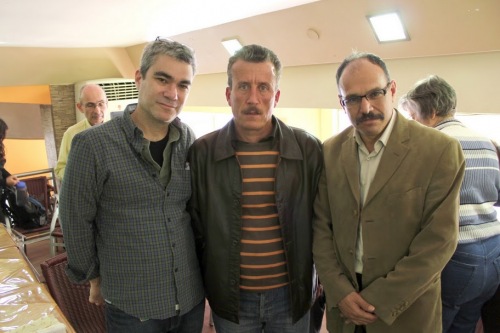
I had the honor of meeting Bassem in Ramallah this past December (that’s him above center, with Iyad Morrar, leader of the Popular Committee in the village of Budrus). As I commented at the time, Palestinian leaders such as Bassem and Iyad are eminently deserving of our attention and support – especially since their struggles are largely ignored by the mainstream media.

As the JVP statement states, “(any) act of violence, especially one against civilians, marks a profound failure of human imagination and causes a deep and abiding trauma for all involved.”

Amen. I can think of no better antidote to the tragedy of violence than to champion the cause of Palestinian leaders such as Bassem Tamimi.

On Gaza and Jerusalem: The End of an Unsustainable Status Quo?

Like many, my heart just sank when I heard about the bus station bombing in Jerusalem today. Over the past two weeks we’ve witnessed the tragic, needless deaths of too many Palestinians and Israelis.

On this point I am in full agreement with MJ Rosenberg, who wrote today (in a post I strongly encourage you to read):

One thing is clear. Making reference to acts of violence by one side without reference to those inflicted by the other only perpetuates one side’s feelings of victimhood, reinforcing the sense of grief and grievance that leads to more violence.

Since I heard the news, I’ve been hoping and praying all day long that we aren’t witnessing the onset of a violent Third Intifada. I can only imagine what such a war might mean, not only for Israelis and Palestinians, but for the entire Middle East, which is several notches beyond tinderbox status already.

As yet, no one has claimed responsibility for the Jerusalem bombing and according to Ha’aretz, police don’t believe it was connected to the increase in rocket fire out of Gaza. Elsewhere in Ha’aretz, military analysts Amos Harel and Avi Issacharoff suggested that neither Israel nor Hamas want the Gaza confrontation to escalate into large-scale clashes. I can only hope their analysis is correct. (As I write, there are already reports that Israeli aircraft have struck at several targets, including a power station in Gaza City.)

Regardless of what happens in this latest round, it is clear that Israel is reaching the end of an unsustainable status quo. It was always a given that the current balance would not hold indefinitely. And now there are even larger, revolutionary changes occurring in the Middle East – whatever happens, Israel will certainly not be immune from this unprecedented upheaval.

Again from MJ Rosenberg:

Although Egypt still observes the terms of its treaty with Israel, that could change at any time. The Jordanian regime is shaky. Hezbollah now controls Lebanon. Syria grows ever closer to Iran. And Turkey, once Israel’s staunch ally, is so disgusted by Israel’s Gaza policy that it is a distant friend, at best. Even the Europeans are turning, with not even France, Germany, or the United Kingdom joining the United States in opposing a Security Council Resolution on West Bank settlements.

Israel’s best chance of surviving these dramatic changes is by resolving the conflict with the Palestinians. In fact, it is Israel’s only chance.

As he correctly concludes:

President Obama is the one person who can turn this situation around. History will not forgive him if, in the name of political expediency, he looks away.

Wisconsin Then and Now

Please check out these two wonderful pieces about the current labor struggles in Wisconsin by Leon Fink, a history professor at the University of Illinois at Chicago, JRC member, and a member of our recent trip to Israel/Palestine. (You may recall he posted about his experiences on our tour for this very blog.)

In a piece he wrote for the News & Observer last month, Leon offers a profoundly important history lesson about The Wisconsin Idea – “a forward-looking set of policies developed under four Republican governors (most notably Robert M. La Follette and Francis McGovern) that proved a blueprint for a nationwide Progressive Era.”

(The Wisconsin Idea) helped lift Wisconsinites from the doldrums of the great depression of the 1890s into a prosperous “mixed” economy combining the resources of farm and factory with science, engineering and human welfare expertise rooted in a state university system centered in Madison.

The policy initiatives were legion. After years of retrenchment, Wisconsinites turned to “tax fairness” as a way of redistributing the burden for vital government services, inaugurating an inheritance tax on the rich and raising rates for railroads, insurance companies and utilities. The wage-earners of the state – recognized as suffering under “unequal conditions of contract” – were rewarded with pioneering statutes in worker’s compensation, health and safety regulations and extension schools for adult education…

It was a formula that soon made Wisconsin the envy of the nation on questions ranging from taxation to industrial relations to land use policy. All told, the Wisconsin Idea suggested that through a close working relationship among major stakeholders, as pioneer labor economist John R. Commons put it, “order, intelligence, care, and thought could be exercised by the state.”

(What else is there to say except the times they have a’changed?)

The second piece is an op-ed from today’s Chicago Trib. The title really says it all: “Et Tu Barack? The President Takes a Powder on Workers’ Plight.”

Leon begins by noting Obama’s visible absence amidst legions of Democrats (and even some Republicans) who showed up at a mass protest against WI Gov. Scott Walker’s union-busting bill in Madison last Saturday.

For those who had such high hopes that Obama would truly fight for the working men and women of this country (see clip above) the answers are not pretty. As Leon sadly concludes:

People in the streets in Madison recognize the need for shared sacrifice. All they see is the rich and powerful taking their pound of flesh from the poor and weak. For Democrats and workers, Gov. Walker has become the poster child for the raid on their democratic rights and standard of living. However, one wonders how long it will be until the attention is turned to that man behind the curtain.

Hanukkah in March: Light a Candle for Gaza

Last December, on the third anniversary of Israel’s Operation Cast Lead, Rabbi Alissa Wise and I submitted an article to the Washington Post in which we asked the public to mark this occasion by lighting a Hanukkah candle for Gaza. The piece was edited further and we were told that it would run in WaPo’s online “On Faith” section.

At the eleventh hour, one day before our piece was to run, we were asked to make some more substantive edits in ways that would have significantly altered the message of the article. Unlike the earlier changes, these weren’t editorial tweaks – they were all too familiar pro-Cast Lead talking points.

Alissa and I rejected the last minute demands, and offered even more links to substantiate our claims. In the meantime, Hanukkah came and went and ultimately the piece never ran.

Fast forward to last week: blogger Phil Weiss had learned about the whole sad story and wrote a short post about it on Mondoweiss. After reading it, I got in touch with him and gave him the full background. M’weiss posted the complete story today, complete with the text of WaPo’s censored version.

So click below to read the article that never saw the light of day. Not seasonally appropriate any more, but still sadly relevant.

Continue reading

This is Why Unions Matter

Many are saying that the battle in Wisconsin is, at long last, shedding some much needed light on the critical role unions play in our economy and in the lives of real working people. If that’s actually so, I’d say it’s high time.

A few recent insights on the subject that are well worth taking to heart. First, from Kevin Drum, writing in Mother Jones:

Of course unions have pathologies. Every big human institution does. And anyone who thinks they’re on the wrong side of an issue should fight it out with them. But unions are also the only large-scale movement left in America that persistently acts as a countervailing power against corporate power. They’re the only large-scale movement left that persistently acts in the economic interests of the middle class.

Robert Reich, who blogged two years ago on the reasons unions are so central to the health of our economy:

The American middle class isn’t looking for a bailout or a handout. Most people just want a chance to share in the success of the companies they help to prosper. Making it easier for all Americans to form unions would give the middle class the bargaining power it needs for better wages and benefits. And a strong and prosperous middle class is necessary if our economy is to succeed.

Mik Moore, on unions and the 21st century Jewish community:

Warren Jacobson is the president of the Madison chapter of the Zionist Organization of America. He is middle class. Conservative. Mid-Western. And for 18 years, a union member and government worker.

In 2010, he voted for Scott Walker. But when asked by a JTA reporter if he supported the Governor’s effort to effectively neuter the state government employees’ union, he said no. He had experienced anti-Semitism and discrimination. Unions might not be perfect, he acknowledged, but:

“I want someone supporting me.”

His statement is a powerful distillation of why unions remain vital. Without a union, each worker is on his or her own. They must fend for themselves. And more often than not, they will lose…

We are fooling ourselves if we think unions are no longer important to maintaining and growing the large Jewish middle class. They are. Jacobson is more typical than we realize.

And finally, Rabbi Jill Jacobs offers a trenchant historical reminder in Religion Dispatches:

Almost exactly a century ago, on March 25, 1911, the Triangle Shirtwaist Factory went up in flames, killing 146 people, mostly immigrant women workers. The management had locked exit doors and stairwells to prevent workers from leaving early. As a result, workers trying to escape the fire were forced to jump from as high as the tenth floor, or simply to wait and smolder to death.

At a gathering in the Metropolitan Opera House a few days after the fire, labor organizer Rose Schneiderman rallied the crowd with the following words:

“Every time the workers come out in the only way they know to protest against conditions which are unbearable the strong hand of the law is allowed to press down heavily upon us… I know from my experience it is up to the working people to save themselves.”

Schneiderman understood that more was at stake in the days following the catastrophe than fire safety regulations. Instead, she argued that only a strong union movement would guarantee workers a safe and dignified workplace in the long run…

Governor Walker and his billionaire supporters are on the verge of destroying the labor movement in America. If that happens, workers will lose most negotiating power, wages will fall, and many more of us will lose our health insurance and other benefits. If Rose Schneiderman were here today, she would tell us, “It’s up to us to save ourselves.”