Fire in Northern Israel: Israel’s Katrina?

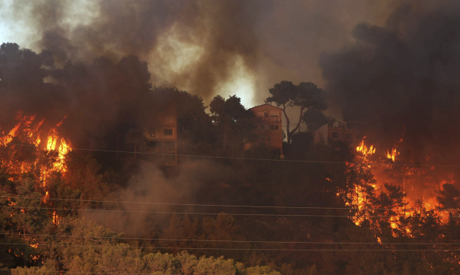
The news out of Israel is just heartbreaking.

We in post-Katrina America know a thing or two about a how a country can spend obscene amounts of resources on weapons of war while its basic home front preparations are left to languish. I well remember how back in 2005, even while the causalities in NOLA mounted, painful readiness issues were being publicly debated.

Now they’re asking the same questions in Israel. Israeli blogger Noam Sheizaf has placed direct blame at the feet of the Ministry of Interior, who may turn out to be the the Israeli equivalent of our Michael (“You’re doin’ a heck of a job, Brownie”) Brown:

By yesterday evening the supply of chemicals used in fighting flames ran out, and the firefighters had to settle for water. Israel issued an urgent request for help form other European countries, but for the casualties and their families it was too late…

Eli Yishai is the Interior Minister. Yesterday, when PM Netanyahu did the right thing and showed up at the emergency command center in Haifa, Yishai was nowhere to be found. Earlier, he tried to spin the story, blaming the finance ministry for the budget cuts.

Reuters pointed out that for all of its high tech military aircraft, Israel lacked even one even one water bombing plane:

Israel could buy three state-of-the-art Bombardier Superscooper firefighting planes for the price of just one of the F-35 stealth fighters it has on order.

The highly specialized amphibious aircraft, costing $28.5 million each, can scoop and drop six tones of water up to 10 times per hour on a fire that is near a big body of water. The Israeli blaze is only a few km (miles) from the sea.

But Israel does not have any. Instead it has to rely on Mediterranean neighbors who also face a constant wildfire risk and were prudent enough to buy the water-bomber aircraft. Greece has 21 of them, Croatia 6.

Israel instead has chosen to “improvise,” critics said. On Thursday night, airforce mobile water cannon designed to operate on flat tarmac could be seen trundling warily into position on steep earthen slopes, their range still quite inadequate.

By contrast, Israel has 360 F-16 fighters, far more than most countries outside the United States that have bought the world’s best-selling attack plane, not to mention many F-15s and the whole panoply of costly, advanced military aviation.

Israeli journalist Aluf Benn, writing in Haa’retz, says this tragedy makes it clear that Israel might well think twice about waging war on Iran:

Under such circumstances, it is best for Israel not to embark on war against Iran, which will involve thousands of missiles being fired on the home front.

After the Second Lebanon War, which exposed how pathetic the civil defense system was, reports were written, exercises were held, but everything broke down under the stress of a real emergency on the Carmel range − an area that already experienced the trauma of Hezbollah missiles.

Yesterday Israel asked for help from Cyprus and Greece, and the air force traveled to France to bring fire retardants to make up for the material that had run out. In war time, it is doubtful whether Israel will be able to rely on the generosity and largess of its neighbors.

We can expect more recrimination and accounting in the days to come. In the meantime, however, I know our hearts and prayers are with all whose lives have been torn by this horrible tragedy that, as of this writing, continues to rage on.
A Jew In Solidarity With the Palestinian People

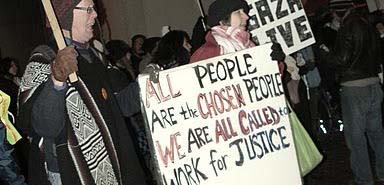
As today marks the UN’s International Day of Solidarity with the Palestinian People, I’d like to take occasion of this day to publicly state, without hesitation, that I stand in solidarity with the Palestinian people.

As a Jew, I will also say without hesitation that I reject the view that I must choose between standing with Jews or standing with Palestinians. This is a zero-sum outlook that only serves to promote division, enmity and fear.

For me, the bottom line is this: the cornerstone value of my religious tradition commands me to stand in solidarity with all who are oppressed. It would thus be a profound betrayal of my own Jewish heritage if I consciously choose not to stand with the Palestinian people.

In other words, I believe my Jewish liberation to be intrinsically bound up with Palestinian liberation. It’s really that simple.

But of course, there is nothing simple or uncomplicated about it. To take such a step it is deeply painful in many ways. It means, among other things, facing down my peoples’ own potential for oppression; to admit that the state of Israel, born in the wake of persecution, has itself become a persecutor.

However, I must also admit that this pain, uncomfortable though it is, is nothing compared to the pain felt that is being experienced by the Palestinian people on a daily basis. Anyone person of privilege who stands in solidarity with the oppressed would do well to bear this in mind: while must we explore our own guilt and culpability, we must also bear in mind that it is not ultimately about us.

From a wonderful essay on white privilege, but very applicable in this case:

Solidarity…is a long-term participation in the struggle, understanding the part you play and how the issues affect you personally. As well, solidarity may very well mean not being the center of the solution, but just a small part. It may mean deferring your sense of authority and leadership. It can also mean dropping your own agenda for how change should be achieved. It can be very problematic when the leadership in an organization is people from the dominant culture. When people from the dominant culture define the issues or strategies for oppressed people it can be condescending and ineffective. So, an example of solidarity is being part of community organizing efforts led by people of color, womyn, etc in an active, but non-leadership role. Being in solidarity means seeing how you will benefit from the liberation of others.

And so today I’ll take this opportunity to say I stand in solidarity with the Palestinian people. But I’m not taking it to assuage my Jewish pain and guilt, nor to claim I personally know how this liberation must eventually be achieved.

In the end, I stand here because I know in my heart it is where I must be.

Afghanistan: Our New Vietnam (Just Worse and Longer)

Two must-reads on our war in Afghanistan, which is now officially the longest war in our nation’s history (and longer, btw, than the Soviets’ Afghani adventures in the 1980s):

Robert Wright’s recent NY Times op-ed:

Is Afghanistan, as some people say, America’s second Vietnam? Actually, a point-by-point comparison of the two wars suggests that it’s worse than that.

For starters, though Vietnam was hugely destructive in human terms, strategically it was just a medium-sized blunder. It was a waste of resources, yes, but the war didn’t make America more vulnerable to enemy attack.

The Afghanistan war does. Just as Al Qaeda planned, it empowers the narrative of terrorist recruiters — that America is at war with Islam. The would-be Times Square bomber said he was working to avenge the killing of Muslims in Afghanistan and Pakistan. And Major Nidal Hasan, who at Fort Hood perpetrated the biggest post-9/11 terrorist attack on American soil, was enraged by the Afghanistan and Iraq wars.

From the report of the Afghanistan Study Group released this past August:

Myth #8
Withdrawal from Afghanistan will be seen as a great victory for Al Qaeda and enhance its popularity and prestige. If we scale back our engagement in Afghanistan, they will simply follow us home.

Reality: It is our military presence that is actively aiding Taliban recruitment and encouraging disparate extremist groups to back one another. The Afghan mujaheddin did not “follow the Soviets home” after they withdrew. The same will be true once the United States reduces its military footprint and eventually disengages. In fact, military disengagement will undermine Al Qaeda’s claims that the United States is trying to “dominate” the Muslim world. A smaller U.S. footprint in the Muslim world will make Americans safer, not encourage terrorist attacks against American targets at home and abroad.

Of course the above report was released before the Obama administration changed its tune on a 2011 pullout – we’re now being told that American troops will be in Afghanistan until at least 2014.

That’s right: the longest war in US history is now guaranteed to continue on for at least four more years. To my mind, this is the very definition of “quagmire.”

On this point, Andrew Bachevich puts it more eloquently than I ever could (my third must-read):

So are we almost there yet?  Not even.  The truth is we’re lost in the desert, careening down an unmarked road, odometer busted, GPS on the fritz, and fuel gauge hovering just above E.  Washington can only hope that the American people, napping in the backseat, won’t notice.

My “Budrus” Review

Just saw “Budrus” last night. (Why it takes independent films forever and a day to get to Chicago is beyond me. Aren’t we even considered a movie market any more? Sheesh…)

My two cents:

I think it’s a brilliant film in so many ways. I simultaneously experienced it as a compelling “how-to textbook” on grassroots organizing, an honest portrait of real nonviolent resistance in action, an up-close document of the human impact of the Occupation and a compassionate profile of life in one West Bank village.

It is also a masterfully constructed film that often transcends the documentary genre itself. Filmmakers Julia Bacha, Ronit Avni and Rula Salameh present us with a true story that has a genuine dramatic arc.

The story in short: in 2003, Ayed Morrar a remarkable Palestinian community leader, organized a nonviolent resistance movement to save his village Budrus from being destroyed by Israel’s Separation Barrier. He brought together an impressive coalition of local Fatah and Hamas members along with Israeli and international solidarity activists to resist the wall’s construction.

After some initial success, Budrus was put under military curfew and their resistance effort threatened to come apart. In the end, however, after ten months of steadfast resistance, the Israeli government relented and redrew the route of the fence, saving the village.

There is no question that “Budrus” is a profound and authentic document of what well-organized nonviolent resistance can truly achieve. It’s the kind of story that would move you even if it wasn’t actually true. And I won’t deny the story of these villagers’ courage left me deeply inspired.

And yet…

…and yet I must also confess to having a nagging feeling that there was one critical puzzle piece left out of the story. The film is essentially the document of one village and it more or less takes place within the bubble of this village’s exclusive universe. But I was somewhat disappointed that “Budrus” failed to explore the overall context of institutional oppression in which this one village’s story took place.

The film does indeed explain how the barrier cut significantly into Palestinian lands rather than simply follow the route of the Green Line. The filmmakers, however, never address the reasons why Israel chose to do this. There are many references to Israel’s security needs, but notably, no one ever asks the critical question: why, if security was the only reason for the barrier, didn’t Israel build it along the internationally recognized border between the West Bank and Israel proper?

The answer, of course, is that this wall is not just about security. It is also very much about about the settlements and about Israel’s desire to create its own unilateral border in advance of a final negotiated settlement. To wit: it is ultimately about taking land away from Palestinians.

If the film had included but one talking head to address this reality, viewers would understand the true stakes of Budrus’ struggle. But by leaving this context unexamined, the filmmakers essentially document one village’s travail without really explaining how it fits into a much larger injustice.

In truth, it must also be admitted that Budrus’ victory was and continues to be notably exceptional. While the film mentions briefly at the end that this kind of nonviolent resistance is ongoing in other West Bank villages, none of these villages have experienced anything near the level of Budrus’ success.

In fact, the exact opposite is happening. The Israeli military is brutally clamping down on the leaders of the popular committees that organize nonviolent campaigns. And although this repression is not regularly reported in the mainstream media, it is in fact unfolding on an almost daily basis.

Last Monday, for instance, it was reported that Abdallah Abu Rahmah, a leader in the Bil’in campaign was denied release from prison even though he has completed his twelve month sentence in full. Just yesterday we learned that the sixteen year old son of another jailed Bil’in activist leader, Adeeb Abu Rahmah, was arrested by a “a group of masked soldiers (who) forcefully entered the house without showing a warrant.”

Adeeb, by the way, was sentenced to one year but also remains in jail beyond his release date as the military prosecutors appeal his sentence. He will stay imprisoned “indefinitely” – which likely means for a long, long time. (That is Adeeb Abu Rahmah in the clip above. I encourage you to watch this incredible video document in its entirety if you can).

These kinds of actions, tragically, are taking a huge toll on local nonviolent resistance campaigns. With many of their leaders in jail or targeted for imprisonment, local committees (with the notable exception of Sheikh Jarrah) are reporting fewer numbers at their demonstrations. Those of us who are justifiably inspired by Budrus’ story should find these developments deeply, deeply troubling.

Bottom line? Please see “Budrus” and encourage your friends to do the same. Buy copies when it comes out on DVD and give them to anyone you know that needs to know that despite media portrayals to the contrary, there is a significant and important nonviolent resistance movement in the Palestinian community.

But after you see it, please don’t leave the film with the impression that this movement is experiencing the kind of success you’ve just witnessed. Israel is quite rightly threatened by Palestinian nonviolent resistance, and is currently doing its level best to crush this movement under its military heel. Alas, it is too often succeeding.

To learn more about these campaigns, you should regularly visit the blog of activist Joseph Dana, who has been indefatigably reporting from the ground in the West Bank and East Jerusalem. (He’s probably uploaded enough video onto his site to make hundreds of documentary films on the subject.)

And if the film inspires you to make a difference yourself, please visit the website of Taayush: Arab-Jewish Partnership and send them a much-needed donation.

An Inspiring Conversation With Congressman Brian Baird

Ta’anit Tzedek hosted an incredible conference call today with outgoing Congressman Brian Baird from Washington state. I’ve long admired Rep. Baird as one of the most fearless politicians on Capitol Hill on the issue of Israel/Palestine; indeed, his comments today were a powerful reminder that there are still politicians left in Washington who are doing this work for all the right reasons.

Rep. Baird spoke candidly and courageously on a host of issues: his four visits to Gaza, the Corrie family’s quest for justice for their daughter Rachel (the Corries are his constituents), the state of the current peace process, and the political reality of the Israel/Palestine issue in Congress.

We’ve just uploaded the audio of the entire conference call to the Ta’anit Tzedek website. Please, please listen to it and send it on to anyone who you think need to hear words such as these. Rep. Baird is a truth teller of the highest order. He will be sorely missed in Washington.

We’re Not Muslims! (Not That There’s Anything Wrong With Them…)

Here’s a sure sign that American Islamophobia has officially sent us through the proverbial looking glass.

From the WashPo blog:

A Christian church in Phoenix has had to make a presidential-type denial: It is not Muslim. The building under construction will feature a domed ceiling, and protesters have taken that as a sign the church is not what it says it is. The leaders have hung up a sign saying, “We are building a Christian house of worship,” the Atlantic reports...

“I have nothing against Islamic people,” Carlos Montemayor, the pastor of the church, said in a phone interview. But local commentary had been growing, saying that the building was a mosque and an investigation should be launched into the church. He put the sign up to stop the comments.

Latest Peace Process Reboot: “Borders First” All Over Again

In yesterday’s post I posed the question:

Does anyone really believe that anything substantive will be accomplished during a ninety day settlement (non) freeze?

According to many peace process policy wonks, the answer is as follows:

The logic behind a 90-day extension is that the two sides would aim for a swift agreement on the borders of a Palestinian state. That would make the long dispute over settlements irrelevant since it would be clear which housing blocks fell into Israel and which fell into a Palestinian state.

This approach is known by said wonks as “Borders First” – and it’s not the first time it’s been attempted by the US. It was, in fact, the method of choice more than a year ago, when the Obama administration first started engaging seriously with the peace process – and the potential pitfalls with this method were pointed out even then.

From Mideast analyst Mark Lynch (aka “Abu Aardvark”) writing in September 2009:

Indeed, “borders first” negotiations under current conditions — especially if Gaza is ignored and the Jersualem area either deferred or ratified — might well lead not to a two state solution but to what I’ve heard described as a “five statelet” outcome: Israel, Gaza, Ramallahstan, Nablusstan in the northern West Bank and Hebronstan in the southern West Bank.  Does anyone really think that this would be the foundation for an end of conflict agreement?

So if ‘borders first’ is going to be the approach to negotiations then I sure hope that early attention is paid to the questions of Gaza and Jerusalem.  If serious spoiler violence is to be avoided, then Hamas and its constituency are going to have to be engaged.  If acceptable borders are going to be drawn, they have to grapple with the realities of the Jerusalem area. And if it is meant to lead to a genuine and lasting end of conflict, then it can’t just be about borders — as Rob Malley has argued the Palestinian refugees need to be brought into the discussion.

I was full agreement with Mr. Aardvark then as now. But now it’s one year later and it seems to be deja vu all over again. While the US again pushes “Borders First,” other core issues are being completely ignored: Israel is still Judaizing East Jerusalem with abandon – and as for the crisis in Gaza, well, no one seems to consider the plight of that region issue even germane to the discussion any more.

I’ve been told Einstein didn’t actually say this, but it doesn’t make it any less true: “Insanity is doing the same thing over and over again and expecting different results.”

Parsing the Latest Peace Process “Breakthrough”

From today’s New York Times:

Prime Minister Benjamin Netanyahu of Israel has agreed to push his cabinet to freeze most construction on settlements in the West Bank for 90 days to break an impasse in peace negotiations with the Palestinians, an official briefed on talks between the United States and Israel said Saturday evening.

In return, the Obama administration has offered Israel a package of security incentives and fighter jets worth $3 billion that would be contingent on the signing of a peace agreement, the official said. The United States would also block any moves in the United Nations Security Council that would try to shape a final peace agreement.

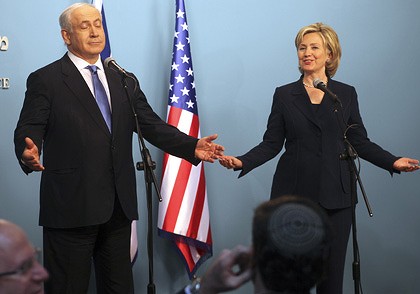
The quid pro quo was hashed out by Mr. Netanyahu and Secretary of State Hillary Rodham Clinton in seven and a half hours of talks in New York on Thursday.

Let’s parse this now:

According to Peace Now’s most recent research, in six short weeks, Israel has all but made up for the construction it lost during the ten month freeze. So that means we’re back to square one. And since this new ninety day freeze is “nonrenewable,” this latest breakthrough is essentially meaningless (except perhaps as a face-saving maneuver on for the Obama administration).

We’re also told that this new freeze would not include East Jerusalem, which was likewise never a part of the last freeze – when home demolitions, evictions of Palestinians, and plans for new Jewish construction continued apace.

(I personally find American Jewry’s deafening silence over what is going on in East Jerusalem to be beyond egregious. Can’t find it in your heart to address the humanitarian implications? Fine. But if you are at all a proponent of the two state solution, you should at least be concerned that Israel’s actions have now made the prospects for a shared capital in Jerusalem all but impossible).

By any other name, this latest diplomatic “breakthrough” is nothing but a fig leaf.  Does anyone really believe that anything substantive will be accomplished during a ninety day settlement (non) freeze? When will our community find the courage to name these dangerously empty gestures for what they really and truly are?

Ta’anit Tzedek Sponsors Conference Call with Congressman Brian Baird


The next Ta’anit Tzedek fast day will take place on Thursday, November 18. To mark the day, we will present a conference call, “After the Elections: US Policy, Israel and Gaza” – A Conversation with Congressman Brian Baird.

Congressman Baird is the outgoing Representative for Washington state’s 3rd District. Prior to being elected in 1998, Congressman Baird practiced as a licensed clinical psychologist in Washington state and Oregon. He also worked in state and Veterans Administration psychiatric hospitals, community mental health clinics, substance abuse treatment programs, and institutions for juvenile offenders.

Congressman Baird is also notable for being one of the few members of Congress who is willing to openly advocate for Palestinian human rights. He has visited Gaza on three separate occasions and had this to say after his visit in February 2009 (immediately following Israel’s Operation Cast Lead):

The amount of physical destruction and the depth of human suffering here is staggering… Entire neighborhoods have been destroyed, schools completely leveled, fundamental water, sewer, and electricity facilities hit and relief agencies heavily damaged. The personal stories of children being killed in their homes or schools, entire families wiped out, and relief workers prevented from evacuating the wounded are heart wrenching – what went on here, and what is continuing to go on, is shocking and troubling beyond words.

After his third visit to Gaza in February 2010, Baird called on the US to break Israel’s blockade of the strip to deliver humanitarian aid. He was also one of the few members of the House to vote against a bill that “unequivocally opposed any endorsement or further consideration” of the Goldstone Report. (Click the clip above to watch his passionate defense of report on the House floor.)

Our conference call will take place on Thursday, November 18 at 12:00pm (EST). During our conversation, we will ask Congressman Baird to discuss his experiences in Gaza, to comment on current efforts to lift the blockade and to share his views on the search for a just peace in Israel/Palestine in light of the recent midterm elections.

Congressman Baird will also address the wrongful death trial, brought by Craig and Cindy Corrie against the Israeli government, for the death of their daughter Rachel (who was crushed by an Israeli bulldozer in Gaza in 2003). As the Corrie’s congressman, Rep. Baird has long supported the Corrie family in their quest for justice and personally testified in the trial last May.

Here’s the call-in info:

Dial the Access Number: 1.800.920.7487
Participant Code: 92247763#

As always, we encourage you to join the call and spread the word.

Young, Jewish and Proud – Time to Make Room at the Table

Here is some video of yesterday’s incident at the Jewish Federation GA.

After watching this clip this morning, my wife Hallie and I had a long conversation about it. Though I was eager to talk about its political/Jewish communal implications, she responded to it more as a parent of teenagers.

As she put it, “As parents, what kinds of values do we want to impart to our kids? Don’t we always say we want them to educated, to be critical thinkers, and to stand up for what they believe in? And even if we don’t approve of the places their critical thinking take them, what, are we going to disown them because we don’t agree with them?”

Take a close look at this clip and pay particular attention to the reaction of the audience in the hall. It would be quite an understatement to say the crowd disapproved of what these young people were saying. Frankly, it was something of a miracle that any of them made it out of that room in one piece.

But as Hallie pointed out to me, these young Jews were doing precisely what they were raised to do: they took a good, educated look around them, they thought critically about what they saw, and they took a stand for what they believed in. And for this they are being disowned by their Jewish family.

I’m sure many will be tempted to say, “Well, I don’t disapprove of what they said, just how they said it.”

Yes, we parents often say things like that, don’t we?  I’m pretty sure that many white parents said similar things when their children joined the Freedom Riders to protest oppression and to show solidarity with oppressed African Americans. I imagine many of their parents disapproved of their actions. But at the end of the day weren’t these young people ultimately just acting upon the values that had long been instilled in them?

I certainly have no illusions that there were also many young people in that room cheering on Netanyahu – young adults who have been given a place at the Jewish communal table. But believe me when I tell you that there are many, many young Jews who have been kept away from the table  – but who refuse to walk away. And frankly, given the extent of their alienation we should be grateful that they even seek a place at all any more.

The Jewish community is reaching a serious reckoning point. Trust me, those five young people in that hall are only the tip of the iceberg. They are growing in number, they are rapidly finding their voice, and as their new moniker indicates, they are “young, Jewish and proud.” And regardless of whether we agree what they are saying, we should be proud of them. It’s time to act like grownups, stop marginalizing them, and make room for them at the table.

Click here and read the “Young, Jewish and Proud” manifesto. What beautiful, beautiful words. I couldn’t be prouder of these young people if they were my own children.