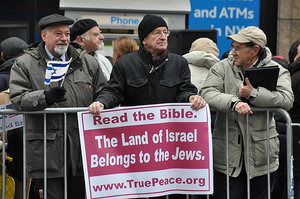
You Are But Strangers: Jewish Theology and the Land of Israel

The land of Israel is ours because God gave it to us.

This particular Jewish claim is bandied about so much that I imagine it would some as a surprise to many that it is, in fact, a misrepresentation of the Torah and its teachings.

I would go farther and say this: this view is actually a betrayal of Jewish tradition – and has only become widely popular since the rise of political Zionism.

Let’s take a closer look at the texts in question:

Jewish fundamentalists and ultra-nationalists are fond of pointing out that God promised the land of Israel to Abraham in the book of Genesis:

On that day, the Lord made a covenant with Abram, saying, “To your offspring I assign this land, from the river of Egypt to the great river, the river Euphrates…” (Genesis 15:18)

Biblical scholars and commentators note that the covenant God makes with Abram (soon to be renamed Abraham) appears as a promisory covenant. In this early point in the narrative, the land indeed seems to be assigned to the people Israel with “no strings attached.”

Later in Exodus, however, once Israel has left Egypt and has become a nation at Sinai, God clarifies the terms of this covenant. It is spelled out in decidedly conditional language: if Israel follows God’s commandments, then they will indeed be able to live on the land that has been assigned to them by God. In other words, Israel now learns that their future on the land will be radically dependent on how they behave on the land.

As I see it, this is the fatal mistake made by those who claim that the land must ipso facto “belong” to the Jewish people. They focus exclusively on the Abrahamic promise, but neglect the critical next step: God’s conditional covenant with the Israelite nation.

In so doing, they pervert the Torah’s meaning – and do great damage to the central Jewish understanding of our relationship to the land. The land is not given to us unconditionally – we will only be able to live on the land if we prove ourselves worthy of it.

Interestingly, the Torah actually points out that previous inhabitants of the land had failed in this regard. Following a long litany of laws in Leviticus, we read:

Do not defile yourselves in any of those ways, for it is by such that the nations that I am casting out before you defiled themselves. Thus the land became defiled; and I called it to account for its iniquity and the land vomited out its inhabitants. (Leviticus 18:24-25)

In similarly colorful language, Israel is told that they might well meet the same fate if they do not keep God’s laws when they live on the land:

So let not the land vomit you out for defiling it, as it spewed out the nation that came before you. (18:28)

In another important verse from Leviticus, God makes it clear to whom the land ultimately belongs. In the discussion of the Jubilee year (in which landholdings revert back to their original owners) we read:

…the land must not be sold beyond reclaim, for the land is Mine; you are but strangers resident with Me. (Leviticus 25:23)

Notably, the Hebrew word for “stranger,” (“ger”) literally means “resident alien.” This word appears over and over throughout the Torah – particularly in admonitions to Israel not to mistreat the stranger, “for you were once strangers in the land of Egypt.” It is sobering indeed to learn that even after the Israelites enter Israel, they will still be, in effect, resident aliens on the land.

In the end, although many Jewish fundamentalists often treat the Torah as the Jews “deed of sale” to the land of Israel, it might be more accurate to describe it as a “lease” with very explicit conditions. In Deuteronomy, this conditional language reaches its apex. As the Israelites prepare to enter the land of Israel, Moses reminds them that they could be exiled from the land in an instant if they do not remain faithful to God’s covenant:

If you fail to observe faithfully all the terms of this Teaching…the Lord will scatter you among all the people from one end of the earth to the other, and there you shall serve other gods, wood and stone, whom neither you nor your ancestors have experienced. Yet even among those nations you shall find no peace, nor shall your foot find a place to rest… (Deuteronomy 28:58-65)

For the prophets and later the rabbis, the conditional covenant was central in understanding Israel’s collective tragedy: “mipnei chataeinu” – “because of our sins” we were exiled from the land. This in fact remained the normative Jewish understanding of our centuries-long sojourn in the diaspora until the advent of Zionism and the establishment of the state of Israel.

Though today we live in a radically different context than Ancient Israel, this question remains powerfully relevant: now that we have returned again to this land, how will we prove ourselves worthy of it?

Whatever our answer, this much seems clear: we will not be worthy of the land if we betray our own religious teachings and cling to misguided, exclusivist claims. The Torah teaches us still: if we insist that the land “belongs” to us and us alone, we will only endanger our collective future upon it.

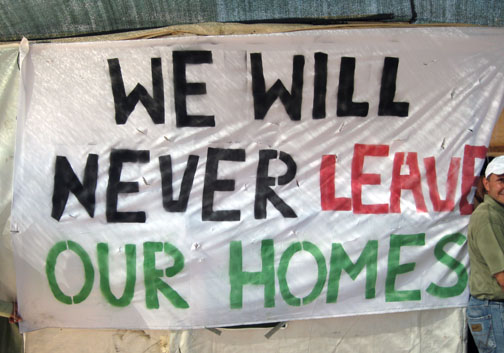
Pogo Was Right

From today’s JTA:

The Los Angeles Police Department is investigating whether Israeli organized crime is connected to an attack at a local synagogue.

The department initially listed the Oct. 30 shooting at the Adat Yeshurun Valley Sephardic Synagogue in North Hollywood, Calif., as a hate crime, but in recent weeks police been working on the theory that the shooting was to silence someone, the Los Angeles Times reported Thursday.

Two people were shot in the legs in the parking lot of the synagogue, located in the San Fernando Valley’s Orthodox community. Police believe one of the men that was shot was the target of the attack, the newspaper reported…

Israeli organized crime has been operating in Los Angeles since the mid-1990s, according to the newspaper.

Postscript: I spoke with a friend who read the local Israeli press in LA immediately after the shooting and said that even then there was serious speculation that Israeli organized crime was behind it.

If it was indeed an “inside job,” it puts a very interesting twist on our thinking about Jewish safety in general. It was notable that the ADL, immediately after the shooting, issued a press release with the predictable language:

Statistics consistently show Jews to be far and away the most frequently targeted religious group, with 74 percent of hate crimes motivated by religion being perpetrated against Jews in Los Angeles County.

I think the issue of Jewish power vs. vulnerability in America and the diaspora at large is an important and complex one. For my part, I believe (ADL’s problematic “annual audit” notwithstanding) that we Jews have never been more secure in our history than we are in present day America. If for nothing else, this latest incident is newsworthy for adding one more complicated dimension to the issue.

The Judaization of Jerusalem: What is Our Response?

Are these the actions of a country interested in negotiating in good faith for a Palestinian state alongside it, with East Jerusalem as its capital?

Ha’aretz announced today that

2008 set an all-time record for the number of Arab residents of East Jerusalem who were stripped of residency rights by the Interior Ministry. Altogether, the ministry revoked the residency of 4,577 East Jerusalemites in 2008 – 21 times the average of the previous 40 years.

Also from today’s Ha’aretz:

Clashes erupted yesterday in the Sheikh Jarrah neighborhood of East Jerusalem between demonstrators and counter-demonstrators, after a group of Jews announced their intention to move into a house in the neighborhood. The entry of the Jews into the home follows a court order ruling that the Arab al-Kurd family, which lives in a portion of the house, had no right to occupy an addition that they had built onto the house.

This situation has been unfolding for some time. In an nutshell: Palestinian families in Sheikh Jarrah have been evicted from their homes so that their land can be turned over to a settler organization that seeks to build a Jewish settlement called Shimon Ha Tzadik. According to the Jerusalem NGO Ir Amim, this settlement

constitutes one of a series of plans that seek to penetrate and surround Sheikh Jarrah with Israeli settlements, yeshivas, and other institutions as well as national park land, and complement government efforts to ring the Old City with Jewish development and effectively cut it off from Palestinian areas.

Meanwhile, since their eviction, the Palestinian families (55 people in total) have been sleeping on mattresses in the street “and spend the day sitting in the shade watching settlers walk in and out of their front doors.”

And in another part of East Jerusalem:

The World Likud movement held a cornerstone-laying ceremony yesterday for the expansion of the neighborhood of Nof Zion, despite – or possibly because of – American pressure against building in East Jerusalem. The Jewish settlement is in the middle of the Arab village of Jabal Mukkaber. Meanwhile, the Jerusalem municipality razed two Palestinian homes in East Jerusalem yesterday.

The plan is to add to Nof Zion 105 new apartments to the 90 ones that are already there, most of which are already occupied. The neighborhood is considered “prestigious,” but the developers ran into trouble a few years ago after they failed to sell the apartments to Jews from overseas. About a year ago the developers changed their marketing strategy to target the local national-religious market – and the apartments began selling quickly. The developers expect the same for the new part of the neighborhood…

In Isawiyah villagers tried to block the entrance to the village with cars, while in Silwan local residents threw rocks at police officers after the house was destroyed.

Addressing the ceremony, MK Danny Danon (Likud) said that Jerusalem will never be a part of negotiations with the Palestinians. He called Barack Obama “naive” and said the U.S. president still does not seem to understand who are the good guys and who are the bad guys in the conflict.

Yesterday the Jerusalem municipality razed two Palestinian homes in East Jerusalem, one in Isawiyah and one in Silwan. In both cases, local residents battled security forces.

It does not take a great deal of insight to connect these dots. These are not simply random municipal disputes. We are witnessing the systematic Judaization of Jerusalem.

International protesters refer to these actions as “ethnic cleansing.” If that seems like too incendiary a term, what do we prefer to call it? And more critically, what are we going to do about it?

Postscript: I just received an email from Rabbi Arik Ascherman (of Israel’s Rabbis for Human Rights) who was at yesterday’s demonstration at Sheikh Jarrah.  Though he is a veteran of such demonstrations, I have never heard Arik express such a profound level of despair.

His report has left me speechless.

Click below:

Continue reading

The Voice of Reason and Honest Hearts in Dark Times

I’ve been reading With an Iron Pen, a newly translated anthology of Israeli protest poetry from the past two decades.  I can’t recommend it enough – especially for those prefer poetry that goes straight to the heart and the gut.

Though I’d heard of some of these poets, I was unfamiliar with the remarkable depth and breadth of this particular genre.  It’s a diverse collection with one critical aspect in common: all these poems express a powerful voice of protest against Israel’s oppressive treatment of Palestinians dating back to the days of the First Intifada. The collection felt to me like nothing other than forty-two poets letting loose one singular prophetic howl of rage and sorrow over what their nation has wrought.

And like all protest poetry, this is art that clearly seeks to transform. As the editors write in introduction:

The ethical stand taken by the poets and poems of this anthology represents today the minority position – a minority that is seen by the majority of the Jewish Israeli public as “self-hating” and as desecrators of sacred ideals. And still, throughout history, literary creations have expressed  the forbidden and revolutionary and have preceded – in fact precipitated – changes in attitudes and societal norms. The day will come when the poems collected in With an Iron Pen will be read as the voice of reason and of honest hearts in dark times.

I see something quintessentially Jewish in the inner struggle reflected these poems – and at the same time, the tradition of protest they draw upon is so clearly universal.  I can’t help but think that these works represent, in their way, a contemporary form of sacred text.

Check out Richard Silverstein’s wonderful review for Tikkun. Click below for two of my particular favorites from the collection:

Continue reading

Parsing Ft. Hood

I’ve been voraciously reading the various editorial reactions to the Ft. Hood shooting – and have found much of it to be confused at best and patently offensive at worst. If you’re eager for some intelligent commentary, I recommend this post from my friend Rabbi Nancy Fuchs-Kreimer, who took NY Times columnist David Brooks to task for his recent piece that explored the nature and causes of religious extremism, focusing exclusively on Islam.

Nancy writes:

Yes, there is evil in human hearts. Yes, religion can be the carrier of malevolent narratives. But it is both historically and ethically flawed to write a whole column devoted to this theme and never once even mention that Islam is not the only tradition that has this problem. Brooks speaks about suicide bombers and terrorists but he does not mention that we have seen these troubled tales of “us and them” played out by many other religious folks.

As a Jew, David Brooks might have had the grace to remind us that in 1994 an orthodox Jew,  Baruch Goldstein,  killed 29  Muslims and wounded 150 while they prayed in Hebron.  Like Dr. Hassan, Dr. Goldstein, also a physician,  was both a deeply troubled individual and a product of a deeply problematic version of his faith tradition.

Another adherent to a deeply problematic version of our faith tradition is Rabbi Yitzhak Shapira, head of the Od Yosef Chai Yeshiva in the West Bank settlement of Yitzhar, who recently published a book in which he opined that gentile babies and children can be killed if they pose a threat to the Jewish nation. This followed on the heels of the arrest of Jewish terrorist Yaakov Teitel, a West Bank settler who was charged with murdering two Palestinians in 1997 and bombing the home of a prominent Israeli professor last year.  (Teitel reportedly had this to say when arraigned in an Israeli courtroom: “It was a pleasure and an honor to serve my God. I have no regret and no doubt that God is pleased.”)

Intolerance is intolerance, regardless of the faith tradition to which it is attached.  As Nancy correctly points out, all religions can be carriers of malevolent narratives. And when deeply disturbed individuals such as Teitel and Hassan attach themselves to these toxic world views, we can predict all too well the tragic results.

“Cursed Be He That Keepeth Back His Sword From Blood.”

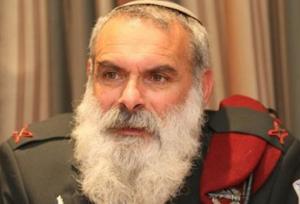
Rabbi-Avi-Ronzki_From yesterday’s Ha’artez:

The Israel Defense Forces’ chief rabbi told students in a pre-army yeshiva program last week that soldiers who “show mercy” toward the enemy in wartime will be “damned.”

Brig. Gen. Avichai Rontzki also told the yeshiva students that religious individuals made better combat troops.  Speaking Thursday at the Hesder yeshiva in the West Bank settlement of Karnei Shomron, Rontzki referred to Maimonides’ discourse on the laws of war. That text quotes a passage from the Book of Jeremiah stating: “Cursed be he that doeth the work of the Lord with a slack hand, and cursed be he that keepeth back his sword from blood.”

In Rontzki’s words, “In times of war, whoever doesn’t fight with all his heart and soul is damned – if he keeps his sword from bloodshed, if he shows mercy toward his enemy when no mercy should be shown.”

Whatever else we might think about Maimonides’ (or Jeremiah’s) words, we are certainly free to debate their academic meaning. But when they are uttered by the Chief Rabbi of the IDF to future Israeli soldiers, words such as these are much, much more than merely academic.

You may remember that Rabbi Rontzki (above) was in the news following Israel’s military operation in Gaza, when soldiers alleged that he gave them a religious booklet entitled “Go Fight My Fight.”  This publication includes extensive quotes by Rabbi Shlomo Aviner, head of the Ateret Cohanim yeshiva in Jerusalem, who ruled that Palestinians were the equivalent of the Biblical Philistines and that cruelty can sometimes be a “good attribute.”

You may also remember that Israeli soldiers from the organization Shovrim Shtika (“Breaking the Silence”) brought this issue to light following the war in Gaza.  Though they have been attacked mercilessly by the Israeli political establishment, these young soldiers have continued to speak out. Last September, Gal Einav and Shamir Yeger, two reserve infantry soldiers who fought in Gaza wrote a powerful editorial in the Israeli press about what they considered to be an unwelcome “messianic” religious influence into the IDF:

There is a problem with the growing tendency to provide religious elements with a monopoly on values and fighting spirit, and particularly with the legitimacy granted to organizations with a missionary and messianic character to operate amongst the soldiers. Most of the commanders in our division are religious, yet up until the last war there was complete separation between their private world and their military position.

If we fail to clearly draw the line right now, in a few years we shall find ourselves shifting from wars of choice or no-choice to holy wars.

In a September BBC report, Reserve General Nehemia Dagan had this to say about the issue:

We (soldiers) used to be able to put aside our own ideas in order to do what we had to do. It didn’t matter if we were religious or from a kibbutz. But that’s not the case anymore.

The morals of the battlefield cannot come from a religious authority. Once it does, it’s Jihad. I know people will not like that word but that’s what it is, Holy War. And once it’s Holy War there are no limits.

(You can watch the BBC report in its entirety here and here. Highly recommended).

What explains the growth of this right-wing religious influence in the IDF? I tend to agree with blogger Zachary Goelman, who points out an larger demographic trend in Israeli society:

With conscription rates dropping annually, especially among secular Jews, and a simultaneous increase in the country’s religious population, Yeger and Einav are part of a shrinking minority. No doubt they know many who ducked their conscription call. If they have draft-age children, they’ve certainly heard them discuss the myriad ways of obtaining a deferral.

This trend is reversed in the dati-le’umi sector, the category of Israeli Jews broadly classified as “national religious.” In one way or another the men and women woven from this cloth see military and national service as a form of religious duty, and their ranks in uniform and civil society will increase in the coming decades. Coupled with the consistent growth of ultra-orthodox families, secular Israel may be in the final throes of its götterdämmerung.

Whatever the explanation, I personally find the implications of this trend to be beyond troubling. How will we, as Jews, respond to the potential growth of Jewish Holy War ideology within the ranks of the Israeli military?  How do we  feel about Israeli military generals holding forth on the religious laws of warfare? Most Americans would likely agree that in general, mixing religion and war is a profoundly perilous endeavor.  Should we really be so surprised that things are now coming to this?

I do not ask these questions out of a desire to be inflammatory. I ask them only because I believe we need to discuss them honestly and openly – and because these kinds of painful questions have for too long been dismissed and marginalized by the “mainstream” Jewish establishment.

For myself at least – as a Jew and as a rabbi – I will take this opportunity to register my personal offense at statements such as those made last week by Rabbi Rontzki.

Gaza 1956

gaza1956

Earlier this year I shared a 2004 Jerusalem Post interview with Arnon Soffer, the architect of Israel’s disengagement from the Gaza Strip. It was a painfully sobering read, not least for his chilling predictions of Israel’s post-disengagement reality:

(When) 2.5 million people live in a closed-off Gaza, it’s going to be a human catastrophe. Those people will become even bigger animals than they are today, with the aid of an insane fundamentalist Islam. The pressure at the border will be awful. It’s going to be a terrible war. So, if we want to remain alive, we will have to kill and kill and kill. All day, every day…

If we don’t kill, we will cease to exist. The only thing that concerns me is how to ensure that the boys and men who are going to have to do the killing will be able to return home to their families and be normal human beings.

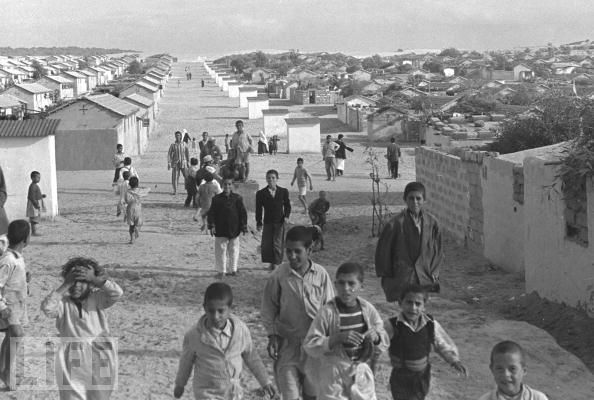
I thought of this article today as I read another piece about Gaza: a famous 1956 eulogy given by Moshe Dayan for a young kibbutznik named Ro’i Rotenberg, who was killed by Gazan Arabs who had crossed over the border into Israel.

At the start of his eulogy, Dayan offered these astonishingly candid remarks:

Do not today besmirch the murderers with accusations. Who are we that we should bewail their mighty hatred of us?  For eight years they sit in refugee camps in Gaza, and opposite their gaze we appropriate for ourselves as our own portion the land and the villages in which they and their fathers dwelled.

Not from the Arabs in Gaza, but from ourselves shall we require the blood of Ro’i. How did we close our eyes so as not to see the goal of our generation in its full measure of cruelty?  Did we forget that this group of young men and women, which dwells in Nahal Oz, bear on their shoulders the heavy gates of Gaza, gates on the other side of which are crowded together with hundreds of thousands of eyes and hands that pray for our weakness, that it may come, so that they may rip us to shreds – have we forgotten this?

This we know: that in order that the hope to destroy us should die we have to be armed and ready, morning and night. We are a generation of settlement, and without a steel helmet and the barrel of a cannon we cannot plant a tree and build a house. Our children will not live if we do not build shelters, and without a barbed wire fence and a machine gun we cannot pave a road and channel water. The millions of Jews that were destroyed because they did not have a land look at us from the ashes of Israelite history and command us to take possession of and establish a land for our nation.

(Translation, Michael Shalom Kochin, 2009)

Shabbat with a Shi’ite Cleric

IMG_0689
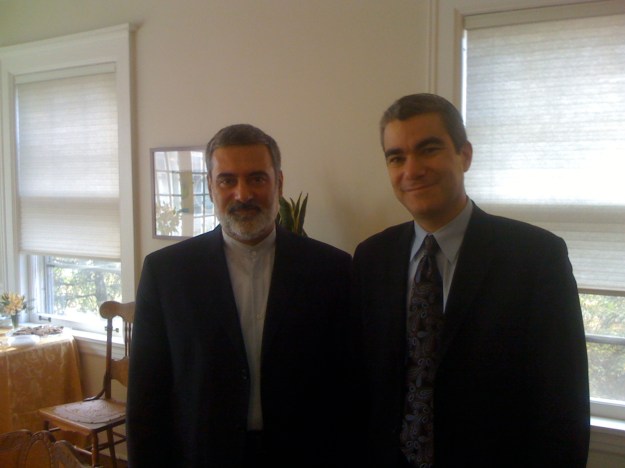
I spent a remarkable Shabbat lunch yesterday at the home of JRC members Mark and Margie Zivin, where I had the opportunity to meet and talk with prominent Iranian cleric, Dr. Mohsen Kadivar.  Those who assume all Iranian Shi’ite clergy are fundamentalist totalitarians would do well to learn about figures such as Dr. Kadivar, who is both a respected Muslim scholar and a vocal proponent for religious and political reform in his home country.

Among other things, Dr. Kadivar is well-known for his important three-volume treatise in which he sets forth a religious argument for the creation of an Iranian state based on the values of human rights, freedom and democracy.  He also has the dubious honor of having been jailed twice for his activism: once by the Shah and once by the Islamic regime.

During the latter imprisonment, he spent 18 months in Iran’s notorious Evin prison, where he repeatedly rejected offers of clemency if he renounced his religious ideas.  Political pressure has led Dr. Kadivar to leave his post at the Iranian Institute of Philosophy. He is currently serving as a visiting professor of Religious Studies at Duke University.

Our lunch conversation ran the gamut from political discussions of the current nuclear standoff, to human rights, to the political realities in Iran post-election.   For me, however, the most fascinating element of our discussion came when  Dr. Kadivar expressed his religious views.

Indeed, his dissent is notable because it is essentially spiritual rather than political. At the core of his critique is a challenge to the concept of velayat-e faqih, the religious rationale that was used by the Ayatollah Khomeini to grant absolute power to a Supreme Leader:

Kadivar argues that because the concept was conceived by clerics rather than by Allah, it cannot be considered sacred or infallible. And if clerics have no God-given right to rule, he says, that means that Muslims may freely select their government in a democratic Islamic republic. Kadivar has also formulated a theory on why terrorism is forbidden in Islam—an indirect reproach to an Iranian regime that is widely accused of backing terrorist groups (from Time Magazine, 2004.)

I find the notion of religious reform in Iran to be immensely exciting and I am eager to learn more. In the meantime, our conversation provided yet one more reminder for me that it is enormously important for us – as Americans and as Jews – to make the effort to understand the rich complexities of Iranian society. I am more convinced than ever that the most important way we can engage with Iran is by reaching out to and supporting of courageous individuals such as Dr. Kadivar.

J Street Reflections

jst.I’m back from the national J Street Conference in DC and its been a whirlwind. There’s so much to tell, but I’m not sure I can do it any better than the myriad of bloggers who have already weighed in. For your reading pleasure, I recommend the missives from the good folks at Jewschool and the Velveteen Rabbi’s thorough session transcriptions. Also worthwhile: Adam Horowitz’s insightful piece in Mondoweiss and Richard Silverstein at Tikun Olam. Wade through all of those and you can consider yourself an honorary conference participant.
My proverbial two cents:

There is no denying that this was a milestone event for the American Jewish left. In a breathtakingly short amount of time, Jeremy Ben-Ami and his cohorts have rallied the “Pro- Israel, Pro-Peace” troops in an undeniably impressive show of force. For years, this message has been languishing in the hands of too many small groups that did little but wring their hands at the institutional strength of AIPAC. The American Jewish left is clearly ready to play with the big boys now.

Even before the conference began, however, it became obvious that it would not be a simple matter to gather the various progressive Jewish factions under a single tent. I was personally disappointed when J Street ominously bowed to pressure from the right wing press and rescinded its invitation to poets Kevin Coval and Josh Healy, who were scheduled to perform at the conference.

Now that the conference is over, it’s even clearer to me that this will be J Street’s greatest challenge: can it be a “big Israel tent” for the progressive Jewish community as well as a political lobbying force that must necessarily hew closely to its two-state solution talking points?

The JTA viewed this challenge in largely generational terms:

Older conference goers appeared to be virtually unanimous in expressing support for a  two-state solution, calling themselves Zionists and saying that while they back more U.S. pressure on the parties, they reject cutting aid to Israel if it does not accede to U.S. demands.

But a number of delegates under 40, especially college students and recent graduates, appeared to be much more equivocal on the idea of two states for two peoples. Some were hesitant about identifying as Zionists, and some were open to the idea of making U.S. aid to Israel conditional on progress in the peace process.

Whether this divide is strictly generational or not, I can attest that it was clearly apparent throughout the conference.  While virtually everyone I spoke to agreed that the conference was remarkable and often inspiring, I also heard widespread frustration that the content of most of the sessions revealed nothing particularly new.

Over the course of the three days, we repeatedly heard professions of love for Israel, concern over the endangered “Jewishness” of the Jewish state, and expert analysis of the peace process. But for many in the crowd, it seemed that the conference was most galvanizing during the relatively rare and unscripted moments when presenters and participants delved more deeply into the inherent injustice of the situation on the ground.

Indeed, this dynamic was apparent from the very beginning of the conference. During Jeremy B-A’s opening words, for instance, it was lost on no one that the only applause he received was when he acknowledged the suffering of Palestinian children. This kind of energy played out in notable ways over and over again. I can’t help but wonder if by pitching a wide tent, J Street has unwittingly opened a Pandora’s Box that will not easily be closed back up.

For me, the most unabashedly diverse and honest sharing of ideas occurred during the “bloggers lunch.” Interestingly enough the session was not officially sponsored by J Street – and given the free-wheeling nature of the opinions expressed it was to their credit that they allowed it to take place at all. (In a much-discussed Atlantic interview with Jeffrey Goldberg, Jeremy B-A defended his decision thus: “Come on Jeffrey, I’m letting them have a room for lunch.”)

Therein lies J Street’s genius – and its challenge.

B’tselem Endorses Ta’anit Tzedek

bstelemI’m thrilled to report that the Israeli human rights organization B’tselem has officially endorsed Ta’anit Tzedek.  B’tselem has long been high up on my list of organizations that do right by the Jewish people and we’re incredibly honored to receive their support.

Amidst the intense Jewish community vilification of Goldstone and his report, it’s extremely important to note that B’stelem and other Israeli human rights organizations reached many similar conclusions in their Gaza investigations as well. Witness this excerpt from a September 9 press release on B’stelem’s findings – which were released almost a month before the Goldstone report:

According to B’Tselem’s research, Israeli security forces killed 1,387 Palestinians during the course of the three-week operation. Of these, 773 did not take part in the hostilities, including 320 minors and 109 women over the age of 18. Of those killed, 330 took part in the hostilities, and 248 were Palestinian police officers, most of whom were killed in aerial bombings of police stations on the first day of the operation. For 36 people, B’Tselem could not determine whether they participated in the hostilities or not…

Behind the dry statistics lie shocking individual stories. Whole families were killed; parents saw their children shot before their very eyes; relatives watched their loved ones bleed to death; and entire neighborhoods were obliterated.

The extremely heavy civilian casualties and the massive damage to civilian property require serious introspection on the part of Israeli society. B’Tselem recognizes the complexity of combat in a densely populated area against armed groups that do not hesitate to use illegal means and find refuge within the civilian population. However, illegal and immoral actions by these organizations cannot legitimize such extensive harm to civilians by a state committed to the rule of law.

The moral courage of the Israeli human rights community is something of which all Jews can justifably be proud. But I also see little point in this pride unless we are ready to confront the painful truths they bring to our door. B’stelem is among the true modern day prophets of Israel. It is time we heeded their call.

(I’m currently at the J Street conference in Washington DC. There’s much to report – I’ll be sending out some thoughts about my experiences here soon. Please stay tuned…)