Yom Kippur: Life as a Terminal Illness

3463-000028

I included this reading in our service for Shabbat Shuvah yesterday: an excerpt from a 1999 commencement speech by one of my favorite writers, Anna Quindlen. I believe it’s about as wonderful a Yom Kippur message as you will find.

I’ll be offline until Monday evening. May we all be sealed for health, meaning, peace and life in the coming year…

So here’s what I wanted to tell you today: get a life. A real life, not a manic pursuit of the next promotion, the bigger paycheck, the larger house. Do you think you’d care so very much about those things if you blew an aneurysm one afternoon, or found a lump in your breast?

Get a life in which you notice the smell of salt water pushing itself on a breeze over Seaside Heights, a life in which you stop and watch how a red-tailed hawk circles over the water gap or the way a baby scowls with concentration when she tries to pick up a Cheerio with her thumb and first finger.

Get a life in which you are not alone. Find people you love, and who love you. And remember that love is not leisure; it is work. Each time you look at your diploma, remember that you are still a student, still learning how to best treasure your connection to others. Pick up the phone. Send an e-mail. Write a letter. Kiss your Mom. Hug your Dad.

Get a life in which you are generous. Look around at the azaleas in the suburban neighborhood where you grew up; look at a full moon hanging silver in a black, black sky on a cold night. And realize that life is the best thing ever, and that you have no business taking it for granted.

Care so deeply about its goodness that you want to spread it around. Take money you would have spent on beers and give it to charity. Work in a soup kitchen. Be a big brother or sister. All of you want to do well. But if you do not do good, too, then doing well will never be enough.

It is so easy to waste our lives: our days, our hours, our minutes. It is so easy to take for granted the color of the azaleas, the sheen of the limestone on Fifth Avenue, the color of our kids’ eyes, the way the melody in a symphony rises and falls and disappears and rises again. It is so easy to exist instead of live.

I learned to live many years ago. Something really, really bad happened to me, something that changed my life in ways that, if I had my druthers, it would never have been changed at all. And what I learned from it is what, today, seems to be the hardest lesson of all.

I learned to love the journey, not the destination. I learned that it is not a dress rehearsal, and that today is the only guarantee you get.

I learned to look at all the good in the world and to try to give some of it back because I believed in it completely and utterly. And I tried to do that, in part, by telling others what I had learned.  By telling them this: Consider the lilies of the field.  Look at the fuzz on a baby’s ear. Read in the backyard with the sun on your face. Learn to be happy.

And think of life as a terminal illness because if you do, you will live it with joy and passion as it ought to be lived.

Well, you can learn all those things, out there, if you get a real life, a full life, a professional life, yes, but another life, too, a life of love and laughs and a connection to other human beings. Just keep your eyes and ears open. Here you could learn in the classroom. There the classroom is everywhere. The exam comes at the very end.

On Gaza and Yom Kippur: A Call to Moral Accounting

From my op-ed in this morning’s Sunday Chicago Tribune:

The actions of the Jewish State ultimately reflect upon the Jewish people throughout the world. We in the Diaspora Jewish community have long taken pride in the accomplishments of the Jewish State. As with any family, the success of some reflects a warm light on us all. But pride cannot blind us to the capacity for error on the part of the country we hold so dear. We cannot identify with the successes, but refuse to see the failures.

As we approach Yom Kippur, I call on America’s Jews to examine the Goldstone findings, and consider their implications. In the spirit of the season, we must consider the painful truth of Israel’s behavior in Gaza, and understand that we must work, together, to discover the truth — and then urge on all relevant parties in the search for peace.

Judaism as Nonviolence: A Sermon for Rosh Hashanah

During my Rosh Hashanah sermon, I asked the following questions:

Is there a place in Judaism for pacifism? Is it in fact possible – or desirable – as a Jew, to walk the path of nonviolence?

Click below to read my answers…

Continue reading

Faith and Faithfulness: A Sermon for Erev Rosh Hashanah

From my sermon this past Rosh Hashanah eve:

How do we discover the true meaning of spiritual commitment in our lives? Perhaps the first step is simply taking a closer look at our lives themselves. Maybe, just maybe, the source of our emunah is much closer than we think.  On Rosh Hashanah we say in our liturgy “Hayom Harat Olam” – on this day the world is born.  Your entire life has been leading up to this moment. Take the time to look back. What has led you here to this place tonight? Who are the people who have helped to guide you on your journey? What are the memories and experiences that you continue to hold sacred? And, finally, how will you transform them into faithful action? How will you commit to them honor them in the coming year and the years after that?

Click below for the entire sermon:

Continue reading

Conservative Movement: Hatikvah Instead of Shofar

The Rabbinical Assembly (the rabbinical association of the Conservative movement) distributed this letter today to its members, asking its rabbis to read the piece below in lieu of the Shofar service on Rosh Hashanah. (The shofar is traditionally not sounded when RH falls on Shabbat, as it does this year.)

Friends,

On this Rosh Hashanah our brothers and sisters in Israel face the threat of a nuclear Iran – a threat to Israel’s very existence.

Today, we Jews around the world also confront the anti-Semitism and anti-Israel sentiment of the Goldstone report which blames Israel disproportionately for the tragic loss of human life incurred in Operation Cast Lead, which took place last winter in Gaza.  This unbalanced United Nations sponsored report portends serious consequences for Israel and the Jewish people.

On this holy day, which is not only Rosh Hashanah, but also Shabbat, the Shofar is silent in the face of this spurious report, the world is far too silent.

Today the state of Israel needs us to be the kol shofar, the voice of the shofar!

We ask you to write to our governmental leaders and call upon them to condemn the Goldstone report and to confront the threat of a nuclear Iran.

While the shofar is silent today, all Conservative rabbis, cantors and congregations have been asked to sing Hatikvah at this moment in the service.

We rise in solidarity with our brothers and sisters in Israel.

What troubles me most about this suggestion is how profoundly it flies in the face of the very meaning of the festival itself. On Rosh Hashanah, we affirm Malchuyot – God’s sovereignty over the universe. Rosh Hashanah is the only time of the year that Jews are commanded to bow all the way to the ground and pledge our allegiance to God and God alone. We acknowledge that our ultimate fealty lies with a Power beyond ourselves, beyond any mortal ruler, any government, any earthly power.

Beyond the political arguments over such a statement, it strikes me as something approaching idolatry.

I’m curious to know your reactions, particularly in regard to its religious implications.

The UN Reports on Gaza: How Will We Respond?

gaza-un-investigation

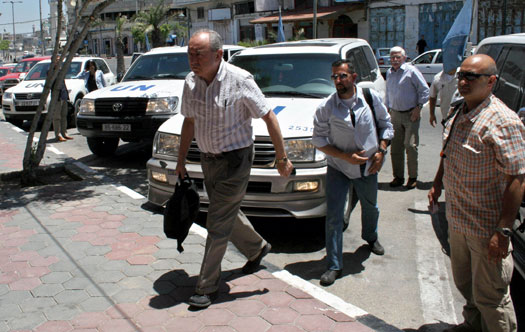
The long awaited UN Human Rights Council Fact Finding Report on Israel’s war in Gaza has finally been released and its conclusions are breathtaking. The mission led by Justice Richard Goldstone (above) has concluded that serious violations of international human rights and humanitarian law were committed by Israel during the Gaza conflict, and that Israel committed actions amounting to war crimes, and possibly crimes against humanity.

Some background: Justice Richard Goldstone, who is Jewish, is a highly respected international jurist. He is a former member of the South African Constitutional Court and former Chief Prosecutor of the International Criminal Tribunals for the former Yugoslavia and Rwanda. His mission compiled a 574 page report, which contains detailed analysis of 36 specific incidents in Gaza, as well as a number of others in the West Bank and Israel.  According to the UN press release announcing the report:

The Mission conducted 188 individual interviews, reviewed more 10,000 pages of documentation, and viewed some 1,200 photographs, including satellite imagery, as well as 30 videos. The mission heard 38 testimonies during two separate public hearings held in Gaza and Geneva, which were webcast in their entirety. The decision to hear participants from Israel and the West Bank in Geneva rather than in situ was taken after Israel denied the Mission access to both locations. Israel also failed to respond to a comprehensive list of questions posed to it by the Mission. Palestinian authorities in both Gaza and the West Bank cooperated with the Mission.

Here is what the Mission concluded:

In the lead up to the Israeli military assault on Gaza, Israel imposed a blockade amounting to collective punishment and carried out a systematic policy of progressive isolation and deprivation of the Gaza Strip. During the Israeli military operation, code-named “Operation Cast Lead,” houses, factories, wells, schools, hospitals, police stations and other public buildings were destroyed. Families are still living amid the rubble of their former homes long after the attacks ended, as reconstruction has been impossible due to the continuing blockade. More than 1,400 people were killed during the military operation.

Significant trauma, both immediate and long-term, has been suffered by the population of Gaza. The Report notes signs of profound depression, insomnia and effects such as bed-wetting among children. The effects on children who witnessed killings and violence, who had thought they were facing death, and who lost family members would be long lasting, the Mission found, noting in its Report that some 30 per cent of children screened at UNRWA schools suffered mental health problems.

The report concludes that the Israeli military operation was directed at the people of Gaza as a whole, in furtherance of an overall and continuing policy aimed at punishing the Gaza population, and in a deliberate policy of disproportionate force aimed at the civilian population. The destruction of food supply installations, water sanitation systems, concrete factories and residential houses was the result of a deliberate and systematic policy which has made the daily process of living, and dignified living, more difficult for the civilian population.

The Report states that Israeli acts that deprive Palestinians in the Gaza Strip of their means of subsistence, employment, housing and water, that deny their freedom of movement and their right to leave and enter their own country, that limit their rights to access a court of law and an effective remedy, could lead a competent court to find that the crime of persecution, a crime against humanity, has been committed.

According to the JTA, the Israeli government and the American Jewish establishment has wasted no time in pouncing on the report. But from what I’ve read so far, none of the respondents have addressed its substance. Not surprisingly, they’re only interested in attacking the UN – in particular, the UN Human Rights Council. 

Israeli Knesset Speaker Reuven Rivlin said, “The same U.N. that allows (Iranian President Mahmoud Ahmadinejad) to announce on a podium its aspiration to destroy the State of Israel has no right to teach us about morality.” According to ADL Director Abe Foxman: “This is a report born of bias. What do you do with an initiative born of bigotry?”

AJC Director David Harris:

Let us not forget that this commission was a creation of the Human Rights Council, arguably the U.N.’s most flawed body. The Council has consistently demonized Israel, while giving a free pass to some of the world’s worst tyrants, from Sudan to Iran.

My two cents:

It is worth noting that this “flawed, biased” commission had this to say about Palestinian human rights abuse during the Gaza war:

The Fact-Finding Mission also found that the repeated acts of firing rockets and mortars into Southern Israel by Palestinian armed groups “constitute war crimes and may amount to crimes against humanity,” by failing to distinguish between military targets and the civilian population. “The launching of rockets and mortars which cannot be aimed with sufficient precisions at military targets breaches the fundamental principle of distinction,” the report says. “Where there is no intended military target and the rockets and mortars are launched into civilian areas, they constitute a deliberate attack against the civilian population.”

The Mission concludes that the rocket and mortars attacks “have caused terror in the affected communities of southern Israel,” as well as “loss of life and physical and mental injury to civilians and damage to private houses, religious buildings and property, thereby eroding the economic and cultural life of the affected communities and severely affecting the economic and social rights of the population.”

The Mission urges the Palestinian armed groups holding the Israeli soldier Gilad Shalit to release him on humanitarian grounds, and, pending his release, give him the full rights accorded to a prisoner of war under the Geneva Conventions including visits from the International Committee of the Red Cross. The Report also notes serious human rights violations, including arbitrary arrests and extra-judicial executions of Palestinians, by the authorities in Gaza and by the Palestinian Authority in the West Bank.

So much for the accusations of bias.

If Foxman, Harris, et al have any problems with the procedural process of the Mission (with which Israel refused to cooperate) I’m interested in hearing it. And if they have any evidence that counters the findings of the report, then let them bring it. Until this happens, I’m not sure their general opinion of the UN is germane to the matter at hand.

 Based upon comments and e-mails I get on a daily basis, I know I will be considered by some to be a self-righteous simpleton at best and a traitor to my people at worst. But here goes: as a Jew, I am devastated by these findings.  The moral implications of this report should challenge us to the core. And I am deeply, deeply troubled that the primary response of our Jewish communal leadership is to attack the source of the report while saying absolutely nothing about its actual content.

Yes, there are other human rights abusers in the world. And yes, some of them are even worse than Israel. Yes, the structure and governance policy of the UN is far from perfect. And yes, nations tend to use the UN for their own self-serving ends. But do these facts give us a pass on holding Israel up to the most basic standards of human rights and international law?

A Rosh Hashanah Wish for Israel/Palestine

Please read my editorial just published in the New York Jewish Week. Heartfelt thanks to editor extraordinaire, Emily Hauser and Brit Tzedek v’Shalom, with whom I collaborated on this piece:

One of the holiday season’s key lessons is that it’s never too late for reconciliation: between humanity and God, between loved ones, between bitter enemies. We see this later in Genesis when Abraham dies, and Isaac and Ishmael bury him together. Our rabbis teach us that the brothers had put aside their differences and reconciled – but only a fool would presume that it had been easy for them.

 As we greet our new year, President Obama is preparing a new peace initiative, intent upon bringing Israelis and Palestinians back to negotiations. Unlike his predecessor, Obama understands what so many of us know: Achieving a real Israeli-Palestinian peace will require painful compromise and difficult decisions. It will be hard. But it is doable.

Click here for the full article.

Parsing the J Street Generation

J STREET LOGOEnjoyed James Traub’s feature about J Street in yesterday’s NY Times Magazine. Great to see them getting such high profile press.

For me, the most fascinating insight in the article came from J Street director Jeremy Ben-Ami’s comments on the young ‘uns who work there:

The average age of the dozen or so staff members is about 30. Ben-Ami speaks for, and to, this post-Holocaust generation. “They’re all intermarried,” he says. “They’re all doing Buddhist seders.” They are, he adds, baffled by the notion of “Israel as the place you can always count on when they come to get you.” Living in a world of blogs, they’re similarly skeptical of the premise that “we’re still on too-shaky ground” to permit public disagreement.

I would say that this is my sense of 20-30 something Jews generally. I’m 46 myself, but I’m still old enough to remember the Yom Kippur War, Entebbe and Soviet Jewry rallies. Today’s new generation of Jews, however, has grown up with a decidedly different experience of their Jewish place in the world.  For them, the Jewish State doesn’t represent an antidote to Jewish insecurity, nor is it their last bastion of Jewish safety and survival.  Most Jewish young people I meet these days are comfortable enough in their post-modern Jewish skin and frankly, they fail understand why questioning traditionally held assumptions about Israel is considered so taboo.

I’ve long felt that unless the organized Jewish community makes an effort to grasp this, we’re going to lose this next generation. (I don’t care how many kids we send on Birthright – I don’t think the Jewish establishment is going to turn this tide around.)

Are you going to the first national J Street Conference on October 25-28? It’s increasingly looking like it’s going to be the place to be…