Monthly Archives: June 2010

Support Worker Justice at Hyatt!

If you’re a rabbi, cantor or Jewish community leader, I encourage you to support Hyatt workers by signing on to this new statement, “An Appeal to for Justice at Hyatt:”

The Torah commands us “You shall not abuse a needy and destitute laborer” (Deut 24:14), and the Rabbis later teach that employees have a right to organize and demand just conditions and compensation for their labor (Tosefta Bava Metzia 11:24).

We cannot stand idly by as the housekeepers and hotel workers of the Hyatt Hotels stand to lose their hard won and fair compensation. The call to pursue justice (Deut. 16:20) demands that we stand with these workers so that they don’t slip into poverty.

Therefore, we, the undersigned concerned rabbis, cantors, and community leaders, call on the owners and leadership of Hyatt Hotels to commit to the Jewish and universal obligations to treat workers fairly and to recognize the value of their labor. We call on all Jewish institutions and individuals to support Hyatt workers in their disputes, and we express our willingness to boycott Hyatt properties in support of these principles if requested to do so by the affected workers.

I’m thrilled to report that the primary signers of the statement include Reform, Reconstructionist, Conservative and Orthodox rabbis from across the country. Sixty more leaders have already signed on as supporters.

For more background, read my recent post on the subject or check out the website Hotel Workers Rising.

The BP Disaster: New Orleans Betrayed Again

Before we headed out to volunteer at the Second Harvest Food Bank of Greater New Orleans and Acadiana, we heard an eye-opening presentation by David Hammer, an investigative reporter for the Times-Picayune whose articles have contained some of the most important and damning revelations about patterns of corporate negligence that ultimately led to the BP disaster.

David is a seventh-generation New Orleanian and an immensely talented reporter who knows just about everything there is to know and more about the latest Gulf tragedy.  He told us that before the Deepwater Horizon explosion he didn’t know anything at all about deep water drilling, “cement linings,” and “well heads.” I’d say that as a result of this investigation, he’s now one of the country’s foremost authorities on such things.

David told us that just before the Deepwater Horizon explosion, he attended an editorial meeting in which the major subject under discussion was how the Times-Picayune would cover the fifth anniversary of Katrina (coming up this August.) The Gulf disaster soon wiped that story off the front page and as the catastrophic  significance of this event became clearer, David was eventually asked to track the growing allegations of negligence against BP and the other companies involved.

David was the first to break a number of important revelations. One of the most important was his finding that BP dismissed a top oilfield service company it had hired to test the strength of cement linings on the Deepwater Horizon’s well.  The firm, Schlumberger, left without performing a critical final check – and eleven hours later the oil rig exploded.

I highly recommend David Hammer’s articles, which contain the most trenchant reportage there is on the BP disaster. I will warn you, however, it is not pleasant reading. With Hurricane Katrina, the citizens of New Orleans were utterly betrayed by its local, state and national governments.  Now they’ve been betrayed yet again – this time by corporate negligence and greed. It’s truly tragic to witness the repeated wounding of this region through disasters that could well have – and should have – been avoided.

David also addressed the issue of the White House’s six month deep water drilling moratorium, which most Louisianans firmly oppose. Sadly enough, the two largest industries in Louisiana are oil drilling and fishing, both of which have been devastated by the BP disaster. While most in the state understand the need for the US to break its oil addiction, most also believe that a six month moratorium would have a catastrophic impact on citizens already hard hit by the Gulf disaster. David added that a moratorium also seems increasingly unnecessary given that there is growing evidence that this particular event was caused by one company’s negligence.

I’ve spoken to several locals about these issues – and no matter where they fall on the politics, the overriding sense I get is a deep and palpable sadness. More than one person has said that this latest disaster is in many ways even scarier than Katrina. The breech of the levees, for all of its devastation, was a singular event – and in its aftermath the citizens of New Orleans  knew what they needed to do. They rolled up their sleeves and got to work restoring their city.

In this case, however, the sense is the disaster is only beginning – no one knows how long it will last or what its ultimate impact will eventually be. In the meantime, it’s difficult to know what anyone can really do. As the corporations and the politicians trade accusations, there is little that average New Orleanians can do but wait to see how it will all turn out.

Some pix:

Up top: during a free afternoon, I went to the New Orleans Audubon Aquarium – and took this grotesquely ironic shot from the “Gulf of Mexico” exhibit.

Below: Three JRC kids volunteering at the Second Harvest Food Bank.

Bottom: During our final volunteer effort we cataloged library books at the Sci Academy – one of NOLA’s many impressive new charter schools that have arisen in the wake of Katrina.

We’re home now,  filled with sadness at this latest devastation – but also admiration and awe at this truly amazing city. Despite it all, I can’t imagine a citizenry more devoted to its community than New Orleans. And in the end, I can’t help but believe that their devotion to one another will bring them through yet again.

It’s Takes a Village in the Lower 9th

We spent the day volunteering at the Lower 9th Ward Village - a community-led, community-driven neighborhood center that opened almost immediately in the wake of Katrina. It was founded by Mack McClendon a former telephone technician who originally had his eye on the large abandoned facility as a place to store and work on old cars. After Katrina, Mack acquired the property with his mind on a deeper purpose: to build a community center to serve the dislocated citizens of the Lower 9th, complete with a gymnasium, job training programs, a recording studio, a dining room, computer lab for youth, and free meals for the homeless.

Mack is nothing if not a visionary. Though he is the leader of a neighborhood community center, he addressed us with the passion of a preacher. He spoke movingly of the dislocation suffered by the citizens of the Lower 9th, how his community is struggling to regain its footing, and how he discovered his own true purpose following the devastation of Katrina. His plans for the Lower 9th Village are ambitious to be sure, but it is impossible not to be awed at what he and his fellow organizers have accomplished in such a short amount of time. (That’s me above, with Mack on the left and his brother Joe on the right.)

Our group helped Joe organize a huge mass of supplies and equipment that had been donated to the center: lots of hauling, sorting and restocking in a large warehouse-like space that will eventually serve as a basketball court. Some of us also did a little bit of carpentry – that’s my son Jonah below helping Joe build storage bins for their sports equipment.

The center’s computer lab already has nine internet-equipped computers and they also house an impressively stocked library. Mack’s short-term plan is to provide A/C for these rooms and to complete a lounge/recording studio. In its short life, the Lower 9th Ward Village has already become a valuable resource for neighborhood youth – and its difficult not to be inspired by its huge potential to serve the citizens of this community.

If you’d like to donate to their effort, visit and join their Facebook group. You can get your name/s inscribed on a brick for a donation of $100.00 or $200.00. I can personally attest it’s a simple but powerful way to support community rebirth in New Orleans.

JRC Returns to New Orleans

I’ve spent the last two days participating in JRC’s second congregational trip to New Orleans. We were last here in October 2007, when we spent of our time stripping the interiors of storm damaged houses in Gentilly. It’s been fascinating to observe the difference in the city since our last visit. While there are undeniable signs of improvement and rebirth, there are clearly some areas that continue to languish – and several aspects of the city’s comeback come with no small share of controversy. And of course, there is the BP spill: a fresh wave of anguish to this already tortured region.

We spent a good portion of our first day as the guests of St. John #5 Faith Church, who welcomed us with a heartfelt hospitality and a delicious home cooked meal. St. John’s is located in the 7th Ward, an area that was hit hard by Katrina but has received little of the publicity or attention that has been paid to neighborhoods such as the Lower 9th.

The 7th Ward is plagued by poverty, gangs and rising levels of HIV/AIDS – and in many ways St. John’s seems to be one of the few institutions actually fighting to bring stability and relief to the neighborhood. The church is led by Pastor Bruce Davenport (right), a joyful, deeply religious, profoundly beloved religious leader who is committed to helping the citizens of this community one member at a time.

As we shared dinner together, Pastor Bruce was unabashedly open about his own past of gang activity and drug abuse – as were the parishoners with whom we spoke. While the realities facing the members of this community are profoundly dire, we couldn’t help but be moved by their deep commitment to God, to one another, and to their home in the 7th Ward.

At the same time, however, it is clear that they harbor a justifiable resentment over the government’s abandonment of their community. It certainly appears that if not for churches like St. John’s, there would be little significant institutional support for the 7th Ward whatsoever.

Today we spent most of our day volunteering in the Lower 9th, where we’re seeing a significant change since our last visit. In 2007 this area looked washed clean away – a once densely populated neighborhood now reduced to concrete slab foundations and abandoned rotting homes.

Today, the Lower 9th is clearly on a rebound, thanks to efforts such as Brad Pitt’s “Make it Right” Foundation, which is building new green homes for former residents. It’s a noble effort that hopes to have 150 new state of the art LEED certified Platinum homes built by the end of the year.

The homes are striking and eye-catching to be sure (see above) and there is apparently some controversy that they have not been built according to the architectural vernacular of the area. It’s also hard to imagine that this project can ever replace the enormity of what was lost in the Lower 9th. On the other hand, we’ve heard from more than one resident that every act of support and kindness is welcomed and appreciated, no matter what the complexities involved.

The fifteen participants of our delegation split into work teams and mine spent the better part of the afternoon today working in the garden of a Lower 9th resident named Veronica (top pic). She and her husband (who was paralyzed) were evacuated in advance of Katrina and ended up spending over a year in Shreveport, LA where their return to their home was repeated stymied by Kafka-esque red tape. (They were told by FEMA that they did not qualify for assistance because their home, which had been completely destroyed by flood water up to the roof, was not located in a “flood zone.”) After too many painful runarounds, they received some compensation and their home was rebuilt by their son.

Of course, the BP spill is on everyone’s mind now. The timing of this latest disaster is particularly cruel: just when the city seems to beginning to rebound (winning a Super Bowl, no less), here comes yet another catastrophic communal event. The region’s fishermen, who depend upon this time of year for their livelihood – and upon whom the area depends for a large portion of its economy – have been devastated by the spill. The palpable sense of betrayal and abandonment is all too familiar – and all too tragic.

More soon.

Gaza Witness: A Conversation With Ashley Bates

Yesterday Ta’anit Tzedek hosted an incredibly powerful conference call with journalist/blogger Ashley Bates, who spoke to us from Gaza City. If you didn’t make the call, you can listen to it yourself by clicking here. Ashley’s personal testimony provided an extremely important antidote to the misinformation about Gaza that we’ve heard bandied about – particularly since the flotilla crisis.

At the opening of our conversation, I asked Ashley to address the claims of the Israeli government that “there is no humanitarian crisis in Gaza” and that no one is starving as result of Israel’s blockade. I also asked her to address press reports that cite the upscale Roots Restaurant and well-stocked market stalls in Gaza City as proof that things are not nearly as dire as critics are claiming.

Ashley validated the reports that these kinds of goods are indeed available in the more affluent areas of Gaza. She added, however, that the only ones who can afford them are internationals such as herself or a relatively small number of affluent Gazans. She pointed out that the Gazan economy has completely collapsed as a result of the blockade, causing widespread unemployment and poverty for an overwhelming number of citizens. Ashley herself can afford to live a relatively comfortable life in a rented Gaza City apartment. Unlike most Gazans, she could purchase her own electric generator – so she is unaffected by the daily eight hour blackouts that are a familiar part of life in Gaza.

Ashley said that she saw no signs of starvation, but it was clear to her that the nutritional needs of Gazans are not being met. Eight out of ten Gazans are on some form of international aid. In the refugee camps, Gazans are essentially living on diets devoid of fruits and vegetables. As a result, anemia and malnutrition is on a sharp rise – particularly among children.

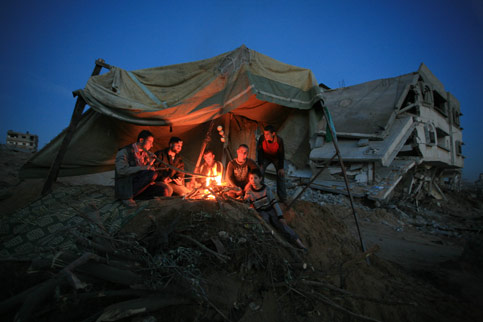
She also witnessed considerable numbers of homeless Gazan families, whose homes were destroyed during Israel’s military assault in December 2008. The majority of them have moved in with relatives or friends and live in very cramped quarters. Others rent apartments they cannot afford, relying upon the largess of landlords. Still others are forced to live in unstable, partially destroyed residences or in tents next to the rubble of their former homes (see pic above).

Ashley said she was not qualified to to comment as to whether this all constitutes a “humanitarian crisis.” She did, however, call it “a crisis of human dignity” – and it is clear to her that these circumstances are a direct result of the blockade.

It is also becoming clear to me that the world is becoming less and less inclined to buy the Israeli government’s calculated misinformation campaign about the blockade. Yesterday, blogger Richard Silverstein posted an extremely telling e-mail missive that the Israeli PR org The Israel Project recently sent out to its members:

Subject: In the “messages that fail” department, please see this…
Date: Tue, 15 Jun 2010 13:36:40 -0400
From: Jennifer Laszlo Mizrahi
To: Jennifer Laszlo Mizrahi

As to research on saying that there isn’t a “humanitarian crisis” in Gaza and that no one is starving, we will have that on what Luntz and Greenberg are testing next week. But you don’t need that data to know it is a complete dead-end of a message. Reporters and leaders all over Washington are complaining about this and some say they see Israel and cold and heard hearted. Given that 6 more flotillas are headed to Israel (including one of Jews from Germany and one of Jews from the UK) we need to make sure we understand this well.

Watch this from Jon Stewart. Watch to the end and listen to how they react to when Krauthammer uses the message…ouch!

http://vimeo.com/12350665

Clearly we need to be saying that “While no one is starving in Gaza because Israel delivers so much aid, there IS suffering in Gaza. We want the suffering to stop. That is why Iran-backed Hamas must stop using supplies for rockets and Hamas must release Gilad Shalit. Hamas must be accountable for their actions and for the suffering they are causing their OWN people.”

On a good note, the topic in the US tonight will shift to energy. Alternative energy is obviously a great topic for Israel as Israel has much to say that could help on this.

Thanks!

Jennifer

Spin notwithstanding, it’s an amazing admission. (You know, it’s often occurred to me that if Israel spent just a fraction of the time and energy it spends on public relations to actually own up to its responsibility for this crisis, we might see some real progress toward a resolution).

In the meantime, thank God for sane witnesses such as Ashley Bates. Please listen to the call.

What is Really Happening in Gaza? A Conversation with Journalist Ashley Bates

The next Ta’anit Tzedek fast day is Thursday, June 17 and to mark the occasion we’re sponsoring a conference call with freelance journalist Ashley Bates.

Ashley has been living in and reporting from Gaza for the past several months and as I’ve written before, her pieces offer invaluable, in-depth perspectives of life under the blockade. Her articles have appeared in Jerusalem Post, Jerusalem Post Magazine, Global Post, Huffington Post, Columbia Journalism Review, and Ha’aretz and she posts regularly on her blog Dispatches from Gaza.

Of course Israel’s recent raid on the Freedom Flotilla has recently put the blockade back on the mainstream media radar screen. Misinformation about this crisis has been on the increase – and it is all the more critical to hear from those such as Ms. Bates: reputable sources of information about life on the ground in the Gaza Strip.

The conference call will take place Thursday, June 17 at 12 noon EST.

Call-in info:

Access Number: 1.800.920.7487
Participant Code: 92247763#

We are thrilled that Ashley will be able to join us for this important and critical conversion. Please join us.

Video: Hyatt Management Eats Bitter Herbs!

Here’s a 10 minute video of our interfaith labor action at the Hyatt shareholders’ meeting last Wednesday.

As I wrote in my previous post, we were met by Robb Webb, chief human resources officer for Hyatt. Here he is addressed by Reverend Lillian Daniel, Rabbi Barbara Penzer (from Boston), Reverend Calvin S. Morris, Reverend David Weasley and me.

Make sure to watch until the very end, where Rabbi Barbara presents a platter of bitter herbs to Mr. Webb, and we all eat it together!

The Hyatt Hotel Workers’ Bitter Herbs

Yesterday I had the honor of joining a demonstration of over 100 interfaith clergy who protested outside the Hyatt Hotel Corp’s shareholders’ meeting in Chicago. Hyatt went public last November and was hoping to have a quiet, pro-forma meeting. In the end, Hyatt’s increasingly draconian labor practices made that fairly impossible.

Here’s some background from the website Hotel Workers Rising:

In city after city across North America, Hyatt Hotels is leading the fight against middle class jobs for hotel workers. Nationwide, the hotel industry is rebounding faster and stronger than expected, with a hearty rebound projected in 2011 and 2012. In the six months following Hyatt’s November initial public offering, Hyatt’s shares were up over 65%. In one day, majority owners of Hyatt Hotels, the Pritzker family, cashed out over $900 million in an initial public offering of the company’s stock. As recently as March 31, 2010 Hyatt had $1.3 billion in cash on hand.

Despite trends showing a strong recovery for the hotel industry and hotel owners, big hotel companies are still squeezing workers and cutting staff. Hyatt is the starkest example. Hyatt is using the weak economy as an excuse to slash benefits, eliminate jobs and lock workers into the recession.  In Boston, Hyatt fired their entire housekeeping staff at three non-union hotels, laying off 98 longtime housekeepers and replacing them with outsourced workers making minimum wage. Many of the fired workers report that Hyatt required that they train their replacements…

In cities across North America, Hyatt is attempting to rollback quality job standards and make the recession permanent for thousands of unionized workers. Proposals in several cities would result in the elimination of quality health care for thousands of low wage workers. Cities with contracts Hyatt union contracts expiring in 2009-2010: San Francisco, Los Angeles, Toronto, Chicago, Vancouver, Monterey, Honolulu, and Washington DC.

As previous attempts to meet with Hyatt management proved fruitless, organizers decided to use the occasion of the shareholders’ meeting to force a meeting. Our clergy group gathered outside the Hyatt Regency McCormick Place and marched up to second floor where the meeting was taking place. We were stopped at the security line, where we were told we had to be “registered shareholders” if we wanted to enter the meeting.

As security scrambled and the police were called (below), we sang outside the doors of the meeting, booming out “Open up for me the gates of justice/I will enter and praise the Holy One” (Psalm 118:19). As we sang, it became clear that the meeting was ending – and one by one the shareholders had to walk through a huge crowd of singing, clapping clergy.

Eventually, our delegation was met by Robb Webb, chief human resources officer for Hyatt. He told us that he honored our motives and he “regretted” the way the Boston firings were handled, but we had to understand that it was ultimately a “business decision” in the end. We responded that If he truly honored our motives, then he must surely understand that “it’s only business” is not an acceptable explanation. Rabbi Barbara Penzner (my Reconstructionist colleague from Boston who has been helping lead the protest of the “Hyatt 100″) pointed out that beyond the economic bottom line, there was a “moral bottom line” due the workers who help make the Hyatt shareholders’ formidable profits possible.

Barbara then presented Mr. Webb with a platter of bitter herbs (top pic), pointing out that Hyatt was indeed embittering the lives of its workers. Noting the symbolism of the Passover story, we all then ate of the maror in solidarity with Hyatt employees.

Outside (above), we shared our experiences with the demonstrating workers (who let out a huge cheer when they learned that the new Hyatt shareholders were forced to run a gauntlet of raucous, singing clergy.)

Click here to sign a pledge of support for the Hyatt 100.


More Gaza Flotilla Aftermath

More odds and ends re the flotilla fallout:

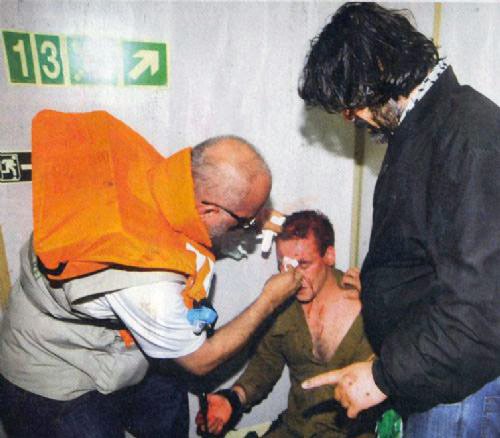
- In contrast to the Israeli characterization of flotilla participants as jihadist thugs, pictures released by Turkish newspaper Hürriyet show activists actually protecting and aiding injured Israeli Navy commandos. (H/T to Ali Abunimah for the link).

- Flotilla participant Jamal Elshayyal (a British citizen and producer for Al Jazeera English) has written an extensive account of his experiences on the night of the raid. While there no way to verify his testimony, it does square with numerous other eyewitness reports. At the very least, it underscores the need for a credible international investigation to get to the bottom of what actually happened aboard the Mavi Marmara:

After spotting the warships at a distance, (at roughly 11pm) the organisers called for passengers to wear their life vests and remain indoors as they monitored the situation. The naval warships together with helicopters remained at a distance for several hours.

At 2am local time the organisers informed me that they had re-routed the ship, as far away from Israel as possible, as deep into international waters as they could. They did not want a confrontation with the Israeli military, at least not by night.

Just after 4am local time, the Israeli military attacked the ship, in international waters. It was an unprovoked attack. Tear gas was used, sound grenades were launched, and rubber coated steel bullets were fired from almost every direction.

Dozens of speed boats carrying about 15-20 masked Israeli soldiers, armed to the teeth surrounded the Mavi Marmara which was carrying 600 or so unarmed civilians. Two helicopters at a time hovered above the vessel. Commandos on board the choppers joined the firing, using live ammunition, before any of the soldiers had descended onto the ship.

Two unarmed civilians were killed just metres away from me. Dozens of unarmed civilians were injured right before my eyes.

One Israeli soldier, armed with a large automatic gun and a side pistol, was overpowered by several passengers. They disarmed him. They did not use his weapons or fire them; instead they threw his weapons over board and into the sea.

After what seemed at the time as roughly 30 minutes, passengers on board the ship raised a white flag. The Israeli army continued to fire live ammunition. The ships organisers made a loud speaker announcement saying they have surrendered the ship. The Israeli army continued to fire live ammunition.

- Finally, click above for a deeply disturbing clip of journalist Max Blumenthal interviewing participants at a recent Israeli rally in front of the Turkish embassy. I’m not sure what made me sadder: the callous celebration of an incident that led to the deaths of nine civilians or the “us against the world” siege mentality expressed by so many Israelis on the street.

Update: Good News From Tent of Nations!

This just in from Daoud Nasser:

Dear Friends of Tent of Nations all over the world,

Our Lawyer appealed to the Israeli Supreme Court to stop the demolishing of our renovations which is planned to take place this coming Sunday or Monday. I believe, because of all the pressure and the reactions from all of you through writing letters to your governments and to the Israeli officers, the Supreme Court of Israel granted an injunction to stop the military from taking any demolishing actions until the Supreme Court takes a decision. The military authority was given 60 days time to send their objection to the Supreme Court. This means that we will have to go for a trial in the Supreme Court.

We, and with all your prayers and support and with the help of your advocacy letters, managed to freeze the demolishing orders and to bring this case to the Supreme Court. It is a victory for justice even if it is a small one for now but it is a victory.

I want to thank you for all your prayers, for the many E-mails  we received from you and for the solidarity visits. I will keep you updated about the development of this case in front of the Supreme court.

Our efforts together made a difference.

Thank you for your friendship.

Blessings and Salaam,

Daoud