Monthly Archives: March 2014

Land and Liberation: An Interview with Reverend Naim Ateek

brantandnaim

This past weekend, I had the great pleasure to engage in an extended interview with Reverend Naim Ateek, founder of Sabeel Ecumenical Liberation Theology Center, during a brief visit he made to Chicago. I’ve known Rev. Ateek for several years and am honored to call him a friend and colleague – and I’ve written before about his important work in the development of Palestinian liberation theology.  Since he’s been the object of unrelenting attack by the Jewish institutional establishment, I was particularly grateful for the opportunity to model a different kind of Jewish-Christian engagement on his life and his work.

An edited version of our conversation follows here:

Continue reading

My Al Jazeera Debate with Rabbi Ari Hart

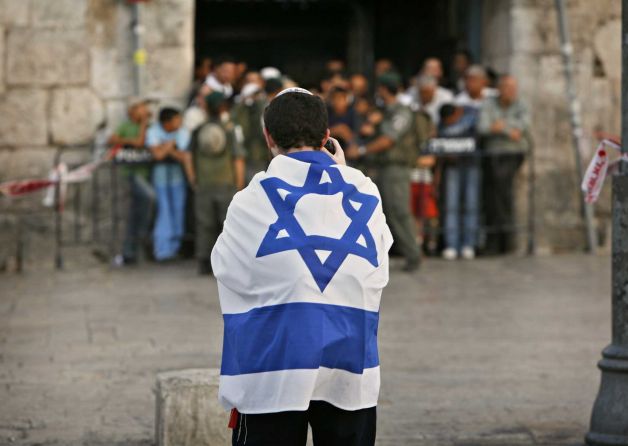
628x471

Al Jazeera has just published a “point-counterpoint” dialogue on Zionism between me and Rabbi Ari Hart, Assistant Rabbi of the Hebrew Institute of Riverdale, Director of Recruitment and Admissions at Yeshivat Chovevei Torah Rabbinical School and founder of the orthodox social justice organization, Uri L’Tzedek.

An excerpt from Rabbi Hart’s piece:

The state of Israel is the single best expression of the dreams of the Jewish people to have been realised in thousands of years. Since it was founded in 1948, it has meant that thousands of persecuted and displaced Jews from Ethiopia and Arab countries have been able to find safety and that millions of oppressed Russian Jews have been able to freely practice their faith. It has resulted in an explosion of Jewish culture and life unlike anything we have witnessed in millennia and led to a flourishing of the Jewish faith, with more people studying the Torah than at any other point in Jewish history.

And it has not only been positive for the Jewish people: the state of Israel has produced scientific, literary, medical, agricultural, and academic advances that have benefitted billions of people across the planet.

I am always confounded by my Jewish brothers and sisters who do not recognise that the state of Israel has represented the realisation of a dream for our people, and how vital its health and security is to our continued flourishing.

And from my counterpoint:

While Rabbi Hart is certainly correct when he asserts the ways the state of Israel has benefitted the Jewish people, I am struck by the fact that he is relatively silent on the precise nature of the “nightmare” it has created for the indigenous people of the land.

I believe that as Jews, we must be willing to own this dark history and say it out loud: during 1947 to 1948, Zionist military forces either displaced or forcibly expelled over 700,000 Palestinians then forbid their return, creating what is today the largest refugee population in the world. Today more than 4,000,000 Palestinians harbour their own dream of return – not to a mythic Biblical homeland but to a land that they remember only too well.

In short, Israel’s founding is inextricably bound up with an inherent injustice to the people who had made a home in this land. More critically, it is an injustice that continues until today through policies of dispossession and displacement designed to maintain a Jewish demographic majority in the state of Israel.

Why I Celebrated the Persian New Year on Purim this Year

Nowruz

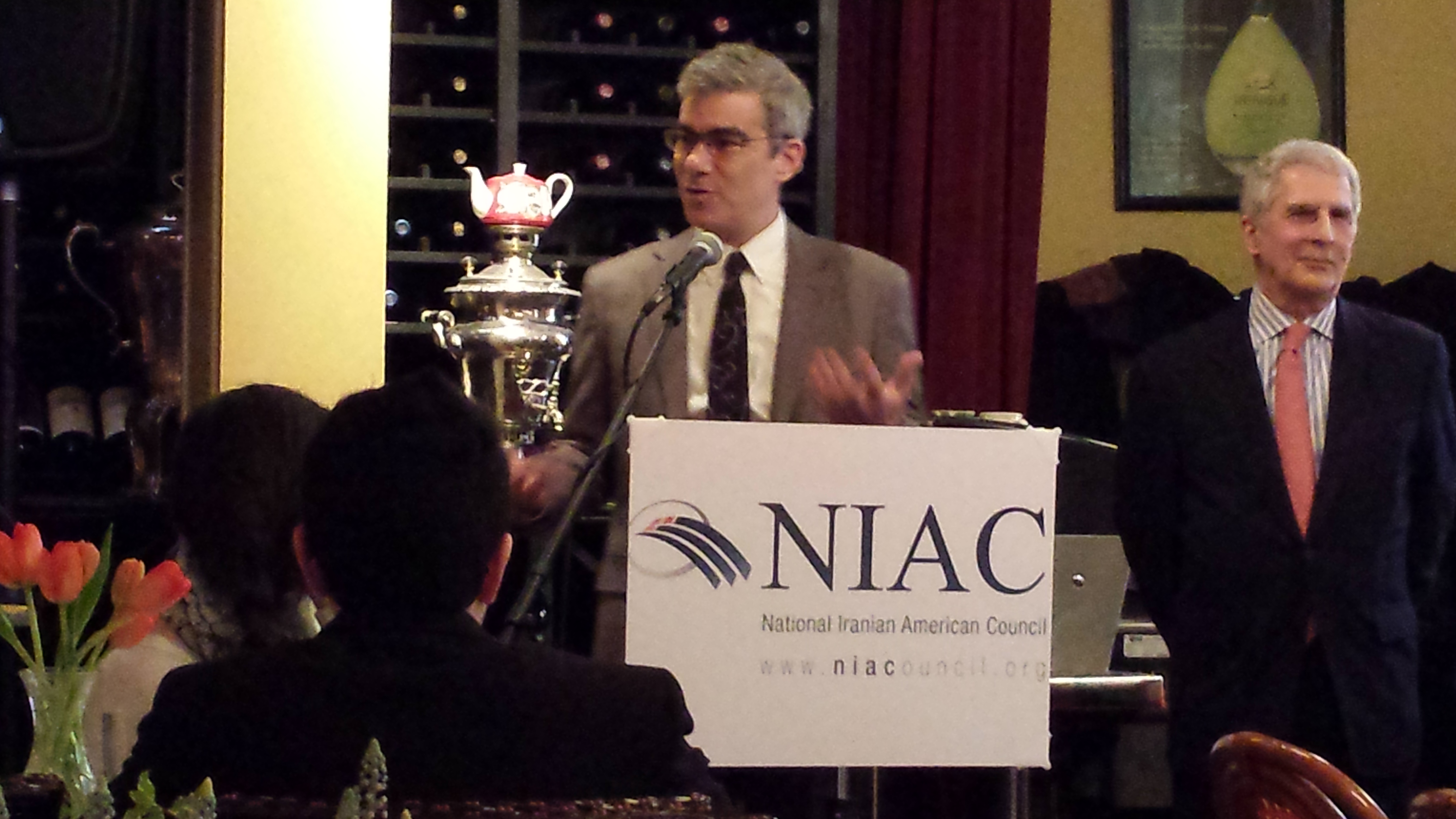
Addressing the NIAC Chicago Nowruz Celebration, March 16, 2014 (photo: Roxane Assaf)

Like many American rabbis around the country, I spent the most of the day yesterday leading my congregation’s noisy, joyously raucous Purim celebration, complete with a carnival and a family Megillah reading. As per usual, we read a somewhat watered-down version of the Book of Esther – one that characteristically kept the sexual hijinx and violence to a minimum.  Even with our PG version, however, there was no getting around the decidedly darker aspects of the Purim story – particularly the infamous ninth chapter in which we read that the Jews of Persia slew 75,000 Persians then celebrated the day after with a festival of “feasting and merry making.”

As always, this part of the story stuck seriously in my throat. While we adults can intellectualize the more disturbing parts of the Purim narrative (“it’s irony,” “it’s a revenge fantasy,” “it’s cathartic,” “it’s not meant to be taken seriously, after all…”) I’m just not sure we do any favors to our children when we read these kinds of stories to them, even in censored form. I’m fast coming to believe it’s time to tell a fundamentally different version of the Purim story to our children – one that celebrates the venerable Persian-Jewish experience rather than cynically telling a Persian version of “when push comes to shove, all the world really just wants the Jews dead.”

I’m also mindful that there are all too many adults who are willing to take the Purim story literally. I’ve written before about the disgusting Purim violence annually inflicted against the non-Jewish population in Israel. And on a geopolitical level, leaders of the state of Israel (and many in the American Jewish establishment) have openly and unabashedly used the Purim story to frame our relationship to Iran – presenting present day Ayatollahs and Mullahs as nothing less than Haman incarnate and promoting all out war as the only way to settle the current nuclear impasse.

For all this, however, I’m happy to report that Purim ended for me on something of a redemptive note this year.

As it turns out, the Persian New Year known as Nowruz is fast approaching and last night, I was thrilled to attend a Nowruz party sponsored by the Chicago chapter of the National Iranian American Council (NIAC).  So after I got home from my congregation’s Purim carnival, I took off my clown costume, put on a suit, and drove to a suburban restaurant where I celebrated the coming of spring with Chicago’s Persian community and supported the important work of NIAC, which among other things supports a “policy of persistent strategic engagement with Iran that includes human rights as a core issue.”

When I addressed the gathering (above), I thanked them for reaching out to me and explained that ever since I returned from a visit to Iran in 2008, I’ve always hoped to score a Nowruz party invitation from my Persian friends. I also explained why celebrating Nowruz with NIAC was for me the perfect, redemptive coda to Purim. And I added that contrary to the impression created by some Israeli politicians and Jewish institutional leaders, there were many in my community who believed that the current crisis should be settled through diplomacy and engagement and not an inexorable march to war.

Now I’m thinking there might well be something to this Nowruz/Purim celebration. Can’t think of a better way to, in words of the Book of Esther, “turn grief and mourning into festive joy….”

Untold Stories from Gaza: A Conversation with Ayman Qwaider and Sameeha Elwan

1970760_685811398124958_1228021371_n

I’ve written before about the wonderful Chicago initiative “Untold Stories,” which features Palestinians sharing their personal stories of their lives under occupation. While it began as a project of my congregation, it has since expanded to become an interfaith community effort. I’m so gratified by the success of this program, which draws upon the unique power of narrative rather than political rhetoric. As ever, the simple sharing of stories has an uncanny ability to cut through the convoluted complexities of political issues like little else.

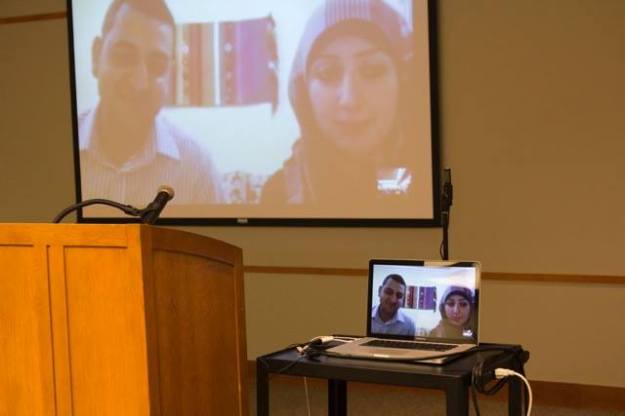
Up until now, “Untold Stories” has featured Palestinian-Americans (and recently, the addition of Israelis as well.)  This past Sunday, however, for the first time participants were able to hear from Palestinian presenters speakers speaking to us directly from Palestine. I was honored to serve as the facilitator of a Skype conversation between attendees at the Evanston Public Library and a young Palestinian couple in Gaza: Ayman Qwaider, a community educator and peace activist and his wife Sameeha Elwan – a blogger/student/activist.

For well over an hour, Ayman and Sameeha shared details of life inside the Gaza blockade.  Ayman, 26, received his degree from the Islamic University of Gaza in 2008, after which he worked for two years as an international humanitarian aid worker. In 2010, he was granted a scholarship to travel to Spain, where he received his master’s degree in Peace, Conflict and Development Studies. He currently works for a non-governmental organization in Gaza.

Sameeha is a talented writer and blogger who, like Ayman, received her BA at the Islamic University, then received a scholarship to earn an MA in Culture and Difference at Ustinov College in Durham, UK. Her work is featured in the important new anthology, “Gaza Writes Back,” recently published by Just World Books. Sameeha has received a scholarship to pursue a Phd in English literature but it is as yet unclear if she will receive permission to travel once again pursue her studies.

It was clearly important for Ayman and Sameeha to be able to share their stories with us, particularly since the plight of Palestinians in Gaza is the chronically forgotten story in the Palestinian-Israeli conflict. Now six years into this blockade, Gazans still live in a virtual open-air prison with severely curtailed access to the most basic necessities of living.  As Ayman and Sameeha told us, 80% of the population is dependent on international aid, the economy has all but collapsed, the percentage of children suffering from malnourishment is rising, unemployment is at 60%, there is a shortage of drinkable water and access to electricity is limited to several hours a day.
1902074_685811491458282_1311275468_n

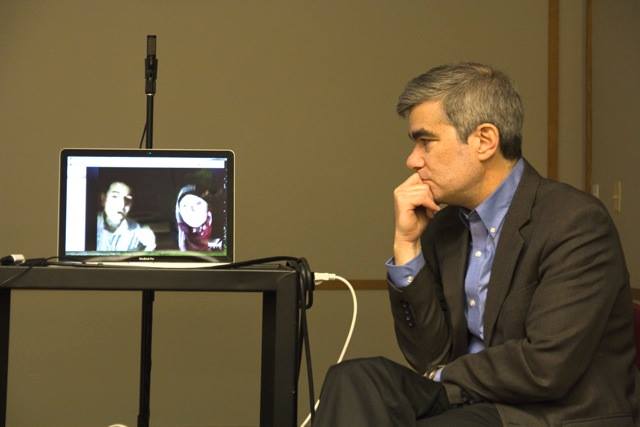
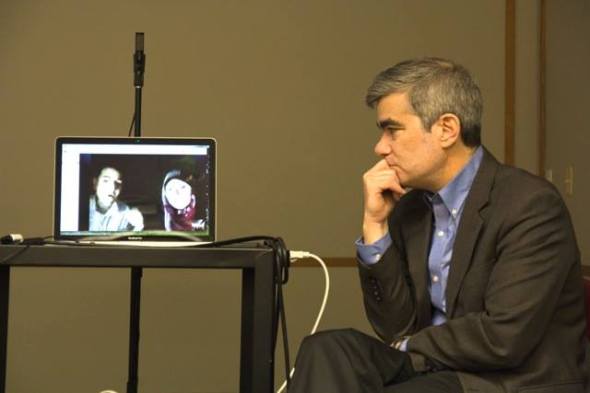
To drive this point home, Ayman told us at the beginning of the program that we should expect their electricity to go down in one hour. At that point, we would need to wait for a few minutes while they hooked their computer up to a reserve battery. When we reconnected, they were sitting in the darkness of their Gaza City flat, their faces illuminated only by the light from their computer. (Compare top pic with the pic above).

I’ve written extensively about the politics dimensions of the Gaza crisis so I won’t belabor the point here. I will only say that I am deeply grateful to “Untold Stories” (and its coordinators, Sallie Gratch and Mark Miller) for enabling us to hear Ayman and Sameeha’s story – and help us bear witness to this injustice with a unique kind of power.

It’s truly difficult to describe how it felt to converse with a young couple who were sitting in the darkness of their apartment from inside a blockaded strip of land while we sat in the comfort and freedom of an Evanston library. It is so very, very important to hear these untold stories and to create real relationships with those who are living them out day after day. I’d add it is even more important to view ourselves as an integral part of these stories, so that we might somehow participate in their just resolution.

Some links I encourage you to read: click here to read Ayman’s blog and here to read Sameeha’s. Click here to read an excellent article by journalist Ruth Pollard which describes the current reality under the Gaza blockade and prominently features Ayman and Sameeha’s story.

And finally, click here to donate to ANERA – a heroic NGO that has long been endeavoring to provide sustainable support to the people of Gaza.

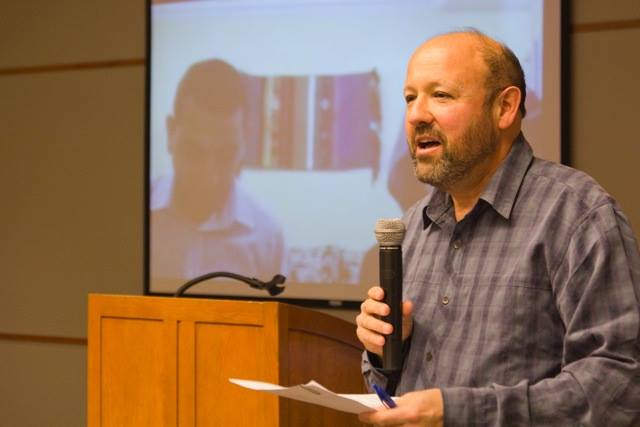
"Untold Stories" co-coordinator Mark Miller

“Untold Stories” co-coordinator Mark Miller
The Story of Anibal Fuentes and a Tragicially Broken Immigration System

3.4.13- Press Conference- CRLN group

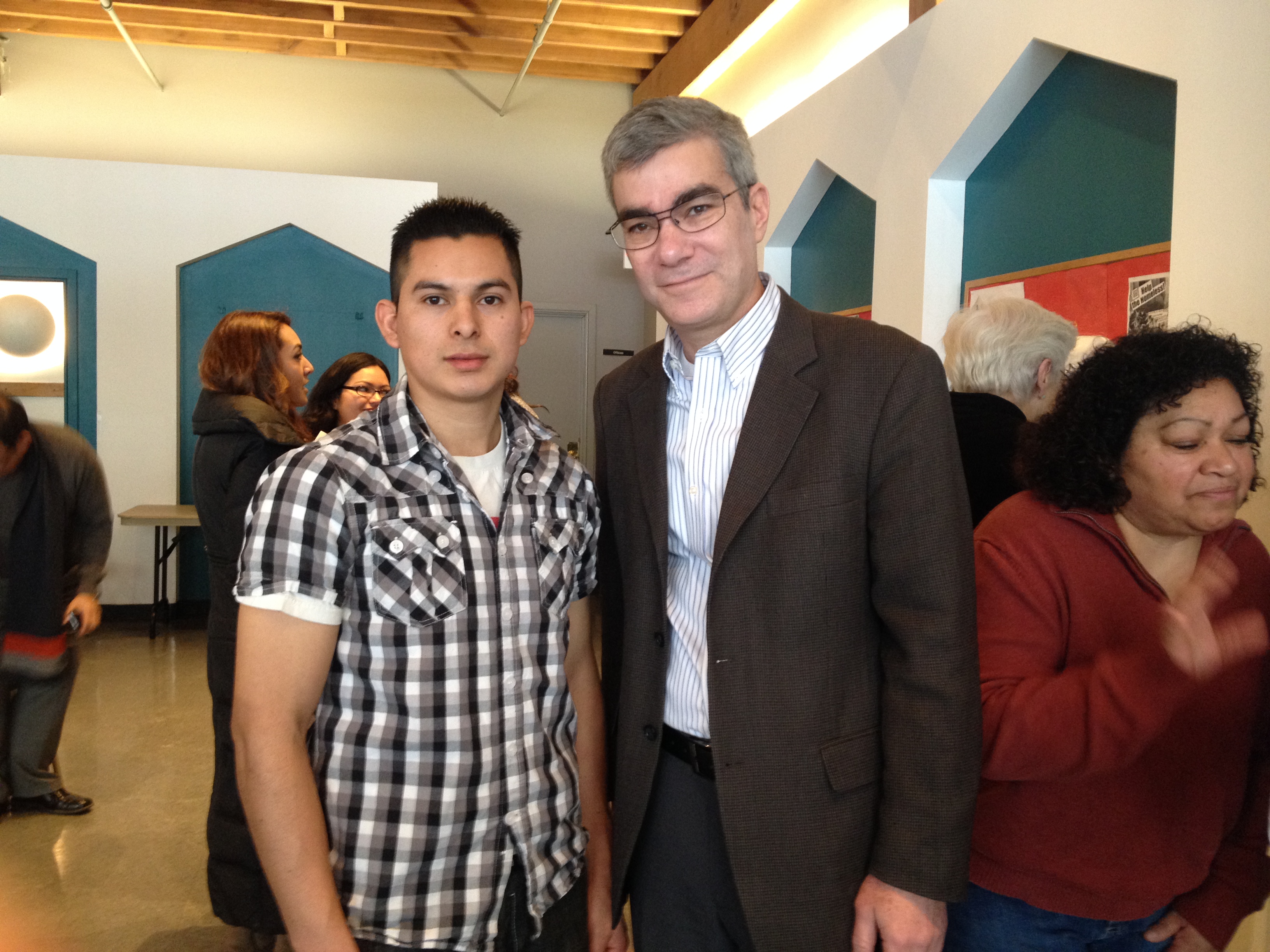
Anibal Fuentes (fourth from left) with his wife and son.

One individual story to drive home the tragically high cost of our nation’s broken immigration system:

On Friday, December 6, US Immigration and Customs Enforcement (ICE) agents raided an apartment building in the Albany Park neighborhood on the north side of Chicago. They knocked at all of the apartments in the building holding a picture of somebody they claimed to be looking for and interrogating anyone who answered the door. When Anibal Eligio Fuentes Aguilar tried to help answer their questions they took him away from his wife and infant son, placed him in a detention center and told him he was going to be deported.

The apartment building where Anibal and his family live has been raided by ICE at least four times in the past year and there have been immigration raids in other parts of the neighborhood as well. ICE agents arrive wearing police vests, question anybody they come across and take undocumented immigrants into custody.

Anibal first came to the US to when he was 16. When his mother passed away he visited Guatemala to attend her funeral but was stopped once by border patrol on his way back to Chicago in 2009. He has always been very active in his community and is a member of his local soccer league. He has a 6-month old baby, Franky, who is a US citizen. Anibal has no criminal record, and was only placed into immigration custody due to his encounter with border patrol five years ago. In addition, Anibal fears returning to Guatemala, a country where before his father passed away, he had been kidnapped three times.

anibalAfter Anibal was detained in December his family and community began to mobilize. He was released from detention, given an ankle bracelet and placed under continuous monitoring. ICE agents told him to have a ticket back to Guatemala by January 30th. His subsequent request for  prosecutorial discretion was denied, and he was given two months to leave the country. Last week he submitted a deferred action application to qualify under a relief program for undocumented youth established last year.

Yesterday, Anibal and his supporters held a press conference (pictures above and to the right) where we reaffirmed our  solidarity with him and his family before he resubmitted his application at Chicago ICE headquarters. By the end of the day, we learned he was granted a 6-month stay of removal.  While we are all obviously relieved by this latest outcome, ICE still has not closed his case. Unless something changes before September, we will continue our campaign to stop Anibal’s deportation.

Anibal’s case is but one of millions of stories of injustice across our nation, in which undocumented immigrants are victimized by a horribly broken system that is quite literally tearing families apart. While politicians dither in Washington over comprehensive, compassionate immigration reform, it makes sense at the very least to provide relief from deportations for those such as Anibal, who would be included in the bill.

Please click here to sign a petition urging President Obama to suspend deportations until Congress passes immigration reform – and to make sure those seeking a path to citizenship aren’t deported before it even opens.

In the meantime, I will continue to report on Anibal’s case. Stay tuned.