Author Archives: Rabbi Brant Rosen

Unknown's avatar

About Rabbi Brant Rosen

I'm a rabbi, blogger, and activist with a special interest in Israel/Palestine justice work.

Jewish Violence on Purim: Time for a Religious Reckoning?

533143-512853818766199-1284922135-n

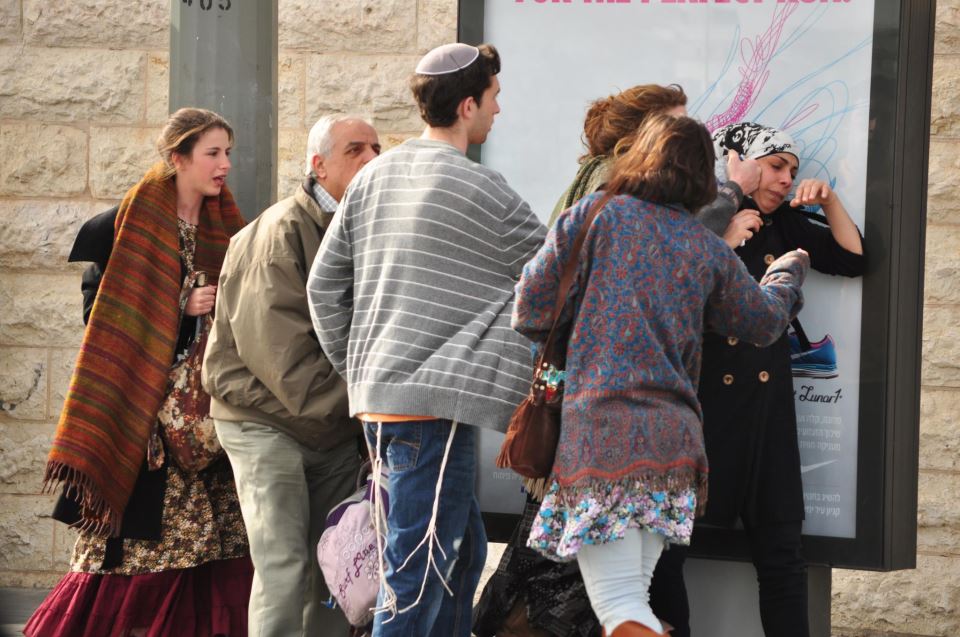
Purim 2013: A Palestinian woman is attacked by ultra-nationalist Jews in Jerusalem.

Like many Jews around the world, I dutifully celebrated Purim last week. In my case, it meant hearing the Book of Esther read aloud in my synagogue while drinking an occasional shot of scotch, enjoying our annual “Oy Vey Cafe,” (a beloved congregational tradition that mixes member-written and performed show tune and classic rock parodies) and attending our synagogue Religious School’s costume parade and Purim carnival.

I’m sure that many middle-class American Jews celebrated Purim in similar fashion. I’m also fairly sure that most middle-class American Jews are unaware that Purim has long been “celebrated” in a very different manner by ultra-nationalist Jews in Israel.

Last week on the day after Purim, it was reported that a Palestinian woman was attacked by ultra-orthodox women at a light rail station in Kiryat Moshe, Jerusalem.  According to the Israeli newspaper Ma’ariv, an ultra-Orthodox Jewish woman walked by the Palestinian woman and began punching her (see pic above).  Others soon joined in the attack and eventually tore off her hijab. According to the report, the light rail security guard, as well as some 100 religious Israeli men, stood by and did nothing. Eyewitness Dorit Yarden Dotan, who was horrified by the violence and took photos of the beating with her telephone, reported that the security guard even “watched and smiled”. “It was simply terrible,” she added.

ShowImage.ashx

Photo: Jerusalem Post

By the way, this was not the only act of Purim violence this year. On the same day as the Jerusalem attack, a Palestinian citizen of Israel, Hassan Usruf (right), was attacked by drunken Jewish youths whom police suspect had been participating in Purim celebrations during the evening. Usruf was punched, hit in the head with a bottle and kicked after he fell to the ground. He sustained injuries to his head, eye socket and jaw. The police have yet to arrest any suspects.

Those who follow the news must surely know that this kind of Jewish violence against Palestinians have become an annual inevitability in Israel. The most infamous Purim moment, of course, occurred in 1994, when Baruch Goldstein walked into the Cave of Machpelah in Hevron wearing an Israeli army uniform and opened fire on Palestinian worshipers, killing 29 and wounding more than 125.  By committing this act of mass murder, Goldstein believed he was fulfilling the the Book of Esther, which describes the slaughter of seventy five thousand Persians at the hands of the Jews. Since that time, Goldstein has become venerated by ultra-orthodox, ultra-nationalist Jews and for rest of us, Purim has never been quite the same.
FQO

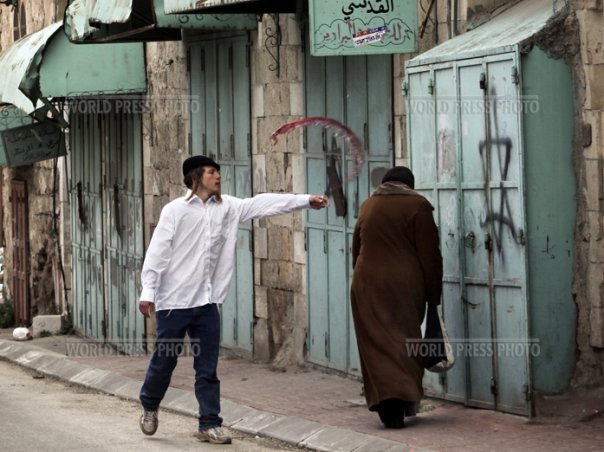
Purim 2009: A Jewish settler throws wine at Palestinian woman in Hevron, West Bank, (Photo: Rina Castelnuovo, NY Times)

I’ve recently finished Elliot Horowitz’s 2006 book “Reckless Rites: Purim and the Legacy of Jewish Violence” – a deeply troubling (but to my mind, profoundly essential) book that traces the history of Jewish violence on Purim over the centuries. Among the many disturbing revelations of Purim history in Horowitz’s book, I was surprised to learn that bad Jewish behavior on Purim has a long and not so venerable history – one that most Jewish histories either gloss over or simply choose to ignore.

Horowitz also parses the history of Purim violence in contemporary Israel, going back to Purim 1981, when Jewish settlers brought down the roof of a Palestinian upholsters’ home, expelled its owner and took over the house. (The house had once been a Jewish infirmary and synagogue, “Beit Hadassah.”) Since then, the settlers’ Purim parade in Hevron has become an annual tradition of Jewish pogroms against Palestinians. As last week’s events have demonstrated, however, this brutality is now ominously expanding into Israel proper.

Yes, the Book of Esther does come off as a kind of Jewish communal revenge fantasy, one that portrays the Jews’ massacre of the ancient Persians with sick kind of relish. As for me, I’ve always read the book according to the satirical spirit of the day: an expression of the “Jewish Id” that gives us the chance to indulge our darker fantasies in this one cathartic moment, perhaps so that they might have less of a hold over us during the rest of the year.  But of course, there are – and apparently have always been – religious literalists who are all too prepared to treat what is essentially a secular tale of palace intrigue as a sacred imperative to engage in xenophobic violence against others.

In his book, Horowitz quotes the venerable Jewish scholar Samuel Hugo Bergman (1883-1975), a former rector and professor at Hebrew University, who expressed dismay at boorish and violent behavior of Jews on Purim. Bergman – a religiously observant Jew – commented that its continued observance as a religious holiday was a sign of “the deep decay of our people.”  (p. 277)

In the post-Goldstein era, I’d say Bergman’s words resonate with ever-increasing urgency.
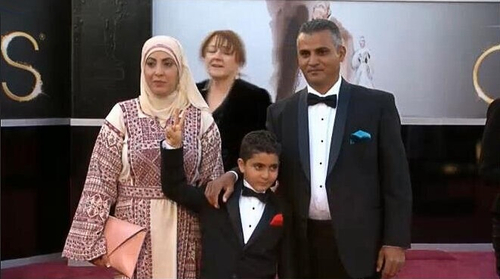
The Critical Difference Between “The Gatekeepers” and “5 Broken Cameras”

tumblr_mir1v1xAaW1qazgz2o1_500

Emad Burnat with wife Soraya and son Gibreel at the Academy Awards

Like many Israel/Palestine activists, I was thrilled to see two thoughtful films on the subject nominated for Best Documentary Oscars – and if I was pulling for any movie at all last Sunday night, it was Emad Burnat and Guy Davidi’s “5 Broken Cameras.”   If you haven’t seen it yet, please do. It is, I believe, one of the most important films on Palestine and Palestinians you will ever see. It’s also brilliantly constructed and deeply, almost unbearably moving. It’s available for free on Netflix, so you won’t need to wait for it to come to a theater near you.

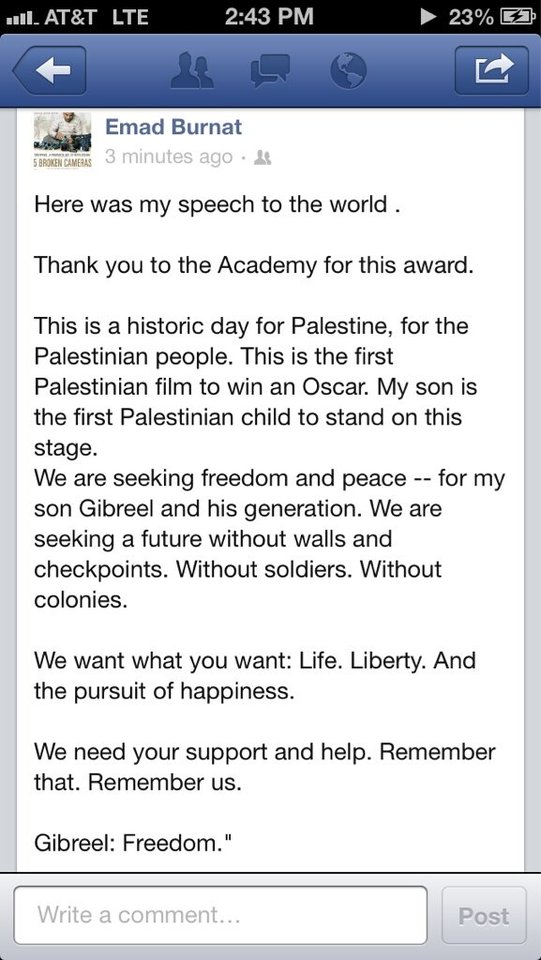
I knew, of course, that it was a long shot, but oh, what an incredible, incredible opportunity it would have been if Emad Burnat could have gotten up before 3 billion people and read the speech he had prepared:

BD-VaFkCUAMj-j4

I’ve been thinking a great deal lately about the differences between “Cameras” and the other nominated Israel/Palestine documentary, “The Gatekeepers.”  I’m particularly struck that the latter film, which features interviews with six ex-Shin Bet chiefs, is in many ways as characteristically Israeli as “Cameras” is Palestinian. For me, the most fundamental difference between the two films resides in their literal perspectives: In “Gatekeepers,” we largely view Palestinians from above – mostly through footage taken by the Israeli Air Forces as they surgically strike their targets from the skies. We never see anyone actually get killed  – they just seem to disappear in a sudden puff of smoke.

By contrast, “Cameras” was filmed on the ground in a Palestinian village. We see Palestinian non-violent protesters getting beaten and shot. In one particularly heartbreaking instance we witness the shooting death of Bassem (“Phil”) Abu-Rahma.  Indeed, the moral center of this movie resides in the way it places us firmly in the lives and reality of these Palestinians – we experience their humanity, their tragedies, their courage up close and personally.

For all of its depth and nuance, “The Gatekeepers,” is ultimately a film that presents us with the moral angst of a people who are, quite simply, on the side of the oppressor.  Many critics have have been struck by the level of ethical soul-searching evidenced by ex-Shin Bet chiefs who were, after all, the heads of Israel’s powerful security establishment – and I fully agree. It is a tribute to the genius of “Gatekeepers”  that it gives us a genuine glimpse into the humanity of men who occupy a position of invisibility in Israel’s massive national security apparatus.

For me, however,  this insight cuts both ways. While we can and should understand the concerns of the real, living flesh and blood human beings behind the Shin Bet, their humanity is ultimately subsumed by an inherently oppressive infrastructural reality. And this reality is much, much larger than these individuals, no matter how deeply they might engage in soul-searching over their actions.

This institutional soul-searching is, in fact, a time honored Israeli cultural enterprise – they even have a name for it: “Yorim U’vochim” (“Shoot and Cry”) –  a term that was coined in the wake of the Six Day War to describe this uniquely Israeli expression of angst. Indeed, Israelis have produced countless films, books, poetry and essays that struggle deeply over their treatment of Palestinians. But in the end, no amount of individual soul searching, no matter how heartfelt, can itself erase the collective guilt of what Israel has perpetrated – and continues to perpetrate – against Palestinians.

Take a look at the clip below: an interview with “Gatekeepers” director Dror Moreh on “Democracy Now.” Pay particular attention to Moreh’s comments at the 3:30 mark, where he expresses his discomfort with those who portray Israelis as the oppressors and the Palestinians as the poor innocent victims. In a (possibly) unguarded but telling moment, he says, “After, all, there is a reason why the Shin Bet is doing what it is doing.”  Moreh continues: this is not a black and white situation – we must see it in “shades of grey.”

I fully agree that this is a complicated situation. But I would add that there is nothing complicated about the institutional oppression that the Shin Bet inflicts on Palestinians. While the fears and pain and moral anguish of Israelis very real, we must be willing to admit that these feelings are largely helpless in the face of a larger infrastructural reality that Israelis have created – and within which they have become subsumed.

Critics who condemn those who stand in solidarity with Palestinians often fail to appreciate this point: it is not Israelis to whom we stand in opposition, but rather the oppressive institutions that they have constructed and which we believe threaten the well being and future of Israelis and Palestinians alike.  In watching “The Gatekeepers,” I could understand the concerns of men such as Ami Ayalon, Avraham Shalom and Carmi Gillon. But I never forgot for a second that the organization they led was and remains a profoundly oppressive, even criminal institution – and no amount of soul-searching, no matter how heartfelt can wash away this essential reality.

A final note: less than one week before the Academy Awards ceremony, the Israel Defense Forces and the Shin Bet arrested a 30 year Palestinian named Arafat Jaradat, claiming that he threw stones at cars from a nearby settlement. Jaradat was taken first to the Jalameh Interrogation Center in the northern West Bank before being transferred to Megiddo Prison. Four days later, he was dead, tortured to death by the Shin Bet.

Jaradat was a student at Al Quds Open University, married with two children (Yara, 4 years old and Mohammad, 3 years old) and was expecting a third child with his wife Dalal.  His lawyer, Kamil Sabbagh, who defended him in a court hearing two days before he died, reported that Jaradat was terrified and complained of intense back pain when he saw him.

The Shin Bet claimed Jaradat died from cardiac arrest, despite the fact that an initial autopsy indicated he was in fine cardiac health. A subsequent autopsy determined that Jaradat had been beaten with repeated blows to his chest and body and had sustained a total of six broken bones in his spine, arms and legs; his lips lacerated; his face badly bruised.

I agree with Dror Moreh: there is a reason the Shin Bet is doing what it is doing. We just disagree what that reason actually is.  Their ultimate goal is not simply the security of Israelis, but the security of Israelis maintained through the subjugation of Palestinians.

And for all the Israeli soul-searching on this point, this oppression will only make Israel less secure in the long run.

Kindness Is Not Optional: Creating an Interfaith Covenental Community

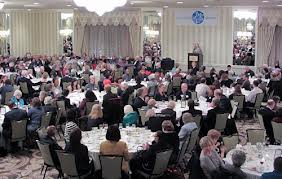
vk dinner

Here is a text of my keynote speech at last night’s annual Vision Keepers dinner of Interfaith Action – a faith-based direct service organization that serves the hungry and homeless population of my hometown of Evanston:

I’d like to begin my remarks tonight by sharing you with one of my chronic pet peeves – and I’d like to apologize at the outset to my congregants and loved ones, who are probably getting very tired of hearing me complain about this:  I really, really don’t like the saying “Practice Random Acts of Kindness and Senseless Acts of Beauty.”

Now I say this with all due apology to any of you who might have this bumper sticker on your car – I mean you no disrespect.  And believe me: I am a huge fan of encouraging kindness and beauty. It’s just that personally speaking, I would argue the exact opposite. I would argue for “non-Random acts of kindness and mindful acts of beauty.”  After all, if by kindness we mean simple human respect and dignity – qualities that are essential to the core of our basic humanity – I think we would all agree that there should be nothing random about it. Kindness shouldn’t be random – quite frankly, it should be mandatory.

In its way, I think this slogan reflects something very profound about contemporary American culture. As a society that values individual initiative, it is natural that we will view compassion as a random, voluntary enterprise.  We act compassionately whenever we feel compassionate. And yes, we might well feel a great deal of compassion: for our loved ones, we may even feel compassion for people we don’t actually know. But the problem with this approach, of course, is that feelings cannot be guaranteed. They come and go. Feelings are, by definition, elusive and transient.

Biblical tradition provides us with a different model.  Compassion is not random – it is an imperative. Even love itself is commanded: “Love your neighbor as yourself.” “You shall love Adonai your God.” “You shall love the stranger, for you were once strangers in the land of Egypt.” In other words, feelings are wonderful, but feelings are not enough. Kindness and compassion should not be relegated to random feeling – they should be cultivated as a mindful, ongoing conscious practice. We have to teach ourselves how to be compassionate even if we are not feeling particularly compassionate – even if we are too overwhelmed to feel compassionate. Compassion is, for lack of a better word, a discipline.

In the Bible, kindness and compassion are complex and profound concepts. In fact, there are many different Hebrew words for compassion. The most well known word, “rachamim,” comes from the root rechem, or “womb” and suggests the kind of unconditional compassion that comes with parental love. More broadly, we might understand rachamim as the kind of compassion that we show toward those with whom we have a unique personal connection. The word “chen” is usually translated as “grace.”  This form of compassion generally refers to gestures of favor or goodwill.

And then there is  “chesed,” a word that is usually rendered as “lovingkindness.”  As I learned back in my Rabbinical school Biblical Hebrew class, “lovingkindness” is probably not the best definition for chesed.  It’s a little too general, a little too mushy.  Most contemporary Hebrew scholars suggest that a better definition of chesed is “covenantal loyalty.”  Indeed, if we look at the way this word is used in the Bible, it has less to do with a feeling of lovingkindess than a deep sense of responsibility that comes out of sacred relationship. God shows chesed for the Israelites – and the Israelites for God – when they remain loyal to the mutual covenant they established together at Sinai. In another example, Ruth is praised in the Bible for the chesed she demonstrates to her mother-in-law Naomi when she remains loyal to her promise to stand by her side.

In Jewish tradition, this abstract notion of chesed was applied by the ancient rabbis to the everyday life of the community. Chesed societies, for instance, were the prototypical communal welfare institutions that were the cornerstone of Jewish communities for centuries. They too were guided by the central ethic of covenantal loyalty – “commanded compassion,” if you will.  At my congregation, as at yours, I’m sure, we have a committee of members helps members in need, usually due to illness or the loss of a loved one.  We call it, naturally, the Chesed Committee. And the members who participate in it will surely at attest that they don’t participate out of a desire to be randomly kind, but rather out of the sense of responsibility that comes through belonging to a community. Probably more often than not, the members of the Chesed Committee serve people they don’t even know personally – and that, of course, is precisely the point.

So in its way, chesed presents us with a compelling and important way of understanding collective compassion.  It is intimately connected to the concept of covenant and mutual obligation. Chesed is the kind of love and compassion that comes from a deeper sense of communal accountability. When a people live in a covenantal context –with chesed – it is with the fundamental understanding that the community is accountable to the individual just as much as the individual is accountable to the community.

By the same token, all of us in the room tonight – we are part of a covenantal community as well. All of us: the congregations that make up Interfaith Action understand on a deep, spiritually cellular level, that we have an abiding sense of covenant with the Evanston community. The Interfaith Action soup kitchens, the warming centers, the homeless hospitality centers, the Producemobile, are much, much more than mere direct service projects – they are expressions of our sacred sense of commitment to the city in which we live – and of the conviction that our compassion for every single member of this community must not be regarded as random or voluntary. On the contrary, we are compelled to feed the hungry, to shelter the homeless out of a collective sense of sacred, covenantal imperative.

In this regard, I want to honor the work of our honorees tonight – and all who participate in Interfaith Action – for the sacred work you do.  I know you don’t do it just because it makes you feel good. I’m willing to bet there have been plenty of times you went over to soup kitchen when you were tired or just plain didn’t feel like going. I’m willing to go out on a limb and say there may have been times that you went even while you were doubting that your actions even made a difference. But in the end, you did go – and you continue to go – and you are here tonight because you know that at the end of the day, kindness should not be optional.

I’d like to go a bit further now, however, and offer a few thoughts about what an even deeper covenantal obligation might look like for our community.  I’ve always believed that religion is at its best when it not only comforts the afflicted, but challenges the oppressive status quo that afflicts them. What does it mean when we literally feed the hungry, but fail to challenge a system that countenances hunger in its midst?  Is it enough to provide warming centers, or should we also see it as our religious obligation to ask whether or not our city is also doing everything in its power to provide something as essential to life as heating for all its citizens?  On an even deeper level, shouldn’t we be finding ways to challenge an infrastructural reality that makes “warming centers” even necessary in the first place?

I believe that religion is at its best when it manages to balance what I would call the “pastoral” with the “prophetic.”  In other words, when our Biblical tradition demands that we clothe the naked and feed the hungry, this is a pastoral imperative. And when we are commanded to speak truth to powerful Pharaohs, to create societies of fairness and equity, to proclaim liberty throughout the land unto all the inhabitants thereof – this is a prophetic imperative.

And so I’d like to take this opportunity to ask those of us in this room – those of us who act on a deep and profound sense of pastoral commitment to the Evanston community: what would it look like for us to create a similar kind of covenantal coalition out of a prophetic commitment?  More to the point: do we believe that our city of Evanston is doing what it must to ensure that its citizens are not going to bed hungry, that they have roofs over their heads and heat in their homes?   And if the answer is no, then I believe we must ask ourselves: do we believe that holding our own city accountable is just as much a religious obligation as running soup kitchens and warming centers?

Now I know that there are a myriad of complicated policy discussions to be had on these kinds of issues, and I obviously don’t intend to parse them all right now. But I do think that too often we hide behind a mantra of “it’s complicated” to avoid dealing with some fairly simple truths. And just as often, I think, we shy away from policy debates because we feel as though we shouldn’t be mixing religion and politics.

But at the end of the day, however, it’s really not all that complicated.  There’s nothing complicated about food, shelter and heat – these are among our most human basic needs. And when it comes to mixing religion and politics, I’ll repeat again: religion should not only about comforting the afflicted – it’s also about afflicting the comfortable. It’s about challenging the attitudes of those who view the world with a scarcity mentality that claims there is only so much to go around – and that it’s not our problem if there are those who will inevitably go without.

I hope that gatherings such as this will redouble our resolve to both the pastoral and the prophetic aspects of our faith traditions. I hope that as we go forward with this sacred work, we will find ways to open conversations about what a truly covenantal Evanston faith community might look like. And I hope that in doing so, we might provide a truly prophetic voice of conscience.

Thank you again for all you do. Congratulations to our honorees tonight. May all of our efforts continue to transform the lives of others – may they ultimately transform our world as well.

Amen.

Rabbi Margaret Holub Explores Life During and After Apartheid

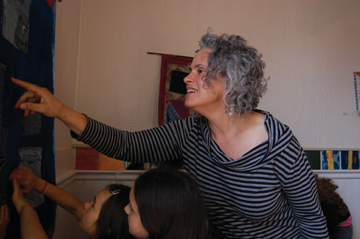
Jsmalltown jews4My dear friend and colleague Rabbi Margaret Holub (who recently joined me as co-chair of the JVP Rabbinical Council) has just traveled to South Africa to spend the next six weeks in Cape Town. It’s her second sojourn there and in addition to reconnecting with old friends, she’ll be spending her time interviewing clergy in the Dutch Reformed Church about their life during and after the fall of apartheid.

The DRC is the Afrikaans-speaking church which was famous – or notorious – for more or less inventing apartheid and upholding it all the way through to its end in the 1990s.  The Church has come a long way since then – their leaders recanted the doctrine of apartheid, appeared before the Truth and Reconciliation Commission to publicly ask forgiveness and have made moves to integrate their churches.

As a self-described rabbi “edging into the world of organizing about ending Israel’s occupation of Palestine,” Margaret is particularly interested in learning more about the experience of white South African clergy:

What was it like, I wonder, for the rest of them as the world’s banks and universities and entertainers boycotted South Africa, as other churches condemned and isolated the DRC?  What was it like as it became clear that white rule and the separation of the races were going to end?  Did they feel cornered?  Did these ministers have misgivings about their church’s teachings?  Did they  feel like they had to defend them even so?  Were their certain messages that penetrated their defenses?  What would they say to rabbis today, twenty years after apartheid ended, about being on the wrong side of history?  Maybe, with all this hindsight, they’d even have some advice…  I really don’t know, but I look forward to asking.

The quote above came from Margaret’s blog, “Summer in Winter,” in which she promises to faithfully chronicle her experiences on this amazing trip. I plan to follow her adventures faithfully and recommend that you do too!

Interfaith Coalition Launches Boycott of SodaStream

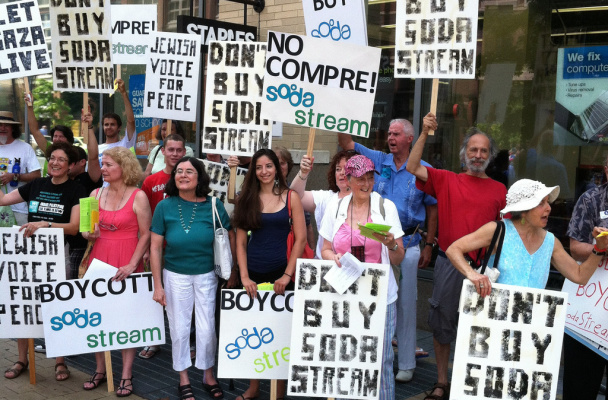
sodastream-protest

Since my previous post on the SodaStream boycott, I’ve received a number of questions regarding which specific campaign/s to support. While there have been a number of great local actions around the country, I’m happy to announce that a new interfaith coalition has just launched a national boycott effort that includes a petition as well as a spoof ad contest. I hope you will join me in signing on to this important campaign.

For more information on SodaStream, here is an excellent point by point response to the claims made by the company, courtesy of Stop SodaStream – Italy:

1. “SodaStream is headquartered in Tel Aviv, Israel, and manufactures its products in 12 production plants distributed in many countries, including factories in China (2), Germany, Sweden, New Zealand, Australia, South Africa, Netherlands, the US and two in Israel, one of which is Mishor Adumim … “

Even if there were hundreds of “production facilities” all over the world, it would not change the fact that the factory in Mishor Adumim is built on land stolen from the Palestinians and thus violates human rights and international law.

In any event, Sodastream’s annual report clearly demonstrates that the factory in Mishor Adumim is also the company’s main production facilities:

  • At 15,256 m2, the plant is four times larger than the headquarters in Tel Aviv, and eight times that of the other Israeli plant at Ashkelon, which produces only flavors for soft drinks.
  • The plant in China produces only “certain components”.
  • The “production facilities” in Germany, Sweden, New Zealand, Australia, South Africa, the Netherlands and the USA are mere sales and marketing offices and refill stations for CO2 cylinders.

Source: Sodastream International Ltd. Annual Report for the Fiscal Year Ended December 31, 2010, “Manufacturing and Production,” p. 37 and “Facilities,” p. 40.

2. “… where approximately 160 Palestinians receive full social and health services in accordance with, and exceeding, Israeli law, including pension contributions and insurance. Labor law in Israel requires an employer to pay wages and contributions 4 times higher than those required by the Palestinian Authority. If you consider that, on average, each employee is responsible for 10 Palestinian dependents, considering the rate of unemployment in the Palestinian Authority (estimated at 30%), the company provides food and shelter to 1,600 people. In addition, SodaStream also provides benefits that include: daily hot meals, clothing, transportation and overtime pay for up to 200% as required by Israeli law. “

The fact that a company such as SodaStream, which profits from the Israeli occupation regime, considers itself a benefactor of the Palestinians is downright bizarre. Even if working conditions for the Palestinians at the Mishor Adumim factory were as described (something that has been proven false in the past by the Israeli organization Kav LaOved), the fact remains that, as subjects an occupation regime, these workers do not enjoy civil rights (including the right of workers to organize) and are under constant threat of having their permits to work in the settlement revoked by the company at any moment.

Palestinian workers often have no choice but to work in the settlements, with high unemployment rates that are a direct result of the Israeli occupation. The 2011 United Nations Conference on Trade and Development report explicitly links the decline in Palestinian agricultural and industrial sectors and the dire humanitarian conditions with Israeli government policies, in particular the confiscation of land and natural resources, restrictions on movement of people and goods, and isolation from international markets. Only a colonial mindset could claim to provide jobs to the very same people whose land and freedom have been stolen.

Sources:
– Kav LaOved, “Palestinian Workers in Israeli West Bank Settlements – 2009”; “Employees at Soda Club fired without wages (follow up report)”
Report on UNCTAD assistance to the Palestinian people: Developments in the economy of the occupied Palestinian territory

3. “Among the 700 employees at the Mishor Adumim factory are Jews, Palestinians, Christians, Russians, Ethiopians, Bedouins, and Americans. In SodaStream’s view, this is a splendid example of peaceful coexistence that will lead to economic prosperity on which everyone benefits. The company regularly celebrates the holidays of all and has fostered cultural exchange.”

To speak of “peaceful coexistence” between people who do not have equal rights and equal social, economic and political opportunities is absurd. Among Sodastream employees, there is a marked difference between the conditions of the occupiers and those who suffer under occupation. For example, just as in Apartheid South Africa the black majority was allowed to enter areas reserved for whites only in order to work, so do the Palestinians depend on the occupying power for work permits.

Furthermore, the Jahalin Bedouin, who had already been driven from their lands in the Negev in the 1950s, were then expelled from the very area where the Sodastream has its factory.

Sources:
– Kav LaOved, “Palestinian Workers in Israeli West Bank Settlements – 2009”;
– Human Rights Watch, Separate and Unequal, “Jahalin Bedouin and Ma’ale Adumim”

4. “As you know, Sodastream recently decided not to expand the factory at Mishor Adumim, but rather to build one inside the Green Line. The construction is already underway, as decided by the Board of Directors.”

Committing to not to expand an illegal activity, which according to the company website, Sodastream has been carrying out since 1996, counts for very little. The fact remains that the main production facilities are located in an illegal Israeli settlement in violation of international law.

Source: Sodastream web site, History of the Sodastream Group

5. “SodaStream does not currently benefit from low rents and could rent other facilities in the uncontested territories of Israel for much less. The same applies to incentives, the company enjoys the same tax incentives as any other industrial area of Israel, regardless of whether it is located in the disputed territories or not.”

Sodastream’s annual report lists among its “risk factors” the possibility, due to negative publicity and boycotts, of having “to transfer a significant portion of manufacturing activities to a location outside of the West Bank” that would “limit certain of the tax benefits for which we are currently eligible”.

In fact, according to the web site for the Mishor Adomim Industrial Park, it is designated as “Development Zone ‘A'”, which enjoys the highest tax incentives from the Israeli state.

And finally, the Palestinian territories are occupied, not “disputed”, as recognized by the International Court of Justice, the International Committee of the Red Cross and the Conference of High Contracting Parties to the Fourth Geneva Convention, among others.

Sources:
Sodastream International Ltd. Annual Report for the Fiscal Year Ended December 31, 2010, “Risks related to our Location in Israel,” p. 17
– Adumim Industrial Park, Business Benefits
– International Court of Justice: Legal Consequences of the Construction of a Wall in the Occupied Palestinian Territory; International Committee of the Red Cross; Conference of High Contracting Parties to the Fourth Geneva Convention: Declaration,

6. “With regards to Coop Sweden, yes it is true that on July 19 they decided to suspend sales of these products, however it is also true that, after a brief investigation, they then decided to put them back on the shelves.”

Swedish activists inform us that COOP Sweden claims to have the results of an investigation that justify, in their view, the marketing of Sodastream products. COOP Sweden has refused, however, to share the report with the Swedish activists. If Sodastream would like to provide us with the report, we would be happy to comment on it.

7. “SodaStream is also under tight control by the Office for Environmental Protection of Israel, leading to surprise inspections, and the company adheres to the highest environmental standards.”

It is well known that Israeli and international companies consider Israeli laws on environmental protection inapplicable with regard to factories in the occupied West Bank. According to 2009 report by the Israeli organization B’Tselem, Israel does not enforce environmental laws in the settlements and industrial areas in the occupied West Bank.

As for surprise inspections, according to Bloomberg Businessweek and the Corporate Watch website, the Sodastream Factory in Mishor Adumim is “the most heavily protected in the area, with multilevel electric fencing protecting its perimeters and cameras monitoring everything going on outside of them.”

Sources:
– B’Tselem, “Foul Play: Neglect of wastewater treatment in the West Bank
– Corporate Watch, “Occupation Industries: The Israeli industrial zones
– Bloomberg Businessweek, “EU Eyes Exports from Israeli Settlements

8. “Following the publication of false reports, the company also decided to host visits and inspections, in particular social audits, including the internationally accepted BSCI (Business Social Compliance Initiative) audit, with the conclusion that they no corrective actions are necessary.”

Clearly, an auditing organization that certifies a factory located in the occupied Palestinian territories has no credibility whatsoever.

The Stop Sodastream campaign will continue to challenge the deceptions of Sodastream, organizing initiatives to reveal the truth that the company wants to hides and promoting a boycott of its products.

Why I’m Boycotting SodaStream

boycott_sodastream_smaller

Israel’s settlement juggernaut continues at full speed, creating apartheid conditions on the occupied West Bank while making a mockery of any hope of a two state solution. Since no nation or institution seems willing to hold Israel accountable, it seems to me the least any concerned citizen can do is to refuse to patronize companies that directly profit from this brutal and unjust occupation.

At the moment, Exhibit A is SodaStream – a company that produces home carbonating devices. Promoting its product as eco-friendly, SodaStream is sold in 39 countries in 35,000 stores worldwide, including Macy’s, Bed Bath and Beyond, Bloomingdale’s, Sears, and Kmart.

It is also manufactured in the Israeli settlement of Mishor Adumim.

A bit of history: Mishor Adumim is the industrial park section of Ma’aleh Adumim, the largest settlement in the West Bank.  The land for both of these settlements originally belonged to the Palestinian towns of Abu Dis, Azarya, Atur, Issauya, Han El Akhmar, Anata and Nebbi Mussa, but was expropriated by Israel in the 1970s.  Today, Ma’aleh and Mishor Adumim are a key part of the Israeli government’s plan to create Jewish facts on the ground around Arab East Jerusalem.

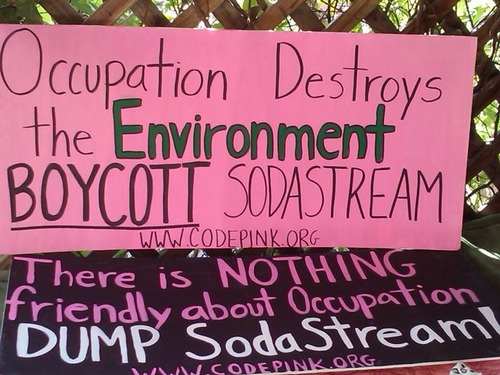
The SodaStream boycott is a particularly instructive action since the company actively promotes itself as an environmentally concerned enterprise. This is a tactic known as “greenwashing” – a cynical attempt to hide behind liberal environmental values in order to divert attention away from egregious violations of human rights. On this subject, I was profoundly saddened to read a post today by Rabbi Jason Miller, who sang the environmental praises of SodaStream and encouraged folks support Israel (and celebrate the Jewish festival of Tu B’shvat) by buying their product.

And what about the fact that the company says its product is “Made in Israel”, yet is based in the West Bank? By way of answer, Rabbi Miller approvingly quoted the company CEO Daniel Birnbaum, who he claims is “a strong proponent of human rights”:

(Birnbaum) said that thanks to SodaStream thousands of local Palestinians in Mishor Adumim have good paying jobs. Those workers, he explains, would not be able to support their families without their jobs in SodaStream’s manufacturing plant.

Wow. My jaw nearly hit the floor when I read that one. I’m not sure that resorting to a colonial “white man’s burden” argument is the surest way to defend entrepreneurial activity in occupied territory.

It’s also patently untrue. I strongly recommend this report by “Who Profits” for an important and in-depth expose of SodaStream, including the manner in which it exploits Palestinian laborers who come from the villages surrounding Mishor Adumim.

Jordan Ash, writing in the Twin Cities Daily Planet has also recently addressed this issue:

As with the Maquiladoras along the U.S.-Mexican border, the high unemployment rate means that many Palestinians are forced to try to earn a living through jobs in the settlements, despite the low pay and harsh working conditions.

Palestinian workers in the settlements do not enjoy the full protection of Israeli labor laws.   They must get special permits and security clearance just to be able to enter these factories.   Involvement in a labor dispute constitutes a security risk and can result in the loss of not only a worker’s current job but their ability to work in settlements in the future.   Thus, many Palestinian workers do not demand their legal employment rights due to fear of losing their work permit.

At the SodaStream factory, when workers protested that they were being paid less than half of the minimum wage and were forced to work 12 hour days, they were fired. On another occasion, when workers who were fired and were still owed a month’s wages went to the factory to request their pay, SodaStream had them removed from the factory and banned from the entire industrial park.

As with all business in the illegal settlements, SodaStream pays taxes to Israel, not to the Palestinian Authority.  The municipal taxes that SodaStream pays are used exclusively to support the growth and development of the settlement through things such as roads, education, and sewage treatment.

While I certainly don’t have any illusions that this boycott will bring the Israeli economy to their knees, I do believe it provides us with the means to take a public moral stand against the injustices Israel is committing in the occupied West Bank – and to stand in solidarity with those whose lives are impacted by this oppression.

It is a particularly timely action since the company has spent $3.8 million on a 30-second spot during next month’s Super Bowl. Apparently the commercial advocates “setting the bubbles free”. Those concerned with human rights should know that freedom for real, living breathing human beings is what is truly at stake here.

Zero Dark Thirty: My Shalom Rav Review

1163224_Zero-Dark-Thirty-2

Finally saw Zero Dark Thirty yesterday. Here’s my review:

From an artistic point of view, I can say without hesitation that I was riveted by ZDT from beginning to end. Kathryn Bigelow is clearly one of our most talented American directors, particularly in her ability to construct a film with a palpable sense of documentary realism. In so many ways she, along with screenwriter Mark Boal, and her entire filmmaking team had me in the palm of their collective hand.

Which is why I also found ZDT to be a morally reprehensible piece of cinematic propaganda.

My experience of this film, among other things, was a profound reminder that movies have immense power to manipulate emotions and shape attitudes. I will readily admit that I found myself thoroughly caught up in the intensity of the CIA’s quest (embodied by character of the passionately driven agent “Maya”) to find and kill Usama Bin Laden. What can I say? For two and half hours, the film worked its magic on me. But when it was over, all I felt was dirty and ashamed. Sickened, actually, that I allowed myself to be seduced by what amounted to an insidious, if deeply sophisticated, revenge fantasy.

I use the word insidious very consciously here – particularly since the film purports to be a facts-driven portrayal of the CIA hunt for Bin Laden. In the very first frame, in fact, a title that tells us we are about to watch a film “based on firsthand accounts of actual events”. The next title we see are the words “September 11, 2001”. Then for at least a minute we listen to audio tapes of terrified 9/11 victims calling for help. One woman in the World Trade Center tells a 911 dispatcher that she is “burning up,” then says, crying, “I’m going to die aren’t I?” The dispatcher tells her to “stay calm” but there is no further answer. The last thing we hear is the dispatcher’s voice saying, “Oh my God…”

This is how the movie is framed from the outset: we are told we are watching a movie based on actual events, constructed from information gained from those who were there. We hear the very real voices of American citizens as they are being burned alive.  Then we watch the “real-life” account of how the man responsible for their deaths was hunted down and killed by the CIA.

Listening to those terrified voices unsettled me to my core – but it was only after the movie was over that I realized how obscene their usage actually was.  Why did the filmmakers choose to play these recordings? After all, aren’t the tragic events of 9/11 well-known to everyone in the world? If the filmmakers were really interested in making a dispassionate, non-fiction account of the hunt for Bin Laden, wouldn’t it have made more sense to start with the beginning of the hunt itself?

Indeed, Bigelow has been quoted as saying she used “a journalistic approach” to making this film and that “it doesn’t have an agenda, and it doesn’t judge.” This, of course, is hogwash.  If Bigelow and Boal were interested in presenting a “values-free” docudrama, they certainly wouldn’t have manipulated viewers with the voices of civilians being burned alive. After hearing the terrified voices of actual victims, how could we not cheer the CIA on as it uses any means necessary to find and kill Bin Laden?

Much has been written about the infamous scene in which one tortured Al-Qaeda operative gives up the name of Bin Laden’s courier after having been beaten, waterboarded, sexually humiliated and stuffed into a tiny wooden box. The inclusion of this scene – along with numerous references to information gained from tortured detainees – has been rightly condemned by many who point out it has already been conclusively determined that the information that ultimately led to Bin Laden’s execution was not gained through the use of torture. By including these scenes, ZDT conveys the incorrect – and dangerous – impression that torture “works.”  It’s a critical point to which I have nothing to add except to refer you to Glenn Greenwald’s excellent pieces on the subject.

Beyond this issue, ZDT is dangerous for an even more essential reason. As Peter Haas pointed out in a recent piece for the Atlantic, it represents a new genre of “entertainment” he calls “embedded filmmaking”:

The fundamental problem is that our government has again gotten away with offering privileged access to carefully selected individuals and getting a flattering story in return. Embeds, officially begun during the invasion of Iraq, are deeply troubling because not every journalist or filmmaker can get these coveted invitations (Seymour Hersh and Matt Taibbi are probably not on the CIA press office’s speed dial), and once you get one, you face the quandary of keeping a critical distance from sympathetic people whom you get to know and who are probably quite convincing. That’s the reason the embed or special invitation exists; the government does its best to keep journalists, even friendly ones, away from disgruntled officials who have unflattering stories to tell…

(The) new and odd rub in the case of Zero Dark Thirty is that the product of this privileged access is not just-the-facts journalism but a feature film that merges fact and fiction. An already problematic practice—giving special access to vetted journalists—is now deployed for the larger goal of creating cinematic myths that are favorable to the sponsoring entity (in the case of Zero Dark Thirty, the CIA). If the access that Boal and Bigelow received was in addition to access that nonfiction writers and documentarians received, I would be a bit less troubled, because at least the quotes in history’s first draft would be reliable, and that means a lot. But as it stands, we’re getting the myth of history before getting the actual history.

In other words, no matter how unsavory the protagonists behavior might be, no matter how “gritty” and “journalistic” the style, this is the CIA’s movie through and through.

In a more recent article, Greenwald pointed out the essential simplicity of ZDT’s world view:

All agents of the US government – especially in its intelligence and military agencies – are heroic, noble, self-sacrificing crusaders devoted to stopping The Terrorists; their only sin is all-consuming, sometimes excessive devotion to this task. Almost every Muslim and Arab in the film is a villainous, one-dimensional cartoon figure: dark, seedy, violent, shadowy, menacing, and part of a Terrorist network…

Other than the last scene in which the bin Laden house is raided, all of the hard-core, bloody violence is carried out by Muslims, with Americans as the victims. The CIA heroine dines at the Islamabad Marriott when it is suddenly blown up; she is shot at outside of a US embassy in Pakistan; she sits on the floor, devastated, after hearing that seven CIA agents, including one of her friends, a “mother of three”, has been killed by an Al Qaeda double-agent suicide-bomber at a CIA base in Afghanistan … Nobody is ever heard talking about the civilian-destroying violence brought to the world by the US.

The CIA and the US government are the Good Guys, the innocent targets of terrorist violence, the courageous warriors seeking justice for the 9/11 victims. Muslims and Arabs are the dastardly villains, attacking and killing without motive (other than the one provided by Bloomberg) and without scruples. Almost all Hollywood action films end with the good guys vanquishing the big, bad villain – so that the audience can leave feeling good about the world and themselves – and this is exactly the script to which this film adheres.

And in the end, that is what makes the technical and narrative brilliance of this film all the more pernicious. It creates the illusion of authenticity and truth when what we’re really watching is the CIA’s truth. One in which Bin Laden was never, once upon a time, an ally of the United States government. One in which “heroes” commit war crimes in secret locations in the furtherance of extra-judicial assassination. One that utterly ignores the realities of what the CIA’s civilian-destroying violence has wrought.

More than anything else, this is why I felt so very dirty after allowing myself to be entertained – and at times even moved – by Zero Dark Thirty.

Naftali Bennett and the Politics of Jewish Supremacy

By all accounts, Bibi Netanyahu will be the winner of the upcoming elections on January 22 – after which he will proceed to form the most right-wing/ultra-nationalist coalition in Israeli history. The only question that remains is by what degree.

Among new political figures on the scene, Naftali Bennett, the leader of the HaBayit HaYehudi (“Jewish Home”) party seems to be garnering the most attention. Even as Bibi’s Likud-Beiteinu party drops in the polls, HaBayit HaYehudi (a restructured version of the old National Religious Party) is growing in popularity – and will almost certainly become an important player in a new coalition.

If you’ve never heard of Bennett, you will soon. He’s the son of American immigrants, a successful hi-tech businessman, Bibi’s former chief of staff (they’ve since had a high profile falling out) and the former head of the West Bank settlers’ Yesha Council. Bennett raised some major dust last month when he told a television interviewer that he would personally refuse orders to evacuate settlements or outposts in the West Bank while on reserve army duty.  He also is on record as advocating the annexation of Area C of the West Bank. Under his plan, Palestinians already living there would be given the choice to accept Israeli citizenship or leave.

While he was roundly criticized from many political quarters for his remarks about army service, his party has become the most popular Israeli party with young Israelis under the age of 30. Clearly, Bennett and his views represent Israel’s future – one that seems to be skewing further and further away from democracy and ever closer to apartheid policies.

Take a look at HaBayit Hayehudi’s English language campaign video ad at the top of this post. As Don Futterman recently observed in Open Zion, it’s a canny attempt to gloss over the more odious aspects of Bennett’s ideology with a legit and cheerful veneer designed specifically to appeal to American immigrants to Israel:

This ad, which is part of a campaign to create different and more positive associations with the name HaBayit HaYehudi (the Jewish Home), is an invitation, not a polemic. It mentions buzzwords—Jewish values and Zionist ideals—and one issue from the party’s platform—Jewish education—but does not harp on any of them. You wouldn’t guess that HaBayit HaYehudi has any connection to the national religious right in Israel, and you might even miss the single reference to West Bank settlements (“I live in Samaria”). You certainly wouldn’t suspect that Bennett has promised he would go to jail rather than evacuate a settlement.

Watching the video, I was also struck that it made repeated references to the importance of Israel’s Jewish character without explicitly explaining why this should in any way be considered a political issue:

If you want to bring Jewish values and Zionist ideals to Israel, then the Bayit Yedudi is your home…If you believe that every Israeli child deserves a quality Jewish education, the Bayit Yehudi is your home.

While on the surface, remarks such as this sound perfectly innocuous, they mask a profoundly troubling agenda.  What about the Palestinians citizens of Israel who do not adhere to “Jewish values” or “Zionist ideals?”  It’s certainly sounds noble to say that Israeli child deserves a quality Jewish education, but what about the considerable percentage of Israeli children who don’t happen to be Jewish? The answer, of course, is not too difficult to understand. These Israeli citizens simply don’t fit in the xenophobic ideology advocated by Naftali Bennett and HaBayit HaYedudi.

In a recent post for +972 mag, Noam Sheizaf makes a perfectly reasonable argument – but given Israel’s current reality it would likely strike many as radical in the extreme. Pointing out that in 64 years of Israel’s existence, no government has ever included one of the Arab parties in a coalition, Sheizaf concludes:

Cooperation between Palestinian and Jews is by far the greatest, most important challenge in this country. Every element of Israeli life – from the education system to zoning plans – is constructed to promote ethnic separation, with politics being just the tip of the iceberg…Therefore, the ability to create joint structures and partnerships is the single most important element that would determine the chances of survival and the quality of life for the entire society.

The necessary conclusion for me is that it is simply forbidden to vote for parties which are not shared by Palestinians and Jews, or for ones that preserve the policy of separation between Palestinians and Jews. There are no perfect parties, but this should be the basic condition, just as an American shouldn’t vote for a party that doesn’t accept black people.

Alas, voices like Sheizaf’s are but a whisper in the Israeli wilderness. According to the latest polls, Arab-Jewish parties will garner only a small sliver of votes in the upcoming election.  When it comes to the Israeli electorate, the ideology of Jewish supremacy is clearly the order of the day.

For comparison purposes, take a look, below, at this campaign video ad for the Da’am Workers Party – one of the few Arab-Jewish parties of which Sheizaf spoke.  I’d say their values provide a powerful contrast to ethnic exclusivism of HaBayit Hayehudi:

(This) movement is our hope, everyone’s hope that here will arise, in the State of Israel, for the first time in history a political, social, economic alternative, sane, human, fair, that knows how to be part of the region where it’s located. For 64 years we’ve lived in a ghetto. The time has come to get out of the ghetto! Israel has to stop isolating itself…We say no! We’ll bring down the wall of Occupation, the wall of racism, and the wall of violence. We want to be free in our land indeed, and our land is the entire world, and this world needs one unique answer, it needs a revolution!

Time for Visions Beyond the Two State Solution

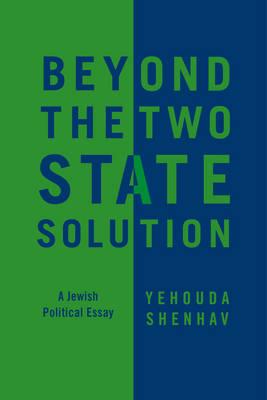
beyond-the-two-state-solution-a-jewish-political-essayI’ve been pointing out for some time now that Israel has been increasingly building settlements in Area C of the West Bank, while evicting Palestinians from their homes there and moving them to far reaching sections of Areas A and B. The intention? To eventually annex Area C to Israel and warehouse the Palestinian population of the West Bank in disconnected, isolated, bantustans.

Now it’s come to this: Israeli coalition leaders are unabashedly bandying about this plan in public:

From a recent article in the Jerusalem Post:

Israeli annexation of the West Bank’s Area C – where all settlements are located – received public support from two high-ranking Likud politicians on Tuesday evening, Public Diplomacy Minister Yuli Edelstein and MK Ze’ev Elkin.

“Lack of Israeli sovereignty over Area C means the continuation of the status quo,” said Edelstein, as he spoke about an area of the country that is now under Israeli military control. “It strengthens the international community’s demand for a withdrawal to the pre-1967 lines.”

But Edelstein and Elkin cautioned that annexation was a process that should happen slowly, not immediately.

Together with the Netanyahu government’s stated intention to build in the critical West Bank territory of E-1, it is clearer than ever that the conventional liberal Zionist notion of a two-state solution is a dead anachronism. It’s even worse, actually: as long as we cling to a two-state paradigm, Israel will be given free reign to entrench this injustice in perpetuity.

I’ve also come to believe that its high time for those who are interested in a truly just peace between Israelis and Palestinians to come forth with some new creative thinking that might provide alternatives to an obsolete two-state model. In this regard, I was happy to learn that “Beyond the Two State Solution: A Jewish Political Essay” by the great Israeli academic Yehouda Shenhav, has finally been published in English. Shenhav has long been providing precisely the kind of innovative thinking that I believe is so very lacking in political circles – and I’m delighted his work on this subject will now find a wider audience.

Using post-colonial political and critical theory, Shenhav challenges many of the fundamental paradigms and assumptions that have delineated the Israeli political “left” and “right,” while suggesting new and exciting models that might well help us to envision a better future for Palestinians and Jews in the land.

Here’s an excerpt, from his Introduction:

I am deeply concerned with the violation of the political rights of the Palestinians, but no less so with the future political rights of the Jews themselves. I believe that the combination of a persistent foundational state of emergency and blatantly racist legislation – which grows restrictive and bare-faced day by day – poses a threat not only to Palestinians, but to Jews in the Middle East. For this reason, I wish to unpack the Jewish-Israeli discourse on the conflict, to highlight the dangerous political zones within which it roams, and offer an alternative political vision in which the rights of both Jews and Palestinians are intertwined and co-determined…

In particular, I argue that the so-called “two-state solution” in the form proposed by the Israeli liberal left no only is unrealistic but in essence is based on false assumptions that sustain and reinforce the non-democratic Israeli regime and mask the essence of the conflict. Instead, I offer a different vision for political thought, which is not based on state terror or Jewish supremacy.

Shenhav is a well known thinker in Israel, but less familiar to American audiences. Whether or not you agree with his ideas, I hope you will at least be open to this sort of new thinking. I personally find it liberating – I do believe that these kinds of outside the box ideas serve to provide us with a ray of hope along what is otherwise a very dark road…

“Beneath the Blindfold” and Torture’s Tragic Legacy

“Zero Dark Thirty” hasn’t come to Chicago yet, so I can’t weigh in on the controversy surrounding its portrayal of the torture in the Bin Laden raid. Having read countless articles already, however (most notably the pointed criticisms by Glenn Greenwald), I can safely say it’s going to be pretty hard for me to overcome my prejudices going in. I certainly can’t imagine feeling sanguine about a film that gives the mistaken (and dangerous) impression that torture “works.” Still, I’ll do my best to keep an open mind – and offer my thoughts after I’ve actually seen the movie.

In the meantime, if you’re looking interested in a film that accurately and powerfully explores torture’s tragic legacy, check out “Beneath the Blindfold,” a new documentary by Evanston-based independent filmmakers Ines Somer and Kathy Berger. The film follows the lives of four torture survivors – a nurse from Africa, an actor from Colombia, A US Navy veteran from Chicago, and a physician from Guatemala – and documents their journeys as they attempt to build new lives, careers, and relationships. Despite the painful fallout from their experiences, we witness each of them becoming empowered to speak out and become public advocates for an end to torture.

“Beneath the Blindfold” has been garnering rave reviews and was just voted the Best Political Documentary of 2012 by the Chicago Reader. JRC was honored to host Ines and Kathy four years ago when they showed and discussed some footage of their work in progress. Now that the film in finished, we are thrilled to screening and discussion with the filmmakers on Saturday, January 19 at 7:00, in partnership with Percolator Films. (Click here for more info.)

Click here for Ines’ and Kathy’s recent interview with Jerome McDonnell on WBEZ’s Worldview.