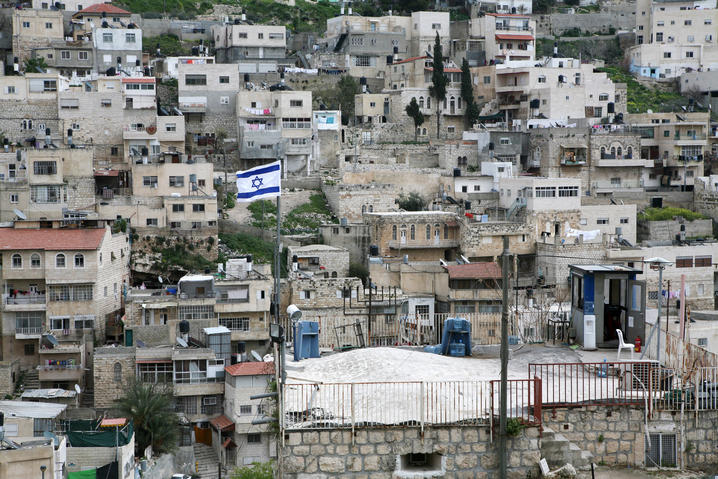
Jewish settlement in Silwan, East Jerusalem (photo from Activestills)
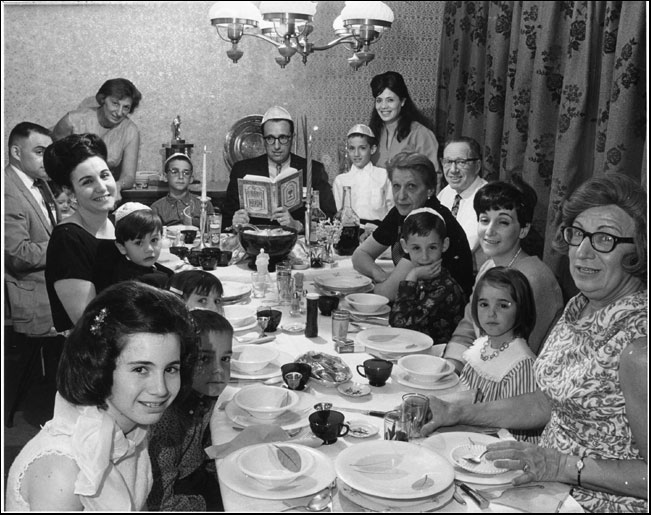
The words “Next Year in Jerusalem” seriously stuck in my throat at seder this year.
I know that these words are largely a spiritual metaphor. I know that for centuries of Jewish history these words referred to a messianic vision of the future and not literal immigration. Still, given the political realities of the day, it’s just so very to difficult to separate spiritual metaphor from literal facts on the ground.
It was enormously difficult for me to proclaim “Next Year in Jerusalem” together with Jews the world over knowing that right now in Yerushalayim Shel Mata (“earthly Jerusalem”), non-Jewish residents are being evicted from their homes and the construction of Jewish residences are increasing with utter impunity. By any other name this would be called “ethnic cleansing,” and I have no trouble saying so.
Many will claim that Jews have a right to build houses anywhere that they please. That is not the issue. This issue, of course, is that Palestinians in Israel do not. Others will say that the government is only building in parts of Jerusalem that “everyone knows” will be always be part of Israel anyway. This is, in fact, exactly what Netanyahu claimed in his address at the recent AIPAC Policy Conference:
Everyone knows that these neighborhoods will be part of Israel in any peace settlement. Therefore, building them in no way precludes the possibility of a two-state solution.
This claim is hogwash. If you would like to know why, please read this article by Danny Seidemann and Lara Friedman, who understand the recent history and politics of Jerusalem better than just about anyone:
What Netanyahu really means is that East Jerusalem land falls into two categories: areas that “everybody knows” Israel will keep and where it can therefore act with impunity, and areas that Israel hopes it can keep, by dint of changing so many facts on the ground before a peace agreement is reached that they move into the first category.
It is an approach that can be summed up as: “what’s mine is mine, and what you think is yours will hopefully be mine, too.” It discloses with stark clarity the underlying principle of Netanyahu’s Jerusalem policies: the status of Jerusalem and its borders will be determined by Israeli deeds rather than by negotiations. More bluntly, who needs agreement with Palestinians or recognition of the international community when “everybody knows”?
And it is an approach that we see today on the ground, where Israel is doing its best — through construction, demolitions, changes in the public domain — to transform areas of East Jerusalem that have always been overwhelmingly Palestinian into areas that everybody will soon recognize as Israeli, now and forever. This is happening in the area surrounding the Old City, in the heart of Palestinian neighborhoods like Ras al Amud and Jebel Mukabber, and it is now starting to target areas like Shuafat and Beit Hanina.
The notion that a peace process can survive such an Israeli approach in Jerusalem is not rational. The notion that Israel can be taken seriously as a peace partner while acting this way is farcical. And the notion that the United States can be a credible steward of peace efforts while tolerating such behavior is laughable.
Next year in a Jerusalem for all of its citizens…



 The Israeli government’s blindsiding of Joe Biden
 Shalom Rav