Category Archives: BDS

MSCI and TIAA-CREFF Divest from Caterpillar!

This is huge.

In the most significant Israel divestment milestone to date, the MSCI (Morgan Stanley Capital International) World Socially Responsible Index recently removed Caterpillar from its list.  Shortly thereafter, financial retirement fund giant TIAA-CREF divested Caterpillar from its portfolio as well!

Did I say this was huge? CAT has been a target of divestment activists for many years – and rightly so. The company has come under increasing criticism from human rights organizations for continuing to supply bulldozers to Israel, which uses them to demolish Palestinian civilian homes and destroy crops and agricultural land in the occupied territories. In the succinct words of Amnesty International: “Thousands of families have had their homes and possessions destroyed under the blades of the Israeli army’s US-made Caterpillar bulldozers.”

This is only the beginning. Last month, the Quaker Friends Fiduciary Corporation, divested $900,000 in shares of Caterpillar. And earlier this month the undergraduate student government at Arizona State University,  unanimously passed a bill demanding that ASU divest from and blacklist all companies that continue to provide the IDF with weapons and militarized equipment.  All this in advance of the Presbyterian Church (USA) General Assembly in Pittsburgh later this month, in which church commissioners will vote on a motion to divest from Caterpillar and two other companies (Motorola Solutions and Hewlett-Packard) that profit from Israel’s occupation.

To those who say that the BDS (Boycott, Divestment and Sanctions) movement will not succeed, stay tuned.  This is precisely how movements get started. A few significant victories and the dominoes begin to fall more rapidly.  Individual actions such as this may have more symbolic than financial impact, but don’t discount the power of symbolic victories.  History has taught us again and again that nonviolent direct action has the power, step by step, to leverage real and lasting political change.

Israel continues its brutal occupation and settlement policy with impunity and no government (notably our own) seems able or willing to hold it to account.

Just watch as people power moves in to fill the vacuum.

Some Final Thoughts on the United Methodist Divestment Vote

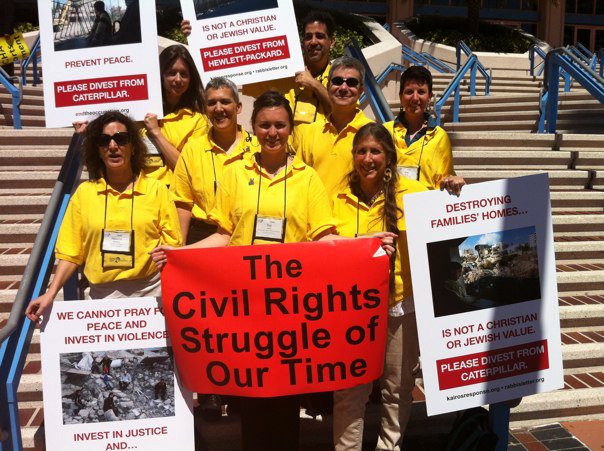
Jewish activists at the 2012 UMGC in Tampa, from left to right: Rebecca Vilkomerson (Executive Director of Jewish Voice for Peace), Anna Baltzer, (National Organizer, US Campaign to End the Israeli Occupation), Dalit Baum (Founder, “Who Profits?”), Rae Abileah (Co-director, CODEPINK Women for Peace), Sydney Levy, (Director of Advocacy, JVP), Rabbi Brant Rosen, Rabbi Lynn Gottlieb (Founder, Shomer Shalom Center for Jewish Nonviolence), Ariel Vegosen (Fair Trade and Media Social Justice Activist)

After the United Methodist divestment resolution was voted down at the UM General Conference last week, I’ve received my fair share of gloating responses from divestment opponents.  (Award for the most colorful goes to “Tzahal,” who sent in this attention-grabber: “BDS Fail, you f***ing KAPO”).

Actually, while many of us were disappointed by the final vote, I don’t view this as a fail. Not by a long shot.

First of all, as I reported from Tampa, I was deeply inspired to meet so many remarkable activists – Christians, Muslims, Palestinians, Israelis and American Jews – who constitute a new community of conscience working for justice in Israel/Palestine. This new interfaith/inter-ethnic coalition is growing rapidly and we are most certainly succeeding in raising conscience and awareness each time these kinds of resolutions are brought forth.

Beyond the final vote on this one specific resolution, we should consider it a success that these issues are increasingly being publicly discussed by our religious communities. My fellow activists and I had numerous conversations with delegates in the convention hall and we were heartened to engage so many people so honestly on this difficult issue. I was particularly gratified to speak with the numerous African delegates (who constituted 40% of the convention) who immediately understood the very real parallels to the legacy of colonialism in their own countries.

In addition, as my fellow activist Anna Baltzer recently pointed out, while the divestment resolution did not ultimately pass, the UM General Conference did adopt a resolution that among other things urged the US government to “end all military aid to the region,” called on all nations “to prohibit… any financial support by individuals or organizations for the construction and maintenance of settlements,” and “to prohibit… the import of products made by companies in Israeli settlements on Palestinian land.”

In BDS terms, this means that while the United Methodists did not affirm D (“Divestment”), they did support B and the S (“Boycott” and “Sanctions”).  No small statement, this.

I am coming away from this experience more convinced than ever that divestment is a critical tool in our quest for a just peace in I/P.  Over and over I’ve heard that divestment is an unduly harsh and polarizing tactic – and that the emphasis should be on positive engagement and investment. This, despite the fact that decades of political engagement by our government have failed miserably. This despite almost a decades worth of failed attempts by church groups to engage companies such as Caterpillar, Motorola Solutions and Hewlett/Packard – companies that literally profit from an oppressive, illegal occupation.

Add to this the testimonials of numerous Palestinian leaders who addressed “positive investment” by telling us it wasn’t charity they needed, but real, actual justice. In the words of Zahi Khouri, a prominent Palestinian Christian businessman and CEO of Coca-Cola Palestine:

It may shock you, but whenever there is a viable project identified in Palestine, we can raise the funds. We don’t need your financial help, your charity. What we need is to be able to operate freely. Divestment is the best, most immediate way that you can help us achieve that. We have been waiting for more than 40 years; we need action now.

Archbishop Desmond Tutu was so correct when he urged support of the divestment resolution by invoking MLK’s “Letter from a Birmingham Jail.” Then, as now, those who sought justice were counseled by religious leaders to “be patient” and to address the issue of oppression through engagement and non-confrontational tactics. Then, as now, there was an assumption that those who wielded corrupt power could somehow be “convinced” to give up their power voluntarily. Then, as now, this kind of patronizing counsel rings hollow and false in the ears of those who continue to suffer daily from ongoing injustice and persecution.

No, this was not a fail. There is a movement is building and this was only the beginning. Stay tuned. Similar resolutions will soon be considered in Pittsburgh at the General Assembly of the Presbyterian Church (USA) and the General Convention of the Episcopal Church in Indianapolis.

My new colleagues and I look forward to continuing this sacred work together.

Archbishop Tutu in Support of Methodist Divestment

Archbishop Desmond Tutu has just written a powerful op-ed in support of United Methodist church divestment.

I have no doubt that he will once again incur the wrath of the Jewish establishment – especially since he criticizes the 1,200 rabbis who recently signed a public letter opposing church divestment:

While they are no doubt well-meaning, I believe that the rabbis and other opponents of divestment are sadly misguided. My voice will always be raised in support of Christian-Jewish ties and against the anti-Semitism that all sensible people fear and detest. But this cannot be an excuse for doing nothing and for standing aside as successive Israeli governments colonize the West Bank and advance racist laws.

I recall well the words of the Rev. Martin Luther King Jr. in his Letter from a Birmingham Jail in which he confesses to his “Christian and Jewish brothers” that he has been “gravely disappointed with the white moderate … who is more devoted to ‘order’ than to justice; who prefers a negative peace which is the absence of tension to a positive peace which is the presence of justice; who constantly says: ‘I agree with you in the goal you seek, but I cannot agree with your methods of direct action;’ who paternalistically believes he can set the timetable for another man’s freedom. …”

King’s words describe almost precisely the shortcomings of the 1,200 rabbis who are not joining the brave Palestinians, Jews and internationals in isolated West Bank communities to protest nonviolently against Israel’s theft of Palestinian land to build illegal, Jewish-only settlements and the separation wall. We cannot afford to stick our heads in the sand as relentless settlement activity forecloses on the possibility of the two-state solution.

Hear, hear. His invocation of MLK’s “Letter from a Birmingham Jail” is apt and spot on.

I’m particularly appreciative of the Archbishop’s shout out to “the brave rabbis of Jewish Voice for Peace.”  It’s wonderful to see our letter of support garnering such widespread acclaim from so many quarters.  And it’s especially gratifying to be showing a decidedly different face of the Jewish community to our brothers and sisters in the Christian community over this issue.

The divestment resolution is scheduled to voted on by the UM Conference plenum tomorrow. Stay tuned.

United Methodist Divestment: Standing in Solidarity in Tampa

It was my honor to attend the opening of the 2012 General Conference of the United Methodist Church in Tampa, where they will be considering a resolution to divest church funds from three companies – Motorola Solutions, Hewlett-Packard and Caterpillar – that profit from Israel’s oppressive occupation.

I’ve been so inspired by the amazing people I’ve met in Tampa – Methodists from around the country, Palestinians, and many Jews – who constitute a new community of conscience on this profoundly important issue. This coming-together has been particularly important for me, because many quarters of the United Methodist Church have been unfairly demonized by the Jewish establishment over the issue of church divestment.

The resolution will be considered in committee some time over the next few days – and may possibly be voted on in plenary next week. If you, like me, stand with our Methodist brothers and sisters in our desire for justice in Israel/Palestine, please sign our Rabbi’s Letter that supports “conscientious nonviolent strategies, such as phased selective divestment, to end the occupation.”

You can read a thorough report about our efforts here on Tampa Community Radio. The clip above: my statements at a press conference yesterday which was convened by my friends at United Methodist Kairos Response – the primary sponsors of the UM divestment resolution.

Rabbi Mordechai Liebling: Why I Now Support Church Divestment

My good friend and colleague Rabbi Mordechai Liebling has just written one of the most eloquent and thoughtful statements in support of church divestment I have yet read. Mordechai’s voice on this subject is particularly noteworthy becuase he has long been an important Jewish community leader on the issue of ethical investing.

Mordechai has previously served as the director of the “Torah of Money” initiative at The Shefa Fund and later became the Executive Vice President of Jewish Funds for Justice. He currently serves as the director of the newly created Social Justice Organizing Program at the Reconstructionist Rabbinical College.  His statement is all the more powerful because in 2004 he wrote a public article questioning the effectiveness of divestment as a strategy – and as late as two years ago, he still viewed divestment as counterproductive.

As he wrote in his statement, he has reconsidered his position for compelling reasons:

What happened that made me change my views? I changed a little, and the reality on the ground changed even more.

At the time I wrote the article I was organizing the Jewish Shareholder Action Network in my capacity as the Torah of Money Director at the ShefaFund. I was very involved in the world of faith-based socially responsible investments and learned a lot about shareholder activism.

When Protestant churches started considering selective divestment from corporations profiting from the occupation back in the mid-2000′s, I knew many of the socially responsible investment staff people in those denominations. I did not think divestment was a good strategy and said so to my colleagues. But things have changed since.

I was concerned about the potential that divestment measures would have in undermining the Israeli political center. I was concerned about Israelis feeling more isolated than ever and adopting a circle-the-wagons mentality that would make peace harder to attain. These concerns are valid and real. But in the last number of years, the Israel political center has moved to the right–even without divestment. The Israeli government has become more intransigent in its position; the settlers more aggressive. The Netanyahu government has already circled the wagons.

Given this reality, we need to take a look at new approaches. We cannot rule out options that are rooted in non-violence, promote non-violence and call for an end to unjust practices. Divestment is one such option. Palestinian nonviolent direct action is another.

If the reality on the ground in Israel and in the West Bank has changed, so have the attitudes of Israeli Jews and Jews abroad towards the use of tools such as divestments and boycotts. Previously very few Jewish groups would have supported such initiatives. Now we see a lively discussion inside our Jewish communities about the appropriateness of using these tactics to end the occupation and oppose settlement expansion. Countless Israeli artists refuse to perform in the Cultural Center of the settlement of Ariel in the West Bank. Boycotting settlement goods is now discussed in Israel, in the pages of the New York Times, and inside our very own Jewish communities. Symptomatic of its move to the right, the Israeli government has outlawed this practice, and the brave Israelis that speak about it, risk heavy court-mandated fines for expressing their views. But inevitably, the more intransigent the Israeli government, the more popular this and other nonviolent measures will become.

Now to be sure, boycott and selective divestment are not the same thing. The former is carried out by consumers; the latter by investors. Divestment from a corporation does not come in a vacuum. It is the logical step that follows after shareholders try to negotiate with a company to address their concerns and after shareholder activism fails. Back when I opposed divestment, I was concerned that divestment was being invoked when the first two steps had not been tried yet, or at least pursued to its completion. This is not the case today. To their credit, the churches have gathered a full record of failed corporate engagement and have experienced years of frustrated shareholder resolutions that do not achieve the desired change in corporate behavior. Now that step one and step two have failed, it is time to move to the inevitable step three, and that is divestment. Not doing so puts at risk the integrity of the whole socially responsible investment model.

I want to make clear that I would not support divestment or boycotts from Israel as a whole. I do not support turning Israel into a pariah state. And it is precisely because of this that I support the churches’ measure approach to selective divestment. The resolutions under consideration–divesting from Caterpillar, Motorola Solutions, and Hewlett-Packard–do not single out Israel, and they certainly do not single out Jews either. They single out specific corporate complicity with the occupation. Churches hold tobacco companies in their no-buy list, not because they believe that smokers are bad people. They do not single out smokers for criticism. They do so because smoking is wrong. In the same way, bulldozing civilian homes and making people homeless is wrong too. It does not matter whether this happens in Israel or elsewhere. The problem is not with the place or with the people, but with the action. This bulldozing is taking place in Jerusalem, where Palestinian homes are being bulldozed to make room for more Jewish settlements. Not condemning wrongdoing simply because it happens in Israel is singling out Israel. Israel does not need affirmative action; it needs to be treated exactly the same as every other state, not better, and not worse. This means acknowledging when it does things right, but also taking corrective action when it does not.

I’m thrilled that Mordechai has now signed on to our Rabbi’s Letter campaign in advance of the United Methodist Conference in Tampa this week, where the divestment resolution will be presented once again.

There will be much more to report on this important story – please stay tuned.

Jewish Voices of Support for Church Divestment Resolutions!

I’m already on record as fully supporting the Presbyterian Church (USA) divestment resolution that is being brought to the PC (USA) General Assembly this summer. Now I’m thrilled to report that my colleagues on the Jewish Voice for Peace Rabbinical Council have released a letter in support of both the Presbyterian and the Methodist Church’s efforts to divest from three companies (Caterpillar, Motorola Solutions, and Hewlett-Packard) that profit from the Israeli occupation.

Here’s an excerpt of our letter:

Every day Jewish leaders are building alliances with our interfaith partners to oppose all forms of oppression and to express our outrage over the confiscation of Palestinian land, the destruction of Palestinian farms, groves and homes, and to work to end the daily harassment and violence against Palestinian people.

Several Christian denominations are making brave, constructive decisions to investigate whether their churches’ investments contribute to this violence and oppression in Israel and Palestine.

We believe that to invest your own resources in corporations which pursue your vision of a just and peaceful world, and to withdraw your resources from those which contradict this vision, is the best way to support Muslims, Christians, Jews, Israelis, Palestinians –truly all people.

We can think of no greater act of friendship than to work with us, side by side to bring justice, equality and self-determination to all people. This selective divestment process is one of the strongest tools we have.

In making this decision, we are together, Jews and Christians, living up to the biblical promise to pursue justice.

I encourage you to visit rabbisletter.org for a plethora of resources, including FAQs, additional Jewish expressions of support – and the opportunity to sign on to our letter.

You can also click here to directly support the Methodist resolution (which will be considered at the United Methodist Church General Conference in Tampa on April 24-May 4)  and here to support the Presbyterian initiative (which will brought before the PC USA General Assembly in Pittsburgh, June 30-July 7).

I Support the Presbyterian Church (USA) Divestment Resolution

As a Jew, a rabbi and a person of conscience, I am voicing my support of the divestment resolution being brought to the General Assembly of the Presbyterian Church (USA) this June.

This resolution, which has been a point of divisive contention between the PC (USA) and some American Jewish organizations for many years,  recommends that the Church divest its funds from Caterpillar, Motorola and Hewlett-Packard. It was put forth by the church’s committee on Mission Responsibility Through Investment – an appointed body that recommended church divestment of companies engaged in “non-peaceful pursuits in Israel/Palestine.”

There is a long and tumultuous history to this resolution – here’s a basic outline:

– In 1971 and 1976 the Presbyterian Church stated that it had a responsibility to ensure that its funds be invested responsibly and consistent with the church’s mission.

– In 1986, the PC (USA) formed the Committee for Mission Responsibility Through Investing (MRTI) in 1986. The MRTI Committee carried out the General Assembly’s wish to engage in shareholder activism and as a last resort, divest itself of companies which contravened the GA’s position. Divestment would follow a phased process starting with attempted dialogue and shareholder resolutions and ultimately the total sale of and future ban on the church’s holdings in a company.

– In June 2004, the PC (USA) General Assembly adopted by a vote of 431-62 a resolution that called on the MRTI Committee “to initiate a process of phased, selective divestment in multinational corporations operating in Israel.” The resolution expressed the church’s support of the Geneva Accord, said that “the occupation . . . has proven to be at the root of evil acts committed against innocent people on both sides of the conflict,” that “the security of Israel and the Israeli people is inexorably dependent on making peace with their Palestinian neighbors”, that “horrific acts of violence and deadly attacks on innocent people, whether carried out by Palestinian suicide bombers or by the Israeli military, are abhorrent and inexcusable by all measures, and are a dead-end alternative to a negotiated settlement,” and that the United States government needed to be “honest, even-handed broker for peace.”

– In 2005, MRTI Committee named five US-based companies – Caterpillar Inc., Citigroup, ITT Industries, Motorola and United Technologies – for initial focus and that it would engage in “progressive engagement” with the companies’ management.

– In 2006, following an uproar of criticism from American Jewish organizations, the PC (USA) General Assembly overwhelmingly (483-28) replaced language adopted in 2004 that focused the “phased, selective divestment” specifically on companies working in Israel.  It now called for investment in Israel, the Gaza Strip, eastern Jerusalem and the West Bank “in only peaceful pursuits.” The new resolution also required the consideration of “practical realities,” a “commitment to positive outcomes” and an awareness of the potential impact of strategies on “both the Israeli and Palestinian economies.”  The 2006 resolution also recognized Israel’s right to build a security barrier along its pre-1967 boundaries. The GA acknowledged the “hurt and misunderstanding among many members of the Jewish community and within our Presbyterian communion” that resulted from the 2004 resolution and stated that the Assembly was “grieved by the pain that this has caused, accept responsibility for the flaws in our process, and ask for a new season of mutual understanding and dialogue.”

The most recent resolution is the result of this new process and now focuses on three of the original six companies under consideration.  From the PC (USA) website:

The General Assembly Mission Council (GAMC) is recommending that the upcoming 220th General Assembly of the Presbyterian Church (USA) divest the church of its stock in three companies “until they have ceased profiting from non-peaceful activities in Israel-Palestine.”

The three companies are Caterpillar, Motorola Solutions and Hewlett-Packard.

At issue are their participation in the Israeli occupation of the West Bank, the construction of the “security barrier” between Israel and Palestinian territory, and the destruction of Palestinian homes, roads and fields to make way for the construction of Israeli settlements in the West Bank, which have been declared illegal under international law.

“We have run out of hope that these companies are willing to change their corporate practices [in Israel-Palestine],” said the Rev. Brian Ellison, a Kansas City pastor and chair of the denomination’s Mission Responsibility Through Investment Committee (MRTI). “We have made diligent effort to engage in conversation. We’d like to do more, to make progress, but substantial change does not seem possible.”

As stated above, I support this resolution without reservation and urge other Jewish leaders and community members to do so as well. I am deeply dismayed that along every step of this process, Jewish community organizations (among them, the Anti-Defamation League, the Simon Wiesenthal Center and the Jewish Council on Public Affairs) that purport to speak for the consensus of a diverse constituency have been intimidating and emotionally blackmailing the Presbyterian Church as they attempt to forge their ethical investment strategy in good faith.

It is extremely important to be clear about what is at stake here. First of all, this is not a resolution that seeks to boycott or single out Israel. Divestment does not target countries – it targets companies.  In this regard speaking, the PC (USA)’s ethical investment process seeks to divest from specific “military-related companies” it deems are engaged in “non-peaceful” pursuits.

We’d be hard-pressed indeed to make the case that the Israeli government is engaged in “non-peaceful pursuits” in the Occupied Territories and East Jerusalem.  I won’t go into detail here because I’ve been writing about this tragic issue for many years: the increasing of illegal Jewish settlements with impunity, the forced evictions and home demolitions, the uprooting of Palestinian orchards, the separation wall that chokes off Palestinians from their lands, the arbitrary administrative detentions, the brutal crushing of non-violent protest, etc, etc.

All Americans – Jews and non-Jews alike – have cause for deep moral concern over these issues.  Moreover, we have cause for dismay that own government tacitly supports these actions. At the very least, we certainly have the right to make sure that our own investments do not support companies that profit from what we believe to be immoral acts committed in furtherance of Israel’s occupation.

As the co-chair of the Jewish Voice for Peace Rabbinical Council, I am proud that JVP has initiated its own divestment campaign which targets the TIAA-CREF pension fund, urging it to divest from companies that profit from Israel’s occupation. Among these are two of the three companies currently under consideration by PC (USA): Motorola and Caterpillar.

Why the concern over these specific companies? Because they are indisputably and directing aiding and profiting the oppression of Palestinians on the ground. Caterpillar profits from the destruction of Palestinian homes and the uprooting of Palestinian orchards by supplying the armor-plated and weaponized bulldozers that are used for such demolition work.  Motorola profits from Israel’s control of the Palestinian population by providing surveillance systems around Israeli settlements, checkpoints, and military camps in the West Bank, as well as communication systems to the Israeli army and West Bank settlers.

And why is Hewlett-Packard under consideration for divestment by the PC (USA)? HP owns Electronic Data Systems, which heads a consortium providing monitoring of checkpoints, including several built inside the West Bank in violation of international law.  The Israeli Navy, which regularly attacks Gaza’s fishermen within Gaza’s own territorial waters and has often shelled civilian areas in the Gaza Strip, has chosen HP Israel to implement the outsourcing of its IT infrastructure.  In addition, Hewlett Packard subsidiary HP Invent outsources IT services to a company called Matrix, which employs settlers in the illegal settlement of Modi’in Illit to do much of its IT work at low wages.

I repeat: by seeking to divest from these companies the PC (USA) is not singling out Israel as a nation.  The Presbyterian Church has every right to – and in fact does – divest its funds from any number of companies that enable non-peaceful pursuits around the world.  In this case specifically, the PC (USA) has reasonably determined that these particular “pursuits” aid a highly militarized, brutal and oppressive occupation – and it simply does not want to be complicit in supporting companies that enable it.

I am fully aware that there are several organizations in the Jewish community that are already gearing up a full court press to intimidate the PC (USA) from passing this resolution in June.  JCPA President Rabbi Steve Gutow recently accused national Presbyterian leaders of “making the delegitimization of Israel a public witness of their church.” The Simon Wiesenthal Center has called the resolution “poisonous,” and that by considering it the PC (USA) is “showing its moral bankruptcy.”

These sorts of statements do not speak for me nor, I am sure, do they speak for the wide, diverse spectrum of opinion on the issue in the American Jewish community.  There is no place for public bullying in interfaith relations – it is, needless to say, decidedly counter to principles of honest, good faith dialogue.  To our Presbyterian friends: please know there are many Jewish leaders who stand with you as you support the cause of peace and justice in Israel/Palestine.

In a recent open letter to the PC (USA), Rabbi Margaret Holub, my colleague on the JVP Rabbinical Council expressed this sentiment eloquently with the following words:

Your Church has long been active in pursuing justice and peace by nonviolent means, including divestment, in many places around the world.  As Christians, you have your own particular stake in the land to which both our traditions have long attachments of faith and history.  We particularly acknowledge the oppression of Palestinian Christians under Israeli occupation and the justice of your efforts to relieve the oppression directed against your fellows.

To advocate for an end to an unjust policy is not anti-Semitic.  To criticize Israel is not anti-Semitic.  To invest your own resources in corporations which pursue your vision of a just and peaceful world, and to withdraw your resources from those which contradict this vision, is not anti-Semitic.  There is a terrible history of actual anti-Semitism perpetrated by Christians at different times throughout the millennia and conscientious Christians today do bear a burden of conscience on that account.  We can understand that, with your commitment to paths of peace and justice, it must be terribly painful and inhibiting to be accused of anti-Semitism.

In fact, many of us in the Jewish community recognize that the continuing occupation of Palestine itself presents a great danger to the safety of the Jewish people, not to mention oppressing our spirits and diminishing our honor in the world community.  We appreciate the solidarity of people of conscience in pursuing conscientious nonviolent strategies, such as phased selective divestment, to end the occupation.

I am proud my name is under this letter, alongside many other members of our Rabbinical Council. If you stand with us, please join us in supporting the PC (USA) divestment resolution at their GA in Pittsburgh this summer.

“Social Justice” Israel Trips Must Not Cover Up Oppression

Here is a guest post by Michael Deheeger, who you may know from the radio interview about our JRC Israel/Palestine Study Tour last year.

Michael grew up in my congregation and has worked for several years as in Chicago as a political activist and a community organizer. His most recent job, from which he has just resigned, was as Program Director for AVODAH: Jewish Service Corps in Chicago.

On October 26, I resigned from my position as Chicago Program Director for AVODAH: The Jewish Service Corps. Each day I have spent in this job has been a blessing, but I have no choice in light of AVODAH’s decision to co-sponsor a 10-day “service-learning” trip to Israel with the American Jewish World Service through their joint initiative Pursue: Action for a Just World.

AVODAH and AJWS agreed to this trip as a grant stipulation for funding from the Charles and Lynn Schusterman Family Foundation, a prominent donor in the Jewish nonprofit world, major supporter of pro-Israel causes, and Pursue’s principal funder.

I believe it is irresponsible for social justice organizations to organize a trip that focuses on “diversity, poverty and social integration” without meaningfully, and publicly, addressing Israel’s military occupation of Palestinian land, systematic oppression of Palestinians across “Israel proper” and the Occupied Territories, and enforced exile of Palestinian refugees.

I believe doing so contributes to the “normalization” of a deeply abnormal oppressive situation – presenting Israel as a liberal democracy with nothing more than the usual challenges rather than a state which imposes an ethnicity-based military regime on millions of people. It perpetuates the idea that it is acceptable to ignore Israel’s daily abuses of Palestinians in the pursuit of cultural, religious, financial or other interests.

Similar Jewish “social justice”, artistic, LGBTQ and environmental trips are often used to mount a facade of democracy over Israel’s state-sponsored human rights abuses.  It is well known that Israeli government ministries and American Jewish organizations have been collaborating on an extravagantly funded “Brand Israel” project designed to improve the country’s image abroad by “avoiding any discussion of the conflict with the Palestinians.” Arye Mekel, former Deputy Director-General for Cultural Affairs with Israel’s Foreign Ministry, has described this strategy as a way to “show Israel’s prettier face.” I have no doubt that the Schusterman Foundation has a similar agenda for this Pursue trip.

Through this trip, AVODAH and AJWS become active participants in covering up oppression, whether that is their intention or not. They publicly lend their organizations’ names and reputations to injustice, violating the social justice principles enshrined in their missions which inspired me to join AVODAH’s staff in the first place.

My decision to resign is informed by my support of the Palestinian call for Boycott, Divestment and Sanctions (BDS) against Israel. Initiated in 2005, BDS is a call endorsed by the great majority of Palestinian civil society groups as a nonviolent strategy to pressure Israel into ceasing its systematic oppression of Palestinians.

I believe in listening to people fighting their own oppression when they lay out a strategy to achieve their human rights. For the overwhelming number of Palestinians, BDS is that strategy.  Being strong allies and taking our lead from people directly impacted by oppression is, in fact, a philosophy deeply held by organizations such as AVODAH and AJWS.

I decided to write about my decision in the spirit of Tokhecha, or sacred rebuke, a central value of Torah:

Reprove your kinsman but incur no guilt because of him” (Leviticus 19:17)

Rashi’s interpretation of “incur not guilt” is “Do not embarrass [them] in public.” My goal is not to embarrass or shame AVODAH or AJWS. I love and respect AVODAH, which is staffed by dedicated and thoughtful individuals, and which remains committed to open discussion on this and other issues among its participants and alums.

However, this trip communicates a public message – that these organizations are willing to overlook Israel’s oppression of Palestinians in exchange for funding. It therefore requires a public response.

My understanding of Tokhecha is that it includes the responsibility to help those to whom it is directed make amends. I echo the call put out by AVODAH alums and current Corps members that AVODAH and AJWS commit publicly to “never sponsor an Israel trip in this way again.”

We in the Jewish social justice community have a choice. On the one hand, we can stay silent and try to avoid provoking the ire of powerful donors like the Schusterman Foundation. On the other hand, we can publicly oppose, or at least not cover up, the oppression Israel commits directly in our name.

I have faith that our community, increasingly, will choose the latter, and that as BDS continues to gain traction among young Jews, there will be a growing cost in staff and participants for organizations that allow themselves to be used as cover for the oppression of Palestinians.

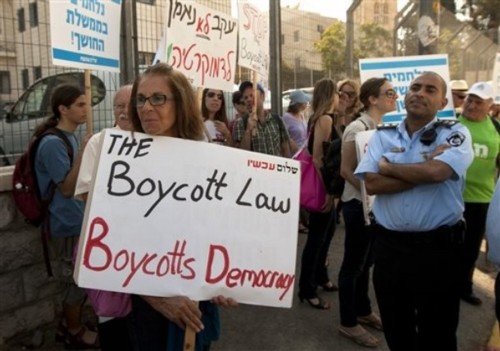
Boycott Law: Israel Further Delegitimizes Itself

The Knesset’s new “anti-boycott law” in a nutshell:

According to the law, a person or an organization calling for the boycott of Israel, including the settlements, can be sued by the boycott’s targets without having to prove that they sustained damage. The court will then decide how much compensation is to be paid. The second part of the law says a person or a company that declare a boycott of Israel or the settlements will not be able to bid in government tenders.

The upshot? For comparison purposes, consider this: if this law had been passed by the US Congress, the city of Montgomery could have legally sued MLK for leading a boycott against its bus system.

My two cents? Israel, a country that repeatedly claims the mantle of “the only democracy in the Middle East” is fast dismantling its own democracy. Knesset member Nitzan Horowitz put it about as well as it could be put, I think:

We are dealing with a legislation that is an embarrassment to Israeli democracy and makes people around the world wonder if there is actually a democracy here.

And I’d only add this: any law that manages to unite the Anti-Defamation League and Jewish Voice for Peace in opposition has to be one helluva stinker.

Here’s the thing: Israel and its “right or wrong” advocates have been working overtime fighting what it considers to be “delegitimization” of the Jewish state. But for all the effort exerted, in the end it is Israel that delegitimizes itself by passing increasingly anti-democratic legislation such as this. It’s not the first time we’ve seen the Knesset pass such a bill, and although it pains me to say so, I believe we’re going to see similarly odious laws coming down the pike in the future.

Among the many reactions to this law from throughout Israeli society, I found it extremely notable that Peace Now – an organization that has resolutely refused to support boycotts – has now called for a boycott of settlement products in reaction to the legislation.

Hear, hear. If you believe that the Occupation is immoral and unjust, then boycotting products produced in the Occupied Territories is a moral and just thing to do.

Even if you’re queasy about a full-blown boycott of all Israeli products, please consider boycotting products produced in West Bank settlements. Click here for a full list of settlement products as well as companies that engage in West Bank construction and services. If you’d like to sign on to a public settlement boycott effort, I encourage you to join Code Pink’s “Stolen Beauty” campaign of Ahava beauty products, which come from the Occupied West Bank settlement of Mitzpe Shalem.

(For a detailed guide to the implications of the new law, check out Noam Sheizaf’s excellent piece in +972. )

AIPAC: Dangerous for Jews and Other Living Things

I encourage you to read this important guest post by Alice Rothchild:

The American Israel Public Affairs Committee is holding its annual conference May 22-24, where Congress people and many of our national leaders will rush headlong into the committee’s open arms and bountiful coffers. In an increasingly bizarre time warp they will congratulate each other and kvell about Israel’s special relationship with the US, our strategic partnership, and Israel’s commitment to democratic ideals in a “sea of dictatorships” (to quote the website).

What they will not talk about is reality. US Jews are increasingly uncomfortable with a lobby that claims to represent us, but is deeply committed to the militaristic and rightwing policies of successive Israeli governments. Jews in the US tend to be politically progressive, but we are being asked to suspend our liberal beliefs when it comes to Israel. While maintaining a steady dream beat for war against Iran and a world view that, “Israel continues to fulfill its ancient obligation as a ‘light unto the nations,’” AIPAC lobbyists with their Christian Zionist allies guarantee billions of dollars in military aid for Israel each year . Much of this goes towards buying US military weapons and machinery, cementing the massive, interconnected, and lucrative military-industrial-security complex that now exists between our two countries.

Not only has this made a brutal 43 year military occupation possible, but it also provides military and political support to the current Netanyahu government. Let’s be clear. Netanyahu is committed to building Jewish settlements in the West Bank and East Jerusalem, undermining any possibility for a two-state solution. He is building Jewish settler-only roads and roads for Palestinians funded by USAID. He tightly controls Palestinian movement through checkpoints, permits, and the Separation Wall which has stolen thousands of acres of Palestinian land and destroyed the lives and livelihoods of people whose families have lived in the region for centuries. His idea of Palestinian statehood, (should he still have one), is a scattering of weak enclaves surrounded by Israeli military. The recently released Palestine Papers painfully documented the degree to which Palestinian negotiators were willing to sell their souls while Israeli negotiators refused to accept any concessions. The US was revealed twisting the arms of Palestinians diplomats to give up basic demands and the massive security coordination between the Israelis and the Palestinian Authority was exposed.

Within Israel, there is a rightwing crackdown on human rights activists, and laws brewing in the Knesset that will criminalize:

1. Nonviolent protests (in Israel and internationally) that advocate boycotts, divestments, and sanctions;

2. Providing information that could lead to Israeli war crime charges;

3. Any activity against Israeli soldiers or State symbols including nonviolent legitimate resistance to the occupation;

4. Commemorations of the Nakba, the Palestinian experience of 1948

At the same time there are over 20 laws that maintain the second class status for Palestinians with Israeli citizenship.

While Israeli activists worry about rising fascism in Israeli society, Palestinians are celebrating the Arab Spring that is blossoming in the region and Fatah and Hamas are gingerly talking about unity and democratic elections. Arabs from Tunisia to Yemen are putting their lives on the line for equality and freedom of speech. This breathtaking political moment is changing the political discourse in the Middle East and the US Congress needs to take notice and shake itself free of the world view that is promoted by AIPAC lobbyists. Fear of anti-Semitism and the traumas of the Holocaust do not justify Israeli exceptionalism, militarism, racism towards Arabs, or a belief in permanent Jewish victimization.

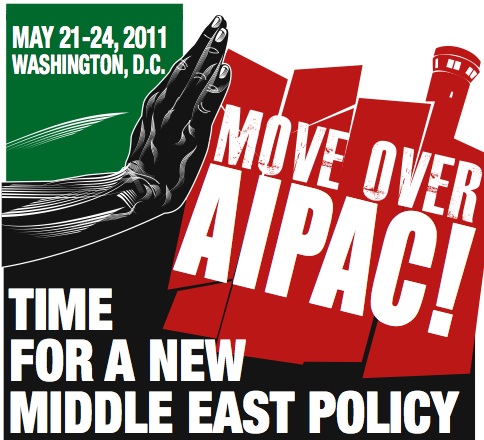
Peace in the Middle East is more urgent than ever, but it needs to be based on international law, human rights, and UN resolutions. AIPAC and its supporters are deluding themselves, promoting a perpetual state of war and hostility, living in a world that does not match reality. At the same time, over 100 peace organizations will be meeting in Washington. Under the call: Move Over AIPAC: Building a New US Middle East Policy, they will explore the impacts of US military aid and political cover, the demand to end the Israeli occupation, and the building of a solution that respects the rights and dignity of everyone in the region. There will be no big donors there, but Congress would do well to listen.