Category Archives: Civil Rights

On Passover, Israel and Demographic Threats

2016_0427rrisr_

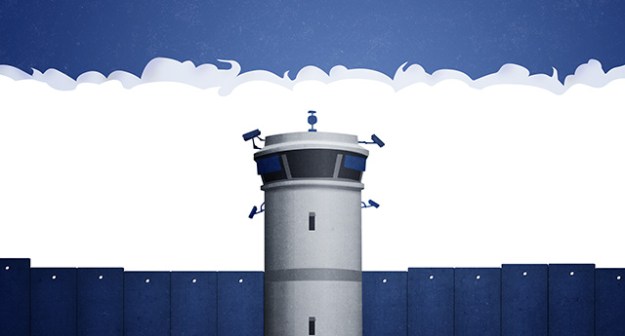
(Image: Jared Rodriguez / Truthout)

Crossposted with Truthout

The weeklong Jewish festival of Passover is coming to a close, but like many Jews around the world I’m still digesting the myriad questions, answers and discussions that ensued as we retold the biblical story of the Exodus at our seder. While it’s a story our community returns to over and over again, I’m continually astonished at the ways it provides a frame for understanding struggles for liberation past and present.

This year, I’ve been contemplating one aspect of the story in particular: when a new pharaoh arises over Egypt “who did not know Joseph.” We immediately learn in no uncertain terms that this new ruler was considerably more xenophobic than his predecessor:

And (Pharaoh) said to his people, “Look, the Israelite people are much too numerous for us. Let us deal shrewdly with them, so that they may not increase; otherwise in the event of war they may join our enemies in fighting against us.” (Exodus 1:8-9)

To use contemporary parlance, Pharaoh clearly views the Israelites as a “demographic threat” to the Egyptians.

The demographic threat meme, of course, has been played out countless times since the age of the pharaohs. It has certainly been a deeply woven thread in the fabric of American culture from our very origins. To cite but one example: Centuries before Donald Trump started railing against Mexican “criminals” and “rapists,” Benjamin Franklin wrote a 1751 essay in which he bemoaned the influx of “Palatine Boors” into the colonies who would “shortly be so numerous as to Germanize us instead of our Anglifying them, and will never adopt our language or customs, any more than they can acquire our complexion.”

So yes, as an American, I can’t read these words from the Exodus story without connecting it to an ignoble aspect of my own country’s legacy — one that is all too real even today.

And as an American Jew, I can’t help but connect it to another country that also purports to act in my name.

Indeed, ever since Israel’s establishment, Zionist leaders knew well that the future Jewish state would only be “viable” if it could create and maintain a demographic Jewish majority in historic Palestine. In the late 19th century, this must surely have seemed like a tall order, since Jews constituted but 2 to 5 percent of the population. By 1947, following decades of Zionist colonization and Jewish immigration, their number had swelled to 32 percent. Under the UN-sponsored partition plan, the percentage of Jews allotted to the new Jewish state would have been 55 percent.

During the 1948 war — known as the War of Independence by Zionists and the Nakba (“catastrophe”) by Palestinians — the issue of demographics was solved through the forced expulsion of Palestinians from their homes and Israel’s refusal to allow them to return. However, the demographic stakes were raised once again in 1967, when Israel conquered the West Bank and Gaza and began a military occupation that exists to this day.

In 2010, Jews officially become a minority population from the Jordan River to the Mediterranean Sea; around the same time, it was determined that the Jewish majority in Israel proper was slowly diminishing. For some time now, Zionists have been warning that the Palestinians’ birth rate poses a “demographic threat” to the future of the Jewish state.

Perhaps the most surprising aspect of this rhetoric is that it doesn’t only come from Israel’s far right, but from liberal Zionists, who use the demographic argument to advocate for a two-state solution. Witness, for instance, the words of J Street executive director Jeremy Ben-Ami:

When it comes to Israeli-Palestinian peace, the two-state solution and the inexorable demographic threat to Israel’s future as a democratic state that remains the homeland for the Jewish people, our position is the same as that of the Israeli government, the Obama administration and the vast bulk of the American Jewish community.

Leaving aside the issues of whether or not the two-state solution actually is the policyof the Israeli government, let’s unpack this statement for a moment. The liberal Zionist argument for a “democratic Jewish state” is predicated on a view of Palestinians as a “demographic threat.” As an American, if I referred to any other ethnic group in this country with such a term, I would surely be viewed as a bigot or a racist. But as a Jew, I can refer to Palestinians with this epithet and still remain a member in good standing of the liberal peace camp.

Thus the inherent contradiction of liberal Zionism: democracy and demographic engineering simply do not go hand in hand. At the end of the day, there is nothing liberal about supporting an ethno-national project predicated upon the identity of one group over another. The late Meir Kahane, revered by Israel’s ultra right, loved to make liberal Zionists squirm by repeatedly articulating this point: “A western democracy and Zionism are not compatible. You can’t have both.”

Kahane’s solution, of course, was “forced transfer” of the Palestinian population. The current government of Israel is accomplishing this goal through more subtle means:home demolitions, land expropriation and the revocation of Palestinians’ residency and citizenship. In truth, Israel has been dealing with its demographic threat under cover of US support for years, all the while claiming the mantle of “the only democracy in the Middle East.”

This, along with its massive settlement expansion has brought Israel’s demographic problem home to roost. The real decision before them is not between a one-state or two-state solution, but between two one-state solutions: an apartheid Jewish state or one state of all its citizens, regardless of religion or ethnicity.

As I watch this tragic process unfold this Passover, I find myself returning to the universal lesson this festival imparts on the corrupt abuse of state power. Although the Exodus story is considered sacred in Jewish tradition, it would be a mistake to assume that the contemporary state of Israel must be seen as equivalent to the biblical Israelites.

On the contrary, any people who suffer under oppressive government policies are, in a sense, Israelites. And any state — even a Jewish state — that views a people in its midst as a demographic threat can become a Pharaoh.

Standing Down Legal Segregation on Yom Hashoah

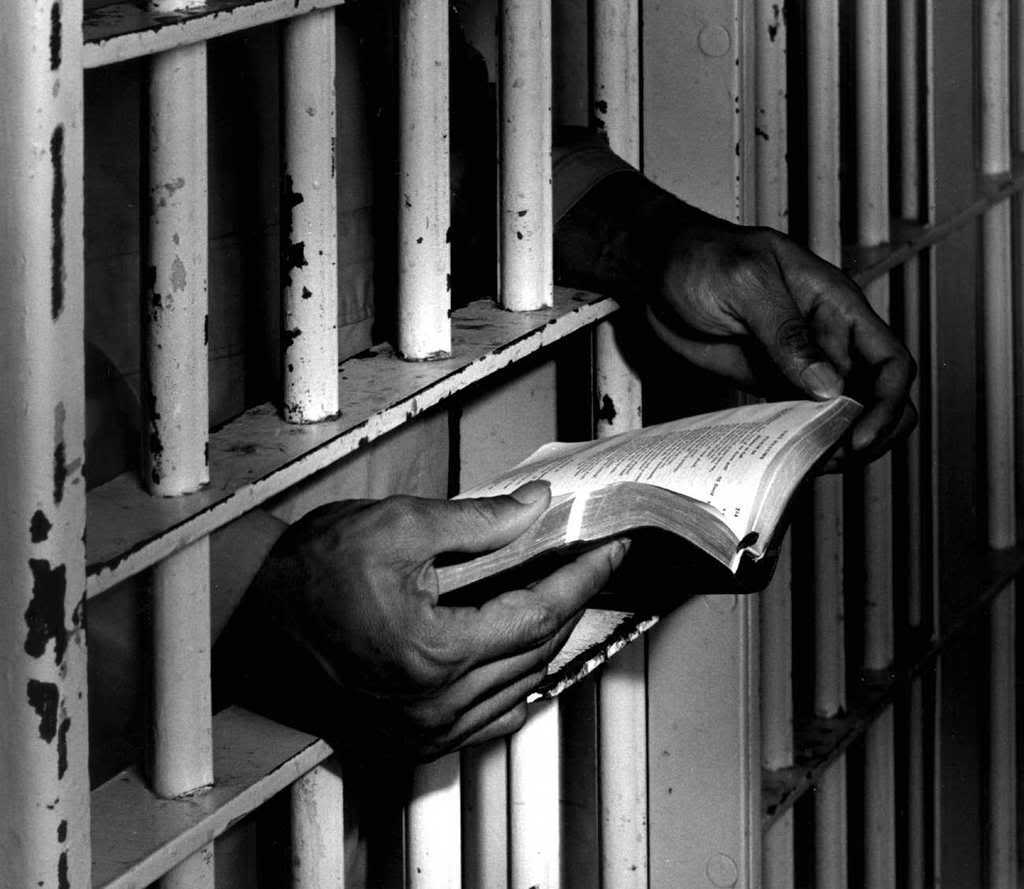
bibleinjail21 Today marks Yom Hashoah – Holocaust Remembrance Day – and as it turns out, this year it falls on a serendipitous milestone: namely the 52nd anniversary of Dr. Martin Luther King’s “Letter from a Birmingham Jail.” Although MLK wrote his letter to respond to the reality of Jim Crow in the American South, I do believe his words have much to offer us as we remember those who perished at the hands of the Nazis during World War II – in particular, King’s insistence on the moral imperative to break unjust laws and the inherent immorality of legal segregation:

(There) are two types of laws: just and unjust. I would be the first to advocate obeying just laws. One has not only a legal but a moral responsibility to obey just laws. Conversely, one has a moral responsibility to disobey unjust laws…

Now, what is the difference between the two? How does one determine whether a law is just or unjust? A just law is a man made code that squares with the moral law or the law of God. An unjust law is a code that is out of harmony with the moral law. To put it in the terms of St. Thomas Aquinas: An unjust law is a human law that is not rooted in eternal law and natural law. Any law that uplifts human personality is just. Any law that degrades human personality is unjust.

All segregation statutes are unjust because segregation distorts the soul and damages the personality. It gives the segregator a false sense of superiority and the segregated a false sense of inferiority. Segregation, to use the terminology of the Jewish philosopher Martin Buber, substitutes an “I it” relationship for an “I thou” relationship and ends up relegating persons to the status of things. Hence segregation is not only politically, economically and sociologically unsound, it is morally wrong and sinful.

In light of King’s words, it is worth noting that the rise of Nazism in Germany was facilitated by largely “legal” means – through myriad laws and regulations that successfully segregated Jews from the rest of German society.  King himself pointed this out in his letter when he wrote:

We should never forget that everything Adolf Hitler did in Germany was “legal…” It was “illegal” to aid and comfort a Jew in Hitler’s Germany. Even so, I am sure that, had I lived in Germany at the time, I would have aided and comforted my Jewish brothers.

In this regard, Dr. King’s insight might well inspire us to commemorate this sacred day by redoubling our resolve to eradicate laws that segregate peoples on the basis of their national, ethnic or religious identities.

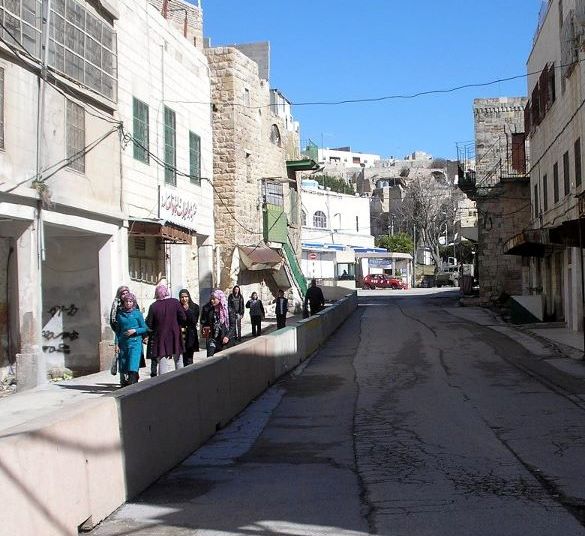
Hebron_shuhada

Segregated Shuhada street in Hebron, February 2012 (photo: Hithabrut-Tarabut)

While it pains me to say it, I cannot help but note that the very country that first established Holocaust Remembrance Day itself enforces its own form of legal segregation between Jews and non-Jews. As one Israeli observer wrote in Ha’aretz five years ago, “Segregation of Jews and Arabs in Israel…is almost absolute.” In the West Bank, Jews and non-Jews are segregated by separate legal systems, separate roads, separate transportation systems, and in some cases, separate sidewalks. And in Gaza, Palestinians are segregated from the outside world entirely.

I have no doubt that there will be those who consider it unseemly of me – or worse – to point this out on Yom Hashoah of all days. To this inevitable criticism, I can only respond, how can we purport to take the lessons of the Shoah to heart while ignoring realities such as these? How long will we, as Jews, look way from these unjust laws in Israel that “distort the soul and damage the personality?” On this, of all days, shouldn’t we, as King suggested in his letter, “bring to the surface the hidden tension that is already alive?”

May the memory of the fallen be for a blessing.

A Rabbi at AFSC: Quaker and Jewish connections – Part 1

American Quaker Marjorie McClelland with Jewish refguee child, Vichy France (photo: Ha'aretz)

American Quaker Marjorie McClelland with Jewish refugee child, Vichy France (photo: Ha’aretz)

(Crossposted with Acting in Faith)

When I tell people that I’ve just started working for the American Friends Service Committee, some will inevitably scratch their heads and ask, “What is a rabbi doing working for a Quaker organization?”

Those who know me well, know enough not to ask. During my twenty-plus years as a congregational rabbi/activist, I’ve often worked alongside AFSC staff and progressive Quakers, particularly on the issue of Mideast peace and justice. I’ve cultivated a wonderful ongoing relationship with the Friends Meeting in my hometown of Evanston and have spoken there on more than one occasion. During the course of my travels throughout the peace and justice activist community in Chicago and beyond, I can say without hesitation that some of my best friends have been Friends.

For those who do ask, I explain that while AFSC is a Quaker organization, it is wonderfully multi-faith in its composition. I’m certainly not the first Jew to work for AFSC (nor am I even the first rabbi – my friend and colleague Rabbi Lynn Gottlieb served as Co-Director of AFSC’s Middle East Program in San Francisco from 2007 to 2009). Since the announcement of my hiring, in fact, I’ve heard from increasing numbers of Jewish friends and colleagues who have told me of their involvement in AFSC in various capacities over the years.

Of course this connection is more than merely anecdotal; there are in fact important historical affinities between Quakers and Jews. During the course of the 20th and 21st centuries, our respective communities have been proportionally well represented in progressive movements of social change, particularly in the American civil rights and anti-war movements. Our faith communities are also historically linked by the heroic efforts of Quakers and the AFSC to help save thousands of European Jews during the Holocaust and to provide relief for scores of Jewish refugees in the war’s aftermath.

Quakers from AFSC handing out blankets in Gaza, 1948 (photo: AFSC)

Quakers from AFSC handing out blankets in Gaza, 1948 (photo: AFSC)

In more recent years, it would be fair to say that the Quaker-Jewish connection has become somewhat fractured over the Israel-Palestine issue. While this subject deserves consideration in another blog post, I will only say for now that I have long been dismayed at the hypocrisy of those in my community who applaud the Quakers’ work on behalf of Jewish refugees, yet bitterly criticize them for applying the very same values and efforts on behalf of Palestinian refugees. I would add as well that there are increasing numbers of Jews like myself who reject the nationalism/militarism of Zionism in favor of a Jewish vision that promotes peace with justice and full rights for all who live in the land. I do believe that this trend is providing an important new place of connection between Jews and Quakers – particularly among a younger generation of activists and organizers.

Beyond these historical connections, I’ve become increasingly interested in exploring a different form of Quaker-Jewish encounter: namely, the deeper spiritual commonalities between our respective faith traditions themselves. I do believe that this Jewish-Quaker connection transcends simple political affinity. In this regard, I’ve been particularly struck by Jews who identify deeply with the Jewish people and Jewish tradition while at the same time unabashedly embrace Quaker practice and spirituality.

For instance, Claire Gorfinkel, who worked for the AFSC for many years and attends both a Quaker Meeting and a Jewish synagogue, explored this territory memorably in her 2000 Pendle Hill pamphlet, “I Have Always Wanted to be Jewish – And Now Thanks to the Religious Society of Friends I Am.”

For Gorfinkel, the most critical point of commonality between these two faiths lies in their rejection of Divine intermediation as well as their powerful ethical traditions:

For both Quakerism and Judaism, God is directly accessible to the seeker, without need for priests or other intermediaries. God appears in the faces of our community and in the wonders of our natural world.

For both traditions, faith and the words we use are far less important than how we treat one another and our environment. Our human worth is measured in acts of loving kindness, “doing justice, loving mercy, walking humbly with your God.” (p. 31)

More recently, Jonathan Zasloff, a Jewish law professor at UCLA wrote a powerful piece for the Los Angeles Jewish Journal entitled, “Some of My Best Jews are Friends.” In his article, a commentary on Prophetic portion for the Sabbath of Hanukkah, Zasloff revealed that he regularly attends a Quaker meeting – and that the practice of silence “has deeply enhanced (his) Jewish practice.”

Contending that “silence and individual spiritual expression” are “absent from modern Judaism,” he suggested “there is no reason why Jews cannot adopt Quaker practice:”

Some form of silent worship has a long tradition in Judaism, one that our people has regrettably allowed to lapse. The Talmudic sages would “be still one hour prior to each of the three prayer services, then pray for one hour and afterwards be still again for one hour more.” (Moses Maimonides) interpreted this as silent motionlessness in order “to settle their minds and quiet their thoughts.”

As a Jew who also finds a comfortable spiritual home in the Quaker community, I’m encouraged and excited by these kinds of connections. In our increasingly multi-faith 21st century, I firmly believe it is time to seek out those places where we might lift up and celebrate our spiritual commonalities rather than simply fall back upon a religious tribalism for its own sake.

As I think more about potential areas of further Jewish – Quaker encounter, I am particularly intrigued by the parallels between Quaker Testimonies and Jewish religious values. Indeed, when I first read AFSC’s booklet “An Introduction to Quaker Testimonies,” I was immediately struck by a myriad of connections – causing me to think more deeply about the similar ways these ideals have been understood and acted upon in unique ways by our respective faith traditions.

As I read through them, I’m struck by a number of questions. As a Jew who has found a comfortable home in the Quaker community, I wonder:

To what extent do these testimonies/values reflect the unique experiences of our respective faith communities?

What is ultimately more important: the uniqueness of our paths or our shared vision of universal peace and justice?

And how might we find the wherewithal, despite our differences, to travel this road together?


Thoughts on the Passing of Rabbi Leonard Beerman, of Blessed Memory

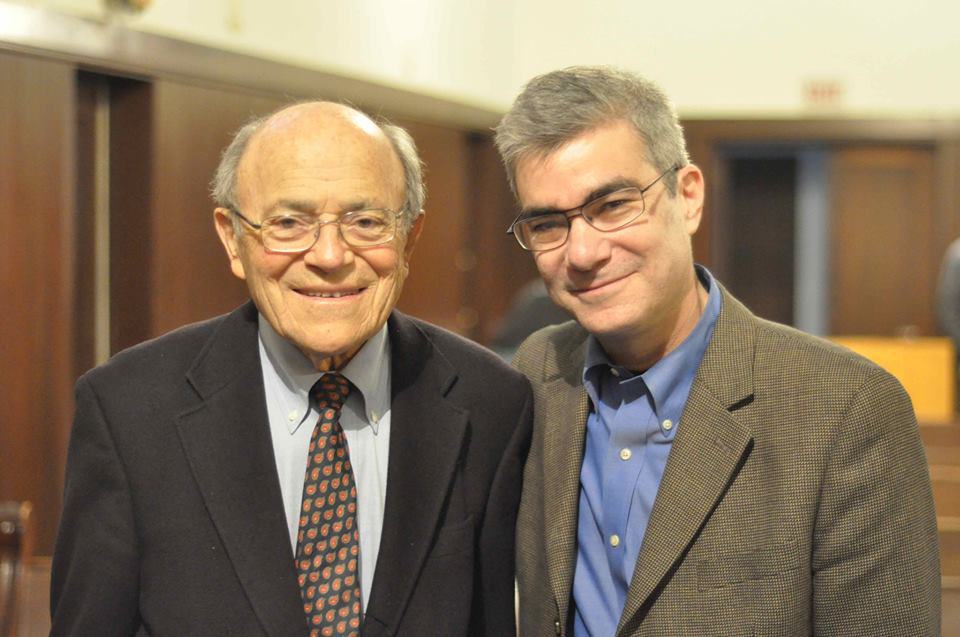
With Rabbi Leonard Beerman, left, Los Angeles, 2/2014

With Rabbi Leonard Beerman, left, Los Angeles, 2/2014

I am devastated to learn of the passing of my dear friend and mentor, Rabbi Leonard Beerman z”l, who died early this morning at the age of 93. His death comes as a profound shock to those of us who knew and loved him. Despite his advanced age, Leonard maintained his extraordinary vigor and energy until very recent days.

Readers of this blog may recall my post on our joint speaking presentation in Los Angeles last February. It was such a tremendous honor for me hold this open conversation with him, in which we mutually explored the subject of “Progressive Politics from the Pulpit.”

Here’s what I wrote at the time:

As Rabbi Beerman has been one of my true rabbinical heroes for so many years, it was truly a thrill for me to share a podium with him as we shared our thoughts on the challenges facing congregational rabbis who engage in progressive social justice activism.

As a Los Angeles native myself, I’ve long known of Rabbi Beerman’s inspired work during the years he served as the Senior Rabbi of LA’s Leo Baeck Temple. He was the founding rabbi of Leo Baeck in 1949 and stayed there for the next 37 years until his retirement in 1986. During that time, he challenged his congregants – and the Jewish community at large – to awaken to some of the most critical socio-political issues of the late 20th century.

Rabbi Beerman was a maverick in his day – and in many ways still is. He is a self-described pacifist who came by his stance honestly, after serving in the Marines in World War II and in the Haganah in 1947 while attending the newly founded Hebrew University. He was a student of Rabbi Judah Magnes, the great Reform leader who advocated for a bi-national state for Jews and Arabs – and he remains a passionate advocate for a just peace in Israel/Palestine to this day.

Rabbi Beerman came to Leo Baeck fresh from Hebrew Union College in Cincinnati during the height of the Cold War and quickly became an outspoken and visionary peace activist. In one of my very favorite stories, he described his anguish at the execution of Julius and Ethel Rosenberg, which took place on a Friday afternoon in 1953. During Shabbat services that evening, he decided to add their names to the end of the yahrtzeit list (the list of names read before the recitation of the Kaddish) much to the dismay of some of his congregants.

Rabbi Beerman was also one of the first rabbis in the country to publicly condemn the US war in Vietnam and later instituted draft counseling in his congregation. He invited such figures as Daniel Ellsberg (who spoke on Yom Kippur afternoon while he was awaiting trial) and Cesar Chavez to speak at his synagogue. Rabbi Beerman was also a visionary leader for civil rights and worker justice and during the nuclear arms race was one of the leading Jewish voices in the disarmament movement.

I’ve particularly admired Rabbi Beerman’s fearlessness when it came to the subject of Israel/Palestine – clearly the issue that has earned him the angriest criticism from the Jewish establishment. He was a consistent and faithful advocate for justice for the Palestinian people long before such a thing was even countenanced in the Jewish community. Literally going where few other rabbis would dare to tread, he met with Palestinian leaders such as Yasser Arafat and Fatah founder Abu Jihad. That he was able to do all of this while serving a large, established Los Angeles synagogue speaks volumes about his integrity – and the abiding trust he was able to maintain with the members of his congregation.

Now in his 90s, Rabbi Beerman is still deeply engaged in the issues of our day. During our conversation together, we spoke about the current state of the Israel/Palestine conflict, the languishing peace process and the rise of the Boycott, Divestment and Sanctions movement. I mentioned to those present that in 2008, during the height of Operation Cast Lead, when Rabbi Brian Walt and I were calling rabbinical colleagues to sign on to a Jewish Fast for Gaza, Rabbi Beerman was one of the first to sign on without hesitation. He did the same when we were forming the Jewish Voice for Peace Rabbinical Council and his presence there is truly an inspiration to our members.

Little did I know, as I wrote these words, that I would be posting them again in less than a year’s time, as a tribute to his memory. And little did I know last February, as I openly shared my open admiration for Leonard as a congregational rabbinical role model, that in only a few months I would be find myself unable to continue combining radical political activism with a congregational rabbinate. I am all the more in awe of what Leonard was able to achieve, serving as the rabbi for Leo Baeck Temple for 37 years as he bravely spoke out on important and controversial issues of his day. We will not soon see the likes of him again.

I encourage you to read this wonderful LA Times profile of Rabbi Beerman that was published just last month. You can see our presentation in its entirety below.

May his memory be a blessing forever.

Yom Ha’atzmaut 2014: Is the Jewish State Truly Free?

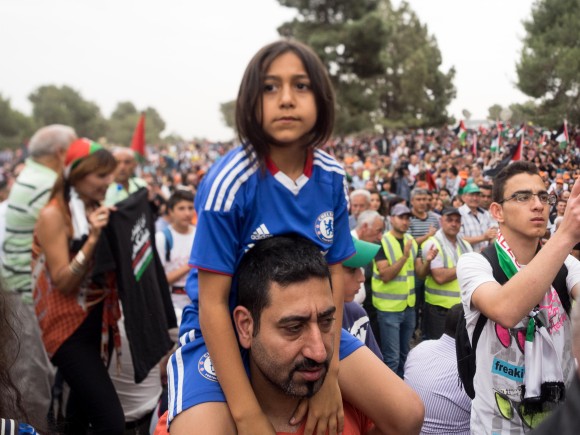
The massive Palestinian protest rally in the clip above took place this past Tuesday, on the day Israelis celebrated as Yom Ha’atzmaut (Independence Day). What’s particularly notable about this rally is that it didn’t take place in the West Bank or Gaza, but rather in Israel proper. More precisely, it took place on the site of the village of Lubya in the lower Galilee, one of hundreds of Palestinian villages depopulated by Jewish militias in 1948 to make way for the founding of the State of Israel.

This protest was part of an annual event known as the “March of Return,” which has taken place inside Israel for the past 17 years. Organized by a coalition of Palestinian groups, the march annually promotes the conviction of Palestinian citizens of Israel that Israel’s independence is irrevocably bound up with the Palestinian collective tragedy known as the Nakba.

By all reports, this was the largest March of Return yet; an estimated 10,000 Palestinian citizens of Israel defied Israel’s anti-Nakba law, driving and hiking past angry Israeli-Jewish counter-demonstrators and police who confiscated their Palestinian national flags. Then they gathered together at Lubya to hear from a variety of Palestinian politicians and activists. Most notably, this year’s commemoration included explicit calls for a recognition of the Palestinian right of return.

Several years ago I wrote that I believed Yom Ha’atzmaut should much more appropriately be observed by Jews as a day of reckoning rather than a day of unmitigated celebration. Watching the clip above, I am all the more convinced of this than ever. Can a nation truly celebrate itself, as its national anthem would have it, as an “am chofshi be’artzeynu” (“a free people in our own land”) when it includes a minority such as this in its midst?

photo: Dan Cohen/Mondoweiss

photo: Dan Cohen/Mondoweiss

Meanwhile, here in Chicago, a prominent synagogue observed Yom Ha’atzmaut through public readings of Israel’s Declaration of Independence, which an organizer referred to as a “sacred text:”

Most of the holidays are mentioned in the Bible or were created in ancient time and there is already a tradition…Every Jewish holiday, usually, you have a text. This is something special about the Jewish culture or religion.

As a religious Jew, I personally take great exception to the use of the term “sacred text” in reference to such a patently political document as Israel’s Declaration of Independence. For me, it is yet another sad example of how political advocacy for the State of Israel has become so firmly (and idolatrously) ingrained in the religious life of the American Jewish community.

The organizer of this event took pains to add:

It’s very important that we keep on making sure that people that are not Jewish will get equal rights and the same opportunities…The declaration gives us a very good vision, as a start of the discussion.

It’s a noble statement, but it belies the fact that Palestinian citizens of Israel do not actually enjoy “equal rights” and “the same opportunities” as Jewish citizens of Israel. There are, in fact, more than 50 Israeli laws that structurally discriminate against Palestinian citizens of Israel in virtually all areas of life, including their rights to political participation, access to land, education, state budget resources, and criminal procedures. (Click here for an extensive list of these laws.)

This statement also belies the fact that the Israeli political establishment increasingly views Palestinian citizens of Israel as a “Fifth Column.” For his part, Israel’s Foreign Minister, Avigdor Lieberman, who openly promotes the transfer of Israel’s Palestinian citizens across the Green Line, responded to Tuesday’s March of Return commemoration with the following statement:

To those Arabs that took part today in the “Nakba Day” procession and waved Palestinian flags, I suggest that next time they march directly to Ramallah and they stay there.

With such clear and increasing polarization on both sides, I submit that it is still too early for Jewish citizens of Israel to truly declare themselves to be an “am chofshi be’artzeynu.”


Reclaiming MLK’s Vision of Economic Justice in Chicago!

1536429_471889092915536_1609444794_n

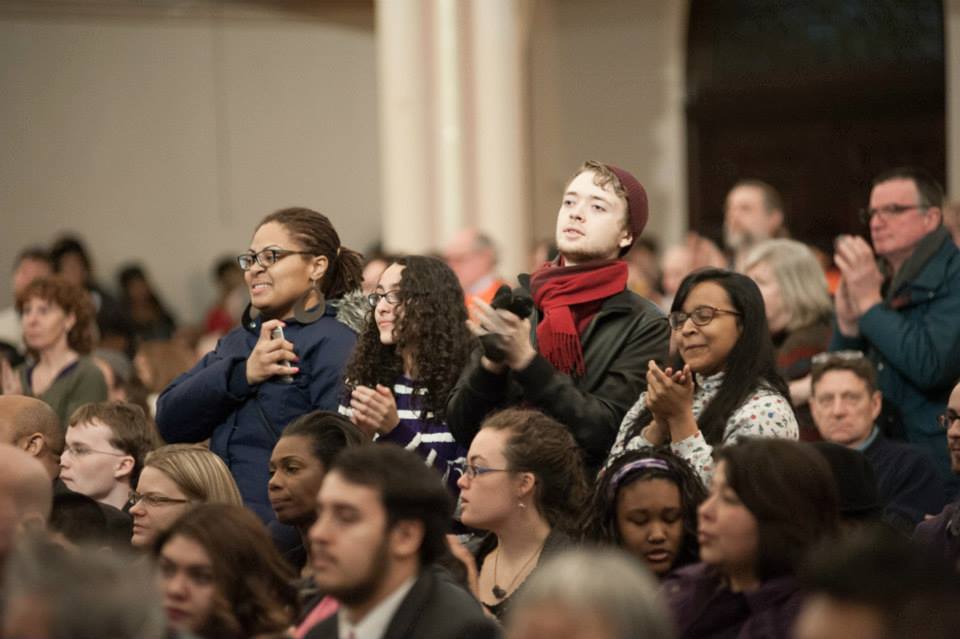
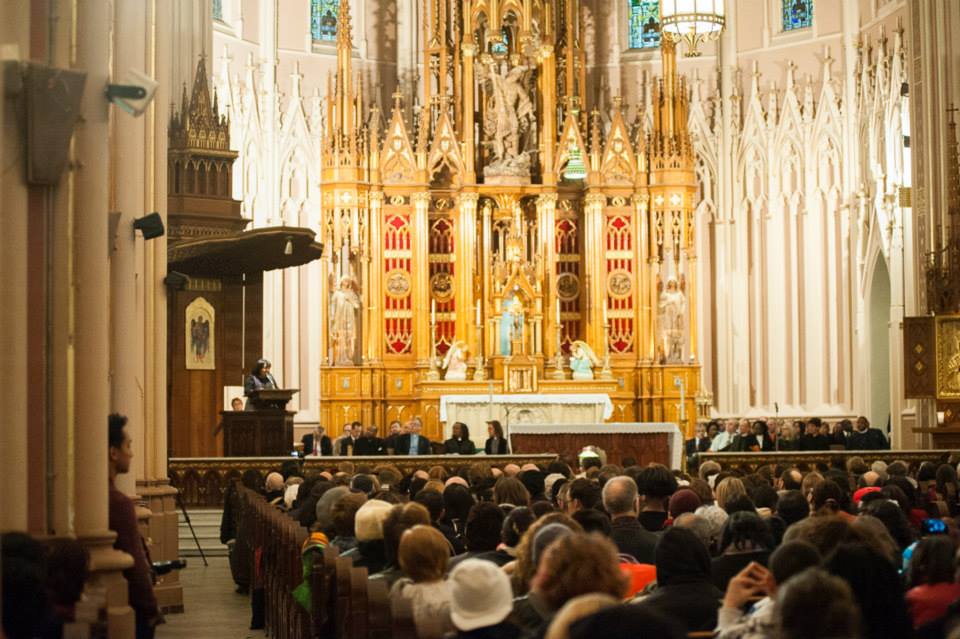
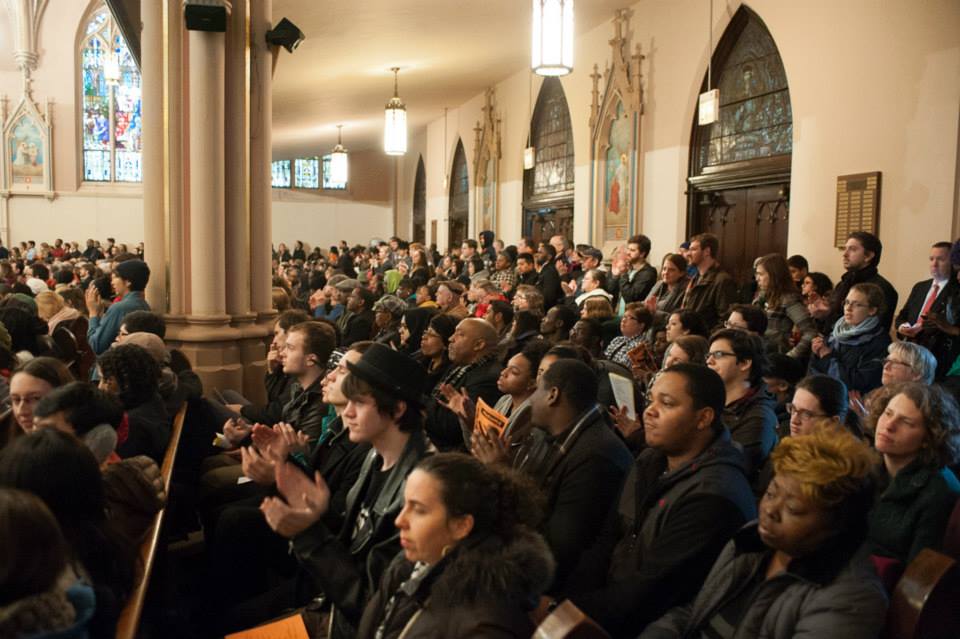
It was my great honor to participate yesterday in the profound and important MLK commemoration: “Hope in an Age of Crisis: Reclaiming Dr. King’s Radical Vision for Economic Equality.”  On a cold Sunday afternoon, an SRO crowd of 2,000 participants streamed into St. Michael the Archangel Catholic Church on Chicago’s South Side to reaffirm King’s unfinished work: the dream of economic equality for all Americans.

While few of us would deny the importance of devoting a National Holiday to the life and work of Dr. King, I believe this day too often sanitizes his legacy into meaninglessness. Even worse is the way corporate America has co-opted his name for its own profit and gain. (This morning, I opened the morning paper and was greeted by ads that invoked King to sell everything from cars to Macy’s merchandise.)

1549561_471889592915486_1435665852_n

It’s worse than ironic, when you consider how often King railed against corporate greed in this country – particularly toward the end of his life. Here’s but one example – a pointed MLK quote that was read aloud at yesterday’s gathering:

You can’t talk about solving the problem of the Negro without talking about billions of dollars. You can’t talk about ending the slums without first saying profit must be taken out of slums. You’re really tampering and getting on dangerous ground then. You are messing with captains of industry. Now this means that we are treading in difficult water, because it really means that we are saying that something is wrong with capitalism. There must be better distribution of wealth and maybe America must move toward a democratic socialism.

Our keynote speaker, Reverend Dwight Gardner, of Trinity Baptist Church in Gary Indiana, put it very, very well:

Today in this celebration we will not lift up the toothless, scrubbed and anesthetized Dr. King as created by the mainstream media and ruling elite but we will uncover the real Rev. Dr. Martin Luther King and his radical vision for economic equality.

In 1963 during the March on Washington, Dr. King gave an address that included a short section about a dream, but in the same speech he also declared that America had written the Negro a bad check that had come back stamped insufficient funds.  To paint him with only the hope that we could all just get along does his legacy a disservice and confuses Dr. King with Rodney King.

BeYHFLACUAAVM_R

And so our event, organized by the People’s Lobby and IIRON, brought together a wide range of citizens to reclaim King’s radical and unfinished legacy of economic equality. And more: to commit to creating a new movement to make it so.

Speaker after speaker spotlighted local Chicago and Illinois legislation that addressed issues ranging from corporate financial accountability, a living wage, public sector jobs, the prison industrial complex and environmental protection. One by one we invited elected officials to the stage and asked them tell us if they would support these legislative initiatives. Then we ended with a pledge to continue organizing to make this dream a reality.

One of our speakers, George Goehl, Executive Director of National People’s Action, correctly pointed out that the unprecedented inequities currently facing our nation are the product of a “masterful forty year plan hatched by CEOs and right wing politicians who were clear that they had to aggregate power to expand profit.”  Goehl noted that those of us who believe in a more equitable system will now have to develop our own long term plan for the “New Economy” with the following core goals:

– Everyday People Controlling the Economy

– An End to Structural Racism

– Corporations Serving the Common Good

– True Democracy – People in, Money Out

– Ecological Sustainability

1560529_471888859582226_130926385_n

The power of these kinds of public meetings resides in their modeling of a system that is generated by people power. Unlike most political events, in which elected leaders or candidates drive the agenda, this gathering was driven forward by the people themselves. The politicians who participated were not allowed to give stump speeches but were rather asked to say aloud to the community whether or not they intended to support these legislative efforts. As King himself taught us, our elected leaders are not change agents – it is rather the popular movements that lay their demands at their door.

I encourage you, this MLK Day, to resist the corporate co-opting of King’s name – and to support efforts in your community to create true economic justice to our nation. Click here to learn about organizing initiatives near you.

Stand in Solidarity with Walmart Workers this Black Friday!

If you want to do a mitzvah this Black Friday, please consider joining the growing movement that is demanding that Walmart treat its employees with human dignity and pay them a livable wage.

Emboldened by news from Walmart CEO that hundreds of thousands of Walmart workers are paid less than $25,000 a year, Walmart workers and supporters announced plans today for protests on Black Friday (November 29). Workers are demanding that Walmart to commit to improving labor standards, providing workers with more full time work at $25,000 a year and to put an end to illegal retaliation.

Today’s announcement follows revelations this week that many Walmart workers don’t have enough money to cover Thanksgiving dinner for their families, as well as the historic federal government finding that Walmart has been violating workers’ rights nationwide. In the meantime Walmart is the country’s largest retailer and employer, making more than $17 billion in profits, with the wealth of the Walton family totaling over $144.7 billion – equal to that of 42% of Americans.

Check out the new online video, above, in which the OUR Walmart campaign member Martha Sellers discusses employee’s struggles to get by on Walmart’s low pay. The video includes incredulous reactions from the media to the news that employees – not the company – are coming together to donate food to those who can’t afford a Thanksgiving dinner on their Walmart wages.

Over the past month, there have been exciting grassroots Walmart actions across the country, including the largest-ever civil disobedience against the retail giant in Los Angeles, Chicago, Miami, Seattle, Ohio and Dallas. On Black Friday last year, 30,000 Americans called for the country’s largest employer to change at over 1,000 stores in 46 states. This year is set to be even bigger, with experts like Occidental College professor Peter Dreier already calling Black Friday 2013 a “day for the history books” and a “major turning point in American history, similar to the Flint sit-down strikes of 1937.

Click here for information about a Walmart action near you (or to register one). Click here to sign an online petition started by Walmart employee Charmain Givens-Thomas that calls on President Obama to meet with strikers to “hear firsthand why they are appealing for respect and calling on Walmart to pay them enough to feed and support their families.”

I’ll see you in the streets this Black Friday!

Civil Disobedience in Chicago for Immigrant Justice!

Photo: Illinois Coalition for Immigrant and Refugee Rights

photo: Illinois Coalition for Immigrant and Refugee Rights

This evening it was my honor to participate in an act of civil disobedience in Chicago in support of immigrant justice – a cause I fervently believe is the civil rights issue of our time. One hundred and sixty strong, a large and diverse coalition of activists, faith leaders, politicians, labor leaders and undocumented immigrants sat down together in the busy intersection of Congress and Clark in the South Loop with two demands: that Speaker of the House John Boehner bring comprehensive immigration reform to a vote, and that President Obama stop the oppressive deportations of undocumented immigrants (which have now grown to 2,000,000 under his administration.)

We gathered at 3:30 pm for a press conference, after which we filed off the sidewalk into the intersection and sat down around a banner reading “Stop Deportations – Give us a Vote.” On all four corners of the intersection, hundreds of supporters unfurled banners and held signs and chanted along with us. Eventually, after three warnings, Chicago police led each of us away one by one.

photo: Jewish Council on Urban Affairs

photo: Jewish Council on Urban Affairs

Our demonstration tonight was but one of a growing numbers of civil disobedience actions currently proflierating across the country. Last month, thousands rallied for immigration reform on the National Mall in Washington DC during the government shutdown – and 200 were led away by police.  A few days earlier, similar rallies were held in Los Angeles, San Diego and Boston and other cities as part of a “National Day of Immigrant Dignity and Respect.”

While politicians in post-shutdown Washington dither on this critical issue in Washington, citizens are literally taking to the streets to demand compassionate immigration reform. There is a very real movement building – trust me, as long our leaders refuse to act, you will be witnessing many more actions such as these in the coming weeks and months.

photo: Tina Escobar

photo: Tina Escobar

It was my honor to be among the speakers at  press conference before the demonstration (above). Here is the full text of my remarks (which was shortened due to time restraints):

My name is Brant Rosen – I’m the rabbi of Jewish Reconstructionist Congregation in Evanston and I’m a member of this amazing, diverse and growing coalition of activists who are working for the cause of immigrant justice. I am part of the majority of Americans and 80% of Illinoisians who support compassionate immigration reform that provides a path to citizenship.

And I am here to say it is time for our national leaders to lead. It is time for Speaker John Boehner and Republican leader Peter Roskam to give us a vote. It is time for President Barack Obama to end the daily deportatins that are now approaching 2,000,000 and has left 3,000,000 children orphaned.  This is not simply a political issue – and shame on any politician who treats immigration reform as “business as usual.”  Immigration reform is one of the most critical moral and human rights issues facing our country today.

As a Jew, my faith tradition teaches that societies will ultimately be judged by the way they treat their immigrants. My faith tradition teaches that when we label another human being as “illegal,” we diminish God’s presence in our world. When we incarcerate and deport those who come to this country seeking a better life, we diminish God’s presence in our world. And when we create and enforce laws that rip children away from their parents – and parents from their children – we most certainly diminish God’s presence in our world.

My faith tradition also teaches that God stands with the oppressed and demands that we do the same.  And make no mistake: our immigration system constitutes a very real form of oppression against families in our nation.  It is thus our sacred duty to stand here today, in front of US Immigration Customs and Enforcement headquarters, to say: this oppression must end.  The destruction of our families must end. The daily deportations of 1,100 human beings must end.  It is our sacred duty to bring it to an end.

John Boehner and Peter Roskam: It’s time to give us a vote on citizenship.  It’s time to end the oppression of our undocumented brothers and sisters.  President Obama: it’s time to keep your promise to the American people. 2,000,000 deportations is 2,000,000 too many. Stop deportations now!

If our national leaders refuse to lead, then it is time to take to the streets. And tonight, we will take to the streets. Our movement is the new civil rights movement growing in cities across the nation, rising up to demand compassionate immigration reform now. You will hear from us tonight in Chicago – and you will be hearing from us again and again until our oppressive immigration system is no more!

It has been my honor to stand together in this movement with so many people from so many different faiths and ethnicities and histories. It has been a particular honor to stand together with our undocumented sisters and brothers, whose steadfast courage and dignity are an inspiration to us all.

My own grandparents were immigrants to this nation. I know all too well that I am the beneficiary of their decision to come to this country, and of my country’s willingness to provide them with a path to citizenship. For those of us who enjoy the privileges of the courageous decisions of those who came before us, it would be a profound betrayal if we did not stand together here today.

We are here today. We will be here tomorrow. And we will stand together every day until compassionate immigration reform is finally a reality in our country.  Ken Yehi Ratzon – as it is God’s will, so my it be ours.

Amen and thank you all for coming out tonight.

___________________________________

En Español (Gracias a Gonzalo Escobar):

Mi nombre es Brant Rosen – Soy el rabino de la Congregación Judía Reconstruccionista en Evanston y soy un miembro de esta increíble y diversa y creciente coalición de activistas que trabajan por la causa de la justicia para los inmigrantes. Yo soy parte de la mayoría de los estadounidenses y el 80 % de Illinoisians que apoyan la reforma migratoria compasiva que proporcione un camino a la ciudadanía.

Y yo estoy aquí para decir que es hora de que nuestros líderes nacionales para hagan su trabajo de legislar. Es hora de que los Representantes, John Boehner, y el líder republicano Peter Roskam nos den un voto. Es hora de que el presidente Barack Obama ponga fin a las deportaciones diarias que se están acercando a 2 millones y han dejado a 3 millones de niños y niñas huérfanos. Esto no es simplemente una cuestión política y es una vergüenza que un político trate la reforma migratoria como “como si no pasara nada”, la reforma de inmigración es uno de los temas de derechos humanos y morales más importantes que enfrenta nuestro país hoy en día.

Como judío, mi tradición de fe nos enseña que las sociedades en última instancia, serán juzgadas por la forma en que tratan a sus inmigrantes. Mi tradición de fe nos enseña que cuando etiquetamos a otro ser humano como “ilegal”, disminuimos la presencia de Dios en nuestro mundo. Cuando encarcelamos y deportamos a los que vienen a este país en busca de una vida mejor, disminuimos la presencia de Dios en nuestro mundo. Y cuando creamos y hacemos cumplir las leyes que separan a los niños de sus padres – y a los padres de sus hijos – ciertamente estamos disminuyendo la presencia de Dios en nuestro mundo.

Mi tradición de fe también enseña que Dios está con los oprimidos y demanda que hagamos lo mismo. Y no nos engañemos: nuestro sistema de inmigración constituye una forma muy real de la opresión contra las familias en nuestro país. Por tanto, es nuestro deber sagrado de estar aquí hoy, frente a la sede de inmigración y aduanas de EE.UU. para decir: la opresión debe terminar. La destrucción de nuestras familias debe terminar. Las deportaciones diarias de 1.100 seres humanos deben terminar. Es nuestro sagrado deber de ponerle fin.

John Boehner y Peter Roskam : Es hora de que nos den un voto para la ciudadanía . Es hora de poner fin a la opresión de nuestros hermanos y hermanas indocumentados. Presidente Obama: es el momento de mantener su promesa al pueblo estadounidense. 2 millones de deportaciones y 2 millones es demasiado. ¡Detengan las deportaciones ahora!

Si nuestros líderes nacionales se niegan a legislar, entonces es el momento de salir a la calle. Y esta noche, vamos a salir a las calles. Nuestro movimiento es el nuevo movimiento de derechos civiles que crece en las ciudades de todo el país, para exigir una reforma migratoria compasiva ahora. Ustedes nos escucharán esta noche en Chicago -¡y ustedes nos escucharan a nosotros una y otra vez hasta que nuestro sistema de inmigración opresivo no exista más!

Ha sido un honor para mí estar juntos en este movimiento con tantas personas de tantas religiones y etnias e historias diferentes. Ha sido un gran honor particular, estar junto a nuestras hermanas y hermanos indocumentados, cuyo valor y dignidad inquebrantable son una inspiración para todos nosotros.

Mis abuelos eran inmigrantes de esta nación. Sé muy bien que soy el beneficiario de su decisión de venir a este país, y de la voluntad de mi país para proporcionarle un camino a la ciudadanía. Para aquellos de nosotros que disfrutamos de los privilegios de las decisiones valientes de los que vinieron antes que nosotros, sería una traición profunda si no nos mantenemos unidos hoy aquí.

Estamos aquí hoy. Vamos a estar aquí mañana. Y vamos a estar juntos todos los días hasta que la reforma migratoria compasiva sea finalmente una realidad en nuestro país. Como se dice en Hebreo “Ken Yehi Ratzon” – ya que es la voluntad de Dios, y será la nuestra.

Amén y gracias a todos por venir esta noche.

Remembrance as Palestinian Resistance

Zochrot's Eitan Bronstein leading a tour of Lifta

Zochrot’s Eitan Bronstein leading a tour of Lifta

There are many forms of resistance to oppression. One is memory itself.

On Tuesday our delegation visited the village of Lifta, a Palestinian village on the outskirts of Jerusalem that was depopulated of its residents by Jewish militias early in 1948. Our tour was led by Eitan Bronstein, director of Zochrot, an Israeli organization that educates Israelis about the Nakba, actively advocating for the Palestinian Right of Return. It’s truly one of the bravest, most important Israeli organizations I know.

Zochrot’s tours of destroyed Palestinian villages are an critical aspect of their educational work. They are, of course, not your typical tours – in most cases they do not show you what is, but rather what is no more. Most Palestinian villages destroyed during the Nakba were razed to the ground, leaving little behind but the shell of a building or the occasional foundations of homes.  Zochrot keeps the culture life of these communities alive through their tours, underscoring the profound enormity – and collective tragedy – of what was lost.

IMG_0789

Lifta

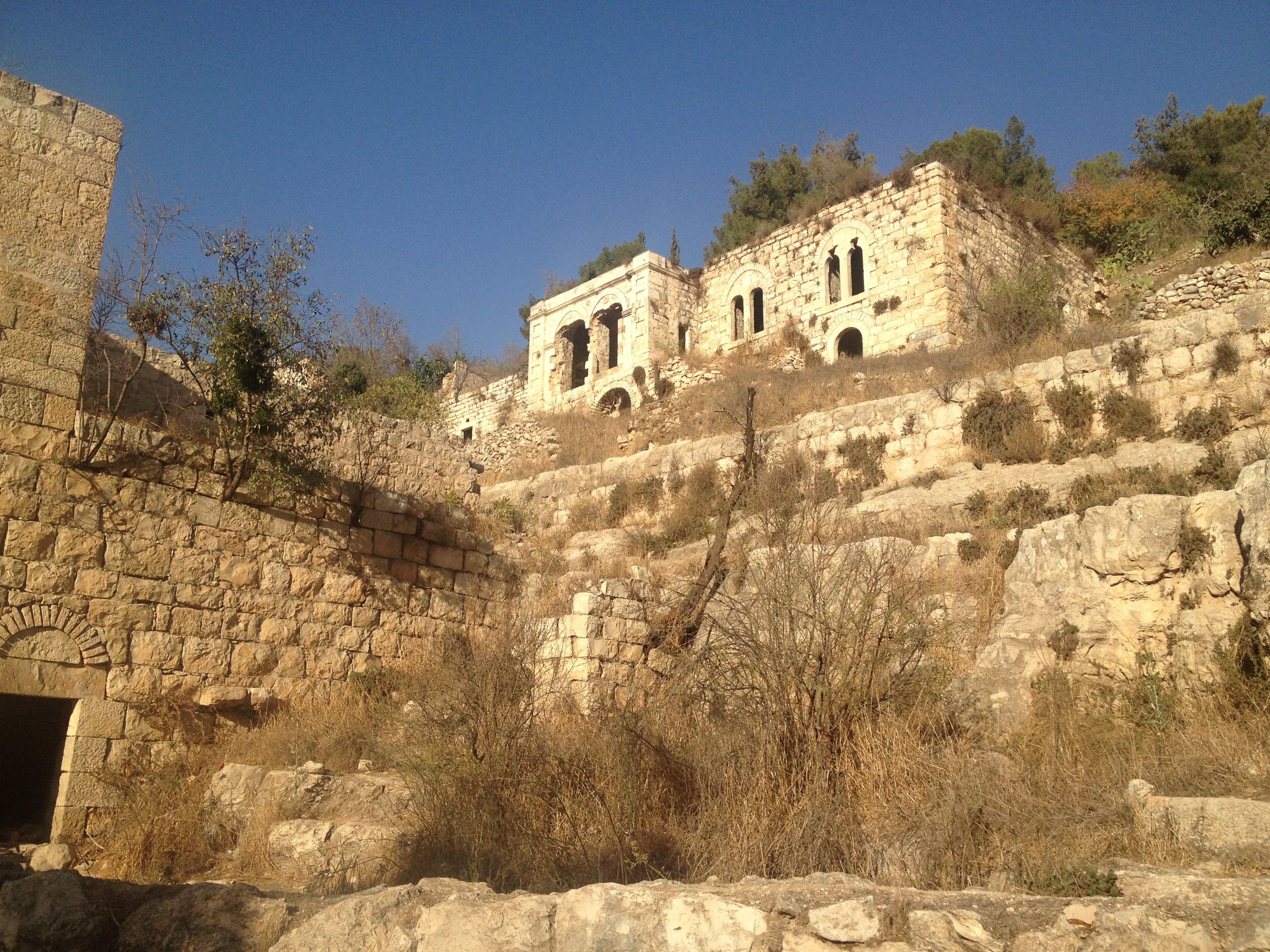
Lifta is somewhat unique among these villages in that it is the only Nakba-era village that still remains largely intact. In its day it was a fairly well-to-do community, with a population of 2,550.

In the years leading up to the 1948, the village fell under attack by Jewish militias in the area. On the December 28, 1947 six people were gunned down in the village coffeehouse, by members of two Jewish militias, the Stern Gang and the Irgun. In late January or early February, the militias attacked and seized the neighboring village of Qaluba and then invaded Lifta from the West. They occupied Lifta’s new town and the remaining residents took refuge in the old town in the valley. The village was cut-off from the west and anyone trying to leave was killed. The villagers resisted but were defeated after several hours of fighting.

By the time the entire village was occupied, most of the people had already left Lifta and fled into the West Bank, the rest were taken by truck and dumped in East Jerusalem. By February 1948, Lifta had been completely depopulated.  It’s not completely clear why the Jewish forces did not raze Lifta to the ground as it had so many other villages. For a time it allowed newly-immigrated Yemenite Jews to occupy the houses, but when the homes proved uninhabitable, they were eventually abandoned

IMG_0791

with Eitan Bronstein

Lifta was the object of some controversy when the Jerusalem municipality announced plans to redevelop the area as a luxury area for Israelis. The plans were dropped after an outcry from former residents and progressive Israeli activists. In the meantime, the remnants of this remains, a testament to the legacy of a rich communal life that was lost during the Nakba.

I can see why Lifta is such a popular spot for Israeli tourists – the town ls nestled in a long valley, with homes and buildings built into either side. The mosque and the Muktar’s house are still in decent condition, testifying to what clearly once was a beautiful, desirable town. At the bottom of the valley is a natural spring that still attracts swimmers, particularly ultra-orthodox who attribute spiritual significance to it. As Eitan showed us the area, the swimmers glared at us as if we were interloping in their own “sacred territory.”  They clearly had no comprehension of the actual profanity that had occurred here in 1948.

On Wednesday evening, we visited another Nakba site: El Ghabsiya, located in the upper Galilee (where were visiting members of delegation members Shafic and and Dima Budron’s family – more on this later). Our tour of El Ghabsiya was led by Muhammad Kaial of the Association for the Defense of the Rights of the Internally Displaced Persons in Israel, and Daoud Bader, an original survivor of the original village.

The story of El Ghabsiya, like Lifta, is an example of how the Nakba is not only a historical event of the past, but an injustice and a struggle that occurs even in our very day. In March 1948, fearful that uncertainty in Palestine’s future could endanger the people of the village, prominent members of El Ghabsiya made an agreement with Jewish militia leaders. In exchange for his cooperation, the militia promised not to invade the village. (At that time, the population of the village numbered about 700 people.)

Inside El Ghabsiya mosque (far right: Muhammad Kaial)

Inside El Ghabsiya mosque (far right: Muhammad Kaial)

The agreement was not to be honored. In May 1948, Jewish militias surrounded and entered the village. Families living near entrance to the village greeted the soldiers with coffee; in return father and his son were taken out into the nearby woods – Daoud told us that they have never been heard from to this day. When the soldiers entered El Ghabsiya, a community leader named Daoud Zainl climbed to the roof of the mosque and raised a white flag. The militia ignored his act of surrender, opened fire, and killed him on the spot. In  all, eleven Palestinians were killed during the attack on El Ghabsiya and the subsequent expulsion of its residents, despite the fact that there was no local resistance.

The inhabitants of the village escaped to surrounding villages, becoming “internally displaced refugees.” Unlike other internally displaced Palestinians, the people of El Ghabsiya were allowed to return to their homes less than twelves months later – but two years later, on August 2, 1951, then Prime Minister David Ben-Gurion declared the village a “closed military zone” and the villagers were again forced to leave their homes.

The people of El Ghabsiya fought for their right of return all the way to the Israeli Supreme Court and on November 1951, the court ruled that they did indeed have the legal right of return to their village. Armed with this ruling, the villages gathered and headed back to their homes – and were met by Israel military forces the blocked their way and refused to recognize the decision of the court.  In succeeding years, government bulldozers destroyed all of the houses in the village – the only building left standing was the village mosque.

For the next forty five years, the Israeli Land Authority allowed the mosque to sit in disrepair and desecration, used as a stable for horses and other animals. Finally, in 1995 residents and descendents of residents of El Ghabsiya initiated a clean-up project and began weekly attempts to pray at their mosque. In response, the Israeli Land Authority sealed the windows and doors and ringed the mosque with barbed wire.

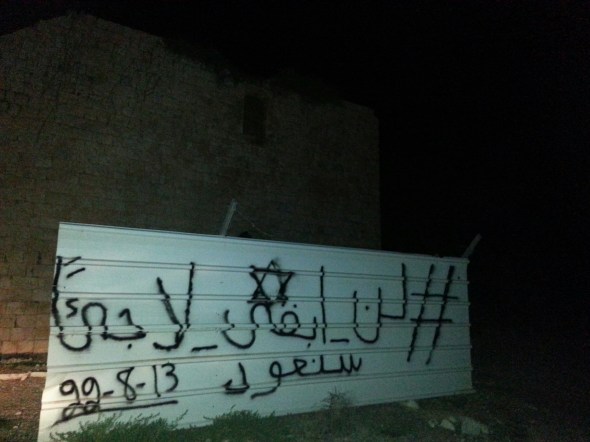
Outside El Ghabsiya mosque: “I will not remain a refugee – we will return.”

Still, the people of El Ghabsiya have not given up. Most live in villages near their ancestral village and they still make regular attempts to gather to pray at their mosque. Above you can see the sign villagers have placed in front of the mosque: “I will not remain a refugee – we will return.” (You can also see that the sign has been vandalized, sadly enough, with a Jewish star.)

After hearing this story, our group toured the mosque and gathered in the courtyard. On of our members Kalman Resnick said that as a member of the Jewish community and a man whose own family fled persecution, he felt shame at hearing this story of dispossession, that continues to this day. I then led the Jewish members of our delegation in the recitation of Kaddish for those who were killed on this site in 1948.  In return, Daoud, the original resident of the village, emotionally expressed his appreciation for our presence and our solidarity – a profoundly moving moment for us all.

After our visit, our group discussed ways we might help support the people of El Ghabsiya in their quest for justice – and their simple desire to pray in their ancestral mosque. More info on this effort will be forthcoming.

We’ve just returned from our Friday demonstration. It was, quite simply, an indescribable experience –  I’ll do my best to describe it in my next post…

In Memory of our Voting Rights Martyrs: A Sermon for Kol Nidre 5774

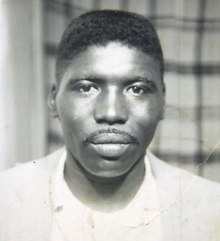
Jimmie Lee Jaskson

Jimmie Lee Jackson

I’d like to begin tonight by telling you the stories of three heroes of the civil rights era. I’d wager most Americans have never heard of them – but as far as I’m concerned, they deserve to be at least as well known as Emmett Till, Medger Evers and Rosa Parks.

The first is Jimmie Lee Jackson, an African-American farmer and woodcutter from in Marion, Alabama. Jackson grew up in poverty, but planned to move North for a better life after graduating from high school. After his father’s early death however, he spent his the remainder of his life on his small family farm in Marion, where he lived together with his sister, mother, and grandfather.

Jackson was an army veteran and a deeply faithful man; he became the youngest deacon in the history of Marion’s St. James Baptist Church. He also turned into a political activist at an early age after unsuccessfully attempting to register to vote for four years. Jackson spearheaded his church’s voter registration drive and eventually became a prominent civil rights leader in Merion.

On the night of February 18, 1965, Jackson participated in a demonstration in which 500 people peacefully marched from a church in Marion to the county Jail about a half a block away to protest the imprisonment of a young civil rights worker. On their way, the marchers were met and beaten by a line of Marion City police officers, sheriff’s deputies, and Alabama State Troopers. Among the injured were two United Press International photographers. A NBC News correspondent was so badly beaten that he was later hospitalized.

The marchers quickly turned and scattered back towards the church. Pursued by the state troopers, Jackson, his sister, mother, and 82-year-old grandfather ran into a café. The troopers followed them in and clubbed his grandfather to the floor. When Jackson’s sister and mother attempted to pull the police off and they began to beat them as well. Jackson went to protect them and a trooper threw him against a cigarette machine. A second trooper moved in and shot Jackson twice at point blank range in the abdomen.

Jackson staggered outside, was clubbed again and fell wounded in the street, where he lay for half an hour. Later that night, Jackson, his mother and grandfather were transported to a hospital in Selma. His mother and grandfather suffered head wounds but were treated and released – Jimmie Lee remained in the hospital where his condition grew steadily worse. Four days later, an Alabama state trooper walked into and hospital room and charged Jackson with assault and battery with intent to murder a peace officer. Eight days later, on Friday, February 26, Jimmie Lee Jackson died from his wounds.

His funeral took place on March 3. Dr. Martin Luther King was among the speakers at the service, after which a thousand people followed Jackson’s casket through the rain to a local cemetery. Four days later, several hundred marchers left Brown Chapel in Selma, formed a long column, and began walking up the steep incline of the Edmund Pettus Bridge, which spans the Alabama River. Their goal was to walk 54 miles to the state capitol in Montgomery to protest Jackson’s death and petition the governor and legislature to open the state’s voting rolls to all citizens. The march ended violently on a day we would all come to know as “Bloody Sunday.” It was a galvanizing moment in the fight for voting rights in this country.
Reverend James Reeb

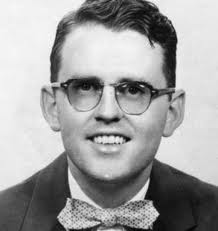
Reverend James Reeb

The second person I’d like to profile for you now is Reverend James Reeb. Reeb was raised in Caspar, Wyoming, served in the Army during World War II, and was later ordained by the Princeton Theological Seminary. Soon after, however, he left the Presbyterians and joined the Unitarian Universalist church. As a white man who believed in civil rights, he was particularly drawn to the UU’s strong emphasis on social justice.

Reverend Reeb was fully ordained as a Unitarian Universalist minister in 1962. After serving for a few years at All Souls Church in Washington DC, he became the director of the American Friends Service Committee Metropolitan Boston Low Income Housing Program in 1964. With his wife and four children, he moved to Boston and purchased a home in Roxbury, a predominantly African-American area of the city. His daughter Anne later recalled that her father “was adamant that you could not make a difference for African-Americans while living comfortable in a white community.”

Following Bloody Sunday, Reeb went down to Selma with 45 Unitarian ministers and 15 laypeople to participate in the voting rights demonstrations that arose in the wake of Bloody Sunday. On March 9, he joined 2,500 marchers for a second march from Selma to Montgomery. As on previous attempts they were stopped by the police – and so the marchers returned to Browns Chapel for an evening of speeches, singing and prayers.

Later that night, Reeb and two other Unitarian ministers had dinner in a local black restaurant. Although he had planned to return to Boston that night, he called his wife and told her he had decided to stay for one more day. Upon leaving the cafe, the trio was set upon by four men brandishing clubs and yelling racist slurs. They attacked and beat the three men – wounding his two colleagues and severely injuring Reeb with a blow to his skull. Needing a neurosurgeon, he was driven ninety miles by ambulance to University Hospital in Birmingham. He died two days later.

Reverend James Reeb’s death sparked mourning event throughout the country – tens of thousands held vigils in his honor, including a ceremony in Selma, where he, like Jimmie Lee Jackson, was eulogized by Dr. King. That evening, on March 15, President Johnson spoke to a joint session of Congress on behalf of the Voting Rights Act. It was his famous “We Shall Overcome” speech, in which he urged Congress to outlaw all voting practices that denied or abridged “the right of any citizen of the United States to vote on account of race or color.” Six months later, Johnson signed the Voting Rights Act into law.

Viola Liuzzo

Viola Liuzzo

And finally, let me tell you now about Viola Liuzzo – born in 1925 to a poor white family that moved constantly throughout the Deep South. During the early months of World War II, her family moved to Michigan, where she worked in a bomber factory. Eager to contribute to the war effort herself, Viola moved to Detroit, where she married and had two daughters. They divorced shortly after and she eventually married Anthony James Liuzzo, a union organizer for the Teamsters. Anthony adopted her daughters and they had three more children together.

Though she was a high school dropout, Liuzzo trained as a medical laboratory assistant and later took classes at Wayne State University. There she was exposed to political ideas of the time, including debates about the Vietnam War, education reform, and economic justice. This period marked the beginning of her political activism. She was arrested twice in demonstrations and both times she insisted on a trial in order to publicize her causes.

In 1964 Liuzzo, a former Catholic, joined the First Unitarian Universalist Church of Detroit – attracted, like Reverend Reeb, by its commitment to civil rights. She also became active in the Detroit chapter of the NAACP. Like so many others, Liuzzo was galvanized by events in Selma. Following Reverend Reeb’s murder she attended a memorial service for him and soon after, she decided to go down to Selma herself to volunteer for a week. As she explained to her husband, she believed there were “too many people who just stand around talking.” She asked her closest friend, an African-American woman named Sarah Evans, to explain to her children where their mother had gone and to tell them she would call home every night. When Evans warned her that she could be killed, she replied simply, “I want to be part of it.”

So on March 21, Liuzzo joined 3,000 other marchers as they marched across the Edmund Pettus Bridge attempting to reach Montgomery. She stayed on to volunteer over the next few days, driving shuttle runs from the airport to the marchers’ campsite and helping at a first-aid station.

On March 25, she joined the marchers for the final four miles to Montgomery, where she joined the thousands that demonstrated at the Alabama State House. When the march was over, Liuzzo and African-American civil rights worker named Leroy Moton drove five marchers back to Selma. After they were dropped off, Viola volunteered to return Moton to Montgomery. On their way back, four Ku Klux Klan members pulled up alongside their car. Liuzzo tried to outrun them, but they caught up with her car and opened fire. Viola was shot twice in the head and died instantly.

Following her murder, President Johnson publicly demanded that the arrest of Liuzzo’s murderers be a top priority. In just 24 hours, the FBI arrested the four Klan members, one of home was an FBI informant. Johnson appeared personally on national television to announce their arrest.

The FBI would later attempt to publicly discredit Liuzzo – most likely to cover up the fact that their agent was a KKK member and may have actively participated in her murder. J. Edgar Hoover personally spread rumors that Liuzzo was a member of the Communist party and a drug addict and that she had traveled to Selma to have sexual relations with black men. Viola’s family was also targeted by hate groups – after crosses were burned in front of their home. Anthony Liuzzo had to hire armed guards to protect his family.

However, as in the case of Jimmie Lee Jackson and Revered James Reeb, Viola Liuzzo’s death had a powerful impact on the voting rights movement across the country. On March 27 hundreds of protesters marched to the Dallas County courthouse in Selma in her memory. The next day Dr. King eulogized her at San Francisco’s Grace Episcopal Cathedral. The NAACP also sponsored a memorial service for Liuzzo at a Detroit church that was attended by fifteen hundred people including Rosa Parks. A Roman Catholic Church in Detroit celebrated a high requiem mass that was broadcast on TV. Dr. King was among the 750 people in attendance.

As with Jackson and Reeb, Viola Liuzzo’s murder played a critical role in the eventual passage of the Voting Rights Act. According to historians, Johnson invoked her death repeatedly as he lobbied Congress. Five months after she died, he signed it into law.

Why am I telling you the stories of these three individuals tonight? One simple reason is that I believe they deserve to be told. We owe Jimmie Lee Jackson, Reverend James Reeb and Viola Liuzzo at least that much. And we owe it to ourselves. I took the time to tell you about them because so few really know the stories of these American heroes. And we should. We should know who they were, how they lived and the significance of their sacrifice.

I also have a specifically liturgical reason for telling you their stories tonight of all nights. The traditional  Yom Kippur service includes a section known as the Martyrology (or as we call it in Hebrew, “Eleh Ezkarah,” meaning “These I Remember.”) The centerpiece of Martyrology is a long liturgical poem that recounts the death of ten rabbis – including the famous Rabbis Akiba, Ishmael and Shimon ben Gamliel – who were executed for their support of the failed revolt against Rome in the year 132.

We traditionally read these accounts on Yom Kippur because of the classical Jewish belief that blood atones.  Our Torah portion tomorrow will, in fact, describe an ancient sacrificial rite of atonement, in which the High Priest sacrifices a goat on behalf of the entire Israelite people. Though the sacrificial system is no more, we ask for God’s forgiveness by invoking the deaths of those who made the ultimate sacrifice. And so on Yom Kippur, we beseech God: even if we are unworthy of God’s mercy in the coming year, we ask for forgiveness us on account of those who made the supreme sacrifice on our behalf.

Whether or not we buy into such a theology, I believe the Martyrology has an additional function as well: on Yom Kippur we  pose the question honestly: what have we done in the past year to prove ourselves worthy of these profound sacrifices? What have we done to affirm that these courageous people did not die in vain? Have we honored their memories by transforming these lost lives into justice, hope and healing for our world?

When we ask these questions as 21st century American Jews, I believe they resonate for us on multiple levels. When we invoke those Jews who died for practicing their faith, we must ask: have we done what we can to ensure that this Judaism – this exquisite spiritual tradition of ours – will be passed on to future generations? And as Americans, when we remember those who died in furtherance of justice in our country, we are challenged: how have we honored their sacrifice? What to have we done in the past year to ensure that they did not die in vain?

Indeed, at the heart of this liturgy is a refusal to accept that our martyrs have died for nothing. I’ve just recounted for you the stories of three lesser-known martyrs of the American civil rights movement – but this Sunday, as a matter of fact, we will commemorate the 50th anniversary of four others who are much better-known: Addie Mae Collins, Denise McNair, Carole Robertson, and Cynthia Wesley – the four little girls who were killed by a KKK bomb in Birmingham’s 16th St. Baptist Church on September 15, 1963.

At the funeral for three of the girls, Dr. King gave a famous address that has since come to be known as the “Eulogy for the Martyred Children.” At one point in his eulogy, King said as follows:

So they did not die in vain. God still has a way of wringing good out of evil. History has proven over and over again that unmerited suffering is redemptive. The innocent blood of these little girls may well serve as the redemptive force that will bring new light to this dark city … The spilt blood of these innocent girls may cause the white citizenry of Birmingham to transform the negative extremes of a dark past in to the positive extremes of a bright future. Indeed, this tragic event many cause the white South to come to terms with its conscience

Amongst the many religious texts I’ve read on the meaning of martyrdom, I personally find King’s words to be among the most spiritually meaningful and profound. I am particularly moved by his hope, by his realism, but most of all, by his refusal to surrender to the possibility that these four little girls died for nothing. Even in the midst of this wretched tragedy, he was determined to find a spark of spiritual meaning in their loss.

In his eulogy, King also described of blood of the martyrs as redemptive – but he did so in a way that affirmed goodness and justice in the face of an evil, unjust act. As horribly tragic as their deaths were, King could not help but affirm that their deaths would, as he put it, “serve as a redemptive force” that would eventually bring new light during those very dark days. And perhaps most important: his theology was not limited to mere words. As soon as he finished speaking, he continued to lead a movement that would ensure these sacrifices would bring social and political transformation to the American South.

In the end, I’m taking the time to tell you about Jimmie Lee Jackson, Reverend James Reeb and Viola Liuzzo because I believe their stories are utterly appropriate to this day. On Yom Kippur, as we bear witness to their lives, their work and their sacrifice, we are the recipients of a direct spiritual challenge. Now that we’ve heard their stories, it’s time to ask ourselves: have what have we done to carry on the work that they have left unfinished? Have we done all that we can to give their lives and their deaths meaning? Have we done everything in our power to ensure their deaths were not in vain?

Well my friends, we have a very real opportunity to find out, because these are not merely academic questions. Just three months ago, the US Supreme Court dealt a devastating blow to the very cause for which these three individuals sacrificed their lives. As I’m sure everyone here tonight knows, on June 25, the Supreme Court ruled 5-4 to invalidate a key element of the Voting Rights Act – the section that required states with the worst history of voting discrimination to seek preclearance from federal government before implementing new voting changes.

Indeed, there have been numerous attempts to weaken or gut the Voting Rights Act over the past 50 years. Only a month after it was enacted, in fact, it was constitutionally challenged by South Carolina. Over the years, the Voting Rights Act has been challenged in the Supreme Court four separate times – in 1966, 1973, 1980 and 1999 – and each time, the Court has voted to uphold it. Meanwhile, the US Congress has voted to reauthorize the Voting Rights Act on four separate occasions; each and every time it was signed back into law by a Republican president.

In his ruling for the majority last June, Chief Justice John Roberts argued that there is no longer a need for the federal government to actively ensure voting rights:

Nearly 50 years later, things have changed dramatically. Largely because of the Voting Rights Act, (voter) turnout and registration rates in covered jurisdictions now approach parity. Blatantly discriminatory evasions of federal decrees are rare. And minority candidates hold office at unprecedented levels. The tests and devices that blocked ballot access have been forbidden nationwide for over 40 years.

According to this reasoning, voter suppression is simply not the problem it was back in 1965. As Justice Roberts put it, “the Nation is no longer divided along those lines yet the Voting Rights Act continues to treat it as it were.”

Justice Ruth Ginsberg,in a brave and blistering dissent to the majority, stated the patently obvious: the reason things have changed since 1965 because the Voting Rights Act has been in place since 1965. As she wrote:

Throwing out preclearance when it has worked and is continuing to work is like throwing away your umbrella in a rainstorm because you are not getting wet.

If there could be any doubt to Justice Ginsberg’s argument, her point has since been driven home with brutal clarity. Two hours after the ruling, officials in Texas announced that they would begin enforcing a strict photo identification requirement for voters, which had been blocked by a federal court on the grounds that it would disproportionately affect African-American and Hispanic voters. And as we speak, state officials in Mississippi, Alabama, North Carolina and Florida, among others, are now moving to change voter identification laws – laws that had previously been rejected as discriminatory by the federal government.

Make no mistake: this Supreme Court ruling has struck a devastating blow to voting rights in our country. And in so doing, it has reinforced a hard truth: it challenges us with a reminder that the struggle for justice is not a one-time moment but an ongoing process. Indeed, we are so very good at commemorating the victories of the past – but too often, it seems to me, we do it at the expense of the present. I do believe as King has famously said that the arc of freedom bends toward justice – but it doesn’t do so all by itself. Justice will only prevail if we remain vigilant. It is not enough to commemorate and teach our children about the heroes of the civil rights movement in ages gone by. On the contrary, we must teach that we ourselves must consistently do what we must to honor their achievements – and most importantly, their sacrifices.

On Yom Kippur, we ask: who has paid the ultimate sacrifice in the cause of righteousness – and what will we do in the coming year to honor their sacrifice? And on this Yom Kippur, I can think of no better spiritual gesture than to lend our support to the political efforts currently underway to restore the hard fought laws that ensure voting rights for all in our country.

At the moment, these efforts are taking many forms. Given the current reality in Washington, it is clear that our bitterly divided Congress is unable to legislatively address this issue. But there are other efforts ongoing that are eminently worthy of our attention and support. This past July, the Obama administration asked a federal court in Texas to restore the preclearance requirement there. In a speech to the Urban League, Attorney General Eric Holder said that this action is only the first of many different moves the Justice Department will make on behalf of voting rights throughout the country. A more ambitious effort: a Constitutional Amendment that would guarantee the right to vote, is currently being advocated by Wisconsin Congressman Mark Pocan and Minnesota’s Keith Ellison, among others.

In fact, there is no explicit right to vote spelled out in the US Constitution – and as a result, individual states continue to set their own electoral policies and procedures. At present, our electoral system is divided into 50 states, more than 3,000 counties and approximately 13,000 voting districts, all, in sense, separate and unequal. As Rep. Ellison has put it, “It’s time we made it clear once and for all: every citizen in the United States has a fundamental right to vote.”

Obviously passing a Constitutional amendment is a daunting prospect, but this campaign certainly has the potential to build a broad movement that would keep this issue front and center of our national consciousness. And such a movement could well create space for more immediate action at the congressional and state levels to address the devastating fallout from the Supreme Court’s ruling.

I frankly can think of no political actions more appropriate this Yom Kippur than this: actions that will bring redemption to the lives and deaths of Jimmie Lee Jackson, Reverend James Reeb and Viola Liuzzo. I hope you found meaning in their stories – and I fervently hope that we will all come to see ourselves as participants in their stories that continue to unfold even now.

I’d like to conclude with words from Reverend Reeb’s final sermon. They clearly have a heartbreaking significance when you hear them today – but I do believe they speak to us with as much urgency as the day he spoke them in All Souls Church in July 1964: At the very end of his sermon, Reverend Reeb said:

If we are going to be able to meet their need, we are going to have to really take upon ourselves a continuing and disciplined effort with no real hope that in our lifetime we are going to be able to take a vacation from the struggle for justice. Let all who live in freedom won by the sacrifice of others, be untiring in the task begun, till every man on earth is free.

This and every Yom Kippur, may we be worthy of his words.

(Click here to sign a petition that urges the Justice Department to block discriminatory voter ID laws in our country.  Click here to contact your representative and demand Congress act now to pass a constitutional amendment guaranteeing the right to vote.)

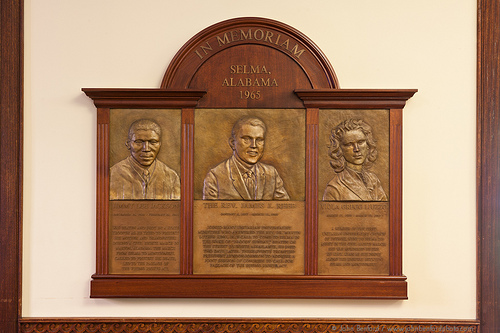
Memorial for Jimmie Lee Jackson, Reverend James Reeb and Viola Liuzzo, UU Headquarters, Boston
Memorial for Jimmie Lee Jackson, Reverend James Reeb and Viola Liuzzo, UU Headquarters, Boston