Category Archives: Human Rights

Solidarity in Hevron: Occupation is Not Our Judaism

415beafb-862e-47b8-8363-673fa969cc27

I’ll soon be traveling Israel/Palestine this weekend with 40 other Jews from around the world as part of a solidarity delegation to Hebron and the South Hebron Hills sponsored by the Center for Jewish Nonviolence. CJNV is a relatively new organization that has been doing important work bringing Diaspora Jews to Israel/Palestine to stand in solidarity with Palestinians in nonviolent actions against the occupation. Last year, CJNV traveled to Tent of Nations (a very special place about which I’ve written many times before) to plant trees to replace the 1,500 fruit bearing trees that had been destroyed by the IDF. More recently the CJNV participated in an action at the World Zionist Congress to protest the complete absence of the occupation from the World Zionist Organization’s agenda.

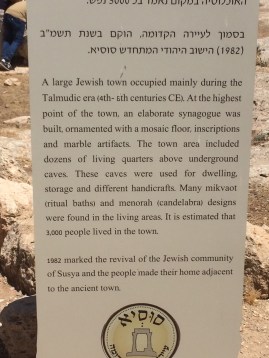
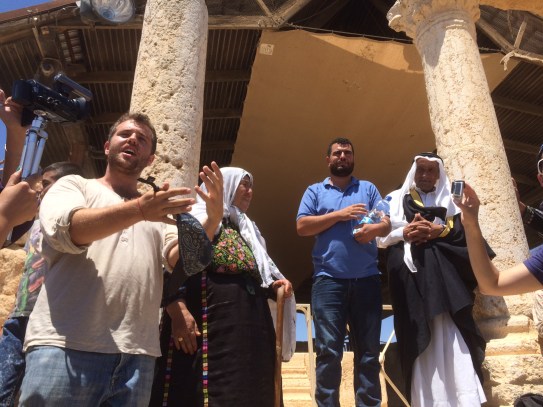
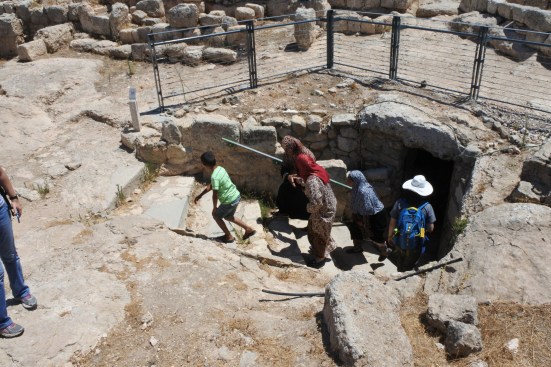
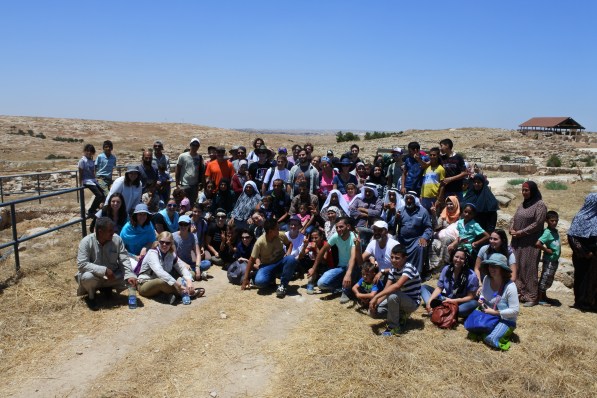
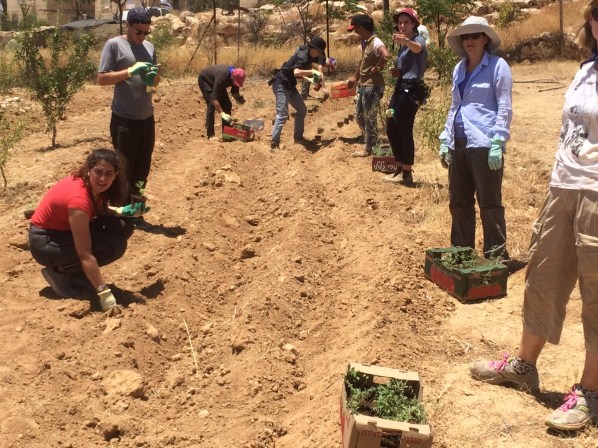
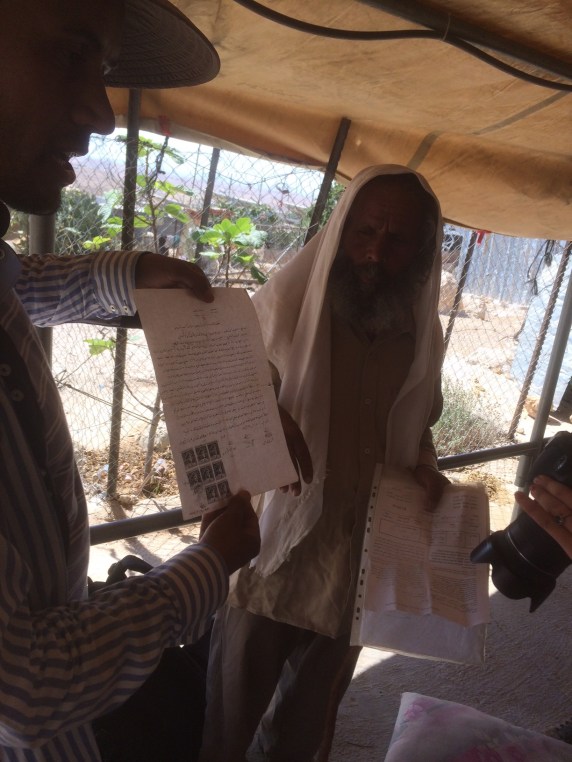
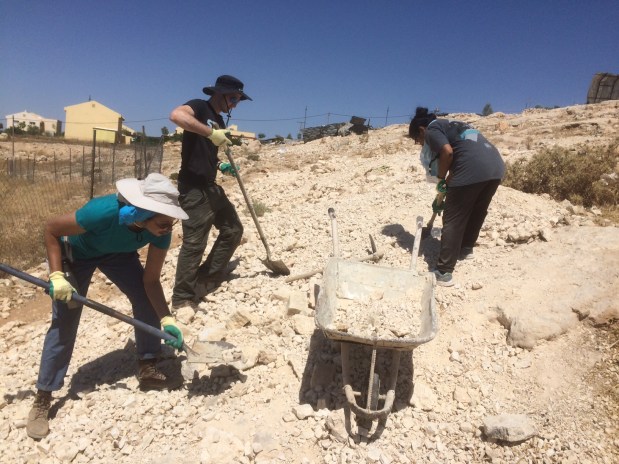
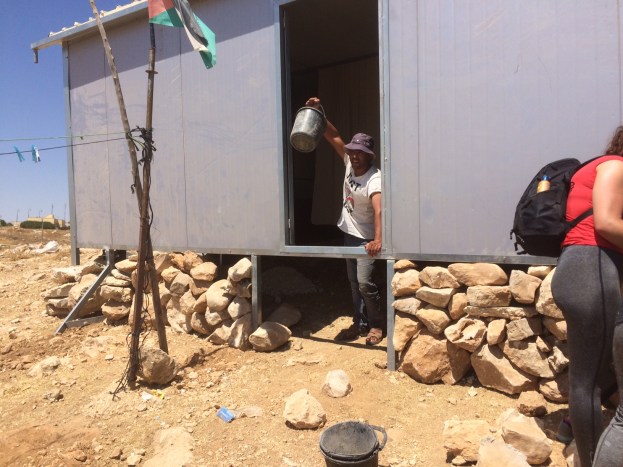
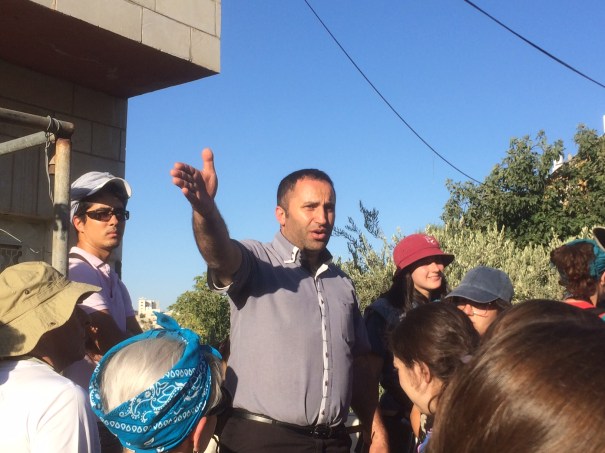
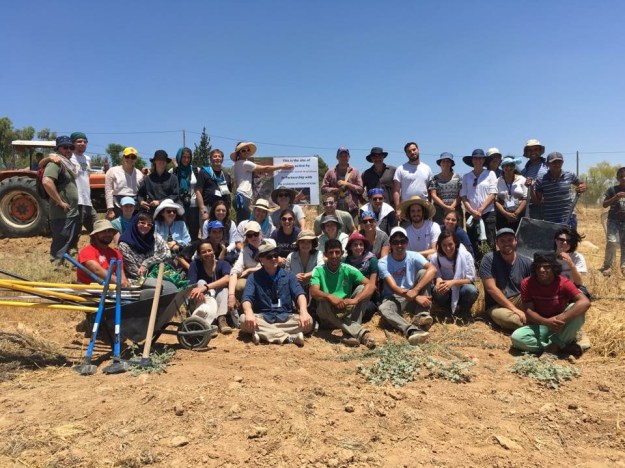
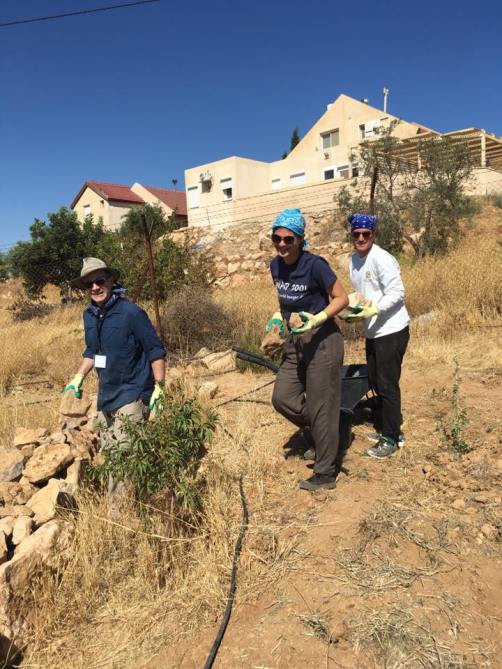
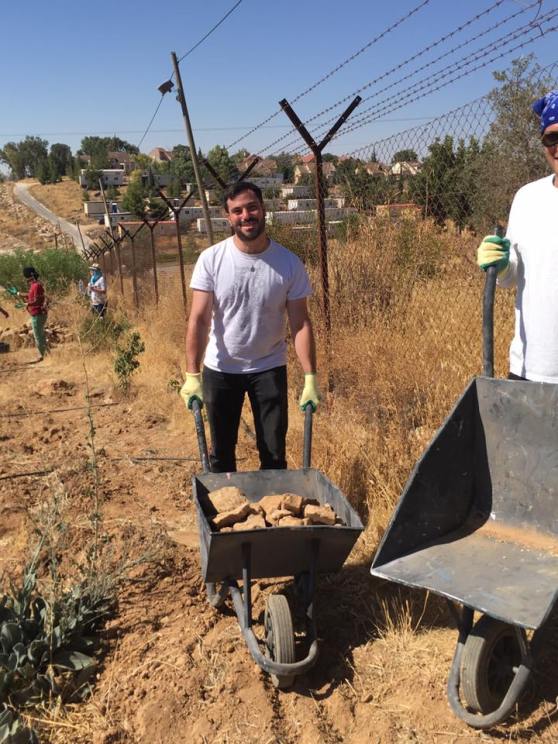
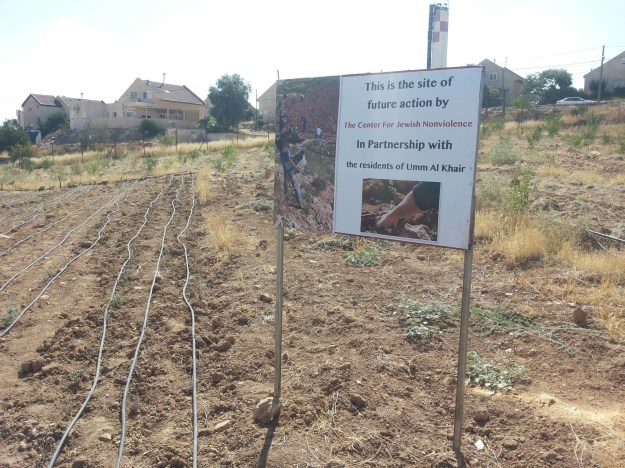
The name of this new campaign is entitled “Occupation is not our Judaism” and will include work in the village of Susiya (which recently experienced home demolitions that left 26 Palestinians homeless) and planting in the nearby village of Umm Al Khair (see photo above). We’ll also be standing in solidarity with Palestinian residents of the city of Hebron – I’ll be writing more about this aspect of our work in the coming days.

I’ve visited and written about the injustices wrought upon Hevron in posts from past visits – and since that time the situation has only grown more dire. You may have read about the recent visit to Hevron by authors Michael Chabon and Ayelet Waldman. After their experience there the clearly shaken Chabon was quoted as saying:

(This is) the most grievous injustice I have ever seen in my life … this is the worst thing I have ever seen, just purely in terms of injustice. If saying that is going to lose me readers, I don’t want those readers. They can go away and never come back.

For more on the daily reality faced by Palestinians in Susiya and the South Hevron Hills, check out the clip below:

Finally, like everyone else in our country I’m following recent events in Louisiana, Minnesota and Dallas, and am mindful that racist state violence is all too brutally real right here at home as well. As I leave, I’m taking to heart the very wise words that my friend, the historian/writer/activist Barbara Ransby has just posted on her Facebook page:

In these difficult and trying times, as we grieve the horrible murders of our people, suffer the skewed media coverage that attempts to relegate our work to the gutter, and witness the backlash that has already begun, our response must be sober and strategic. Fear is understandable. But a fierce fortitude is what is required. And a principled unity is necessary today more than ever.

Whether it’s here or anywhere else in the world, I’m more convinced than ever that my place is to be accountable to those affected by this violence and take our cue from their “fierce fortitude.”

I look forward to sharing my experiences with you in the coming days.

For Passover: “Your Child Will Ask”

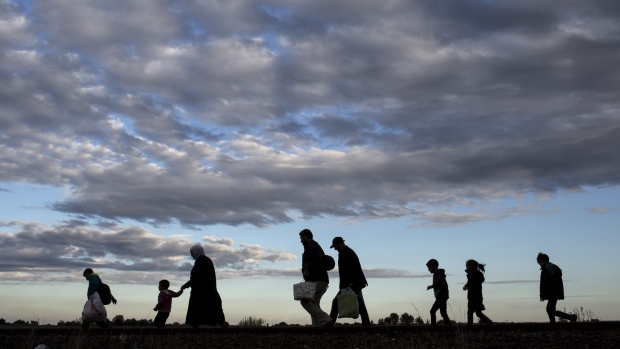
europe-migrants-hungary

Photo:Marko Djurica/Reuters

Your child will ask
why do we observe this festival?

And you will answer
it is because of what God did for us
when we were set free from the land of Egypt.

Your child will ask
were we set free from the land of Egypt
that we might hold tightly
to the pain of our enslavement
with a mighty hand?

And you will answer
we were set free from Egypt
that we might release our pain
by reaching with an outstretched arm
to all who struggle for freedom.

Your child will ask
were we set free from the land of Egypt
because we are God’s chosen people?

And you will answer
we were set free from the land of Egypt
so that we will finally come to learn
all who are oppressed
are God’s chosen.

Your child will ask
were we set free from the land of Egypt
that we might conquer and settle
a land inhabited by others?

And you will answer
we were set free from the land of Egypt
that we might open wide the doors
to proclaim:

Let all who are dispossessed return home.
Let all who wander find welcome at the table.
Let all who hunger for liberation
come and eat.

Yes, Zionism is Settler Colonialism

20090927

Is Zionism “settler colonialism?” It’s an important question that is increasingly invoked in public debates over Israel/Palestine – and BDS in particular.

While I personally do believe Israel to be a settler colonial state, I think it’s critical to understand what we mean when we use this term, what it means in the context of Israel/Palestine, and its implications for the wider struggle against systems of oppression in the US and throughout the world.

Let’s start with the definition itself. Many people use the term “settler colonialism” and “colonialism” interchangeably, but they are not in fact the same thing. Colonialism is defined by the Collins Dictionary as “the policy and practice of a power in extending control over weaker peoples or areas.” Historically speaking, it generally refers to specific European imperial powers during a period that lasted from the 16th to mid-20th centuries.

“Settler colonialism,” is a different concept, as Professor of Anthropology Tate A. LeFevre explains:

Though often conflated with colonialism more generally, settler colonialism is a distinct imperial formation. Both colonialism and settler colonialism are premised on exogenous domination, but only settler colonialism seeks to replace the original population of the colonized territory with a new society of settlers (usually from the colonial metropole). This new society needs land, and so settler colonialism depends primarily on access to territory. Britain, for example, implemented the doctrine of “terra nullius” (“land belonging to no one”) to claim sovereignty over Australia. The entire continent was thereby declared legally uninhabited, despite millennia of Aboriginal occupation.

In other words, while colonialism typically refers to events, settler-colonialism is viewed as an ongoing process. Professor LeFevre puts it this way: “Settler colonialism is premised on occupation and the elimination of the native population, while colonialism is primarily about conquest.”

Given this definition, the claim that Zionism is a form of settler colonialism it is not at all inappropriate and certainly not anti-Semitic (as some of the more vociferous Israel advocates will often claim).

There is, for instance, a striking similarity between the British colonial concept of “terra nullius” and the early Zionist slogan, “a land without a people for a people without a land.” This is not say that Zionists viewed the land as literally empty – they most certainly recognized the existence of an Arab population in Palestine. It does mean, however, that they did not always factor its indigenous inhabitants into their equations – and when they did, it was invariably as a problem to be dealt with.

The father of modern Zionism made this clear in his diary when he wrote of Palestinian Arabs:

We shall try to spirit the penniless population across the border by procuring employment for it in the transit countries whilst denying it any employment in our own country.

David Ben-Gurion expressed similar intentions in a 1937 letter to his son Amos (who was critical of his father’s intention to support the 1937 Peel Commission partition plan):

My assumption (which is why I am a fervent proponent of a state, even though it is now linked to partition) is that a Jewish state on only part of the land is not the end but the beginning…

The establishment of a state, even if only on a portion of the land, is the maximal reinforcement of our strength at the present time and a powerful boost to our historical endeavors to liberate the entire country.

We shall admit into the state all the Jews we can. We firmly believe that we can admit more than two million Jews. We shall build a multi-faceted Jewish economy– agricultural, industrial, and maritime. We shall organize an advanced defense force—a superior army which I have no doubt will be one of the best  armies in the world. At that point I am confident that we would not fail in settling in the remaining parts of the country, through agreement and understanding with our Arab neighbors, or through some other means.

Thanks to Israeli historians such as Benny Morris, Avi Shlaim, Tom Segev and Ilan Pappe, we now know that the creation of Israel was accomplished through “some other means.”  More recently, journalist Avi Shavit recently made reference to this ignoble history in his book, “My Promised Land.” The most chilling chapter (which was reprinted in the New Yorker magazine) describes in detail the depopulation of the Palestinian village of Lydda.

Even more chilling are Shavit’s musings on the meaning of this tragic event:

Looking straight ahead at Lydda, I wonder if peace is possible. Our side is clear: we had to come into the Lydda Valley and we had to take the Lydda Valley. There is no other home for us, and there was no other way. But the Arabs’ side, the Palestinian side, is equally clear: they cannot forget Lydda and they cannot forgive us for Lydda. You can argue that it is not the occupation of 1967 that is at the core of the Israeli-Palestinian conflict but the tragedy of 1948. It’s not only the settlements that are an obstacle to peace but the Palestinians’ yearning to return, one way or another, to Lydda and to dozens of other towns and villages that vanished during one cataclysmic year. But the Jewish State cannot let them return.

Many who reject the “Zionism as Settler Colonialism” label often argue that this claim ignores the historic and Biblical connection of the Jewish people to the land – and that Jews are its “true indigenous people” who have been longing for a return and restoration to their ancient homeland for centuries.

Leaving aside the use of a profoundly ahistorical document such as the Bible as justification for the establishment for a modern Jewish nation state, let’s look more closely at the Zionist claim of Jewish indigeneity to the land.

It is certainly true following the destruction of the Temple in 73 CE and the spread of the Jewish people throughout the diaspora, Jewish tradition continued to maintain an important attachment to the land of Israel. Eretz Yisrael (“the Land of Israel”) is a central subject in many sacred Jewish texts and numerous traditional Jewish prayers express a longing for a return of the Jewish people to the land. It is also true that there have been small Jewish communities in historic Palestine throughout the ages and that pilgrimage to Eretz Yisrael was considered to be a mitzvah  (“or sacred commandment”.)

However, it is important to note that the Jewish attachment to this land has traditionally been expressed as an inherently religious connection. From its very beginnings, Judaism has spiritualized the concept of the land. Moreover, throughout the centuries, rabbinical authorities strictly prohibited an en masse return to the land in order to establish a Third Jewish Commonwealth. Such an act was viewed as an anathema – a profane forcing of God’s hand. The restoration of the Jewish People to the land would only occur with the coming of the Messiah and the onset of the Messianic Era.

It is against this context that we must understand Zionism as a modern political movement, arising in the 19th century as an explicit rejection of Jewish tradition. While Judaism was a diaspora-based religion that taught God could be found anywhere in the world, Zionism preached “shlilat hagalut” (“negation of the diaspora”), advocating for a literal return to the land in order to establish a modern Jewish nation state. Influenced by the European nationalisms of its day, Zionism sought to create a new kind of Judaism and indeed, a new kind of Jew.

This radical revisioning of Jewish life and culture in many ways represents the exact opposite of indigeneity. Indigenous peoples by definition maintain unique cultural and linguistic practices distinctive to their presence in a particular land. Zionism created a completely new Hebraic Jewish culture – one that was deeply influenced by a European Ashkenazic ethos and transplanted into the Middle East. To be clear: this is not to say that Jews have no connection to this land and no right to live there, only that the claim of Jewish indigeneity is ideological, rather than factual – and that this claim has had a devastating impact on the actual indigenous people of this land.

Other critics of the settler colonialist label point out that there is no such thing as a discrete “Zionism;” that this movement was historically made up of many different Zionisms, not all of which shared the same political goals. There were, for instance, cultural Zionists such as Ahad Ha’am who did not share Herzl’s desire of a Jewish political state but rather advocated for a gradual colonization of Palestine that would make it the center of a Jewish cultural renaissance. There also Zionists such as Judah Magnes and Hannah Arendt, who believed in the creation of a bi-national Jewish/Arab state in Palestine.

These variants of Zionism represent an important fact of history. But it is also true that they are precisely that: part of the historical past. If Magnes or Arendt were living today, they would surely be considered “anti-Zionist”. In the end, the form of Zionism that ultimately triumphed was the political Zionism advocated by those who sought to create a sovereign Jewish state in historic Palestine. And it was this Zionism that aimed to solve the problem of Palestine’s indigenous population “through some other means” – that is, by means of settler colonialism.

In one of the most comprehensive treatments I’ve yet read on this subject, Bennett Muraskin writes:

Zionism is described by its supporters as the national liberation movement of the Jewish people, but it must be recognized that until the 1947 UN Partition Plan, the land it sought to liberate had a minority of Jews, consisting mainly of recent Europeans immigrants living under the protection of an imperial power. When the British turned against the Jewish colony, the Zionists succeeded in liberating themselves, but in the war it fought with the Palestinian Arabs and Arab armies, the Zionists dispossessed the native population.

In this sense, Israel is a colonial settler state.

Muraskin, however, then goes on to list the ways that make Israel different from other settler colonial states.  His intention, I assume, is to leave open the possibility that it somehow isn’t. This equivocal attitude is obvious from the outset – Muraskin’s article is actually entitled “Is Israel a Colonial Settler State? Perhaps but with Lots of Provisos.”

In the end, however, I believe these “provisos” only demonstrate that Zionism represents but one form of settler colonialism. One obvious difference is that Israel was created by what began as a small movement, not an existing colonial power such as Great Britain, France or Belgium. However it is also true that Israel could never have been created without the help of great world powers (Britain and later the US) who supported the creation of the Jewish state because it advanced their own imperial agendas. James Baldwin put it very aptly in 1979: “The state of Israel was not created for the salvation of the Jews; it was created for the salvation of the Western interests.”

In the end, this insight explains why the debate over this term is more than just academic or semantical. Israel’s oppressive policies against the Palestinians do not exist in a vacuum. They are but part of a larger hegemonic system of white supremacy and institutionalized racism that exists in the US and throughout the world.

As Professor LeFevre writes, “Settler colonialism does not really ever ‘end.’”  Perhaps the first step in that direction is to call it out for what it really and truly is.

Anti-Zionism Isn’t a ‘Form of Discrimination,’ and It’s Not anti-Semitism

2261882899

Cross-posted with Ha’aretz

As an alum of UCLA, I was particularly interested when I learned that the working group for the Regents of the University of California Board had released their draft “Statement of Principles Against Intolerance.”  Having followed the news at my alma mater I knew that despite its title, this report wasn’t going to be merely a general statement about the importance of tolerance on campus. It was written in response to allegations of rising anti-Semitism at UCLA and other UC campuses.

On the face of it, there is much to admire about the report, particularly its strong support of campus environments “in which all are included, all are given an equal opportunity to learn and explore, in which differences as well as commonalities are celebrated, and in which dissenting viewpoints are not only tolerated but encouraged.”

In the end, however, this “Statement of Tolerance” actually achieves the exact opposite of its stated goals. If heeded, it would serve to silence dissent and open debate on college campuses.

At the beginning of the draft report, it states:

Fundamentally, commenters noted that historic manifestations of anti‐Semitism have changed and that expressions of anti‐Semitism are more coded and difficult to identify.In particular, opposition to Zionism often is expressed in ways that are not simply statements of disagreement over politics and policy, but also assertions of prejudice and intolerance toward Jewish people and culture.

The statement thus concludes that “anti‐Semitism, anti‐Zionism and other forms of discrimination have no place at the University of California.”

It is certainly important to state unequivocally that anti-Semitism will not be tolerated on UC campuses. But it is incorrect and even disingenuous of the report to make the unsupported claim that anti-Zionism is “often expressed (as) assertions of prejudice and intolerance toward Jewish people and culture,” and blithely conflate anti-Semitism with anti-Zionism as a “form of discrimination”.

It is true that some anti-Semites lurk behind the label of anti-Zionism – and when they do they should rightly be exposed and condemned. But it is deeply problematic to label anti-Zionism as a form of discrimination.

In fact, growing numbers of Jews and others identify as anti-Zionists for legitimate ideological reasons. Many profess anti-Zionism because they do not believe Israel can be both a Jewish and democratic state. Some don’t believe that the identity of a nation should be dependent upon the demographic majority of one people over another. Others choose not to put this highly militarized ethnic nation-state at the center of their Jewish identity.  Far from being discriminatory, their beliefs are motivated by values of equality and human rights for all human beings.

Blurring the distinction between anti-Zionism and anti-Semitism muddles the definition of anti-Semitism to the point that it becomes meaningless.This conflation is irresponsible and harmful and invariably draws our attention away from real anti-Semitism, whether it be the targeting of Jews, the vandalization of synagogues and cemeteries or the proliferation of hate groups at home and abroad.

Certainly all forms of racism should be called out in no uncertain terms. But erasing the lines between anti-Semitism and anti-Zionism only makes this task more difficult.

I can’t help but notice that this report’s broadside on anti-Zionism strongly evokes the right-wing agenda of groups such as the AMCHA initiative. Tammi Rossman-Benjamin, Director of AMCHA has long made it clear that tarring anti-Zionists as anti-Semites is part of a larger strategy to ban Palestinian solidarity groups from campuses across the country.

Such a policy would have a devastating impact on Palestinian activists and their allies. It would prevent many Palestinian and Israeli human rights advocates from speaking on college campuses. It would prevent students from displaying a model of Israel’s separation wall to demonstrate to the oppressive effects of Israel’s occupation. And it would forbid student efforts to hold Israel accountable through economic pressure, through campaigns to boycott and divest from settlements or from corporations that profit from the abusive policies of the state of Israel.

Having long worked in the Jewish community, I know that some Jewish organizations equate anti-Zionism with anti-Semitism because they seek to protect Israel’s image or because they do not want Jewish college students to have to tolerate criticism of Israel and Zionism.Those who believe in a one state solution are accused of seeking “the destruction of the Jewish state” when they actually hold their position as a result of honest political analysis and a genuine concern for all who live in the land, regardless of their religion or ethnicity.

Yes, critics of Israel and Zionism can sometimes be harsh and their tactics confrontational, but I do believe we do our young people no favors when we attempt to silence them. Though I have come a long way since my UCLA days, I still remember all too well how uncomfortable it was to have one’s beliefs and opinions challenged.But we should not confuse “uncomfortable” with “unsafe.” Forbidding debate and free speech will not create more comfortable campus environments – it will only marginalize students for legitimately expressing their beliefs.

The UC Regents claims to support the open exchange of ideas on their campuses. But they will never accomplish this if they teach students that their ideas only matter if they pass a political litmus test.

“Who will be Next?” Max Blumenthal’s Yom Kippur Presentation at Tzedek Chicago

Max and BrantOn Yom Kippur, journalist Max Blumenthal delivered this powerful presentation during the afternoon program at Tzedek Chicago, where he discussed what he witnessed in Gaza during Israel’s military onslaught last summer. He wrote about his experiences at length in his recent book, “The 51 Day War: Ruin and Resistance in Gaza.”

Max attended our services for the duration of Yom Kippur and remarked to me on more than one occasion how important it was for him to be invited to speak in a Jewish congregation for the first time.

For my part, I could not think of a more appropriate presentation for the Jewish Day of Atonement.

Please watch and share…


On Sukkot and the Struggles Over Chicago’s Dyett High School and the South Side Trauma Center

TCNOW

We’re currently in the midst of the Jewish festival of Sukkot – the harvest festival that commemorates the wanderings of the Israelites in the wilderness. I’ve always been fascinated tension by an inherent tension in this holiday: on the one hand Sukkot is referred to as “Zman Simchateinu,” the “time of our rejoicing,” but it is also a time tinged with seriousness and an innate sense of existential fragility.

Yes, this is the season in which we rejoice over our bountiful harvest – but this is also the time in which we plant a new set of crops and begin our prayers for rain, keenly aware that they/we are ultimately dependent upon forces outside our control. Yes, we rejoice as we arrive at this latest point in our journey – but we build and dwell in impermanent sukkot, as if to acknowledge the challenges and trials that most certainly await us on the road ahead.

I can’t help but think of this Sukkot-tension in relation to two local struggles going on here in Chicago. The first is the movement to save Dyett High School in the South side neighborhood of Bronzeville. Dyett was one of the many Chicago public schools that was closed by the city in predominantly black and brown communities. In response, a local coalition formed that developed an extensive plan to reopen Dyett as open enrollment neighborhood school focused on Global Leadership and Green Technology.

After first refusing, CPS eventually agreed to consider the community’s plan – but when it became clear that CPS had no intention in engaging in an honest, engaged process with the community, twelve members of the coalition went on a hunger strike in protest. (It was my honor, along with members of my congregation Tzedek Chicago, to draft a Jewish community letter to Mayor Rahm Emanuel demanding that he respond to the Dyett hunger strikers request. We delivered it to the mayor’s office on the second day of Rosh Hashanah)

After three weeks, CPS announced a “compromise.” It would reopen Dyett as a neighborhood public school, but not according to the Global Leadership Plan or any of the two other plans that had since been put forth. At the time the hunger strikers rejected this decision, stating that it was made over the heads of community members and without any due consideration of the desires of those who actually live in Bronzeville. The hunger strike continued on for a total of 34 days before they ended their action due to the health concerns of some of the strikers.

In announcing the end of the strike, hunger striker Monique Redeaux-Smith commented:

While we cannot yet claim complete victory, we do understand that our efforts so far have been victorious in a number of ways … Last year, Dyett was closed. But through community resistance, it was slated to be reopened in 2016 and ’17. And even though there was a request for proposals, we know that the plan was for that space to become another privatized school within Bronzeville. But again, through community resistance and this hunger strike, we pushed CPS and the mayor to commit to reopening Dyett as a public, open-enrollment neighborhood school. So that is an accomplishment.

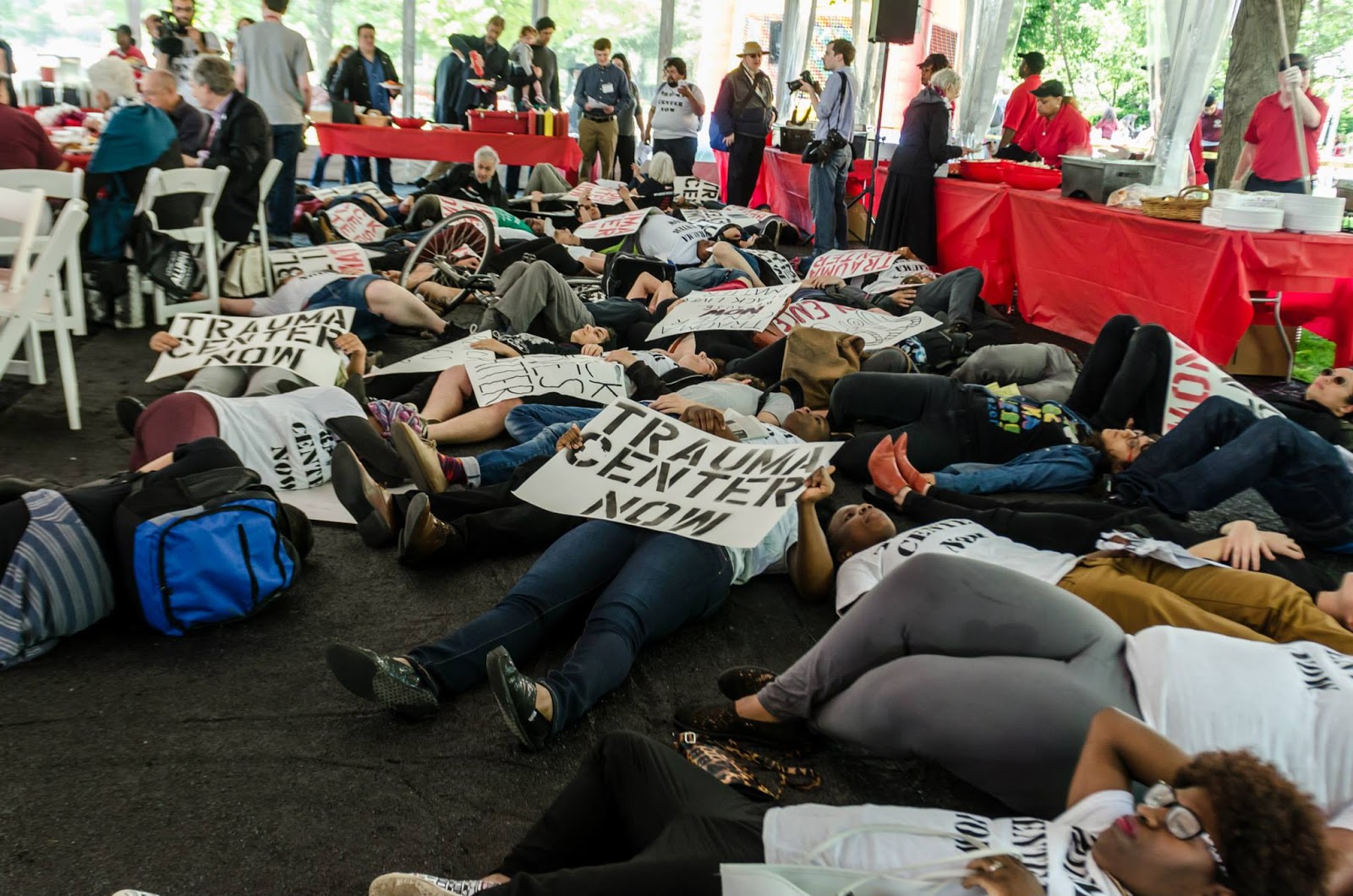
The other local struggle I’m thinking of this Sukkot is the movement to establish a Level 1 trauma center on Chicago’s south side.  There are eight adult trauma centers serving Chicago, but none are in this area that includes some of the city’s most gun violence-prone neighborhoods. Victims of gun violence are much more likely to die when more than five miles from a trauma center. As a result, large sections of the south side comprise Chicago’s only “trauma center desert.”

The campaign for a south side Level 1 adult trauma center was formally launched after 18-year-old student and youth activist Damian Turner was shot near the corner of 51st Street and Cottage Grove Avenue, just a few blocks away from the University of Chicago hospital. Turner was transported to a hospital farther away due to the absence of a nearby Level 1 trauma center, but he died an hour-and-a-half later.

The trauma center coalition was led by the remarkable youth-based grassroots organization, Fearless Leading by the Youth. Here’s an excerpt from an interview with FLY organizer Veronica Morris Moore:

As a young Black queer organizer, I feel affirmed by the trauma center campaign. The principles of the BLM movement helped us frame our tactic around the Obama library and I believe that framing our message with BLM principles put the [University of Chicago] in a big spotlight locally and nationally in terms of race issues. Having this national conversation about police shootings created opportunities to address gun violence in the Black community and the reality and root of the problem. Gun violence is the leading killer of young Black people in poor neighborhoods across this nation, and growing up on the South Side of Chicago, FLY members understand that gun violence stems from the economic violence that bankrupts our communities and bankrolls big business hospitals like the University of Chicago.

Like the Dyett HS struggle, this grassroots effort leveraged people power to shift political power. On September 10, the University of Chicago and Sinai Health System announced that they would partner to open a Level-I Adult Trauma Center at Holy Cross Hospital. But like the Dyett struggle, it was clear to organizers that the victory was not complete – having been made with no accountability or transparency to the community impacted by this decision. Moreover, in making their decision, the University of Chicago reneging on its previous commitment to raise the age of its pediatric trauma center.

If you are a member of the Chicago Jewish community you should should know that on Sunday, November 1, the Jewish Council on Urban Affairs – one of the members of the trauma center coalition – will host “L’Chaim: JCUA Community Meeting for Trauma Care” at KAM Isaiah, 1100 E. Hyde Park Ave. This meeting will provide an important opportunity to:

► Celebrate the growing momentum of this campaign, and be a part of the next victory.
► Take part in one of the most important racial justice issues facing Chicago today.
► Hear from the youth leaders that started the campaign for trauma care.
► Take action so the University of Chicago keeps all of its commitments for trauma care.

This Sukkot, let us rejoice in our victories – and let us give each other strength for the struggle that inevitably lays ahead…

The Uprooted and Unwanted: A Sermon for Tzedek Chicago’s First Yom Kippur Service

b65c5c8a711d4489888a5e00f1b443c6_18
Like you, I’ve been profoundly horrified by the refugee crisis that has resulted from Syria’s ongoing civil war. The reports and images and statistics continue to roll out every day and the sheer level of human displacement is simply staggering to contemplate. Since 2011, over half of that country’s entire population has been uprooted. At present, there are more than 4 million Syrian refugees are registered with the UN. Another 7 million have been internally displaced. Experts tell us we are currently witnessing the worst refugee crisis of our generation.

The tragic reality of forced migration has been brought home to us dramatically this past summer – but of course, this crisis did not just begin this year and Syria is not the only country in the region affected by this refugee crisis. Scores are also fleeing civil war and violence from countries such as Iraq, Libya, Afghanistan and Yemen. In all of 2014, approximately 219,000 people from these countries tried to cross the Mediterranean to seek asylum in Europe. According the UN High Commissioner for Refugees, in just the first eight months of 2015, over 300,000 refugees tried to cross the sea – and more than 2,500 died.

And of course this issue is not just limited to the Middle East. It extends to places such as Latin and Central America and Sub-Saharan Africa as well – and it would be not at all be an exaggeration to suggest that the crisis of forced human migration is reaching epidemic proportions. Just this past June, the UN High Commissioner on Refugees issued a report that concluded that “wars, conflict and persecution have forced more people than at any other time since records began to flee their homes and seek refuge and safety elsewhere.”

It is all too easy to numb ourselves to reports such as these – or to simply throw up our hands and chalk it up to the way of the world. But if Yom Kippur is to mean anything, I would suggest it demands that we stand down our overwhelm. To investigate honestly why this kind of human dislocation exists in our world and openly face the ways we are complicit in causing it. And perhaps most importantly to ask: if we are indeed complicit in this crisis, what is our responsibility toward ending it?

There is ample evidence that we as Americans, are deeply complicit in the refugee crises in the Middle East. After all, the US has fueled the conflicts in all five of the nations from which most refugees are fleeing – and it is directly responsible for the violence in Iraq, Afghanistan, and Libya.

In Iraq, our decade-long war and occupation resulted in the deaths of at least a million people and greatly weakened the government. This in turn created a power vacuum that brought al-Qaeda into the country and led to the rise of ISIS. Over 3.3 million people in Iraq have now been displaced because of ISIS.

In Afghanistan, the US occupation continues and we are war escalating the war there, in spite of President Obama’s insistence that it would end by 2014. According to the UN, there are 2.6 million refugees coming out of Afghanistan.

In Libya, the US-led NATO bombing destroyed Qaddafi’s government. At the time, then Secretary of State Clinton joked to a news reporter, “We came, we saw, he died.” Shortly after Libya was wracked with chaos that led to the rise of ISIS affiliates in northern Africa. Many thousands of Libyans are now fleeing the country, often on rickety smuggler boats and rafts. The UN estimates there are over 360,000 displaced Libyans.

In Yemen, a coalition of Middle Eastern nations, led by Saudi Arabia and backed by the US, has been bombarding Yemen for half a year now, causing the deaths of over 4,500 people. We continue to support this coalition, despite the fact that human rights organizations are accusing it of war crimes that include the intentional targeting of civilians and aid buildings. As a result, the UN says, there are now over 330,000 displaced Yemenis.

And the US is not free of responsibility for the crisis in Syria either. For years now, we have been meddling in that civil war, providing weapons to rebels fighting Assad’s government. But since the rise of ISIS the US has backed away from toppling his regime – and there are now reports that the US and Assad have even reached “an uncomfortable tacit alliance.”

Despite our role in the Syrian civil war, our government is taking in relatively few refugees from that country. Just last Monday, Secretary of State Kerry announced that the US would increase the number of refugees to 100,000 by 2017, saying “This step is in the keeping with America’s best tradition as land of second chances and a beacon of hope.” In reality, however, this number is still a drop in the bucket relative to the dire need – and only an eighth of the number that Germany has pledged to take in this year.

Kerry’s comment, of course, expresses a central aspect of the American mythos – but in truth it is one that flies in the face of history. While we like to think of ourselves “as a land of second chances and a beacon of hope,” these words mask a darker reality: it is a hope that only exists for some – and it has largely been created at the expense of others. Like many empires before us, our nation was established – upon the systemic dislocation of people who are not included in our “dream.”

If we are to own up to our culpability in today’s crises of forced human migration, we must ultimately reckon with reality behind the very founding of our country. The dark truth is that our country’s birth is inextricably linked to the dislocation and ethnic cleansing of indigenous peoples this land. It was, moreover, built upon the backs of slaves who were forcibly removed from their homes and brought to this country in chains. It is, indeed, a history we have yet to collectively own up to as a nation. We have not atoned for this legacy of human dislocation. On the contrary, we continue to rationalize it away behind the myths of American exceptionalism: a dream of hope and opportunity for all.

And there’s no getting around it: those who are not included in this “dream” – the dislocated ones, if you will – are invariably people of color. Whether we’re talking about Native Americans and African Americans, the Latino migrants we imprison and deport, or the Syrian, Iraqi, Afghani or Yemini refugees of the Middle East. If we are going to reckon with this legacy, we cannot and must not avoid the context of racism that has fueled and perpetuated it.

As a Jew, of course, I think a great deal about our legacy of dislocation. To be sure, for most of our history we have been a migrating people. Our most sacred mythic history describes our ancestors’ travels across the borders of the Ancient Near East and the Israelites’ wanderings in the wilderness. And in a very real sense, our sense of purpose has been honored by our migrations throughout the diaspora – yes, too often forcibly, but always with a sense of spiritual purpose. For centuries, to be a Jew meant to be part of a global peoplehood that located divinity anywhere our travels would take us.

Our sacred tradition demands that we show solidarity with those who wander in search of a home. The most oft-repeated commandment in the Torah, in fact, is the injunction against oppressing the stranger because we ourselves were once strangers in the land of Egypt. And given our history, it’s natural that we should find empathy and common cause with the displaced and uprooted.

However, I do fear that in this day and age of unprecedented Jewish success – and dare I say, Jewish privilege – we are fast losing sight of this sacred imperative. One of my most important teachers in this regard is the writer James Baldwin, who was an unsparingly observer of the race politics in America. In one particularly searing essay, which he wrote in 1967, Baldwin addressed the issue of Jewish “whiteness” and privilege in America. It still resonates painfully to read it today:

It is galling to be told by a Jew whom you know to be exploiting you that he cannot possibly be doing what you know he is doing because he is a Jew. It is bitter to watch the Jewish storekeeper locking up his store for the night, and going home. Going, with your money in his pocket, to a clean neighborhood, miles from you, which you will not be allowed to enter. Nor can it help the relationship between most Negroes and most Jews when part of this money is donated to civil rights. In the light of what is now known as the white backlash, this money can be looked on as conscience money merely, as money given to keep the Negro happy in his place, and out of white neighborhoods.

One does not wish, in short, to be told by an American Jew that his suffering is as great as the American Negro’s suffering. It isn’t, and one knows that it isn’t from the very tone in which he assures you that it is…

For it is not here, and not now, that the Jew is being slaughtered, and he is never despised, here, as the Negro is, because he is an American. The Jewish travail occurred across the sea and America rescued him from the house of bondage. But America is the house of bondage for the Negro, and no country can rescue him. What happens to the Negro here happens to him because he is an American.

In other essays, Baldwin referred to white immigrant success in America as “the price of the ticket” – in other words, the price for Jewish acceptance into white America was the betrayal of the most sacred aspects of our spiritual and historical legacy. We, who were once oppressed wanderers ourselves, have now found a home in America. But in so doing we have been directly or indirectly complicit in the systematic oppression and dislocation of others.

On Rosh Hashanah I talked about another kind of Jewish deal called Constantinian Judaism – or the fusing of Judaism and state power. And to be sure, if we are to talk about our culpability this Yom Kippur in the crime of forced migration, we cannot avoid reckoning with the devastating impact the establishment of the state of Israel has had on that land’s indigenous people – the Palestinian people.

According to Zionist mythos, the Jewish “return” to land was essentially a “liberation movement.” After years of migration through the diaspora, the Jewish people can finally at long last come home – to be, as the national anthem would have it, “a free people in their own land.”

The use of the term “liberation” movement, of course is a misnomer. It would be more accurate to term Zionism as a settler colonial project with the goal of creating an ethnically Jewish state in a land that already populated by another people. By definition the non-Jewish inhabitants of Palestine posed an obstacle to the creation of a Jewish state. In order to fulfill its mandate as a political Jewish nation, Israel has had to necessarily view Palestinians as a problem to somehow be dealt with.

Put simply, the impact of Jewish nation-statism on the Palestinian people has been devastating. The establishment of Israel – a nation designed to end our Jewish wanderings – was achieved through the forced dislocation of hundreds of thousands of Palestinians from their homes, which were either destroyed completely or occupied by Jewish inhabitants.

In turn, it created what is now the largest single refugee group in the world and our longest running refugee crisis. Millions of Palestinians now live in their own diaspora, forbidden to return to their homes or even set foot in their homeland. Two and a half million live under military occupation in the West Bank where their freedom of movement is drastically curtailed within an extensive regime of checkpoints and heavily militarized border fences. And nearly two million live in Gaza, most of them refugees, literally trapped in an open-air prison where their freedom of movement is denied completely.

This, then, is our complicity – as Americans, as Jews. And so I would suggest, this Yom Kippur, it is our sacred responsibility to openly confess our culpability in this process of uprooting human beings from their homes so that we might find safety, security and privilege in ours. But when then? Is our confession merely an exercise in feeling bad about ourselves, in self-flagellation? As Jay said to us in his sermon last night, “Our sense of immense guilt over our sins, collective and individual, could paralyze us. How do we move forward with teshuvah when the task is so great?”

According to Jewish law, the first step in teshuvah is simply recognizing that a wrong has been committed and confessing openly to it. This in and of itself is no small thing. I daresay with all of the media attention to the Syrian refugee crisis, there is precious little, if any, discussion of the ways our nation might be complicit in creating it. And here at home, we are far from a true reckoning over the ways our white supremacist legacy has dislocated Native Americans and people of color in our own country. And needless to say, the Jewish community continually rationalizes away the truth of Israel’s ongoing injustice toward the Palestinian people.

So yes, before we can truly atone, we must first identify the true nature of our wrongdoings and own them – as a community – openly and together. The next step is to make amends – to engage in a process of reparations to effect real transformation and change. But again, the very prospect of this kind of communal transformation feels too overwhelming , too messianic to even contemplate. How do we even begin to collectively repair wrongs of such a magnitude?

I believe the answer, as ever, is very basic. We begin by joining together, by building coalitions, by creating movements. We know that this kind of organizing has the power to effect very real socio-political change in our world. We have seen it happen in countries such as South Africa and Ireland and we’ve seen it here at home – where Chicago became the first city in the country to offer monetary reparations to citizens who were tortured by the police. In this, as in the aforementioned examples, the only way reparations and restorative justice was achieved was by creating grassroots coalitions that leveraged people power to shift political power.

And that is why we’ve prominently identified “solidarity” as one of our congregation’s six core values:

Through our activism and organizing efforts, we pursue partnerships with local and national organizations and coalitions that combat institutional racism and pursue justice and equity for all. We promote a Judaism rooted in anti-racist values and understand that anti-Semitism is not separate from the systems that perpetuate prejudice and discrimination. As members of a Jewish community, we stand together with all peoples throughout the world who are targeted as “other.”

How do we effect collective atonement? By realizing that we are not in this alone. By finding common cause with others and marching forward. It is not simple or easy work. It can be discouraging and depleting. It does not always bear fruit right away and it often feels as if we experience more defeats than successes along the way. But like so many, I believe we have no choice but to continue the struggle. And I am eager and excited to begin to create new relationships, to participate as a Jewish voice in growing coalitions, with the myriad of those who share our values. I can’t help but believe these connections will ultimately reveal our true strength.

I’d like to end now with a prayer – I offer it on behalf of refugees and migrants, on behalf of who have been forced to wander in search of a home:

Ruach Kol Chai – Spirit of All that Lives:

Help us. Help us to uphold the values that are so central to who we are: human beings created in the image of God. Help us to find compassion in our hearts and justice in our deeds for all who seek freedom and a better life. May we find the strength to protect and plead the cause of the dislocated and uprooted, the migrant and the refugee.

Guide us. Guide us toward one law. One justice. One human standard of behavior toward all. Move us away from the equivocation that honors the divine image in some but not in others. Let us forever affirm that the justice we purport to hold dear is nothing but a sham if it does not uphold basic human dignity for all who dwell in our midst.

Forgive us. Forgive us for the inhumane manner that in which we too often treat the other. We know, or should, that when it comes to crimes against humanity, some of us may be guilty, but all of us are responsible. Grant us atonement for the misdeeds of exclusion we invariably commit against the most vulnerable members of society: the uprooted and unwanted, the unhoused, the uninsured, the undocumented.

Strengthen us. Strengthen us to find the wherewithal to shine your light into the dark places of our world. Give us ability to uncover those who are hidden from view, locked away, forgotten. Let us never forget that nothing is hidden and no one lost from before you. Embolden us in the knowledge that no one human soul is disposable or replaceable; that we can never, try as we might, uproot another from before your sight.

Remind us. Remind us of our duty to create a just society right here, right now, in our day. Give us the vision of purpose to guard against the complacency of the comfortable – and the resolve in knowing that we cannot put off the cause of justice and freedom for another day. Remind us that the time is now. Now is the moment to create your kingdom here on earth.

Ken Yehi Ratzon. May it be your will. And may it be ours.

And let us say,

Amen.
Confronting the “New Campus Anti-Semitism”

wall-palestine-side1-brown-u

Throughout the organized Jewish community, the mainstream media and academia, we’re hearing increasing talk of a sharp increase in anti-Semitism on American college campuses. In response to recent incidents at UCLA and elsewhere, one congregational rabbi from LA has warned of  “something deeper, more troubling, insidious, and pervasive…on college campuses nationwide.” Another rabbi has declared ominously, “This is a war — a war for the heart, mind, and soul of the American university.” Barry Kosmin of Trinity College, who co-authored a recent study alleging rising antisemitism on campus, has opined that the “the events in California” were not “isolated incidents” and that this “type of hatred, stereotyping and bias is a worrying new development that suggests a generational problem.”

To judge from these comments, it would appear that colleges and universities have become virtual petri dishes of Jew-hatred. Have our campuses indeed become overrun by anti-Semitism?

I would argue that something very different is going on. As the movement for Boycott, Divestment and Sanctions against Israel grows and student divestment campaigns increasingly find traction throughout the United States, we’re witnessing a new kind of tension forming between Palestinian solidarity activists and Israel advocates on college campuses. And while it doesn’t surprise me that some Jewish community leaders are raising the all too familiar cry of anti-Semitism, I believe it’s critical to carefully examine the context that lies beyond the hysteria.

Some background: the UCLA incident occurred last February, when a student candidate for the Judicial board of the Undergraduate Students Association was asked by a student member how, given that she was Jewish and affiliated with Jewish campus organizations, would she “see (herself) being able to maintain an unbiased view?”  After a subsequent discussion, the council first voted to reject her nomination – but after a faculty adviser pointed out that it was not appropriate to view a student’s affiliation with Jewish organizations as a conflict of interest, the students voted again and unanimously approved of her nomination.

This incident, which was captured on video and posted on YouTube, led to an intense and at times painful reckoning throughout the UCLA campus community. The four students who initially opposed the student’s nomination wrote a public apology in the campus newspaper, stating that their “intentions were never to attack, insult or delegitimize the identity of an individual or people” and that they were “truly sorry for any words used during this meeting that suggested otherwise.” UCLA’s chancellor, referred to the incident as a “teaching moment.” Later, the student council  unanimously passed a sweeping resolution condemning anti-Semitism.

Many observers have referred to the board members’ line of questioning as “anti-Semitic,” claiming that their questions raised the infamous anti-Jewish tropes of dual loyalties. But whether their comments were anti-Semitic, obnoxious, or merely naive, it is important to note that in the charged world of campus divestment politics, attitudes toward Jewish students – particularly those who serve on student boards – do not exist in a vacuum.

To begin with, any serious analysis of this issue must factor in the heavy-handed interventions of off-campus advocates of Israel into student politics. Perhaps the most infamous example is Adam Milstein, a businessman and convicted felon who is connected to right-wing Zionist groups and has reportedly funneled money through UCLA Hillel to influence student elections and oppose divestment campaigns.

Blogger Richard Silverstein has written extensively on the controversies surrounding Milstein’s activities at UCLA:

For at least the past three years, Milstein has donated funds via UCLA Hillel (another comprehensive review of the entire scandal is here) to support the pro-Israel student government slate Bruins United, an affiliate of Bruins for Israel.  Though we know that Milstein personally donated $1,000 to the slate (e-mails confirming this are published here), he also solicited funding from other pro-Israel donors.  Both he, Hillel, and the slate have refused to reveal how much external funding was given. Milstein was much more than a mere donor.  He held strategy sessions with the executive candidates.  He held a gala fundraising event at his home attended by Hillel staff, prospective donors, and UCLA faculty and staff.  The purpose was to encourage donors to participate in the project to benefit both Hillel and Bruins United and to oppose BDS.

In addition to individual actors such as Milstein, there are many Jewish institutional initiatives (such as AIPAC Campus Initiatives, Hasbara Fellows, the JNF Campus Fellowship Program) that receive direct support from the State of Israel  to train students to advocate for Israel and combat divestment initiatives. Last year, in fact, the Judicial board of the UCLA Undergraduate Students Association heard a complaint that two student government members had taken trips to Israel sponsored by the Anti-Defamation League and the American Jewish Committee prior to voting on a student divestment resolution.

Although this context has not been widely reported, it is crucial to our understanding of the most recent incident involving the questioning of the student Judicial board candidate. Given the high profile of professional Israel advocates in student affairs, it is fair to assume that these interventions might well affect attitudes and assumptions about the loyalties of Jewish students at UCLA.

Having said this, it would be a mistake to characterize these campus tensions in simple binary terms as a conflict between Jewish students and Palestinian solidarity activists. In truth, there is a significant and growing percentage of Jewish students actively participating in campus divestment campaigns through Students for Justice in Palestine and student chapters of Jewish Voice for Peace. I know first hand that many of them are motivated to their activism by their deeply held Jewish values of justice and the dignity of all. I took it as something of a sign of the times when just a few months ago, I was contacted by a undergraduate at Northwestern University who grew up in my congregation. This young man, whom I had not seen since his Bar Mitzvah, told me he was involved in the student divestment campaign and invited me to speak in support of it on campus.

By the same token, it would be mistaken to assume that all campus Israel advocates are necessarily Jewish. There are for instance numerous Christian Zionist campus groups that work alongside Jewish Israel advocates, the most prominent of which is CUFI on Campus – the student affiliate of Pastor John Hagee’s Christians United for Israel.

On their website, CUFI on Campus notes:

As anti-Semitic activity on American college campuses has steadily increased, CUFI recognizes that Christian students have a responsibility to speak up on behalf of Israel and the Jewish people.Field Organizers travel the country actively developing student leaders. Our Field Organizers travel the country actively developing student leaders to ensure they have the skills, resources, and guidance they need to do this successfully on their campuses.

Anyone familiar with the right wing Evangelical theology of Christians United for Israel might well find it puzzling that CUFI on Campus is concerned with rising anti-Semitism on college campuses, particularly when you consider that CUFI Pastor John Hagee has long preached that the Holocaust was God’s will, that the Jewish people need to accept Jesus to avoid going to hell, and that the contemporary Zionist settlement of Israel is a necessary precursor to Armageddon.

Despite these its embrace of these wildly anti-Semitic beliefs, Jewish Federations and Zionist organizations have had no qualms about partnering with CUFI when it comes political Israel advocacy. The same can be said for student groups. Earlier this month, for instance, CUFI on Campus co-sponsored a program with Rutgers Hillel which focused, ironically enough, on “how to combat anti-Semitism.”

Given these realities, I would suggest we avoid simplistic narratives that blame Palestinian solidarity activists for creating an “unsafe environment” for Jewish students. The truth is that there are Jewish students and non- Jewish students on both sides of this issue.

We should also think seriously about what we mean by the term “unsafe” – an oft-heard complaint of Jewish Israel advocates on campus. I have no doubt that some Jewish students are uncomfortable with divestment resolutions and other actions employed by Palestinian solidarity activists. I also have no doubt that on occasion such actions might spill over into the inappropriate or offensive. But as a rabbi who has worked together with activists from SJP and JVP on several campuses over the years, I can personally attest that I have found these student leaders to be smart, passionate organizers who are motivated by deeply held anti-racist values – and who understand full well the difference between anti-Israel and anti-Semitic.

And if, on occasion, the line between the two sometimes get blurred, we might well ask ourselves: is this due to the abject Jew-hatred on the part of Palestinian solidarity activists or a contemporary Jewish communal mentality that has placed support for the State of Israel at the center of Jewish identity?

In fact, for all of the hue and cry about the rise of campus anti-Semitism, statistics show otherwise. In fact, a recent Forward editorial entitled “The Anti-Semitism Surge that Isn’t” dismissed the Trinity College report as flawed, citing studies by the Anti-Defamation League that show campus anti-Semitism is in fact at “the lowest it’s been since the ADL started keeping track in 1999:”

In its audit of 2014, set to be released April 1 and shared with the Forward, the ADL said there were 47 incidents of anti-Semitism on campuses nationwide, where hundreds of thousands of Jews study. The number organically fluctuates year to year … but this is one trend that’s unmistakeable. Overall, anti-Semitic incidents are at the lowest point in 15 years.

47 incidents of anti-Semitism on campuses nationwide. Now compare that to the institutional repression faced by Palestinian campus activists during the same year. According to Liz Jackson, a staff attorney with Palestinian Solidarity Legal Support:

The reality is that, for every real incident of anti-Semitism on campus, Palestine Solidarity Legal Support has documented many more false accusations aimed solely at thwarting serious discussions about Israel’s treatment of Palestinians. In 2014 alone, we documented over 240 incidents of repression and requests for legal advice, nearly 75% on campuses. These ranged from disciplinary actions against students for peaceful speech activities, to attempts to cancel events, to smear campaigns against groups, students and professors, to death threats and anti-Arab and Islamophobic slurs and assaults against activists because they voiced their views. Virtually all of these cases resulted from unfounded accusations of anti-Semitism and unrelenting pressure from Israel advocacy groups to censor and punish those organizing and engaging in speech activities advocating for Palestinian rights. So far this year, we have already documented over 80 such cases, 40 of which occurred in California.

In the end, I would suggest this concern over the “new campus anti-semitism” is really a red herring. Anti-semitism, like all forms of racism should certainly be condemned and stood down in no uncertain terms. But for all the concern over anti-Jewish attitudes, it is worth noting that Jewish students and Israel advocates face absolutely no institutional restrictions to their cause or to their freedom of speech on campus.

It is far from clear that the same could be said for students who advocate on behalf of Palestinian rights.

Standing Down Legal Segregation on Yom Hashoah

bibleinjail21 Today marks Yom Hashoah – Holocaust Remembrance Day – and as it turns out, this year it falls on a serendipitous milestone: namely the 52nd anniversary of Dr. Martin Luther King’s “Letter from a Birmingham Jail.” Although MLK wrote his letter to respond to the reality of Jim Crow in the American South, I do believe his words have much to offer us as we remember those who perished at the hands of the Nazis during World War II – in particular, King’s insistence on the moral imperative to break unjust laws and the inherent immorality of legal segregation:

(There) are two types of laws: just and unjust. I would be the first to advocate obeying just laws. One has not only a legal but a moral responsibility to obey just laws. Conversely, one has a moral responsibility to disobey unjust laws…

Now, what is the difference between the two? How does one determine whether a law is just or unjust? A just law is a man made code that squares with the moral law or the law of God. An unjust law is a code that is out of harmony with the moral law. To put it in the terms of St. Thomas Aquinas: An unjust law is a human law that is not rooted in eternal law and natural law. Any law that uplifts human personality is just. Any law that degrades human personality is unjust.

All segregation statutes are unjust because segregation distorts the soul and damages the personality. It gives the segregator a false sense of superiority and the segregated a false sense of inferiority. Segregation, to use the terminology of the Jewish philosopher Martin Buber, substitutes an “I it” relationship for an “I thou” relationship and ends up relegating persons to the status of things. Hence segregation is not only politically, economically and sociologically unsound, it is morally wrong and sinful.

In light of King’s words, it is worth noting that the rise of Nazism in Germany was facilitated by largely “legal” means – through myriad laws and regulations that successfully segregated Jews from the rest of German society.  King himself pointed this out in his letter when he wrote:

We should never forget that everything Adolf Hitler did in Germany was “legal…” It was “illegal” to aid and comfort a Jew in Hitler’s Germany. Even so, I am sure that, had I lived in Germany at the time, I would have aided and comforted my Jewish brothers.

In this regard, Dr. King’s insight might well inspire us to commemorate this sacred day by redoubling our resolve to eradicate laws that segregate peoples on the basis of their national, ethnic or religious identities.

Hebron_shuhada

Segregated Shuhada street in Hebron, February 2012 (photo: Hithabrut-Tarabut)

While it pains me to say it, I cannot help but note that the very country that first established Holocaust Remembrance Day itself enforces its own form of legal segregation between Jews and non-Jews. As one Israeli observer wrote in Ha’aretz five years ago, “Segregation of Jews and Arabs in Israel…is almost absolute.” In the West Bank, Jews and non-Jews are segregated by separate legal systems, separate roads, separate transportation systems, and in some cases, separate sidewalks. And in Gaza, Palestinians are segregated from the outside world entirely.

I have no doubt that there will be those who consider it unseemly of me – or worse – to point this out on Yom Hashoah of all days. To this inevitable criticism, I can only respond, how can we purport to take the lessons of the Shoah to heart while ignoring realities such as these? How long will we, as Jews, look way from these unjust laws in Israel that “distort the soul and damage the personality?” On this, of all days, shouldn’t we, as King suggested in his letter, “bring to the surface the hidden tension that is already alive?”

May the memory of the fallen be for a blessing.

Debating Israel/Palestine on Chicago Tonight

mezzanine_916.png.resize.768x432_0Last night I appeared on WTTW’s “Chicago Tonight” with my friend and colleague Rabbi Andrea London to discuss the issue of Israel/Palestine in the wake of Netanyahu’s re-election. Andrea spoke to the J Street position while I represented the Jewish Voice for Peace point of view. Although the station tried repeatedly to find a local rabbi to represent the AIPAC line, none were willing to participate. I’m sad to report that several of the rabbis contacted cited my presence on the panel as the reason for their refusal.

On the other hand, I was so heartened that Andrea and I were able to model a principled and respectful Jewish communal debate on this issue and I was so grateful for her willingness to engage.  Click here to watch.