Category Archives: Human Rights

Palestinian Family Ties: The Most Sacred Solidarity

IMG_0808

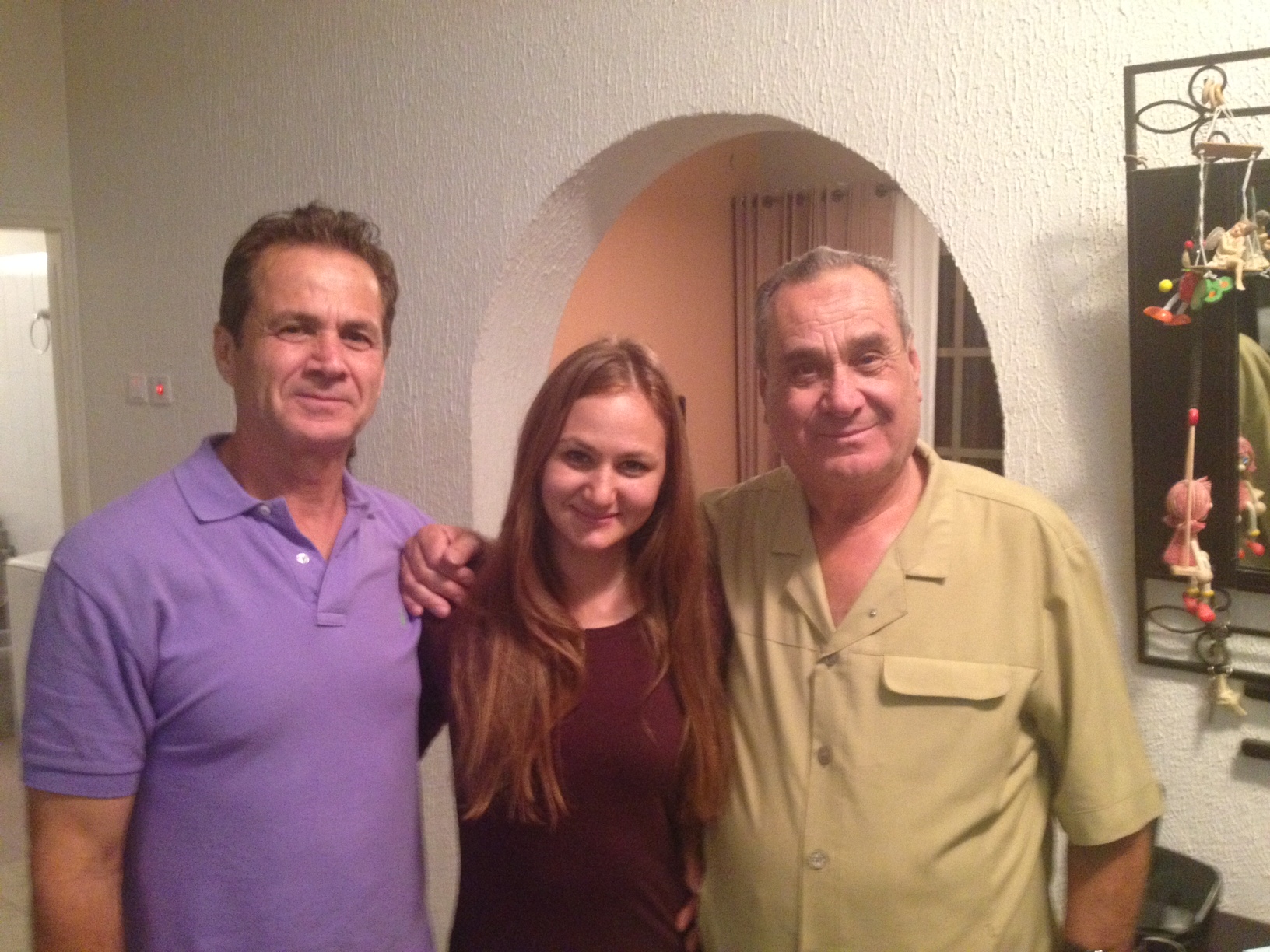
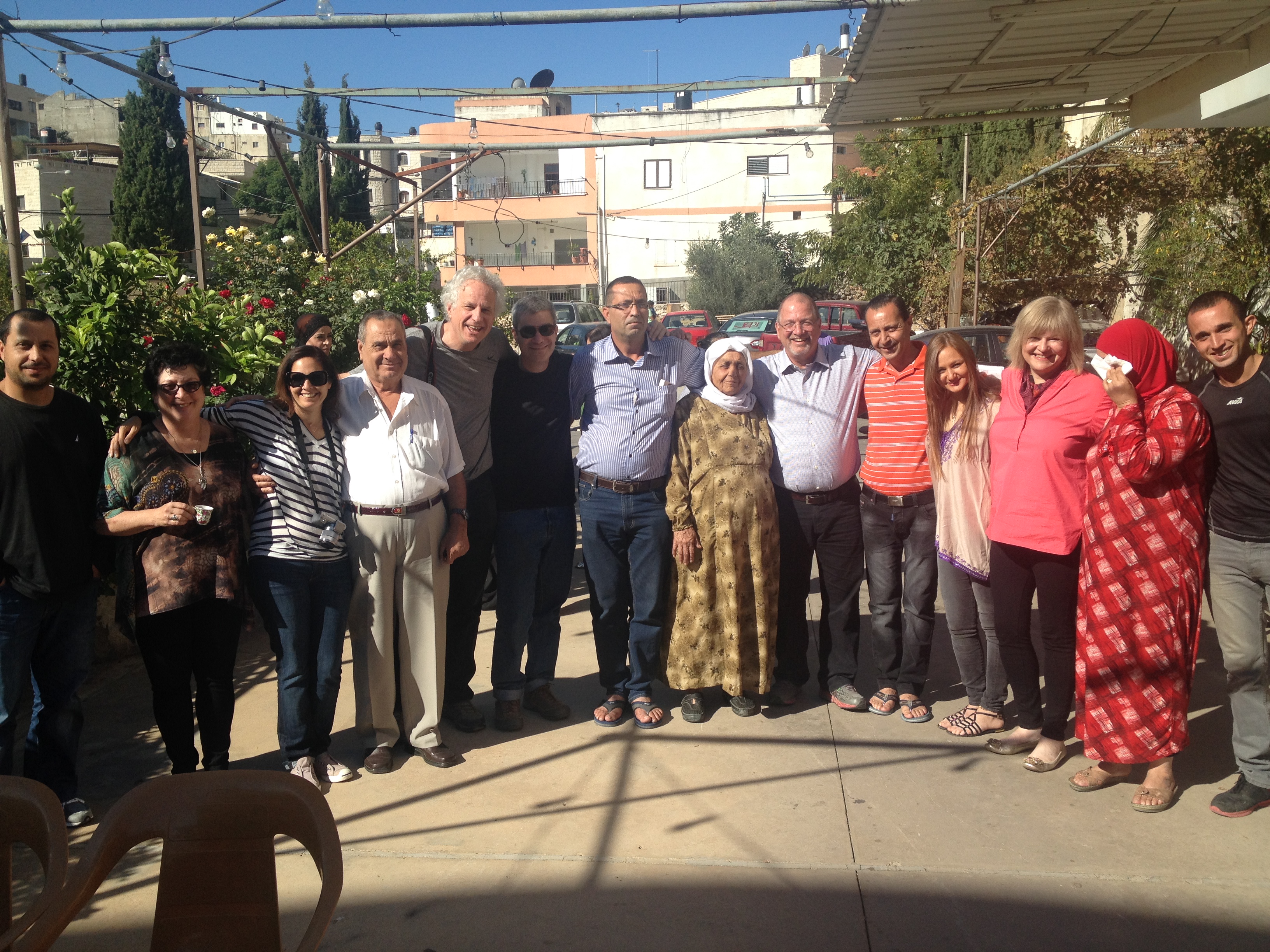
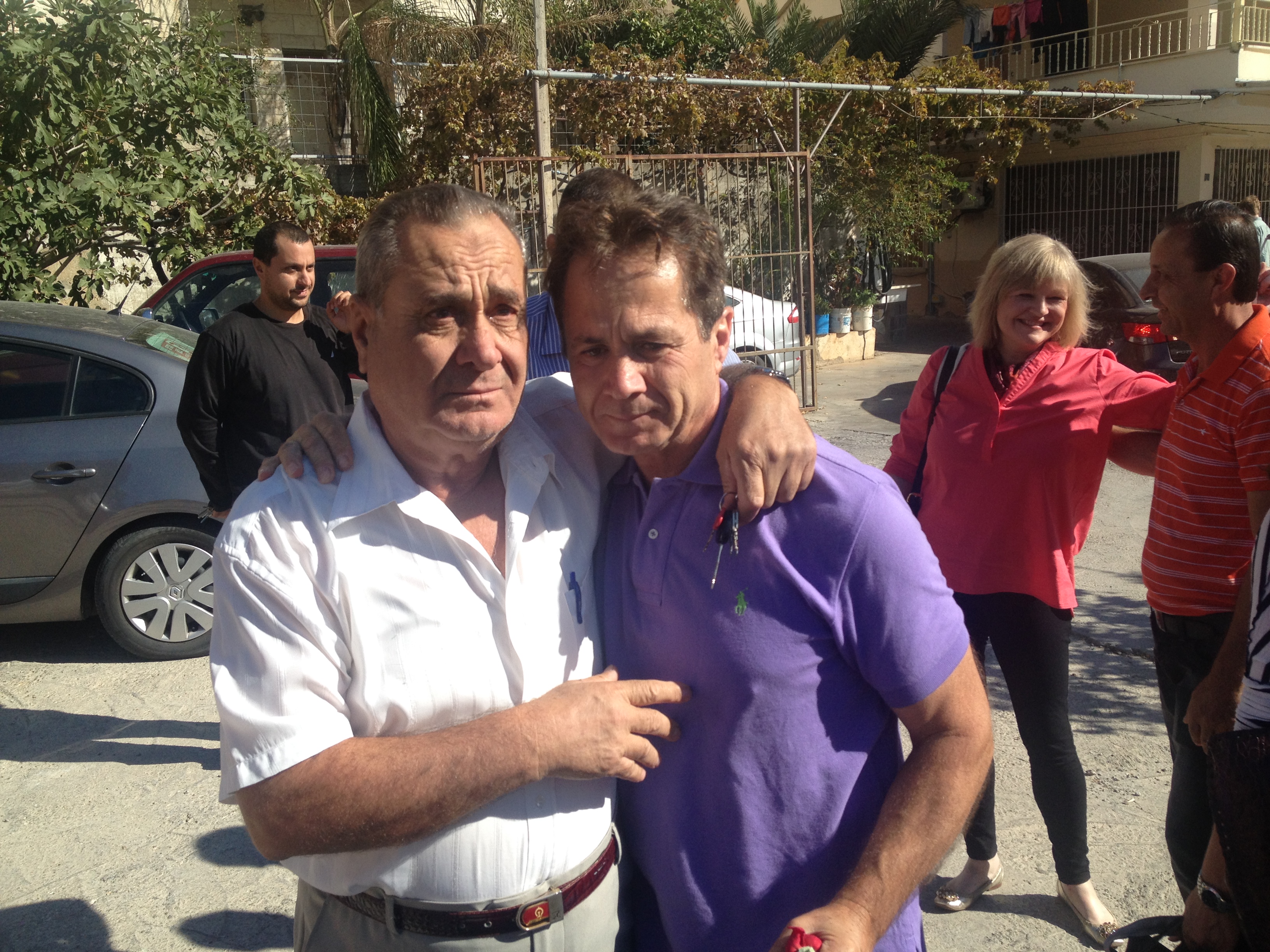
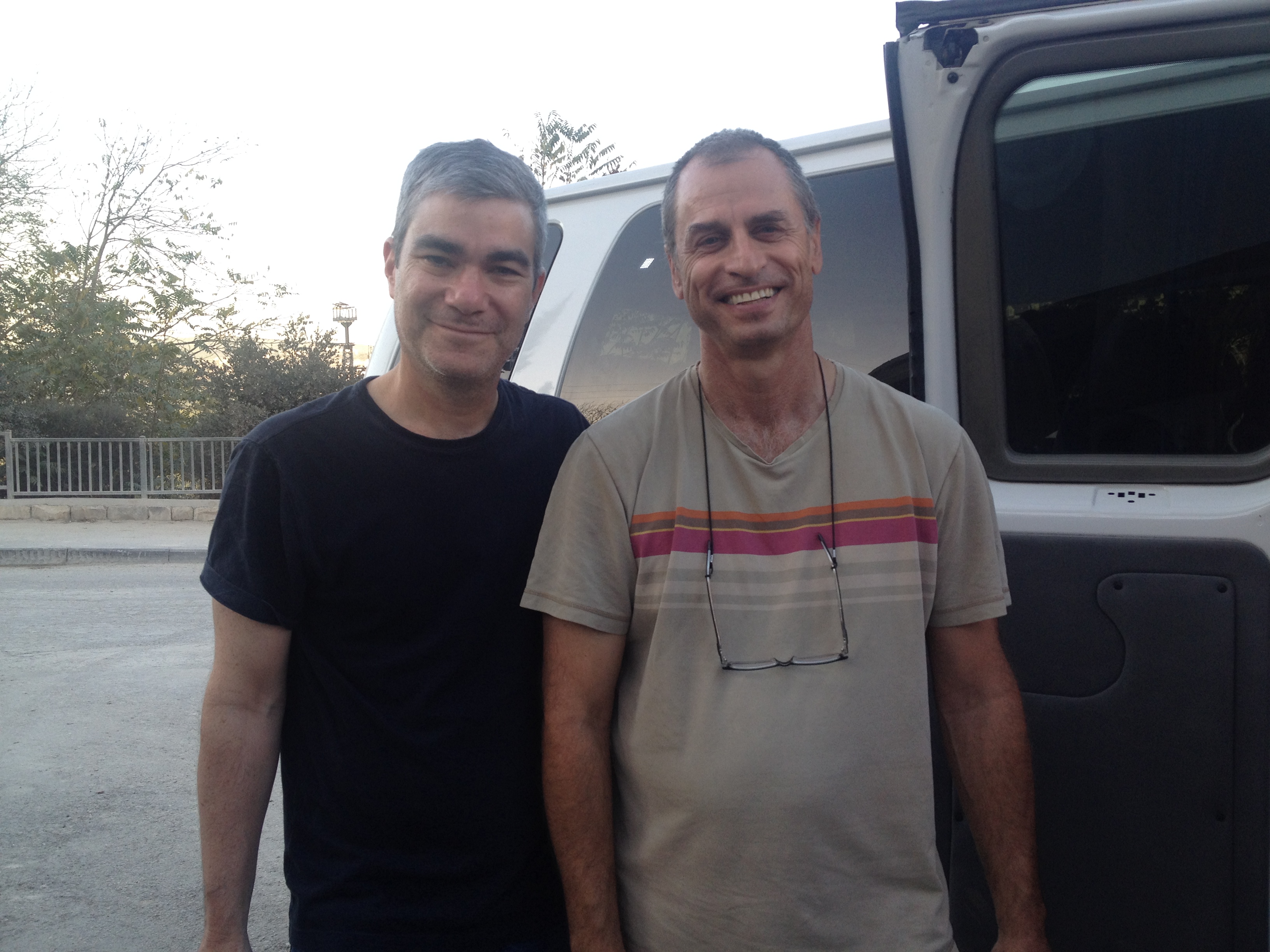
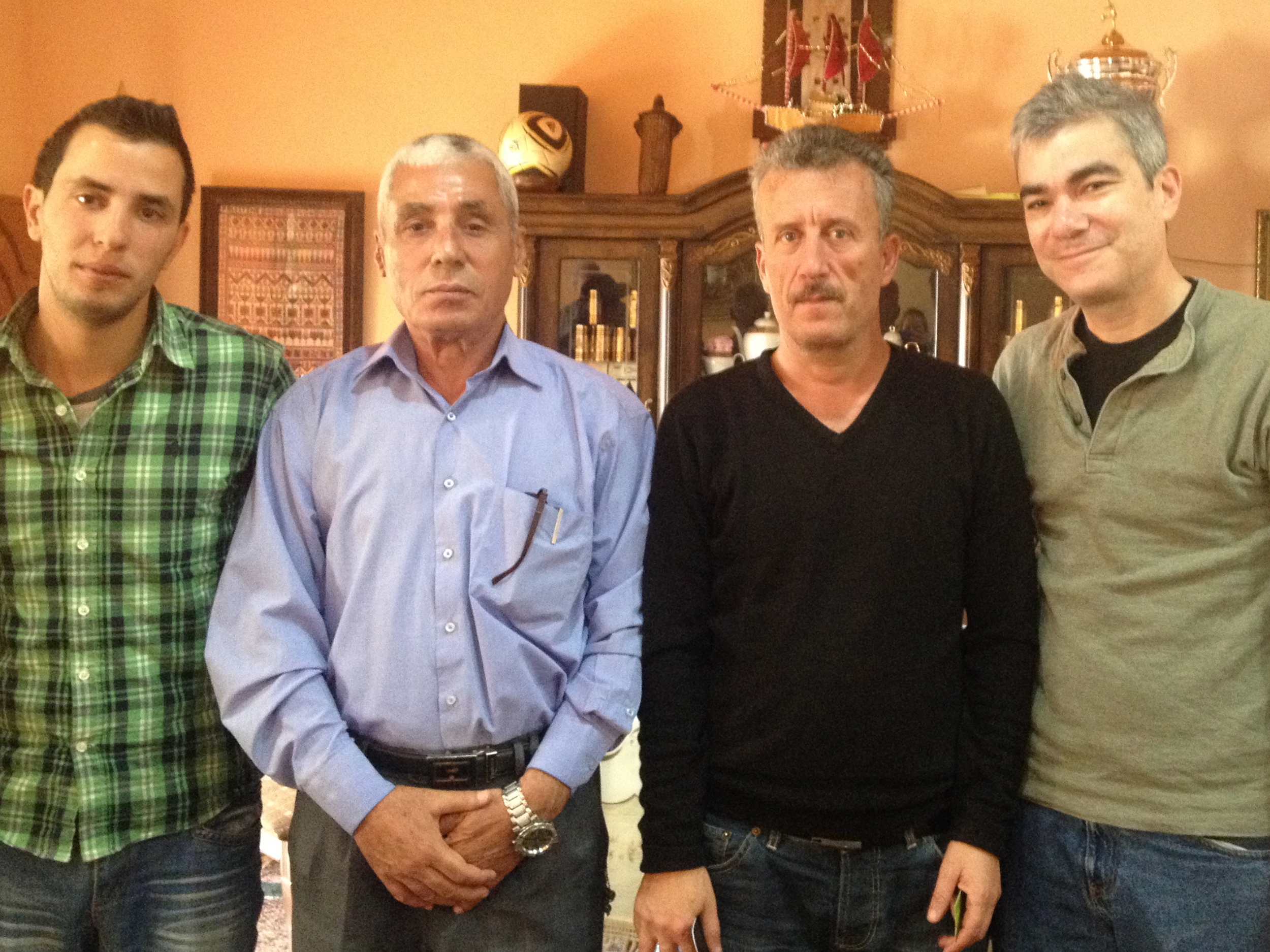
From left to right: delegation members Shafic Budron and his daughter Dima with Shafic’s Uncle Hasan, Al-Bi’na, Israel.

Early in the planning of our delegation, two of our Palestinian-American members, Shafic Budron and his daughter Dima, invited our group to visit to the homes of their family members in the Upper Galilee of Israel.  Shafic and his immediate family are dear friends to many of members of the delegation – and of course we graciously accepted their invitation. I think I can safely say this visit was one of the most eagerly anticipated part of our itinerary.

Like many Palestinian families, Shafic’s family was devastated by the Nakba. While many of his family members became internally displaced – and eventually became Palestinian citizens of Israel, others became refugees. Shafic himself was born after the Nakba and grew up in the infamous Shatilla refugee camp south of Beirut, Lebanon.

Shafic’s personal story is a harrowing one, but he eventually made his way to the US, where he became an American citizen, a successful businessman and a prominent member of the Palestinian community in the Chicago area. Shafic and his family are among the most genuine, open-hearted people I know – indeed his friendship with so many Jewish members of our delegation was a major inspiration for this remarkable trip.

IMG_0797

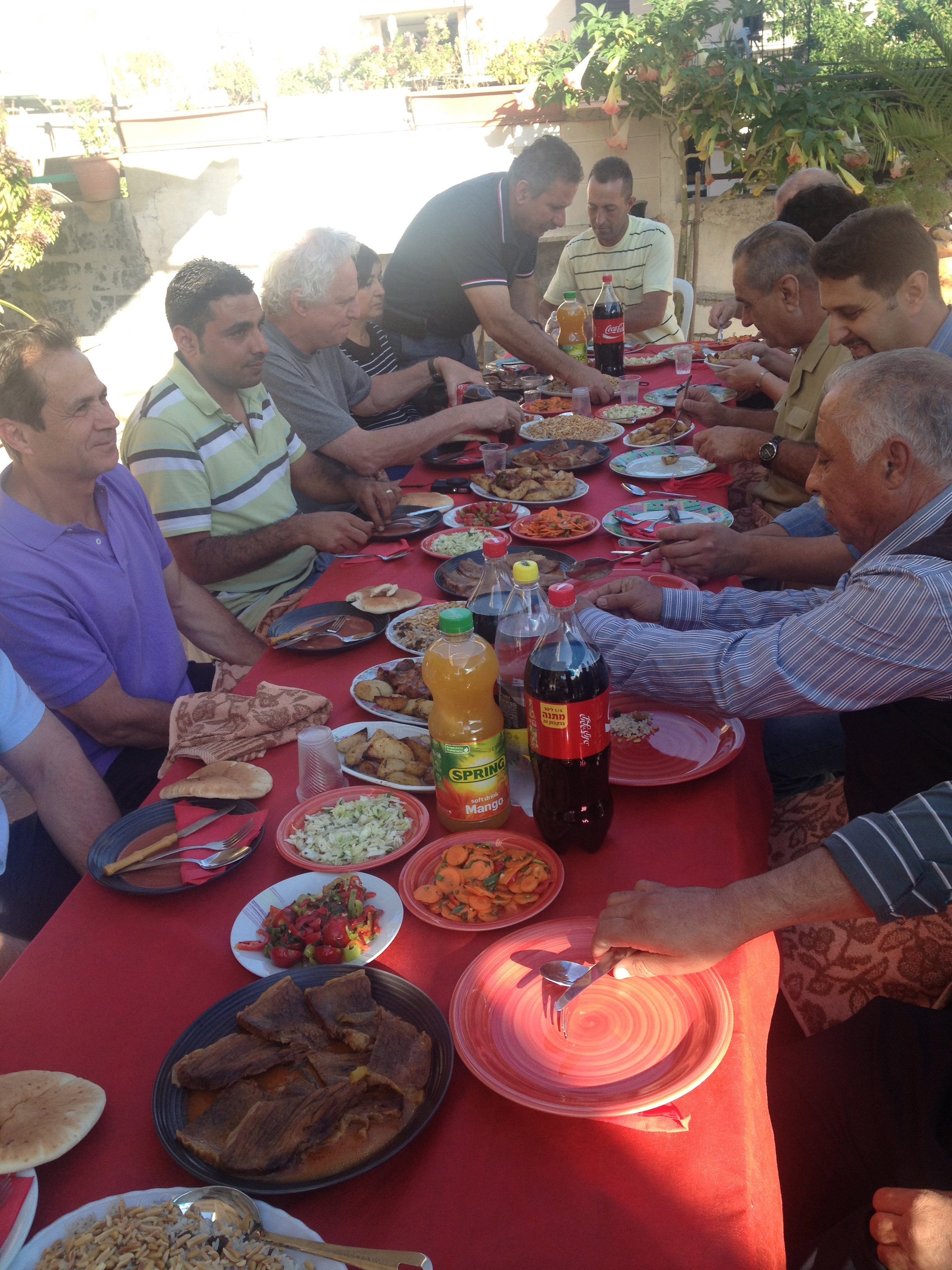
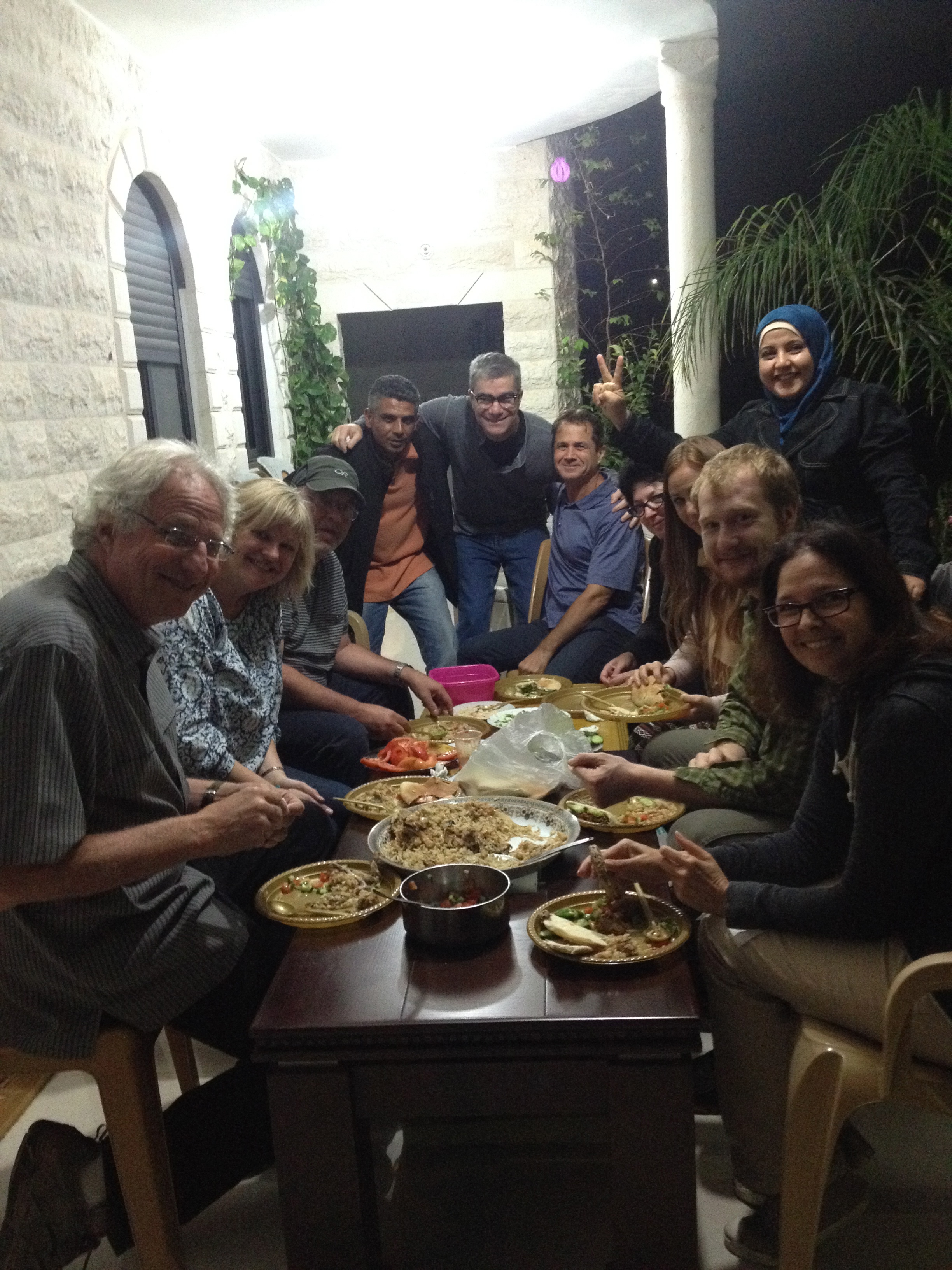
Most of Wednesday was a travel day as we drove north through the Jordan Valley toward the Upper Galilee. When we arrived at our destination in the village of Al-Bi’na, we were literally swarmed by joyous family members, who quickly and graciously welcomed the members of our delegation. Shafic’s uncle Hasan (his father’s youngest and only surviving brother) introduced us to his many children and grandchildren and extended family members as we sat in a circle for a cursory “get to know each other” session. Then we sat down to a sumptuous lunch (above), where we continued to get to know each other some more. By the end of the meal, we felt as if we had become adopted members of the family.

After a visit to the former village of Al-Ghabsiyah (see my earlier post), we went to Shafic’s cousin Dr. Abed’s home in the nearby village of Al-Jedaidah for a dinner that lasted well into the wee hours of the evening. Tired but exhilarated, we were eventually put up in family members’ homes for the night.

IMG_0811

This was clearly an emotional visit for the entire family, not least for Shafic and Dima themselves. The Budrons have, quite understandably, experienced a myriad of emotions on this trip and during our Galilee sojourn in particular. This was, in fact, Dima’s very first trip to Israel/Palestine. While she has visited her father’s family several times in Lebanon, she has never visited her homeland until now. She tells me she has heard stories about her ancestral home from her parents and grandparents for years – and is overwhelmed to finally make the visit now as a young woman.

It has been a profound and emotional visit for our entire American Palestinian/Jewish delegation as well. As of now, the trip has officially wound down. Several members are already returning home and I am preparing to depart today. There’s so much more to say, so many more experiences to describe. I’ll do my best to share as many of them as I can after I return.

In my next and final post, I’ll offer some concluding thoughts – and I have put out an open invitation to our members to share their thoughts with you as well.  Suffice to say for now this has been a sacred journey – one that has strengthened our relationships with one another and our solidarity with those who devote their lives every day toward a just peace in Israel/Palestine.

More thoughts to come…

IMG_0815

Hasan and Shafic say goodbye.

“Beautiful Resistance” in Aida Refugee Camp

Our trip is winding down, but I’m going to try and slip in a few more posts before I head stateside…

As I mentioned in an earlier post, Palestinian resistance takes many different forms. On Thursday, we received a profound tutorial in cultural resistance courtesy of the educational and theatre training center, Alrowwad.

Alrowwad (in Arabic: “Pioneers for Life”) is located in the Aida refugee camp adjacent to Bethlehem and refers to its mission as “Beautiful Resistance.” As their vision statement eloquently articulates:

(We seek to create) an empowered Palestinian Society on educational and artistic level, free of violence, respectful of human rights and values, (with special focus on children and women) based on the spirit of social entrepreneurship and innovation in self-expression and respect of human values.

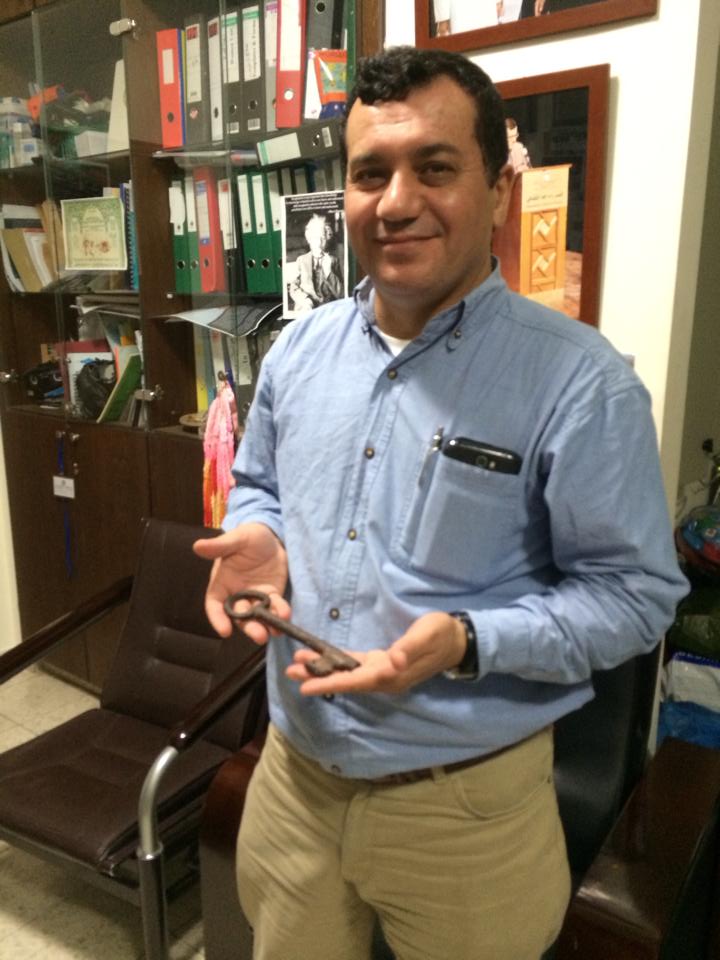
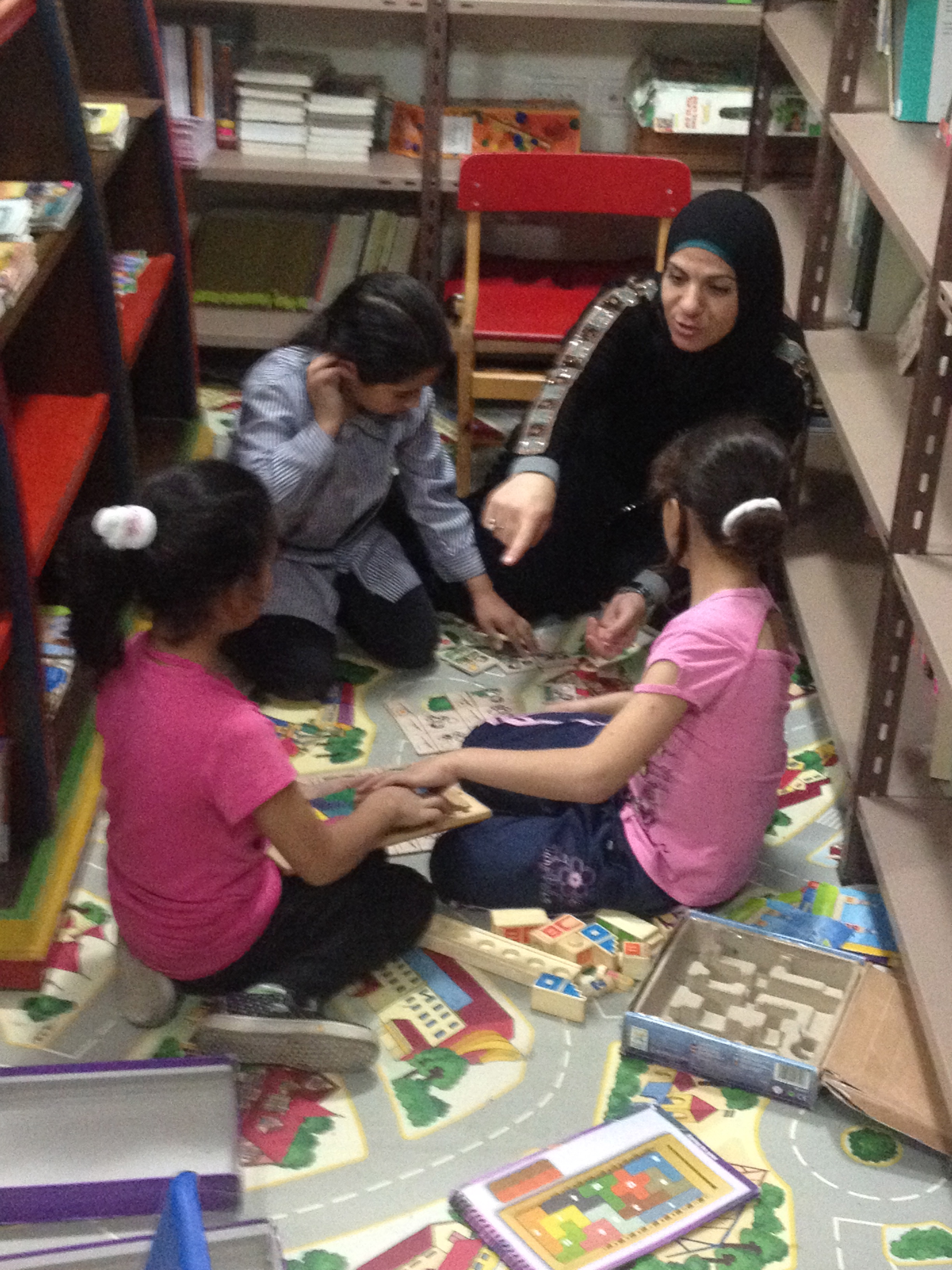
We spent the afternoon with Alrowwad’s founder and director, the inspiring and visionary Dr. Abdelfattah Abusrour (below), who gave us a tour of the center and the Aida refugee camp itself.  Abdelfattah was born and raised in Aida, but went to Paris to study Biological and Medical Engineering at Nord University. While in France, he also nurtured a passion for theater and painting and he quickly became involved in the educational/cultural life of Paris. He told us that he could easily have “married a French woman” and lived a comfortable life in France, but he eventually felt compelled to return to Aida and utilize his cultural training in his home community.

Dr. Abdelfattah Abusrour with the key to his family's home (it is a well-known custom for Palestinian families to keep the keys to the homes they lost during the Nakba as a sign of their hope for return.

Dr. Abdelfattah Abusrour with the key to his family’s ancestral home (it is a well-known custom for Palestinian families to keep the keys to the homes they lost during the Nakba as a sign of their hope for return.)

Abdelfattah established Alrowwad in 1998, and it very quickly became an anchor in the Aida community.  It has also become a model of cultural resistance for Palestinian society at large. Their concept of “Beautiful Resistance” uses culture as a therapeutic method to encourage and promote creativity and non-violence, and to teach peace and respect for others.

Abdelfattah and Alrowwad has now introduced a future generation of Palestinian youth to this a new method of self-expression and resistance. They believe their work increases the spirit of collaboration between children as well as their sense of belonging in the community. Their hope is that given the chance to be creative and to set their own priorities, children can provide a bridge for a democratic and independent Palestinian society — to build a better future even amidst a dire present.

IMG_0826

In many ways, touring Alrowwad reminded me the Jenin Freedom Theatre, which I visited with my congregational delegation in 2010. Adelfattah told me that his center does indeed collaborate with the Freedom Theatre, as well as other similar Palestinian cultural projects throughout the West Bank. Adelfattah also travels abroad to promote his work – and this spring will be directing a performance of “The Diary of Anne Frank” in North Carolina!  Just another reminder that there is an extensive and powerful grassroots movement of Palestinian cultural resistance that is relatively unknown to the West, but is eminently worthy of our support.

IMG_0831

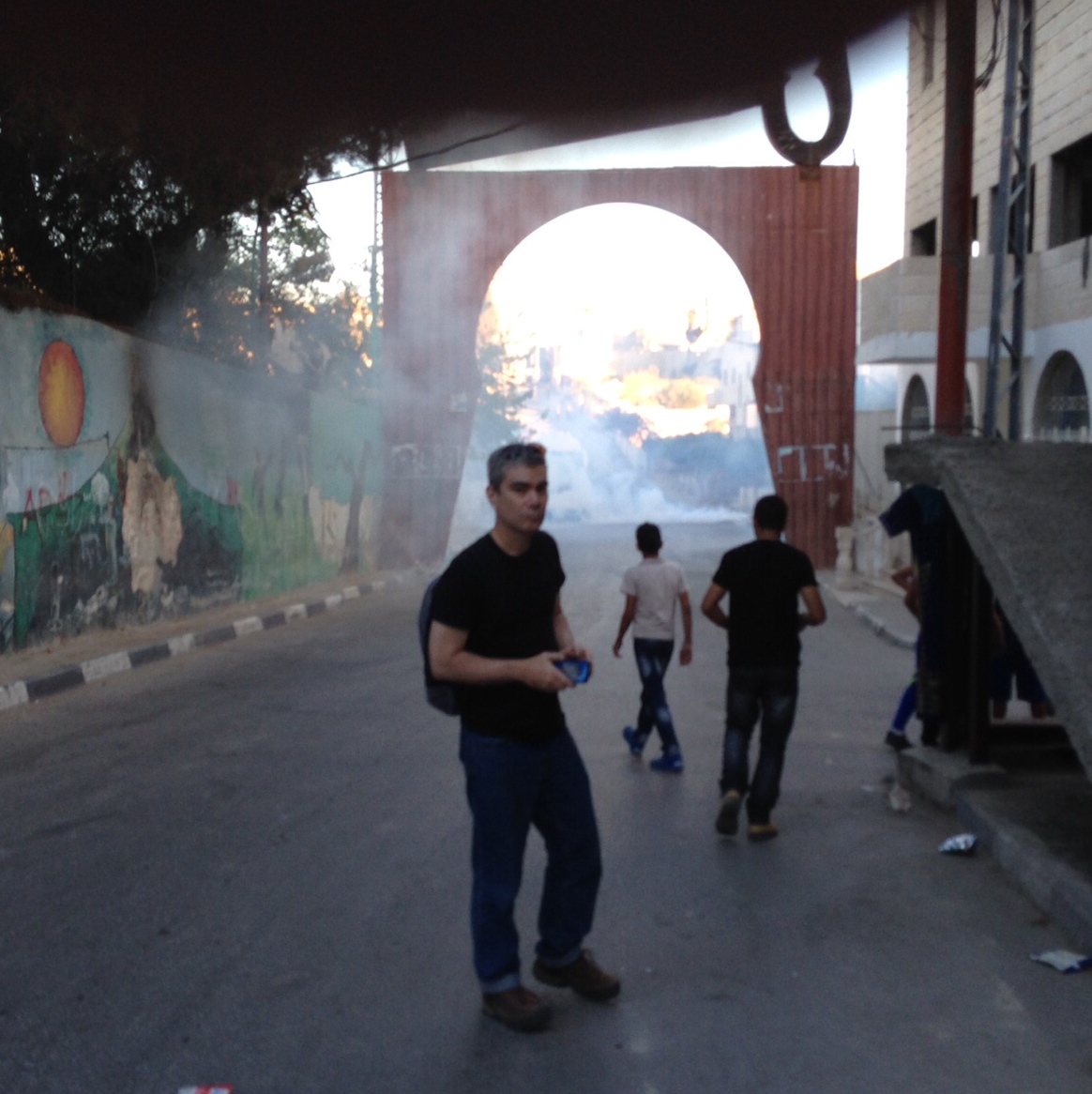
During our tour of Aida (above), Abdelfattah gave us a glimpse of the life of his community – explaining its history and illuminating life amidst the ever-present reality of military incursions, night raids, etc. At one point, our group actually witnessed this reality up close: near the gate to the camp, several IDF soldiers shot tear gas at some children who were a few meters in front of us. (We did not witness the incident that precipitated this violence.) Though we were not in the immediate vicinity of the tear gas clouds, it carried toward us downwind – and though it was only a vestige of the gas, several of us experienced its powerful, lingering sense of burning in our eyes and throats. (I can’t begin to imagine what it must feel like to sustain a direct hit.)

teargas

We continued our way down the streets of Aida, along the separation wall that butts up directly against Bethlehem. As we walked, a women called to Adelfattah from a third story window and invited us up for tea. We sat together on the roof of her home, sipping our tea and looking out over the wall toward the wide open spaces that led toward greater Jerusalem. Our hostess told us that she and Aida owes their very lives to Abdelfattah and it was an honor to have us in her home.

Please join us in supporting the work of Alrowwad through Friends of Alrowward USA. Our delegation can personally attest to the power of their “Beautiful Resistance.”

An Anniversary of Popular Struggle in Al-Ma’asra

IMG_0883

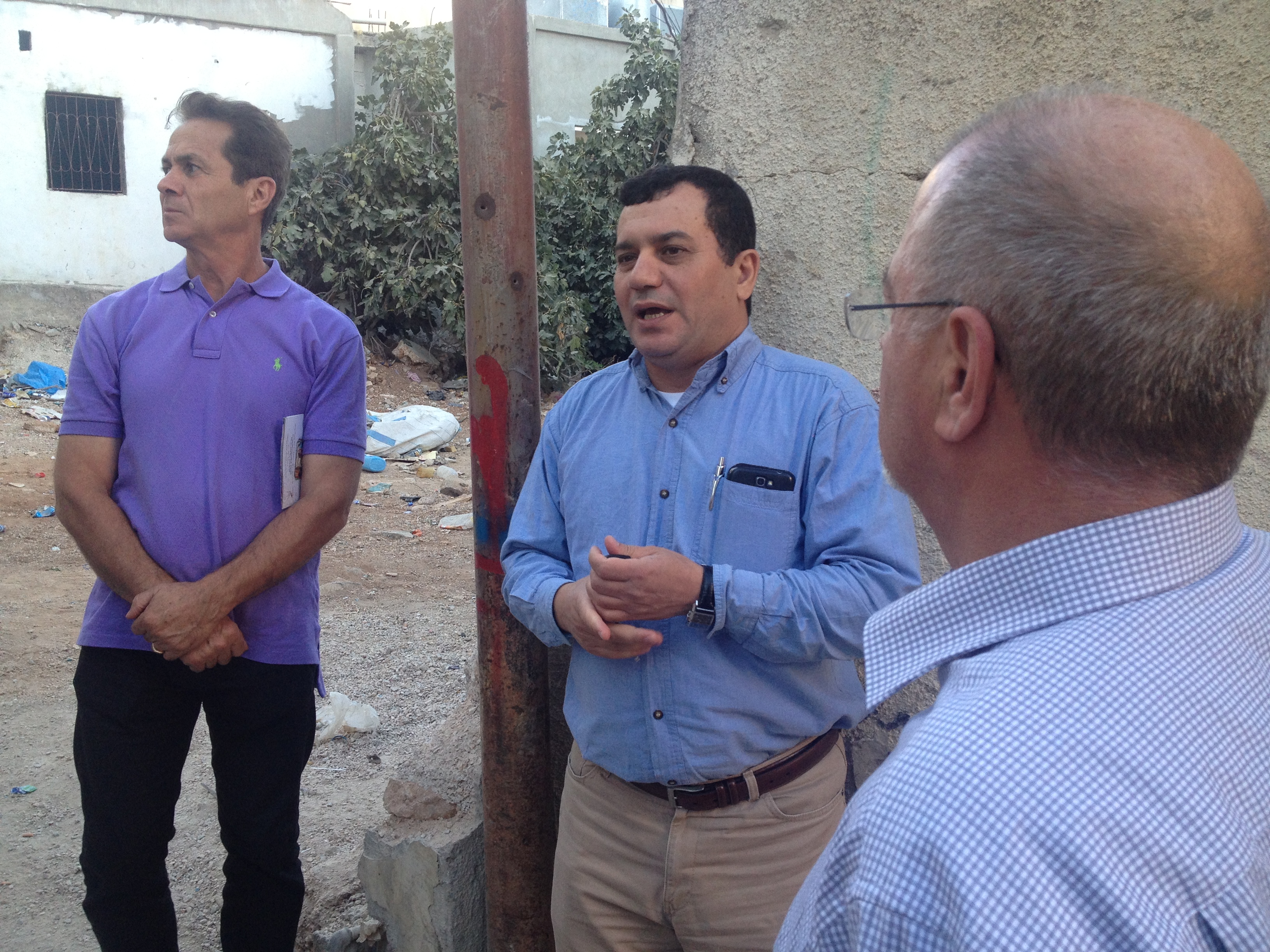
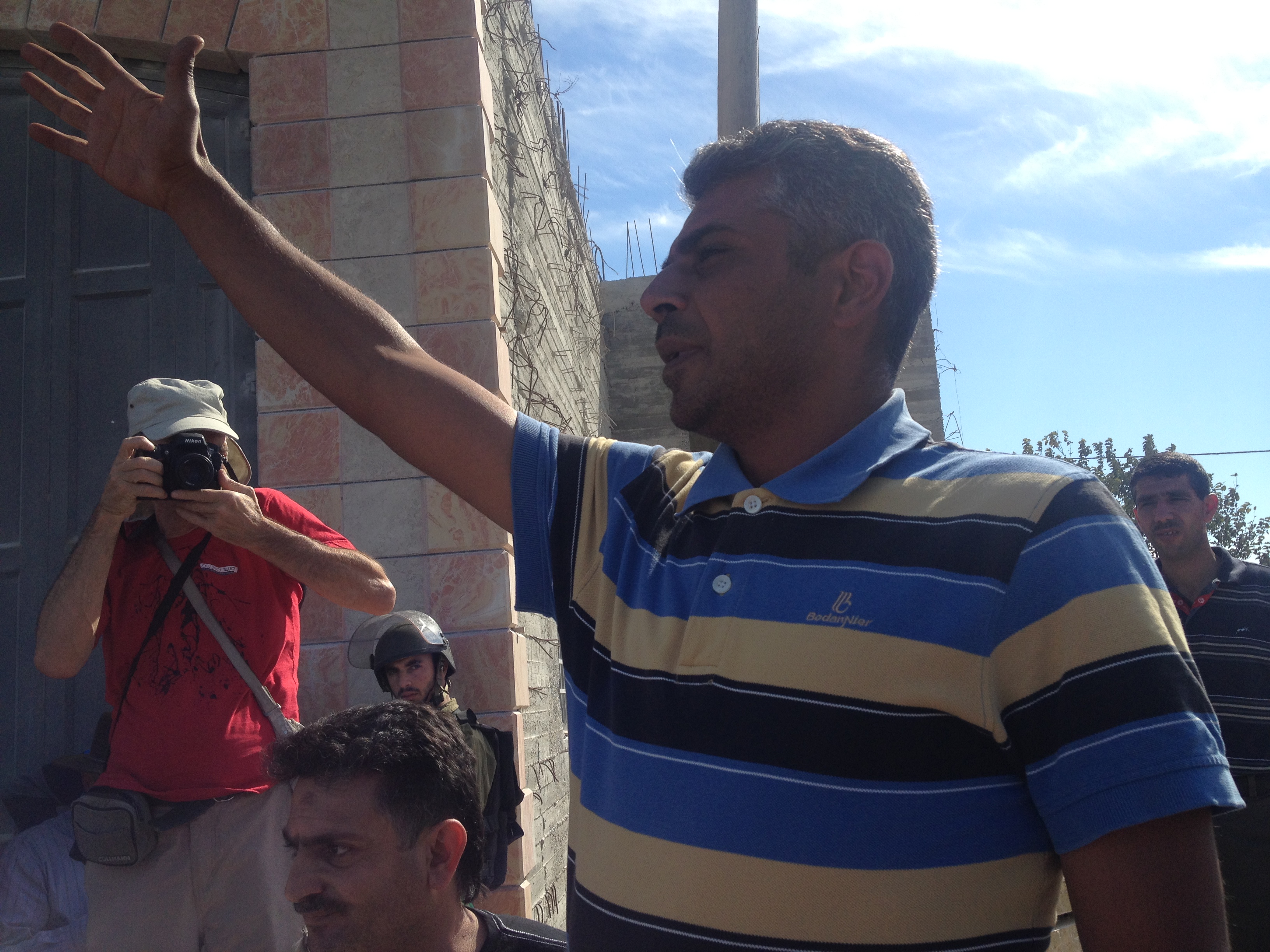
Al-Ma’asra Popular Committee Leader Hassan Brijeh

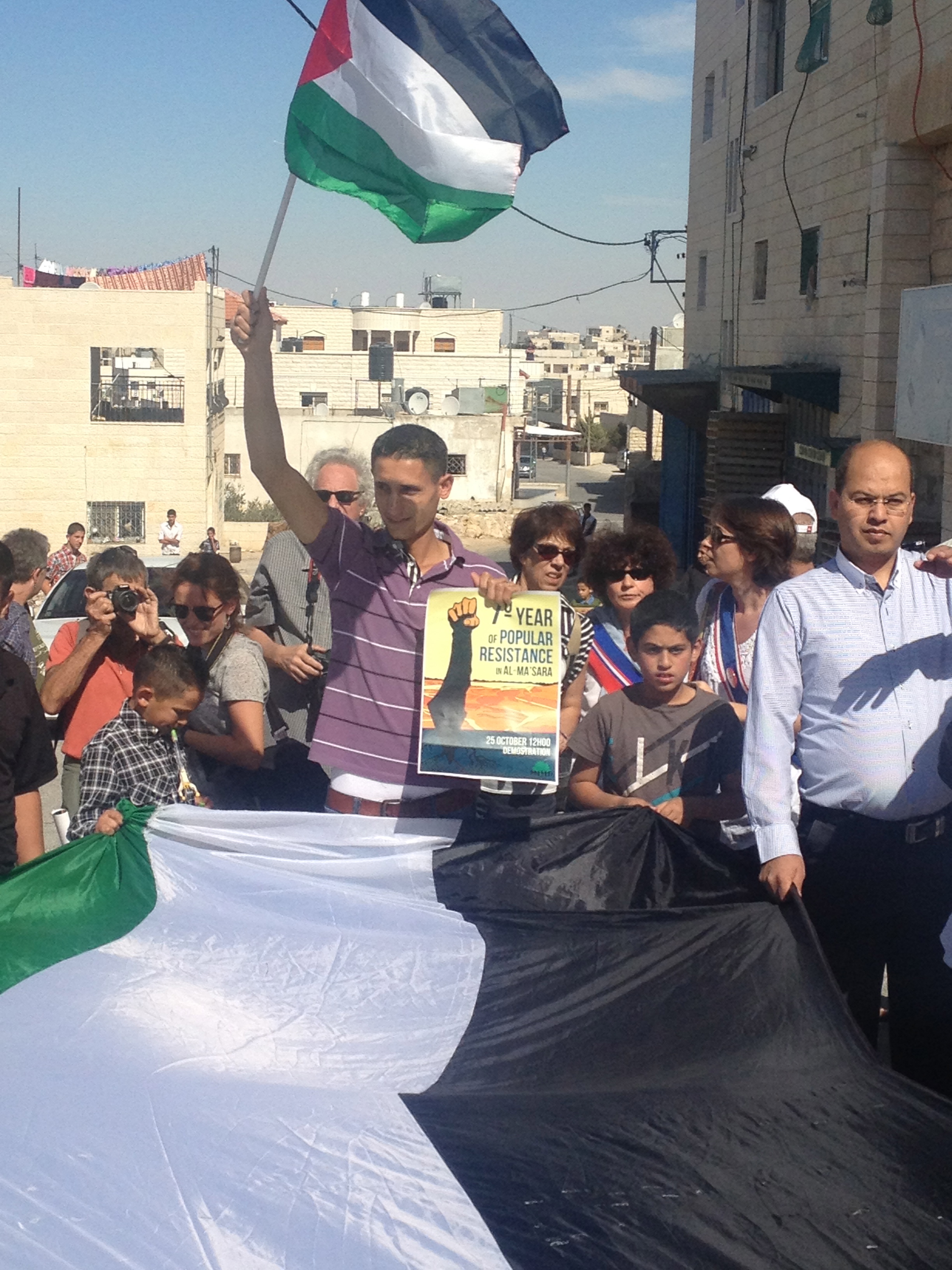
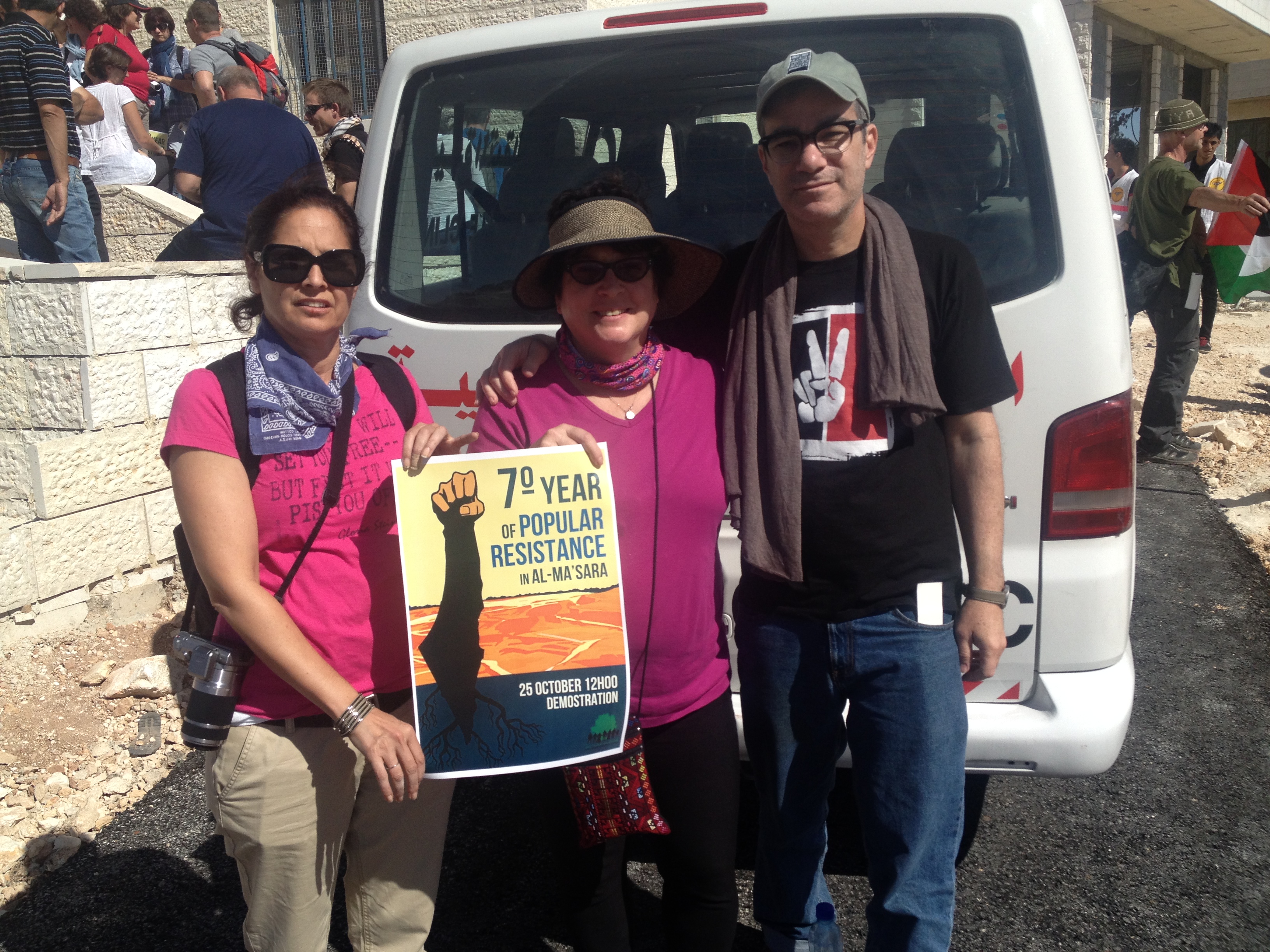
Earlier in the week, our Bil’in host Iyad Burnat told us that a neighboring village, Al-Ma’sara, was celebrating the 7th anniversary of its popular resistance against the occupation – and was inviting other village communities involved in the movement to march join them for their weekly Friday demonstration. Although our original plan was to march in the weekly demonstration in Bil’in, this turned out to be a rare opportunity to see the wider movement in action. So on Friday, our delegation traveled with Iyad to show solidarity with the people of Al-Ma’asra.

Al-Ma’asra is located in the Southern Bethlehem area, with a population of approximately 950 residents, 50 of whom are between the ages of 6 and 18. Like many villages in this location – near Israel’s coveted Gush Etzion settlement region – the construction of the separation wall is cutting off Al-Ma’asra from accessing more than half of their land and the main water supply.

About 90% of the houses in Al-Ma’asra are located in Area C – a region in which Israel is rapidly demolishing houses and moving out its Palestinian residents. (I’ve written extensively about this issue here, among other places).  Like Bil’in, Nabi Saleh and so many other villages, Al-Ma’asra has turned to popular resistance – including weekly nonviolence demonstrations – to protest the theft of their land and devastation of their livelihood. And like these other villages, they have been subject to the Israeli military’s devastating use of tear gas, sound bombs, coated steel bullets etc. Since the beginning of their demonstrations, more than 30 of their inhabitants have been arrested.

IMG_0886

After we arrived in Al-Ma’asra, we received a briefing/update from Mohammed Brijeh (above, later at the rally), after which we joined the growing ranks of villagers, Israeli solidarity activists and internationals who were quickly pouring into the village’s main street.  Then at 12:00 pm we gathered together and began marching. The street was filled with approximately 300 individuals: young and old, representing a myriad of nationalities and ethnicities. But it was clearly the people of Al-Ma’asra who were leading the way: leading us in chants, singing songs and waving to their neighbors,

IMG_0874

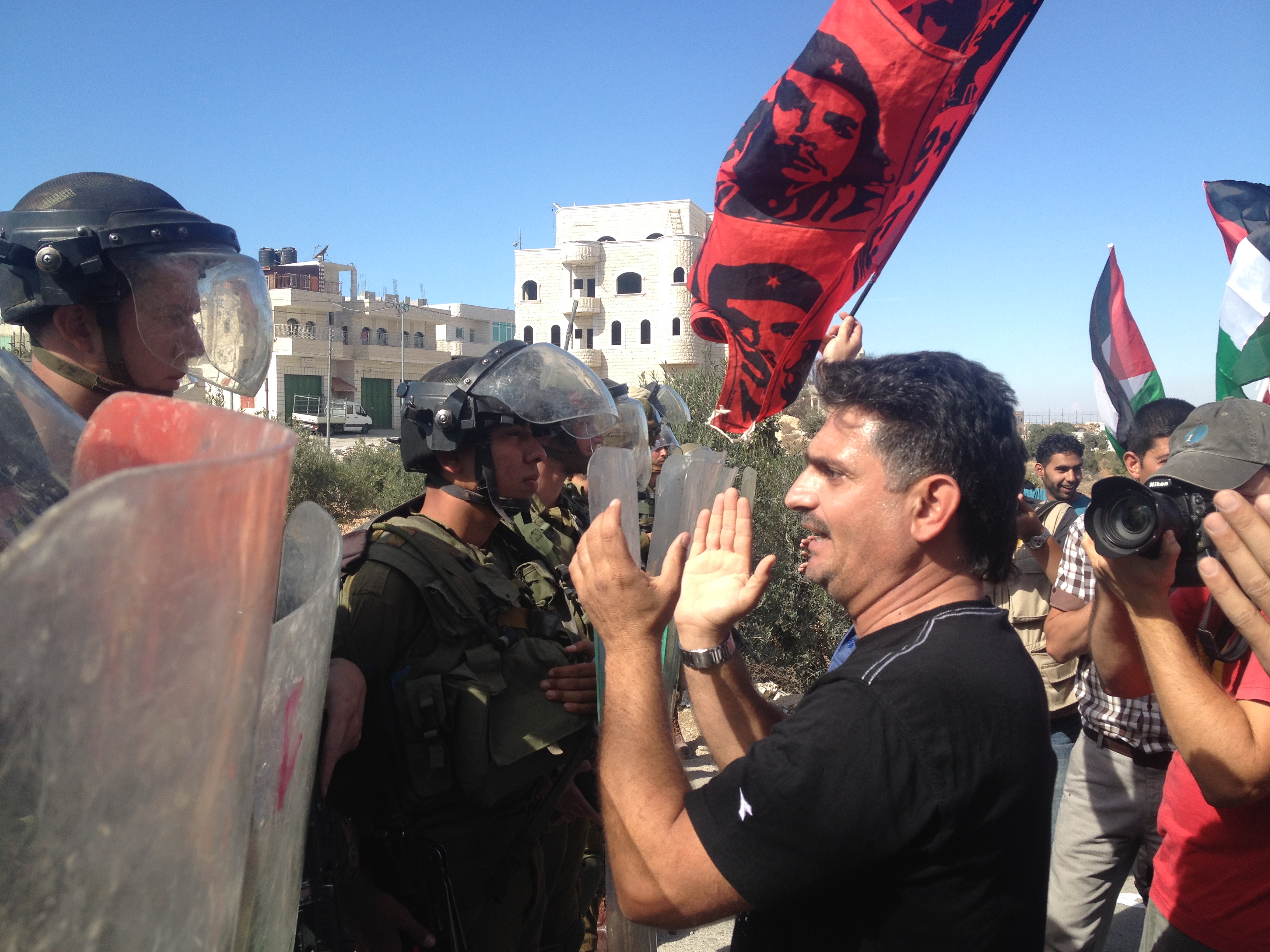
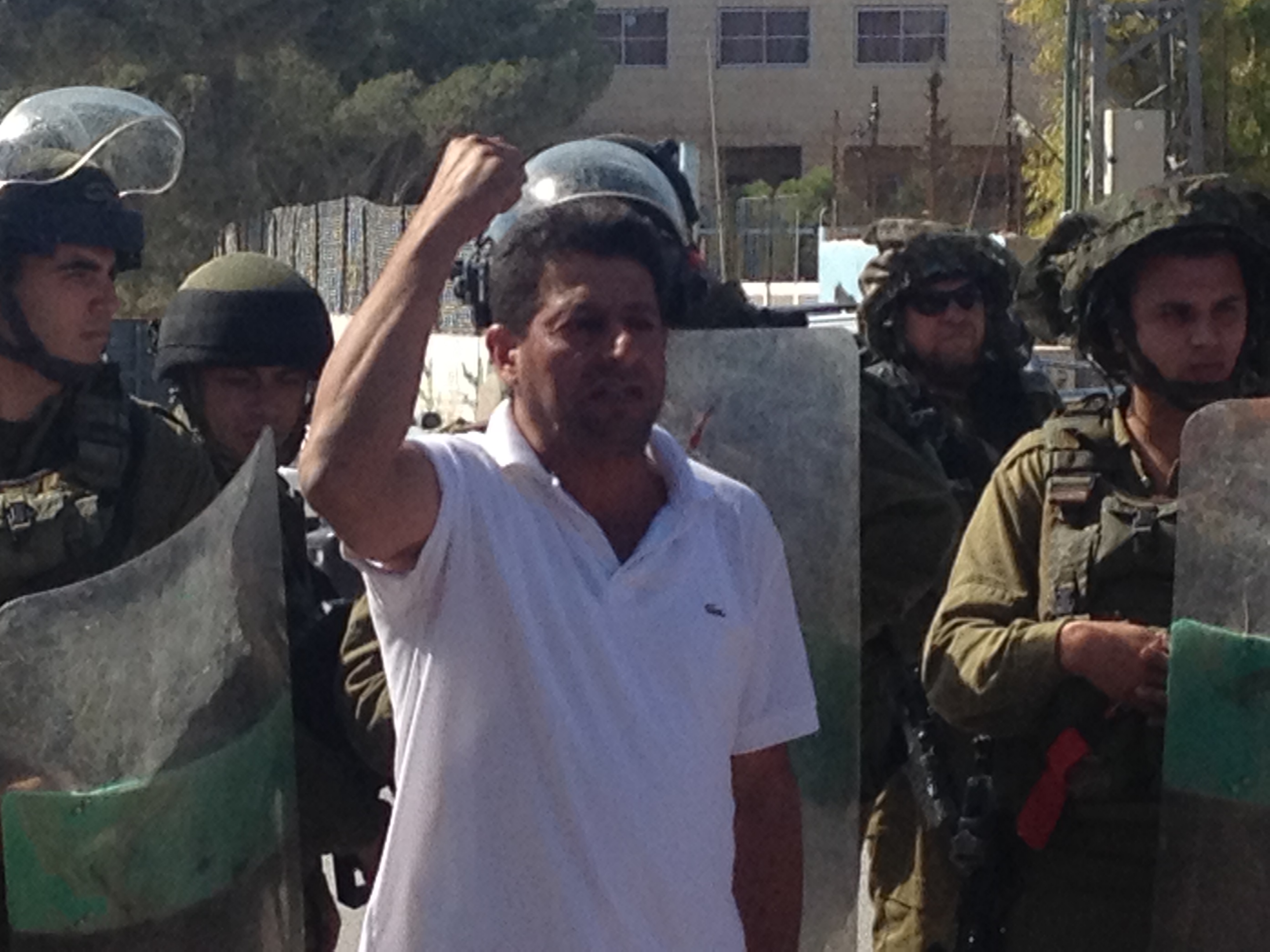
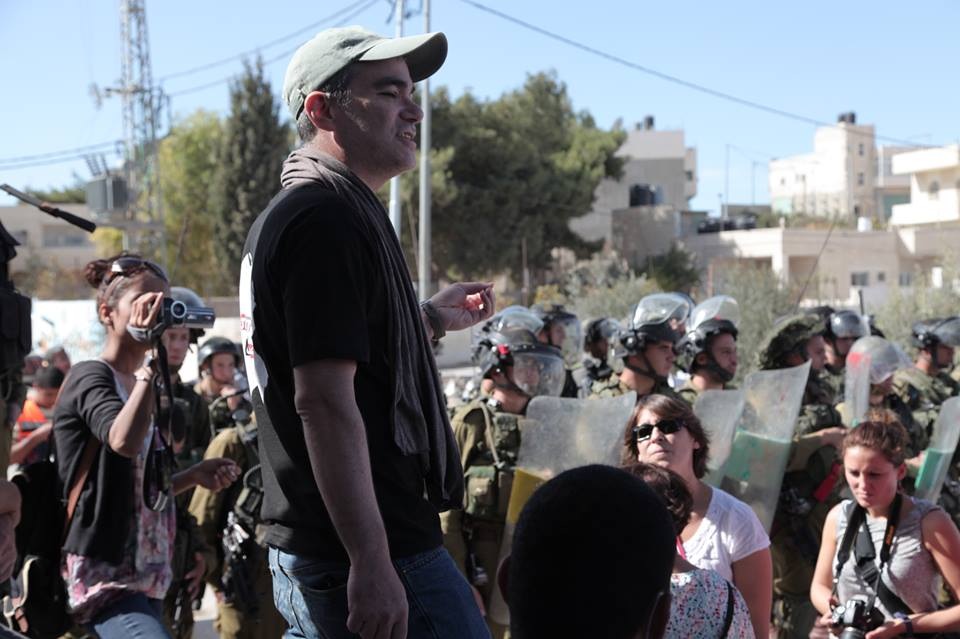
After 15 minutes or so, we noticed a long line of Israeli soldiers in riot gear, standing in formation across the street, blocking our way to the wall. The crowd pressed up close against the soldiers and standoff commenced. When the villagers were told they were denied passage, Mahmoud stepped forward and starting chastising the soldiers in English. Careful not to use any physical violence or overly incendiary rhetoric, he asked the soldiers why they were not allowed the right to live and assemble freely in their own village.

He explained to them they could oppress them all the wanted, but that one day, like all oppressed people, they would be free. Pointing to their extensive riot gear, their bullet-proof vests, their M-16s, their helmets, he told them that none of this expensive equipment would ever bring them peace – then pointing to his head, he said “it’s not what you wear, it’s what’s in here that you need to change.”

Perhaps the most powerful moment for me came when he said to one soldier, “What would your mother think – would she want you to bully the people of this village, to oppress them, to take their land away from them? Shame on you!” The chant spread quickly through the crowd: “Shame on you! Shame on you!”

About 20 minutes or so into the standoff, there was a roll call of participants, a myriad of countries were called out with the obligatory hometown cheers. (Among those represented: the US, Great Britain, Ireland, Germany, Scandinavia, France, Spain, and more). A succession of speakers then got up on a raised area to the right of the soldiers to give speeches. They introduced Iyad, and he offered greetings (below) from their brothers and sisters in Bil’in.

IMG_0882

After Iyad spoke, one of our delegation participants, Estee Chandler, called out “We have a rabbi here!” Then one of the organizers shouted, “We have a rabbi here! Let’s here from the rabbi!”  And before I could even think about what I might possibly say, I got up and started to address the crowd (below).

I told them that the Torah teaches us – as all spiritual traditions do – that God stands with the oppressed and demands that we do the same. Thus, I said, this demonstration was a sacred act for all of us – a mitzvah. And that it was all the more sacred because it contained such a diversity of nationalities and religions. I told them we were honored to stand together with our Palestinian brothers and sisters who were struggling for justice and dignity and that we would take this message back with us when we returned home to the US.

IMG_0895

After the speakers, something of a waiting game began. The demonstrators sat down in the street in front of the solders, singing and chanting as the soldiers were obviously conferring on their next move. Eventually, the commander told us we have 5 minutes to disperse before they opened fire on us. Little by little, the crowd got up and walked back down the street. Some of the younger villagers went to another main street where we later could see some kind of skirmish in the distance.

In the end, all the demonstrators dispersed; I felt a myriad of emotions at that moment. I had no doubt that the decision to disperse came from the organizers, who understandably wanted to avoid violence in the streets. Still, I admit it felt galling that in the eyes of the IDF, this was a just another “successful” job of unruly crowd control . On the other hand, the message of solidarity and defiance had been delivered – as it had been every week for the previous seven years in Al-Ma’asra and would for many more years to come. And in so doing, new relationships were created, new coalitions built – and the movement was that much stronger for having come together that day.

During our standoff in the street with the IDF, it occurred to me that this was precisely the same circumstance that occurred on the Edmund Pettus Bridge in Selma in 1965. The demand for justice was the same, the solidarity was the same, the message of nonviolence was the same, as was the  show of force by a brutal and overmiltarized gauntlet. Though that particular standoff ended violently, I was all too mindful that, in a sense, there is a reenactment of Bloody Sunday every week in villages throughout the West Bank.

PS: Upon our return, we learned to our dismay that the village of Bil’in was tear-gassed during their demonstration that day.  We were told that several canisters actually landed near Iyad’s house and at one point most of the village was shrouded in choking white smoke.

This is life on the front lines of the Palestinian popular resistance – just a small sample of the regular crimes committed against a people who are literally choking on an unjust and illegal occupation.

Remembrance as Palestinian Resistance

Zochrot's Eitan Bronstein leading a tour of Lifta

Zochrot’s Eitan Bronstein leading a tour of Lifta

There are many forms of resistance to oppression. One is memory itself.

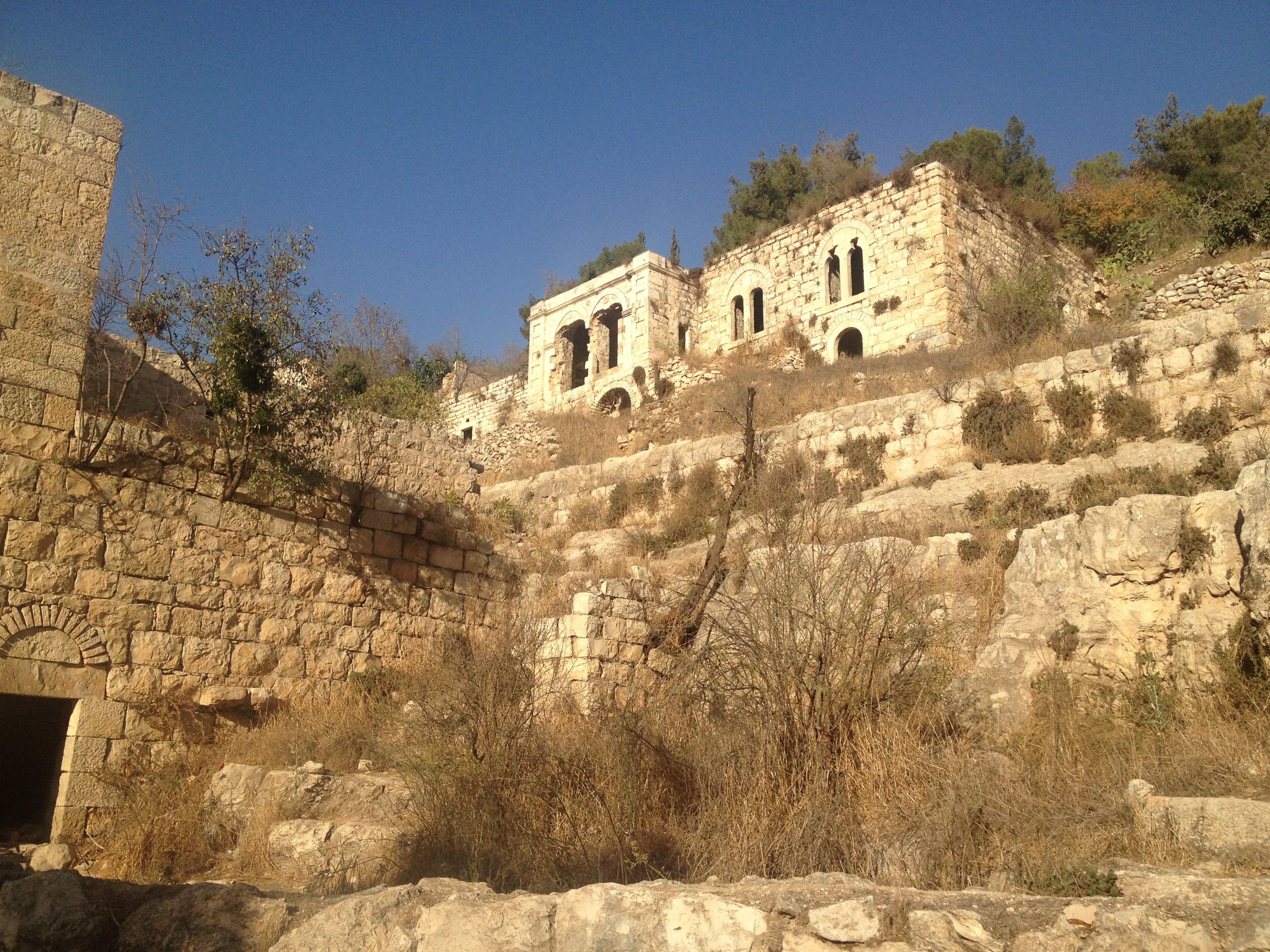
On Tuesday our delegation visited the village of Lifta, a Palestinian village on the outskirts of Jerusalem that was depopulated of its residents by Jewish militias early in 1948. Our tour was led by Eitan Bronstein, director of Zochrot, an Israeli organization that educates Israelis about the Nakba, actively advocating for the Palestinian Right of Return. It’s truly one of the bravest, most important Israeli organizations I know.

Zochrot’s tours of destroyed Palestinian villages are an critical aspect of their educational work. They are, of course, not your typical tours – in most cases they do not show you what is, but rather what is no more. Most Palestinian villages destroyed during the Nakba were razed to the ground, leaving little behind but the shell of a building or the occasional foundations of homes.  Zochrot keeps the culture life of these communities alive through their tours, underscoring the profound enormity – and collective tragedy – of what was lost.

IMG_0789

Lifta

Lifta is somewhat unique among these villages in that it is the only Nakba-era village that still remains largely intact. In its day it was a fairly well-to-do community, with a population of 2,550.

In the years leading up to the 1948, the village fell under attack by Jewish militias in the area. On the December 28, 1947 six people were gunned down in the village coffeehouse, by members of two Jewish militias, the Stern Gang and the Irgun. In late January or early February, the militias attacked and seized the neighboring village of Qaluba and then invaded Lifta from the West. They occupied Lifta’s new town and the remaining residents took refuge in the old town in the valley. The village was cut-off from the west and anyone trying to leave was killed. The villagers resisted but were defeated after several hours of fighting.

By the time the entire village was occupied, most of the people had already left Lifta and fled into the West Bank, the rest were taken by truck and dumped in East Jerusalem. By February 1948, Lifta had been completely depopulated.  It’s not completely clear why the Jewish forces did not raze Lifta to the ground as it had so many other villages. For a time it allowed newly-immigrated Yemenite Jews to occupy the houses, but when the homes proved uninhabitable, they were eventually abandoned

IMG_0791

with Eitan Bronstein

Lifta was the object of some controversy when the Jerusalem municipality announced plans to redevelop the area as a luxury area for Israelis. The plans were dropped after an outcry from former residents and progressive Israeli activists. In the meantime, the remnants of this remains, a testament to the legacy of a rich communal life that was lost during the Nakba.

I can see why Lifta is such a popular spot for Israeli tourists – the town ls nestled in a long valley, with homes and buildings built into either side. The mosque and the Muktar’s house are still in decent condition, testifying to what clearly once was a beautiful, desirable town. At the bottom of the valley is a natural spring that still attracts swimmers, particularly ultra-orthodox who attribute spiritual significance to it. As Eitan showed us the area, the swimmers glared at us as if we were interloping in their own “sacred territory.”  They clearly had no comprehension of the actual profanity that had occurred here in 1948.

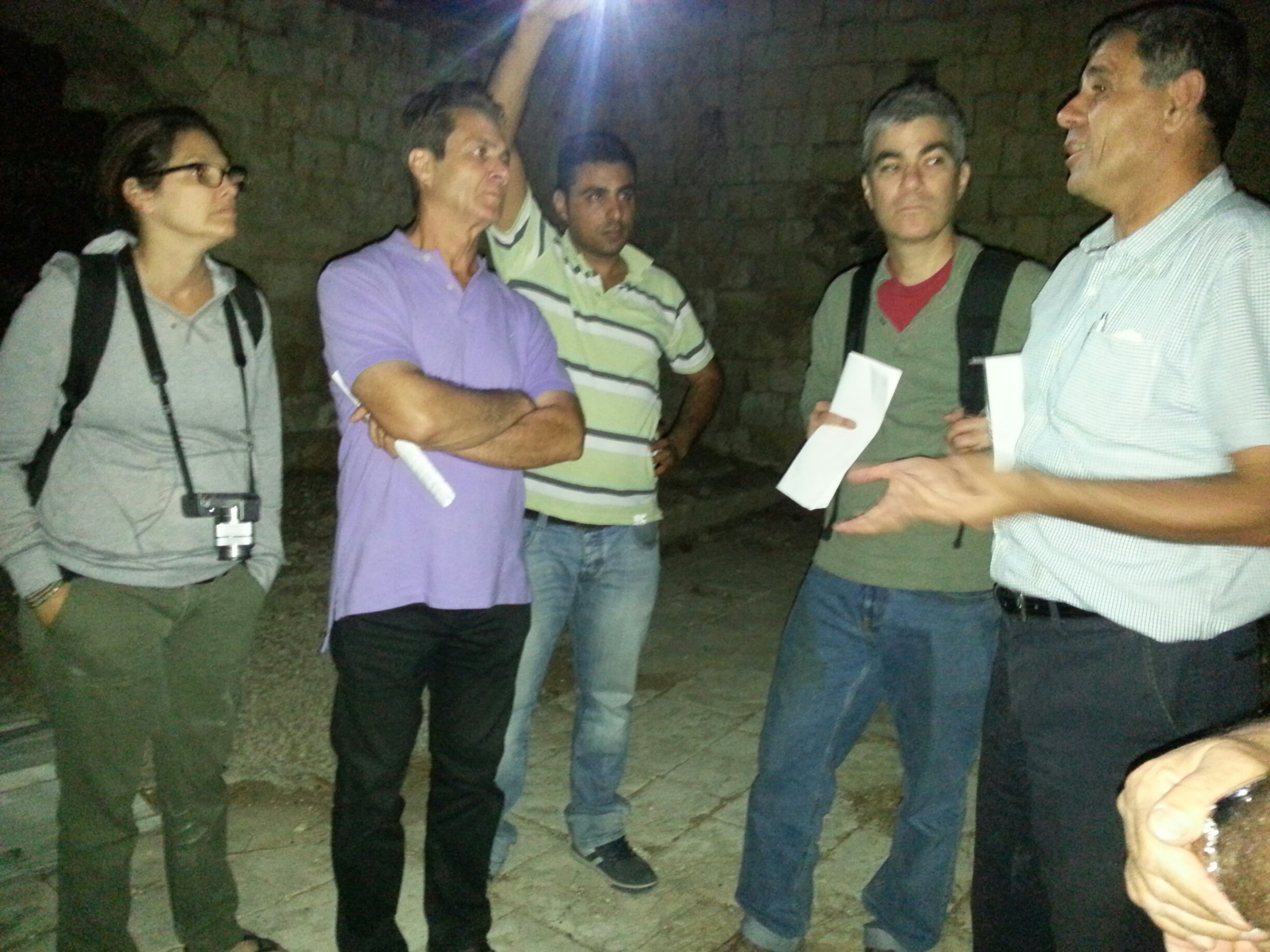
On Wednesday evening, we visited another Nakba site: El Ghabsiya, located in the upper Galilee (where were visiting members of delegation members Shafic and and Dima Budron’s family – more on this later). Our tour of El Ghabsiya was led by Muhammad Kaial of the Association for the Defense of the Rights of the Internally Displaced Persons in Israel, and Daoud Bader, an original survivor of the original village.

The story of El Ghabsiya, like Lifta, is an example of how the Nakba is not only a historical event of the past, but an injustice and a struggle that occurs even in our very day. In March 1948, fearful that uncertainty in Palestine’s future could endanger the people of the village, prominent members of El Ghabsiya made an agreement with Jewish militia leaders. In exchange for his cooperation, the militia promised not to invade the village. (At that time, the population of the village numbered about 700 people.)

Inside El Ghabsiya mosque (far right: Muhammad Kaial)

Inside El Ghabsiya mosque (far right: Muhammad Kaial)

The agreement was not to be honored. In May 1948, Jewish militias surrounded and entered the village. Families living near entrance to the village greeted the soldiers with coffee; in return father and his son were taken out into the nearby woods – Daoud told us that they have never been heard from to this day. When the soldiers entered El Ghabsiya, a community leader named Daoud Zainl climbed to the roof of the mosque and raised a white flag. The militia ignored his act of surrender, opened fire, and killed him on the spot. In  all, eleven Palestinians were killed during the attack on El Ghabsiya and the subsequent expulsion of its residents, despite the fact that there was no local resistance.

The inhabitants of the village escaped to surrounding villages, becoming “internally displaced refugees.” Unlike other internally displaced Palestinians, the people of El Ghabsiya were allowed to return to their homes less than twelves months later – but two years later, on August 2, 1951, then Prime Minister David Ben-Gurion declared the village a “closed military zone” and the villagers were again forced to leave their homes.

The people of El Ghabsiya fought for their right of return all the way to the Israeli Supreme Court and on November 1951, the court ruled that they did indeed have the legal right of return to their village. Armed with this ruling, the villages gathered and headed back to their homes – and were met by Israel military forces the blocked their way and refused to recognize the decision of the court.  In succeeding years, government bulldozers destroyed all of the houses in the village – the only building left standing was the village mosque.

For the next forty five years, the Israeli Land Authority allowed the mosque to sit in disrepair and desecration, used as a stable for horses and other animals. Finally, in 1995 residents and descendents of residents of El Ghabsiya initiated a clean-up project and began weekly attempts to pray at their mosque. In response, the Israeli Land Authority sealed the windows and doors and ringed the mosque with barbed wire.

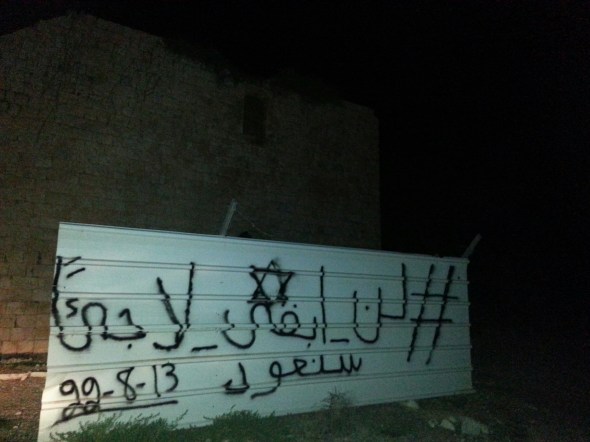
Outside El Ghabsiya mosque: “I will not remain a refugee – we will return.”

Still, the people of El Ghabsiya have not given up. Most live in villages near their ancestral village and they still make regular attempts to gather to pray at their mosque. Above you can see the sign villagers have placed in front of the mosque: “I will not remain a refugee – we will return.” (You can also see that the sign has been vandalized, sadly enough, with a Jewish star.)

After hearing this story, our group toured the mosque and gathered in the courtyard. On of our members Kalman Resnick said that as a member of the Jewish community and a man whose own family fled persecution, he felt shame at hearing this story of dispossession, that continues to this day. I then led the Jewish members of our delegation in the recitation of Kaddish for those who were killed on this site in 1948.  In return, Daoud, the original resident of the village, emotionally expressed his appreciation for our presence and our solidarity – a profoundly moving moment for us all.

After our visit, our group discussed ways we might help support the people of El Ghabsiya in their quest for justice – and their simple desire to pray in their ancestral mosque. More info on this effort will be forthcoming.

We’ve just returned from our Friday demonstration. It was, quite simply, an indescribable experience –  I’ll do my best to describe it in my next post…

Morning in Nabi Saleh

IMG_0767

Mohammed Tamimi, Abu Hussam Tamimi, Bassem Tamimi, me (left to right)

On Monday morning our group traveled to the nearby village of Nabi Saleh, another prominent community in the Palestinian nonviolence resistance movement. You may have heard recently about Nabi Saleh from this New York Times Magazine cover story by Ben Ehrenreich last March. If you haven’t read it, I highly recommend it – I believe it is by far the most thoughtful consideration of this movement by the mainstream media.

Although this was my first time in Nabi Saleh, I met Bassem Tamimi, one of its most prominent leaders briefly in Ramallah on our congregational trip to the West Bank in 2010. That’s me above with Bassem, his cousin Abu Hussam Tamimi and nephew Mohammed Tamimi.

Our group spent several hours in Abu Hussam’s home learning about the history of Nabi Saleh and its place in the greater popular movement. Bassem explained to us that unlike other villages, Nabi Saleh’s protest is not directed toward the separation wall, but rather the confiscation of the village’s lands and the takeover of its spring by the nearby Israeli settlement Halamish.

The protest movement in Nabi Saleh began when Bassem and other village members met with and learned from leaders of similar demonstrations in Budrus and Bil’in. Rejecting the violent resistance of suicide bombers in the Second Intifada, they consciously sought a return to the approach of the First Intifada – a nonviolent popular grassroots resistance that evolved into a coordinated mass movement.  The village leaders of Nabi Saleh studied the work of Ghandi, King and Mandela – knowing at the same time that the Palestinian nonviolent movement had its own unique context and would have to have its own unique characteristics as well.

Nabi Saleh launched its first demonstration on December 9, 2009 – the anniversary of the First Intifada – and since that time, it has been an critical link the chain of the Palestinian popular resistance. Like Bil’in and other villages that hold weekly demonstrations, their protests have been met with visceral force from the Israeli military. Protesters have been regularly met with tear gas, shot with coated steel bullets and sound grenades and sprayed with skunk water. These “crowd-dispersal” weapons invariably cause painful, often grievous, physical distress – and almost all of these armaments are manufactured in the US.

Bassem and the other leaders of the Nabi Saleh resistance have suffered profoundly for their efforts. Bassem has been arrested twelve times by the Israeli military – at one point spending more than three years in administration detention without trial. His most recent arrest took place on March 2011 and led to a year-long prison term. He was released one year later. Tragically, like other villages Nabi Saleh now has its own martyrs: Mustafa Tamimi was killed when he was shot in the face with a tear gas canister at point blank range in December 2011. And on November 2012, Rushdi Tamimi was killed after being shot in the head while protesting the Israel’s military attacks on Gaza in November 2012.

When I asked Bassem about the status of the Palestinian popular movement, he responded that while it is still growing, and despite the ongoing weekly demonstrations of ten to fifteen villages every week and the proliferation of popular committees, they are still far from the “Third Global Intifada” that he and other Palestinian nonviolence are advocating. Bassem and his fellow leaders seek nothing less than a worldwide movement that seeks to leverage the power of nonviolent resistance – including Boycott, Divestment and Sanctions – to eventually shift this unjust balance of power. Still it is clear that they these leaders are settling in for the long haul. And the fact that Israel reacts so strongly and violently to these efforts that it takes such a prospect very seriously indeed.

During our visit, enjoyed a sumptuous lunch graciously served to us by the Tamimi family. They also showed us several YouTube videos of significant Nabi Saleh demonstrations over the past few years. Our consensus favorite was the video, below, of Bassem’s thirteen year old daughter Ahed and her young friends confronting the Israeli military after the arrest of her mother, Neriman. By the end of the video, this little amazing girl was, quite simply, our hero. Please watch and see for yourself (Ahed is the little blond girl with the red pants):

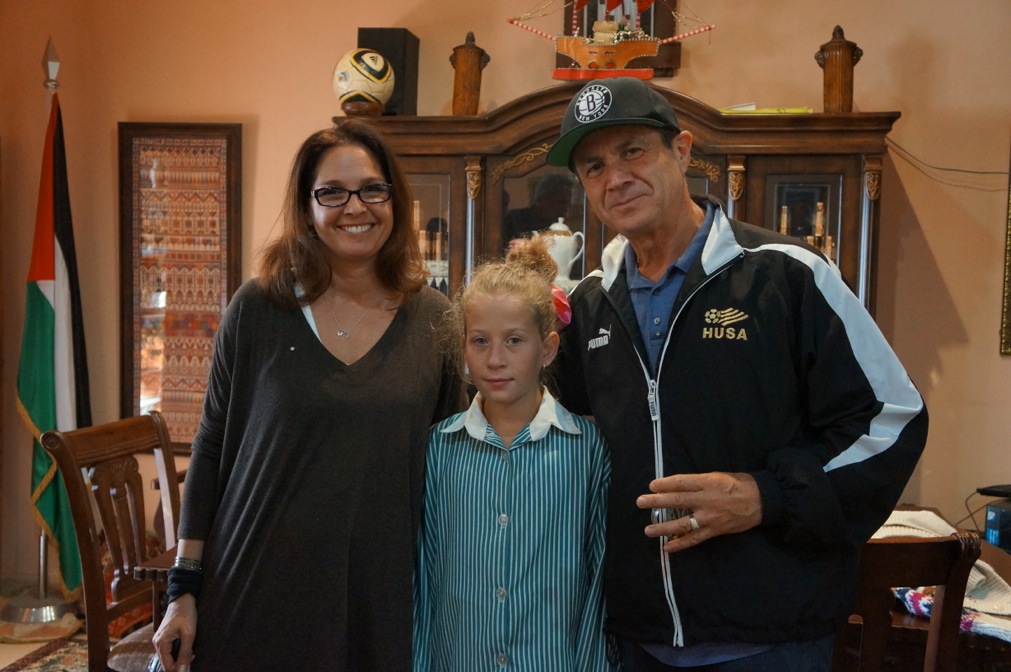
We were so thrilled to actually get to meet Ahed when she came home from school.  Somehow, the quiet, shy girl we met seemed to bear little resemblance to the ferocious, courageous girl speaking her truth to overwhelming military power – yet another example of how the battle for justice is being waged by ordinary people and families who find themselves living in extraordinary times. (That’s her below, with delegation participants Estee Chandler (left) and Shafic Budron (right):

DSC01639

We’re actually meeting and spending time with many amazing children growing up in activist families during our stay here. I will be writing more about this subject – among many others – in upcoming posts. Please stay tuned.

American Jews and Palestinians Showing Soliarity with Bil’in

IMG_0752

Just finished my first full day with our delegation to Bil’in – I think I speak for all our participants when I say we are honored and thrilled to be here.

As I mentioned in my previous post, our group is made up of Chicago-area Jews and Palestinians, with one participant from Los Angeles. We are longtime friends and fellow activists for a just peace in Palestine and we organized this trip to show solidarity with the Palestinian nonviolence resistance movement on the West Bank.  While individual members of the delegation have different personal opinions on the politics of the Israeli/Palestinian conflict and might differ on how a solution should politically be achieved, we are united in the conviction that full equality and civil rights should be enjoyed by all the people – Jews and Palestinians alike.

IMG_0753

With Iyad Burnat

Our “home base” for the trip is Bil’in; our host is Iyad Burnat, a prominent leader in this movement. Iyad serves as the head of the Bil’in Popular Committee Against the Wall, which has led weekly demonstrations against Israel’s separation barrier for the past nine years and has been one of the leading communities in the Palestinian popular resistance. I’ve written a great deal about Bil’in over the years and I’ve closely followed the news out of this small but mighty West Bank village. And like many, I was transfixed by the Oscar nominated documentary, “5 Broken Cameras,” directed by Iyad’s brother Emad, which movingly documented Bil’in’s ongoing struggle.

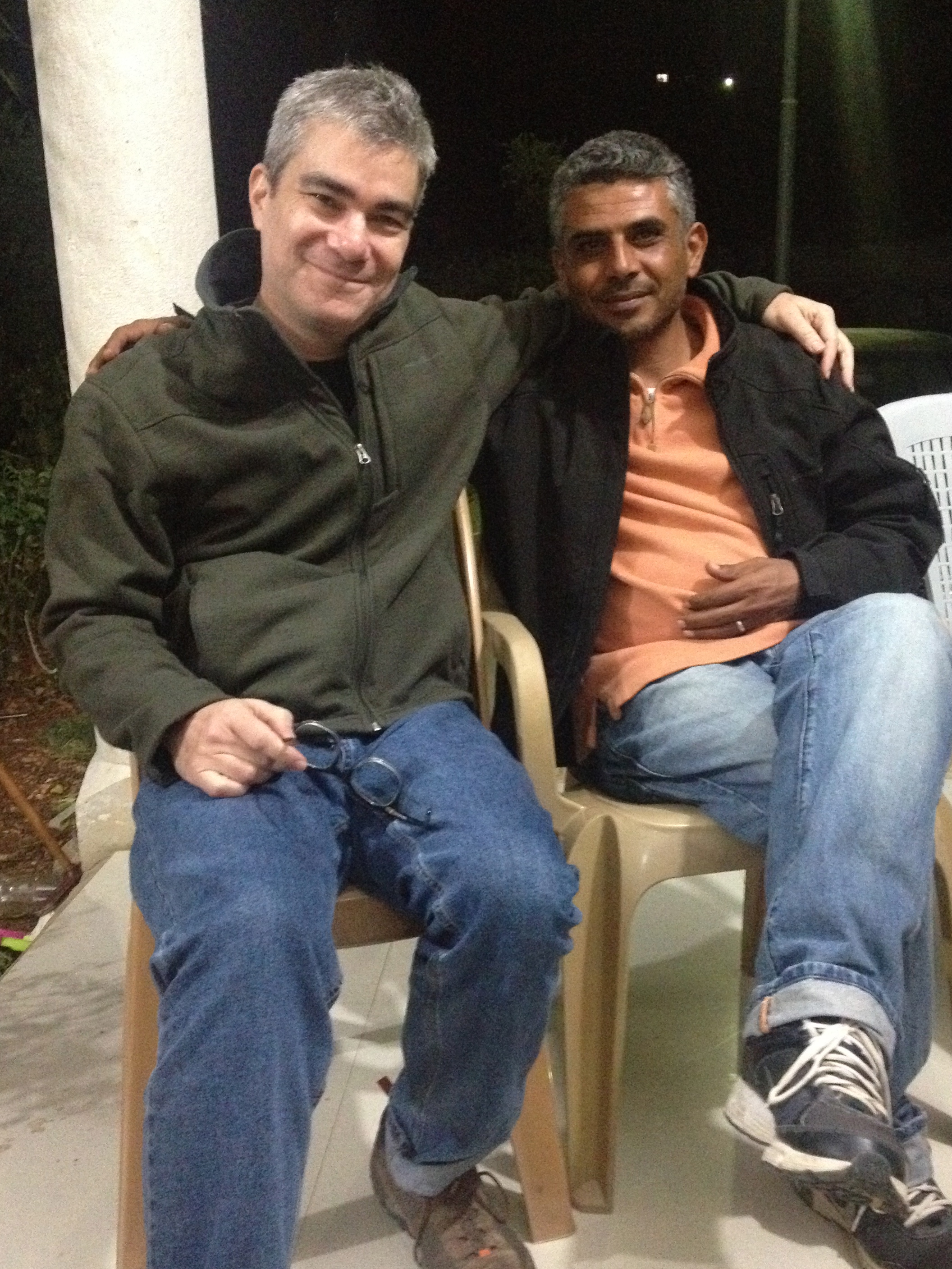
Our hosts here have been gracious and wonderful – Iyad (in the orange shirt, top pic) and his wife Tasaheel (in the blue hijab)  and his cousin Mustafa and his wife Sabrin have joyfully welcomed us into their homes and their families. This is clearly much more than a chance to learn about a movement – it is an opportunity to share in a way of life, to forge new relationships, to make dear new friends.

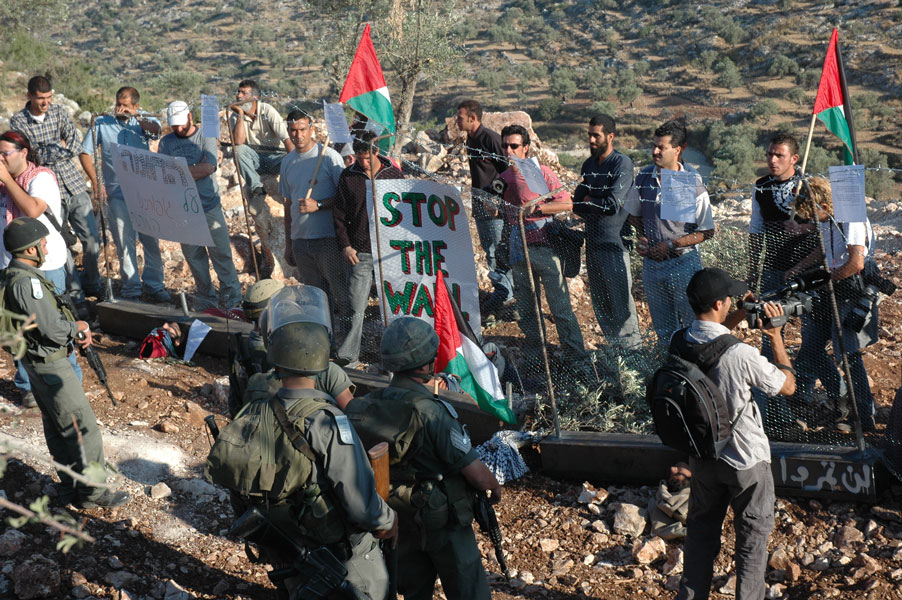
In our introductory tour, Iyad explained that Bil’in was one of the early West Bank villages to organize regular nonviolent demonstrations against the wall that was cutting the village off from a significant portion of agricultural land in order to create a buffer around the nearby settlement of Mod’in Ilit. Bil’in’s efforts have borne fruit – in September 2007, the Israeli Supreme Court ruled that the wall should be moved back 500 meters. The ruling was finally carried out by the military on June 2011, which restored 1,100 dunams of farmland back to the village (almost half of their of their originally confiscated land.)

And yet the struggle continues: the wall continues to choke off the people of Bil’in from their livelihood and the occupation continues to take a major toll on the life of the village. Our group will be participating the demonstration at the wall at Bil’in’s weekly demonstration this Friday – at which time similar demonstrations will take place in villages across the West Bank. This act of solidarity will be, without question, the most important aspect of our itinerary.

IMG_0764

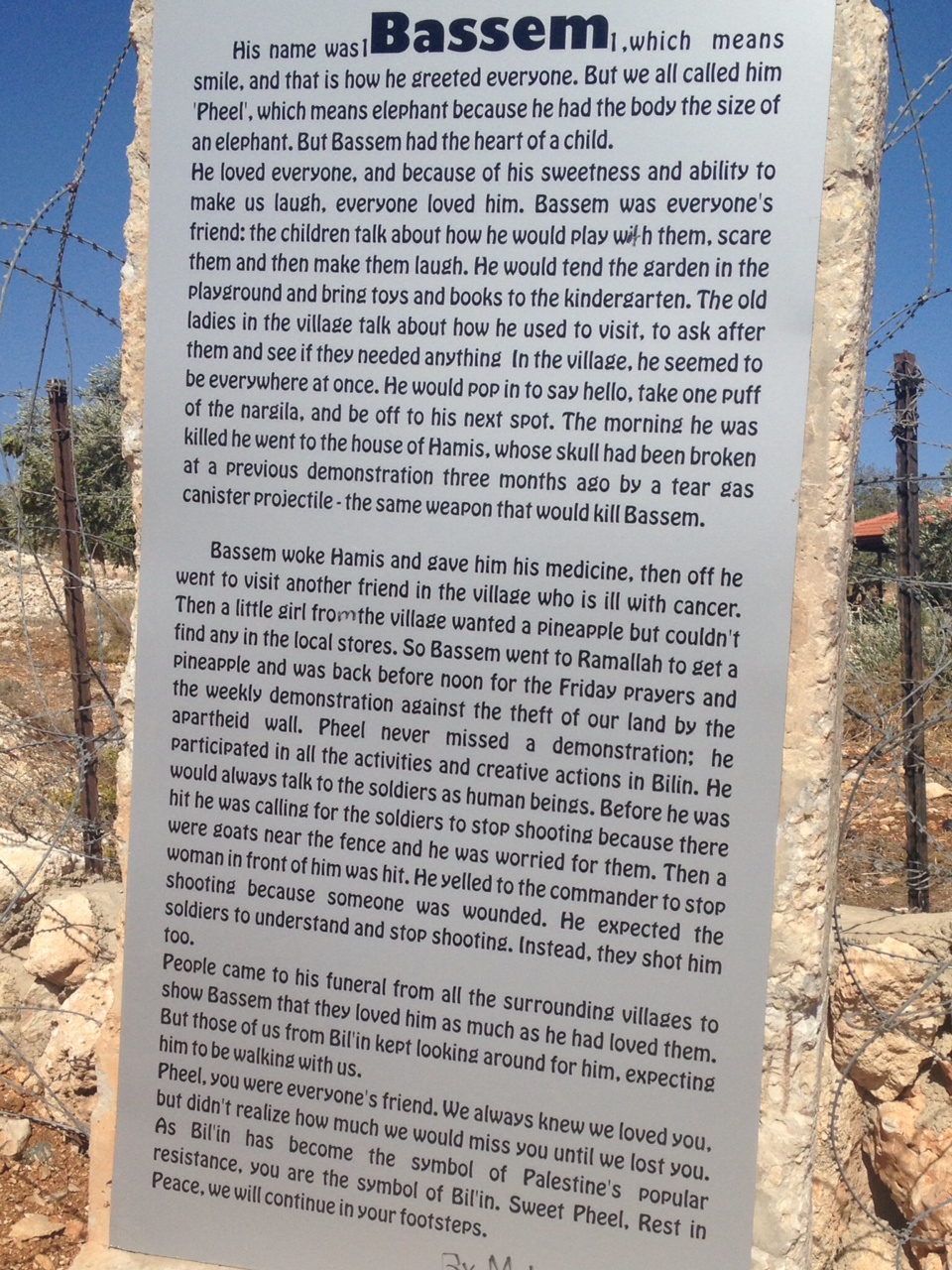
One of the newest additions to the village is a new garden dedicated to the memory of Bassem (“Pheel”) Abu Rachme, a much beloved and very charismatic leader in Bil’in who was killed in 2009 when a tear gas canister struck him in the torso. His killing was captured on camera in “5 Broken Cameras” in one particularly heart-rending moment.

Last month, the IDF officially announced it was closing the investigation into his death. According to a report in +972:

The military prosecution claims it was unable to determine the identity of the Israeli soldiers and border policemen involved or whether open-fire regulations were breached. This, despite the fact that as B’Tselem and Yesh Din pointed out in a joint press release condemning the decision, three video segments filmed during the demonstration show that Abu Rahmeh was situated to the east of the barrier, did not act violently and did not endanger the soldiers in any way…

Late last year, a soldier who served in the same unit that killed Abu Rahme gave testimony about the incident to Breaking the Silence. “…(T)his one time, one of the soldiers simply aimed at someone directly, and [the tear gas canister] hit his chest and he got killed. .. The guy who shot him … was kind of pleased with the whole thing, he had an X on his launcher,” the former soldier continued. An X on a weapon indicates a “kill.”

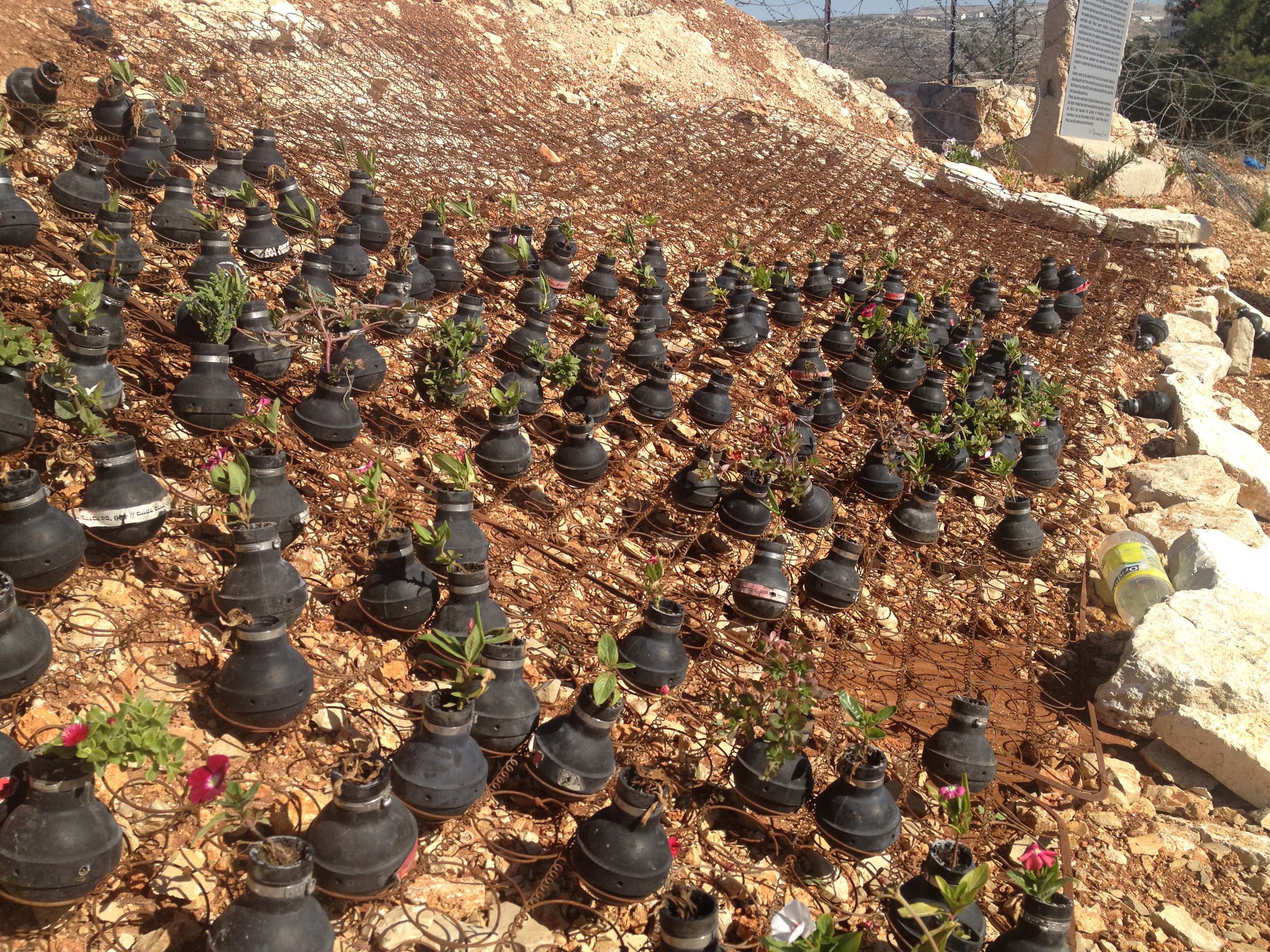
Bassem’s memorial garden (above) lies in the land that was recently reclaimed from the relocation of the wall. The myriad of small black planters are made of tear gas canisters. Please read the long tribute from the plaque at the garden, below, to get a sense of this man who will always occupy a dear place in the hearts of the villagers of Bil’in.

In my next post I’ll write about our memorable visit to Nabi Saleh, another prominent village involved in the Palestinian nonviolent resistance. Back soon.

photo

Coming Soon: A Solidarity Delegation to Bil’in

bilin

My next several posts will come from the West Bank, where I will be traveling as part of a group of Chicago-area Jews and Palestinians to learn from and show solidarity with Palestinians who are engaged in nonviolent resistance to the Israeli occupation. Our delegation will be hosted in the village of Bil’in, where, for the past several years, residents have been protesting the construction of the Separation Wall that has separated the village from its farming land – land that Israel is using to expand its settlement of Modi’in Illit, which lies immediately to the west. (You may recall the story of Bil’in is the subject of the great documentary, “5 Broken Cameras.”)

Our group will also be traveling to sites throughout the West Bank and Israel to visit with leaders of the Palestinian nonviolent movement and Israelis who show solidarity with them. I am thrilled to be taking this trip together with dear friends who I have long known though our activism for a just peace in Israel and Palestine.

I will blog as much as I can about my experiences from the ground and upon my return. Please stay tuned!

Sukkot Activism: Young Jews Protest the Prawer Plan in Chicago


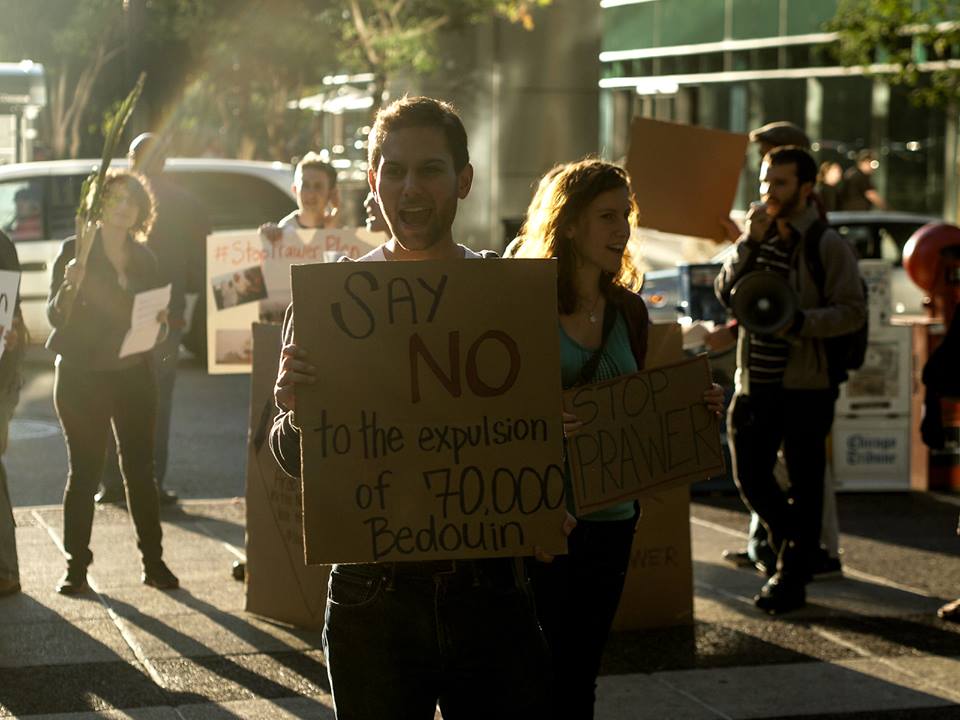
This past Wednesday there was a powerful action in front of the Israeli Consulate in Chicago: a Sukkot protest against the Israeli government’s Prawer Plan, which is currently poised to evict up to 40,000 Bedouin citizens of Israel from their homes in the Negev desert.

As you can see from the clip above, this action was organized by a community of young Chicago Jews inspired by the Sukkot festival’s message of shelter and salvation to stand in solidarity with Bedouin who are on the verge of devastating displacement. An inspiring example of spiritual activism at its finest – bravo to Young, Jewish Proud/Jewish Voice for Peace for spearheading this action in Chicago (as well as a simultaneous event in Boston!)

As I wrote last June, the Prawer Plan has already passed its first reading in the Knesset – and there are already disturbing indications that the plan has already begun to be implemented. If you live in the Midwest, please join us this Monday, September 30, for a collective “Call in to Stop Prawer!” (Details here.) And if you haven’t yet, please sign this Avaaz petition that urges Knesset members to follow their conscience “support a solution coordinated in cooperation with local residents instead of this discriminative bill.”

601589_10101081122069727_1933659252_n

Blowing the Whistle: A Sermon for Rosh Hashanah 5774

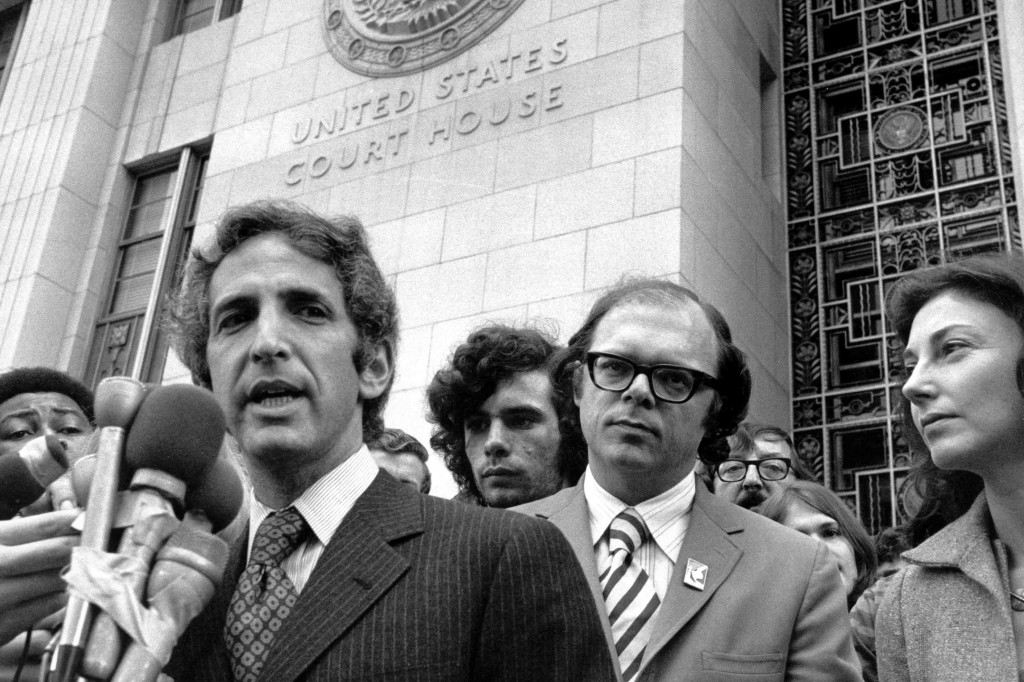
Ellsberg-on-trial-for-Pentagon-Papers-e1373757335455-1024x682

I’m sure many of you remember the story of John Walker Lindh, a young American citizen who converted to Islam as a teenager and eventually went to Afghanistan to fight with the Taliban. Lindh was captured by the US military in November 2001 and was eventually brought back to the US to stand trial.  It was the Justice Department’s first high-profile case in the post-9/11 war on terror.

While many are familiar with the story of the so-called “American Taliban,” I’m sure far fewer know the story of a woman named Jesselyn Radack, who was a legal advisor to the Justice Department at the time.  Shortly after Lindh was arrested, Radack received a call from an FBI attorney, who asked her about the ethics of interrogating Lindh without a lawyer present, specifically mentioning that Lindh’s father had retained counsel for his son. Radack told the FBI that under no circumstances could Lindh be interviewed without his lawyer present.

In spite of her clear response – and numerous follow-up emails to that effect – John Walker Lindh was subsequently interrogated without counsel. Attorney General John Ashcroft then held a press conference where he stated, bald-faced, “The subject here is entitled to choose his own lawyer and to our knowledge has not chosen a lawyer at this time.”  It was clear to Jesselyn Raddack that Ashcroft and the Justice Department had lied to the American public about its legal handling of John Walker Lindh.

Around this time, Radack discovered the emails she had written to the FBI – emails that explicitly spelled out Lindh’s rights – had disappeared from the Justice Department office files.  When she realized what was going on, she resigned her post. To her mind, something very, very wrong was going on and she refused to be party to it.

When Lindh’s initial hearing began, it became clear to Radack that none of her emails had been presented to the judge on the case – communications that were clearly germane to Lindh’s defense.  Now Radack was now faced with an even more powerful ethical decision.  She could do nothing, which would in effect continue the cover-up, or she could blow the whistle on the Justice Department.

So in June of 2002, three weeks before Lindh’s hearing was to take place, Jesselyn Radack downloaded the emails from her personal files and sent them to Newsweek magazine. Her revelation of the Justice Department’s malfeasance had a powerful impact on the government’s case.  Although he originally faced three life sentences, Lindh eventually plea-bargained to 20 years in prison without possibility of parole.

For her part, Radack’s whistleblowing came at a huge price, as she knew it would.  The Justice Department subsequently brought a criminal case against her, although she was never told for what she was being investigated or for what she might be charged.  She also lost her new job at a private law firm after her former government employers put pressure on her partners.   The Justice Department then referred her for discipline to her bar associations, effectively rendering her unemployable. As a final insult, she was placed on the national “no-fly” list.

The criminal case against Radack was later dropped without explanation and she was eventually removed from the no-fly list, but the damage to her career and her livelihood was permanent.  Her experience obviously cost her any future in government, but in the end it led her to a different calling.  Radack now devotes her life to defending whistleblowers at the Government Accountability Project.

I first learned about Jesselyn Radack’s story when I read an article she wrote about it in, of all places, Reform Judaism magazine.  In the article Radack, who is an active member of the Jewish community, wrote openly and passionately about the Jewish values that lay behind her actions. She quoted her adult Bat Mitzvah Torah portion: “Lo ti’eh aharay rabim” – “Thou shalt not follow a multitude to do wrong” (Exodus 22:3) – a dictum she says has motivated her ethical decision-making ever since.

Here’s what Radack had to say in the conclusion of the article:

People also ask me if this experience has engendered a crisis of faith. On the contrary, Judaism has helped me get through this difficult period. My (rabbis have) been sympathetic and supportive. I have also drawn strength from the writings of Rabbi Harold Kushner, who taught me that God did not cause my suffering and could not prevent it.  Rabbi Kushner’s re-interpretation of the story of Adam and Eve teaches that the ability to choose between right and wrong is what makes us human. God does not interfere with that choice. But God can give us the strength of character we need to handle the consequences.

I chose my conscience over my career and take pride in having spoken truth to power.

I remember reading that article back in 2006 – and in particular I remember being deeply affected by the religious and moral convictions that motivated her actions.  On a personal level, I’d always been a strong advocate of whistleblowers and the value of government transparency.  But I don’t think I had ever truly thought about the act of whistleblowing in the context of Jewish values until I read Jesselyn Radack’s words in Reform Judaism magazine that day.

Since that time, I’ve thought a great deal about this issue.  And so this morning I’d like to take some time to discuss the subject of whistleblowing – a subject that has been in the media spotlight a great deal this past year.  I’d like to explore the issues raised by the more well-known whistleblowers such as Chelsea (formerly Bradley) Manning and Edward Snowden – and others who are not as well known but whose actions are just as worthy of our attention.  Most of all, I want to share with you why I believe whistleblowing is not only a critically important American value, but a deeply sacred Jewish value as well – one that challenges us particularly as we gather now for the New Year.

I’ve often been struck that while government whistleblowers are often excoriated as unpatriotic at best and traitors at worst, the practice of whistleblowing is in fact rooted in American values. Our founding fathers fervently believed, and wrote repeatedly, that democracy is strengthened when it is transparent – and that government can only be truly accountable when it ensures an informed citizenry.  As John Adams famously wrote:

And liberty cannot be preserved without a general knowledge among the people who have a right from the frame of their nature to knowledge … But besides this they have a right, an indisputable, unalienable, indefeasible divine right to the most dreaded and envied kind of knowledge, I mean of the characters and conduct of their rulers.

True whistleblowing is not a traitorous act, though I think many governments would love their citizens to believe so.  Whistleblowers are not employed by enemy nations – by definition they act individually and out of their own conscience. And while they do break laws, they do so not for personal gain but for the greater good. They do so to assert that no one – not even the most powerful of governments – are above the law.

In their defense, governments will invariably claim that secrecy is essential to “national security.”  On the face of it, it’s difficult defense to for us to refute.  After all, every nation’s primary duty is to ensure the safety and security of its citizens – it would be naive and in fact dangerous to try to claim otherwise.  But it would be equally naive to assume that when our government acts in secrecy, it must somehow be doing so for reasons of legitimate national security.  History has taught us repeatedly that governments will invariably use secrecy to cover up their own illegitimate actions – actions that will often end up betraying the very well-being and security of their own citizens.

Possibly the most famous whistleblower in American history, Daniel Ellsberg, has written extensively and eloquently on this subject and about the process he went through that ultimately led to his revelation of the Pentagon Papers in 1971.  Ellsberg was a former marine who joined the Pentagon in 1964 and later worked for the RAND Corporation.  Like almost all whistleblowers, he was originally among the “true faithful” – a patriotic American who believed that the US could and should be a force for good in the world.  But as his government career progressed, he harbored profound inner doubts as he became privy to the highest decision making institutions during the buildup of Vietnam War.

Daniel Ellsberg had first hand knowledge that leaders at the highest levels of government knew from early on that the Vietnam war could never be won and yet insisted otherwise to the Congress and the American public. Moreover, they continued to escalate a war they knew was doomed, knowing full well their actions would lead to more American deaths overseas.

When Ellsberg went public with the Pentagon Papers, he went up against a powerful bureaucracy and government culture of secrecy. As a former insider, he had a first row seat at a massive act of government malfeasance, but he also was constrained by a deep-seated mentality that considered the telling of secrets to be a traitorous act.  It’s no coincidence that most whistleblowers begin as patriotic insiders. But ironically enough, it’s the same motivation that initially drives them to serve their country that eventually drives them to bring the truth of their government’s wrongdoing into the light of day.

It is, of course, an act that carries with it a huge cost.  When whistleblowers decide to go public, they know full well it is an act that will cost them their jobs and their livelihoods.  They know they will likely be publicly vilified, their personal lives dissected, their reputations slandered.  And of course, they also know they will likely endure prison time, be forced to go underground or live in exile.

Whistleblowers are indeed lightning rods – and governments count on this.  That’s why, I believe, we invariably focus more attention on the whistleblowers themselves than the actual crimes they reveal. That’s why, for instance, I believe we’re hearing so much bandied about regarding Chelsea Manning’s personal life and emotional struggles.  Our leaders and the media would much rather we focus on Manning personally. As long as we do so, we’re given a pass on the disturbing information Manning brought to light – and we don’t have to confront the truths of our nation’s crimes in Iraq, in Guantanamo and around the world.

Among Manning’s many revelations through Wikileaks is the now infamous video taken from an Apache helicopter in 2007, in which Americans soldiers shot and killed eleven individuals, including two Reuters reporters, in the streets of New Baghdad.  When a van arrived to help the injured, the soldiers fired upon it as well, seriously injuring two children. As you watch the video, you can hear the voices of American soldiers urging each other on, joking about the dead and dying. At one point a soldier laughs when Humvee runs over a dead body lying in the street.

I remember watching this video when it was released in 2010. I posted and wrote strongly about it on my blog at the time. It was deeply and profoundly horrifying to see the dark reality of our military actions in Iraq in such a graphic and brazen manner.  But I remember well being so grateful that this video had been brought out into the light of day.

As it turned out, however, Manning was not the only member of the military who recoiled from this particular action.  An American infantryman named Ethan McCord rescued the two children from the shot-up van – and after the video was released, McCord publicly thanked Manning for bringing it to light.

McCord later criticized the media for going into great and often lurid detail about Manning’s gender identity issues while utterly ignoring the devastating significance of his revelations.  In a letter to the editor of New York Magazine, McCord wrote the following:

By focusing so heavily on Manning’s private life (the article) removes politics from a story that has everything to do with politics. The important public issues wrapped up with PFC Manning’s case include: transparency in government; the Obama Administration’s unprecedented pursuit of whistle-blowers; accountability of government and military in shaping and carrying out foreign policy; war crimes revealed in the WikiLeaks documents… and more.

McCord then ended his letter with these words:

If PFC Manning did what he is accused of, he is a hero of mine, not because he’s perfect or because he’s never struggled with personal or family relationships –most of us do – but because in the midst of it all he had the courage to act on his conscience.

Chelsea Manning has paid a profound price for blowing the whistle on the actions of the American military.  After her arrest, she was put in a Marine brig in Quantico, Virginia, held in solitary confinement for 23 hours a day for nine months, forced to sleep naked without pillows and sheets and restricted from physical recreation or access to a television or newspaper. Manning’s punishment was later condemned as “excessive” by a military judge and “torture” by the UN. And of course, Manning has now been sentenced and faces an additional 35 years in prison.

As for the soldiers responsible for the attack in the video?  The US military conducted its own investigation of the incident and eventually cleared everyone involved of wrongdoing. To date, no one has ever been held accountable – for these or for any of the numerous disturbing revelations Manning has brought to light.

I don’t think I could put it any better than the ACLU when it made this statement following Manning’s sentencing:

When a soldier who shared information with the press and public is punished far more harshly than others who tortured prisoners and killed civilians, something is seriously wrong with our justice system.

On Rosh Hashanah, the day for asking the hard questions, it’s well worth asking: who has committed the greater crime? The government that breaks the law and covers its actions up under the pretense of national security, or the single individual that breaks the law in order that these crimes might be brought out into the light?

It’s well worth asking why?  Why is Chelsea Manning facing thirty five years in prison for revealing the disturbing truths about our government’s actions in Iraq while the very leaders who deceived us into that war have yet to be made to account for their actions?

And why, for that matter, has Edward Snowden, the man who blew the whistle on the NSA’s surveillance on American citizens, been forced to live in exile in Russia while our Director of National Intelligence can deny the facts Snowden brought to light under oath and still remain in his job?

I believe Jewish tradition demands that we ask these kinds of questions. After all, asking hard questions to powerful leaders is a time-honored Jewish value that dates all the way back to the days of the Prophets.  The Prophets were, in fact, the whistleblowers of their day. Just like our present day examples, they too spoke truth to power; they too sought to publicly reveal political corruption and hypocrisy of the governments of their time; and they too were hounded and persecuted by the powers that be for their truth-telling.

I’ve said and written often that I believe the prophetic stream in Judaism to be the most important – and in many ways the most sacred – of our tradition. As a Jew, I’ve always been enormously proud of the classic rabbinical response to government power. I believe that the Jewish people have been able to survive even under such large and mighty powers because we’ve clung to a singular sacred vision that says there is a Power even greater. Greater than Pharaoh, greater than Babylon, even greater than the mighty Roman empire and the myriad of powerful empires that have come and gone since.

As Jews, we know all too well that powerful nations and empires have historically exploited fear in order to increase their control at home and abroad. To be sure, it’s when times are fearful that we need these kinds of truth tellers the most.  In today’s post 9/11 world, I think it’s fair to say that levels of our government’s control – and the secrecy it employs to cover it up – go deeper than anything we witnessed even at the height of the Cold War.

Indeed, over the past decade, we’ve created a national security bureaucracy that many believe has evolved into a juggernaut with a life of its own. As one important Washington Post investigative article concluded:

The top-secret world the government created in response to the terrorist attacks of Sept. 11, 2001, has become so large, so unwieldy and so secretive that no one knows how much money it costs, how many people it employs, how many programs exist within it or exactly how many agencies do the same work.

During his first presidential campaign, Obama promised to rein in Washington’s culture of secrecy that has grown so significantly during our nation’s so-called War on Terror.  While we can argue about whether or not he’s been successful in this regard, it cannot be denied that Obama has become he most aggressive president in American history when it comes to whistleblowers.

Until this administration, only three government whistleblowers (including Daniel Ellsberg) had ever been charged by the Justice Department under the Espionage Act of 1917.  Under Obama, the Justice Department has brought charges against eight individuals – more than all previous American presidents combined.  His administration’s actions drive home the reality that this issue is not really about left or right.  It is about government – and in particular, large powerful governments such as ours, that will invariably abuse their power and act to cover up their abuses.

To quote another great American truth teller, the venerable investigative journalist Izzy Stone,  “All governments lie.”   Stone didn’t mean this to be a criticism of government itself – on the contrary, he wrote endlessly about the critical role governments must play in creating ordered and just societies.  He simply meant that there will always be a gap between what a government does and what it says it is doing. And that as citizens, we simply cannot sit back and assume governments will voluntarily rein in their abuse of power or hold themselves to account.

That, quite frankly, is our job. And that is why whistleblowers are so critical and why I believe they are worthy of our gratitude and support. They represent, in a sense, the final defense of an informed citizenry. They are the ones who are willing, at great personal sacrifice, to hold the most powerful people and institutions in the world accountable.

I know that all citizens want to trust their governments. We all want to believe our governments have our best interests at heart and will act to keep us safe – particularly in fearful times such as these.  But as fearful as we are, we would do we to ask whether increased militarism abroad and the narrowing of our civil liberties here at home will truly bring us security in the end.

As for me, I tend to agree with Daniel Ellsberg, who recently wrote: “One of the lessons of the Pentagon Papers and Snowden’s leaks is simple: secrecy corrupts just as power corrupts.”  Today, as in years past, we owe a profound debt to those who courageous enough to tear down the shrouds of secrecy, often at enormous personal cost, so that we may all find our way to a future of true security – not a false sense of security in which the powerful hide behind higher and higher walls but a real security based upon leaders and citizens are truly accountable to one another.

After all, isn’t that really what our sacred day today is all about? When we sound the Shofar on Rosh Hashanah, we are, in a sense, “blowing the whistle.”  The Shofar represents, among other things, an act of revelation. When the shofar is sounded, we bring all the secrets of the past year out of the shadows. We announce our readiness to shine light into the dark places of our souls and all the actions for which we are accountable.  We do this because we know, deep down that secrecy corrupts the soul – and that true security, true liberation, can only come from living lives of transparency and openness.

I do believe what is true for our national soul is true for our individual souls as well.  Up until now, I’ve been specifically addressing the topic of government whistleblowers, but of course, whistleblowing takes many forms – it comes in may shapes and sizes. You might say that each of us is presented the opportunity to be a whistleblower in ways large and small each and every day. Every day, each of us is challenged by the Torah demonstrated to us so eloquently by Jesselyn Radack: “Do not follow the multitude to do wrong.”

Indeed, in the coming year, each of us will inevitably be faced with the challenge to speak out or remain silent. To remain in the darkness, in a place or secrecy and shame, or to shine a light into the dark places that we might all find our way forward together.  This New Year, I hope we can all find the means to be truth tellers in our own right, to find the courage to speak where there is only silence.  And to wrestle honestly with the questions: what is the world in which we truly seek to live?  Where, in the end, will we find true security? And what will we be willing to do about it?

Baruch ma’avir afeilah u’meivi orah – Blessed is the one who removes the darkness and brings light.

Amen.
On the Trayvon Martin Verdict and the “National Conversation”

photo credit: Boston Herald

photo credit: Boston Herald

A few thoughts in the wake of Tisha B’Av yesterday…

According to Jewish tradition the Second Temple was destroyed because of the Jewish people’s sinat chinam – or “baseless hatred.”  On Tisha B’Av we affirm that isn’t enough to simply mark our collective tragedies and mourn our collective losses. We must honestly own the ways our own prejudices and intolerance have contributed to these losses.

I was particularly mindful of this spiritual insight this year, as Tisha B’Av followed directly on the heels of the Trayvon Martin verdict and the communal soul-searching it sparked on racism in America. Indeed, more than once over the past several days we’ve heard politicians and pundits call for yet another “national conversation on race.”  Witness Attorney General Eric Holder’s post-verdict remarks:

Independent of the legal determination that will be made, I believe that this tragedy provides yet another opportunity for our nation to speak honestly about the complicated and emotionally-charged issues that this case has raised. We must not – as we have too often in the past – let this opportunity pass.

This isn’t the first time, of course, that we’ve heard the call for such a conversation. I distinctly remember President Bill Clinton making just such a call back in 1997.  It was actually considered fairly controversial at the time  – sad to say we haven’t made much headway in the conversation over the past 17 years.

I don’t mean to be facetious about this. Part of the problem, I think, is that I’m not sure anyone really knows what something as monumental as a “national conversation” would actually look like, particularly on a subject as profoundly charged as race.  Though I hesitate to say so, in some ways I think this call does more harm than good. While I do believe in the importance of dialogue, I can’t help but think that the constant call for communal conversation on race mostly serves to help us to feel better while we dodge the deeper infrastructural realities of racism in America.

While we regularly call for “conversation,” for instance, hard facts such as these continue to go chronically unaddressed:

– Prison sentences of black men are nearly 20% longer than those of white men convicted of similar crimes;

– While people of color make up about 30 percent of the United States’ population, they account for 60 percent of those imprisoned;

– While people of color are no more likely to use or sell illegal drugs than whites, they have higher rate of arrests;

– Voter laws that prohibit people with felony convictions from voting  disproportionately impact men of color.

And the list of shameful statistics goes on and on…

This litany, quite frankly, is nothing short of institutional sinat chinam. And at the end of the day, its going to take much more than dialogue it we’re going to take down the patently unjust and racist laws that oppress people of color in our country.  In this regard, I’d claim national conversation is only truly valuable inasmuch as it leads to real socio-political transformation and change.

So where do we start?  Why not with the “Stand Your Ground” laws, one of which egregiously allowed a man go free after stalking and shooting an unarmed African-American teenager?  It’s critically important that we know that history of laws such this, many of which have been long been pushed through legislatures by the corporate-funded American Legislative Exchange Council (ALEC) and have subsequently been spreading across the country:

Ostensibly a network of state legislators, ALEC is a shadowy, $7 million-a-year organization funded by powerful corporate interests like the Koch brothers, Big Oil, and Big Tobacco.  The NRA has been a longtime financial supporter and served as the corporate co-chair of the ALEC Criminal Justice Task Force, voting with legislators on “model” bills.  Through ALEC, special interests groups like the NRA push their dream legislation through state legislatures. Wal-Mart was corporate co-chair of ALEC task
force approving FL’s “Shoot First” bill as a “model” for other states. The NRA was the next co-chair of that ALEC committee.

According to PR Watch’s Brendan Fischer, ALEC’s influence has has been behind other racially discriminatory legislation as well:

ALEC’s connections to those issues are not limited to Stand Your Ground. The group was instrumental in pushing “three strikes” and “truth in sentencing” laws that in recent decades have helped the U.S. incarcerate more human beings than any other country, with people of color making up 60 percent of those incarcerated. At the same time ALEC was pushing laws to put more people in prison for more time, they were advancing legislation to warehouse them in for-profit prisons, which would benefit contemporaneous ALEC members like the Corrections Corporation of America.ALEC has also played a key role in the spread of restrictive voter ID legislation that would make it harder to vote for as many as ten million people nationwide — largely people of color and students — who do not have the state-issued identification cards the laws require.

If you’d like to engage in action as well as conversation, you can click here to sign a petition urging Attorney General Holder to “review the application of Stand Your Ground laws nationwide and the importance of their repeal.”

And if you live in or around Chicago, I encourage you to join me and other activists of conscience at the ALEC Exposed Protest Rally, which will take place outside ALEC’s 40th Anniversary Conference on Thursday, August 8 at 12 noon.

I hope I’ll see you there.