Category Archives: Human Rights

Some Final Thoughts on the United Methodist Divestment Vote

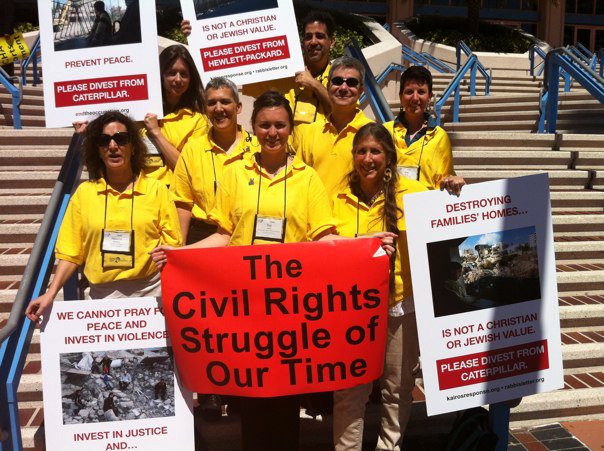
Jewish activists at the 2012 UMGC in Tampa, from left to right: Rebecca Vilkomerson (Executive Director of Jewish Voice for Peace), Anna Baltzer, (National Organizer, US Campaign to End the Israeli Occupation), Dalit Baum (Founder, “Who Profits?”), Rae Abileah (Co-director, CODEPINK Women for Peace), Sydney Levy, (Director of Advocacy, JVP), Rabbi Brant Rosen, Rabbi Lynn Gottlieb (Founder, Shomer Shalom Center for Jewish Nonviolence), Ariel Vegosen (Fair Trade and Media Social Justice Activist)

After the United Methodist divestment resolution was voted down at the UM General Conference last week, I’ve received my fair share of gloating responses from divestment opponents.  (Award for the most colorful goes to “Tzahal,” who sent in this attention-grabber: “BDS Fail, you f***ing KAPO”).

Actually, while many of us were disappointed by the final vote, I don’t view this as a fail. Not by a long shot.

First of all, as I reported from Tampa, I was deeply inspired to meet so many remarkable activists – Christians, Muslims, Palestinians, Israelis and American Jews – who constitute a new community of conscience working for justice in Israel/Palestine. This new interfaith/inter-ethnic coalition is growing rapidly and we are most certainly succeeding in raising conscience and awareness each time these kinds of resolutions are brought forth.

Beyond the final vote on this one specific resolution, we should consider it a success that these issues are increasingly being publicly discussed by our religious communities. My fellow activists and I had numerous conversations with delegates in the convention hall and we were heartened to engage so many people so honestly on this difficult issue. I was particularly gratified to speak with the numerous African delegates (who constituted 40% of the convention) who immediately understood the very real parallels to the legacy of colonialism in their own countries.

In addition, as my fellow activist Anna Baltzer recently pointed out, while the divestment resolution did not ultimately pass, the UM General Conference did adopt a resolution that among other things urged the US government to “end all military aid to the region,” called on all nations “to prohibit… any financial support by individuals or organizations for the construction and maintenance of settlements,” and “to prohibit… the import of products made by companies in Israeli settlements on Palestinian land.”

In BDS terms, this means that while the United Methodists did not affirm D (“Divestment”), they did support B and the S (“Boycott” and “Sanctions”).  No small statement, this.

I am coming away from this experience more convinced than ever that divestment is a critical tool in our quest for a just peace in I/P.  Over and over I’ve heard that divestment is an unduly harsh and polarizing tactic – and that the emphasis should be on positive engagement and investment. This, despite the fact that decades of political engagement by our government have failed miserably. This despite almost a decades worth of failed attempts by church groups to engage companies such as Caterpillar, Motorola Solutions and Hewlett/Packard – companies that literally profit from an oppressive, illegal occupation.

Add to this the testimonials of numerous Palestinian leaders who addressed “positive investment” by telling us it wasn’t charity they needed, but real, actual justice. In the words of Zahi Khouri, a prominent Palestinian Christian businessman and CEO of Coca-Cola Palestine:

It may shock you, but whenever there is a viable project identified in Palestine, we can raise the funds. We don’t need your financial help, your charity. What we need is to be able to operate freely. Divestment is the best, most immediate way that you can help us achieve that. We have been waiting for more than 40 years; we need action now.

Archbishop Desmond Tutu was so correct when he urged support of the divestment resolution by invoking MLK’s “Letter from a Birmingham Jail.” Then, as now, those who sought justice were counseled by religious leaders to “be patient” and to address the issue of oppression through engagement and non-confrontational tactics. Then, as now, there was an assumption that those who wielded corrupt power could somehow be “convinced” to give up their power voluntarily. Then, as now, this kind of patronizing counsel rings hollow and false in the ears of those who continue to suffer daily from ongoing injustice and persecution.

No, this was not a fail. There is a movement is building and this was only the beginning. Stay tuned. Similar resolutions will soon be considered in Pittsburgh at the General Assembly of the Presbyterian Church (USA) and the General Convention of the Episcopal Church in Indianapolis.

My new colleagues and I look forward to continuing this sacred work together.

Archbishop Tutu in Support of Methodist Divestment

Archbishop Desmond Tutu has just written a powerful op-ed in support of United Methodist church divestment.

I have no doubt that he will once again incur the wrath of the Jewish establishment – especially since he criticizes the 1,200 rabbis who recently signed a public letter opposing church divestment:

While they are no doubt well-meaning, I believe that the rabbis and other opponents of divestment are sadly misguided. My voice will always be raised in support of Christian-Jewish ties and against the anti-Semitism that all sensible people fear and detest. But this cannot be an excuse for doing nothing and for standing aside as successive Israeli governments colonize the West Bank and advance racist laws.

I recall well the words of the Rev. Martin Luther King Jr. in his Letter from a Birmingham Jail in which he confesses to his “Christian and Jewish brothers” that he has been “gravely disappointed with the white moderate … who is more devoted to ‘order’ than to justice; who prefers a negative peace which is the absence of tension to a positive peace which is the presence of justice; who constantly says: ‘I agree with you in the goal you seek, but I cannot agree with your methods of direct action;’ who paternalistically believes he can set the timetable for another man’s freedom. …”

King’s words describe almost precisely the shortcomings of the 1,200 rabbis who are not joining the brave Palestinians, Jews and internationals in isolated West Bank communities to protest nonviolently against Israel’s theft of Palestinian land to build illegal, Jewish-only settlements and the separation wall. We cannot afford to stick our heads in the sand as relentless settlement activity forecloses on the possibility of the two-state solution.

Hear, hear. His invocation of MLK’s “Letter from a Birmingham Jail” is apt and spot on.

I’m particularly appreciative of the Archbishop’s shout out to “the brave rabbis of Jewish Voice for Peace.”  It’s wonderful to see our letter of support garnering such widespread acclaim from so many quarters.  And it’s especially gratifying to be showing a decidedly different face of the Jewish community to our brothers and sisters in the Christian community over this issue.

The divestment resolution is scheduled to voted on by the UM Conference plenum tomorrow. Stay tuned.

Jeff Halper: Israel is Warehousing Palestinians

I’m sure there are many who watch Israel’s Jewish settlement policy unfold in the West Bank and East Jerusalem and ask themselves: is there actually a method to this madness?  Among the most compelling answers to this question comes from veteran Israeli peace activist Jeff Halper, co-founder and coordinator of the Israeli Committee Against House Demolitions.

One of the truly great Israeli peace organizations, ICAHD has been indefatigably tracking the demolition of homes and evictions of Palestinians in the Occupied Territories since 2007.  Even more critically, Halper and Co. have been exposing Israel’s institutionalized displacement of Palestinians and their resettlement in concentrated areas throughout the West Bank.

In an interview last week, Halper offered a detailed – and profoundly troubling – picture of Israel’s resettlement of Palestinians throughout the Occupied Territories:

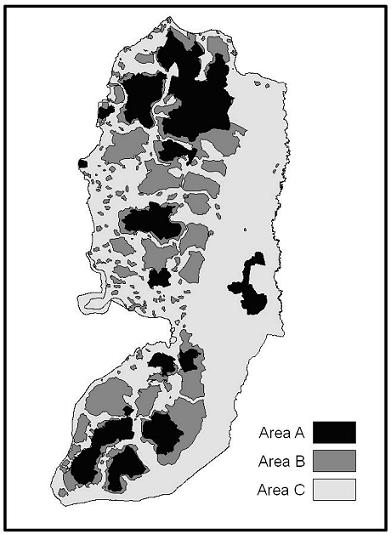
(Area C of the West Bank) contains less than 5 per cent of the Palestinian population. In 1967 the Jordan valley contained about 250,000 people. Today it’s less than 50,000. So the Palestinians have either been driven out of the country, especially the middle class, or they have been driven to areas A and B. That’s where 96 or 97 per cent of them are. The Palestinian population has been brought down low enough, there is probably somewhere around 125,000 Palestinians in area C, so Israel could annex area C and give them full citizenship.

Basically, Israel can absorb 125,000 Palestinians without upsetting the demographic balance. And then, what is the world going to say? It’s not apartheid, Israel has given them full citizenship. So I think Israel feels it could get away with that. No one cares about what’s happening in areas A and B. If they want to declare a state, they can…

In other words, we’re finished. Israel is now from the Mediterranean to the Jordan River, the Palestinians have been confined in areas A and B or in small enclaves in East Jerusalem, and that’s it.

To better understand Halper’s point, look carefully at the map on the top right of this post. Areas A, B and C refer to regions that were created through the terms of the 1993 Oslo Accords.  According to the agreement, Palestinians are responsible for security and for the civil administration of Area A; Area B is under Israeli military control and Palestinian civil authority; and Area C is under total Israeli military and civil control. (In reality, however, the Israeli military has ultimate control over all three areas – for over a decade the IDF regularly has made incursions into Areas A and B with impunity).

According to the terms of the Oslo Accords, these three regions were intended to be temporary until 1998; today they have become permanent facts on the ground. As you can see from white portions of the map, Area C comprises the strong majority of the West Bank. It contains nearly all Israeli settlements; it is crisscrossed by Israeli-only access roads that connect the settlements to each other and to Israel proper; it includes large buffer zones and almost all of the Jordan Valley and the Judean Desert (the large swath of white on the east).

As Halper points out, Israel is pursing policies that are systematically driving Palestinians out of Area C, to the extent that these regions now contain less than 5% of the population. The overwhelming majority of West Bank Palestinians now live in Areas A and B (on the map, grey and black) – which are essentially concentrated, disconnected cantons separated by checkpoints and choked off from Israel by the Separation Wall.

Bottom line? Israel has succeeded extending its control over the majority of the West Bank by moving Palestinian residents into what amount to “legal” open-air prisons – or as Halper calls it,”warehousing.”

(Warehousing) captures what’s going on better than apartheid. Warehousing is permanent. Apartheid recognizes that there is another side. With warehousing it’s like prison. There is no other side. There is us, and then there are these people that we control, they have no rights, they have no identity, they’re inmates. It’s not political, it’s permanent, static. Apartheid you can resist. The whole brilliance of warehousing is that you can’t resist because you’re a prisoner.

Prisoners can rise up in the prison yards but prison guards have all the rights in the world to put them down. That’s what Israel has come to. They are terrorists and we have the right to put them down. In a sense Israel has succeeded with the international community, and the US especially, in taking out of this situation the political. It’s now solely an issue of security, just like in prisons.

Halper actually predicted the warehousing phenomenon as long ago as 2008, in an important piece that offered an in depth analysis of Israel’s practices throughout the West Bank. Among other things, he compared Israel’s practice to South Africa’s creation of Bantustans, in which 3.5 million black South Africans were forced from their homes from the 1960s through the 1980s:

Warehousing…is in many ways worse than the Bantustans of apartheid-era South Africa. The ten non-viable “homelands” established by South Africa for the black African majority on only 11% of the country’s land were, to be sure, a type of warehouse. They were intended to supply South Africa with cheap labor while relieving it of its black population, thus making possible a European dominated “democracy.” This is precisely what Israel is intending – its Palestinian Bantustan encompassing around 15% of historic Palestine – but with a crucial caveat: Palestinian workers will not be allowed into Israel. Having discovered a cheaper source of labor, some 300,000 foreign workers imported from China, the Philippines, Thailand, Rumania and West Africa, augmented by its own Arab, Mizrahi, Ethiopian, Russian and Eastern European citizens, Israel can afford to lock them out even while withholding from them a viable economy of their own with unfettered ties to the surrounding Arab countries. From every point of view, historically, culturally, politically and economically, the Palestinians have been defined as “surplus humanity;” nothing remains to do with them except warehousing, which the concerned international community appears willing to allow Israel to do.

Perhaps most crucially, Halper places Israel’s policies and practices within a larger global context.  He refers to a “Global Palestine”: a new 21st century reality in which political considerations and human rights are jettisoned in favor of a corporate-military model that seeks to control, manage, contain (and profit from) “surplus populations.”

Again, from last week’s interview:

(Warehousing) does not have any legal reference today but we’d like to put that in because warehousing is not only in Israel. Warehousing exists all over the capitalist world. Two-thirds of the people have been warehoused. That’s why I’m writing about Global Palestine. I’m saying that Palestine is a microcosm of what’s happening around the world.

Even though Jeff Halper may be a secular Israeli anthropologist, I believe him to be a prophetic figure of the highest order. He has long been speaking hard truths on the wages of corrupt power in his country. Do we have the courage to listen to his message?

United Methodist Divestment: Standing in Solidarity in Tampa

It was my honor to attend the opening of the 2012 General Conference of the United Methodist Church in Tampa, where they will be considering a resolution to divest church funds from three companies – Motorola Solutions, Hewlett-Packard and Caterpillar – that profit from Israel’s oppressive occupation.

I’ve been so inspired by the amazing people I’ve met in Tampa – Methodists from around the country, Palestinians, and many Jews – who constitute a new community of conscience on this profoundly important issue. This coming-together has been particularly important for me, because many quarters of the United Methodist Church have been unfairly demonized by the Jewish establishment over the issue of church divestment.

The resolution will be considered in committee some time over the next few days – and may possibly be voted on in plenary next week. If you, like me, stand with our Methodist brothers and sisters in our desire for justice in Israel/Palestine, please sign our Rabbi’s Letter that supports “conscientious nonviolent strategies, such as phased selective divestment, to end the occupation.”

You can read a thorough report about our efforts here on Tampa Community Radio. The clip above: my statements at a press conference yesterday which was convened by my friends at United Methodist Kairos Response – the primary sponsors of the UM divestment resolution.

Rabbi Mordechai Liebling: Why I Now Support Church Divestment

My good friend and colleague Rabbi Mordechai Liebling has just written one of the most eloquent and thoughtful statements in support of church divestment I have yet read. Mordechai’s voice on this subject is particularly noteworthy becuase he has long been an important Jewish community leader on the issue of ethical investing.

Mordechai has previously served as the director of the “Torah of Money” initiative at The Shefa Fund and later became the Executive Vice President of Jewish Funds for Justice. He currently serves as the director of the newly created Social Justice Organizing Program at the Reconstructionist Rabbinical College.  His statement is all the more powerful because in 2004 he wrote a public article questioning the effectiveness of divestment as a strategy – and as late as two years ago, he still viewed divestment as counterproductive.

As he wrote in his statement, he has reconsidered his position for compelling reasons:

What happened that made me change my views? I changed a little, and the reality on the ground changed even more.

At the time I wrote the article I was organizing the Jewish Shareholder Action Network in my capacity as the Torah of Money Director at the ShefaFund. I was very involved in the world of faith-based socially responsible investments and learned a lot about shareholder activism.

When Protestant churches started considering selective divestment from corporations profiting from the occupation back in the mid-2000′s, I knew many of the socially responsible investment staff people in those denominations. I did not think divestment was a good strategy and said so to my colleagues. But things have changed since.

I was concerned about the potential that divestment measures would have in undermining the Israeli political center. I was concerned about Israelis feeling more isolated than ever and adopting a circle-the-wagons mentality that would make peace harder to attain. These concerns are valid and real. But in the last number of years, the Israel political center has moved to the right–even without divestment. The Israeli government has become more intransigent in its position; the settlers more aggressive. The Netanyahu government has already circled the wagons.

Given this reality, we need to take a look at new approaches. We cannot rule out options that are rooted in non-violence, promote non-violence and call for an end to unjust practices. Divestment is one such option. Palestinian nonviolent direct action is another.

If the reality on the ground in Israel and in the West Bank has changed, so have the attitudes of Israeli Jews and Jews abroad towards the use of tools such as divestments and boycotts. Previously very few Jewish groups would have supported such initiatives. Now we see a lively discussion inside our Jewish communities about the appropriateness of using these tactics to end the occupation and oppose settlement expansion. Countless Israeli artists refuse to perform in the Cultural Center of the settlement of Ariel in the West Bank. Boycotting settlement goods is now discussed in Israel, in the pages of the New York Times, and inside our very own Jewish communities. Symptomatic of its move to the right, the Israeli government has outlawed this practice, and the brave Israelis that speak about it, risk heavy court-mandated fines for expressing their views. But inevitably, the more intransigent the Israeli government, the more popular this and other nonviolent measures will become.

Now to be sure, boycott and selective divestment are not the same thing. The former is carried out by consumers; the latter by investors. Divestment from a corporation does not come in a vacuum. It is the logical step that follows after shareholders try to negotiate with a company to address their concerns and after shareholder activism fails. Back when I opposed divestment, I was concerned that divestment was being invoked when the first two steps had not been tried yet, or at least pursued to its completion. This is not the case today. To their credit, the churches have gathered a full record of failed corporate engagement and have experienced years of frustrated shareholder resolutions that do not achieve the desired change in corporate behavior. Now that step one and step two have failed, it is time to move to the inevitable step three, and that is divestment. Not doing so puts at risk the integrity of the whole socially responsible investment model.

I want to make clear that I would not support divestment or boycotts from Israel as a whole. I do not support turning Israel into a pariah state. And it is precisely because of this that I support the churches’ measure approach to selective divestment. The resolutions under consideration–divesting from Caterpillar, Motorola Solutions, and Hewlett-Packard–do not single out Israel, and they certainly do not single out Jews either. They single out specific corporate complicity with the occupation. Churches hold tobacco companies in their no-buy list, not because they believe that smokers are bad people. They do not single out smokers for criticism. They do so because smoking is wrong. In the same way, bulldozing civilian homes and making people homeless is wrong too. It does not matter whether this happens in Israel or elsewhere. The problem is not with the place or with the people, but with the action. This bulldozing is taking place in Jerusalem, where Palestinian homes are being bulldozed to make room for more Jewish settlements. Not condemning wrongdoing simply because it happens in Israel is singling out Israel. Israel does not need affirmative action; it needs to be treated exactly the same as every other state, not better, and not worse. This means acknowledging when it does things right, but also taking corrective action when it does not.

I’m thrilled that Mordechai has now signed on to our Rabbi’s Letter campaign in advance of the United Methodist Conference in Tampa this week, where the divestment resolution will be presented once again.

There will be much more to report on this important story – please stay tuned.

Moment of Truth: Hunger Striker Khader Adnan Released

photo: Ma'an News Agency

Anyone who doubts the power of nonviolent resistance should study the case of Palestinian hunger striker Khader Adnan, who was imprisoned by Israel without charge or trial, fasted in protest for 66 days, lost almost 70 pounds, hovered painfully between life and death – and is now a free man.

From Ma’an News Agency:

Israeli authorities released former hunger-striking administrative detainee Khader Adnan late Tuesday … Adnan arrived at his home in Araba in the northern West Bank to meet his family before returning to a tent reception where he spoke to well-wishers and officials in the village.

Hundreds of Palestinians chanted slogans in solidarity with prisoners as they welcomed the former detainee, whose 66-day hunger strike inspired others to protest administrative detention.

In the meantime, the majority of the 4,699 Palestinians currently held in Israeli prisons refused meals on Prisoners’ Day – and 1,200 of them vow to hunger strike indefinitely to protest unfair conditions.

I’m particularly struck by Israel’s official response:

The Israeli Prisons Authority has coped with hunger strikes in the past and is prepared to cope with it now.

Ever the victim, they still don’t get it.

Palestinian nonviolent resistance is providing Israel with a very real moment of truth. Do they think that releasing Adnan will pacify their resolve? Trust me, this is only the very beginning…

Click here to read Khader Adnan’s remarks upon returning home to his family.

What Must Be Said: We All Profit from Occupations

There’s been a great deal of analysis written about German writer Gunther Grass’ now-infamous new poem, “What Must Be Said” (in which Grass criticized Israel’s nuclear program as endangering an “already fragile world peace.”)  For me, the most astute response by far comes from Mideast historian Mark LeVine, writing in Al-Jazeera.

LeVine skillfully parses the psychology and the politics behind the uproar – but it is his identification of the larger context of the issue that resonates most powerfully for me. Here’s a long excerpt from a much longer article. The entire piece is well worth reading:

Israel has always sought to portray itself as a “normal” country, yet goes out of its way to ensure no one “names it” – to use Grass’ words – as what it is, a colonial state that every day intensifies its occupation of another people’s land. And so Grass has taken it upon himself to “say what must be said”, to name Israel as what it is, a “nuclear power” that “endangers the already fragile world peace”. It’s worth noting he doesn’t even mention the occupation, which is the far greater threat to world peace.

I have no idea if Grass really believed himself to be “bound” to Israel; if he did, we can imagine the bond is broken today, at least by Israel, now that he’s banned from returning. But Grass’ feelings are not what’s interesting or important. What’s important is the larger context, all the other “facts” which refuse to be accepted as “pronounced truths”.

These facts are that Israel, however egregious its crimes – and anyone who denies them is either completely ignorant or a moral idiot – is but one cog in a much larger global machine, one that includes too many other cases of occupation, exploitation, and wanton violence to list comprehensively here (we can name a few – Syria, China, Russia, India, Sudan, Saudi Arabia, Iran, Bahrain, Uzbekistan, Sri Lanka, the Congo, and of course, NATO and the United States – whose oppression, exploitation, and murder of their own or other peoples is a far more concrete “fact” than the potential for mass destruction caused by Israel’s nuclear programme)…

The larger fact is that the global economy is addicted to war, to militarism, oil and the rape of the planet for the minerals and resources that fuel the now globalised culture of hyperconsumption that will doom our descendants to a fate we dare not contemplate. Israel’s gluttony for Palestinian territory, and its willingness to encourage a regional nuclear arms race to keep it, is ultimately no different than the the gluttony for the 60-inch TV, the iPhone/Pad, the cavernous homes and cars, the ability to live at levels of consumption that are only sustainable if most of the world lives in poverty that increasingly defines all our cultures.

Israel has gotten Palestine on the cheap, and it costs relatively little to continue the occupation. Far less than it would cost to end it. So why bother? Especially when everyone else is doing, more or less, the same thing and, it’s clear, no one really cares anymore. Germany, whose remarkable economic stability in the recent global financial crisis is in good measure due to its central role in this global economy of hyper-consumption (think of all the energy and resources that go into making and driving all those fancy German cars), is certainly playing its role all too well.

If Grass is right that we must talk about the threat to world peace posed by Israel’s nuclear programme – and far more by its ongoing occupation – then we must also talk about the threat to global peace posed by the sick global system of which Israel is merely one of the more easily identifiable symptoms. Unlike my parents, I’m happy that Germans finally feel secure enough publicly to speak critically about Israel. But if they want their words to have a chance of bringing about a change in its behaviour, they, and everyone else, needs to broaden the discourse to include their own role in enabling and profiting from the system that Israel’s actions so benefits, and the global scope of the victims it daily produces.

Of course, this discourse would require a much longer and more complex poem, written by an even better poet than Grass. If someone manages to write it, I hope it will get the same publicity as “What Must Be Said”.

Moral Courage from the General’s Son

Please, please take 30 minutes of your time to watch this presentation by Israeli peace activist, Miko Peled, author of the recently published book, “The General’s Son.”

Among other things, Peled’s ideas and convictions carry a profound sense of moral authority because he comes with impeccable Zionist credentials. His grandfather, Avraham Katznelson, was a prominent Zionist leader and signer of the Israeli Declaration of Independence. His father Matti Peled was a major Israeli military leader who fought in the 1948 War of Independence and was an Aluf (“Major-General”) during the 1967 Six-Day War. He later became a scholar of Arabic literature, a leftist politician, and a prominent Israeli advocate of peace talks with the PLO.

Miko is following in his father’s footsteps in more ways than one. In reading his book, it is so clear to me that he is an Israeli through and through and very much a product of his family’s remarkable history. At the same time, he has carried his father’s work of moral witness firmly into the 21st century.

In the video above, he addresses what he considers the fundamental myths of Israeli society: the “Land Without a People for a People Without a Land” myth of 1948, the “War of Survival” myth of 1967, and the myth of “Israeli democracy.” He also speaks eloquently about the moral outrage of the war in Gaza and the issue of Palestinian terror.  (Tragically, Peled’s family has first-hand experience with the latter subject: his niece Smadar was killed by a Palestinian suicide bomber in Jerusalem in 1997).

Please watch the clip and send the link on. Moral heroes such as Miko Peled deserve the widest possible audience.

PS: I’m thrilled to be able to say that the publisher of “The General’s Son,” Just World Books, will be soon publishing my book – a curated anthology of “Shalom Rav” posts and comments from 2008-2010.  Much more on this soon – stay tuned!

Jewish Voices of Support for Church Divestment Resolutions!

I’m already on record as fully supporting the Presbyterian Church (USA) divestment resolution that is being brought to the PC (USA) General Assembly this summer. Now I’m thrilled to report that my colleagues on the Jewish Voice for Peace Rabbinical Council have released a letter in support of both the Presbyterian and the Methodist Church’s efforts to divest from three companies (Caterpillar, Motorola Solutions, and Hewlett-Packard) that profit from the Israeli occupation.

Here’s an excerpt of our letter:

Every day Jewish leaders are building alliances with our interfaith partners to oppose all forms of oppression and to express our outrage over the confiscation of Palestinian land, the destruction of Palestinian farms, groves and homes, and to work to end the daily harassment and violence against Palestinian people.

Several Christian denominations are making brave, constructive decisions to investigate whether their churches’ investments contribute to this violence and oppression in Israel and Palestine.

We believe that to invest your own resources in corporations which pursue your vision of a just and peaceful world, and to withdraw your resources from those which contradict this vision, is the best way to support Muslims, Christians, Jews, Israelis, Palestinians –truly all people.

We can think of no greater act of friendship than to work with us, side by side to bring justice, equality and self-determination to all people. This selective divestment process is one of the strongest tools we have.

In making this decision, we are together, Jews and Christians, living up to the biblical promise to pursue justice.

I encourage you to visit rabbisletter.org for a plethora of resources, including FAQs, additional Jewish expressions of support – and the opportunity to sign on to our letter.

You can also click here to directly support the Methodist resolution (which will be considered at the United Methodist Church General Conference in Tampa on April 24-May 4)  and here to support the Presbyterian initiative (which will brought before the PC USA General Assembly in Pittsburgh, June 30-July 7).

On “Rogues” in Afghanistan and the “Insanity” of War

Four Marines urinate on Taliban corpsesUS troops burn Korans on an American army base. Now an American solider has murdered 16 Afghan civilians (including nine children and three women) before burning their corpses.

I’m not paying one whit of heed to what our leaders are telling us about this horrid tragedy. We’re told this act was the work of one lone deranged gunman – and it may well be, despite the fact that some eyewitnesses reported seeing more than one shooter – and other locals are publicly dubious that a single soldier could have shot and killed 16 civilians in houses over a mile apart then burned the bodies afterward.

Defense Secretary Leon Panetta’s explanation: “War is hell.” Yes, I suppose it is, but we are all sadly, tragically deluded if we feel we can sugar-coat the insanity of war by dismissing this incident as the handiwork of one “rogue” gunman.  I’m always fascinated that when these kinds of atrocities occur, defenders of war practically fall over themselves explaining that it was the work of “deranged individuals.” The sad truth is that in war, atrocities are the rule – not the exception.

Camillo “Mac” Bica, writing in a recent op-ed hit this point right on the head:

(Soldiers in war) are dehumanized and desensitized to death and destruction. Judgments of right and wrong – morality – quickly become irrelevant, and cruelty and brutality become a primal response to an overwhelming threat of annihilation. Consequently, atrocities in such an environment are not isolated, aberrant occurrences prosecuted by a few deviant individuals. Rather, they are commonplace, intrinsic to the nature and the reality of war, the inevitable consequence of enduring prolonged, life-threatening and morally untenable conditions, what psychologist Robert Jay Lifton describes as “atrocity-producing situations.”

Let’s assume for the sake of argument that there was only one shooter in this recent tragedy. Authorities report that he was in his fourth combat deployment in ten years and that he had suffered from a war-related head injury. Does this describe a “rogue” gunman to you?  I’d say given the insane circumstances in which his nation had placed him, his actions sound eminently understandable.

Afghanistan is now officially our longest war – i.e., the longest example of mass psychosis in our nation’s history. Contrary to what our leaders have been telling us, we are not experiencing anything resembling “success” in that country. The longer we stay, the more we will continue to desensitize and dehumanize the young Americans we have seen fit to place there – and the more we will continue to rain death and destruction upon the people of that country. Indeed, our interminable presence in Afghanistan virtually guarantees we will see more “rogue” incidents like the one we witnessed this past weekend.

The classic midrashic commentary “Mechilta of Rabbi Ishmaelteaches: When an arrow leaves the hand of a warrior he cannot take it back.  God help us if we truly believe we can control the insane forces we’ve unleashed in Afghanistan. It’s time to come to our senses and bring our troops home.