Category Archives: Human Rights

Jerusalem Has Other Lovers, Too: A Guest Post From Palestine

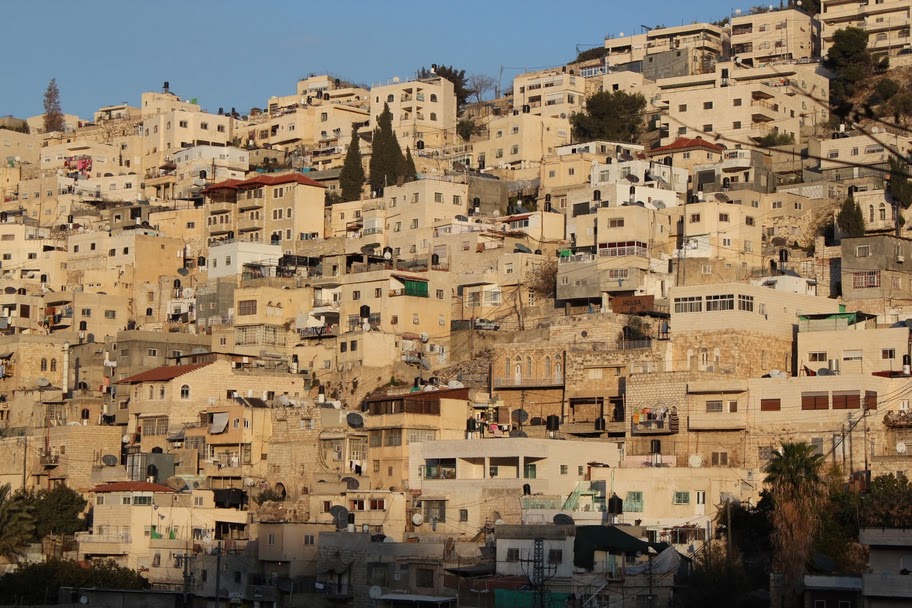
Silwan, E. Jerusalem, 12/24/10 (Photo: Rich Katz)

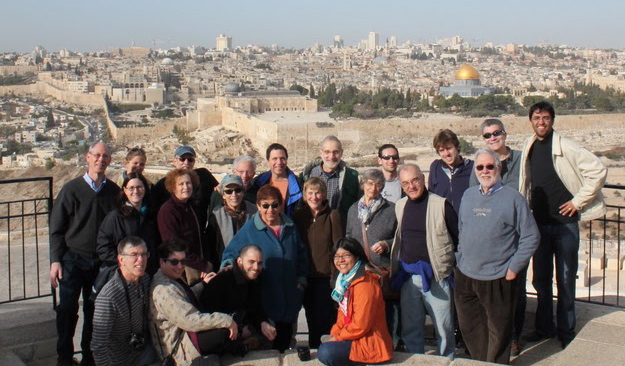
Here’s a guest post by Liz, another participant from our trip:

Looking back, it becomes clear to me that I fell in love with Jerusalem years before I would ever meet her.

We finally did meet for the first time in 1987, when I went to Israel on a high school summer program. Arriving instantly confirmed my feelings. I saw the forests of trees that I helped to build as a little girl all those times I answered the JNF’s call to give money to plant a tree in Israel. I saw the beautiful Jerusalem stone buildings everywhere. I saw Jews, feeling safe after the Holocaust, walking around proud to be there. I knew I was in love.

Subsequently, now that I was in love, I planned to spend my Junior year of college abroad in Jerusalem. But the Gulf War was launched the semester I was supposed to go and I was stuck in the US, separated from my lover. I missed being in Jerusalem so much that I told myself if I couldn’t go Junior year, then I would go for graduate school. I lived in Jerusalem from 1992-1996 and received my Master’s degree in English and Hebrew Literature from Hebrew University.

I was still in love. I was a young woman in my twenties living in Jerusalem walking the streets with pride — as though my whole life had led me to live, work, and study in this beautiful city. I deserve to be here, I am welcomed here, I need to be here.

Having just returned from the JRC trip to Israel/Palestine, I can’t get two things out of my mind. First, that my love for Jerusalem still runs very deep. And second, that it does for others even more so. Having stayed in the West Bank once before as a facilitator for Hands of Peace (a Chicago-based Israeli-Palestinian coexistence program), I was not blind to the Palestinians’ plight. For many of the Palestinians with whom I stayed, I was the first Jewish person they had met who wasn’t a soldier. They were hospitable, generous, and hungry to tell their stories. I listened, and when I returned to Chicago, I read everything I could.

This JRC trip, however, was very different. It was incredible to go with a group of Jews who had agreed to put themselves in emotionally vulnerable, uncomfortable situations which would require a lot of thinking, reflecting, and feeling. It was as though we all walked out onto a tightrope, knowing we could not go back.

Continue reading

A Day in Jenin, Return via Checkpoint

On our final full day in Palestine, we spent the morning and afternoon in the Jenin refugee camp. Our first stop was the Jenin Freedom Theatre.

The Freedom Theatre was founded by Israeli political and human rights activist Arna Mer Khamis in the wake of the First Intifada. Arna’s project used theater and arts to address Jenin’s childrens’ trauma, chronic fear and depression that resulted from the violence of the Intifada and the Occupation. Arna passed away in 1995 and her work has since been carried on by her son Juliano.

The Freedom Theatre’s theater building was destroyed during Israel’s military invasion of the Jenin refugee camp in 2002. It was rebuilt in 2007 and now flourishes with an array of amazing programs, performances and cultural events.

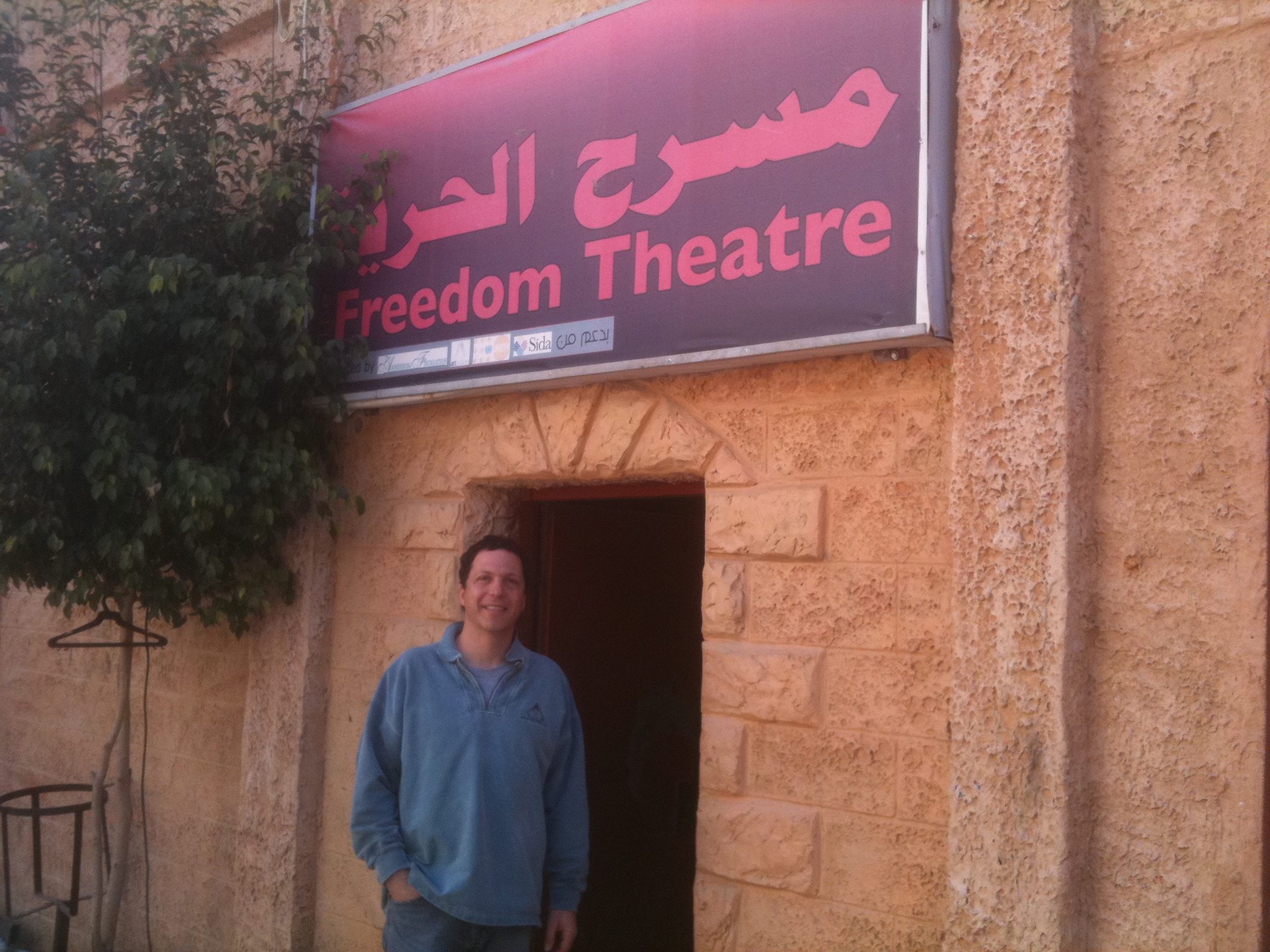
JRC member Joel Gratch at the entrance to the Jenin Freedom Theater

What makes the Freedom Theatre truly special is at the end of the day, it is about Palestinian solidarity – not simply another example of coexistence, dialogue or Israeli noblesse oblige. All who work at the Theatre, whether they are Palestinians, Israelis or internationals understand that above all, the Freedom Theatre is a form of Palestinian cultural resistance.

As part of our tour, we viewed these two films (at top and below) about the Theatre’s work. The films elicited a deeply emotional reaction from our group. When you will watch them you will understand why – and why we must learn about and support invaluable projects such as this.

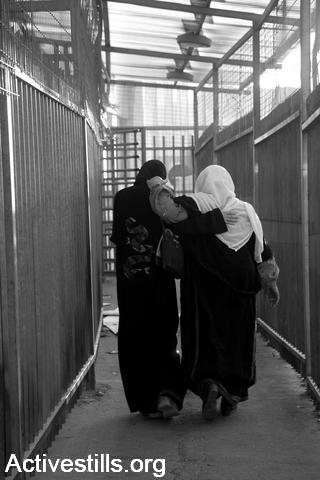
After our visit, we toured the refugee camp, which has only partially been rebuilt since the Israeli military invasion in 2002. We then boarded the bus for our ride back to Jerusalem. When we arrived at Bethlehem (though we technically didn’t need to) we got off the bus and walked through the checkpoint in order to get a first hand look at this daily, signature Palestinian experience. We had the luck of arriving before rush hour – and of course of being American tourists who were undoubtedly being given preferential treatment by the IDF.

We waited in line and eventually arrived at a long, narrow chute that forced us into single file. One by one, we filed through a huge steel turnstile, which locked frequently with the flash of a red light and a loud buzzer. Once through the turnstile, were in a kind of an antechamber, in which soldiers spoke to us through a loudspeaker from a control room on the other side of thick glass. We were instructed to put our packs and metal objects on a conveyor belt/x-ray machine, and eventually emerged on the other side.

Those who have never seen an Israeli checkpoint cannot fathom how massive and extensive they are. This is something far beyond a mere road block or airport security line. Everything about this experience reminds you of your abject disempowerment; of the fact that you are utterly, frighteningly at the mercy of an armed power much greater than yourself.

It was impossible for us to begin to comprehend what it must do to Palestinians who has to endure such humiliation on a daily basis. And again: we weren’t even asked to disrobe, step away form the line, or wait for literally hours on end.

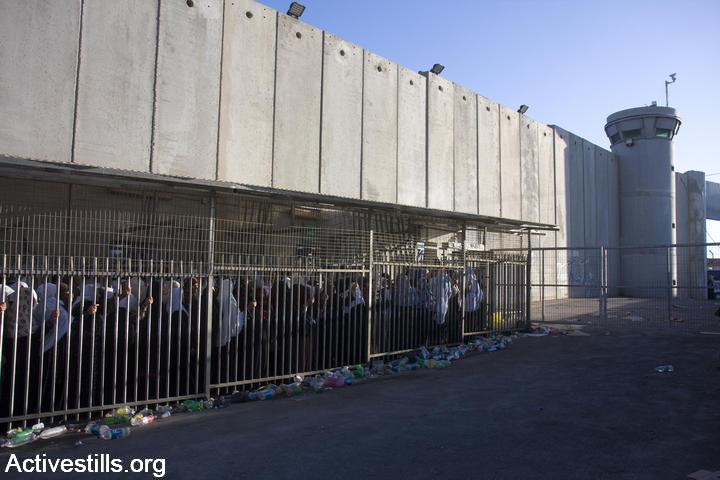
I didn’t take any pictures, but here are some images of the Bethlehem checkpoint from ActiveStills. They’ll give you a good solid sense of the scale of this massive checkpoint:

Stay tuned for some guest posts and final thoughts.

West Bank Realities Beyond the Headlines

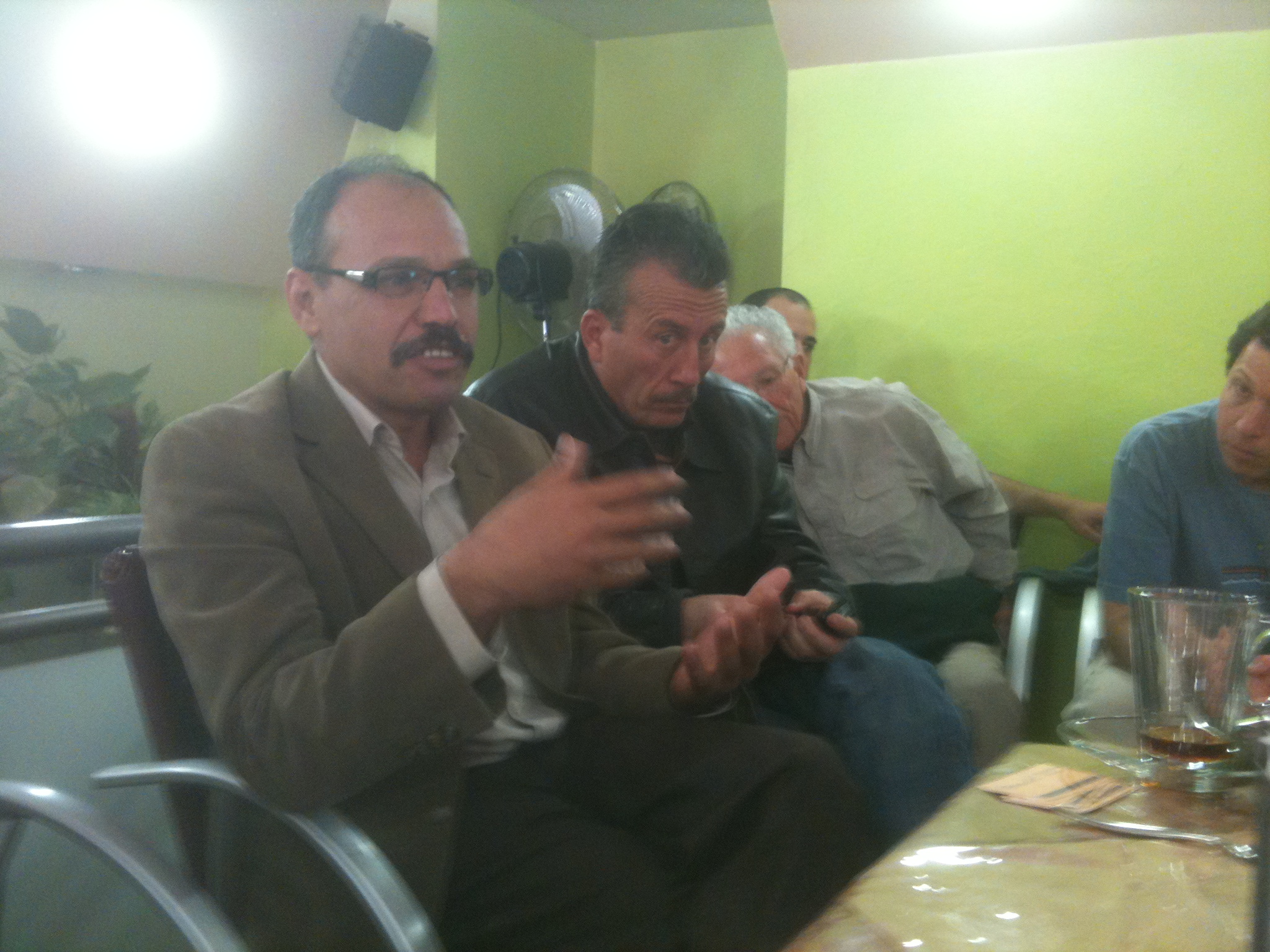
Palestinian nonviolent leaders Iyad Morrar (left) and Bassam Tamimi (right) address our group, Ramallah, 12/26/10

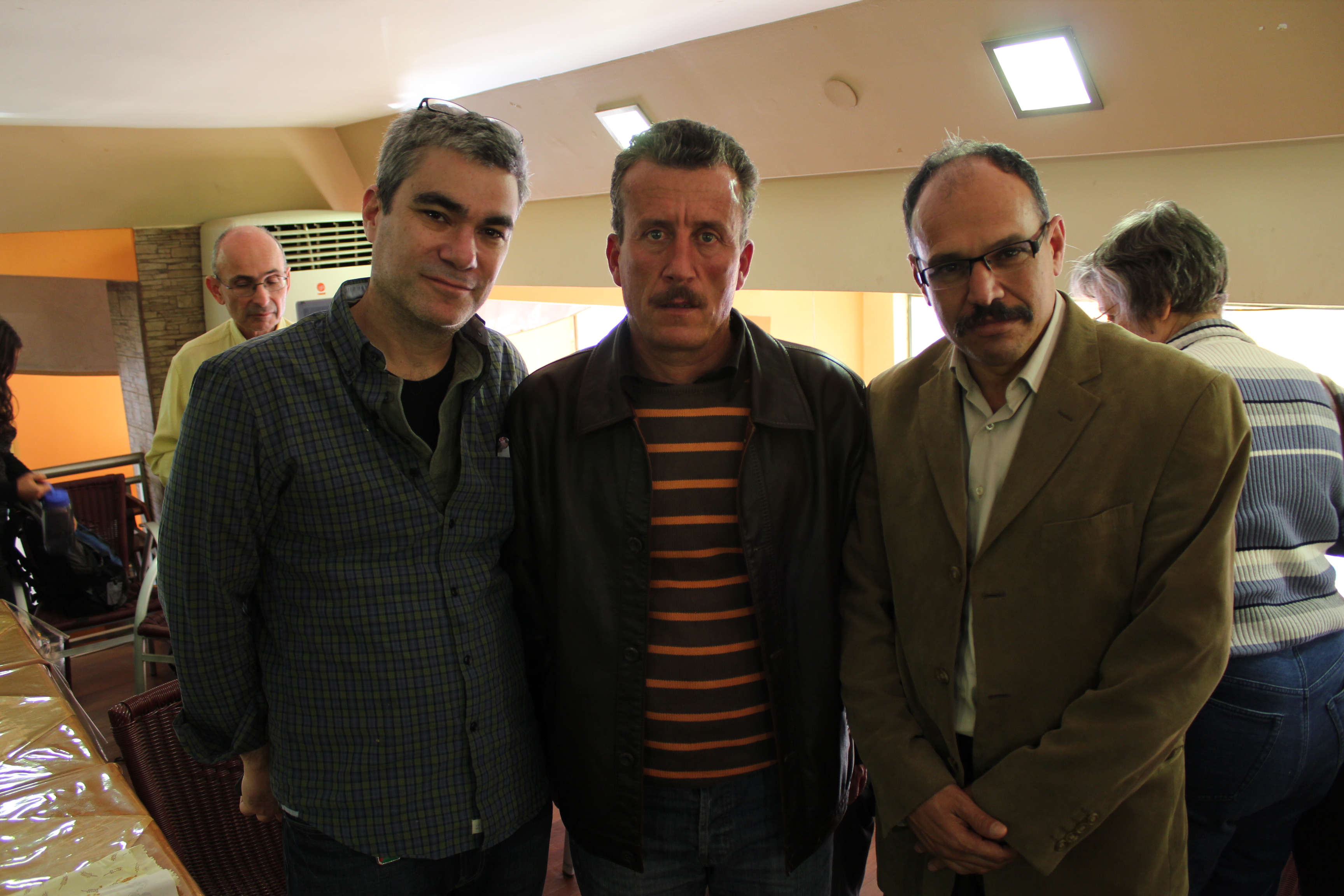
On Sunday morning we visited a cafe in Ramallah where we had meetings with a variety of Palestinian leaders. We gathered into the upstairs room of a coffee house and met first with an official from the Palestinian Authority. But the highlight of our meeting was as visit from two prominent Palestinian nonviolent leaders: Iyad Morrar from the West Bank village of Budrus and Bassam Tamimi from the village of Nabi Saleh.

Iyad’s leadership in Budrus has recently become the subject of a new documentary film, which powerfully demonstrates how he brought together a wide coalition of villagers and solidarity workers to successfully keep the construction of the Separation Barrier from destroying their village. When I saw the film, my first impression was that while it was undeniably inspiring, it didn’t explain that Budrus is largely one isolated success story – and that the IDF is going its level best to suppress the Palestinian nonviolent movement through brutality at demonstrations and the widespread imprisonment of their leaders.

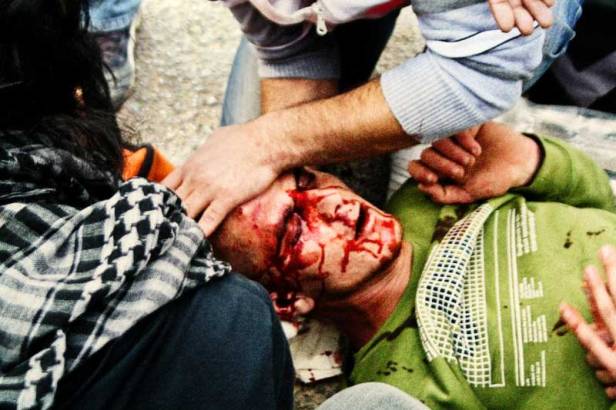
When I mentioned this to Iyad and Bassam, they agreed without hesitation.  There are in fact numerous examples of Israeli soldiers firing tear gas canisters and rubber bullets directly at protesters. Just a week before our visit, an international protester in Nabi Saleh was severely injured after directly hit in the back of the head with a canister as he was trying to take cover (see below).

Tear Gas in Nabi Saleh, Dec. 10, 2010 Photo: Joseph Dana

I’ve been trying my level best on this blog to highlight the growth of nonviolent popular committees in the West Bank, which are enormously important and eminently worthy of our support. It was deeply gratifying to bring congregants to meet leaders such as Iyad and Bassam, who are resisting daily oppression with principled, moral steadfastness. Where are the Palestinian Ghandis, asks the American Jewish community?  Well, we just met with two of them in a Ramallah coffee house.

From Ramallah we headed due north to Jenin. It took our bus driver several attempts to find the right route as it is never immediately clear which roads are open and which are closed. We did however, sail through a checkpoint, which had been eased in honor of the Christmas holiday.

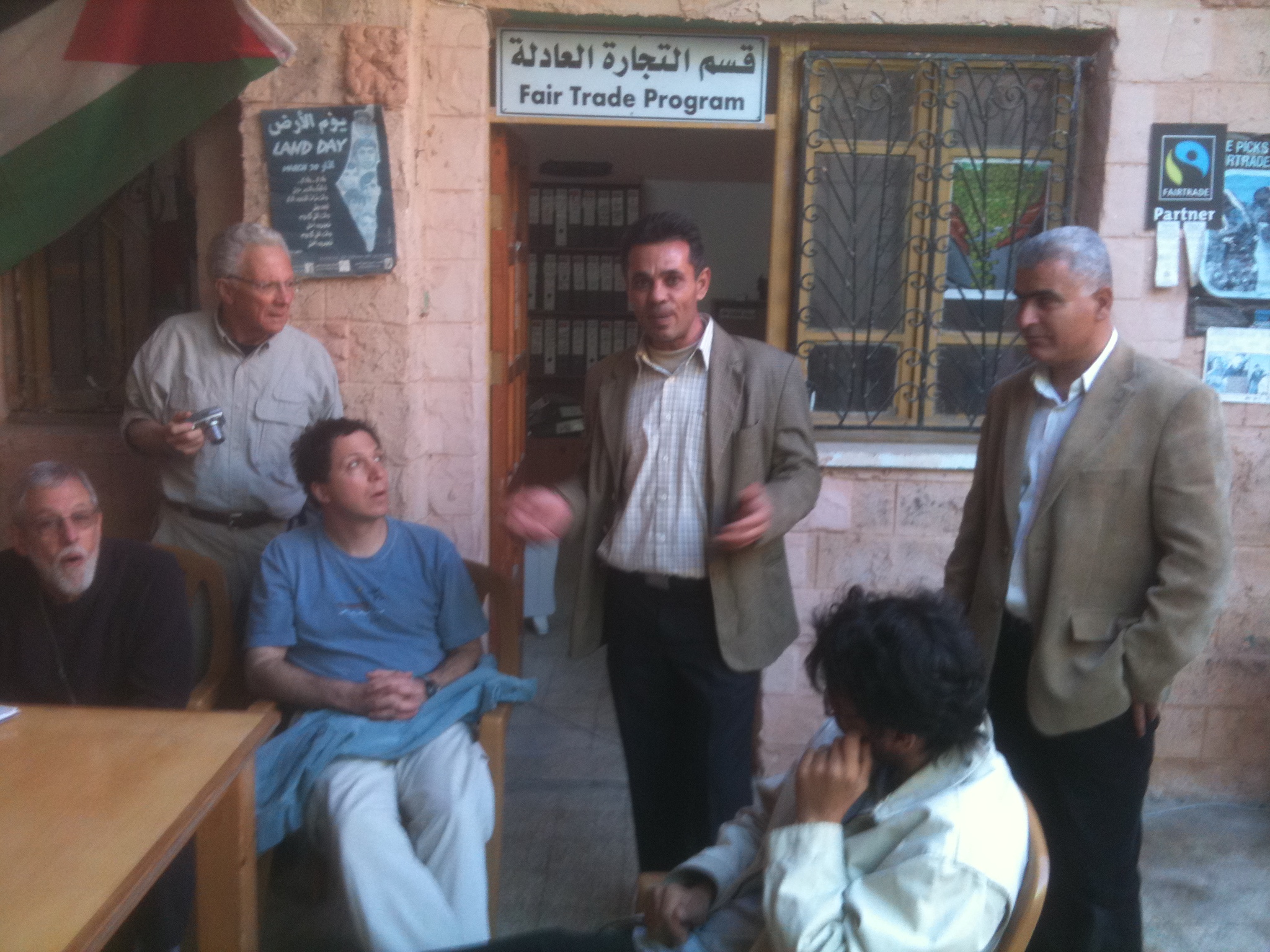
After passing through Nablus, we arrived at the town of Jenin, and gathered in the main office of the Palestinian Fair Trade Association. JRC has been selling PFTA olive oil for years, thanks to the leadership of member Lynn Pollack. The PFTA is the largest fair trade producers’ union in Palestine, with over 1700 small Palestinian farmers joined in fair trade collectives and cooperatives across the country. They work with olive farmers’ cooperatives through the northern West Bank and women’s village cooperatives that produce cousous, za’atar, sun dried tomatoes, olive oil soap, etc.

We then visited the PFTA’s main exporter, Canaan Fair Trade and were given a tour of their impressive facility by Administrative Manager Ahmed Abufarha (below). This multi-level operation is where coop farmers bring their olives to be pressed, stored, packaged and shipped and where their other products are prepared for export as well.

Much like our visit with Iyad and Bassam, our visit the Jenin fair trade community is an important reminder that there is a West Bank reality beyond the headlines that we read every day. Our job, we now realize, is to bear witness to these realities – to cultivate these relationships, and to do our part to extend them to the world upon our return.

After touring the Canaan Fair Trade facility, we broke up into groups and went off to our home visits. I was in a group of four JRC men who stayed with a family in ‘Anin – a West Bank village 15 minutes west of Jenin, just east of the Green Line.

Just like in Deheishe, we hit it off immediately with our hosts. For several hours, we sat in the living room of Awad – an olive farmer and retired captain from the PA police. Awad has ten children and received us with incredible graciousness. That’s Awad and his youngest, below, flanked by JRC members Ray Grossman, left, and Danny Newman, right

During the course of the evening, several men from the village gathered in the living room to meet us. Between our mutual English, Hebrew, French and pigeon Arabic, we were able to communicate quite well. At one point, we mentioned that we were American Jews and that I was a rabbi – a revelation that stopped them in their tracks somewhat.  After the initial bewilderment, however, our freewheeling conversation continued on and on. At one point, they pulled out the nargila pipe and we puffed away, I confess, with a fair amount of abandon.

Danny Newman, who is a High School math teacher talked extensively with another young man from the village who teaches High School Physics, comparing notes. Michael Deheeger, who speaks fluent French, spoke with another man who studied engineering in Algeria. I talked politics with a young man who wanted to know what I thought of Obama and if I thought he would be able to broker a peace treaty.

After a while, the young men asked us if we’d like to go for a walk through the village. While it had been a long day for us and it was starting to get pretty late, we all readily agreed. It was a mild evening with a dazzlingly clear night sky as we walked through the winding roads of ‘Anin. They showed us two of the natural springs of the village, which produce sweet, fresh water that runs off from a nearby mountain. We then stopped on the side of the road, built a campfire (which we were told was lit up there every evening) and sat around chatting, smoking locally made ‘Anin cigarettes.

'Anin by day

Like our experience in Deheishe, our visit was extraordinary for its simple ordinariness. For our part, we were taken by the humanity of our new friends, which is readily evident despite the obvious turmoil of their day to day existence. We were also moved by their genuine curiosity in us, their desire to get to know us better and host us in their village again. For me, and I think most of the members of our trip, this has been the most transformative experience: getting to know new friends and breaking down the politically-driven barriers that have long kept us from connecting in such a simple but immensely important way.

I do not hesitate to say we will continue to nurture these connections and will return to visit these new friends as soon as we can.

My next post will describe our final day in Jenin and offer some final thoughts. I’ll also post some thoughts from trip members, all of whom had been profoundly transformed by this journey.

Jaffa’s Bereavement Past and Present

Friday began with a trip to Jaffa – once a thriving Arab port city, now part of the Tel Aviv municipality. Jaffa was emptied of its residents in 1948 and today “Old Jaffa” is has been turned into a quaint artist’s colony. For most tourists who frequent Jaffa’s galleries and restaurants today there is little indication of the rich Palestinian cultural history of the city. And even fewer have any idea that there is a Jaffa slum neighborhood, Ajami, which is populated by internally displaced Palestinians and their descendants.

Our tour of Jaffa was led by Sami Abu Shehadeh (above), a Jaffa historian and community activist who was recently elected to the Tel Aviv/Jaffa city council. Sami began by explaining Jaffa’s history as port city and by recounting the long line of occupying forces that have left their mark on the city over the centuries. He then gave us a view into the Palestinian life of a place that only exists today in vestiges: a mosque that is now a fish restaurant, Arab homes that have been converted into stores and high scale art galleries, etc.

Our tour of Ajami was also intensely eye opening. Sami described how in 1948, the majority of Jaffa’s 100,000 Palestinians were expelled or fled in fear for their lives, crowding onto ships that took them to refugee camps in Gaza and Lebanon. Others traveled by foot to camps in Nablus or Jordan. The remaining 4,000 were rounded up and brought to Ajami, which was literally turned into a ghetto surround by fences and guard dogs. Sami said that his own grandfather, who used to be able to drive from Jaffa to Beirut, needed military permission to leave the neighborhood.

According to Sami, the trauma experienced by the Palestinians of Jaffa was really threefold. The first was the total destruction of their social reality as a result of their expulsion from their homes and the lives that they had known. The second trauma was economic: after their expulsion, the new Israeli authorities passed the Absentee Property Law of 1950, by which it could “legally” seize their properties. In many cases, these “absentees’” homes were their taken from them while they lived just a short distance away in their new ghetto.

The third stage of trauma Sami called “coexistence.” After the expulsion of Palestinians from their homes, the new State of Israel began absorbing thousands of new Jewish immigrants from around the world by placing them in seized Arab property. When all of the homes in Jaffa had been occupied, the Israeli housing authorities began dividing the homes in the Ajami ghetto into apartments and housed Jewish immigrants together with Arab families. Imagine, Sami said, if you were forced to live together with the very people who were now serving in the army, and quite possibly going own to kill your own family members in Gaza or Nablus before returning home to live with you under the same roof.

Our tour of Ajami also included a neighborhood that was undergoing heavy gentrification, with multi-million dollar beachfront homes, renamed by developers “North Ajami.” Sami pointed out the irony that many of these rehabbed Arab houses used to be home to poor fishermen who lived near the coast – and are now inhabited by embassy workers and billionaire businessmen.

Later in the afternoon, our group attended a demonstration in Silwan, the neighborhood in East Jerusalem that we visited on Wednesday.

There have been weekly demonstrations held in the East Jerusalem neighborhood of Sheikh Jarrah every Friday for almost two years to protest the ongoing evictions of Arab residents and occupation of their homes by Jewish settler groups. The Sheikh Jarrah solidarity movement sponsored Friday’s protest in solidarity with Adnan Ghaith, a community activist from Silwan who was recently handed a court order expelling him from Jerusalem for four months.

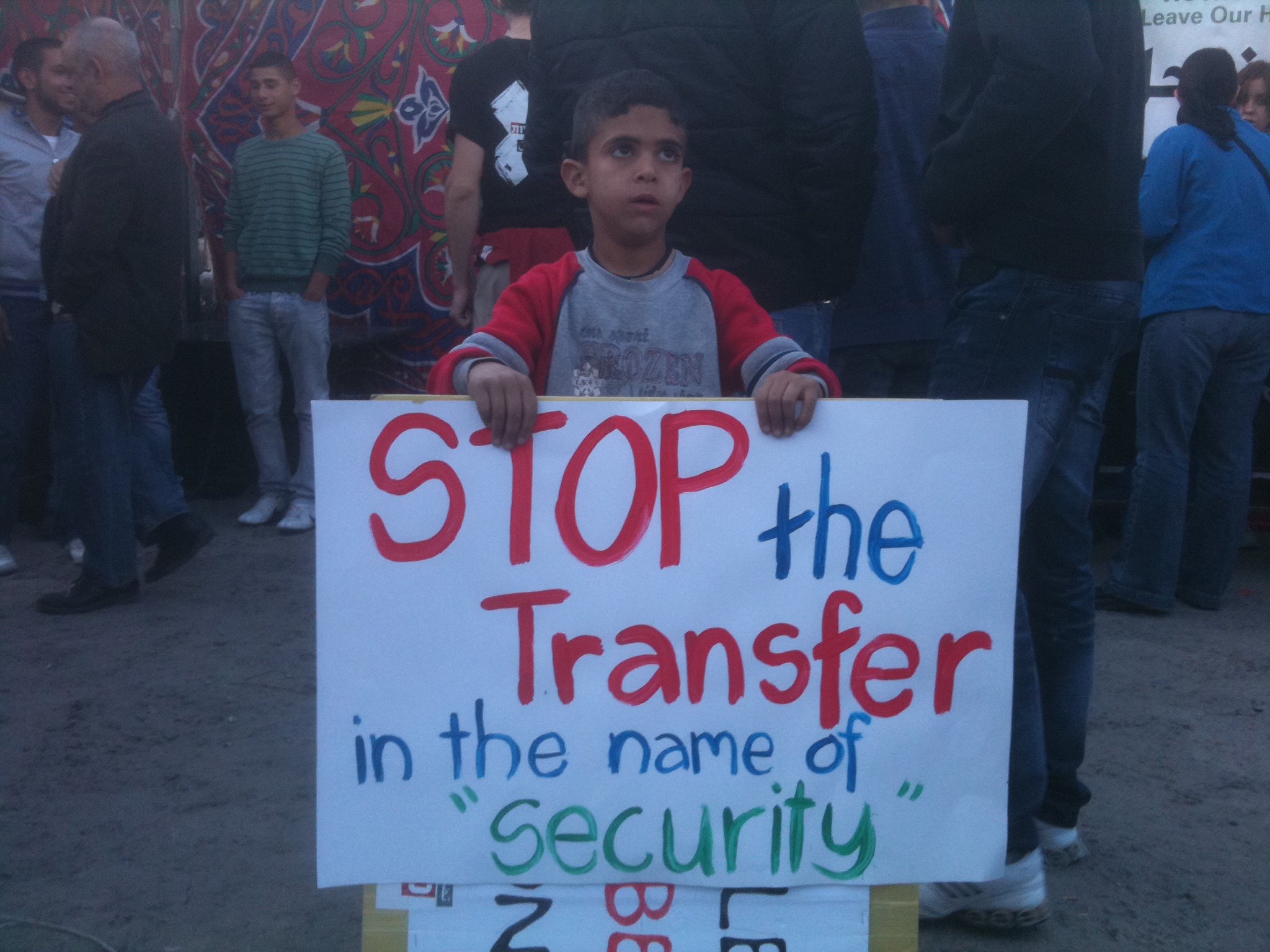
Below is a pic I took of of a young protester inside the Silwan peace tent. The peace tent has been standing since 2008 and has been slated for demolition by the Jerusalem municipality for being a “focal point for incitement.”

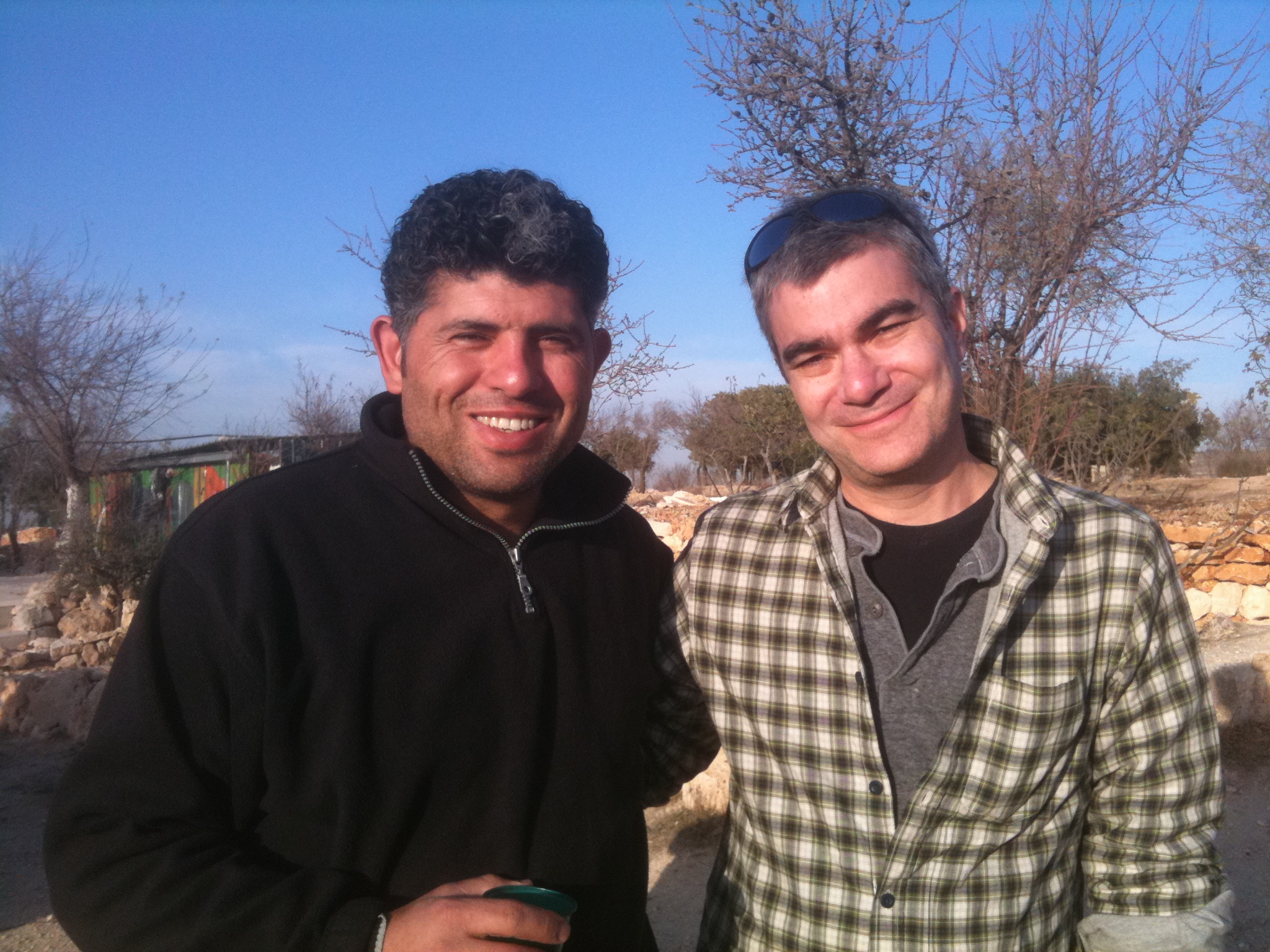
At the protest, I had the pleasure of running into peace activists Yonatan Shapira and Rami Elchanan (below). I met Yonatan last May when he visited Chicago and his activism has since become a huge source of inspiration to me. Both Yonatan (right) and Rami recently participated on the latest flotilla of boats attempting to break the siege of Gaza by bringing symbolic amounts of humanitarian aid to its citizens. (Click here to read more about their experience on the flotilla).

On Shabbat, Rami came to our hotel in East Jerusalem to speak together with our tour guide Aziz about their work in the Bereaved Parents’ Circle. I’ve written a great deal about this organization over the years, which I believe to be one of the most important peace and reconciliation groups in Israel/Palestine. Rami, who lost his fourteen year old daughter to a suicide bombing and Aziz, whose older brother died after being tortured in an Israeli prison as a teenager, both spoke movingly and openly about their pain, the anger, and their personal transformations as a result of their work in this amazing organization.

Later in the afternoon, we heard a presentation by Israeli journalist Orly Halpern, who, for my money is one of the gutsiest and most intelligent reporters on the Mideast conflict. Her talk on the pragmatism of Hamas was eye-opening to say the least. (And she did it all with her three month old Adam in a Snugli…) Check out Orly’s blog here.

Witness to Injustice From Deheishe to Hevron


Thursday is over and we’ve spent another night in the Deheishe refugee camp. Some thoughts, as promised:

As I mentioned in my last post, the main impression we’ve taken away from two nights in Deheishe with our host families was, quite simply, genuinely delightful time spent with wonderful new friends.

But of course it’s not that simple at all.

Just as it’s been impossible to ignore the truth of our common humanity, it was impossible for me to ignore the inherent inhumanity imposed daily upon the residents of Deheishe.

It was palpable in so many ways. During the course of dinner, the electricity cut out on us more than once. At one point, we sat in the dark and I looked out at the window at the bright lights of the nearby settlement of Efrat. From this vantage point I thought of their beautiful homes, their well-tailored landscapes, their swimming pools and I was just emotionally overwhelmed with the injustice of it all.

The people we have met in Deheishe are so gracious despite this reality – their children so smart, so filled with life and love – and all I can think of is the waste of it all. Such incredible human potential forced to live in a virtual box, with little hope for a viable future. I felt a similar feeling yesterday, in Wadi Fukin, where residents lived in the shadow of a fast growing settlement that pumped human waste into their village. I asked myself the same question: how can Jews, of all people, do this to another people? And how can we allow it to happen?

It is clear that there are two very different universes in this country: Jews live in one and Palestinians in another. It’s a reality that is impossible to ignore – and if there was any doubt, our trip to Hevron this afternoon drove this point home for us in a painfully obvious way.

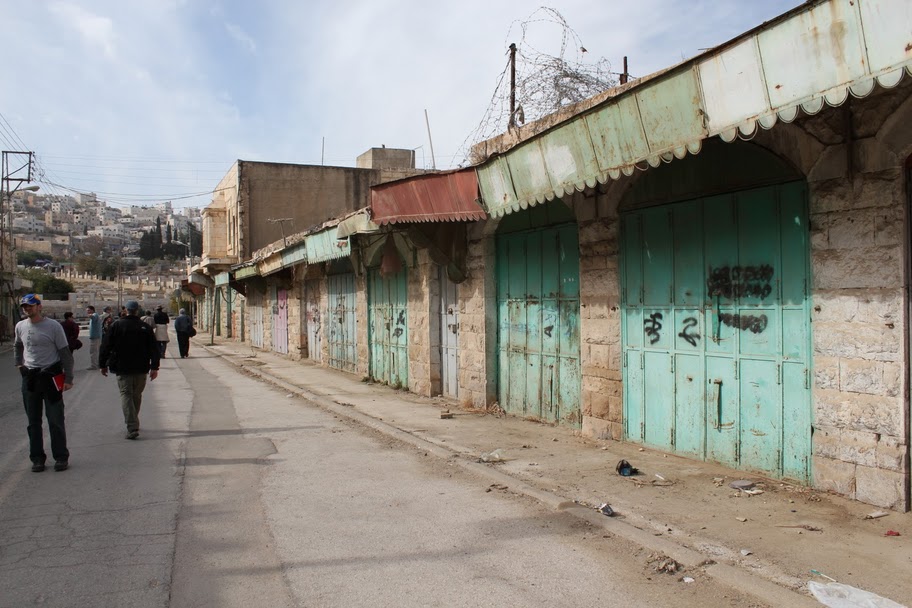
I’ve written about the horrid situation in Hevron from previous trips. A few hundred Jewish settlers live in the heart of the city, protected by 2,000 IDF soldiers. Palestinian presence is severely restricted or is outright prohibited in the Israeli-controlled part of the city known as H2. As a result, what used to be the bustling main commercial area has been rendered a virtual ghost town.

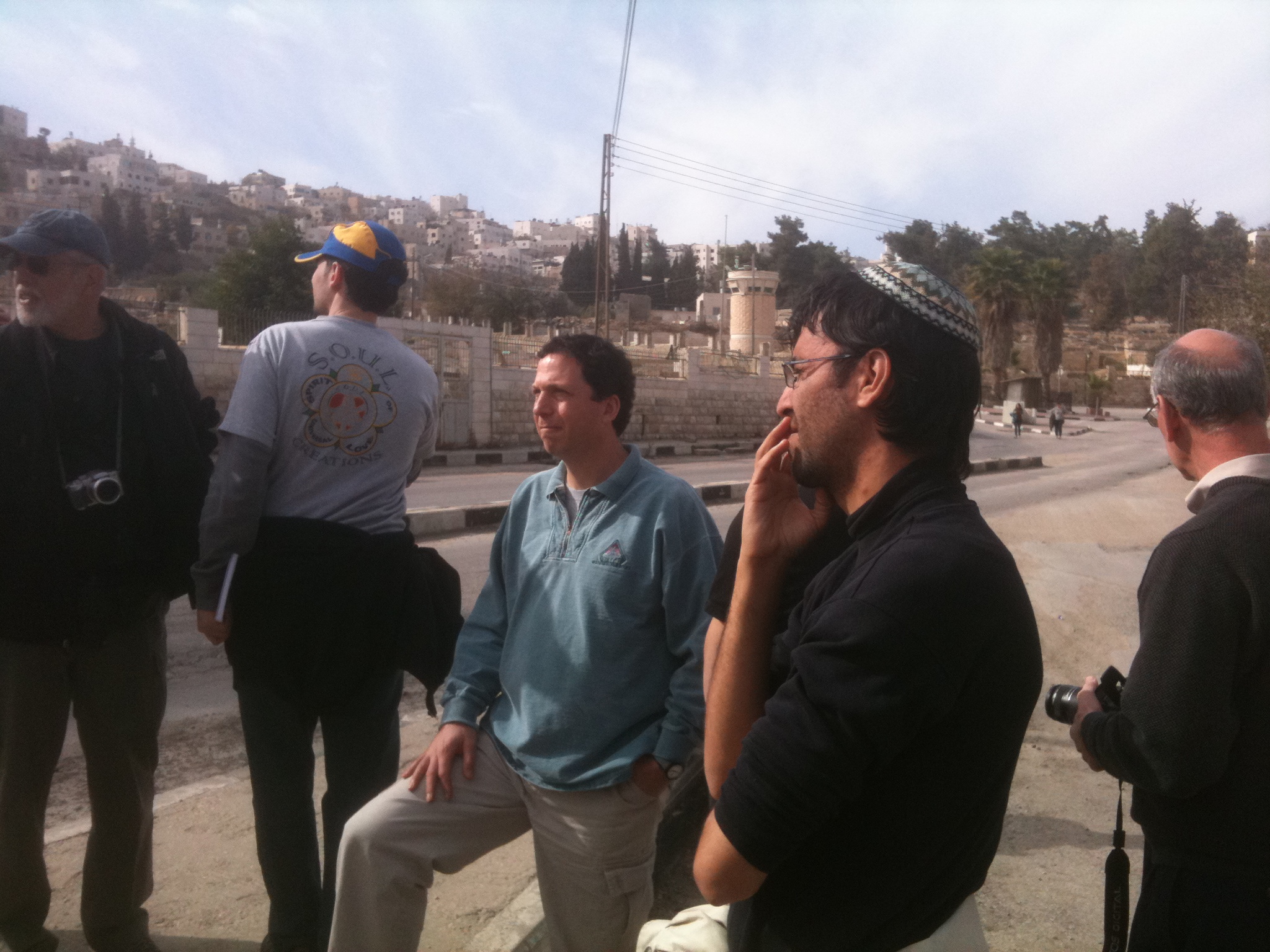
Take a close look at the picture above. In the foreground you’ll see two Jews strolling down the center of the street, which is legally off limits to Palestinians. The men in the background are actually Hevron city officials, regulated by law to the narrow walkway on the side of the road. This is racially enforced segregation. By any other name we would call it apartheid.

As we walked through the streets, our Israeli tour guide, Kobi, told us about his army service in Hevron – how he personally witnessed the brutality of the IDF toward Palestinians, and how this experience sealed his own personal transformation from an extremist right-wing Kach supporter to an Israeli peace/justice activist.

We then passed through the checkpoint into the IDF-controlled area of the city and entered an area that is technically off-limits to our Palestinian tour guide, Aziz.  He asked me for my kippah, which he then put on his head so he could pass for a Jew and take us down Shehadeh Street (see below). Although Aziz was characteristically good-natured about it, it was profoundly disturbing to us. One member of our group said she was moved to tears to see Aziz, a Palestinian man, “protected” by my kippah in a Jewish-only part of town.

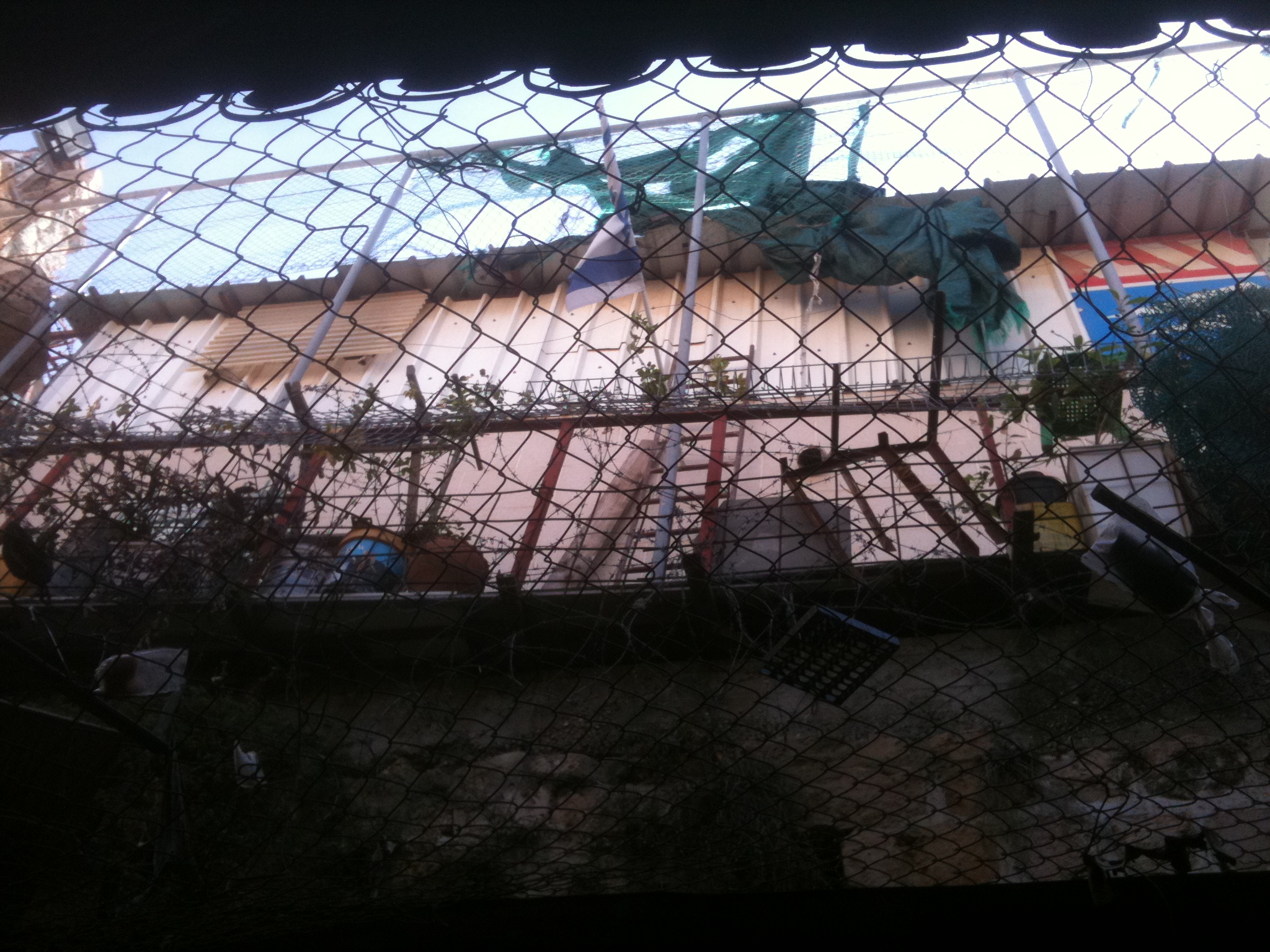
We walked back to our bus through the Palestinian-administered streets of Hevron (H1) and took some time to have lunch and do some shopping in the souk. Along the way Aziz and Kobi pointed out one prominent Jewish settlement that was built literally above the Arab shops. In the picture at the top of this post, you can the settlement marked by an Israeli flag. You’ll also see a chain link fence that was put up to protect the Palestinians below from garbage and debris that is regularly thrown down at them from settlers.

After Hevron, we visited Tent of Nations, a Palestinian family farm located south of Bethlehem. It is owned by Daoud Nasser (below), whose family has owned this land for four generations. His grandfather registered his land with the ruling Ottomans and the Nassars still have the original deeds of ownership from the Ottomans, the British and the Jordanians respectively.

In 1991 the Israeli military initiated proceedings to expropriate the Nasser’s farm, which happens to be located between two Jewish settlements in the Gush Etzion Block – which is considered choice real estate by the Israeli settlement regime.

Despite Daoud’s irrefutable proof of his family’s ownership of the land, the legal battle over it has stretched on for well over two decades – and the Nassar family has spent over $140,000 in legal fees to date. Last May, the Israeli military issued demolition orders because the Nassers added some minor but essential additions to their property. Thanks to an international solidarity campaign, they were granted a stay by the Israeli courts. At present, their case remains in Israeli legal bureaucratic limbo.

In the meantime, the Nassar family has used their land to establish “The Tent of Nations” an inspirational center that provides arts, drama, and education to the children of the villages and refugee camps of the region. Daoud and his family have also established a Women’s Educational Center offering classes in computer literacy, English, and leadership training.  Many rabbis and rabbinical students are familiar with Tent of Nations as a primary destination for Encounter – a well-known educational program that promotes coexistence by introducing Jewish Diaspora leaders to Palestinian life.

Daoud is one of my personal heroes – a gentle, visionary soul with a powerful, implacable moral core. I first met him last year when he passed through Evanston on a speaking tour – and it was a thrill for me to finally introduce him to members of my congregation. I can only say that after our painful experience in Hevron, ending our day with Daoud on his family farm was healing indeed.

Is the FBI Criminalizing Curiosity About Israel/Palestine?

This past summer, Sara Smith, a young Jewish woman from Chicago, visited Israel/Palestine with two Palestinian-American friends. Sarah had never been and was interested in seeing for herself what life was like for Israelis and Palestinians. As she would later put it, “I went there so I could make up my own mind and talk about what I saw.”

On Friday, December 3, Sarah received a phone call from an FBI agent, who asked her if she could come in to answer some questions. When she asked what this was about, he said he “was not at liberty to discuss it.” She asked if she would need a lawyer present; the agent said it was up to her but that she was not in any trouble and that they just wanted to ask her a few questions.

Understandably alarmed, Sarah told the agent that she wanted to consult a lawyer and get back to him. She repeated that it would be easier for her if she knew what this was all about. He replied that it had to deal with the trip she had taken over the summer, adding ominously, “I think you know which one I’m talking about.”

Sarah later learned from her lawyer that she, along with her two friends, were being subpoenaed to appear before a grand jury.

Lest you think that Sara might be an undercover Hamas operative or a naive young radical, let’s let her father introduce her to you:

I don’t think I need to speak in defense of her character. While she was in high school, Crain’s Chicago Business had a special edition called the “100 Most Influential Women in Chicago” and they chose my daughter as being one of Chicago’s six most influential and up-and-coming women high school students. Crain’s Chicago Business chose her partly because they saw she was willing to travel to different parts of the world and see for herself and to make up her own mind about what was happening over there. Evidently, the FBI thinks that there is something criminal in doing that.

I myself have done similar trips as Sara more than once. So have many of my friends and colleagues. This Sunday, I’m going to leave with 20 members of my congregation to visit Israel/Palestine so we can, yes, learn about “what life is like for Israelis and Palestinians.” (More on that very soon.) Is this now standard operating procedure in our country: visit Israel/Palestine to get a real look at the conflict, expect a subpoena from the FBI?

If this all sounds sadly familiar, you might remember that back on September 24, the FBI raided the homes of anti-war activists in Minnesota, Chicago and Michigan and issued subpoenas to 14 of them. To date, they have all refused to testify and US Attorney Patrick Fitzgerald has since withdrawn the summons. However, he recently reissued subpoenas to three Minnesota women who are facing “indeterminate imprisonment” if they continue refusing to testify.

It’s beyond egregious. Back in September, it looked like freedom of dissent was now a potentially punishable crime. This definition of “crime” has now apparently been extended to include honest curiosity about the world around us.

Please visit the website of the Committee to Stop FBI Repression to learn more and for details about how you can take action. Click here to sign a petition that tells President Obama, Attorney General Holder, US Attorney Fitzgerald, et al to stop this growing FBI campaign of repression now.

Tel Aviv, West Bank: A Tale of Two Demonstrations

Tear Gas in Nabi Saleh, Dec. 10, 2010 (Photo: Joseph Dana)

Please read this enormously important post by Israeli activist Joseph Dana, who attended nonviolent West Bank demonstrations in the Palestinian villages of Ni’ilin and Nabi Saleh yesterday. The twist is that these demonstrations happened to occur just as ten thousand Israelis were participating in a Tel Aviv march in honor of International Human Rights Day.

I first learned about these simultaneous events through Dana’s numerous tweets from the ground. Here’s a sampling:

– While the Human Rights March gets underway in Tel Aviv, I am on my to Ni’ilin/Nabi Saleh

– Ni’ilin demo underway while tel aviv marches

– While tel aviv marches for human rights, palestinians are attacked with tear gas

– Human rights day is underway, tel aviv is talking peace while ni’ilin and bil’in are under cover tear gas. I am on the way to nabi saleh

– 10000 people march in tel aviv for human rights and we could not get 20 israelis in ni’ilin. Upsetting

Dana later made the point explicitly in his blog post: for those interested in human rights, the real struggle is not occurring in the streets of Tel Aviv but in the villages of the West Bank, where Palestinian nonviolent activists are regularly brutalized by Israeli military forces. How differently things might have turned out if these thousands of Israelis had saw fit to demonstrate alongside Palestinians in Ni’ilin and Nabi Saleh?

The (Tel Aviv march) brought together various Israeli NGO’s and thousands of concerned citizens in the spirit of presenting a face of Israel that supports human rights and progressive values. Placards were carried through the streets supporting gay rights, woman’s rights, African refugees rights and, also, coexistence between Jews and Arabs. Police lined the streets of the demonstration to ensure the safety of the protesters and keep confrontation with the right wing counter protesters at bay (one has to hand it to the right in Israel, a counter protest to human rights?!). If the Tel Aviv Human Rights Day march wanted to have more authenticity in terms of Palestinian/Israeli coexistence, it should have had more connection with the human rights struggle happening simultaneously in the West Bank.

I’m in complete agreement. Those who seek human rights in Israel/Palestine would do well to support the cause of justice in the Occupied Territories – and in particular, the popular Palestinian committees whose demonstrations are regularly broken up by the IDF with violence and whose leaders are regularly imprisoned without cause.

To this end, I encourage you to this recent statement by Abdallah Abu Rahmah, a leader of the Bil’in popular demonstrations who was imprisoned by Israel a year ago (on, that’s right, International Human Rights Day). This past October, Abdallah was sentenced to an additional year in prison, with a six months suspended sentence for three years and a 5,000 NIS fine:

I often wonder what Israeli leaders think they will achieve if they succeed in their goal of suppressing the Palestinian popular struggle? Is it possible that they believe that our people can sit quietly and watch as our land is taken from us? Do they think that we can face our children and tell them that, like us, they will never experience freedom? Or do they actually prefer violence and killing to our form of nonviolent struggle because it camouflages their ongoing theft and gives them an excuse to continue using us as guinea pigs for their weapons?

My eldest daughter Luma was nine years old when I was arrested. She is now ten. After my arrest she began going to the Friday demonstrations in our village. She always carries a picture of me in her arms. The adults try to look after her but I still worry for my little girl. I wish that she could enjoy her childhood like other children, that she could be studying and playing with her friends. But through the walls and barbed wire that separates us I hear my daughter’s message to me, saying: “Baba, they cannot stop us. If they take you away, we will take your place and continue to struggle for justice.” This is the message that I want to bring you today. From beyond the walls, the barbed wire, and the prison bars that separate Palestinians and Israelis.

Click here to send a letter to Secretary of State Clinton requesting that she advocate the release of Abdallah Abu Rahmah and demand that Israel cease its targeting of the Palestinian popular resistance.

Conference Call With Journalist Jared Malsin: “Operation Cast Lead: Two Years Later”

This Thursday, December 16, at 12:00 pm (EST), Ta’anit Tzedek  – Jewish Fast for Gaza will present a conference call, “Operation Cast Lead: Two Years Later” featuring American journalist Jared Malsin.

Call-in info:

Access Number: 1.800.920.7487

Participant Code: 92247763#

Jared Malsin served as the chief English editor of the Palestinian news agency Ma’an. He spent two and a half years reporting from the West Bank, based in Bethlehem.

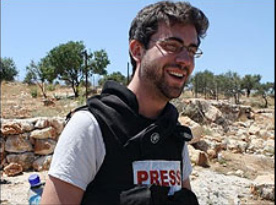
In January 2010, while returning from a vacation in Prague, the Israeli government detained Malsin at Ben-Gurion airport after questioning him about his allegedly “anti-Israeli” political views, Palestinian contacts, and news articles authored “inside the territories.” Malsin spent a week in jail before he was deported to the US.   His deportation was condemned by the head of the International Federation of Journalists as “an intolerable violation of press freedom.”

Since October 2010, Malsin has been reporting regularly from Gaza as a free lance journalist.

Here’s Malsin in an interview with radio journalist Christophen Lydon:

If you’re living in the West Bank or Gaza, your water gets shut off for a week or ten days at a time, in the summer, routinely. Which means that if you live in a refugee camp in Bethlehem, for a week or ten days in the summer you can’t wash yourself; you can’t wash your children. You can’t take a shower. You can’t cook food. It’s incredibly dehumanizing, but it’s one of these issues you just don’t hear about because there are no explosions going on. It’s one of these daily lived ways that people live occupation. And that’s what I think the real meaning of it is… Those are the stories I’m interested in.

My “Budrus” Review

Just saw “Budrus” last night. (Why it takes independent films forever and a day to get to Chicago is beyond me. Aren’t we even considered a movie market any more? Sheesh…)

My two cents:

I think it’s a brilliant film in so many ways. I simultaneously experienced it as a compelling “how-to textbook” on grassroots organizing, an honest portrait of real nonviolent resistance in action, an up-close document of the human impact of the Occupation and a compassionate profile of life in one West Bank village.

It is also a masterfully constructed film that often transcends the documentary genre itself. Filmmakers Julia Bacha, Ronit Avni and Rula Salameh present us with a true story that has a genuine dramatic arc.

The story in short: in 2003, Ayed Morrar a remarkable Palestinian community leader, organized a nonviolent resistance movement to save his village Budrus from being destroyed by Israel’s Separation Barrier. He brought together an impressive coalition of local Fatah and Hamas members along with Israeli and international solidarity activists to resist the wall’s construction.

After some initial success, Budrus was put under military curfew and their resistance effort threatened to come apart. In the end, however, after ten months of steadfast resistance, the Israeli government relented and redrew the route of the fence, saving the village.

There is no question that “Budrus” is a profound and authentic document of what well-organized nonviolent resistance can truly achieve. It’s the kind of story that would move you even if it wasn’t actually true. And I won’t deny the story of these villagers’ courage left me deeply inspired.

And yet…

…and yet I must also confess to having a nagging feeling that there was one critical puzzle piece left out of the story. The film is essentially the document of one village and it more or less takes place within the bubble of this village’s exclusive universe. But I was somewhat disappointed that “Budrus” failed to explore the overall context of institutional oppression in which this one village’s story took place.

The film does indeed explain how the barrier cut significantly into Palestinian lands rather than simply follow the route of the Green Line. The filmmakers, however, never address the reasons why Israel chose to do this. There are many references to Israel’s security needs, but notably, no one ever asks the critical question: why, if security was the only reason for the barrier, didn’t Israel build it along the internationally recognized border between the West Bank and Israel proper?

The answer, of course, is that this wall is not just about security. It is also very much about about the settlements and about Israel’s desire to create its own unilateral border in advance of a final negotiated settlement. To wit: it is ultimately about taking land away from Palestinians.

If the film had included but one talking head to address this reality, viewers would understand the true stakes of Budrus’ struggle. But by leaving this context unexamined, the filmmakers essentially document one village’s travail without really explaining how it fits into a much larger injustice.

In truth, it must also be admitted that Budrus’ victory was and continues to be notably exceptional. While the film mentions briefly at the end that this kind of nonviolent resistance is ongoing in other West Bank villages, none of these villages have experienced anything near the level of Budrus’ success.

In fact, the exact opposite is happening. The Israeli military is brutally clamping down on the leaders of the popular committees that organize nonviolent campaigns. And although this repression is not regularly reported in the mainstream media, it is in fact unfolding on an almost daily basis.

Last Monday, for instance, it was reported that Abdallah Abu Rahmah, a leader in the Bil’in campaign was denied release from prison even though he has completed his twelve month sentence in full. Just yesterday we learned that the sixteen year old son of another jailed Bil’in activist leader, Adeeb Abu Rahmah, was arrested by a “a group of masked soldiers (who) forcefully entered the house without showing a warrant.”

Adeeb, by the way, was sentenced to one year but also remains in jail beyond his release date as the military prosecutors appeal his sentence. He will stay imprisoned “indefinitely” – which likely means for a long, long time. (That is Adeeb Abu Rahmah in the clip above. I encourage you to watch this incredible video document in its entirety if you can).

These kinds of actions, tragically, are taking a huge toll on local nonviolent resistance campaigns. With many of their leaders in jail or targeted for imprisonment, local committees (with the notable exception of Sheikh Jarrah) are reporting fewer numbers at their demonstrations. Those of us who are justifiably inspired by Budrus’ story should find these developments deeply, deeply troubling.

Bottom line? Please see “Budrus” and encourage your friends to do the same. Buy copies when it comes out on DVD and give them to anyone you know that needs to know that despite media portrayals to the contrary, there is a significant and important nonviolent resistance movement in the Palestinian community.

But after you see it, please don’t leave the film with the impression that this movement is experiencing the kind of success you’ve just witnessed. Israel is quite rightly threatened by Palestinian nonviolent resistance, and is currently doing its level best to crush this movement under its military heel. Alas, it is too often succeeding.

To learn more about these campaigns, you should regularly visit the blog of activist Joseph Dana, who has been indefatigably reporting from the ground in the West Bank and East Jerusalem. (He’s probably uploaded enough video onto his site to make hundreds of documentary films on the subject.)

And if the film inspires you to make a difference yourself, please visit the website of Taayush: Arab-Jewish Partnership and send them a much-needed donation.

An Inspiring Conversation With Congressman Brian Baird

Ta’anit Tzedek hosted an incredible conference call today with outgoing Congressman Brian Baird from Washington state. I’ve long admired Rep. Baird as one of the most fearless politicians on Capitol Hill on the issue of Israel/Palestine; indeed, his comments today were a powerful reminder that there are still politicians left in Washington who are doing this work for all the right reasons.

Rep. Baird spoke candidly and courageously on a host of issues: his four visits to Gaza, the Corrie family’s quest for justice for their daughter Rachel (the Corries are his constituents), the state of the current peace process, and the political reality of the Israel/Palestine issue in Congress.

We’ve just uploaded the audio of the entire conference call to the Ta’anit Tzedek website. Please, please listen to it and send it on to anyone who you think need to hear words such as these. Rep. Baird is a truth teller of the highest order. He will be sorely missed in Washington.