Category Archives: Islam

Massacre in Norway: “The Answer to Violence is Even More Democracy”

So much to say about Friday’s tragic massacre in Norway. Chief among them: the death (I hope) of our misguided assumptions that terrorism must necessarily = Islamism.

Much has been written about the immediate media speculation – most notably by the New York Times – that this attack was carried out by an Islamist terror group. As journalist Ahmed Moor correctly points out, these assumption reveal just how deeply this meme is ingrained in the American consciousness – one that cuts across right-left political lines.

I’m also in full agreement with Moor when he says the real “Clash of Civilizations” is not between the West and Islam, but between “normal, sane people of the world and the right-wing zealots who see doom, destruction, hellfire and God’s Will at every turn:”

Anders Behring Breivik, Mohammed Atta and Baruch Goldstein are all cut from the same rotten cloth. Anwar Al-Awlaki and Glenn Beck – the peddlers of the faith – all share the same core afflictions.

These men are insecure, violently inclined, and illiberal. The outside world scares them. They hate homosexuals and strong women. For them, difference is a source of insecurity. Their values are militarism, conformism, chauvinism and jingoism. Worst of all they seek to pressure us into compliance while they work frantically to destroy themselves – and the rest of us with them.

All indications are that the hate-mongers – who are on the same side of this war, irrespective of religion – are winning in America. The unreflective, superficial, wan editors of the NYT are an indication of just how successful the right wing has been at eviscerating the left.

Terror expert Robert Lambert actually warns that ultra-nationalists pose an even greater threat than al-Qaeda, citing a disturbing litany of European plots that were foiled before they were able to be carried out. (Of course, as the example of Timothy McVeigh tragically reminds us, we Americans should not be so blase as to assume ultra-nationalist terror is only a European problem.)

What should be our response?  I can think of none better than that of Norway’s Prime Minister, Jens Stoltenberg. (Oh, would that we had heard these kinds of words from President Bush following 9/11):

This is a message from all of Norway: You will not destroy us. You will not destroy our democracy or our quest for a better world. ..This night we will comfort each other, talk with each other and stand together. Tomorrow we will show the world that Norway’s democracy grows stronger when it is challenged…

We must never cease to stand up for our values. We have to show that our open society can pass this test too, and that the answer to violence is even more democracy, even more humanity, but never naivete.  This is what we owe to the victims and to those they hold dear.

May the memory of the victims be for a blessing.

Not In Your Local Paper: Egyptian Muslims Protect Coptic Community With Their Bodies


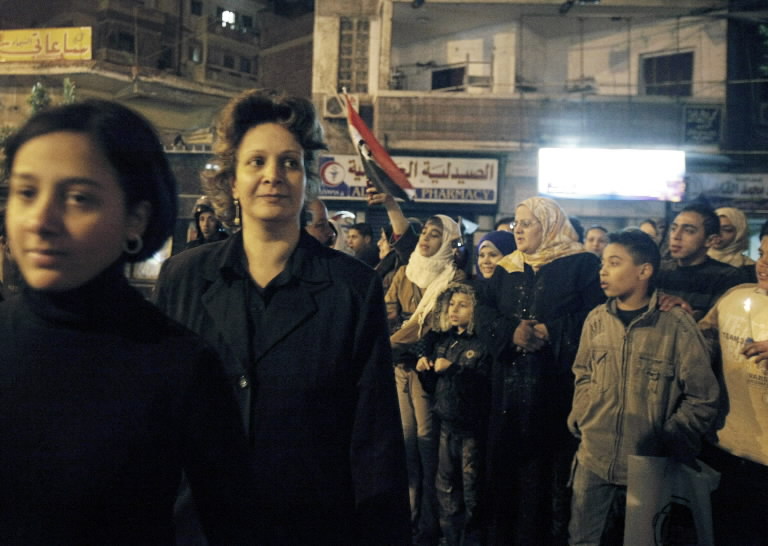
Muslims protect and greet Orthodox Christians leaving the church where Alexandria bomb blast took place. (Photo: REUTERS/Asmaa Waguih)

An important and inspiring report out of Egypt. From AhramOnline:

Egypt’s majority Muslim population stuck to its word Thursday night. What had been a promise of solidarity to the weary Coptic community, was honoured, when thousands of Muslims showed up at Coptic Christmas eve mass services in churches around the country and at candle light vigils held outside.

From the well-known to the unknown, Muslims had offered their bodies as “human shields” for last night’s mass, making a pledge to collectively fight the threat of Islamic militants and towards an Egypt free from sectarian strife.

“We either live together, or we die together,” was the sloganeering genius of Mohamed El-Sawy, a Muslim arts tycoon whose cultural centre distributed flyers at churches in Cairo Thursday night, and who has been credited with first floating the “human shield” idea.

Among those shields were movie stars Adel Imam and Yousra, popular preacher Amr Khaled, the two sons of President Hosni Mubarak, and thousands of citizens who have said they consider the attack one on Egypt as a whole.

Sorry to see that this story has been virtually ignored by the mainstream media. It seems to have been broken by the Egyptian press, but other than a report on WaPo’s online edition, I could only see it covered via the blogosphere.

What else is new? When it comes to Islam, it seems, the actions of an extremist minority is considered newsworthy while the courage of the Muslim majority flies right off the radar screen.

Be sure to pass this one on…

We’re Not Muslims! (Not That There’s Anything Wrong With Them…)

Here’s a sure sign that American Islamophobia has officially sent us through the proverbial looking glass.

From the WashPo blog:

A Christian church in Phoenix has had to make a presidential-type denial: It is not Muslim. The building under construction will feature a domed ceiling, and protesters have taken that as a sign the church is not what it says it is. The leaders have hung up a sign saying, “We are building a Christian house of worship,” the Atlantic reports...

“I have nothing against Islamic people,” Carlos Montemayor, the pastor of the church, said in a phone interview. But local commentary had been growing, saying that the building was a mosque and an investigation should be launched into the church. He put the sign up to stop the comments.

Calling Out Political Islamophobia

Many of you, I’m sure, read about the Pew study last August that determined 18% of Americans (roughly one in five) believe that President Obama is a Muslim. And I’m sure many might be tempted to disprove this claim as patently ridiculous.  My response? What should it matter if he was?

Let’s be honest. Those who cast doubt on Obama’s religious affiliation are not driven by compelling evidence – they are simply fomenting Islamophobia for abject political purposes.

Take a look at this interview clip with Sarah Palin (above). She purports to be making argument against a media “double standard” – but she plays her true cards when she refers to our president as “Barack Hussein Obama.”

This is about as patently cynical as it gets.  It’s clear that Palin and her ilk aren’t really all that interested in media accountability or presenting anything resembling evidence. They’re really just riding a rising wave of American anti-Muslim prejudice, pure and simple.

My two cents? We need to spend less time trying to dissuade irrational people from holding irrational ideas and more time calling out these Islamophobes for who they really are. No, Obama is not a Muslim, but if we’re not troubled in the least by the prospect of a Muslim president, then it seem to me we should be prepared to stand up and say so in no uncertain terms.

Confronting Islamophobia: A Sermon for Rosh Hashanah 5771

From my Rosh Hashanah sermon last Thursday:

So what is the real issue here?  I don’t think it’s about sensitivity to individuals who may or may not be offended by this particular construction project. The real issue is really quite straightforward. The real issue, I believe, is the same as it ever was – and as Jews, it’s an issue we know all too well. Will America be a land of religious liberty for all or merely the few?

Click below to read the entire sermon:

Continue reading

Hallowed Ground: From Jerusalem to Lower Manhattan

Land can be deemed “sacred ground” for many reasons, but I’m struck that much too often this concept has less to do with the experience of divinity than it does the exercise of human power.

The latest debate over the Cordoba Islamic community center is only the latest example of this phenomenon – on this point I believe blogger Paul Woodward hit the nail squarely on the head with this recent insight:

Another way of saying “sacred” is to say “off-limits.”

Something can be sanctified by placing a barrier around it constructed from rigid taboos. The most extreme among those taboos dictates not only silence but also exclusion.

In such a way, for many Americans, 9/11 has been sanctified. The sacred idea occupies a sacred space and only those willing to display sufficient awe and reverence can be allowed to enter.

Woodward is absolutely right that sacred space and exclusion can invariably go hand in hand. When we read in the Torah, for instance about the Israelites’ construction of the Tabernacle (and later in the Bible, the Temple itself), we learn that certain sacred areas correspond to the specific social hierarchies within the Israelite community. Rank and file Israelites are allowed into the outer courtyard, but the inner precincts are off limits to all but the priests. And only the High Priest himself is allowed into the innermost Holy of Holies – and only on Yom Kippur, the holiest day of the year.

Ironically enough, Jewish tradition teaches that it was precisely hierarchy and division that led to the loss of our most central of sacred spaces. According to the Rabbis, the destruction of the Second Temple was due not to the greater military might of the Romans, but because of the divisive, internecine hatreds (“sinat chinam”) harbored by the Jewish people between themselves. I often think about this teaching when I read about the power politics raging over the Western Wall or ongoing attempts to claim the areas in and around the Old City of Jerusalem in the name of the Jewish people alone.

When it comes to the area that is considered to be the holiest of places for Jews, I can’t help but think it has more often been a place of sacrilege, not sanctity. It has ever been thus: the more we press our own claims upon the places we deem sacred, the more we manage only to defile them in the end.

And so, as I have read about the horrid political wrangling over Cordoba House, it is becoming clearer and clearer to me that this little patch of land in Lower Manhattan will only truly become hallowed ground if we resist the temptation to yield exclusive political claims over it.

If there is any Biblical image we might look to for guidance, I would argue it is less the hierarchical, exclusivist priestly model than the universal, inclusive prophetic vision famously expressed in Isaiah 56:7: “My house shall be called a house of prayer for all peoples.”

To this end, I commend to you this recent statement from Faith in Public Life, to which I am honored to be a co-signer. I can think of no better definition of “sacred space” than this:

The profound tragedy of Sept. 11, 2001 revealed the horror that can unfold when a small minority of violent extremists manipulates religious language for political gain and falsely claims to represent one of the world’s great religions. We have witnessed this sinful corruption of religion across faith traditions throughout history and must condemn it without equivocation whenever or wherever it occurs. However, we fail to honor those murdered on that awful day – including Muslim Americans killed in the Twin Towers and Pentagon – by betraying our nation’s historic commitment to religious liberty, fueling ugly stereotypes about Islam and demeaning the vast majority of Muslims committed to peace. The proposed mosque would be part of Cordoba House, a center open to all Americans that will provide Islamic, interfaith and secular programs. The project aims to support “integration, tolerance of difference and community cohesion through arts and culture,” according to the Cordoba Initiative, which promotes improved “Muslim-West relations.” These are exactly the kind of efforts that foster dialogue, break down barriers and begin to build a world where religiously inspired violent extremism is less likely.

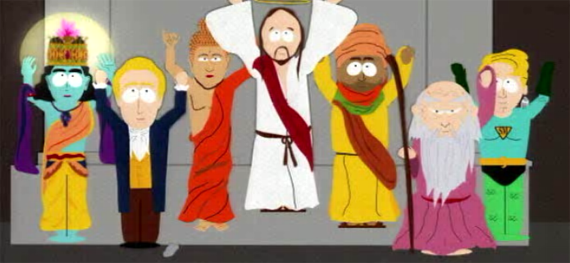
South Park and the Religion of Blasphemy

The brouhaha over South Park’s depiction of Mohammed in a recent episode has given rise to some pretty illuminating commentary about the relationship between religion and open society.  I’ve waded through several and recommend two in particular:

Glenn Greenwald’s important column in Salon, in which he correctly points out the “delusional” assumption that it is only Muslims who issue death threats against religious satire that they find offensive.

Austin Dacey’s amazing piece in Religion Dispatches, in which he shows how puerile anti-religious satire actually predates South Park by several centuries:

Forget the South Park dust up; forget Everybody Draw Muhammad Day. If you want to see truly shocking anti-religious cartoons, you have to go back to the sixteenth century. Near the end of Luther’s life, his propaganda campaign against Rome grew increasingly vitriolic and his language grotesquely pungent. He took to calling his ecclesiastical enemies ‘asses,’ ‘dogs,’ ‘pigs,’ ‘blockheads,’ ‘basilisks,’ and ‘pupils of Satan,’ and the Pope himself ‘Her Sodomitical Hellishness’ and ‘fart-ass’ (no, it doesn’t sound much more dignified in German—fartz-Esel). Eric Cartman would be in awe.

His conclusion?

The debate over cartoon depictions of the Prophet Muhammad is often framed as a clash between free speech and religious attitudes. But it is just as much a clash between conflicting religious attitudes, and the freedom at stake is not only freedom of expression but freedom of religion…

The orthodoxy of today is the blasphemy of yesterday. From the beginning, the spiritual search for religious truth has not been against blasphemy, but by way of blasphemy. Depending on where we sit metaphysically, we may want that search called off, or we may want it furthered. Either way, we must welcome religious offense as the unavoidable consequence of a free religious conscience.

Rohina Malik Unveils Our Common Humanity

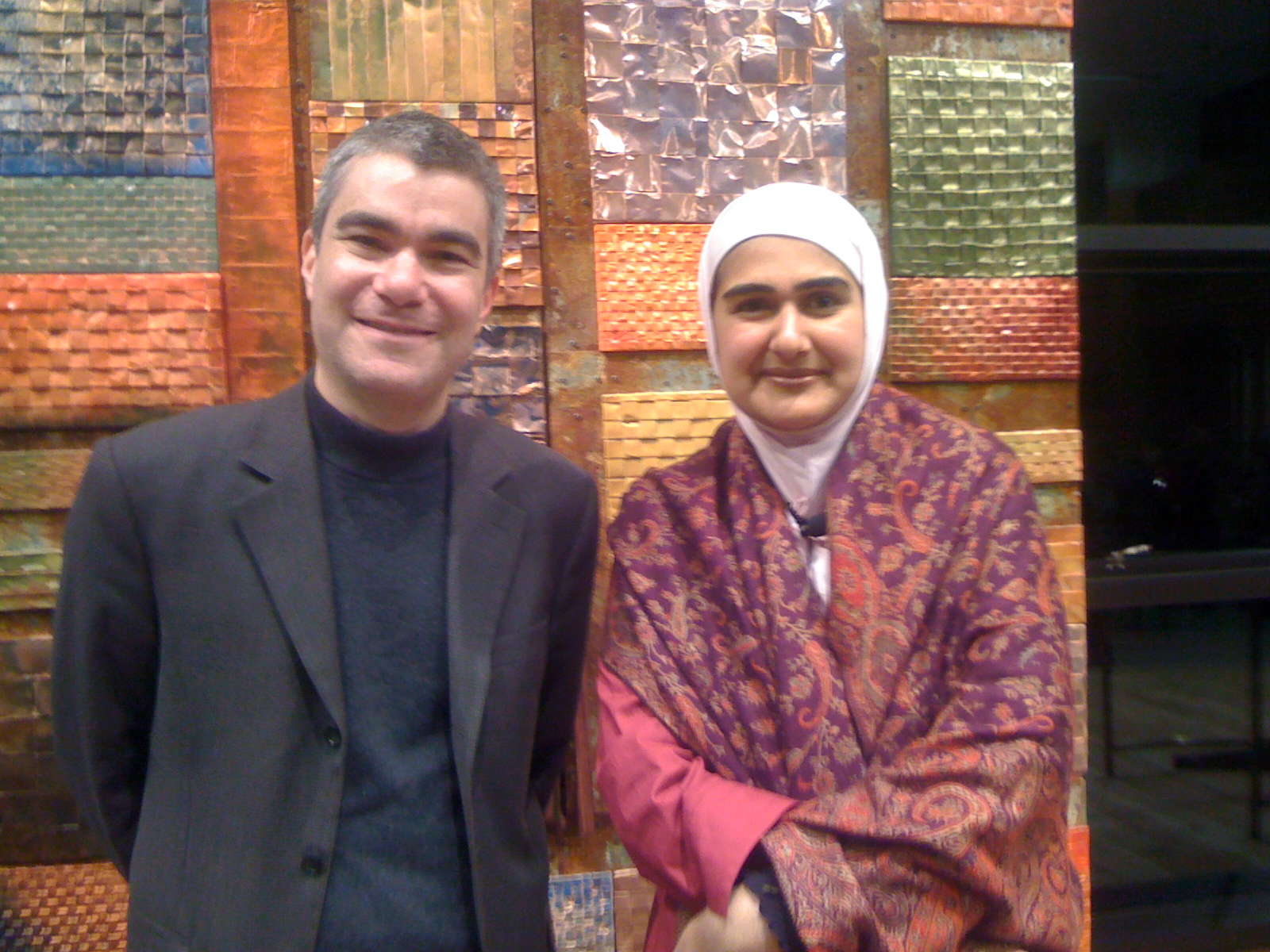
Last night JRC was honored to host a performance of the one-woman show “Unveiled,” by Rohina Malik. Breathtaking.

Rohina is a playwright, actress and solo artist of South Asian heritage who was born in London and emigrated to Chicago when she was 15.  She is an impressive and important contemporary artist – and her identity as an American Muslim woman clearly plays an important role in her art.

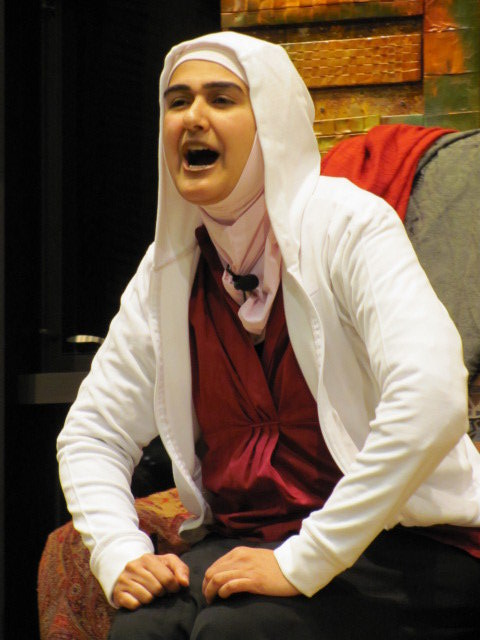
“Unveiled” is constructed around five monologues by five Muslim women. During the course of the play, each of them greets the audience in turn, “welcoming” us with tea.  Each woman tells the story of their lives, explains their Muslim culture and shares the experience of living as a Muslim woman in the post 9/11 world.

For her appearance at JRC last night, Rohina performed three monologues: “Maryam,” a Pakistani-American who has a dress making shop on Chicago’s Devon Avenue; “Shabana,” a young rapper of South Asian descent who was born and raised in London; and “Layla,” a Chicago restaurant owner from the Middle East who lost a brother to the fall of the twin towers.

It’s difficult to convey the cumulative effect these women had upon the audience. Rohina’s performances cut to the heart of painful and complicated political issues – but even more profound was the immediately empathy Rohina was able to conjure for us through these remarkable women. In a relatively short amount of time, she was able to bring us through an entire gamut of emotions – and in the end, the common humanity we shared with these women was palpable to everyone in the room.

Following the play we had an equally powerful post-performance discussion facilitated by the play’s director, Ann Filmer. Nearly 250 people were in attendance – including many members of the Chicagoland Muslim community – and it was truly a tribute to Rohina’s art that so many members of this large and diverse group were inspired to share deeply personal comments about their own lives and struggles.

If you live in the Chicago area, you should know that “Unveiled” will be starting a run at the Victory Gardens Theater on March 24. Highly, highly recommended.

What the US Should Do About Iran

Some of you may have noticed that I’ve been engaging in a bit of lively back and forth with one reader over my 2008 Yom Kippur sermon on Iran. I haven’t posted on Iran in some time, but that certainly doesn’t mean I’m not following developments there with great interest.

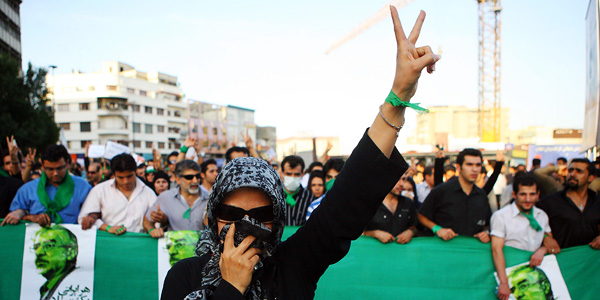
I do believe the Islamic regime’s increasingly brutal crackdown on human rights is a sign that it is taking the challenge of the Green Movement very, very seriously.  For our part, the the US administration appears somewhat paralyzed – issuing tepid statements, wary of throwing too much support to the Greens lest they get accused of meddling in Iranian politics yet again.  Meanwhile, the regime-change drumbeats of the right continue to grow ominously louder and louder.

Still, it would be mistaken and foolhardy to assume the only choice we have is between doing nothing and doing too much. In this regard, I commend to you this very insightful and helpful article by Dr. Trita Parsi and Alireza Nader of the National Iranian American Council.

Here’s my edited version:

(Between) the extremes of doing nothing and doing everything, there is a middle ground: providing the Iranian pro-democracy movement with breathing space, rather than engaging in risky and imprecise exercises that would directly involve America as an actor on the Iranian scene. The United States can achieve this through a few simple steps.

First, the United States should tread carefully when it comes to issuing military threats. Under the shadow of a foreign military threat, the uphill battle of the Iranian pro-democracy movement becomes even steeper, as the Iranian regime is quite adept at exploiting foreign threats to stifle criticism at home…

Second, the United States should avoid sanctions that put a burden on the Iranian people, rather than the Iranian government. Broad-based sanctions that hit the entire economy hurt common citizens far more than the powerful elites. Any new sanctions should demonstrate not only international discontent with the conduct of the Tehran government, but also an effort by the United States to keep from harming average Iranians…

Third, Washington should slow down the diplomatic process. Negotiation with Iran in and of itself is not the problem; engagement doesn’t legitimize the Iranian government, as only the people of Iran can do that. But in spite of President Mahmoud Ahmadinejad’s latest offer to accept the International Atomic Energy Agency nuclear deal, Iran remains in political turmoil. It is questionable that Tehran can make enduring decisions on issues of this magnitude under these circumstances…

Fourth, the international community, including the White House and U.S. State Department, should be vocal in excoriating Iran’s human rights abuses. Condemning abuses should not be confused with interfering in internal Iranian affairs…The Iranian government is, perhaps surprisingly, very sensitive in this area, due to its ambition to be perceived as a regional leader. This sensitivity should be utilized to make advances on the human rights front in Iran…

Finally, Washington should exercise patience and view Iran as a long-term factor in shaping U.S. national security interests across the Middle East. The green movement will not and cannot adjust its action plan to suit the U.S. political timetable. But if patience is granted – which includes avoiding a singular focus on the nuclear issue at the expense of all other considerations – Washington will access a far greater potential for change.

Parsing Ft. Hood

I’ve been voraciously reading the various editorial reactions to the Ft. Hood shooting – and have found much of it to be confused at best and patently offensive at worst. If you’re eager for some intelligent commentary, I recommend this post from my friend Rabbi Nancy Fuchs-Kreimer, who took NY Times columnist David Brooks to task for his recent piece that explored the nature and causes of religious extremism, focusing exclusively on Islam.

Nancy writes:

Yes, there is evil in human hearts. Yes, religion can be the carrier of malevolent narratives. But it is both historically and ethically flawed to write a whole column devoted to this theme and never once even mention that Islam is not the only tradition that has this problem. Brooks speaks about suicide bombers and terrorists but he does not mention that we have seen these troubled tales of “us and them” played out by many other religious folks.

As a Jew, David Brooks might have had the grace to remind us that in 1994 an orthodox Jew,  Baruch Goldstein,  killed 29  Muslims and wounded 150 while they prayed in Hebron.  Like Dr. Hassan, Dr. Goldstein, also a physician,  was both a deeply troubled individual and a product of a deeply problematic version of his faith tradition.

Another adherent to a deeply problematic version of our faith tradition is Rabbi Yitzhak Shapira, head of the Od Yosef Chai Yeshiva in the West Bank settlement of Yitzhar, who recently published a book in which he opined that gentile babies and children can be killed if they pose a threat to the Jewish nation. This followed on the heels of the arrest of Jewish terrorist Yaakov Teitel, a West Bank settler who was charged with murdering two Palestinians in 1997 and bombing the home of a prominent Israeli professor last year.  (Teitel reportedly had this to say when arraigned in an Israeli courtroom: “It was a pleasure and an honor to serve my God. I have no regret and no doubt that God is pleased.”)

Intolerance is intolerance, regardless of the faith tradition to which it is attached.  As Nancy correctly points out, all religions can be carriers of malevolent narratives. And when deeply disturbed individuals such as Teitel and Hassan attach themselves to these toxic world views, we can predict all too well the tragic results.