Category Archives: Israel

“Wrestling in the Daylight” Launch Party!

Please join me in celebrating the publication of my new book, “Wrestling in the Daylight: A Rabbi’s Path to Palestinian Solidarity” on Thursday, September 6, 7:00 pm at The Book Cellar, 4736-38 N. Lincoln Ave, Chicago.

From a recent review by Rabbi Rachel “Velveteen Rabbi” Barenblat:

Gwen Macsai

“Wrestling in the Daylight”… is Rabbi Brant’s self-curated compilation of his blog posts from Shalom Rav, so if you’ve been reading Shalom Rav, this material won’t be new to you. But I’m finding, as I read, that reading the posts in this new setting and context — curated by their author into a narrative which clearly shows the progression of his thinking over time — is a different experience from reading the blog. And Rabbi Brant has chosen to reprint some of the comments from readers as well as responses he’s offered to those comments, which gives the book a bit of the internet’s Talmudic multivocality (and offers an example of how one can host difficult conversations in a thoughtful and generous way — which can be hard to come by on the internet, especially on questions of Israel/Palestine.)

Andrew White

The choice to include commentary makes the book particularly interesting, I think. Some of Rabbi Brant’s most frequent commentors disagree with him deeply. Over the course of the book, one can see conversations unfolding. Sometimes they are quite heated. And his responses are always thoughtful and respectful, even as he resists attempts at derailing the conversation. Having hosted some conversations about Israel at this blog over the years, I have a sense for how difficult that can be.

Kevin Coval

… Rabbi Brant Rosen is one of my role models in the difficult but important work of coming to terms with the clash between the classic Zionist narrative (a story which many of us want to continue believing — I know I still yearn for it to be true) and some of the realities on the ground in Israel and the Palestinian territories. He models for me not how one would do this internal work despite his ardent Jewishness, but precisely of it; not despite being a rabbi, but precisely because his rabbinate calls him to take seriously the Jewish call to stand with those who are oppressed. And he has also taught me a great deal about how to disagree without falling into the trap of looking down on (or dehumanizing) those with whom one disagrees.

If you’re interested in progressive Jewish takes on Israel and Palestine, this book is worth reading, and worth having on your bookshelf to return to again.

I’m thrilled to be joined at our September launch party by local Chicago celebs Kevin Coval, (Poet, Co-Founder, “Louder Than a Bomb“), Gwen Macsai, (Host, WBEZ’s Re:Sound) and Andrew White (Artistic Director, Lookingglass Theatre Company), who will join me in reading excerpts from the book. We’ll also make plenty of time for Q&A, book signing and quality bookstore shmoozing.

It promises to be a wonderful evening – RSVP at our Facebook event page here.

Parsing the (Odious) New Term, “Jew-Washing”

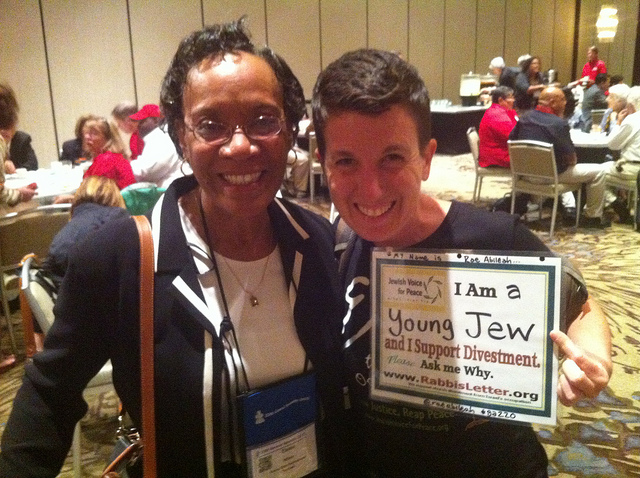
photo: Jewish Voice for Peace

Cross-posted in the “Forward Thinking” blog of the Jewish Daily Forward:

In his latest column, Philologos correctly parses the linguistic problems with Yitzhak Santis and Gerald M. Steinberg’s invented term, “Jew-washing.” His political analysis, alas, fails miserably.

Philologos has it completely wrong when he speaks of the “anti-Semitism in boycotts of Israel.” To begin with, Santis and Steinberg did not use the term “Jew-washing” in reference to a boycott of Israel as a whole, but rather to a resolution recently brought to the Pittsburgh General Assembly of the Presbyterian Church (USA) that called for divestment of their pension funds from three specific companies that profit from Israel’s brutal and illegal occupation of the West Bank.

Regardless, it is highly disingenuous for Philologos to accuse the Presbyterian Church of anti-Semitism. Our Christian friends’ response to the Palestinian civil society call for Boycott, Divestment and Sanctions (BDS), reflects their deeply held commitment to justice in a land their tradition also considers holy.

Philologos asks, “Have the Presbyterians considered boycotting China because of Tibet? India because of Kashmir? Russia because of Chechnya?” This, of course, is classic misdirection. The issue at hand is not global human rights, but a very specific call from Palestinian civil society for international support in ending their oppression.

The real question before them (and us) is not “what about Tibet, Kashmir and Chechnya?”  The question, rather, is: “will we or won’t we respond to the Palestinian call?” To this question, many members of the Presbyterian Church are courageously responding “we will.” So too are increasing numbers of Jews who believe that our legacy of anti-Jewish oppression leads us to stand with Palestinians being denied basic human rights in our name.

No, we are not being used as pawns by Christian partners to further some nefarious “anti-Semitic plot”. Rather, we are standing in solidarity with the oppressed, as the most basic of our Jewish teachings demand that we do.  What irony that other Jews should stand in the way of the Jewish imperative to end injustice. How heartbreaking that some in the Jewish community pervert this imperative by labeling the best intentions of our Christian friends as “anti-Semitism.”

We do, however, fully share Philogos’ distaste for the term “Jew-washing,” the coining of which is a sign of abject desperation that itself crosses the line of anti-Semitism, as blogger Jeremiah Haber pointed out last week. We predict that odious terms such as this will soon be relegated to the history books as part of a last, flailing effort by a fearful generation of Jewish leaders unwilling to recognize the moral urgency of the moment. It also reflects the short-sightedness of an establishment that continues to support war and occupation while deliberately alienating itself from the next generation of courageous Jewish leaders.

The New One-State Solution: Connecting the Dots

Connect these dots:

From The Guardian:

The number of Jewish settlers in the West Bank grew by more than 15,000 in the past year to reach a total that exceeds 350,000 for the first time and has almost doubled in the past 12 years.

Figures from Israel’s population registry show a 4.5% increase in the past 12 months. Most of the newcomers moved into settlements that many observers expect to be evacuated in any peace deal leading to a Palestinian state.

There are an additional 300,000 Jews living in settlements across the pre-1967 border in East Jerusalem, the pro-government and mass-circulation newspaper Israel Hayom reported.

Putting a finer point on these statistics, Dani Dayan, chairman of the settlers Yesha Council had this to say in a recent NY Times op-ed:

(We) aim to expand the existing Jewish settlements in Judea and Samaria, and create new ones. This is not — as it is often portrayed — a theological adventure but is rather a combination of inalienable rights and realpolitik. Even now, and despite the severe constraints imposed by international pressure, more than 350,000 Israelis live in Judea and Samaria. With an annual growth rate of 5 percent, we can expect to reach 400,000 by 2014 — and that excludes the almost 200,000 living in Jerusalem’s newer neighborhoods. Taking Jerusalem into account, about 1 in every 10 Israeli Jews resides beyond the 1967 border. Approximately 160,000 Jews live in communities outside the settlement blocs that proponents of the two-state solution believe could be easily incorporated into Israel.

…Our presence in all of Judea and Samaria — not just in the so-called settlement blocs — is an irreversible fact. Trying to stop settlement expansion is futile, and neglecting this fact in diplomatic talks will not change the reality on the ground; it only makes the negotiations more likely to fail.

In essence, Dayan is calling for a kind of a one-state solution here – albeit one that does not extend citizenship rights to non-Jewish residents. (Although in fairness to Dayan, he does say they should be given “freedom of movement.”)

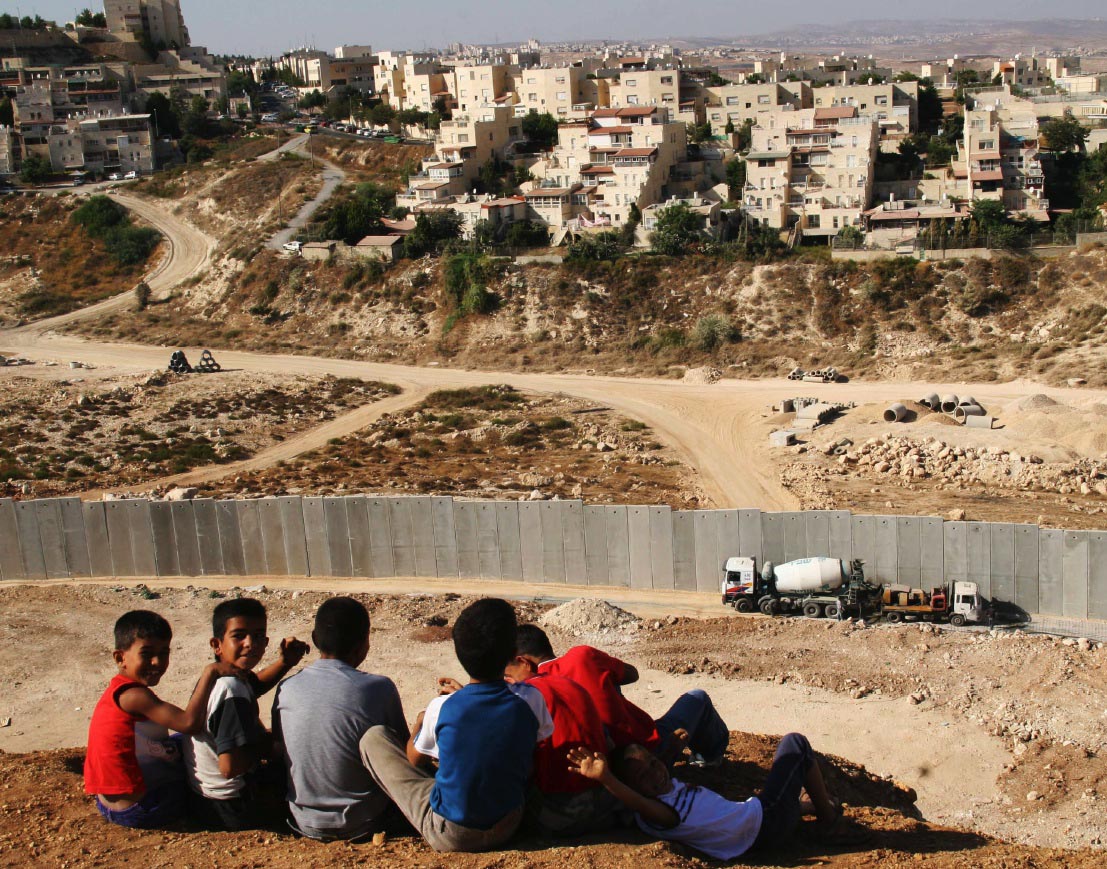
Still can’t figure out what’s going on here? Let’s connect the final dot.  While the Jewish population in Area C of the West Bank is increasing, Israel is demolishing homes, evicting Palestinians, and moving them into Areas A and B at an ever-increasing pace.

Here’s Mya Guarnieri, writing in +972:

At the same time that Israeli settlements are expanding unchecked, the state is putting the Palestinians and Bedouins who live in Area C under extreme, unrelenting pressure, as exemplified by this week’s report by Haaretz that Defense Minister Barak has ordered the demolition of eight Palestinian villages to make way for IDF training.

Demolitions of homes and structures in 2012 have seen an increase. According to a source at the United Nations, between January 1 and April 27 of 2011, 352 Palestinian and Bedouin were forcibly displaced from their homes in East Jerusalem and the West Bank. The same period of 2012 saw “at least 487″ people lose their homes.

It’s a one-two punch intended to increase the Jewish population in the West Bank as much as possible and deplete the Palestinian population as much as possible to ready the area for annexation. Susya, a Palestinian village that is under threat of demolition, is an example of how this works. The village has been destroyed numerous times since the Jewish settlement of Susya was built there in 1983, despite the documents proving it belongs to Palestinians and the fact that this small community has no where else to go.

Israeli pressure on the Palestinian and Bedouin residents of Area C has resulted in a drop in the Arab population in the same area.

And then there’s the Levy Committee Report, which denies that there is an occupation and, according to some observers, lays the legal groundwork (at least in the mind of the Israeli government) for a unilateral annexation of Area C.

It’s not a matter of if. It’s a matter of when.

OK, I’ll say it for you: Israel has no intention of creating a two-state solution. It is creating it’s own “one-state” solution by increasing the Jewish population in the West Bank and warehousing Palestinians in Bantustans throughout Areas A and B. By any other name this would be called an “apartheid” state.

If there are those who disagree with my calculus, I’m certainly open to hearing alternative explanations. In the meantime, here are two questions I’m still unable to answer: when will our community be ready to call out this illegal and immoral behavior?  And what will we be willing to do about it?

The Olympic Moment of Silence and the Politics of Victimhood

I’ve been following with some interest a cyber-dustup between Emory University Jewish Studies professor Deborah Lipstadt and Elisheva Goldberg, Assistant Editor of the Open Zion blog. In its way, I think it shines an interesting light on the ways the Jewish community deals with its sense of victimhood in public discourse.

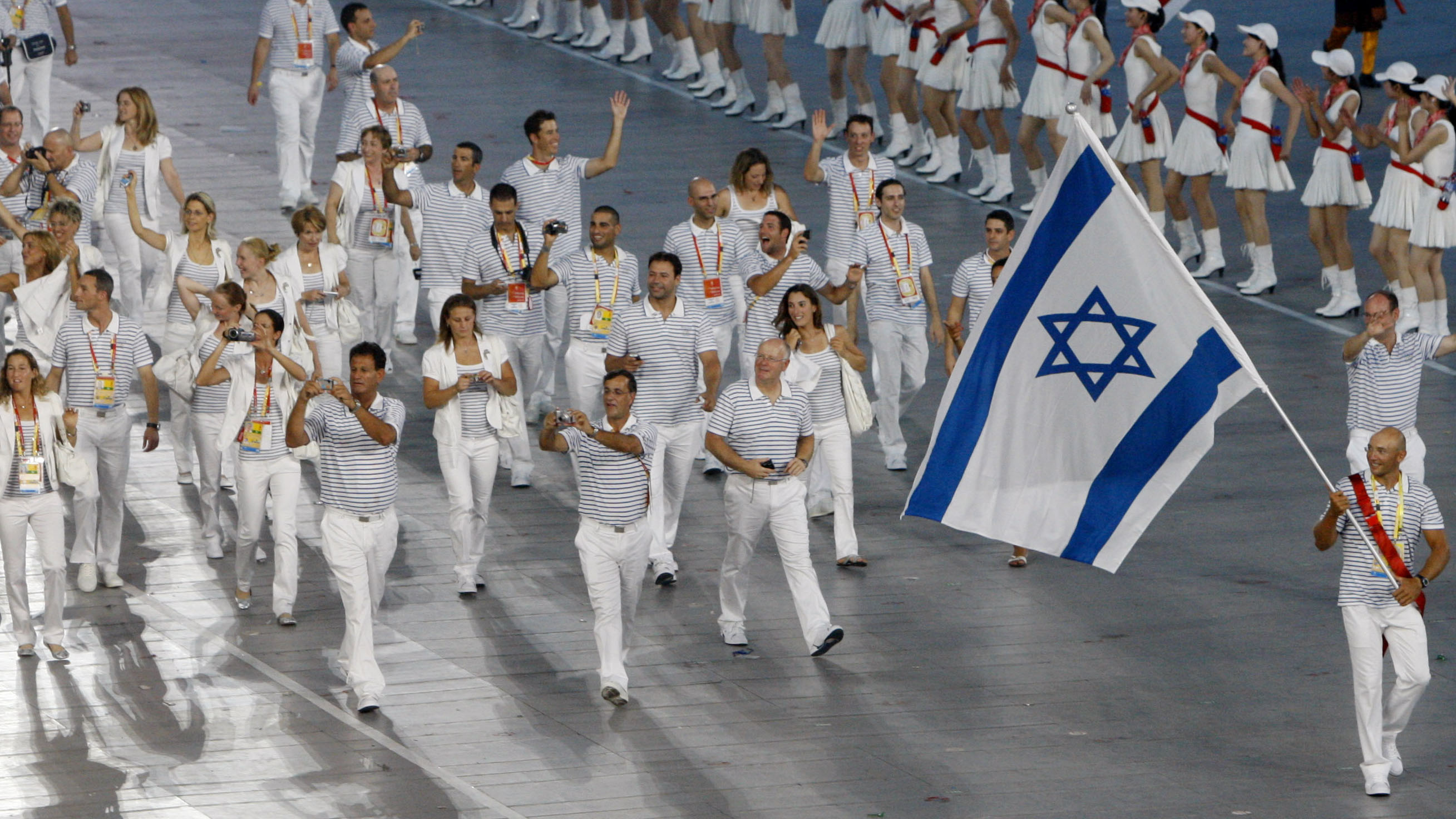
The debate began with a piece Lipstadt wrote for Tablet on July 17, entitled “Jewish Blood is Cheap.” In her article, she inveighed against the International Olympic Committee for refusing requests to hold a one minute moment of silence during Opening Ceremonies to commemorate the 40th anniversary of the murder of 11 Israeli athletes in Munich. Lipstadt explored the various reasons given by the IOC for its refusal: that the IOC has honored the athletes repeatedly in other venues, that the Games should be “apolitical,” and that a commemoration of this sort was inappropriate at a “celebratory event.”

Lipstadt would have none of it:

The IOC’s explanation is nothing more than a pathetic excuse. The athletes who were murdered were from Israel and were Jews—that is why they aren’t being remembered. The only conclusion one can draw is that Jewish blood is cheap, too cheap to risk upsetting a bloc of Arab nations and other countries that oppose Israel and its policies.

…This was the greatest tragedy to ever occur during the Olympic Games. Yet the IOC has made it quite clear that these victims are not worth 60 seconds. Imagine for a moment that these athletes had been from the United States, Canada, Australia, or even Germany. No one would think twice about commemorating them. But these athletes came from a country and a people who somehow deserve to be victims. Their lost lives are apparently not worth a minute.

When I first read Lipstadt’s words, I strongly recoiled at her statement “Jewish blood is cheap” – and her claim that the IOC was motivated by anti-Semitism. Whether or not one agrees with the IOC’s decision, I found Lipstadt’s rhetoric to be incendiary and distinctly smacking of “victim politics.”

So, it seems did Elisheva Goldberg, who gently chided Lipstadt in a post for Open Zion. Goldberg pointed out that in fact, IOC President Jacques Rogge did make a statement and lead a minute of silence during a ceremony last Monday at the athlete’s village promoting the Olympic Truce (a UN backed initiative calling on warring parties around the world to end hostilities during the period of the games).  In her post, Goldberg asked what I thought was a valid question: when it comes to public commemoration of these kinds of tragedies, how much is really enough?  Or as she put it, “when will we be satisfied?”

To my dismay, Lipstadt did not think this question worthy of serious consideration – she responded to Goldberg instead with a petulant smackdown. In a Tablet piece entitled “No, Open Zion, Deborah Lipstadt Won’t Shut Up,” she concluded thus:

In making a statement on Monday, the IOC’s president tried to throw the victims’ families a bone. Goldberg has caught it, and is happily gnawing away. I, and many others, have no intention of being so easily satisfied.

While I agree with Lipstadt that Rogge is disingenuous in claiming the Games aren’t “political,” it bears noting that the Jewish establishment’s full court press on this issue has been highly politicized.  The minute of silence has been now pressed on the IOC by Israel’s Foreign Ministry (who produced a one minute video as part of the campaign), it has been introduced as a US House Resolution, and now of course, the obligatory campaign year statements of support have been elicited from President Obama and Mitt Romey. At this point, even if the IOC did assent to minute of silence at the ceremonies, it would resonate more as a moment of political victory than a genuine act of remembrance.

And that’s the problem I have with Lipstadt and the “many others” who have chosen to press the issue in this manner. They – and we – would do well to ask: when does the desire for public commemoration cross the line into cynical politicking?  On a deeper level, we might well ask: at what point does our need for the world to acknowledge Jewish suffering give way to a collective victim mentality?

To me, these are the critical questions, regardless of what does or doesn’t take place at Opening Ceremonies this Friday.

Why I Support Kairos USA

Last week a group of US clergy, theologians and laypersons unveiled Karios USA, a powerful and important American Christian spiritual call for justice in Israel and Palestine.  As a religious Jew, I am inspired by its prophetic courage, its unabashed call for justice and its heartfelt model of compassion. It truly deserves to be shared and studied by all who who seek a genuinely religious call for justice in this land that is so central to so many peoples and spiritual traditions.

Kairos USA is modeled on the religious testimony of Kairos Palestine, a document that was drafted by prominent Palestinian Christian leaders in 2009 (which was itself inspired by the 1985 South African Kairos statement).  Despite these important influences, however, Kairos USA stands on its own as a uniquely American Christian call for justice in Israel/Palestine.

Indeed, this unique mission is evoked in the statement’s Preamble at the very outset:

In June 2011, a group of U.S. clergy, theologians and laypersons, cognizant of our responsibility as Americans in the tragedy unfolding in Israel and Palestine, and mindful of the urgency of the situation, met to inaugurate a new movement for American Christians. We have been inspired by the prophetic church movements of southern Africa, Central and South America, Asia and Europe that have responded to the call of their Christian sisters and brothers in occupied Palestine. This is our statement of witness and confession—and our response as U.S. Christians to the Palestinian call.

And more specifically, from the Introduction:

As U.S. Christians we bear responsibility for failing to say “Enough!” when our nation’s ally, the State of Israel, violates international law. Our government has financed Israel’s unjust policies and has shielded its government from criticism by the international community. At the outset of the current U.S. administration, our government led Palestinians to believe that at last we would pursue a political solution based on justice. But the “peace process” has continued to be no more than a means for the continuing colonization of the West Bank and East Jerusalem, the imprisonment of Gaza and the intensification of the structures of oppression.

I have no doubt at all that like Kairos Palestine, Kairos USA will be excoriated by many self-appointed leaders of the American Jewish establishment.  As for myself, now that I’ve read the document carefully, I can say without hesitation that I believe this statement is a truly sacred testimony, offered in good faith and with genuine religious integrity.

I was particularly moved to read how sensitively Kairos USA treads over some of the most complex hot-button issues in the Jewish-Christian relationship. For instance, on the issue of historical church anti-Semitism, the statement includes the following confession:

As Christians addressing the Palestinian cause we must also acknowledge our shameful role in the historic persecution of the Jewish people. We recognize the dehumanizing and destructive power of doctrines and theologies that denigrated Judaism. Our predecessors perpetuated anti-Semitic stereotypes, practiced scapegoating and cloaked prejudice, hostility and murder itself in the robes of our religion. We confess that our churches failed to resist, and sometimes even aided and abetted pogroms, mass dislocations of Jews, and the calamity of the Nazi Holocaust itself. In so doing, they betrayed the teaching and example of the one we claim to follow. We speak for and with our forbears in expressing deep remorse. With a commitment to never forget those failures and to be instructed by them, we pledge ourselves to growth in faithfulness, compassion and justice.

The statement goes on, however, to state that Christians’ honest desire to repent for the church’s historic crimes against Jews must not inhibit them from speaking out against injustices perpetrated by Israel against Palestinians. To my mind, this is a call for real and honest interfaith relations – dialogue that is not defined by guilt or emotional blackmail, but rather by a willingness to venture into and openly discuss the more difficult and painful places:

We acknowledge with sadness and distress that because of the powerful impulse on the part of Christians to atone for their sins against the Jewish people, vigilance against anti-Semitism today has come to trump working for justice in Palestine and Israel. The Christian need to rectify centuries of anti-Jewish doctrine and actions and to avoid even the perception of anti-Jewish feeling has served to silence criticism of Israel’s policies and any questioning of the consequences of U.S. government support for Israel. Differences between anti-Semitism and legitimate opposition to Israeli actions are avoided or explained away. Responsible discourse about Zionism is often denounced as hostility toward Israel and its citizens or branded as anti-Semitism. We believe that in our dialogue with our Jewish friends, family members and colleagues and in our relationships with the Jewish community on institutional levels, we must confront this pattern of avoiding, denying or suppressing discussion of issues that may cause conflict or discomfort. The fact that anti-Semitism still exists makes it all the more important to differentiate between actual anti-Jewish feelings and criticism of the actions of a nation state. Uncomfortable though it may be, we cannot be afraid to address the urgent issue of justice and human rights in Israel and Palestine with our Jewish sisters and brothers here in the United States.

I also deeply admire the statement’s willingness to directly address the charged issue of so-called Christian “replacement” or “supersessionist” theology (a view that promotes Christianity – and not Judaism – as the genuine fulfillment of Biblical tradition):

We are aware that in denying a theology of entitlement that gives the Jewish people exclusive rights to the Holy Land, we risk the charge of reviving the Christian doctrine known as replacement theology (sometimes known as supersessionism). In this view, the Church takes the place of Israel in God’s purposes, denigrating Judaism itself and condemning the Jews to suffering for rejecting the Gospel. Christians have rightly wished to distance themselves from this destructive and divisive doctrine. We repudiate the anti-Semitic legacy of the church’s past and the theology that undergirds it.

As a Jew who rejects a sense of Jewish entitlement just as strongly as I reject any religious viewpoint that makes an exclusive claim to the land, I particularly appreciate Kairos USA’s religious approach on this point:

Our core Christian belief is that God’s promise in the Gospel is a promise to all nations. This means that God’s kingdom work in Christ is a promise to everyone regardless of race. We believe that the Church has found in Christ a fulfillment of all that God promised in Abraham, and that both Jews and Gentiles have been invited equally into this promise of a world renewed in love and compassion. The Church does not replace Israel. Jews continue to have a place in God’s plan for the world. In Christ, all nations can be blessed (Genesis 18:18, 22:18; Galatians 3:8). In these times of growing international conflict and cultural mistrust, this is a significant promise. Theologies that privilege one nation with political entitlements to the exclusion of others miss a central tenet of the Gospel and inspire increased conflict.

I believe the above statement provides a crucial challenge to both American Jews and Christians.  From a theological point of view, I believe it is time to reframe the issue. The real debate is not about which religious tradition or people has a more compelling religious “right” to the land of Israel, rather, it is between those who make exclusivist theological claims and those whose theology makes room for all peoples who live on or feel a connection to this land.

I also have no doubt that many in the American Jewish establishment will reject out of hand Kairos USA’s positive advocacy of BDS (“Boycott, Divestment and Sanctions”).  But here again, I find that the statement deals with a hot-button issue with sensitivity and integrity:

Participation in the BDS movement by U.S. churches, notably in the form of initiatives to divest church funds from companies profiting from the occupation of the West Bank and the blockade of Gaza, has generated critically-important discussions at local, denominational and ecumenical levels about the responsibility of the church to act. It has also generated intense controversy. Opposition, from Jewish organizations as well as from voices within the churches, has often been fierce, claiming that such actions will inflict grievous damage on hard-won positive relationships with the Jewish community. Many express fear that these actions may encourage anti-Semitism. We note with distress that many have confused these actions with anti-Jewish discrimination and persecution in the Christian past. But BDS is directed at Israeli policy, not the state itself or its citizens, and certainly not against the Jewish people. Divestment and other forms of socially responsible investing (SRI) are not directed against groups, nor are they intended to hurt individuals, corporations or states. They are, rather, directed at unjust, oppressive policies and are about promoting our own values and stated commitments by noncooperation with evil. Furthermore, methods to exert economic pressure on governments and companies, in addition to being a legal, ethical and time-tested way of influencing the political process and corporate behavior, serve to increase awareness, promote open discussion and create the grassroots support required to urge governments to take effective action and to change unjust policies. We urge congregations, clergy and church leaders to become educated about the BDS movement and to consider the many forms that it can take on personal, local and national levels.

As I American Jew who is deeply distressed by the American Jewish establishment’s abject vilification of BDS, I don’t think I could possibly put it any better.

I urge all people – whether religious and secular, Christian, Jewish or Muslim – to read, share, discuss and respectfully debate this important new American statement of faith.  My deepest gratitude to those (including my good friends Mark Braverman and Father Cotton Fite) who helped spearhead and draft Kairos USA.  May it inspire us all to reframe a new religious response to the sorrows of Israel/Palestine – and lead the way to a better future to all who call this land home.


Some More Thoughts on Caterpillar Divestment


A follow-up on my last post:

I just read an interesting article in the Jewish Telegraphic Agency by Ron Kampeas that concludes the sale of Caterpillar tractors to Israel was a factor (if not the “determining one”) in the MSCI and TIAA-CREFF decisions to delist Caterpillar from its portfolios.

For such a mainstream Jewish publication, it was a fairly bold admission. Of course the article also contained the obligatory statements from Caterpillar and Jewish establishment reps downplaying CAT’s responsibility in the sale of armored/weaponized bulldozers to the Israeli military.  In one instance, Kampeas’ article quoted a Caterpillar statement that denied the direct sales of the infamous D9 Track-Type bulldozers to Israel:

“This is how it works,” corporate spokesman Jim Dugan said. “Caterpillar sells equipment to the U.S. government, which then transfers the equipment to the Israeli government, which then transfers it to the Israeli military.  Israeli is one of about 150 countries that take part in the program, which supports U.S. allies. For the D9s, the protective armor plating, the bullet resistant glass and other modifications take place after the machine has been transferred to the Israeli government by the U.S. government.  These changes happen after the sale, not in our factories.”

Actually, it’s misleading in the extreme to claim that Caterpillar “sells its equipment to the US government.”  In truth, the US government acts as a intermediary between the CAT and the Israeli military through the US Foreign Military Sales program (FMS).  Caterpillar certainly knows full well that it is entering into a contract with the Israeli military – every FMS sale is preceded by a notification to Congress that lists the government purchasing the equipment and the contractor providing it.

It is also highly disingenuous to claim CAT has nothing to do with the armoring and weaponizing of the D9s.  In fact, these massive bulldozers are retrofitted by ITE – Caterpillar’s sole representative in Israel, who is also responsible for the D9’s ongoing maintenance and support during operations, including military operations.

To put it simply, the relationship between CAT and the Israeli military are a key part of the military-corporate alliance that enables the occupation.

I was also struck by this quote from Ethan Felson, the vice president of the Jewish Council for Public Affairs:

Felson … said that linking Caterpillar to Israeli practices was “nonsensical,” noting that it had no say in how the US military resells the tractors, and that it could not legally turn down the U.S. military as a client.

In fact, Felson’s statement is beyond “nonsensical.”  CAT has “no say in how the US resells the tractors?”  The US Foreign Military Sales program exists for the specific purpose of facilitating individual contracts between companies and foreign governments. Moreover, Caterpillar certainly has the right and the ability not to renew its contract with Israel’s military if it determines its equipment is being used to violate human rights.

Yes, there were likely many factors considered in this latest divestment decision, but as the article points out, the efforts of divestment activists certainly played an important part. And it is also important to bear in mind that this is not ultimately about MSCI or TIAA-CREFF or even Caterpillar – it is about exposing the human rights abuses committed by Israel in pursuance of its brutal and illegal occupation.

The professional apologists can spin or distort the facts all they want – but in the end, the dogged efforts of divestment activists are helping, slowly but surely, to bring Israel’s egregious policies out into the light of day.

UPDATE 6/27/12: In a just-released statement, MSCI stated that the “on-going controversy associated with use of the company’s equipment in the occupied Palestinian territories” was a “key factor” in their decision to drop Caterpillar.

MSCI and TIAA-CREFF Divest from Caterpillar!

This is huge.

In the most significant Israel divestment milestone to date, the MSCI (Morgan Stanley Capital International) World Socially Responsible Index recently removed Caterpillar from its list.  Shortly thereafter, financial retirement fund giant TIAA-CREF divested Caterpillar from its portfolio as well!

Did I say this was huge? CAT has been a target of divestment activists for many years – and rightly so. The company has come under increasing criticism from human rights organizations for continuing to supply bulldozers to Israel, which uses them to demolish Palestinian civilian homes and destroy crops and agricultural land in the occupied territories. In the succinct words of Amnesty International: “Thousands of families have had their homes and possessions destroyed under the blades of the Israeli army’s US-made Caterpillar bulldozers.”

This is only the beginning. Last month, the Quaker Friends Fiduciary Corporation, divested $900,000 in shares of Caterpillar. And earlier this month the undergraduate student government at Arizona State University,  unanimously passed a bill demanding that ASU divest from and blacklist all companies that continue to provide the IDF with weapons and militarized equipment.  All this in advance of the Presbyterian Church (USA) General Assembly in Pittsburgh later this month, in which church commissioners will vote on a motion to divest from Caterpillar and two other companies (Motorola Solutions and Hewlett-Packard) that profit from Israel’s occupation.

To those who say that the BDS (Boycott, Divestment and Sanctions) movement will not succeed, stay tuned.  This is precisely how movements get started. A few significant victories and the dominoes begin to fall more rapidly.  Individual actions such as this may have more symbolic than financial impact, but don’t discount the power of symbolic victories.  History has taught us again and again that nonviolent direct action has the power, step by step, to leverage real and lasting political change.

Israel continues its brutal occupation and settlement policy with impunity and no government (notably our own) seems able or willing to hold it to account.

Just watch as people power moves in to fill the vacuum.

Talking to Iran in Moscow – Pray for Success

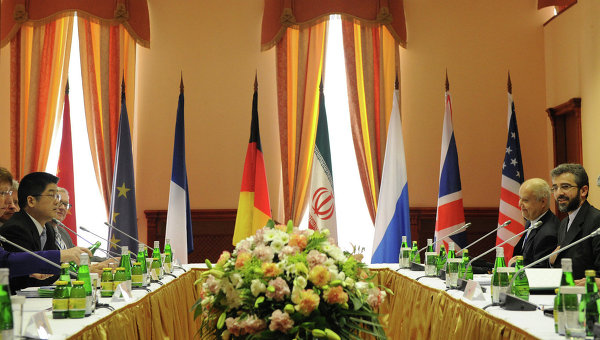
Talks began today in Moscow between Iran and the “P5 +1” (the five permanent member nations of the UN Security Council plus Germany). I’m hoping against hope for a breakthrough, but it’s certainly not looking good.

For a sane and balanced take on Iran, I’ve long turned to Trita Parsi, founder and president of the National Iranian American Council, and one of our foremost experts on US-Iranian relations. In a recent NY Times op-ed, Parsi identified precisely why Obama has precious little room to maneuver going into the Moscow talks. In a word: Congress.

Congress is actively seeking to make a deal on the nuclear issue impossible by imposing unfeasible red lines, setting unachievable objectives — and depriving the executive branch of the freedom to bargain.

Just before last month’s talks in Baghdad, Congress passed a resolution that endorsed the Israeli prime minister Benjamin Netanyahu’s red line on the nuclear issue (Iran can’t have a uranium-enrichment capability), as opposed to the red line adopted by the Pentagon and the president (Iran can’t have a nuclear weapon).  The problem is, Mr. Netanyahu’s red line isn’t feasible and doesn’t leave any room for negotiations…

If Iran agrees in Moscow to accept the American demand that it halt uranium enrichment at the 20 percent level — too low a level to quickly create a nuclear weapon — this would effectively obstruct any Iranian shortcut to a bomb. Congress must then give Mr. Obama the political space to be able to take yes for an answer.

Congress must make up its mind. Does it want to prevent an Iranian nuclear bomb or does it want to maintain its sanctions? Going forward, it can’t have both.

As if to put a period on Parsi’s analysis, last Friday 44 senators (23 of whom were Democrats) sent a letter to President Obama demanding that he insist upon three “absolute minimum steps” for continuation of talks: shutting down the Fordow nuclear enrichment facility, freezing all uranium enrichment above 5%, and shipping all uranium enriched above 5% out of the country.

The letter concludes:

If the sessions in Moscow produce no substantive agreement, we urge you to reevaluate the utility of further talks at this time and instead focus on significantly increasing the pressure on the Iranian government through sanctions and making clear that a credible military option exists. As you have rightly noted, ‘the window for diplomacy is closing. Iran’s leaders must realize that you mean precisely that.

If you needed any evidence of Parsi’s claim that Congress is “actively seeking to make a deal on the nuclear issue impossible by imposing unfeasible red lines, setting unachievable objectives — and depriving the executive branch of the freedom to bargain,” this letter provides it.  The writers and signers of this letter clearly know full well that these demands will be a non-starter for Iran.

Even more disturbing is the role of the Israel lobby in these cynical maneuvers. Mideast analyst MJ Rosenberg revealed, in a piece posted four days before the letter was released, that the letter was drafted by AIPAC staffers, pointing out that it was essentially

an AIPAC device for scoring senators in an election year. Those who sign will be rewarded or left alone. Those who don’t will hear from AIPAC and its friends. Not a pretty possibility.

OK, I’ll say it: the role of the Israel lobby in the Iran issue has been nothing short of shameful.  And at times openly, brazenly disingenuous.  Among the more odious examples: the Emergency Committee for Israel, (what you might call the more “zealous” wing of the lobby) recently released a 30 second scare-ad that proclaimed, among other things, that “Iran has enough fuel for five nuclear bombs” – a spurious claim which belies that fact that Iran currently has no weapons grade material at all.

Yes, this election year gives Obama precious little room to maneuver – and the lobby is clearly doing everything it can to exploit this.  But since Obama has repeatedly bent over backwards to prove his allegiance to Israel and AIPAC, I don’t see how bowing to these latest salvos will do much to significantly improve his electoral prospects. And since he’s going to be excoriated by his political rivals no matter what he does, why not stick to his own administration’s stated policy, behave like a statesman and push for a diplomatic success? After all, who should be determining Obama administration negotiating strategy – the Obama administration or Congress/AIPAC?

When you consider that the alternative is another ill-advised march to another disastrous Mideast war, the stakes could not possibly be higher.

Pray for a breakthrough in Moscow this week.

PS:  I’m honored to be discussing this issue further in a dialogue with Trita Parsi entitled “Can War with Iran be Averted?” on Thursday, June 28, 7:00 pm at Jewish Reconstructionist Congregation in Evanston, IL. Click here for more details.

Obama in 2012: Won’t Get Fooled Again

Just happened to glance at a blog post I wrote during the 2008 Presidential General Election campaign entitled “Go Rabbis for Obama!”

Man, what a difference four years makes. I think I can safely say it will be impossible for me to summon the kind of excitement I expressed in that giddy blog post just four short years ago.

Actually, if truth be told, it was just one year into his presidency when I concluded that Obama, from a foreign policy point of view at least, was essentially Bush 2.0.  Now as his first term comes to a close, I’m daring to consider the possibility that he might actually be worse.

I’ve already written a fair amount about my disillusionment on this score – most pointedly in my Yom Kippur serrmon from earlier this year:

For some Americans the most salient lesson of 9/11 was that the world is a dangerous place and we must use military power to mitigate the danger.  I include myself among those who learned a very different lesson: 9/11 taught us that when we intervene militarily abroad, we beget blowback here at home.

Many of us had hope that Obama truly believed this as well – that he would turn back the Bush doctrine and steer our nation’s foreign policy toward a saner course. But as it has turned out, the very opposite has happened. He has embroiled us in even more Mideast wars and has deployed even larger numbers of special operations forces to that region.  He has also transferred or brokered the sale of substantial quantities of weapons to these countries and has continued to build and expand US military bases at an ever-increasing rate.

He also promised to prosecute the so-called “War on Terror” with greater attention to civil liberties, but that hope has been fairly dashed as well.  During his campaign, note what he had to say about this subject:

“As president, I will close Guantanamo, reject the Military Commissions Act, and adhere to the Geneva Conventions. Our Constitution and our Uniform Code of Military Justice provide a framework for dealing with the terrorists. Our Constitution works. We will again set an example for the world that the law is not subject to the whims of stubborn rulers, and that justice is not arbitrary.”

Well, it’s over two years later and Guantanamo is still open. This past March, the Obama administration announced it would be resuming military tribunals there. And just last week, we learned that our President did something truly unprecedented – our President actually approved the extra-judicial assassination of an American citizen in Yemen.

And it’s gotten even worse since then. More recently, we’ve learned that Nobel Peace Prize Laureate Obama has been personally been maintaining a drone “kill list” which, according to the NY Times:

counts all military-age males in a strike zone as combatants … unless there is explicit intelligence posthumously proving them innocent. (Emphasis mine).

Even more recently, the NY Times has revealed that President Obama has been secretly overseeing a massive cyber-war initiative against Iran (known as “Olympic Games”) that, among other things, almost assuredly represents the official kickoff to a global cyber-weapons race. As the article correctly concludes, the blowback to our nation from Obama’s cyber-adventures could potentially be devastating:

(No) country’s infrastructure is more dependent on computer systems, and thus more vulnerable to attack, than that of the United States. It is only a matter of time, most experts believe, before it becomes the target of the same kind of weapon that the Americans have used, secretly, against Iran.

But my disillusionment in the Obama administration is most profound when it comes to its handling Israeli-Palestinian peace process.  I’ve written about this issue over and over as well – but if you still need more convincing that this administration has utterly caved to the Israel lobby and has abdicated any semblance of “honest broker” status in this process, it was recently reported that Obama unabashedly assured a group of Jewish orthodox leaders that his administration is “decidedly more attentive to Israel than it is to the Palestinians.”

All this to say that I’m in a very different frame of mind as Obama now runs for reelection. The giddiness has been replaced with a dose of hard, cold realism about the role of the President in the 21st century national security regime:

Again, from my Yom Kippur sermon:

I’m focusing these observations exclusively on our Commander-in-Chief, but of course I realize that this issue is much, much larger than just one man.  I know it’s natural to look to our primarily to our President, but in truth what we call “Washington” is really a massive bureaucracy that includes a myriad of interests. It’s a far reaching power elite that includes not only the federal government but the national security state, as well as the intelligence and federal law enforcement communities. It also includes big banks and other financial institutions, defense contractors, major corporations and any number of lawyers, lobbyists former officials, and retired military officers, all of whom hold enormous influence over our foreign policy.

So as we swing into summer and we listen to Obama and Romney trade salvos over foreign policy, don’t be fooled – at the end of the day there is less than an inch of daylight between the two.  Mideast analyst Aaron David Miller, in a Foreign Policy post entitled “Barack O’Romney” only half jokingly suggested that if reelected, Obama ought to consider making Mitt Romney his new Secretary of State.  Another respected analyst, MJ Rosenberg, has gone as far as to suggest that President Obama would actually be more likely to bomb Iran than a President Romney.

What should we do with all this hard political realism?  As for me, I’m taking my cue from the classical Jewish text, Pirke Avot:

Love work. Hate authority. Don’t get too friendly with the government. (1:10)

And for good measure:

Be careful with the government, for they befriend a person only for their own needs. They appear to be friends when it is beneficial to them, but they do not stand by a person at the time of his distress. (2:3)

The events of these last four years have provided a painful education for me.  I’ve learned more than ever that it is not politicians who create socio-political change – it is, rather, the people and the movements who make it impossible for them not to.

Yes, there are some important domestic issues at stake in this election (not least of which are potential Supreme Court appointments) but let’s not be fooled into thinking that the future of US foreign policy fundamentally depends on who we choose to be our Commander in Chief.

The real difference will depend on our readiness to hold him accountable once the election is over.

On Syrians, Palestinians and American Options

I’ve just written the following in response to a comment on the tragic situation unfolding in Syria,  but I think it bears posting here front and center on the main page. Further comments, as always, are welcome:

Ike, you are right that the butchery going on in Syria is heinous and deserves the highest possible condemnation. I also agree 100% with you that the human rights situation going on there is far more acute than “what is going on with the Palestinians.” In fact, Palestinian blogger Sami Kishawi recently made this very point in a recent post in which he also quoted a Palestinian protester in New York who said on YouTube:

The horrible things happening in Syria, even Israel didn’t do to us in Palestine. Anybody who says that the Assad regime is with Palestine and that the atrocities happening are in our favor is wrong, and if the freedom of Palestine was dependent on the slaughtering of Syrian children, I would tell you as a Palestinian that I don’t want to be free.

While this certainly should not be about “who is suffering more,” I do think it’s important to point out that the Syrian situation has been front and center in the mainstream media for at least a year – and has been met with world-wide condemnation, while the Palestinians’ plight, which is constant and ongoing, has flown well under the media radar – and not only is it not condemned by the West; it is actually enabled and made possible by our country. As I’ve written many times before, as Americans and as Jews, I/we are directly culpable in this situation – and, yes, this is indeed something I try to highlight in my blog.

On the issue of “pressing our government to do something about” the Syrian crisis: as tragic as this slaughter may be, I do not think the US has many good options to stop the bloodshed beyond what it is doing right now – and I strongly believe that US military intervention would only beget even greater tragedy. On this point I am in full agreement with Josh Landis – one of the smartest and most insightful Syria experts we have. I recommend his recent post in Syria Comment on this issue:

The US, Europe and the Gulf states want regime change in Syria so they are starving the regime and feeding the opposition. They have sanctioned Syria to a fare-thee-well and are busy shoveling money and arms to the rebels. This will change the balance of power in favor of the revolution. Crudely put, the US is pursuing regime-change by civil-war. This is the most it can and should do…

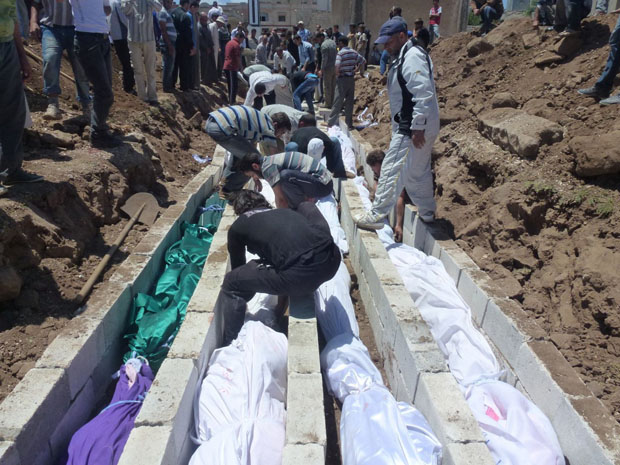
It seems heartless to stand by and do so little as massacres such as that carried out at Houla continue. More than 13 thousand Syrians have been killed in the last 14 months of revolution. All the same US intervention is not the solution. American troops killed over 10 thousand Iraqis in the first month of invasion in 2003. They killed a further 120,000 Iraqis in anger by the time the country was stabilized and safe to leave – and even then Iraq remains in turmoil and a new dictatorship seems to be taking shape. Car bombs are a daily occurrence in Baghdad.

In all likelihood, the Syrian revolution will be less bloody if Syrians carry it out for themselves. A new generation of national leaders will emerge from the struggle. They will not emerge with any legitimacy if America hands them Syria as a gift. How will they claim that they won the struggle for dignity, freedom and democracy? America cannot give these things. Syrians must take them. America can play a role with aid, arms and intelligence, but it cannot and should not try to decide Syria’s future, determine winners, and take charge of Syria. If Syrians want to own Syria in the future, they must own the revolution and find their own way to winning it. It is better for Syria and it is better for America.