
Category Archives: Israel

On Clowns and Illegal Hothouses

PD*28296118

I know I promised to pontificate on this week’s UN World Conference on Racism in Geneva, but I don’t know that I have anything to add that hasn’t already been said about this particular circus. (And I mean this literally – see above.)  For what it’s worth, I found Cecilie Surasky’s dispatches for Muzzlewatch to be the most incisive and helpful reporting on conference doings.

On a completely unrelated topic, I noticed this small news piece in yesterday’s Ha’aretz:

Five Border Policemen were wounded on Thursday in a clash with hundreds of residents of the Israeli Arab town of Kafr Qasem.

The violence broke out when security forces arrived to demolish a concrete surface upon which a hothouse was due to be built illegally. They were met at the scene by about 400 Kfar Kassem residents who had turned out to protest the move.

I suppose its just a minor news story in the scheme of things – still, it did remind me that the media’s impact is often less powerful for what it says than for what it leaves out. In this case, that would be the fact that almost all new building in Israeli Arab villages is technically “illegal” since Israel has made it virtually impossible for its Arab citizens to receive building permits.

From a New Israel Fund report:

There is a lack of planning for Arab neighborhoods and towns that has led to ongoing difficulties in obtaining building permits, and as a result, the demolishing of illegal buildings in the Arab sector. Since 1948, almost no Arab neighborhood or town has legally been permitted to expand.

Also left out of the article is any mention of this particular village’s  tragic history – and why a demolished hothouse is really just the latest chapter for the citizens of Kafr Kassem. Click here to learn more.

Is BDS anti-Semitism?

boycott1For many Jews, no three letters seem to conjure up rage and fury as effectively as “BDS.” Still, I have a strong suspicion that we’ll be hearing them bandied about increasingly in the coming months.

Since the Gaza war, the movement for global Boycott/ Divestment/ Sanctions against Israel seems to have gained new momentum. Among its prominent new supporters is economic journalist/activist Naomi Klein, who made a passionate call for BDS at the peak of the crisis:

Every day that Israel pounds Gaza brings more converts to the BDS cause, and talk of cease-fires is doing little to slow the momentum. Support is even emerging among Israeli Jews. In the midst of the assault roughly 500 Israelis, dozens of them well-known artists and scholars, sent a letter to foreign ambassadors stationed in Israel. It calls for “the adoption of immediate restrictive measures and sanctions” and draws a clear parallel with the anti-apartheid struggle. “The boycott on South Africa was effective, but Israel is handled with kid gloves.… This international backing must stop.”

Yet even in the face of these clear calls, many of us still can’t go there. The reasons are complex, emotional and understandable. And they simply aren’t good enough. Economic sanctions are the most effective tools in the nonviolent arsenal. Surrendering them verges on active complicity.

Count longtime peace activist Rabbi Arthur Waskow is one of those who “still can’t go there.” The current issue of “In These Times” contains a fascinating debate between Klein and Waskow on the merits of BDS. For his part, Waskow opposes it primarily for tactical reasons:

(The) BDS approach is not the way to bring about the change that is absolutely necessary.  The most important, and probably the only effective, change that can be brought about is a serious change in the behavior of the U.S. government. That means we need to engage in serious organizing within the United States…Boycotts and divestment are not going to do it. I understand that they express a kind of personal purity—”not with my money you don’t”— but they won’t change U.S. policy, which is exactly what needs to be changed.

Klein and Waskow’s conversation is edifying as far as it goes, but to my mind it doesn’t address the main concern over BDS articulated by so many American Jews: namely that given all of the odious regimes throughout the world, the unique singling out of Israel for sanction is an expression of flat-out anti-Semitism. This point of view was well summed up by Thomas Friedman in the NY Times back in 2002, at a time when student movements were increasingly pressuring universities to divest from Israel:

How is it that Egypt imprisons the leading democracy advocate in the Arab world, after a phony trial, and not a single student group in America calls for divestiture from Egypt? (I’m not calling for it, but the silence is telling.) How is it that Syria occupies Lebanon for 25 years, chokes the life out of its democracy, and not a single student group calls for divestiture from Syria? How is it that Saudi Arabia denies its women the most basic human rights, and bans any other religion from being practiced publicly on its soil, and not a single student group calls for divestiture from Saudi Arabia?

Criticizing Israel is not anti-Semitic, and saying so is vile. But singling out Israel for opprobrium and international sanction — out of all proportion to any other party in the Middle East — is anti-Semitic, and not saying so is dishonest.

For his part, Alan Dershowitz expressed a similar critique in response to recent reports (later retracted) that Hampshire College was divesting from six companies that profit from Israel’s occupation:

The divestment campaign applies to Israel and Israel alone. Hampshire will continue to deal with companies that supply Iran, Saudi Arabia, China, Cuba, North Korea, Zimbabwe, Libya, Syria, Sudan, Belarus and other brutal dictatorships around the world that routinely murder civilians, torture and imprison dissenters, deny educational opportunities to women, imprison gays and repress speech. Indeed many of those who support divestiture against Israel actively support these repressive regimes. This divestment campaign has absolutely nothing to do with human rights. It is motivated purely by hatred for the Jewish state.

Klein is absolutely right when she writes of BDS that “many of us can’t go there.” The reasons for this are complex and painful – and Friedman and Dershowitz do a compelling job of spelling out just how deeply painful and divisive they are. I must admit I have serious hesitation in taking on an issue that pushes so many of my own Jewish fear-buttons. (I’m not unmindful of the tragic historic spectres that boycotts against Jews and Jewish institutions conjure up for us.)  Still and all, I can’t help but wonder that by dismissing BDS as simple, abject hatred of Jews and Israel, we are misunderstanding the essential of the point of this movement. Even more fundamentally, I wonder if our rejection of BDS simply papers over our inability to face the more troubling aspects of the Jewish state.

I’ll start here: in a way, Dershowitz is correct when he writes that BDS has “nothing to do with human rights.” This particular movement did not in fact arise out of the international community’s concern over human rights in Israel/Palestine: it was founded in 2005 by a coalition of Palestinian groups who sought to fight for self-determination through nonviolent direct action. It arose out of their frustration over Israel’s continued refusal to comply with international law on any number of critical issues – and the oppressive manner in which Israel has occupied and ruled over Palestinians.  In other words, it is absolutely true that BDS is not an international human rights campaign. It is, rather, a liberation campaign waged by the Palestinian people – one for which they are seeking international support.

Yes, there are many oppressive nations around the world – and if a call came from indigenous, grassroots movements in these nations calling for international support of BDS, I’d say we most of us would seriously consider lending them our support. To use a partial list of nations mentioned by Friedman-Dershowitz, if any constituencies of the oppressed in Egypt, Syria, Saudia Arabia, Libya, Zimbabwe or Belarus called for nonviolent global boycott/divestment/sanction campaigns to force change in their countries’ policies, yes, I think we might well agree that they would be worthy of our backing. However, the absence of such movements does not necessarily negate the justice of the Palestinians’ current campaign. And it doesn’t seem to me that support of their call automatically constitutes hatred of Israel or Jews.

What I think Friedman-Dershowitz – and so many of us – fail to grasp is this: even as we recoil from nations that “choke the life out of their democracies” and “routinely murder civilians, torture and imprison dissenters, deny educational opportunities to women, imprison gays and repress speech,” the only way we can help truly address this kind of oppression is to support the ones who struggle for rights within these countries themselves – it is not for us Westerners to determine what is best for them. (And I particularly fear that when we frame this as a fight for “democracy,” as Friedman does,  this is really just a code for “imposing Western influence” – but perhaps that is a discussion for another day.)

The bottom line? While I believe there are undoubtedly those out there who will support BDS out of hatred pure and simple, I think it is just too easy to dismiss this movement as ipso facto anti-Semitism. Beyond the fears articulated by Friedman, Dershowitz and so many others like them, I think there’s an even deeper fear for many of us in the Jewish community: the prospect of facing the honest truth of Israel’s oppression of Palestinians.

For so many painful reasons, it is just so hard for us to see Israel as an oppressor – to admit that despite all of the vulnerability we feel as Jews, the power dynamic is dramatically, overwhelmingly weighted in Israel’s favor.  Though a movement like BDS might feel on a visceral level like just one more example of the world piling on the Jews and Israel, we need to be open to the possibility that it might more accurately be described as the product of a weaker, dispossessed, disempowered people doing what it must to resist oppression.

I have to say it feels like I’m going out on a serious limb by writing these words. I’m only raising these issues, as always, in the hope of starting a wider discussion in the Jewish community. Somehow, I feel that it is only by facing the stuff we prefer not to have to face that we might begin to find a way out of the this painful reality.

As always, I welcome your thoughts and reactions…

E1: End of the Two State Solution?

e1-map-11

From today’s Ha’aretz:

Prime Minister-designate Benjamin Netanyahu has struck a secret deal with Yisrael Beiteinu leader Avigdor Lieberman for highly contentious construction on West Bank land known as E1, Army Radio reported Wednesday.

While this might not seem like major news to some, this report, if true, would be devastating to the peace process (such as it is…)  In fact, settling E1 might well constitute the final nail in the coffin of the two state solution.

“E1” stands for East 1 – it is the administrative title given to the area east of Jerusalem and west of the West Bank development Ma’ale Adumim (see map above). Israeli settlement monitors such as Ir Amim and Peace Now have long cautioned against the dire consequences of settling this critical strip of land:

Construction of E-1 would jeopardize the hopes for a two-state solution.  It would, by design, block off the narrow undeveloped land corridor which runs east of Jerusalem and which is necessary for any meaningful future connection between the southern and the northern parts of the West Bank.  It would thus break the West Bank into two parts – north and south.  It would also sever access to East Jerusalem for Palestinians in the West Bank, and sever access to the West Bank for Palestinian residents of East Jerusalem. Both of these situations are antithetical to the achievement of any real, durable peace agreement and the establishment of a viable, contiguous Palestinian state.

The expansion of Ma’ale Adumim, as with the expansion of any other settlement, is a unilateral act which undermines and jeopardizes efforts to resume negotiations which are based on the principal of two states living side by side with peace and security.

It’s not such a stretch to imagine Netanyahu blithely giving E1 away to Lieberman as a political bargaining chip – he’s been hankering after this piece of earth of some time now. In fact, back in 2005 he choose a barren hilltop in E1 upon which to announce his candidacy for Prime Minister. This is what he had to say at the time:

This is Jerusalem, it’s our capital…Nobody can tell us to freeze building in our capital. What we need to do is to break this siege by building here.

You can see all of E1 quite easily from the top of Mt. Scopus. It’s beyond sobering to think the fate of the peace process might well hand upon a mere 12 square kilometers.

Trust me, this will be one to follow…

PS: Click here to send a letter to Secretary of State Clinton to ask her to make a settlement freeze a necessary part of the peace process going forward.

Gaza: Soldiers Are Speaking Out

israeli-soliders

Once permission has been given to the destroyer to do harm, it does not discriminate between the guilty and the innocent. (Mechilta, Bo)

Today the NY Times reported on an issue that has gripped the Israeli press and public for some time now:

In the two months since Israel ended its military assault on Gaza…testimony is emerging from within the ranks of soldiers and officers alleging a permissive attitude toward the killing of civilians and reckless destruction of property…On Thursday, the military’s chief advocate general ordered an investigation into a soldier’s account of a sniper killing a woman and her two children who walked too close to a designated no-go area by mistake, and another account of a sharpshooter who killed an elderly woman who came within 100 yards of a commandeered house.

In reading these accounts, I’m especially struck by the powerfully defensive reaction of many within Israel – insisting that these were either isolated incidents or that they were simply untrue. Witness Defense Minister Barak’s recent statement on Israel radio:

The Israeli Army is the most moral in the world, and I know what I’m talking about because I know what took place in the former Yugoslavia, in Iraq.

I don’t know if Israel’s army is the “most moral” in the world. I’m not sure if I even know what that means. I don’t know what we really expect when we train young men and women to kill, give them the most sophisticated killing instruments on earth, then demonize their enemies before sending them off to battle.

Israel has long claimed its army follows the military war ethic of  Tohar Haneshek (“Purity of Arms”). Whether or not this was ever true, there is seems to be growing evidence that in the heat of battle (or if you prefer, the “fog of war”), the difference between “legal killing” and “war crimes” becomes increasingly fuzzy to those who wield the weapons. And I’m fairly sure that this is the case whether or not the soldiers in question happen to be Jewish.

Even more disturbing are the reports from Israeli soldiers that the Israeli rabbinate is urging them to view this conflict as nothing less than a holy war. Richard Silverstein, blogging over at Tikun Olam, has translated some of the Hebrew press accounts, uncovering this jaw-dropping testimony from a commander named Ran:

The military rabbis sent us lots of material and in these articles the message was clear: we are the nation of Israel.  We arrived by a miracle in Israel.  God returned us to the Land (of Israel).  Now we must battle to remove the non-Jews who disturb us in our conquest of the Holy Land.  That was the main message.  And the sense of many of the soldiers in this operation was that it was a religious war.  From my perspective as a commander, I tried to talk about politics and various strains within Palestinian society.  That not everyone in Gaza was Hamas and not every resident wants to conquer us.  I wanted to explain to them that this war was not about Kiddush Hashem (sanctifying the name of God), but about stopping Qassam fire.

Expect more horrifying news in the coming weeks…

A Peace Veteran Bears Witness

kathykellyThis past Wednesday, JRC’s Peace Dialogue sponored a visit by longtime peace activist and nonviolence practitioner Kathy Kelly, who traveled to Gaza during the recent war.

If you’ve never heard of Kathy Kelly, you should read her bio because she’s someone you need to know about. This recent article will give some idea of the territory she covered in her presentation.

As she’s has been walking the walk for decades, I was surprised (and somewhat appalled) when she told us that this was the first time she had ever been invited to speak to a specifically Jewish audience. I hope and trust it won’t be the last. Through word and deed, I believe this inspiring peace veteran has a great deal to teach us.

Che Herzl Reconsidered

che-herzl

Wanna “Che Herzl” T-shirt? Just surf your way over to Jewlicious and you’ll find it along with all kinds of other swag designed especially for those aspiring to be the coolest of the cool Jews.

Yep, I did a double take when I saw this one.  I know there all too many leftists who are appalled at the sight of Che Guervara turned into a pop T-Shirt icon, but what on earth are we supposed to make of Che Herzl?

Beyond Jewlicious’ shallow hipster-frumster chic, this image raises some interesting assumptions about the very meaning of Zionism itself.  Indeed, there are many who fancy Zionism as the “national liberation movement of the Jewish people.”  This concept was made especially famous by Chaim Herzog during his remarks in response to the UN’s “Zionism is Racism” resolution in 1975:

Zionism is the name of the national movement of the Jewish people and is the modern expression of the ancient Jewish heritage. The Zionist ideal, as set out in the Bible, has been, and is, an integral part of the Jewish religion. Zionism is to the Jewish people what the liberation movements of Africa and Asia have been to their own people.

While I understand the substance of Herzog’s argument, I have to confess that this particular defense of the Zionist enterprise has always rung a little hollow for me. First of all, I’m not sure it’s all that accurate to describe Zionism as a national liberation movement –  certainly not as we’ve come to understand this concept post WW II.

While its hard for us to admit, Zionism is the product of ideologies  (i.e. 19th century European ethno-nationalism) that have fallen pretty far out of favor today. That’s why it feels like Herzog’s comparison of Zionism to the liberation movements of Africa and Asia is more than a little spurious.  After all, those movements were uprisings of indigenous peoples against centuries of colonial oppression. By contrast, Zionism sought to create an ethnic Jewish presence in Palestine and ended up doing so at the expense of its current inhabitants.

Not surprisingly, Che himself considered Zionism “reactionary” (according to biographer Jon Lee Anderson). I know he’d be rolling in his unmarked grave if he knew that his face adorned the shirts of clueless American teenagers; I can only imagine the cartwheels he’d be doing upon learning that his image had now become fused with Theodor Herzl’s.

Anyhow, I’m not sure that reconceiving Zionism as a proto-national liberation movement is even all that compelling any more. Now that we’ve witnessed the post-modern travails of decolonized nations, we’re learning that  “national liberation”  might not necessarily be all that it’s cracked up to be. I’m not sure I have any good answers (certainly not one that would fit on a T-Shirt); I suppose I’m just suggesting  it’s worth challenging the romanticizing of nationalism in all its various guises. 

The Jews of Iran: Beyond the Rhetoric

p1000298

I was pleased to read two particularly intelligent Iran-related op-eds in the NY Times today: one by columnist Roger Cohen on the Iranian Jewish community and another by Iranian journalist Ali Reza Eshraghi on the importance of engaging diplomatically with Ahmadinejad.

From Cohen’s piece:

Perhaps I have a bias toward facts over words, but I say the reality of Iranian civility toward Jews tells us more about Iran — its sophistication and culture — than all the inflammatory rhetoric.

That may be because I’m a Jew and have seldom been treated with such consistent warmth as in Iran. Or perhaps I was impressed that the fury over Gaza, trumpeted on posters and Iranian TV, never spilled over into insults or violence toward Jews. Or perhaps it’s because I’m convinced the “Mad Mullah” caricature of Iran and likening of any compromise with it to Munich 1938 — a position popular in some American Jewish circles — is misleading and dangerous.

Cohen’s report is very much in line with my own experience. When I attended an interfaith delegation to Iran this past November, we spent considerable time with the Jewish community – and among the many surprising impressions we received was their obvious sense of comfort and safety living as Jews under an Islamic regime.

American Jews are invariably astounded when I tell them that I myself wore a kippah publicly throughout Iran without a moment’s nervousness. (Once we were approached and asked by an Iranian man if we were Jewish – he turned out to be a Jew himself and he promptly invited us to his shul for Shabbat). I’m not being facetious when I say that in retrospect, I realize I actually felt safer as a Jew walking the streets Tehran than I often do in Israel – the only place in the world, frankly, where Jewish lives are under constant threat.

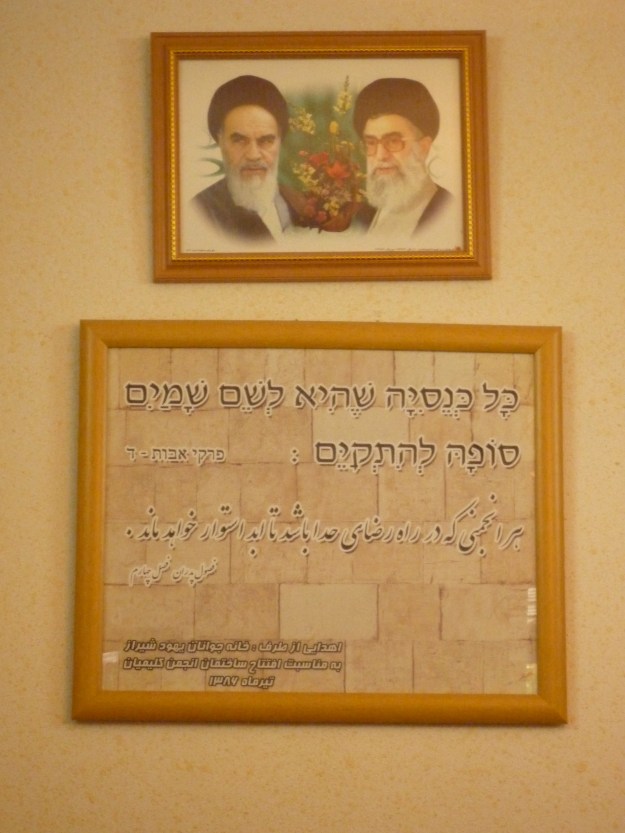
I took the picture above, by the way, at the Jewish community center in Shiraz. Just another assumption-busting Jewish Iranian image: the obligatory Ayatollahs Khomeini and Khamanei hanging on the wall above a classic Jewish quote from Pirkei Avot in Hebrew and Farsi: “Every assembly that is for the sake of heaven will endure.”

(To those who live in the Chicagoland area:  I’ll be speaking about my experiences in Iran tomorrow evening, Tuesday, February 24, 7:00 at the Chicago Chapter of the American Friends Service Committee

Dancing Around Bashir

bashir

Waltz With Bashir” has been racking up the prizes. In addition to a slew of international awards, it was awarded Best Picture by the National Society of Film Ciritics, Best Foreign Film at the Golden Globes, and it seems to have the inside track on the same award at the Oscars this Sunday night.  But as “Bashir” amasses its acclaim, some observers are frankly critiquing the film against Israel’s painful present-day reality.

In a recent Nation article, Israeli author Liel Liebovitz wonders why the Israeli public has so thoroughly embraced this fiercely anti-war statement (enough to vote it as their third-favorite Israeli film of all time) while ignoring its “harrowing lessons” through its strong support of their government’s military actions against Gaza.

Liebovitz concludes that “Bashir’s” popularity not withstanding, Israel is sadly disregarding director Ari Folman’s powerfully moral vision – particularly in light of the recent elections:

Israel of today is not Ari Folman’s. It is Avigdor Lieberman’s and Benjamin Netanyahu’s, the country of the countless men and women crying out for revenge. As we root for Waltz with Bashir, if we want to truly honor that film’s message, let us never forget that. Otherwise, all we have is just a pretty animated film.

Journalist Naira Antoun, writing in the Electronic Intifada comes to a similar conclusion:

(We) are reminded of the psychologist’s comment near the start of the film: “We don’t go to places we don’t want to. Memory takes us where we want to go.” Perhaps this explains how at the same time that Gaza was being decimated, Israel heaped acclaim and awards on Waltz with Bashir; in addition to numerous international awards, the film scooped up six awards at the Israeli Film Academy. Indeed, the same Israelis who flocked to see the film gave their enthusiastic approval to Operation Cast Lead in Gaza. According to a poll released on 14 January by Tel Aviv University, a staggering 94 percent of Israeli Jews supported or strongly supported the operation.

As a Palestinian viewer, however, Antoun goes even farther than Liebovitz: she faults the film for rendering Palestinians essentially invisible:

There is nothing interesting or new in the depiction of Palestinians — they have no names, they don’t speak, they are anonymous. But they are not simply faceless victims. Instead, the victims in the story that Waltz with Bashir tells are Israeli soldiers. Their anguish, their questioning, their confusion, their pain — it is this that is intended to pull us…We don’t see Palestinian facial expressions; only a lingering on dead, anonymous faces. So while Palestinians are never fully human, Israelis are, and indeed are humanized through the course of the film.

Among other things, I think these reviews illuminate the painful difficulties inherent in making an anti-war statement while the war is still raging.  A sad anecdote: a congregant recently told me that when she saw the film, a screaming match erupted in the audience after it ended.  Apparently someone screamed “That’s Gaza!” to which another responded “Shut up!” and on it went…

And on it goes…

Update 2/23/09: Thanks to Eric for forwarding this devastating Ha’aretz piece re “Bashir” by (who else?) Gideon Levy.

Baskin: What the $%#@* Was it All For?

n716645365_5575

Are you ready to throw your head back and scream to the high heavens? Just read Gershon Baskin’s column in today’s J Post, in which he reveals that prior to Israel’s attack on Gaza, he met with a senior Hamas official in Europe to discuss possibilities for renewing the cease-fire. He returned to Israel ten days before Israel began the war and sent a letter to Olmert, Barak and Livni, informing them…

…that Hamas was willing to open a direct secret back channel for a package deal that would include the renewal of the cease-fire, the ending of the economic siege and the prisoner exchange for the release of (Gilad) Schalit. I further indicated that Hamas would be willing to implement the agreement on Rafah which included the stationing of Palestinian Authority personnel loyal to President Mahmoud Abbas in Rafah and a return of the European monitors. I communicated the same message to (Gilad’s father) Noam Schalit and asked him to make sure that Ofer Dekel, who is charged with the Schalit file by the government, received the Hamas “offer.”

Olmert, et al chose to ignore this opportunity, preferring instead to “teach Hamas a lesson.”

Baskin’s final conclusions:

What did this war achieve? What has changed? Has Israel gained its military deterrence? Has Israel changed the security reality in the South? Is Gilad Schalit at home? Has Hamas reduced its basic demands for the release of Schalit? No, no and no! Israel is negotiating now for exactly what could have been achieved without going to war. Israel spent $1 billion on the war, caused some $2 billion worth of damage in Gaza, more than 1000 people have been killed, thousands of lives have been destroyed. Hundreds of thousands of Israelis lived through weeks of terror; millions of Palestinians suffered the bombardment of their towns, cities and refugee camps – what is the result? More hatred, more extremism and more support for fanatics and their ideas – on both sides of the Gaza border.

Read the whole article and weep…

The Contradictions of Ethnic Nationalism

610x

It’s the last day before the Israeli elections, and there seems to be widespread agreement that Yisrael Beiteinu party chairman Avigdor Lieberman is going to win big – perhaps as much as 19-20 seats. They’ve already pulled ahead of the Labor party and by now it’s virtually a foregone conclusion that Lieberman will emerge from these elections with considerable political influence.

It’s also fair to say that those of us who cherish the values of liberal democracy are recoiling at the prospect of a politically ascendant Avigdor Lieberman, whose most notorious campaign promise is a requirement for all Arab citizens of Israel to sign a loyalty oath to the Jewish state:

(Lieberman’s) loyalty oath would require all Israelis to vow allegiance to Israel as a Jewish, democratic state, to accept its symbols, flag and anthem, and to commit to military service or some alternative service. Those who declined to sign such a pledge would be permitted to live here as residents but not as voting citizens.

Currently Israeli Arabs, who constitute 15 percent to 20 percent of the population, are excused from national service. Many would like to shift Israel’s identify from that of a Jewish state to one that is defined by all its citizens, arguing that only then would they feel fully equal.

Mr. Lieberman says that there is no room for such a move and that those who fail to grasp the centrality of Jewish identity to Israel have no real place in it.

These are disturbing ideas to be sure, and it’s even more troubling that they seem to finding traction with increasing numbers of the Israeli electorate.

And yet…

…and yet in the wee hours of the night, I just can’t shake the nagging feeling that the real reason Lieberman makes us squirm is that he shines a bright light on the logical contradictions of political Zionism: an ethnic nationalist movement that has always sought to create a Jewish state in a land that also happens to be populated by millions of non-Jewish inhabitants.

Take, for example, Israel’s Declaration of Independence, which refers specifically to Israel as a “Jewish state” committed to the “ingathering of the exiles” but also promises complete equality of political and social rights for all its citizens, irrespective of race, religion, or sex.  Therein lies the tension: the first principle emphasizes the creation of a state that privileges the Jewish people and the latter promises equal rights for all its citizens.

I don’t say this easily: I’m not sure this is a nut that Israel will ever fully be able to crack.  It is indeed notable that Israel has repeatedly tried and failed to create a constitution that legally guarantees equality for all citizens of this exclusively Jewish state. In the meantime, Israel’s Arab citizens suffer from what we Americans would consider significant institutional discrimination with only limited recourse to the rule of law.

So as a nice liberal American Jew fully prepared to voice my outrage at Lieberman’s likely Tuesday morning success, here are some questions I feel compelled to ponder:

– As proud citizens and beneficiaries of a secular multi-cultural nation, are we ready to face the deeper implications of Israel’s ethnic nationalism?

– Will it ever truly be possible, in a country defined as exclusively Jewish, for its Arab citizens to be considered as anything but second class citizens (or at worst, traitors)?

– If  it does indeed come down to a choice between a Jewish or a democratic state, which will we ultimately support?

I’d love to hear your responses…