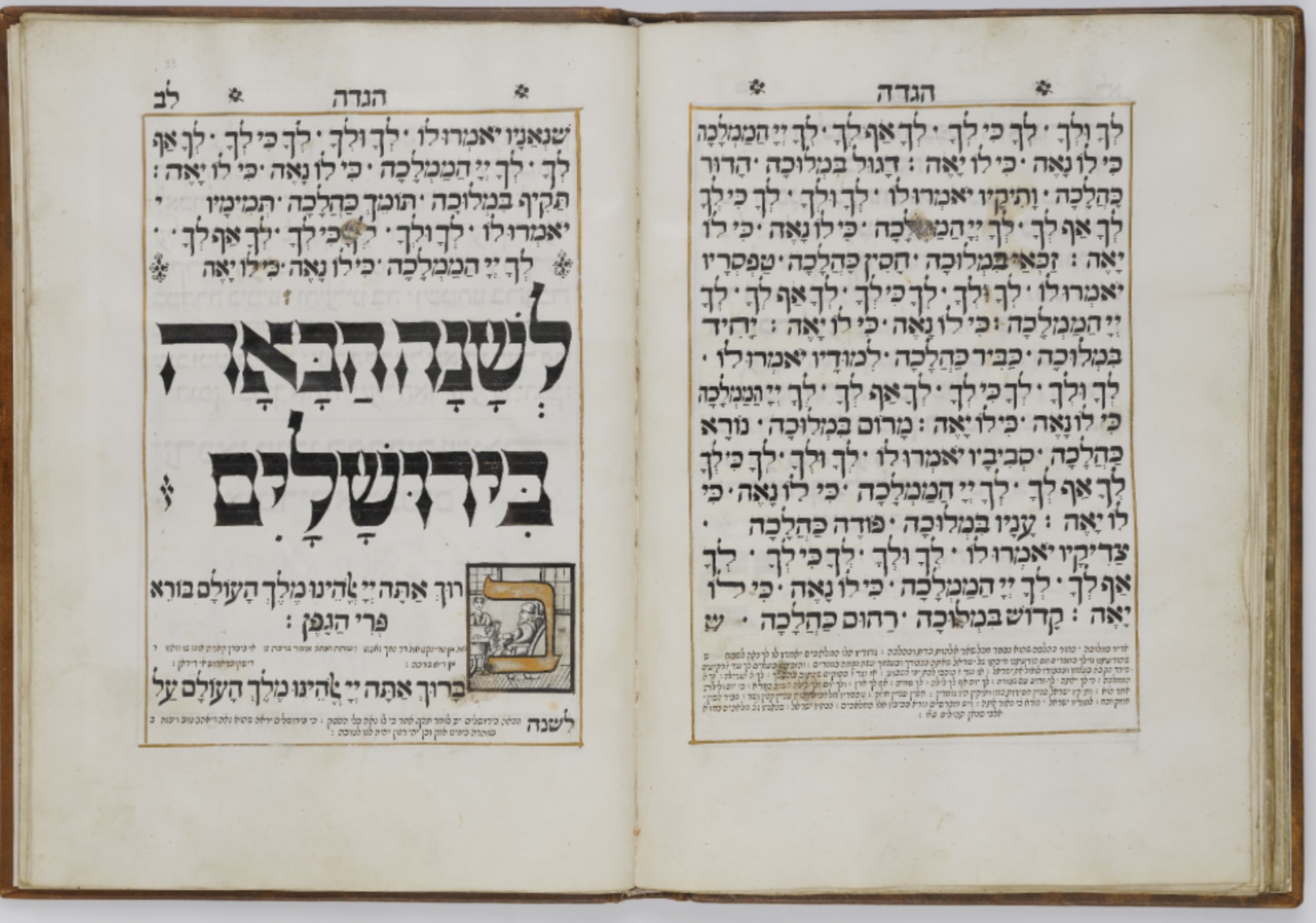
I’m sure I’m not the only anti-Zionist Jew who experiences cognitive dissonance when we get to the line that ends every Passover seder, “Next year in Jerusalem!” In the age of Zionism, what do these words really mean: when a Jewish person can fly to Jerusalem not next year, but tomorrow, and become an instant citizen upon arrival? How can we joyfully shout these words knowing that Israel ethnically cleansed half of Jerusalem in 1948 and militarily conquered and occupied the other half in 1967? What do they mean while scores of Palestinians who have deep generational ties to the land are forbidden from even setting foot in that city?
Over the years, I’ve come to the conclusion that the only way I can say this line with moral integrity is to understand the word “Jerusalem” not as referring to a physical city but to a spiritual ideal. This ideal, in fact, is central to Jewish tradition. After the destruction of the Temple and the ruination of Jerusalem by the Romans, the rabbis posited the existence of two Jerusalems: Yerushalayim Shel Mata (“Jerusalem Below”) and Yerushalayim Shel Mala (“Jerusalem Above”). Earthly Jerusalem is the physical city we know while the Heavenly Jerusalem is the messianic Jerusalem: a mirror reflection of the city on high: the Jerusalem of our highest aspirations.
In other words, while a small number of Jews always lived in the city after the destruction of the Temple, for the majority of Jews who lived throughout the diaspora, the concept of Jerusalem became a spiritualized symbol. I’ve often been struck that diaspora cities that were centers of robust Jewish life have typically been referred to as “Jerusalems.” In the late 16th and early 17th centuries, for instance, Amsterdam was referred to as the “Jerusalem of the West” following the immigration of Sephardic Jews from Spain and Portugal. Likewise, Vilna was known as the “Jerusalem of Lithuania” and Tlemcen, Algeria was called “Jerusalem of the Maghreb.”
When the ideology of Zionism emerged, and this spiritual ideal was subsumed into a physical place, the words “Next Year in Jerusalem” became a literal battle cry. But when we limit our understanding of Jerusalem to one specific city, we do damage to the very idea of Jerusalem itself. It’s tragically ironic that while the Hebrew word Yerushalayim literally means “City of Peace,” it has rarely known a moment’s peace in its history. It certainly hasn’t since the establishment of the state of Israel.
While the metaphor of Jerusalem still has a prominent place in Jewish tradition and liturgy – the words “Next Year in Jerusalem” mark the end of Yom Kippur as well as the Pesach seder – this ideal can be deeply meaningful even for those of us who do not ascribe to the messianic aspects of Jewish tradition. They can continue to be deeply aspirational, indicating our hope for a future of justice, equity, and peace throughout the world – and our commitment to the work it will take to make that future real.
For anti-Zionist Jews, these words are not only a statement, but an affirmation of our opposition to the violence and dispossession that continues to be wrought in the name of the Jewish people in that city and throughout the land. “Next Year in Jerusalem” can mean “Next Year, a Jerusalem for all its inhabitants.” It means “Next Year in Jerusalem without Jewish Supremacy.” It can mean “Next Year, may there be a return for all who have been dispossessed from their homes.” When we affirm that Jerusalem is not only an earthly location, we affirm the true Jerusalem cannot be destroyed, conquered or reconquered: it continues to live in our hearts and motivate our actions.
May it be so this and every Passover: “Next Year in Jerusalem!”
Are some places in the world more inherently sacred than others? Or is the entire world itself a sacred place? These questions are at the heart of this week’s Torah portion, Parsahat Vayetze.
As the portion opens, Jacob has fled his home to escape from the wrath of his brother, Esau. Alone in the wilderness, he arrives at a place (in Hebrew, makom) to spend the night, using a stone as his pillow. That night, he dreams of steps reaching from earth to heaven, upon which angels ascend and descend. God appears to Jacob and reaffirms the promise made to Isaac and Abraham, promising to protect Jacob on his journey until he returns home.
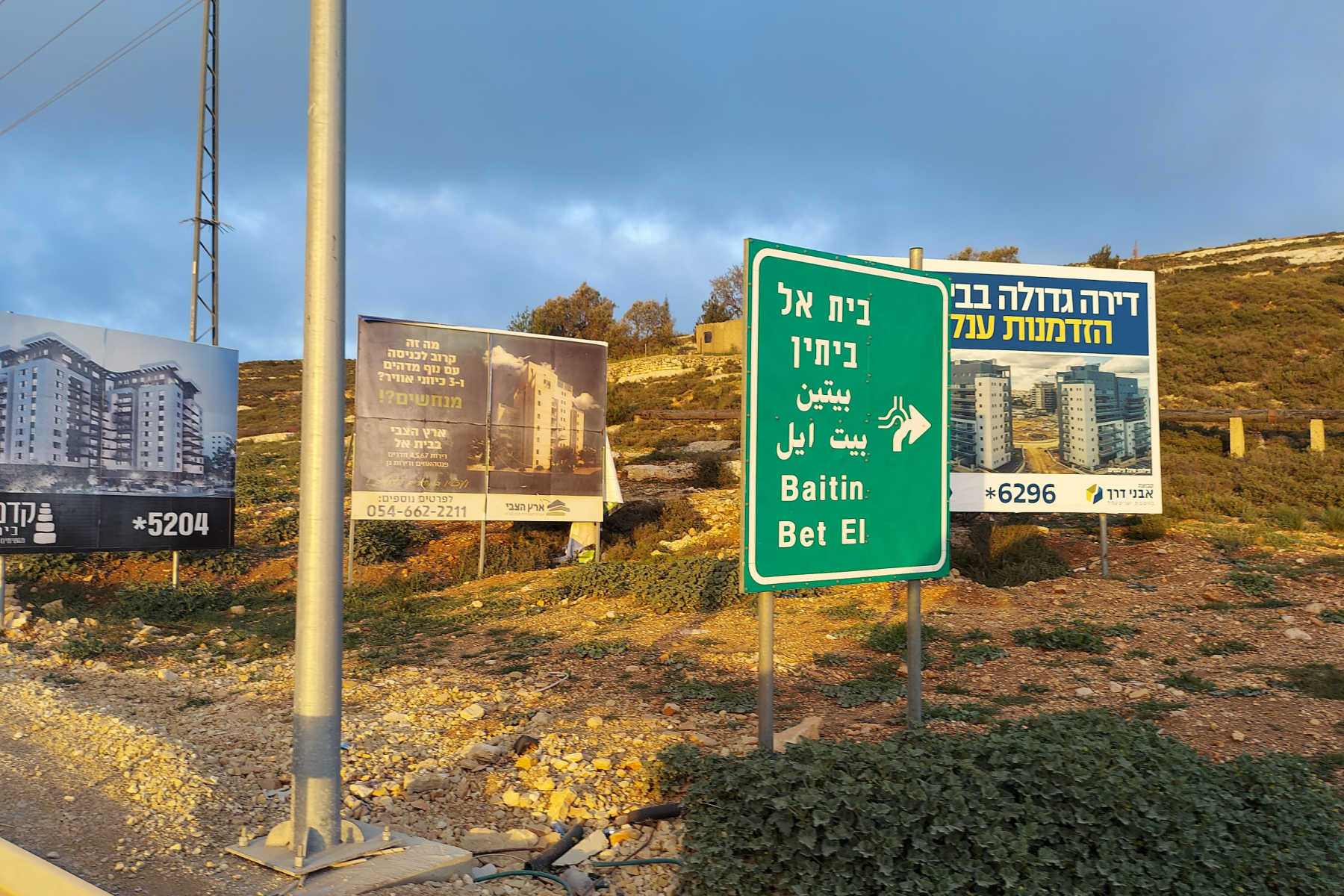
When Jacob awakens, he exclaims, “Mah norah ha’makom hazeh” – “How awesome is this place! God was present in it and I did not know! This is none other than the house of God and that is the gateway to heaven.” Jacob then sets up the stone he used as his pillow as a sacred pillar and names the place Beit El (“house of God”).
Centuries of commentators have inquired about the specific nature of this makom/place. Was it just a random spot where Jacob happened to spend the night or was it a sacred place toward which he was somehow guided by God? Our interrogation of this question begs an even deeper question: is the whole world in a sense, sacred space or are there some places in the world that are “more sacred” than others?
The answers to these questions are not, of course, are not mutually exclusive. Most spiritual traditions consider certain locations or sites to be uniquely invested with divinity. It is undeniable that Jewish tradition has traditionally ascribed sacred meaning to a specific land known as Eretz Yisrael. Some commentators say this land is uniquely holy because certain commandments can only be observed there and nowhere else. According to Jewish mystical tradition Eretz Yisrael – and the Temple Mount in particular – marks the very center of the universe.
It does not follow, however, that these ideas ipso facto give the Jewish people entitlement to assert control or dominion over the land (or the people who dwell upon it). On the contrary, I would argue that this sense of entitlement actually betrays the sanctity of the land. Indeed, it is difficult to read this Torah portion in the age of Zionism and fail to note that Beit El is the name of a prominent West Bank settlement that was established in 1977 by the ultranationalist settler group Gush Emunim.
This sacrilegious hyperliteralism also ignores what the Torah teaches us from the very first chapter of Genesis: namely, that the entire earth is God’s divine creation. This ideal became more critical in Judaism after the destruction of the Temple in Jerusalem in 70 CE, when the Jewish people spread throughout the diaspora and created a spiritual system where God could be found anywhere in the world. Notably, the rabbis taught that the word makom is one of the names of God, referring specifically, the experience of the divine that is connected to place. (Or in the words of my favorite movie superhero, “wherever you go, there you are.”)
The Hebrew word for diaspora, galut, literally means exile, but as a famous rabbinic midrash teaches, “when the people of Israel went into exile, God went into exile with them.” Of course, the experience of exile is a universal one: as human beings, we understand that live in an imperfect world that has not yet experienced a complete and lasting justice. Nevertheless, as this midrash suggests, the imperfect exilic state in which we live is still infused with transcendent meaning and purpose wherever our steps may lead us.
As the great Yiddish writer S. Ansky powerfully wrote in his play “The Dybbuk,” “Every piece of ground on a person resides when they raise their eyes to heaven is a Holy of Holies.” That is to say, every place on earth has the potential to be a place of divine encounter. Every place has the potential to be a makom: holy space. Every home we create can be a Beit El – the sacred meeting place between heaven and earth.
I’m sure we all can think of these holy spaces in our own lives: places that are sacred because they were the sites of deep and significant meaning for us; places made holy because of the experiences we experience in them and the sacred memories we associate with them. At the same time, it is impossible to ignore that the entire earth abounds in sanctity – as we read in the book of Isaiah: “The whole world is filled with God’s glory.”
In other words, like Jacob, any place we lay down our heads has the potential to be a makom: a holy place with limitless potential for sacred, transformative experience.
Exactly ten years ago, the Jewish fast day of Tisha B’Av arrived as Israel was winding down “Operation Protective Edge” – it’s deadly two-month military assault on Gaza. By the end of the summer of 2014, it would eventually leave more than 2,000 Palestinians dead and more than 10,000 wounded. I remember thinking at the time how the scale of human loss was utterly incomprehensible, which of course, it was.
With Tisha B’Av 2014 approaching, I met with a small group of Jewish friends and activists who had been active in the Palestine solidarity movement to plan an observance. Tisha B’Av (literally, the 9th of the month of Av) is a day of mourning for the destruction of the 1st and 2nd Temples in Jerusalem – and by extension the myriad of other tragedies that have befallen the Jewish people throughout the centuries. In addition to a day-long fast, the traditional Tisha B’Av observance includes the chanting Biblical book of Eicha (Lamentations), which vividly and painfully describes the fall of Jerusalem to the Babylonians.
Given the violence Israel had been unleashing on Palestinians in Gaza that summer, we just couldn’t bear to observe the festival in the traditional manner, i.e., as a day of mourning exclusively for Jewish loss. And so, when the festival arrived, we gathered in a home in Evanston to share our fears, our grief, our outrage, over what had transpired over the course of that tragic summer. In a sense, we were mourning the loss of Judaism itself as we had known it. Though it was obviously far from a traditional Tisha B’Av observance, those who attended will never forget that gathering – and would agree it was a turning point in our Jewish lives and identities.
Among the readings shared at the ceremony, was a new poetic translation of the first chapter of Eicha that I had written for the occasion, entitled “A Lamentation for Gaza.” This is how it began:
Gaza weeps alone. Bombs falling without end her cheeks wet with tears. A widow abandoned imprisoned on all sides with none willing to save her.
We who once knew oppression have become the oppressors. Those who have been pursued are now the pursuers. We have uprooted families from their homes, we have driven them deep into this desolate place, this narrow strip of exile.
It’s fair to say that none of those who attended that ceremony could ever have imagined the scale of the genocidal carnage that Israel would unleash on Gaza ten years later. To date, nearly 40,000 Gazans have been killed, though the actual number will almost surely climb far higher. The Israeli military has indiscriminately killed random civilians, relief workers, journalists and health care workers. Israel has wiped out the bloodlines of entire families. The Gaza strip is now gripped by spreading famine and polio epidemics. And unlike ten years ago, this current violence has now brought the entire region to the brink of all-out war.
In anticipation of Tisha B’Av this year, I recently re-read my “Lamentation for Gaza” – and while it’s an accurate snapshot of my feelings at the time, I don’t think it fully expresses my heart and soul now the way it did during the summer of 2014. Most fundamentally, I no longer relate to the essential perspective of the lamentation itself, which I wrote in the first-person plural:
We have become Gaza’s master leveling neighborhoods with the mere touch of a button for her transgression of resistance. Her children are born into captivity they know us only as occupiers enemies to be feared and hated.
When I read this now, it is jarring to realize how I – a diaspora Jew living in the United States – wrote from the perspective of “Gaza’s master” and an “occupier.” When I wrote those words, I still maintained a personal connection to Zionism and reflexively adopted Israel’s perspective. At the same time, however, I clearly expressed deep anguish over what “we” had wrought – as if I didn’t know fully where I stood anymore.
Ten years later, I’m fully secure in my identity as an anti-Zionist Jew. Tzedek Chicago, is (yes) almost ten years old – and avowedly lifts up core values that express diasporist-focused Judaism beyond Zionism. I’m part of a Jewish community that is unabashed about taking a stand in the face of genocide.
I don’t believe it’s an exaggeration to say that as Tisha B’Av falls this year, the Jewish communal fissures over Palestine/Israel have become an abyss – perhaps even a schism. We are facing a deep and profound divide between those who place political nationalism at the center of their Jewish identity and those who refuse to associate settler colonialism, apartheid – and now genocide – with their Judaism. And though it pains me to say so, I don’t think there will be any bridging this gap. Contrary to the final line of Lamentations, “chadesh yameinu ke’kedem” (“renew our days as they were before”), there is no going back to the days of old. There will be no putting the pieces back together the way they were.
According to classical Jewish theology, the cataclysmic fall of the Second Temple in Jerusalem occurred as a result of “sinat chinam” – the baseless internecine hatred in the Jewish community that allowed the Romans to come breach the walls of the city and conquer Jerusalem. There is deep division in the Jewish community in the current moment as well, but now our Jewish trauma and hatred is directed outward rather than inward. Now, it is the Palestinian people – not we – who are bearing the full brunt of violent dispossession and collective loss.
While it would be hubris to predict what the future will hold for our tradition, I fervently believe that the Judaism of the future must be universalist in nature. Just as I suggested this past April that Passover cannot commemorate Jewish liberation exclusively, so too Tisha B’Av can no longer focus on Jewish mourning alone. Our cries of grief must include the Palestinian people – and all who are targeted, othered, and singled out for oppression through state violence.
This year, Tisha B’Av eve falls on Monday night August 12 – and this time, I know where I belong. I encourage local members of Tzedek Chicago to join us at Federal Plaza in downtown Chicago, where we will collaborate with Higaleh Nah, a local non-Zionist havurah, to chant the entire book of Eicha. It feels absolutely fitting that we will gather at the seat of state power to send forth our lamentations toward the nation that is arming and enabling this ongoing genocide in our name.
May our cries pierce the highest heavens, and may our mourning be expansive enough to include all who are oppressed in our midst.
An op-ed version of this sermon was published in Truthout
Jewish tradition teaches that words have a sacred power. In the very beginning of the Torah, God creates the world itself through the power of the word. In the book of Exodus, the Israelites speak as one people at Sinai, thereby entering into a covenant with God. It is said that on Yom Kippur, the High Priest would enter the Holy of Holies in the Jerusalem Temple and utter the otherwise unspeakable name of God – and at that moment the fate of the very world would hang in the balance. On Yom Kippur, we ourselves stand as a community and say the words of our collective confessions together. As our liturgy would have it, we may not be written into the book of Life for the new year unless we speak these words out loud.
In their way, the power of words is akin to energy. Once they are spoken, they are out in the world – and from that point on there are a myriad of ways their impact might be manifest. Sometimes their power will remain dormant. Other times, our words can be the conduit for deep and powerful transformation.
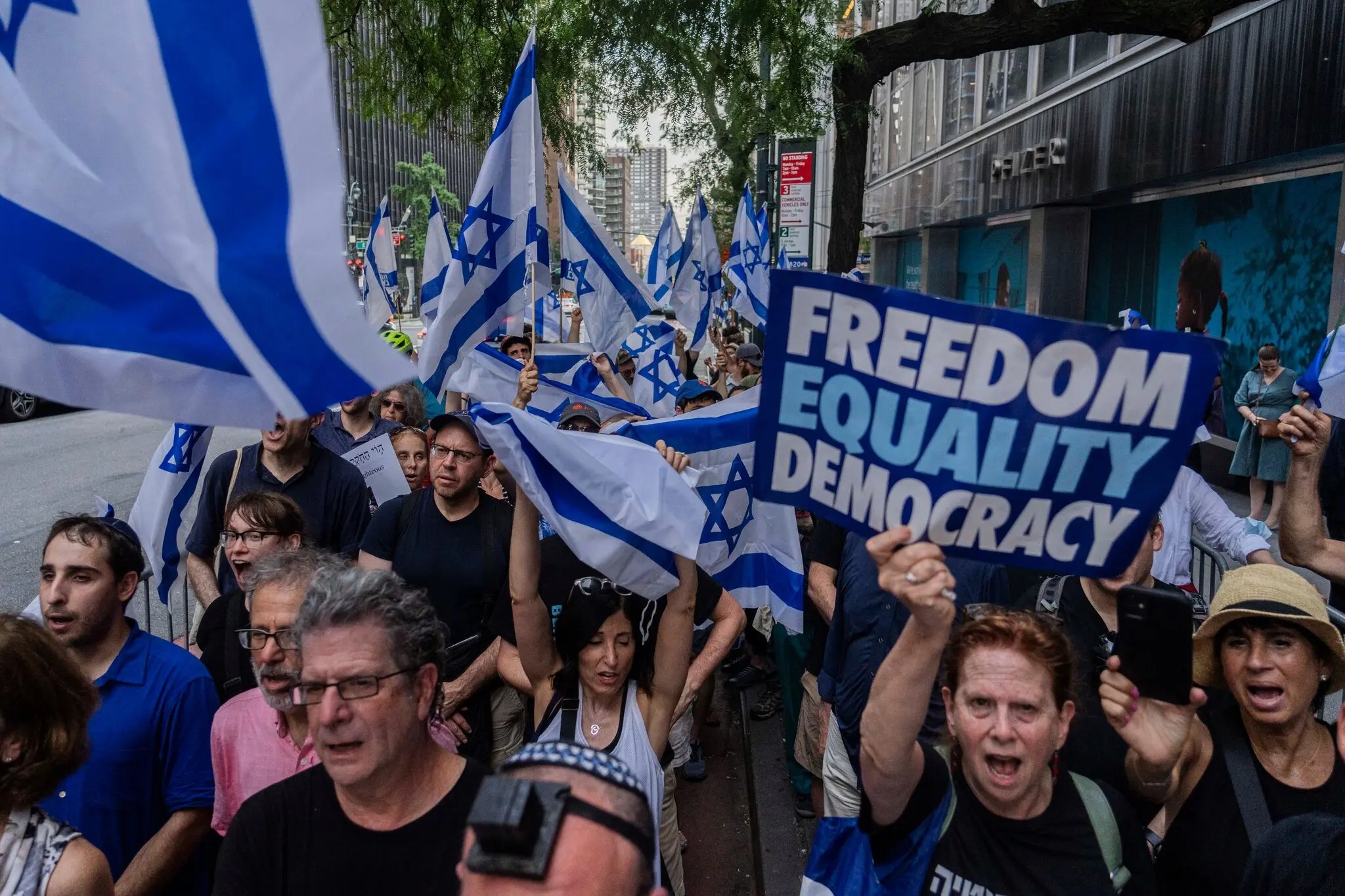
I think a great deal about the impact of our words when it comes to the issue of Israel/Palestine. We have witnessed their power for instance, over the course of this past year, as thousands of Israelis have been holding regular demonstrations against the current Israeli administration and its plans to limit the power of the Israeli judiciary. Week after week, protesters have chanted words in the streets and carried them on signs, expressing their collective outrage over the government’s “threat to Israeli democracy.” More recently, many in the American Jewish community – including many rabbis – have voiced their support for these protests and have even been staging public protests of their own.
On one level, it could be said that these massive rallies have had a powerful impact. They are the largest and most sustained protests in Israeli history and the most massive mobilization of the Israeli left in years. The rhetoric of the rally has also empowered Zionists in general. Many who advocate for Israel will often refer to it as “the only democracy in the Middle East.” I would suggest that the use of this word is powerful for all the wrong reasons. It covers up the reality that while Israel may be a democracy for Jews, it is decidedly not one for Palestinians. Indeed, for many centrist and right wing Israelis these demonstrations are important because they bolster the illusion of democracy. In so doing, they serve to entrench Zionism and strengthen the Jewish state.
It is true that at many of these demonstrations, there have been some chants and signs condemning Israel’s “occupation.” However, this is an oft-invoked word that can mean different things to different people. For some it refers only to Israel’s military occupation of the West Bank and Gaza. For others it also includes annexed territories such as East Jerusalem and the Golan Heights. For still others, the entire land between the river and the sea is considered to be occupied territory. Thus, when the word “occupation” is invoked during the demonstrations, there is little clarity on what it actually means – or what is actually being demanded.
There is yet another powerful word that has recently emerged in relation to Israel/Palestine, and that word is “apartheid.” Last year, three respected human rights organizations: Amnesty International, Human Rights Watch and the Israeli group B’Tselem, all released well-researched reports concluding that Israel is an apartheid regime. Over the past year, many surprising figures have also been increasingly using this word in relation to Israel, including a retired Israeli general.
This past year, a letter was posted online by Israeli academics that openly criticized American Jews for “(paying) insufficient attention to the elephant in the room: Israel’s long-standing occupation.” The letter pointedly stated that “there cannot be democracy for Jews in Israel as long as Palestinians live under a regime of apartheid, as Israeli legal experts have described it.” The so-called Elephant in the Room Letter was widely distributed and was eventually signed by Jewish leaders and figures – to date it has over 2,700 signatures.
With liberal Jewish leaders increasingly willing to use the “A” word in public, there is every indication that it is losing its stigmatized, transgressive status in the Jewish community. But even here, the meaning of the word “apartheid” depends on how it is used. The B’Tselem report, for instance, claims that Israeli apartheid extends “from the Jordan River to the Mediterranean Sea.” The Israeli general, on the other hand, limited it to the West Bank alone.
There are also those who would say that the term “apartheid” itself doesn’t go far enough – that it is a technical term from international humanitarian law that has limited legal applications. Many would argue that the word “settler colonialism” is much more powerful and meaningful because it is related to decolonization – a concrete process of action that includes the return of refugees and reparations to the Palestinian people.
Yes, all of these words do indeed have a complex kind of power when it comes to Israel/Palestine, and I’m often fascinated by the strategic ways we utilize this power. Years ago, I used to avoid controversial and potentially incendiary words in connection with Israel, feeling that they might well alienate and push away the very people I was trying to reach. I would typically use words I thought were less triggering: “dispossession” instead of “ethnic cleansing,” “non-Zionist” instead of “anti-Zionist,” “occupation” instead of “settler colonialism.”
I feel differently about this now. I actually think it’s important to use words such as these. I believe it’s important to name oppression explicitly and not to soften it with euphemisms. If some words make people uncomfortable, that’s OK. Once a word is said, it can’t be unsaid. It’s now part of the discourse. While some may well recoil from that word, they may well come around to accept it in time.
Words can indeed push the line of what is considered acceptable. But they can also represent one step too far, or the crossing of a line. There is still, for instance, a hard line drawn on the word Zionism. For most Jews, it is still considered beyond the pale to refer to oneself as an anti-Zionist: to break not just with the Israeli government, not just with the 1967 occupation, but with the very concept of an exclusively Jewish nation-state.
Apropos of Yom Kippur, it seems to me that when we say these words and cross this particular line openly, we’re really making a kind of confession. It’s not merely a political opinion – it’s an ethical admission that our Jewish identity has been inextricably connected to the oppression of another people.
When I was growing up, I was routinely taught that Zionism was the national liberation movement of the Jewish people. But I was never taught that this “liberation” came at the expense of another people. Like many American Jews, I was raised to view the establishment of the state of Israel as the exclusive Jewish homeland; a Jewish refuge after centuries of persecution; a redemptive homecoming following the collective trauma of the Holocaust.
Our trauma has been compounded by the sense that the world was complicit in it – that the Jewish people were abandoned by the international community. To be sure, the allied nations should rightly bear deep shame for their inaction during the Holocaust and their refusal to accept Jewish refugees following the war. But even as collective Jewish trauma is all too real, it was tragic and profoundly wrong to justify it by inflicting trauma on another people: by establishing a Jewish state on their backs and creating what has now become the largest refugee population in the world.
When Jewish Zionists publicly confess and act on the truth of this history it can often shake their Jewish identity to the core. This phenomenon often reminds me of something James Baldwin wrote in his classic 1962 essay, “A Letter to My Nephew:”
As you will discover, people find it very difficult to act on what they know. To act is to be committed and to be committed is to be in danger. In this case the danger in the minds and hearts of most white Americans is the loss of their identity. Try to imagine how you would feel if you woke up one morning to find the sun shivering and all the stars aflame. You would be frightened because it is out of the order of nature. Any upheaval in the universe is terrifying because it so profoundly attacks one’s sense of one’s own reality.
Though Baldwin was addressing white supremacy in the US, I think his words are equally applicable to Jewish supremacy in Israel. Zionism has become such an indelible part of Jewish identity that it has caused us to enable – or at the very least tolerate – the oppression of another people. The power of this mythic Zionist narrative manages to keep the truth of this ongoing oppression at bay, lest it causes everything we once held so dear to come crashing to the ground.
I experienced this upheaval personally in 2008, at my former congregation. During Israel’s military assault on Gaza, I experienced deep anguish – and I expressed those feelings in a blog post. While I had often been critical of Israel in the past, this was very different. Rather than using the usual words, calling for “balance” and a plea for “peace on both sides,” I used strong and angry language, explicitly naming Israel as the oppressor. I concluded my post with these words:
We good Jews are ready to protest oppression and human rights abuses anywhere in the world but are all too willing to give Israel a pass. It’s a fascinating double standard, and one I know all too well. I understand it, because I’ve been just as responsible as anyone else for perpetrating it.
So no more rationalizations. What Israel has been doing to the people of Gaza is an outrage. It has brought neither safety nor security to the people of Israel and it has wrought nothing but misery and tragedy upon the Palestinian people.
There I said it. Now what do I do?
Now many years after later, I realize that post was a kind of confession. Though I didn’t know it at the time, when I wrote those words I was actually crossing a line that would eventually force me to leave my congregation. To use Baldwin’s words, it was upheaval so profound that it attacked my sense of my own reality. I was fairly sure I couldn’t continue as a congregational rabbi – and I wasn’t completely sure what kind of Jew I would be either.
But as I said earlier, once our words are out in the world, there are myriad ways their power might be manifested. I was eventually able to recover my Jewish identity along with my Jewish conscience. Speaking those words was unexpectedly liberating. I discovered there were other Jews like me – lots and lots of them. And together we became part of an emergent Jewish community that had the freedom to say out loud what must be said. I have no illusions that there is a distinct minority of Jews on this side of the line, but I also know that there are many who are now crossing over, breaking their silence on Israel/Palestine in unprecedented ways.
In its way, this new Jewish community is creating a new counter-narrative to the Zionist narrative that has been dominant for so long. One critical part of this counter-narrative is the understanding that standing in solidarity with Palestinians is a mitzvah – a sacred act. When it comes to solidarity in particular, words are enormously important. Those who engage in solidarity with disenfranchised people know that while words may have great power, words can quickly lose their power if they do not lead to action.
Indeed, history is littered with the betrayal of empty words, promises unkept and treaties broken. Staying true to one’s word can often be a challenge for those who are trying to practice solidarity in good faith. The growing popularity of land acknowledgements is a good example. Land acknowledgements are significant and important, but as many Native people have pointed out, they amount to empty words unless they contain accountability – unless they exist in a larger context of decolonization and reparation. As President Robert Larsen of the Lower Sioux Indian Community has put it, “An apology or an acknowledgment is one thing, but what are you going to do next?”
The same applies to those of us who express solidarity with the Palestinian people. Yes, the words we say matter, but unless they lead to genuine transformation, they will remain little more than empty words. To return to my metaphor of energy, words represent the initial spark, but once kindled, it takes real effort to sustain and increase its power. We must take active responsibility to maintain that initial spark by acting on our words, lest it eventually sputter out.
Putting our words of solidarity with Palestinians can take many forms, but a core priority requested by Palestinian civil society groups is support for BDS – the Palestinian-led Boycott, Divestment and Sanctions movement. In this regard, I encourage those who are able to attend our Yom Kippur afternoon program today. We will be hosting a conversation with Omar Barghouti, the co-founder of the BDS national committee, whose presentation is entitled, “Repentance, Reparation and Ethical Reconciliation: A Palestinian Vision for Common Liberation.” Omar was deeply honored to be asked to be our teacher for Yom Kippur – but as I told him, I could think of no more appropriate way for a congregation such as ours to observe this day.
I also want to remind our members that Tzedek Chicago was one of the first congregations to sign a pledge from the Apartheid-Free Communities initiative, a newly created interfaith coalition convened by the American Friends Service Committee. In that statement, signatories pledge “to join others in working to end all support to Israel’s apartheid regime, settler colonialism and military occupation.” Now that we have publicly made this pledge, it will be our challenge to live out these words as a community – and in the spirit of Yom Kippur, I want to encourage us to explore what this will mean for our congregation in the years ahead. By signing this public pledge, it is also our hope that it will give other Jewish congregations and organizations the courage to speak these previously unspeakable truths as well.
In the Shacharit service – the Jewish morning prayer – we say the words, “Baruch she’amar ve’haya ha’olam” – “Blessed is the one who spoke and the world became.” While this literally refers to God but it is also a statement about the potential within each and every one of us. Our words have the power to transform our lives and our world – indeed, to create whole new worlds anew.
So let this be our collective blessing this Yom Kippur: let us find the courage to speak the words that must be spoken. Let our words kindle sparks of possibility, and may they inspire us all to create the world we know is possible: a world of Tzedek/Justice, of Tikkun/Repair and of Shalom/Wholeness for all who dwell on earth.
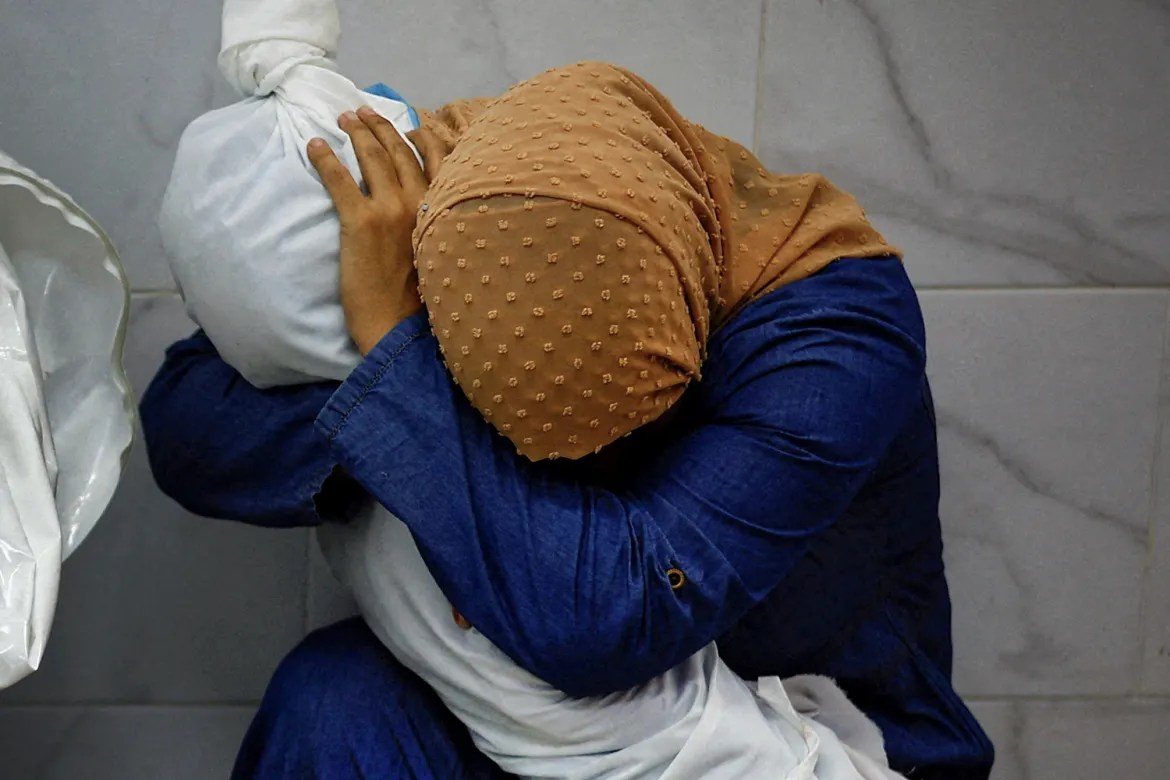
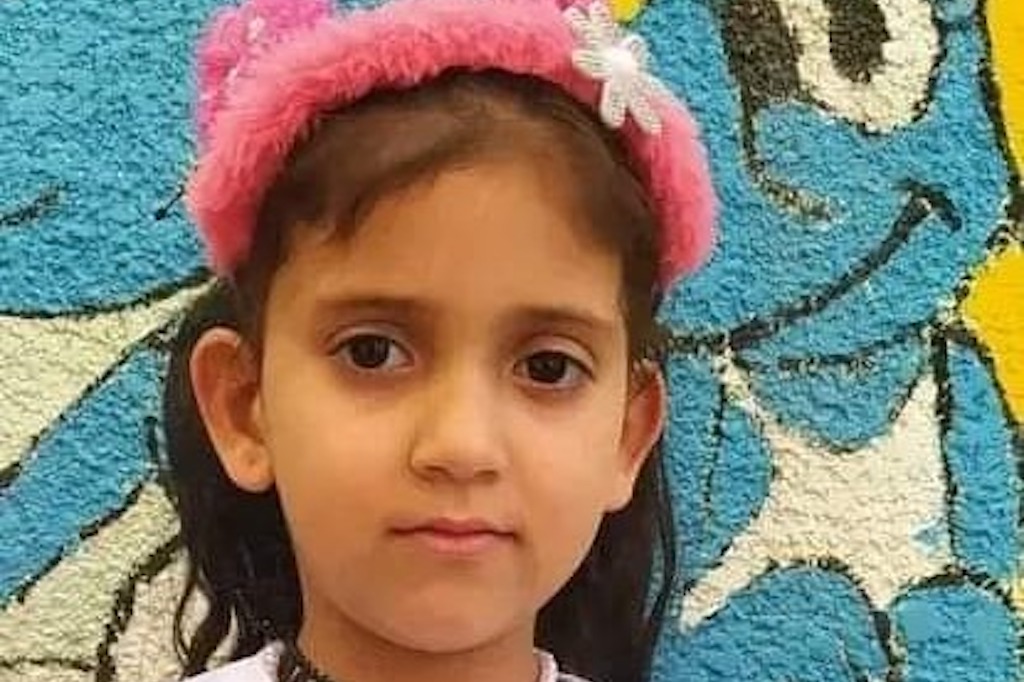
Alaa Abdullah Riyad Qaddoum, age 5, killed by the Israeli military in Gaza City on August 5, 2022.
In August 2014, the Jewish festival of Tisha B’Av arrived as Israel was waging a military onslaught on Gaza that would eventually kill 2,251 Palestinians, 1,462 of whom were civilians, including over 500 children. Tisha B’Av is traditionally observed a day of mourning over the destruction of the Temple in Jerusalem and by extension, the tragedies that have befallen the Jewish people throughout its history. To mark the occasion of the festival in 2014, I wrote a new version of the first chapter of Lamentations (the Biblical book traditionally chanted on Tisha B’Av). At the time, I suggested this new version be added to the ceremony to acknowledge the massive tragedy the state of Israel was inflicting on Palestinians in Gaza in the name of the Jewish people.
Now eight years later, the eve of Tisha B’Av 2022 arrives this evening amidst yet another grievous military assault on Gaza. As of this writing, 24 people have been killed and over 120 more have been wounded. The Israeli military reports it is preparing for a week long operation “that could take longer, if needed.” It is not currently engaging in any ceasefire negotiations.
As in 2014, Israel, its supporters and the mainstream media at large are selling this latest military onslaught by claiming “Israel has a right to defend itself” from Gazan rocket fire. But as I wrote about Israel’s actions in 2014, this is a cynical and empty posture. As was the case eight years ago, this new war on Gaza was openly and unabashedly provoked by Israel. The timeline leading up to this latest assault is a matter of public record that is available to anyone interested in reading past Israel’s hollow propaganda:
• This past May, it was reported that the Israeli military was expanding what it described as a “bank of targets” in the Gaza Strip it had identified since its most recent military offensive in 2021.
• On Monday, August 1, the Israeli military arrested Bassam al-Saadi, a senior member of the Palestinian Islamic Jihad (PIJ), during a raid on the Jenin refugee camp. The PIJ issued threats in response but took no action.
• Concerned that the PIJ would attack in retaliation, the Israeli military directed authorities to close roads near the Gaza border.
• Yesterday, claiming that it was responding to an “imminent threat,” Israel unleashed a wave of airstrikes in Gaza, killing PIJ military commander Tayseer Jabari along with seven other people, including a 5 year old girl, Alaa Abdullah-Riyad Qaddoum.
• The PIJ retaliated by sending more than 100 missiles into Israel. The Israeli military reported that it had intercepted about 95 percent of the rockets. There were no reports of significant property damage.
• The US Ambassador to Israel, Tom Nides, stated that “the United States firmly believes that Israel has a right to protect itself.”
This is, in short, purposeful wanton aggression. That it is repeatedly committed against a blockaded, besieged population of 2,000,000 who literally have nowhere to run raises it to the level of atrocity. It is no less abominable to rationalize it away by with the bromide that “Israel has the right to defend itself” or to blame Palestinians themselves for their own destruction by invoking the allegation of “human shields” – a false claim that has been repeatedly disproved by human rights observers.
These rationalizations are particularly profane in the way they rob Palestinians of their basic humanity. I remember thinking of precisely this on Tisha B’Av 2014 – and how incongruous it felt to engage in a ceremony of grief over Jewish loss while a nation state purporting to act in the name of the Jewish people inflicted such unspeakable losses on another people.
According to Jewish tradition, the fall of the Temple was caused by internal sinat chinam – baseless hatred – that wracked the disempowered, besieged Jewish community of ancient Jerusalem. In the age of Zionism, it seems to me, we must be ready to acknowledge a different kind of sinat chinam – one that is wielded by a Jewish state power against a people it continues to disempower and besiege.
As in 2014, I will not be mourning the destruction of the Temple this Tisha B’Av. I will be mourning the losses of yet another merciless war waged by Israel against the Palestinian people. And as in 2014, this will be my lament:
For these things I weep: for the toxic fear we have unleashed from the dark place of our hearts for the endless grief we are inflicting on the people of Gaza.
The Jewish festival of Tisha B’Av begins this Saturday evening, July 21. In anticipation of the day, I’m reposting the new poetic take on Lamentations that I wrote last year.
While this Biblical book is an expression of Jewish communal loss, my new version places these themes in a universal 21st century context, set in a not-too-distant future that I fervently hope shall never come to pass. In this reimagining, it is less an elegy for what was lost than a spiritual/poetic warning about a future cataclysm that is, in many ways, already underway.
May the grief of this Tisha B’Av give us all the strength to fight for the world that somehow still might be.
A new rendering of Zechariah 2:14 – 4:7 (Prophetic reading for the Sabbath of Hanukkah)
Let loose your joy for
your prayers have
already been answered;
even in your exile
the one you seek has been
dwelling in your midst
all along.
Quiet your raging soul
and you will come to learn:
every nation is my nation
all peoples my chosen
anywhere you choose to live
will be your Holy Land,
your Zion, your Jerusalem.
Open your eyes and
look across the valley
look at this ruined land
seized and possessed
throughout the ages.
Look upon your
so-called city of peace
a place that knows
only debasement
and desecration
at your hand.
Turn your gaze to the heavens
and there you will find
the Jerusalem that you seek:
a city that can never be conquered,
only dreamed of, yearned for, strived for;
a Temple on high
that can never be destroyed.
No more need for priestly vestments
or plots to overrun that godforsaken mount –
just walk in my ways
and you will find your way there:
a sacred pilgrimage to the Temple
in any land you call home.
Enter the gates to
this holiest of holy places,
lift up its fallen walls,
relight the branches of the lamp
so that my house will truly
become a sanctuary
for all people.
Yes, this is how you will
restore the Temple:
not by might, not by power
but by the spirit
you share with every
living, breathing soul.
In response to Donald Trump’s announcement yesterday recognizing Jerusalem as Israel’s capitol, Benjamin Netanyahu stated, “Jerusalem has been the focus of our hopes, our dreams, our prayers for three millennia.” Very true – however for centuries these prayers were irrevocably bound up with the coming of the messiah.
Apart from all of the political analyses about this latest maneuver, this point bears repeating: Zionism has always been, in its way, a kind of false messiah.
I’m not the first to point this out. Back in 1928 for instance, the venerable Jewish scholar Gershom Scholem commented:
The messianic phraseology of Zionism, especially in its decisive moments, is not the least of those Sabbatian temptations which could bring disaster to the renewal of Judaism.
I genuinely believe that the disaster Scholem wrote of has already come to pass. This zealous drive for political sovereignty and control over Jerusalem as the “eternal undivided capitol of the Jewish people” is itself a kind of idolatry. Now I fear a much more cataclysmic disaster is waiting in the wings.
Scholem’s comment about Sabbatianism is instructive in this regard. Shabbatai Tzvi after all, was a false messiah who gained a tremendous Jewish following in the 17th century. His claim to be the chosen one that would lead the Jews back to their sovereign homeland caused so much upheaval that he was forced on pain of death to convert to Islam by the Sultan. His apostasy caused massive disillusionment and schisms that throughout the Jewish world.
Shabbatai Tzvi was very much a product of his time. He arose during a period in a period in the 1600s when a Puritan form of millenarianism was sweeping Europe. Coming primarily out of England, this ideology predicted that the Jewish people would literally return to establish a sovereign state in their Biblical homeland – an event that would bring about the apocalypse and the Second Coming of Christ. If this ideology sounds familiar to you, this is the very same millenarianism that is espoused by American Christian Zionists today. It was indeed brought to our shores by Puritan colonists.
It is safe to say that Jewish political Zionism could not have succeeded without the support of Christian millenarians. Reverend William Hechler, a prominent English clergyman who ascribed to eschatological theology and the restoration of the Jews to the land of Israel, was a close friend and colleague of Theodor Herzl, the founder of the political Zionist movement. Lord Arthur Balfour, who issued the historic Balfour Declaration in 1917 was likewise a Christian Zionist, motivated as much by his religious convictions as by British imperial designs in the Middle East.
Today of course, Christian Zionists are most famously represented by Pastor John Hagee and Christians United for Israel (CUFI), the largest coalition of Evangelical Zionists in the world. Hagee has never made a secret of his apocalyptic religious views. In his 2007 book “Jerusalem Countdown,” he wrote that Armageddon might begin “before this book gets published.” He also claimed The Antichrist “will be the head of the European Union,” and that during the final battle, Israel will be covered in “a sea of human blood.” The Jews, however, will survive long enough to have “the opportunity to receive Messiah, who is a rabbi known to the world as Jesus of Nazareth.” In Hagee’s more recent book, “Four Blood Moons,” he wrote: “In these next two years, we’re going to see something dramatic happen in the Middle East involving Israel that will change the course of history in the Middle East and impact the whole world.”
While one might expect Jewish leaders to keep their distance from a popular Christian pastor with extremist views such as these, Hagee has been closely embraced by Israeli governments (Netanyahu is a fixture at CUFI conventions), Jewish American politicians (Former Senator Joseph Lieberman has referred to Hagee as a modern-day Moses) and prominent American Jewish leaders (Elie Wiesel once called Hagee “my pastor.”)
CUFI’s Jewish Executive Director, David Brog, clearly serves to give cover to Christian Zionists, painting them as “mainstream” and not nearly as scary as their beliefs would indicate. Following the outcome of the recent election, however, Brog seems to smell blood in the water; he recently announced CUFI’s plans to get “a little more aggressive” in pushing its policies with the Trump administration, where it has clout and connections, particularly with evangelical Vice President Mike Pence.
To put it mildly, Jews should be among the least of those who would seek to find common cause with one such as Mike Pence. In an extremely important piece for the Intercept, last year, reporter Jeremy Scahill convincingly argued that Pence is “the most powerful Christian supremacist in US history,” concluding:
The implications of a Pence vice presidency are vast. Pence combines the most horrid aspects of Dick Cheney’s worldview with a belief that Tim LaHaye’s “Left Behind” novels are not fiction, but an omniscient crystal ball.
It should not come as a surprise that Pence family’s last trip to Israel was funded by, you guessed it, John Hagee. Pence, who was then the governor of Indiana, took the time to meet with Netanyahu during his visit.
Now connect those dots to the announcement yesterday. Did you notice whose smug face was peering over Trump’s shoulder?
Beware the false messiahs. And pray for the peace of Jerusalem.
Last month there was an astonishing display of successful, prayerful Palestinian nonviolent resistance, but you wouldn’t have known it from anything written in the mainstream media.
When the Israeli police installed metal detectors at the al-Aqsa mosque following an act of violence that killed two Israeli policemen on July 14, tensions on the Temple Mount were raised to an almost terrifying level. Palestinians Muslims responded, however, not with more violence but with prayer. For a week, the street in the Old City that led from Lion’s Gate to the Via Dolorosa was filled with scores of peaceful worshippers.
During the week of protest, even the right-wing Jerusalem Post noted the true meaning of this prayerful mobilization:
Although there have been clashes here during the last week, the general trend has been toward nonviolent prayer-protest. The profoundly religious aspect of this protest can be seen in the lack of Palestinian flags or outward political affiliation of the attendees. On Wednesday a dozen young men chanted against Palestinian Authority President Mahmud Abbas, but in general political speeches have been rare and religious preaching has been common.
In a +972 article entitled “How the World Missed a Week of Palestinian Civil Disobedience” Aviv Tatarksky, from the Jerusalem-based NGO Ir Amim, said:
The decision to boycott the metal detectors and refrain from going up to Al-Aqsa, the continuous stream of people to the gates of the compound, the mass prayers, all of these are a form of civil disobedience. And as such, it is a legitimate form of protest.
And from Palestinian nonviolent activist Issa Amro, writing in the Jewish Forward:
What you witnessed this week when Israel took down the metal detectors was nothing short of the triumph of nonviolence over the occupation. And while it’s true that individuals carried out violent acts, against two Druze police officers and three Israeli settlers, these are the actions of individuals, while the face of this revolution has been the faces of many Palestinians engaged in nonviolence.
While the Western political elites and media continue to paint Palestinians – and Muslims at large – as incorrigibly violent extremists, I believe it is our sacred duty to lift up stories such as these. There will undoubtedly be more acts of violence committed by individual Palestinians in the future. History has taught us that when people are oppressed, they tend to resist their oppression – yes, often violently. But we must never fall into the racist dismissal of Israel’s devastating state violence as somehow “permissible.”
It is our job to bear witness to the courageous movement of Palestinian civil disobedience, which has a venerable history and occurs virtually ever day in a myriad of ways large and small.
We might start by sharing the pictures above far and wide. They are indeed worth a thousand words.
I’ve just written a new poetic take on Lamentations, the Biblical book traditionally read on the Jewish festival of Tisha B’Av (The Ninth of Av). The context of Lamentations is fall of the 1st Temple and destruction of Jerusalem in 586 BCE; it is at once a funeral dirge for the fallen city, a lament over the communal fate of the people, a confession of the collective sins that led to their downfall and a plea to God to rescue them from their dismal fate.
When all five chapters of Lamentations are chanted on Tisha B’Av, its impact can feel shattering. Taken as a whole, it might be said that this epic lament has the raw power of a primal scream. As Biblical scholar Adele Berlin has described it:
The book’s language is highly poetic and extraordinarily moving. Even though often stereotypical, it effectively portrays the violence and suffering of the events. The experiences of warfare, siege, famine, and death are individualized, in a way that turns the natural into the unnatural or anti-natural—brave men are reduced to begging, mothers are unable to nourish their children and resort to cannibalism. The book’s outpouring is addressed to God, so that God may feel the suffering of his people, rescue them, and restore them to their country and to their former relationship with him. The entire book may be thought of as an appeal for God’s mercy. Yet God remains silent.
According to the Mishnah (an early rabbinic era legal text), Tisha B’v commemorates five historical calamities that befell the Jewish people, including the destruction of the 1st and 2nd Temples, and the crushing of the Bar Kochba rebellion. Over the centuries many other historical cataclysms have been added to be to be mourned on this day as well (including the expulsion of the Jews from England in 1290, the expulsion of the Jews from Spain in 1492 and the beginning of World War I in 1914). Although Lamentations was originally written to address a historically specific context, it’s popularity over the centuries testifies to a uniquely timeless quality.
While Lamentations is an expression of Jewish communal loss, this new version places these themes in a universal 21st century context, set in a not-too-distant future that I fervently hope shall never come to pass. In this reimagining, it is less an elegy for what was lost than a spiritual/poetic warning about a cataclysm that may be yet to come if our world does not turn from the perilous path we are currently traveling.
May the grief of this Tisha B’Av give us all the strength to fight for the world that somehow still might be.



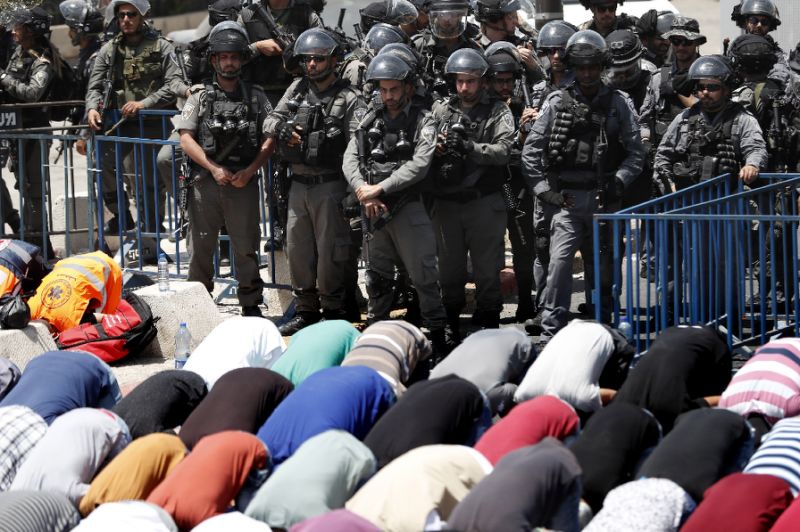 Last month there was an astonishing display of successful, prayerful Palestinian nonviolent resistance, but you wouldn’t have known it from anything written in the mainstream media.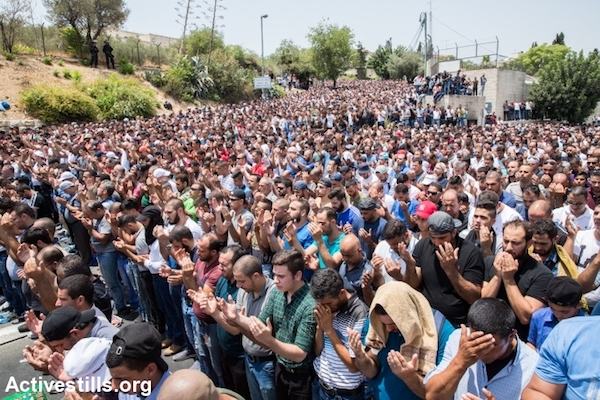
 Shalom Rav