Category Archives: Jewish Voice for Peace

Sukkot Activism: Young Jews Protest the Prawer Plan in Chicago


This past Wednesday there was a powerful action in front of the Israeli Consulate in Chicago: a Sukkot protest against the Israeli government’s Prawer Plan, which is currently poised to evict up to 40,000 Bedouin citizens of Israel from their homes in the Negev desert.

As you can see from the clip above, this action was organized by a community of young Chicago Jews inspired by the Sukkot festival’s message of shelter and salvation to stand in solidarity with Bedouin who are on the verge of devastating displacement. An inspiring example of spiritual activism at its finest – bravo to Young, Jewish Proud/Jewish Voice for Peace for spearheading this action in Chicago (as well as a simultaneous event in Boston!)

As I wrote last June, the Prawer Plan has already passed its first reading in the Knesset – and there are already disturbing indications that the plan has already begun to be implemented. If you live in the Midwest, please join us this Monday, September 30, for a collective “Call in to Stop Prawer!” (Details here.) And if you haven’t yet, please sign this Avaaz petition that urges Knesset members to follow their conscience “support a solution coordinated in cooperation with local residents instead of this discriminative bill.”

601589_10101081122069727_1933659252_n

“Wrestling in the Daylight” in Seattle

Here’s a great quality video of my entire speaking appearance at University Friend’s Meeting in Seattle this past Monday night. I attended series of wonderful – and at times inspiring – events during my short stay in the Northwest and will be reporting on them in due course.  In the meantime here’s a taste:

On Open Hillel, Open Debate and Open Minds

logo

Last November, Harvard’s Progressive Jewish Alliance prepared to sponsor “Jewish Voices Against the Occupation.” One week before it was set to take place at Harvard Hillel, Hillel decided to pull the plug on the program. Why? Because Harvard College Palestine Solidarity Committee was a co-sponsor.

In defense of its position, Harvard Hillel cited the guidelines of Hillel International that state Hillel organizations “will not partner with, house, or host organizations, groups, or speakers” that support the “boycott of, divestment from, or sanctions against the state of Israel.” And since the Harvard PSC promotes boycott, divestment and sanctions, this was enough for Hillel to kibosh a program sponsored by a Jewish student group.

If this sounds vaguely like deja vu to you, that’s because back in March 2011, Brandeis University Hillel refused to allow student chapter of Jewish Voice for Peace to affiliate under its umbrella, citing the very same guidelines. Then senior Lev Hirschorn commented at the time:

We feel like we deserve a seat at the Jewish communal table, but there is a sense that dissent on the question of Israel is not really acceptable.

As open debate and discussion have been indelible aspects of Jewish culture from time immemorial these attempts at muzzling students’ voices are particularly egregious. Hillel International’s guidelines (which are not obligatory for local Hillels) essentially ensure that there will be no honest and open Jewish conversations about Israel on campuses across the country. They will most certainly exclude growing Jewish student groups such as JVP – and they will also prevent Hillels from inviting co-sponsorship or dialogue with Palestinians, since almost all Palestinian campus groups support BDS.

Trust me on this: this has everything to do with the Jewish establishment’s fear of letting young Jews think for themselves on the subject of Israel. Not convinced? Just read this recent piece in the Washington Jewish Week, in which Rabbi Stuart Weinblatt (chairperson of the Jewish Federations of North America Rabbinical Council) offered up this choice observation:

I think it is important to begin to help prepare our children for what they are going to encounter on college campuses in regard to pro-Palestinian groups, the anti-Israel groups on Israel and radical fringe groups like Jewish Voices for Peace.

These are not J Street. Our kids are relatively sheltered, and they go to college and are confronted with hostility and misinformation. I want them to be equipped with the knowledge and understanding of the historical justification for the existence of the state of Israel.

Well that certainly says it all. We need to protect our poor, vulnerable, non-critically thinking young people from Jewish Voice for Peace and other groups that advocate for the rights of Palestinians.  Since we can’t trust college students to think for themselves, we must “equip” them with what we deem to be the acceptable historical Jewish opinions on Israel. This profoundly patronizing, pseudo mind-controlling approach to Jewish outreach explains why the Jewish establishment is fast making itself irrelevant to young people – and why it feels compelled to allocate hundreds of millions of dollars yearly to send college students on all expenses paid Birthright junkets and free trips to the National AIPAC Convention.

Please join me in advocating for a Jewish student community that respects a plurality of Jewish student voices on Israel/Palestine. Please sign this petition by Open Hillel, a coalition of students that seek to change the “standards of partnership” in Hillel International’s guidelines and encourages local campus Hillels to adopt policies that “allow for free discourse on all subjects within the Hillel community.”

From the Open Hillel website:

We believe deeply in the ideal, expressed in Hillel International’s mission statement, of a vibrant, pluralistic Jewish community on campus, in which all people, regardless of their religious observance, past Jewish experience, or personal beliefs, are welcome. In many ways, Hillel has been remarkably successful at fostering such a pluralistic and inclusive community, bringing together students from different backgrounds to learn from and support one another, as well as to openly debate and discuss their differing views. We believe that this pluralism should be extended to the subject of Israel, and that no Jewish group should be excluded from the community for its political views.

In addition, we believe that inter-community dialogue and free discourse, even on difficult subjects, is essential in the context of an educational institution and a democratic society. Open discussion and debate is a Jewish value, and we are proud of our culture’s long tradition of encouraging the expression of multiple, even contradictory, views and arguments. However, Hillel International’s current guidelines encourage Jewish students to avoid seriously engaging with Palestinian students or other students on campus with differing views on Israel-Palestine. This is detrimental to the goal of encouraging mutual understanding, cooperation, and peace. Thus, we believe it is essential that Hillel-affiliated groups be able to partner with other campus groups in order to share perspectives, cooperate in those areas where we agree, and respectfully debate in those areas where we disagree.

Sure doesn’t sound like the words of “sheltered,” “unequipped” young people to me…

American Rabbis to Obama: Hold Netanyahu Accountable!

Obama-and-Netanyahu-rangling-over-Iran

The following letter was just released by Jewish Voice for Peace and will soon be delivered to the White House:

Dear President Obama,

We are writing this letter to you as American rabbis, cantors and rabbinical students, serving a wide range of Jewish communities.   We were dismayed to learn that, immediately following the recognition by the United Nations of observer status for Palestine, the government of Israel issued permits to begin development of two large tracts of settlement housing in highly contested areas in  East Jerusalem (E-1) and the West Bank (Maaleh Adumim.)

As you well know, these expansion permits are damaging not only to prospects for Palestinian self-determination but also for peace in the region.  We urge you in the strongest terms to use your full authority to oppose these expansions, which are illegal under international law and which also make impossible any hope of creating a viable Palestinian state in the West Bank.

We represent a growing voice within American Jewry which seeks an end to Israel’s occupation of the West Bank and its stranglehold by blockade of the people of Gaza.  We believe that the aggressive expansion of settlements in the Occupied territories constitutes a deliberate strategy to obstruct a peaceful resolution to the conflict between Israel and Palestine.  We believe further that the United States, as the primary global source of financial and political support for the  Israeli government, has an obligation to hold the Netanyahu government accountable for these actions, which thwart the possibility of peaceful resolution of the conflict.

It is no longer the case — if it ever was — that the Jewish community in the United States  is unified in its support of the policies of successive Israeli governments, which have sought to create “facts on the ground” that obstruct the hopes of independence and sustainability for the Palestinian people.  Absent active intervention by the United States and other nations, Israel will surely continue to implement these destructive policies.

As leaders of the American Jewish community, we join you in hope for a just peace for all the peoples of the region.  Please know that you have our strong support for demanding that the government of Israel reverse for this latest action and for all that you can do to lead the way to a fair and sustainable resolution.

Yours sincerely,

Rabbi Margaret Holub

Rabbi Brant Rosen

Rabbi Brian Walt

Rabbi Lynn Gottleib

Rabbi Joseph Berman

Rabbi Laurie Zimmerman

Rabbi Elizabeth Bolton

Rabbi Julie Greenberg

Rabbi Borukh Goldberg

Rabbi Eyal Levinson

Rabbi David Mivasair

Rabbi Rebecca Lillian

Rabbi Rachel Barenblat

Alana Alpert

Cantor Michael Davis

Rabbi Michael E. Feinberg

Rain Zohav

Rabbi Zev-Hayyim Feyer

Jessica Rosenberg

Ken Rosenstein

Rabbi Shai Gluskin

Rabbi Rebecca Alpert

Ari Lev Fornari

Rabbi Art Donsky

Rabbi Jeremy Milgrom

Rabbi Linda Holtzman

Rabbi Leonard Beerman

Rabbi Alexis Pearce

Rabbi Sarra Lev

David Basior

Some Final Thoughts on the United Methodist Divestment Vote

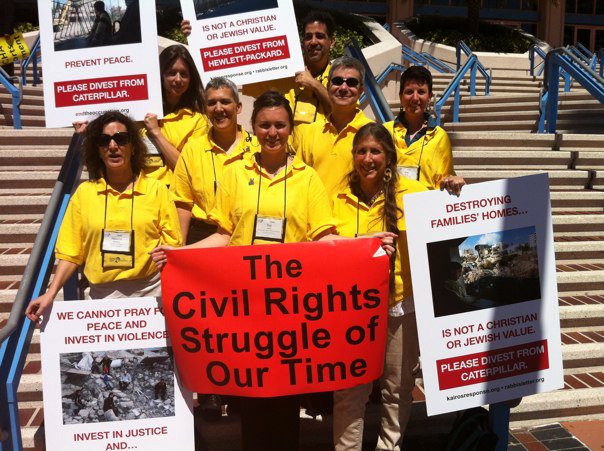
Jewish activists at the 2012 UMGC in Tampa, from left to right: Rebecca Vilkomerson (Executive Director of Jewish Voice for Peace), Anna Baltzer, (National Organizer, US Campaign to End the Israeli Occupation), Dalit Baum (Founder, “Who Profits?”), Rae Abileah (Co-director, CODEPINK Women for Peace), Sydney Levy, (Director of Advocacy, JVP), Rabbi Brant Rosen, Rabbi Lynn Gottlieb (Founder, Shomer Shalom Center for Jewish Nonviolence), Ariel Vegosen (Fair Trade and Media Social Justice Activist)

After the United Methodist divestment resolution was voted down at the UM General Conference last week, I’ve received my fair share of gloating responses from divestment opponents.  (Award for the most colorful goes to “Tzahal,” who sent in this attention-grabber: “BDS Fail, you f***ing KAPO”).

Actually, while many of us were disappointed by the final vote, I don’t view this as a fail. Not by a long shot.

First of all, as I reported from Tampa, I was deeply inspired to meet so many remarkable activists – Christians, Muslims, Palestinians, Israelis and American Jews – who constitute a new community of conscience working for justice in Israel/Palestine. This new interfaith/inter-ethnic coalition is growing rapidly and we are most certainly succeeding in raising conscience and awareness each time these kinds of resolutions are brought forth.

Beyond the final vote on this one specific resolution, we should consider it a success that these issues are increasingly being publicly discussed by our religious communities. My fellow activists and I had numerous conversations with delegates in the convention hall and we were heartened to engage so many people so honestly on this difficult issue. I was particularly gratified to speak with the numerous African delegates (who constituted 40% of the convention) who immediately understood the very real parallels to the legacy of colonialism in their own countries.

In addition, as my fellow activist Anna Baltzer recently pointed out, while the divestment resolution did not ultimately pass, the UM General Conference did adopt a resolution that among other things urged the US government to “end all military aid to the region,” called on all nations “to prohibit… any financial support by individuals or organizations for the construction and maintenance of settlements,” and “to prohibit… the import of products made by companies in Israeli settlements on Palestinian land.”

In BDS terms, this means that while the United Methodists did not affirm D (“Divestment”), they did support B and the S (“Boycott” and “Sanctions”).  No small statement, this.

I am coming away from this experience more convinced than ever that divestment is a critical tool in our quest for a just peace in I/P.  Over and over I’ve heard that divestment is an unduly harsh and polarizing tactic – and that the emphasis should be on positive engagement and investment. This, despite the fact that decades of political engagement by our government have failed miserably. This despite almost a decades worth of failed attempts by church groups to engage companies such as Caterpillar, Motorola Solutions and Hewlett/Packard – companies that literally profit from an oppressive, illegal occupation.

Add to this the testimonials of numerous Palestinian leaders who addressed “positive investment” by telling us it wasn’t charity they needed, but real, actual justice. In the words of Zahi Khouri, a prominent Palestinian Christian businessman and CEO of Coca-Cola Palestine:

It may shock you, but whenever there is a viable project identified in Palestine, we can raise the funds. We don’t need your financial help, your charity. What we need is to be able to operate freely. Divestment is the best, most immediate way that you can help us achieve that. We have been waiting for more than 40 years; we need action now.

Archbishop Desmond Tutu was so correct when he urged support of the divestment resolution by invoking MLK’s “Letter from a Birmingham Jail.” Then, as now, those who sought justice were counseled by religious leaders to “be patient” and to address the issue of oppression through engagement and non-confrontational tactics. Then, as now, there was an assumption that those who wielded corrupt power could somehow be “convinced” to give up their power voluntarily. Then, as now, this kind of patronizing counsel rings hollow and false in the ears of those who continue to suffer daily from ongoing injustice and persecution.

No, this was not a fail. There is a movement is building and this was only the beginning. Stay tuned. Similar resolutions will soon be considered in Pittsburgh at the General Assembly of the Presbyterian Church (USA) and the General Convention of the Episcopal Church in Indianapolis.

My new colleagues and I look forward to continuing this sacred work together.

Archbishop Tutu in Support of Methodist Divestment

Archbishop Desmond Tutu has just written a powerful op-ed in support of United Methodist church divestment.

I have no doubt that he will once again incur the wrath of the Jewish establishment – especially since he criticizes the 1,200 rabbis who recently signed a public letter opposing church divestment:

While they are no doubt well-meaning, I believe that the rabbis and other opponents of divestment are sadly misguided. My voice will always be raised in support of Christian-Jewish ties and against the anti-Semitism that all sensible people fear and detest. But this cannot be an excuse for doing nothing and for standing aside as successive Israeli governments colonize the West Bank and advance racist laws.

I recall well the words of the Rev. Martin Luther King Jr. in his Letter from a Birmingham Jail in which he confesses to his “Christian and Jewish brothers” that he has been “gravely disappointed with the white moderate … who is more devoted to ‘order’ than to justice; who prefers a negative peace which is the absence of tension to a positive peace which is the presence of justice; who constantly says: ‘I agree with you in the goal you seek, but I cannot agree with your methods of direct action;’ who paternalistically believes he can set the timetable for another man’s freedom. …”

King’s words describe almost precisely the shortcomings of the 1,200 rabbis who are not joining the brave Palestinians, Jews and internationals in isolated West Bank communities to protest nonviolently against Israel’s theft of Palestinian land to build illegal, Jewish-only settlements and the separation wall. We cannot afford to stick our heads in the sand as relentless settlement activity forecloses on the possibility of the two-state solution.

Hear, hear. His invocation of MLK’s “Letter from a Birmingham Jail” is apt and spot on.

I’m particularly appreciative of the Archbishop’s shout out to “the brave rabbis of Jewish Voice for Peace.”  It’s wonderful to see our letter of support garnering such widespread acclaim from so many quarters.  And it’s especially gratifying to be showing a decidedly different face of the Jewish community to our brothers and sisters in the Christian community over this issue.

The divestment resolution is scheduled to voted on by the UM Conference plenum tomorrow. Stay tuned.

I Support the Presbyterian Church (USA) Divestment Resolution

As a Jew, a rabbi and a person of conscience, I am voicing my support of the divestment resolution being brought to the General Assembly of the Presbyterian Church (USA) this June.

This resolution, which has been a point of divisive contention between the PC (USA) and some American Jewish organizations for many years,  recommends that the Church divest its funds from Caterpillar, Motorola and Hewlett-Packard. It was put forth by the church’s committee on Mission Responsibility Through Investment – an appointed body that recommended church divestment of companies engaged in “non-peaceful pursuits in Israel/Palestine.”

There is a long and tumultuous history to this resolution – here’s a basic outline:

– In 1971 and 1976 the Presbyterian Church stated that it had a responsibility to ensure that its funds be invested responsibly and consistent with the church’s mission.

– In 1986, the PC (USA) formed the Committee for Mission Responsibility Through Investing (MRTI) in 1986. The MRTI Committee carried out the General Assembly’s wish to engage in shareholder activism and as a last resort, divest itself of companies which contravened the GA’s position. Divestment would follow a phased process starting with attempted dialogue and shareholder resolutions and ultimately the total sale of and future ban on the church’s holdings in a company.

– In June 2004, the PC (USA) General Assembly adopted by a vote of 431-62 a resolution that called on the MRTI Committee “to initiate a process of phased, selective divestment in multinational corporations operating in Israel.” The resolution expressed the church’s support of the Geneva Accord, said that “the occupation . . . has proven to be at the root of evil acts committed against innocent people on both sides of the conflict,” that “the security of Israel and the Israeli people is inexorably dependent on making peace with their Palestinian neighbors”, that “horrific acts of violence and deadly attacks on innocent people, whether carried out by Palestinian suicide bombers or by the Israeli military, are abhorrent and inexcusable by all measures, and are a dead-end alternative to a negotiated settlement,” and that the United States government needed to be “honest, even-handed broker for peace.”

– In 2005, MRTI Committee named five US-based companies – Caterpillar Inc., Citigroup, ITT Industries, Motorola and United Technologies – for initial focus and that it would engage in “progressive engagement” with the companies’ management.

– In 2006, following an uproar of criticism from American Jewish organizations, the PC (USA) General Assembly overwhelmingly (483-28) replaced language adopted in 2004 that focused the “phased, selective divestment” specifically on companies working in Israel.  It now called for investment in Israel, the Gaza Strip, eastern Jerusalem and the West Bank “in only peaceful pursuits.” The new resolution also required the consideration of “practical realities,” a “commitment to positive outcomes” and an awareness of the potential impact of strategies on “both the Israeli and Palestinian economies.”  The 2006 resolution also recognized Israel’s right to build a security barrier along its pre-1967 boundaries. The GA acknowledged the “hurt and misunderstanding among many members of the Jewish community and within our Presbyterian communion” that resulted from the 2004 resolution and stated that the Assembly was “grieved by the pain that this has caused, accept responsibility for the flaws in our process, and ask for a new season of mutual understanding and dialogue.”

The most recent resolution is the result of this new process and now focuses on three of the original six companies under consideration.  From the PC (USA) website:

The General Assembly Mission Council (GAMC) is recommending that the upcoming 220th General Assembly of the Presbyterian Church (USA) divest the church of its stock in three companies “until they have ceased profiting from non-peaceful activities in Israel-Palestine.”

The three companies are Caterpillar, Motorola Solutions and Hewlett-Packard.

At issue are their participation in the Israeli occupation of the West Bank, the construction of the “security barrier” between Israel and Palestinian territory, and the destruction of Palestinian homes, roads and fields to make way for the construction of Israeli settlements in the West Bank, which have been declared illegal under international law.

“We have run out of hope that these companies are willing to change their corporate practices [in Israel-Palestine],” said the Rev. Brian Ellison, a Kansas City pastor and chair of the denomination’s Mission Responsibility Through Investment Committee (MRTI). “We have made diligent effort to engage in conversation. We’d like to do more, to make progress, but substantial change does not seem possible.”

As stated above, I support this resolution without reservation and urge other Jewish leaders and community members to do so as well. I am deeply dismayed that along every step of this process, Jewish community organizations (among them, the Anti-Defamation League, the Simon Wiesenthal Center and the Jewish Council on Public Affairs) that purport to speak for the consensus of a diverse constituency have been intimidating and emotionally blackmailing the Presbyterian Church as they attempt to forge their ethical investment strategy in good faith.

It is extremely important to be clear about what is at stake here. First of all, this is not a resolution that seeks to boycott or single out Israel. Divestment does not target countries – it targets companies.  In this regard speaking, the PC (USA)’s ethical investment process seeks to divest from specific “military-related companies” it deems are engaged in “non-peaceful” pursuits.

We’d be hard-pressed indeed to make the case that the Israeli government is engaged in “non-peaceful pursuits” in the Occupied Territories and East Jerusalem.  I won’t go into detail here because I’ve been writing about this tragic issue for many years: the increasing of illegal Jewish settlements with impunity, the forced evictions and home demolitions, the uprooting of Palestinian orchards, the separation wall that chokes off Palestinians from their lands, the arbitrary administrative detentions, the brutal crushing of non-violent protest, etc, etc.

All Americans – Jews and non-Jews alike – have cause for deep moral concern over these issues.  Moreover, we have cause for dismay that own government tacitly supports these actions. At the very least, we certainly have the right to make sure that our own investments do not support companies that profit from what we believe to be immoral acts committed in furtherance of Israel’s occupation.

As the co-chair of the Jewish Voice for Peace Rabbinical Council, I am proud that JVP has initiated its own divestment campaign which targets the TIAA-CREF pension fund, urging it to divest from companies that profit from Israel’s occupation. Among these are two of the three companies currently under consideration by PC (USA): Motorola and Caterpillar.

Why the concern over these specific companies? Because they are indisputably and directing aiding and profiting the oppression of Palestinians on the ground. Caterpillar profits from the destruction of Palestinian homes and the uprooting of Palestinian orchards by supplying the armor-plated and weaponized bulldozers that are used for such demolition work.  Motorola profits from Israel’s control of the Palestinian population by providing surveillance systems around Israeli settlements, checkpoints, and military camps in the West Bank, as well as communication systems to the Israeli army and West Bank settlers.

And why is Hewlett-Packard under consideration for divestment by the PC (USA)? HP owns Electronic Data Systems, which heads a consortium providing monitoring of checkpoints, including several built inside the West Bank in violation of international law.  The Israeli Navy, which regularly attacks Gaza’s fishermen within Gaza’s own territorial waters and has often shelled civilian areas in the Gaza Strip, has chosen HP Israel to implement the outsourcing of its IT infrastructure.  In addition, Hewlett Packard subsidiary HP Invent outsources IT services to a company called Matrix, which employs settlers in the illegal settlement of Modi’in Illit to do much of its IT work at low wages.

I repeat: by seeking to divest from these companies the PC (USA) is not singling out Israel as a nation.  The Presbyterian Church has every right to – and in fact does – divest its funds from any number of companies that enable non-peaceful pursuits around the world.  In this case specifically, the PC (USA) has reasonably determined that these particular “pursuits” aid a highly militarized, brutal and oppressive occupation – and it simply does not want to be complicit in supporting companies that enable it.

I am fully aware that there are several organizations in the Jewish community that are already gearing up a full court press to intimidate the PC (USA) from passing this resolution in June.  JCPA President Rabbi Steve Gutow recently accused national Presbyterian leaders of “making the delegitimization of Israel a public witness of their church.” The Simon Wiesenthal Center has called the resolution “poisonous,” and that by considering it the PC (USA) is “showing its moral bankruptcy.”

These sorts of statements do not speak for me nor, I am sure, do they speak for the wide, diverse spectrum of opinion on the issue in the American Jewish community.  There is no place for public bullying in interfaith relations – it is, needless to say, decidedly counter to principles of honest, good faith dialogue.  To our Presbyterian friends: please know there are many Jewish leaders who stand with you as you support the cause of peace and justice in Israel/Palestine.

In a recent open letter to the PC (USA), Rabbi Margaret Holub, my colleague on the JVP Rabbinical Council expressed this sentiment eloquently with the following words:

Your Church has long been active in pursuing justice and peace by nonviolent means, including divestment, in many places around the world.  As Christians, you have your own particular stake in the land to which both our traditions have long attachments of faith and history.  We particularly acknowledge the oppression of Palestinian Christians under Israeli occupation and the justice of your efforts to relieve the oppression directed against your fellows.

To advocate for an end to an unjust policy is not anti-Semitic.  To criticize Israel is not anti-Semitic.  To invest your own resources in corporations which pursue your vision of a just and peaceful world, and to withdraw your resources from those which contradict this vision, is not anti-Semitic.  There is a terrible history of actual anti-Semitism perpetrated by Christians at different times throughout the millennia and conscientious Christians today do bear a burden of conscience on that account.  We can understand that, with your commitment to paths of peace and justice, it must be terribly painful and inhibiting to be accused of anti-Semitism.

In fact, many of us in the Jewish community recognize that the continuing occupation of Palestine itself presents a great danger to the safety of the Jewish people, not to mention oppressing our spirits and diminishing our honor in the world community.  We appreciate the solidarity of people of conscience in pursuing conscientious nonviolent strategies, such as phased selective divestment, to end the occupation.

I am proud my name is under this letter, alongside many other members of our Rabbinical Council. If you stand with us, please join us in supporting the PC (USA) divestment resolution at their GA in Pittsburgh this summer.