Category Archives: Judaism

Shabbat Shalom, Donald Trump!

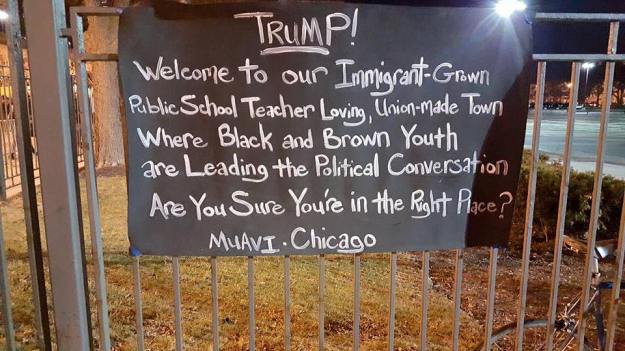
12801612_10209214380945315_4693110439226539460_n

Here is the letter I included in my weekly Friday e-mail to my congregants at Tzedek Chicago:

Dear Haverim,

One week ago, Tzedek Chicago cancelled its regularly scheduled Shabbat service in order to attend the Trump protest that was being held outside the UIC Pavilion. It just felt as if this was just too critical a moment to let pass by, particularly for a congregation committed to social justice and anti-racism. As I wrote to you in last week’s email: “Clearly this is not the most conventional way to greet Shabbat. Nevertheless, I do believe – and trust you will agree – that this is where we need to be.”

In the end, about twenty Tzedek members attended the event – and I think all who were there would agree with me that I say it was one of the most powerful Shabbat moments we have ever experienced.

When we arrived there was still a very long line of people waiting to get into the arena. We couldn’t help but notice that the attendees were exceedingly diverse: there were people wearing Trump swag along with women in hijabs, men and women cheering for Trump alongside African Americans wearing “Black Lives Matter” shirts. While it was clearly a tense and uncomfortable atmosphere, there was was no physical violence we could see among those waiting in line.

When we crossed the street to where the protest was being held, we were swept into a huge sea of people that was quickly being cordoned off by a massive police presence. As the crowd grew, it grew more difficult to keep our contingent together – and eventually we were separated into groups. A variety of different speakers took the microphone and led chants as those attending the rally continued to file into the pavilion.

While the majority of protestors seemed to be of college age, it was clearly an ethnically diverse crowd. It also quickly became evident that this protest was not just about Donald Trump. As Tzedek member Liz Rose subsequently wrote in her post for the blog Mondoweiss:

People came primarily to protest Trump, of course.  But they were trying to draw attention to other pertinent issues as well (issues which might only worsen if Trump is elected).  The diverse crowd was a convergence of these frustrations.  Some protesters carried signs calling for Anita Alvarez to leave Chicago with Trump (Alvarez is the District Attorney who waited a year before bringing murder charges against the officer in the Laquan McDonald case).  Many Chicago public school teachers were at the rally, wearing the red t-shirts that marked the 2012 strike (the Chicago Teachers’ Union is currently prepared to strike again if an agreement cannot be reached regarding their contract).  Black Lives Matter signs and t-shirts were seen throughout the crowds as well, joined by chanting of the now-famous phrase…A scattering of signs showing solidarity with Palestine could be seen throughout the rally.

When word spread through the crowd that Trump had cancelled his event, we were quite simply, dumbstruck. None of us expected this to happen, nor did we ever believe it to be the goal of the protest. At any rate, our shock soon turned to joy and celebration when we realized that together, we had managed to keep the world’s most public purveyor of hate speech from speaking in Chicago.

After celebrating the moment, a group of us walked over to a nearby park and made kiddush and motzi together. It was, as I has suspected it would be, a Shabbat like no other.

Many of us had friends who were on the inside of the pavilion who told us later that there was no real violence in the arena either. Contrary to news reports, the attendees waited together fairly quietly until it was officially announced that the rally was being cancelled. At that point, anti-Trump protestors started cheering and celebrating. This precipitated some scuffling, pushing and shoving in some parts of the arena. But as my friends all reported to me, there was nothing they would describe as “violence.”

In fact, considering that this protest had no clear leaders or organizers, the level of restraint we witnessed outside was quite remarkable – which is why I was truly dismayed to see our protest portrayed as a violent melee in news reports. That is, alas, the power of our 24 hour media. (I couldn’t help but notice that TV reports on the protest repeated the same one or two clips of pushing and shoving over and over.)

I do believe that the media’s characterization of these events follows a common narrative – one that repeatedly portrays street as protesters disruptive trouble makers who are only interested in shutting down freedom of speech. (Leaders of the Black Lives Matter movement surely know this media narrative all to well.) In fact, as any who have attended such protests in Chicago will attest, the overwhelming majority of these protests are nonviolent actions organized to raise a collective voice against racism and injustice.

I’m also struck by those who claim that these kinds of protests infringe on “freedom of speech.” It’s a curious use of the term. The First Amendment of the Constitution, in fact, is intended to be a restriction on the government’s ability to prohibit the public from exercising their freedom of speech. That certainly does not apply in this case. If Freedom of Speech has any relevance to this particular situation at all, it is that “we the people” had exercised our right to freely assemble and protest. (There are, however, laws that prohibit hate speech – laws that might certainly apply to one such as Trump.)

I can’t vouch for what might have happened at rallies in other cities, but I suspect the protesters were nowhere near as violent as the media (and Trump) would have us believe. As a result, some on the left are counseling passivity and quiet is the best course of action in response to a “bigot and bully” such as Trump.

I disagree. Generations from now, we will be asked where we were during Trump’s toxic Presidential campaign. I’m proud to say we were among those who stood up and kept him from spreading his hate in our city.

Anti-Zionism Isn’t a ‘Form of Discrimination,’ and It’s Not anti-Semitism

2261882899

Cross-posted with Ha’aretz

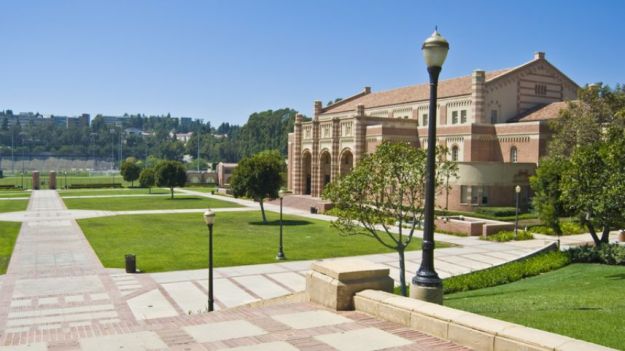
As an alum of UCLA, I was particularly interested when I learned that the working group for the Regents of the University of California Board had released their draft “Statement of Principles Against Intolerance.”  Having followed the news at my alma mater I knew that despite its title, this report wasn’t going to be merely a general statement about the importance of tolerance on campus. It was written in response to allegations of rising anti-Semitism at UCLA and other UC campuses.

On the face of it, there is much to admire about the report, particularly its strong support of campus environments “in which all are included, all are given an equal opportunity to learn and explore, in which differences as well as commonalities are celebrated, and in which dissenting viewpoints are not only tolerated but encouraged.”

In the end, however, this “Statement of Tolerance” actually achieves the exact opposite of its stated goals. If heeded, it would serve to silence dissent and open debate on college campuses.

At the beginning of the draft report, it states:

Fundamentally, commenters noted that historic manifestations of anti‐Semitism have changed and that expressions of anti‐Semitism are more coded and difficult to identify.In particular, opposition to Zionism often is expressed in ways that are not simply statements of disagreement over politics and policy, but also assertions of prejudice and intolerance toward Jewish people and culture.

The statement thus concludes that “anti‐Semitism, anti‐Zionism and other forms of discrimination have no place at the University of California.”

It is certainly important to state unequivocally that anti-Semitism will not be tolerated on UC campuses. But it is incorrect and even disingenuous of the report to make the unsupported claim that anti-Zionism is “often expressed (as) assertions of prejudice and intolerance toward Jewish people and culture,” and blithely conflate anti-Semitism with anti-Zionism as a “form of discrimination”.

It is true that some anti-Semites lurk behind the label of anti-Zionism – and when they do they should rightly be exposed and condemned. But it is deeply problematic to label anti-Zionism as a form of discrimination.

In fact, growing numbers of Jews and others identify as anti-Zionists for legitimate ideological reasons. Many profess anti-Zionism because they do not believe Israel can be both a Jewish and democratic state. Some don’t believe that the identity of a nation should be dependent upon the demographic majority of one people over another. Others choose not to put this highly militarized ethnic nation-state at the center of their Jewish identity.  Far from being discriminatory, their beliefs are motivated by values of equality and human rights for all human beings.

Blurring the distinction between anti-Zionism and anti-Semitism muddles the definition of anti-Semitism to the point that it becomes meaningless.This conflation is irresponsible and harmful and invariably draws our attention away from real anti-Semitism, whether it be the targeting of Jews, the vandalization of synagogues and cemeteries or the proliferation of hate groups at home and abroad.

Certainly all forms of racism should be called out in no uncertain terms. But erasing the lines between anti-Semitism and anti-Zionism only makes this task more difficult.

I can’t help but notice that this report’s broadside on anti-Zionism strongly evokes the right-wing agenda of groups such as the AMCHA initiative. Tammi Rossman-Benjamin, Director of AMCHA has long made it clear that tarring anti-Zionists as anti-Semites is part of a larger strategy to ban Palestinian solidarity groups from campuses across the country.

Such a policy would have a devastating impact on Palestinian activists and their allies. It would prevent many Palestinian and Israeli human rights advocates from speaking on college campuses. It would prevent students from displaying a model of Israel’s separation wall to demonstrate to the oppressive effects of Israel’s occupation. And it would forbid student efforts to hold Israel accountable through economic pressure, through campaigns to boycott and divest from settlements or from corporations that profit from the abusive policies of the state of Israel.

Having long worked in the Jewish community, I know that some Jewish organizations equate anti-Zionism with anti-Semitism because they seek to protect Israel’s image or because they do not want Jewish college students to have to tolerate criticism of Israel and Zionism.Those who believe in a one state solution are accused of seeking “the destruction of the Jewish state” when they actually hold their position as a result of honest political analysis and a genuine concern for all who live in the land, regardless of their religion or ethnicity.

Yes, critics of Israel and Zionism can sometimes be harsh and their tactics confrontational, but I do believe we do our young people no favors when we attempt to silence them. Though I have come a long way since my UCLA days, I still remember all too well how uncomfortable it was to have one’s beliefs and opinions challenged.But we should not confuse “uncomfortable” with “unsafe.” Forbidding debate and free speech will not create more comfortable campus environments – it will only marginalize students for legitimately expressing their beliefs.

The UC Regents claims to support the open exchange of ideas on their campuses. But they will never accomplish this if they teach students that their ideas only matter if they pass a political litmus test.

“Who will be Next?” Max Blumenthal’s Yom Kippur Presentation at Tzedek Chicago

Max and BrantOn Yom Kippur, journalist Max Blumenthal delivered this powerful presentation during the afternoon program at Tzedek Chicago, where he discussed what he witnessed in Gaza during Israel’s military onslaught last summer. He wrote about his experiences at length in his recent book, “The 51 Day War: Ruin and Resistance in Gaza.”
Max attended our services for the duration of Yom Kippur and remarked to me on more than one occasion how important it was for him to be invited to speak in a Jewish congregation for the first time.

For my part, I could not think of a more appropriate presentation for the Jewish Day of Atonement.

Please watch and share…


On the Uprisings in Jerusalem: Let Israel Renounce Violence

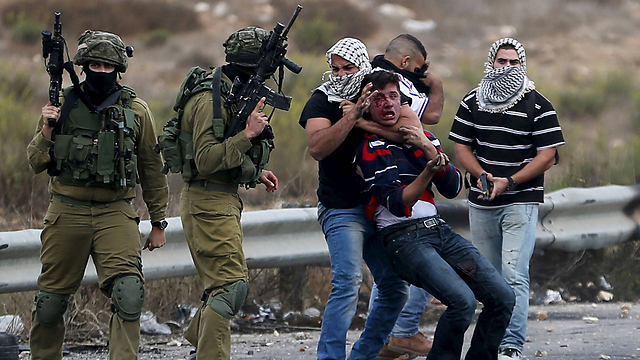
Photo: ynet.com

Photo: ynet.com

During the course of the tragic violence coming out of Jerusalem in the past week, I’ve been reading with familiar frustration the American Jewish establishment’s predictable accusations of “Palestinian incitement.” But I must confess I’m finding the reactions of some liberal Jewish leaders to be even more infuriating.

One prominent rabbi, for instance, who I know personally and would surely describe herself as on the progressive side of the Israeli peace camp, recently wrote this on her Facebook page:

Punching back with violence as a response to violence is the easy reaction. Each side has much to point to on the other side — each claims the mantel of victim, each claims the justice of their violent response. It takes courage to commit to non violence and lasting justice for all.

This is, indeed, the liberal Jewish meme when it comes to these outbreaks of violence in Israel/Palestine: “the level playing field.” According to this narrative, there is violence on both sides and peace will only come when courageous leaders on both sides commit to nonviolence.

The only problem with this narrative of course, is that it utterly ignores the all-pervasive and overwhelming nature of Israeli state violence. And given this structural imbalance of power, it is disingenuous in the extreme to somehow claim that “each side has much to point to on the other side.”

Yes, all violence is ugly and it is tragic – but this violence also exists within a context. Logically and ethically speaking, we simply cannot equate the brutal reality of state violence with the violence of those who resist it.

Yes, it does take “courage to commit to nonviolence and justice for all.” But when a state regularly employs violence to control and dominate another people, it is so very wrong to blithely call for “nonviolence” on all sides when that people inevitably fights back.

Nelson Mandela (once a “terrorist” now a “statesman”) certainly understood this when then South African Prime Minister P.W. Botha offered him the chance to be let out of prison (for the sixth time) if he publicly renounced violence – and Mandela famously responded, “Let him renounce violence.”

And even the most revered nonviolent leader of our day – Dr. Martin Luther King Jr. – had this to say in 1967 after speaking to the “the desperate, rejected and angry young men” who resorted to violence in America’s black ghettos:

I knew that I could never again raise my voice against the violence of the oppressed in the ghettos without having first spoken clearly to the greatest purveyor of violence in the world today, my own government.

Yes, those in the Jewish community who purport to support the cause of peace must first reckon with the reality of the context of violence that exists every single day by a people who live under military occupation.

How many liberal Jewish leaders have called for “nonviolence” when last year, one Palestinian was killed by the Israeli military every 4.26 days? How many called for Israeli “nonviolence” last month after the killing of  Hadeel al-Hashlamoun, an 18 year old Palestinian woman who was shot and killed by an Israeli soldier in Hebron in what Amnesty International has described as an “extrajudicial execution?” For that matter, how many called for “lasting justice” this last July, when a Palestinian family was burned alive by settlers and the Israeli government stated it “had chosen to prevent legal recourse” even though it knew the identity of the murderers?

Frankly, given this constant and all pervasive context of Israeli state violence, it’s remarkable that these kinds of Palestinian uprisings don’t break out more often than they do. But when they invariably occur, we do the cause of peace no favors when we proclaim that “each side has much to point to on the other side” and call for a renewed commitment to “nonviolence.”

How will we achieve lasting justice for all? To paraphrase the oft-quoted Nelson Mandela: “Let Israel renounce violence.”

On Sukkot and the Struggles Over Chicago’s Dyett High School and the South Side Trauma Center

TCNOW

We’re currently in the midst of the Jewish festival of Sukkot – the harvest festival that commemorates the wanderings of the Israelites in the wilderness. I’ve always been fascinated tension by an inherent tension in this holiday: on the one hand Sukkot is referred to as “Zman Simchateinu,” the “time of our rejoicing,” but it is also a time tinged with seriousness and an innate sense of existential fragility.

Yes, this is the season in which we rejoice over our bountiful harvest – but this is also the time in which we plant a new set of crops and begin our prayers for rain, keenly aware that they/we are ultimately dependent upon forces outside our control. Yes, we rejoice as we arrive at this latest point in our journey – but we build and dwell in impermanent sukkot, as if to acknowledge the challenges and trials that most certainly await us on the road ahead.

I can’t help but think of this Sukkot-tension in relation to two local struggles going on here in Chicago. The first is the movement to save Dyett High School in the South side neighborhood of Bronzeville. Dyett was one of the many Chicago public schools that was closed by the city in predominantly black and brown communities. In response, a local coalition formed that developed an extensive plan to reopen Dyett as open enrollment neighborhood school focused on Global Leadership and Green Technology.

After first refusing, CPS eventually agreed to consider the community’s plan – but when it became clear that CPS had no intention in engaging in an honest, engaged process with the community, twelve members of the coalition went on a hunger strike in protest. (It was my honor, along with members of my congregation Tzedek Chicago, to draft a Jewish community letter to Mayor Rahm Emanuel demanding that he respond to the Dyett hunger strikers request. We delivered it to the mayor’s office on the second day of Rosh Hashanah)

After three weeks, CPS announced a “compromise.” It would reopen Dyett as a neighborhood public school, but not according to the Global Leadership Plan or any of the two other plans that had since been put forth. At the time the hunger strikers rejected this decision, stating that it was made over the heads of community members and without any due consideration of the desires of those who actually live in Bronzeville. The hunger strike continued on for a total of 34 days before they ended their action due to the health concerns of some of the strikers.

In announcing the end of the strike, hunger striker Monique Redeaux-Smith commented:

While we cannot yet claim complete victory, we do understand that our efforts so far have been victorious in a number of ways … Last year, Dyett was closed. But through community resistance, it was slated to be reopened in 2016 and ’17. And even though there was a request for proposals, we know that the plan was for that space to become another privatized school within Bronzeville. But again, through community resistance and this hunger strike, we pushed CPS and the mayor to commit to reopening Dyett as a public, open-enrollment neighborhood school. So that is an accomplishment.

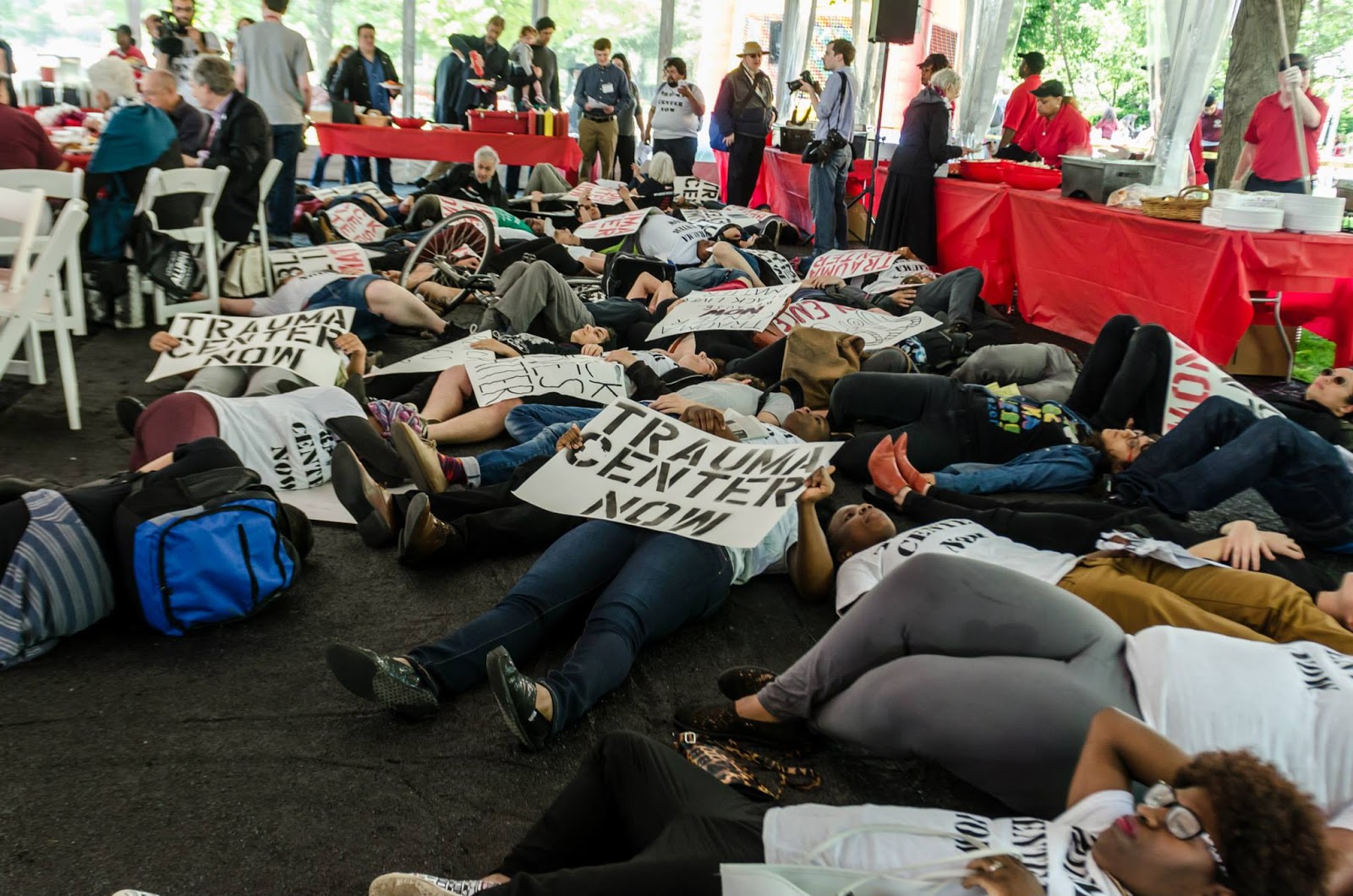
The other local struggle I’m thinking of this Sukkot is the movement to establish a Level 1 trauma center on Chicago’s south side.  There are eight adult trauma centers serving Chicago, but none are in this area that includes some of the city’s most gun violence-prone neighborhoods. Victims of gun violence are much more likely to die when more than five miles from a trauma center. As a result, large sections of the south side comprise Chicago’s only “trauma center desert.”

The campaign for a south side Level 1 adult trauma center was formally launched after 18-year-old student and youth activist Damian Turner was shot near the corner of 51st Street and Cottage Grove Avenue, just a few blocks away from the University of Chicago hospital. Turner was transported to a hospital farther away due to the absence of a nearby Level 1 trauma center, but he died an hour-and-a-half later.

The trauma center coalition was led by the remarkable youth-based grassroots organization, Fearless Leading by the Youth. Here’s an excerpt from an interview with FLY organizer Veronica Morris Moore:

As a young Black queer organizer, I feel affirmed by the trauma center campaign. The principles of the BLM movement helped us frame our tactic around the Obama library and I believe that framing our message with BLM principles put the [University of Chicago] in a big spotlight locally and nationally in terms of race issues. Having this national conversation about police shootings created opportunities to address gun violence in the Black community and the reality and root of the problem. Gun violence is the leading killer of young Black people in poor neighborhoods across this nation, and growing up on the South Side of Chicago, FLY members understand that gun violence stems from the economic violence that bankrupts our communities and bankrolls big business hospitals like the University of Chicago.

Like the Dyett HS struggle, this grassroots effort leveraged people power to shift political power. On September 10, the University of Chicago and Sinai Health System announced that they would partner to open a Level-I Adult Trauma Center at Holy Cross Hospital. But like the Dyett struggle, it was clear to organizers that the victory was not complete – having been made with no accountability or transparency to the community impacted by this decision. Moreover, in making their decision, the University of Chicago reneging on its previous commitment to raise the age of its pediatric trauma center.

If you are a member of the Chicago Jewish community you should should know that on Sunday, November 1, the Jewish Council on Urban Affairs – one of the members of the trauma center coalition – will host “L’Chaim: JCUA Community Meeting for Trauma Care” at KAM Isaiah, 1100 E. Hyde Park Ave. This meeting will provide an important opportunity to:

► Celebrate the growing momentum of this campaign, and be a part of the next victory.
► Take part in one of the most important racial justice issues facing Chicago today.
► Hear from the youth leaders that started the campaign for trauma care.
► Take action so the University of Chicago keeps all of its commitments for trauma care.

This Sukkot, let us rejoice in our victories – and let us give each other strength for the struggle that inevitably lays ahead…

The Uprooted and Unwanted: A Sermon for Tzedek Chicago’s First Yom Kippur Service

b65c5c8a711d4489888a5e00f1b443c6_18
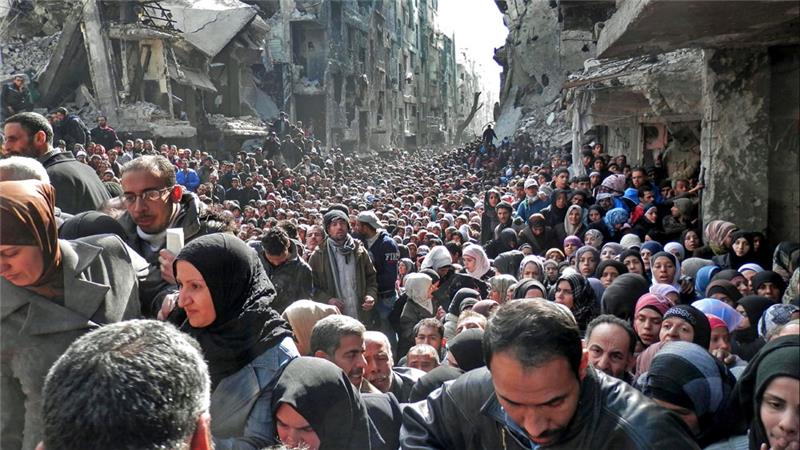
Like you, I’ve been profoundly horrified by the refugee crisis that has resulted from Syria’s ongoing civil war. The reports and images and statistics continue to roll out every day and the sheer level of human displacement is simply staggering to contemplate. Since 2011, over half of that country’s entire population has been uprooted. At present, there are more than 4 million Syrian refugees are registered with the UN. Another 7 million have been internally displaced. Experts tell us we are currently witnessing the worst refugee crisis of our generation.

The tragic reality of forced migration has been brought home to us dramatically this past summer – but of course, this crisis did not just begin this year and Syria is not the only country in the region affected by this refugee crisis. Scores are also fleeing civil war and violence from countries such as Iraq, Libya, Afghanistan and Yemen. In all of 2014, approximately 219,000 people from these countries tried to cross the Mediterranean to seek asylum in Europe. According the UN High Commissioner for Refugees, in just the first eight months of 2015, over 300,000 refugees tried to cross the sea – and more than 2,500 died.

And of course this issue is not just limited to the Middle East. It extends to places such as Latin and Central America and Sub-Saharan Africa as well – and it would be not at all be an exaggeration to suggest that the crisis of forced human migration is reaching epidemic proportions. Just this past June, the UN High Commissioner on Refugees issued a report that concluded that “wars, conflict and persecution have forced more people than at any other time since records began to flee their homes and seek refuge and safety elsewhere.”

It is all too easy to numb ourselves to reports such as these – or to simply throw up our hands and chalk it up to the way of the world. But if Yom Kippur is to mean anything, I would suggest it demands that we stand down our overwhelm. To investigate honestly why this kind of human dislocation exists in our world and openly face the ways we are complicit in causing it. And perhaps most importantly to ask: if we are indeed complicit in this crisis, what is our responsibility toward ending it?

There is ample evidence that we as Americans, are deeply complicit in the refugee crises in the Middle East. After all, the US has fueled the conflicts in all five of the nations from which most refugees are fleeing – and it is directly responsible for the violence in Iraq, Afghanistan, and Libya.

In Iraq, our decade-long war and occupation resulted in the deaths of at least a million people and greatly weakened the government. This in turn created a power vacuum that brought al-Qaeda into the country and led to the rise of ISIS. Over 3.3 million people in Iraq have now been displaced because of ISIS.

In Afghanistan, the US occupation continues and we are war escalating the war there, in spite of President Obama’s insistence that it would end by 2014. According to the UN, there are 2.6 million refugees coming out of Afghanistan.

In Libya, the US-led NATO bombing destroyed Qaddafi’s government. At the time, then Secretary of State Clinton joked to a news reporter, “We came, we saw, he died.” Shortly after Libya was wracked with chaos that led to the rise of ISIS affiliates in northern Africa. Many thousands of Libyans are now fleeing the country, often on rickety smuggler boats and rafts. The UN estimates there are over 360,000 displaced Libyans.

In Yemen, a coalition of Middle Eastern nations, led by Saudi Arabia and backed by the US, has been bombarding Yemen for half a year now, causing the deaths of over 4,500 people. We continue to support this coalition, despite the fact that human rights organizations are accusing it of war crimes that include the intentional targeting of civilians and aid buildings. As a result, the UN says, there are now over 330,000 displaced Yemenis.

And the US is not free of responsibility for the crisis in Syria either. For years now, we have been meddling in that civil war, providing weapons to rebels fighting Assad’s government. But since the rise of ISIS the US has backed away from toppling his regime – and there are now reports that the US and Assad have even reached “an uncomfortable tacit alliance.”

Despite our role in the Syrian civil war, our government is taking in relatively few refugees from that country. Just last Monday, Secretary of State Kerry announced that the US would increase the number of refugees to 100,000 by 2017, saying “This step is in the keeping with America’s best tradition as land of second chances and a beacon of hope.” In reality, however, this number is still a drop in the bucket relative to the dire need – and only an eighth of the number that Germany has pledged to take in this year.

Kerry’s comment, of course, expresses a central aspect of the American mythos – but in truth it is one that flies in the face of history. While we like to think of ourselves “as a land of second chances and a beacon of hope,” these words mask a darker reality: it is a hope that only exists for some – and it has largely been created at the expense of others. Like many empires before us, our nation was established – upon the systemic dislocation of people who are not included in our “dream.”

If we are to own up to our culpability in today’s crises of forced human migration, we must ultimately reckon with reality behind the very founding of our country. The dark truth is that our country’s birth is inextricably linked to the dislocation and ethnic cleansing of indigenous peoples this land. It was, moreover, built upon the backs of slaves who were forcibly removed from their homes and brought to this country in chains. It is, indeed, a history we have yet to collectively own up to as a nation. We have not atoned for this legacy of human dislocation. On the contrary, we continue to rationalize it away behind the myths of American exceptionalism: a dream of hope and opportunity for all.

And there’s no getting around it: those who are not included in this “dream” – the dislocated ones, if you will – are invariably people of color. Whether we’re talking about Native Americans and African Americans, the Latino migrants we imprison and deport, or the Syrian, Iraqi, Afghani or Yemini refugees of the Middle East. If we are going to reckon with this legacy, we cannot and must not avoid the context of racism that has fueled and perpetuated it.

As a Jew, of course, I think a great deal about our legacy of dislocation. To be sure, for most of our history we have been a migrating people. Our most sacred mythic history describes our ancestors’ travels across the borders of the Ancient Near East and the Israelites’ wanderings in the wilderness. And in a very real sense, our sense of purpose has been honored by our migrations throughout the diaspora – yes, too often forcibly, but always with a sense of spiritual purpose. For centuries, to be a Jew meant to be part of a global peoplehood that located divinity anywhere our travels would take us.

Our sacred tradition demands that we show solidarity with those who wander in search of a home. The most oft-repeated commandment in the Torah, in fact, is the injunction against oppressing the stranger because we ourselves were once strangers in the land of Egypt. And given our history, it’s natural that we should find empathy and common cause with the displaced and uprooted.

However, I do fear that in this day and age of unprecedented Jewish success – and dare I say, Jewish privilege – we are fast losing sight of this sacred imperative. One of my most important teachers in this regard is the writer James Baldwin, who was an unsparingly observer of the race politics in America. In one particularly searing essay, which he wrote in 1967, Baldwin addressed the issue of Jewish “whiteness” and privilege in America. It still resonates painfully to read it today:

It is galling to be told by a Jew whom you know to be exploiting you that he cannot possibly be doing what you know he is doing because he is a Jew. It is bitter to watch the Jewish storekeeper locking up his store for the night, and going home. Going, with your money in his pocket, to a clean neighborhood, miles from you, which you will not be allowed to enter. Nor can it help the relationship between most Negroes and most Jews when part of this money is donated to civil rights. In the light of what is now known as the white backlash, this money can be looked on as conscience money merely, as money given to keep the Negro happy in his place, and out of white neighborhoods.

One does not wish, in short, to be told by an American Jew that his suffering is as great as the American Negro’s suffering. It isn’t, and one knows that it isn’t from the very tone in which he assures you that it is…

For it is not here, and not now, that the Jew is being slaughtered, and he is never despised, here, as the Negro is, because he is an American. The Jewish travail occurred across the sea and America rescued him from the house of bondage. But America is the house of bondage for the Negro, and no country can rescue him. What happens to the Negro here happens to him because he is an American.

In other essays, Baldwin referred to white immigrant success in America as “the price of the ticket” – in other words, the price for Jewish acceptance into white America was the betrayal of the most sacred aspects of our spiritual and historical legacy. We, who were once oppressed wanderers ourselves, have now found a home in America. But in so doing we have been directly or indirectly complicit in the systematic oppression and dislocation of others.

On Rosh Hashanah I talked about another kind of Jewish deal called Constantinian Judaism – or the fusing of Judaism and state power. And to be sure, if we are to talk about our culpability this Yom Kippur in the crime of forced migration, we cannot avoid reckoning with the devastating impact the establishment of the state of Israel has had on that land’s indigenous people – the Palestinian people.

According to Zionist mythos, the Jewish “return” to land was essentially a “liberation movement.” After years of migration through the diaspora, the Jewish people can finally at long last come home – to be, as the national anthem would have it, “a free people in their own land.”

The use of the term “liberation” movement, of course is a misnomer. It would be more accurate to term Zionism as a settler colonial project with the goal of creating an ethnically Jewish state in a land that already populated by another people. By definition the non-Jewish inhabitants of Palestine posed an obstacle to the creation of a Jewish state. In order to fulfill its mandate as a political Jewish nation, Israel has had to necessarily view Palestinians as a problem to somehow be dealt with.

Put simply, the impact of Jewish nation-statism on the Palestinian people has been devastating. The establishment of Israel – a nation designed to end our Jewish wanderings – was achieved through the forced dislocation of hundreds of thousands of Palestinians from their homes, which were either destroyed completely or occupied by Jewish inhabitants.

In turn, it created what is now the largest single refugee group in the world and our longest running refugee crisis. Millions of Palestinians now live in their own diaspora, forbidden to return to their homes or even set foot in their homeland. Two and a half million live under military occupation in the West Bank where their freedom of movement is drastically curtailed within an extensive regime of checkpoints and heavily militarized border fences. And nearly two million live in Gaza, most of them refugees, literally trapped in an open-air prison where their freedom of movement is denied completely.

This, then, is our complicity – as Americans, as Jews. And so I would suggest, this Yom Kippur, it is our sacred responsibility to openly confess our culpability in this process of uprooting human beings from their homes so that we might find safety, security and privilege in ours. But when then? Is our confession merely an exercise in feeling bad about ourselves, in self-flagellation? As Jay said to us in his sermon last night, “Our sense of immense guilt over our sins, collective and individual, could paralyze us. How do we move forward with teshuvah when the task is so great?”

According to Jewish law, the first step in teshuvah is simply recognizing that a wrong has been committed and confessing openly to it. This in and of itself is no small thing. I daresay with all of the media attention to the Syrian refugee crisis, there is precious little, if any, discussion of the ways our nation might be complicit in creating it. And here at home, we are far from a true reckoning over the ways our white supremacist legacy has dislocated Native Americans and people of color in our own country. And needless to say, the Jewish community continually rationalizes away the truth of Israel’s ongoing injustice toward the Palestinian people.

So yes, before we can truly atone, we must first identify the true nature of our wrongdoings and own them – as a community – openly and together. The next step is to make amends – to engage in a process of reparations to effect real transformation and change. But again, the very prospect of this kind of communal transformation feels too overwhelming , too messianic to even contemplate. How do we even begin to collectively repair wrongs of such a magnitude?

I believe the answer, as ever, is very basic. We begin by joining together, by building coalitions, by creating movements. We know that this kind of organizing has the power to effect very real socio-political change in our world. We have seen it happen in countries such as South Africa and Ireland and we’ve seen it here at home – where Chicago became the first city in the country to offer monetary reparations to citizens who were tortured by the police. In this, as in the aforementioned examples, the only way reparations and restorative justice was achieved was by creating grassroots coalitions that leveraged people power to shift political power.

And that is why we’ve prominently identified “solidarity” as one of our congregation’s six core values:

Through our activism and organizing efforts, we pursue partnerships with local and national organizations and coalitions that combat institutional racism and pursue justice and equity for all. We promote a Judaism rooted in anti-racist values and understand that anti-Semitism is not separate from the systems that perpetuate prejudice and discrimination. As members of a Jewish community, we stand together with all peoples throughout the world who are targeted as “other.”

How do we effect collective atonement? By realizing that we are not in this alone. By finding common cause with others and marching forward. It is not simple or easy work. It can be discouraging and depleting. It does not always bear fruit right away and it often feels as if we experience more defeats than successes along the way. But like so many, I believe we have no choice but to continue the struggle. And I am eager and excited to begin to create new relationships, to participate as a Jewish voice in growing coalitions, with the myriad of those who share our values. I can’t help but believe these connections will ultimately reveal our true strength.

I’d like to end now with a prayer – I offer it on behalf of refugees and migrants, on behalf of who have been forced to wander in search of a home:

Ruach Kol Chai – Spirit of All that Lives:

Help us. Help us to uphold the values that are so central to who we are: human beings created in the image of God. Help us to find compassion in our hearts and justice in our deeds for all who seek freedom and a better life. May we find the strength to protect and plead the cause of the dislocated and uprooted, the migrant and the refugee.

Guide us. Guide us toward one law. One justice. One human standard of behavior toward all. Move us away from the equivocation that honors the divine image in some but not in others. Let us forever affirm that the justice we purport to hold dear is nothing but a sham if it does not uphold basic human dignity for all who dwell in our midst.

Forgive us. Forgive us for the inhumane manner that in which we too often treat the other. We know, or should, that when it comes to crimes against humanity, some of us may be guilty, but all of us are responsible. Grant us atonement for the misdeeds of exclusion we invariably commit against the most vulnerable members of society: the uprooted and unwanted, the unhoused, the uninsured, the undocumented.

Strengthen us. Strengthen us to find the wherewithal to shine your light into the dark places of our world. Give us ability to uncover those who are hidden from view, locked away, forgotten. Let us never forget that nothing is hidden and no one lost from before you. Embolden us in the knowledge that no one human soul is disposable or replaceable; that we can never, try as we might, uproot another from before your sight.

Remind us. Remind us of our duty to create a just society right here, right now, in our day. Give us the vision of purpose to guard against the complacency of the comfortable – and the resolve in knowing that we cannot put off the cause of justice and freedom for another day. Remind us that the time is now. Now is the moment to create your kingdom here on earth.

Ken Yehi Ratzon. May it be your will. And may it be ours.

And let us say,

Amen.

Kevin Coval Rewrites the Haftarah for Yom Kippur – Chicago Style

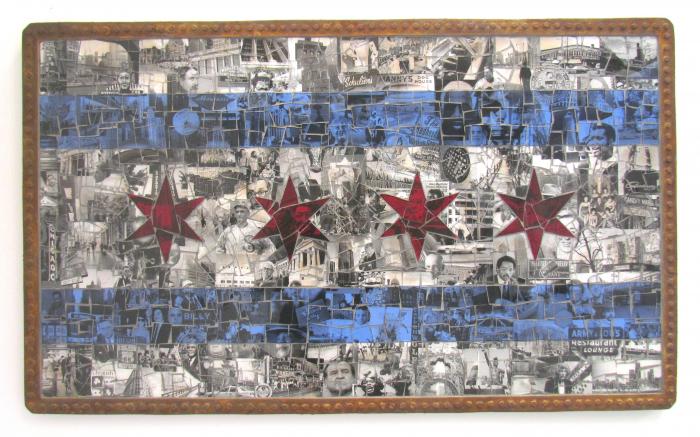
Jeffrey_Conroy_mosaic_2

mosaic by Jeffrey Conroy

Written and read by Chicago poet Kevin Coval as the Haftarah for Tzedek Chicago’s Yom Kippur service yesterday:


atoning for the neo-liberal in all or rahm emmanuel as the chicken on Kapparot

written on the eve and day of Yom Kippur

Do you call that a fast,
A day when the Lord is favorable?
No, this is the fast I desire:
To unlock the fetters of wickedness,
And untie the cords of the yoke
To let the oppressed go free;
Isaiah 58: 5-6

you are the first jewish mayor of Chicago
but have not yet lit one yahrzeit candle
for constituents murdered by the police.

you vacation in montana with the governor
bring your family to Chile on a whim
and never worry about crossing borders
or encountering their patrolmen
or the rent upon return.

your grandparents sought refuge here.
escaping those trying to end them.
they came, worked, learned, created
a life that enabled your parents to raise you
in the suburbs: the immigrant face of the american dream.

when your parents took you
to visit sick children in Israel
you cried. now you clothe
feed, care and ensure
your children’s safe passage
and university of Chicago
lab school tuition, $30000
per year, but you have closed
over fifty public schools
in neighborhoods your family
used to live in. neighborhoods
you no longer live in or love
or allow your children to visit.
neighborhoods bustling with Black
and Brown bodies, whose children
must cross borders called gang lines
you are well aware of, yet wonder
why the murder rates rises.

you dismantle the same system in which your family benefited:
union pay, livable wages, park space safe enough to play outside
arts funding to take ballet, a decent well-rounded public education.

the same ladder your family climbed
you kick the rungs from.

if the schools, housing, health care
trauma centers and corners that cause trauma
are fair across this flat, segregated land-
then eat today. every day there is a harvest
on the carcass of this city for sale. the satiated
carve at a distance, plan and map and redistrict

with careless indifference. how many times
have you been to Kenwood, Woodlawn
Lawndale. what are the names of the people
you know there. what homes have you sat in.

how can you fast
this week, when food
was refused by grandmothers
and educators and organizers
in your back yard, in the front
lawn of a school Chief Keef attended
in a neighborhood you militarize;
more guns and police your solution
to poverty or an extermination strategy.

how can you fast
when those on hunger
strike you couldn’t stand
with in the same room
in a public forum
which is your job by the way:
to listen. you are the antithetical
Studs Terkel.

this not the city he loved
to listen to, not the city
your grandparents were promised

where is your apology
for sending so many jobs elsewhere
for privileging your childrens’ future
and pillaging others’

what do you know of labor
and no savings account and counting
pennies for a pass, for permission to move
or see a movie or museum in this city
of no access and grand canyons of inequity.

your middle name is Israel
it’s come to mean apartheid
in the city, you are mayor
and in Palestine, the city
your family colonized.

there is no safety
said my G-d
for the wicked (1)

for the divvier of cities
for the divider of nations
for the ignorer of horror
for the builder of walls

atone for the smug assuredness
atone for the maintenance of two cities
stratified and unrecognizable to the other
atone for the bounty of the north side
the scarcity of the south
the want of the west
atone for the erasure of the public
school, space, housing, parking
atone for the centrism, the move right
the cow-tow to corporations
atone for the inconceivable income disparity
between those funding your campaign
and those over which you reign
atone for the city’s change
it’s white wash and removable
workers who used to make it
work by working
in jobs with pensions
and benefits
atone for the benefits we have
by merely being white
on the north side of the city
country where that is enough
to make you safe and not think
about driving a car or going
for a jog or walk outside
atone for the rite to the city
that’s for some, not for all
not for real

israel means may G-d prevail

and we pray that’s real, for real
amen
____________________________
Isaiah 57:21 (1)

What Will We Make Different this Year? A Guest Sermon for Erev Yom Kippur by Jay Stanton

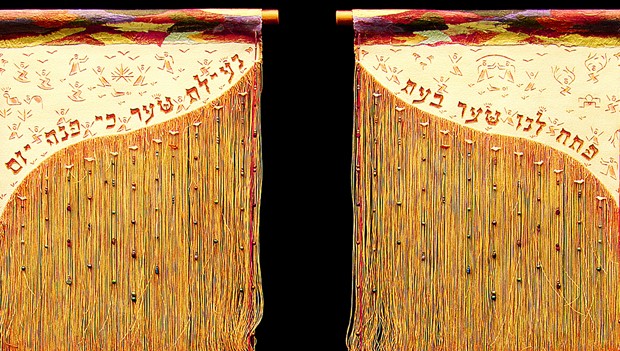
neilah art wohl

Here is the guest sermon that was delivered by Tzedek Chicago member Jay Stanton at our Erev Yom Kippur service last Tuesday night:

Why is this night different from all other nights? I know – wrong holiday. Bear with me. Why is the Day of Atonement different from all other nights?

I] Asking permission

Tonight is the only time we ask permission to pray with other wrongdoers. When actively atoning, we easily acknowledge our wrongdoings. Each of us has transgressed. Today is the most obvious day to pray with transgressors. So why ask permission? Acknowledging our capacity to inflict harm could render us speechless, unable to continue repenting. Giving ourselves permission, having God grant us permission, gives us the courage to confront our failing selves. Is not confronting the self the goal of Yom Kippur?

In our Tzedek community, we face two major obstacles to achieving this goal. The first is feeling we have little merit. A few months ago, my friend Kelvin and I came to an intersection while walking. A car was coming, but there was a stop sign, so I stepped into the intersection, and Kelvin followed hesitantly. After we crossed, Kelvin confessed that, as a Black man, he cannot assume cars will stop for him even at a stop sign. I acknowledged my white privilege and thanked Kelvin for alerting me to this instance of it, of which I was previously unaware. Kelvin thanked me for being aware of my privilege.

From this interaction, Kelvin gained an ally; I gained guilt. How could I, someone actively engaged in antiracist work, be so oblivious to this white privilege? But my awareness of my privilege was enough for Kelvin that day. Our sense of immense guilt over our sins, collective and individual, could paralyze us. How do we move forward with teshuvah when the task is so great?

The other major obstacle we face is potential denial. We created our core values of a Judaism beyond borders, a Judaism of solidarity, a Judaism of nonviolence, a Judaism of spiritual freedom, a Judaism of equity, a Judaism beyond nationalism. We value these just ideals, so we could easily say: therefore, we practice a Judaism beyond borders, a Judaism of solidarity, a Judaism of nonviolence, a Judaism of spiritual freedom, a Judaism of equity, a Judaism beyond nationalism. We did teshuvah for the harms of border-obsessed Judaisms, insular Judaisms, violent Judaisms, coercive Judaisms, oppressive Judaisms, and nationalist Judaisms. We’re done now: we put justice on the agenda and only act justly. Anyone complaining of injustice in our ranks is wrong.

The fear of that outcome weighs heavily on many of us. Are we destined to abandon our values, or, worse, to become some dystopian entity talking justice while perpetuating injustice? I don’t share this fear, and my reason is not because I optimistically see Tzedek as a utopia immune from injustice or a meritocracy of the most righteous folks in the Chicago area. I do not think we can adhere to our core values completely. We will miss the mark. Even behaving our best, we were socialized in systems of oppression which we cannot leave at the door because we wish. We are still unlearning Islamophobia, racism, sexism, transphobia, classism, ableism, heterosexism, Ashkenormativity, militarism, capitalism, and nationalist exceptionalism, to name a few. We cannot completely unlearn these biases. So we will be wrong; we know that. That’s the best possible news for us going into Yom Kippur.

II] Tallit

We are practiced at calling out harmful behavior. The Rev. Stacy Alan teaches that defining sin abstractly is impossible, but that we all get the concept of “messing up.” Tokheja, rebuke, is the prerequisite for meaningful teshuvah. Understanding our wrongs is the only way we can amend our behavior.

We are also committed to becoming more just. As a new community, we are in danger of creating margins. Some people are in the center and some pushed to the edges. Tzedek, however, has another structure in mind. Brant asking me to speak tonight demonstrates this structure. No one would begrudge Brant speaking. We might learn something more interesting, and, we, most of all me, might prefer it. At Tzedek, we each have a say. How many Jewish communities are being addressed tonight by a young, less-than-able-bodied, Sephardic, transgender recovering addict who grew up in an interfaith household? In any other community I would be on the fringe, as I am also here. At Tzedek, Brant is on the fringe, too. We will function best if all at the margin, mimicking this garment, this tallit, evening wear traditionally only this night. The tzitzit, the fringes, are the parts that remind us to engage in mitzvot. At Tzedek, we strive to live at the edge, on the fringe of the community. We are not creating an insular circle, but facing outward, like tzitzit. That way, we avoid a power and oppression dynamic, and we have enough of a marginal perspective that we can call out injustice within our walls. The edge here defines the center, not the reverse.

III] Jacob and Esau

A good structure means little without substance. We need not to only identify injustice but also work to correct it. We need to do our part. We need to take Yom Kippur seriously; we need to take the project of teshuvah seriously.

Again, we face obstacles. Traditionally, the Yom Kippur liturgy dances between two problematic theologies of an authoritarian deity: one, a strict adherent of reward and punishment, and the other, a completely arbitrary megalomaniac. How can we reconcile our knowledge of justice with these concepts of the Divine?

So we are doing liturgy differently at Tzedek. Tomorrow, we will not read from the passage in Leviticus which describes the ancient practice of transferring our sins onto goats and arbitrarily killing one and sending the other away. We know we cannot make teshuvah by putting our sins onto any scapegoat. Instead, we will read the passage in Genesis about Jacob’s reconciliation with Esau. With themes of generosity, transformation, and moving forward from wrongs done without revising or denying past harms, this text reflects the kind of teshuvah we wish to do. It provides hope for intractable conflicts to be resolved justly. We will read about a moment so transformative it turned Jacob from a conniving person into a gentle one. We want that for ourselves. Why is this Yom Kippur different from all other days? Because we can find an example of teshuvah in our text we wish to emulate.

Many say we can’t do this. We can’t establish a Jewish community beyond borders or nationalism, and we certainly can’t change the liturgy or Torah reading for the day. After all, hasn’t it been that way for thousands of years? To them, and to those of us who might be wondering if we should hedge more, I offer this history. Amram Gaon, a 9th century Spanish sage, called the recitation of kol nidre a minhag shetut – a foolish custom. Why? Even though the prayer was already beloved, it encouraged problematic thinking that we can escape responsibility for transgressions with a contract rider on the Covenant. Amram Gaon knew sins don’t transfer to goats and a string of words doesn’t negate injustice we cause. Changing ritual to conform to Jewish values isn’t new.

In tomorrow’s text, we identify with both twins. Jacob victimized Esau. He erred when he stole Esau’s birthright. But we root for Jacob in this reconciliation – not because of lineage but because we know a deep truth. God is the ally of those who seek forgiveness. The story makes us more inclined to forgive and to believe we can be forgiven. Because we are forgiven, for the record. The biggest spoiler in Jewish liturgy is vayomer Adonai salajti kidvarekha. God says I forgive you as I promised. But Jacob messed up. We get the guilt that lives in Jacob’s heart because it lives in ours. Even after we make amends or especially if we cannot, we need God’s help letting go. If our part is making teshuvah, the Lady Magnificent must forgive.

IV] Ne’ilah as protest

Normally, we view Yom Kippur as an end to a process of reflection. This year, Yom Kippur is a beginning. We can use the day of prayer to take stock of our sins. What would we say about our behavior if we had a marginal perspective? What needs to change for us individually and collectively to help us decrease injustice in the coming year? How will we respond when we mess up? When others do?

When we come to ne’ilah tomorrow as the sun sets on this Day of Atonement, let’s be radical. We usually take the idea that the gates of repentance will close as the impetus to finish faster, higher, stronger – to be Olympic penitents.   Instead, we should see it as a call to action. When we read:

פתח לנו שער בעת נעילת שער כי פנה יום. היום יפנה השמשה יבוא ויפנה נבואה שעריך.

Instead of reading it as a lament about the gates closing: Open the gate for us even though the gate is closing because a day turns. Today will pass, the sun will come and set, before it does, please let us enter the gates. Otherwise we’ll be stuck outside – guilty. Instead of reading it that way, let us read it as an exhortation to a Powerful Boss holed up in a gated estate. Ne’ilah is a sit-in, and this is our chant: Keep the gate open for us even at the imposed curfew time, when the day turns to night. We don’t care that today will pass, that the sun comes and goes, we will enter the gates!

When the sun sets tomorrow, we need to occupy Heaven. This won’t require occupying the Luther Memorial Church, but it will require calling out God to make repentance and transformation Her foremost priority not only on Yom Kippur but every day. Our covenantal benefits are not enough. Guaranteed forgiveness on one day a year out of more than 300? That’s less than 1% of the time. We need a better contract. We need better working conditions for creating God’s justice on Earth. We need a more involved, more present, more compassionate boss! We need fewer arbitrary injustices. Life outcomes for teenage boys in Chicago depend on whether the boy is Black. In the West Bank, they depend on whether the boy is Palestinian. And how about less injustice? We didn’t meet our own expectations this year, but why didn’t God soften the hearts of the Pharaohs, free the captive, uplift the fallen? When Jacob wrestled with the man the night before reconciliation with Esau, he did not let the man go until the man gave him a blessing. Similarly, we can’t let God go until She accepts everyone’s teshuvah, which might be until some people are ready to change. So tomorrow night, let’s occupy Heaven.

Strike that (pun intended)! The gates are open now. Let’s move in with our permission to pray with sinners, and let’s extend the opportunity for repentance until those with blood on their hands (literal or symbolic) repent. Let all who lost hope they can change, that those around them can change, enter the gates! Let all who are hungry for justice enter the gates! Let all who are thirsty for forgiveness enter the gates! We transgressors will keep them open until God grants the pardon She promised.

Tzom kal. May your fast be physically easy and spiritually meaningful.

A Confession of Communal Complicity: A New Al Chet For Yom Kippur

NIP000112685893_742138c

Photo credit: The Times, Middle East

I’ve written a new Al Chet prayer that we will be using during Yom Kippur services at Tzedek Chicago. The Al Chet is part of the Vidui – or Confession – in which the congregation stands up and publicly confesses the sins of their community. It is at its core, an open statement of communal complicity. 

I’ll say no more because I think the words really do speak for themselves. Feel free to share and use.


We say together:

עַל חֵטְא שֶׁחָטָאנוּ לְפָנֶיךָ
Al chet she’chatanu lifanecha…
(For the wrong we have done before you…)

Al chet she’chatanu lifanecha for forgetting that we were all once strangers in a strange land;
Ve’ al chet she’chatanu lifanecha for preferring militarized fences to open borders.

Al chet she’chatanu lifanecha for supporting trade policies and murderous regimes that uproot people, families and communities;
Ve’ al chet she’chatanu lifanecha for drawing lines and turning away those who come to our country seeking a better life.

Al chet she’chatanu lifanecha for demonizing migrants as threats to be feared;
Ve’ al chet she’chatanu lifanecha for labeling human beings as “illegal.”

וְעַל כֻּלָּם אֱלוֹהַּ סְלִיחוֹת סְלַח לָנוּ, מְחַל לָנוּ כַּפֶּר לַנוּ
Ve’al kulam eloha selichot selach lanu, mechal lanu, kaper lanu.
(For all these, source of forgiveness, forgive us, pardon us, receive our atonement.)

Al chet she’chatanu lifanecha for internalizing and assenting to racist ideologies;
Ve’ al chet she’chatanu lifanecha for allowing oppressive systems to continue unchecked.

Al chet she’chatanu lifanecha for our complicity in regularly profiling, incarcerating and murdering people of color;
Ve’ al chet she’chatanu lifanecha for denying fair housing, public schools and greater opportunity to our black and brown communities.

Al chet she’chatanu lifanecha for dehumanizing, excluding and murdering gay, lesbian, trans and queer people;
Ve’ al chet she’chatanu lifanecha for shaming and stigmatizing the infirm, the mentally and physically disabled, and the elderly.

וְעַל כֻּלָּם אֱלוֹהַּ סְלִיחוֹת סְלַח לָנוּ, מְחַל לָנוּ כַּפֶּר לַנוּ
Ve’al kulam eloha selichot selach lanu, mechal lanu, kaper lanu.
(For all these, source of forgiveness, forgive us, pardon us, receive our atonement.)

Al chet she’chatanu lifanecha for buying into and promoting the ideology of American exceptionalism;
Ve’ al chet she’chatanu lifanecha for oppressing other peoples and nations in the name of American power and influence;

Al chet she’chatanu lifanecha for profiting off of weapons of death and destruction;
Ve’ al chet she’chatanu lifanecha for contributing to the increased militarization of our nation and our world.

Al chet she’chatanu lifanecha for expanding our military budget while we cut essential services here at home;
Ve’ al chet she’chatanu lifanecha for believing that militarism and violence will ensure our collective security.

וְעַל כֻּלָּם אֱלוֹהַּ סְלִיחוֹת סְלַח לָנוּ, מְחַל לָנוּ כַּפֶּר לַנוּ
Ve’al kulam eloha selichot selach lanu, mechal lanu, kaper lanu.
(For all these, source of forgiveness, forgive us, pardon us, receive our atonement.)

Al chet she’chatanu lifanecha for the destruction of homes, expropriation of land and warehousing of humanity;
Ve’ al chet she’chatanu lifanecha for a brutal and crushing military occupation.

Al chet she’chatanu lifanecha for blockading 1.8 million Gazans inside an open air prison;
Ve’ al chet she’chatanu lifanecha for repeatedly unleashing devastating military firepower on a population trapped in a tiny strip of land.

Al chet she’chatanu lifanecha for wedding sacred Jewish spiritual tradition to political nationalism and militarism;
Ve’ al chet she’chatanu lifanecha for rationalizing away Israel’s oppression of the Palestinian people.

וְעַל כֻּלָּם אֱלוֹהַּ סְלִיחוֹת סְלַח לָנוּ, מְחַל לָנוּ כַּפֶּר לַנוּ
Ve’al kulam eloha selichot selach lanu, mechal lanu, kaper lanu.
(For all these, source of forgiveness, forgive us, pardon us, receive our atonement.)

A Force More Powerful: A Sermon for Tzedek Chicago’s Inaugural Rosh Hashanah Service

10420349_10207561208128694_6384056792802564034_n

One of the most celebrated lines in the traditional Rosh Hashanah liturgy is the verse “Hayom Harat Olam” – “Today is the birthday of the world.” As you might imagine, these words have an added resonance for me on this particular Rosh Hashanah. Hayom Harat Olam indeed. On this day the world was created – and recreated anew for us all.

As our new congregation celebrates its very first Rosh Hashanah, it is difficult to put into words just how profoundly humbling this moment is for me. At this very moment, we are creating a community out of whole cloth, a fabric of connection out of deeply shared communal values. I am so very grateful to be granted this opportunity and so inspired by the many people who have stepped forward so readily and so eagerly to make Tzedek Chicago a reality.

This Rosh Hashanah, I’m feeling, if you pardon the expression, as if we’re celebrating a New Year on steroids. This is truly a season of newness, of potential, a blank canvas upon which we can throw our deepest hopes and dreams and visions. More than any other Jewish holiday, Rosh Hashanah is the time in which we proclaim without hesitation that anything is possible in our lives and our world. And I am truly blessed to be sharing it with you.

I’ll be honest with you: I still can’t quite believe that we pulled this off. It was only a short time ago that we even began to think about creating this new congregation. The leadership of Tzedek Chicago began these conversations a few months ago, and we held our first orientation meeting just this last summer. Our start up period has been astonishingly short – but I think I can speak for the entire leadership of Tzedek when I say I’m not surprised by how far we’ve come in this relatively brief period of time. I’ve known in my heart that there is very real need in the world for a congregation such as ours.

We are at heart, a values-based congregation. As the name of our congregation makes clear, our community is deeply informed by the sacred values of social justice. In this regard, the establishment of Tzedek Chicago is a very mindful attempt to create a Jewish spiritual home for those in our community who cherish these values and are seeking a spiritual community in which to express them.

If you haven’t yet, I encourage you to go to our website and read our six core values carefully. While they are listed separately, I do believe they are part of a larger unified story: a narrative of liberation that runs through the heart of Judaism and Jewish history. It is a narrative rooted in the Exodus story that tells of a God who stands by the oppressed and demands that we do the same. It resonates through the words of Biblical prophets who spoke truth to corrupt power. And it can be found in the courageous example of ancient rabbis who responded to the trauma of exile from the land by creating a global religion with a universal message of healing and hope.

It is particularly relevant to invoke this liberatory narrative on Rosh Hashanah, of all days. Indeed, one of the central themes of this day is the concept of Malchuyot – God’s ultimate sovereignty over our lives and our world. Even if you don’t adhere to the literal belief in God as a supernatural King sitting on his throne on high, I believe we have much to learn from this concept. At its core, I would suggest affirming Malchuyot means affirming that there is a Force Yet Greater: greater than Pharoah in Egypt, greater than the mighty Roman empire, greater than the myriad of powerful empires that have oppressed the Jewish people and many so other peoples throughout the world.

I would argue that this sacred conviction has been one of the central driving forces of Jewish tradition throughout the centuries: that it is not by might and not by power – but by God’s spirit that l our world will ultimately be redeemed. I would further argue that this belief in a Power Yet Greater sustained Jewish life in a very real way during some very dark periods of our history. After all, the Jewish people are still here, even after far mightier empires have come and gone. It might well be said that this allegiance to a Power Yet Greater is the force that keeps alive the hopes of all peoples who have lived with the reality of dislocation and oppression.

I will submit to you, however, that we have tragically betrayed this Jewish narrative of liberation in our own day. With the onset of modernity, we have largely surrendered the ideal of “not by might and not by power” through a kind of Faustian bargain with might and power. We now embrace a new narrative – one that responds to trauma not with a message of healing and hope, but by placing our faith in humanly wielded power. Our new narrative teaches that the pain of our Jewish past will inevitably become our future unless we embrace the ways of power and privilege; nationalism and militarism.

Historically speaking, we know what can happen when religion has been used to justify the aims of empire. This phenomenon is sometimes referred to as Constantinian religion, in reference to the Emperor Constantine, who in the fourth century began the process of making Christianity the official religion of the Roman Empire. In that one critically historic moment, what had previously been a small and persecuted religious community in the first century after Jesus, became a religion of state power. We know the rest. The Jewish people in particular know all too well the sorrows that inevitably ensued from Christianity’s bargain with empire.

In our own day, however, the Jewish people have made a similar kind of tragic bargain. Jewish theologian and thinker Marc Ellis has coined a term for it: “Constantinian Judaism.” With the onset of Zionism and the establishment of the state of Israel, Judaism has now itself become wedded to empire. The unavoidable focal point of Jewish life is now a Jewish nation-state that venerates Jewish power, Jewish militarism and Jewish privilege. Although Israel was established through a mythology of Jewish liberation and a “return to the land,” it has done so on the backs of that land’s indigenous inhabitants. The unavoidable truth is that the Jewish nation state has come into existence – and is continuing to justify its existence – through the oppression of the Palestinian people.

It is difficult to underestimate the extent to which Jewish life now centers on the rationalization and perpetuation of this new Jewish narrative, this new deal with empire. As Marc Ellis points out, we American Jews are deeply implicated in this new Constatinian Judaism:

(The) Jewish establishments in America and Israel have made their own empire deal. Jews are blessed in America. America blesses Israel. What is good for one is good for the other. For the protection American foreign policy offers Israel, Jews offer their support to the American government. (“Future of the Prophetic,” p. 36)

This new narrative has also become an indelible part of American synagogue life. There are so many examples I could point to. Here in Chicago, almost every synagogue has a sign in front with American and Israeli flags that proclaim, “We Stand With Israel.” Congregational religious schools and Jewish camps routinely cite “cultivating a connection to Israel” as an essential part of their curriculum. Perhaps most symbolically telling: it has become standard in most American synagogues to place a US and Israeli flag on either side of the Aron Kodesh.

In other words, in our most sacred Jewish spaces, we are literally bowing down to physical symbols of national power. This is a powerful demonstration of how completely this new narrative has taken hold of post-Holocaust Jewish identity. To my mind, it is nothing short of idolatry – and our inability to recognize it as such shows just how deeply we have bought into a religious mindset that radically values physical power over spiritual power.

So yes, Tzedek Chicago makes a point of stating the following in one of our six congregational core values:

While we appreciate the important role of the land of Israel in Jewish tradition, liturgy and identity, we do not celebrate the fusing of Judaism with political nationalism. We are non-Zionist, openly acknowledging that the creation of an ethnic Jewish nation state in historic Palestine resulted in an injustice against its indigenous people – an injustice that continues to this day.

We reject any ideology that insists upon exclusive Jewish entitlement to the land, recognizing that it has historically been considered sacred by many faiths and home to a variety of peoples, ethnicities and cultures. In our advocacy and activism, we oppose Israel’s ongoing oppression of the Palestinian people and seek a future that includes full civil and human rights for all who live in the land – Jews and non-Jews alike.

With these words, we are intentionally standing down the new Jewish narrative. I know full well what it means to do this. I certainly have no illusions how a Jewish congregation describing itself as “non-Zionist” and openly protests “Israel’s ongoing oppression of the Palestinian people” will be received by the Jewish establishment.  Given centrality of Zionism and Israel advocacy in Jewish communal life, Tzedek Chicago is clearly a dissident congregation in the Jewish world.

I do believe, however, that we must make room in our community for Jews whose values dissent from what the communal establishment deems “mainstream.” It bears noting that dissent has historically occupied a venerable and even sacred place in Jewish life. (It also bears noting that Zionism itself was once a dissident movement in Jewish life.) Our congregation consciously and proudly seeks to lift up this dissident legacy – one that has long been central to Jewish tradition itself in so many critical ways.

After all, we are not promoting dissent for its own sake. We are seeking to reclaim a sacred legacy – a liberatory narrative that has long been indigenous to Jewish life. But I want to underscore – this is not simply a nostalgic exercise in venerating the past. Jewish life in the 21st century is radically different than any in which we have lived before. We live in a global world in which we are connected to individuals, nations and cultures, in unprecedented ways. Having just come out of the ghetto, we have no desire to build new ghettos of our own making. To quote our core values once more:

We celebrate with a Judaism that builds more bridges, not higher walls. Our religious services and educational programs promote a universalist Jewish identity – one that seeks a greater engagement in the world around us. Within our congregation, we view our diversity as our strength. In our activism, we advocate for a world beyond borders and reject the view that any one people, ethnic group or nation is entitled to any part of our world more than any other.

Through our activism and organizing efforts, we pursue partnerships with local and national organizations and coalitions that combat institutional racism and pursue justice and equity for all. We promote a Judaism rooted in anti-racist values and understand that anti-Semitism is not separate from the systems that perpetuate prejudice and discrimination. As members of a Jewish community, we stand together with all peoples throughout the world who are targeted as “other.”

As I said at the outset, I do believe there are many out there who are thirsting for a Jewish community that espouses values such as these. At the same time, however, I am all too mindful that Tzedek Chicago is not for everyone. But that’s OK. In fact, I think, that’s how it should be.

I daresay if you go to the websites of most liberal American congregations and read their core values, you’ll read words like “welcoming,” “inclusive” “warm” and “open.” When you stop to think of it, most of these terms are actually pretty value-free. They aren’t really values per se so much as virtues. They don’t really represent anything anyone would object to and they don’t tell you anything about what the community ultimately stands for.

The reason for this, I believe, is that the overwhelming number of American liberal synagogues simply don’t view political action as part of their mission. Many will articulate a commitment to Tikkun Olam, or “repair of the world,” but whenever this term is invoked, it invariably refers to direct service projects such as soup kitchens or coat drives for the homeless. Now there is of course, a dire need to support service work – particularly in a day and age when our social safety net is under constant and unceasing attack. As you know, here at Tzedek Chicago we are coordinating a High Holiday food drive in conjunction with the Greater Chicago Food Depository – and we thank you for your support of this sacred effort.

But while every religious community should and must engage in service work, we must also ask: what does it mean to ignore the wider context of this reality? What does it mean to do direct service to people in need without directly addressing the political conditions that creates these needs in the first place?

In truth, most liberal congregations are not designed to make waves. They might connect their Jewish identities to political action – they might invoke Jewish community support of the civil rights movement for instance – but when pushed to take a stand on the real political issues of our day, they ultimately fall back on “being inclusive” of the diversity of opinions in the congregation. They won’t mix religion with politics – the notable exception being, naturally, support and advocacy for the state of Israel.

So yes, you might say Tzedek Chicago isn’t really an inclusive congregation. We’re a intentional community driven by very specific values. We’re a community bound by the conviction that a Jewish congregation should be more than simply a fee for service institution for the Jewish middle and upper middle class. We hold that a synagogue should not merely comfort the afflicted, but also afflict the comfortable. We understand that a congregation should not only be about personal transformation, but socio-political transformation as well.

There has been a fair amount of press about our new congregation of late – and one of my favorite lines came from one of our detractors who was quoted as saying about us, “Statistically speaking, they don’t exist.” Now that may actually be true. There aren’t really congregations such as ours in the Jewish world. But I can’t help but be deeply gratified at how far we’ve come in such an astonishingly amount short time. By the growing numbers of people who have formally joined us as members; including many who are joining a Jewish congregation for the very first time in their lives. And by those who have stepped forward to volunteer considerable time and energy on our behalf.

And I will say moreover, that ever since our announcement, I’ve been hearing consistently from people all over the country who have told me they wish that something like Tzedek existed in their community. So while we might not statistically exist in the institutional sense, I believe we are very much alive out there in the borderlands of Jewish life. I just know in my heart that there is a place for a Jewish congregation such as ours. And while we are starting off modestly, mindful of our capacity, of what we are able and not able to do during this first year of our existence, I do believe the response we’ve received thus far indicates that the time has truly arrived for a congregation such as Tzedek Chicago.

And finally, on a personal note, I want to express once more how blessed I feel that I have been granted such an opportunity at this point in my life and my career. I am so very grateful and excited to be embarking on a journey such as this with all of you and many more who will be joining us as we make our way. I know it will be a complex and challenging journey in many ways. We’ve set our sights high and it goes without saying that we will be learning together as we go.

To be sure, it is not easy to do this kind of work. It is challenging, it is painful, it can often mean being alienated or isolated from family and friends, from the larger community. But for so many of us, we don’t have a choice but to do this work – and we know that we will ultimately find the strength to continue this work through the sacred relationships we cultivate along the way. In the end, this is a journey we have no choice but to take – and I can’t think of anyone I’d rather take it with than all of you. Speaking for myself and the leadership of Tzedek Chicago, thank you for putting your faith in us and in one another. Wherever our steps may lead us, I know we will be going from strength to strength.

And finally, please join me in expressing gratitude at having been sustained long enough to reach this incredible new season together:

Holy One of Blessing, your presence fills creation, you have given us life, sustained us and brought us all to this very sacred time together.

Amen.