Category Archives: Nonviolence

Action Alert: Free Captain Jack and the US Boat to Gaza!

This from Joseph Dana yesterday:

The US boat to Gaza, The Audacity of Hope, is dead in the water. Its captain, an American citizen who goes only by the name Captain Jack, will be brought before a judge on felony charges on Tuesday in Athens. Passengers on the ship have been given the freedom to leave the military port where the boat is currently detained but crew members have been forced to stay on board. Many passengers are choosing to stay with the ship and its captain out of solidarity for their plight. Some passengers have begun a hunger strike to protest the Greek government and its handling of the US boat captain…

Saturday night, charges against the US captain were elevated to felony charges for which he could face jail time. This has generated guilt among the passengers of the US boat split between leaving the boat and standing in solidarity with their captain. Some passengers have already left Athens, including the Pulitzer Prize winning author Alice Walker. Other passengers have begun a hunger strike in protest of the Greek government.

Please join me in voicing your protest over the Greek government’s unjust treatment of Capt. Klusmire and the passengers of Flotilla II. Here is some contact info:

– Call the State Department at  (202) 647-4000. Ask for the Overseas US Citizen Services Duty Officer and you can speak to a live State Department official.

– E-mail the US Embassy in Athens at: athensamemb@state.gov or  athensamericancitizenservices@state.gov.

– Call the US Embassy in Athens at 011-30-210-721-2951.

– Please also try to call, fax or email your members of Congress.

When you call, I recommend focusing on US to Gaza’s three key requests:

– That the State Department fulfill its duty to advocate on behalf of Captain Klusmire and insist that Greek authorities drop the charges against him.

– That the State Department demand the immediate release of the US boat, The Audacity of Hope, and allow it to sail to Gaza.

– That the State Department demand the Greek Government stop the harassment of all boats involved in a nonviolent action and to let the entire Freedom Flotilla go.

Freedom Flotilla II Ready to Set Sail

A year after the tragedy aboard the Mavi Marmara, Freedom Flotilla II to Gaza is getting ready to set sail. This time around it will include a US-flagged boat, “The Audacity of Hope,” that will carry dozens of American activists. Click above to watch an interview with two such Americans: attorney Richard Levy and my friend Kathy Kelly, from Voices for Creative Nonviolence.

Here’s Kathy:

It isn’t just a matter of humanitarian cargo being brought into Gaza. It’s a matter of people having been subjected to a state of siege, isolated, 45 percent unemployment, inability to reconstruct after the terrible assaults in Operation Cast Lead, people being trapped, young people not being able to get out to avail themselves of education. There are so many reasons why this siege is wrongful. And so, I think it’s misleading to think that we’re people that are trying to be charitable. We’re people who are trying to say that it’s wrong to impose collective punishment on a civilian population because you want to affect their governance.

(Click here for a full transcript of the interview.)

Joseph Dana will be aboard “The Audacity of Hope” and will report on his experiences for The Nation, blog on +972, and, as usual, send out his ubiquitous tweets via @ibnezra. Medea Benjamin will also be on the boat and will be posting reports on the Code Pink Blog. Other American passengers include Gabriel Schivone, a young Jewish Voice for Peace member, and novelist Alice Walker. (Click here for her essay, “Why I’m Sailing to Gaza.”)

Readers of my blog know how I feel about Israel’s immoral, illegal blockade of Gaza. I also remain firm in my agreement with the UN Human Rights Council report findings that the Israeli military attack on Mavi Marmara passengers amounted to “extra-legal, arbitrary and summary execution.”  (Among those killed was an American, Furkan Dogan, who was shot while videotaping the attack. The US has thus far refused to hold Israel accountable for killing an American citizen in international waters.)

The IDF is already holding military exercises in anticipation of Flotilla II. We can only hope and pray for a peaceful conclusion to this peaceful act of civil disobedience.

For their part, the American passengers of “The Audacity of Hope” have sent the following letter to President Obama:

As U.S. citizens we expect our country and its leaders to help ensure the Flotilla’s safe passage to Gaza – as our country should support our humanitarian demand that the Gaza blockade be lifted. This should begin by notifying the Israeli government in clear and certain terms that it may not physically interfere with the upcoming Flotilla of which the U.S. boat—The Audacity of Hope — is part. We—authors, builders, firefighters, lawyers, social workers, retirees, Holocaust survivors, former government employees and more—expect no less from our President and your administration.

Our boat will sail from the eastern Mediterranean in the last week of June. We shall be grateful to you for acting promptly and decisively to uphold the rights of civilians to safe passage on the seas.

Nadia Hijab: Human Rights for Everybody

We’ve just uploaded the transcript of our conference call with Nadia Hijab last month – the Ta’anit Tzedek website now contains a recording as well as a full text of the call. I encourage you to read and/or listen to this amazing conversation. (Click here for the audio/transcript.)

Nadia covered a wide range of issues during the call, from the one state vs. two state, to human rights, to the Arab Spring, to the evolving Palestinian grassroots leadership. Listening to the conversation again, I was reminded of her impressively  clear-headed, rights-based approach to the conflict – often challenging the conventional liberal American Jewish mindset in important ways.

When we ourselves challenged Nadia to state where she was on the one state vs. two state question, this was her eloquent response:

I believe the Palestinian people have the right to self-determination.  I don’t care if that is exercised in one state or two states.  I believe that whether it’s one state or two states, they should both be states that guarantee equality for all their citizens.

Now, separately from that, I do believe the Palestinians – and this is an individual right – have a right of return. (They) have a right to say if they would like to go back to what is now Israel and live as equal citizens in that state or if they would like to – we have the individual right to say if we’d like to stay in the countries where we’ve landed up and have rights there as citizens or if we’d like to go back to the new state of Palestine and be a citizen there, etc.  Each Palestinian needs to be asked how each one wants to fulfill his or her right of return.

Another highlight from the call:

Rabbi Brian Walt: How do you, as a Palestinian, relate to Jews who feel quite attached to Israel or very attached to Israel and what it offers for Jews?  And how do you feel about that sort of liberal Zionist argument that is perhaps portrayed best by J Street and other organizations like Americans for Peace now, that strongly support a two-state solution but don’t want to deal with the questions of 1947-48?

 Nadia Hijab: Let me answer that in two parts.  First, let me assume, just for the sake of argument that not a single Palestinian refugee returns to Israel.  Let’s just assume that.  There are 1.2 million Palestinian citizens of Israel and that is a challenge to Israel’s current attempt to present itself as a democratic state.  It’s not.  It is by law discriminatory to the Palestinians who are not even recognized as citizens.  They have passports, they’re called Israelis, but they don’t actually have citizenship.  And there are about twenty or thirty laws on the books, and more being added every day, to make sure that they are kept down and, hopefully some day, also out.

There’s a very racist discourse in Israel, a very openly racist discourse, that says: to the extent that we can maybe reshape the borders and get rid of some of these Palestinian Israelis, then we can keep Israel “pure,” ethnically “pure.” Well, in the 21st century that’s nonsense.  And in fact, it’s been nonsense since 1948, because 1948 was not only the year that Israel was created but 1948 was the adoption of the Universal Declaration of Human Rights.  Humanity had been moving towards that after one horror after another during the World Wars and other wars.  So humanity has been trying to define how people deal with each other and how they relate to each other, whether as individuals or as communities or as states.

And in this day and age, it’s no longer acceptable – it’s universally seen as immoral and illegal – to discriminate against people on the basis of their religion or their race or their color, and now growing (on the basis of) their sexuality.  You know, discrimination is abhorrent.

And what Israel is doing, even if you don’t take into account any of what’s going on with the occupation…what Israel is doing within its country is abhorrent.  So therefore, Israel as it’s currently defined: as a state for Jews, by Jews, of Jews – that’s not a modern state, nor is it, by the way, as many states define themselves in the Arab world, (i.e.) by Muslims, for Muslims.

People have to have equal rights, whether Muslim or Christian or Jewish or men or women.  A state is simply a construct in this day and age.  It’s a construct for how to manage resources in a way that is fair and equitable and guaranteeing the rights of its citizens.  That is what a state is.  So Israel faces that challenge irrespective of whether there’s a two-state solution or a one-state solution.

Then I wanted to touch on the other part of your question, which is very important, how Jews feel about Israel or how I feel about Jews and what they feel about Israel.  I work a lot with Jews who uphold a human rights approach, no matter what.  And these are people who are my friends and I work extremely closely with them.  And they struggle for justice for Palestinians as well as human rights for everybody, whether they’re Israelis or Palestinians, in the same way that I do.

I respect the work of many, let’s say, American Jews or liberal Zionists or whatever who stand up for some freedoms and some rights.  But then when it comes to a question of Israel’s security they are less clear about where their loyalties lie.  That’s problematic for me.

But I recognize that there is now a Jewish attachment to Israel and I think that over time it will be okay, because Israel exists – it was created.  It was created in a way that was immoral and unjust to the Palestinians, but it was created.  And eventually the attachment and the sense of belonging will be a cultural one, a social one, and maybe of family ties.

And then those attachments can be built across the Arab world as well.  They don’t have to be restricted to Israel.  And Israel will become a state of all its citizens, in which Palestinians and Jews and Arabs and Muslims and Christians are all equal and just one of the many states of the region.

How Do We Pursue Peace? A Response to Rabbi Shmuley Boteach

In his newsletter, Rabbi Shmuley Boteach (who in his byline refers to himself as “America’s Rabbi”) has written an account of Rae Ablieah’s protest during Netanyahu’s speech in Congress on Tuesday.

Apparently Rabbi Shmuley was two seats away from her at the time and witnessed the entire episode. In his piece, he explained why he decided not to “intervene” during the incident.  He also made some rather colorful observations about the Israel-Palestine conflict, including:

It’s not the ’67 borders that separate the Palestinians and Israelis. Rather, the conflict is all about values, specifically the Palestinians’ growing culture of death versus the Israeli culture of life.

My good friend and colleague Rabbi Lynn Gottlieb wrote an awesome response to Rabbi Shmuley and agreed to let me post it here below:

Dear Shmuley,

Thank you for your Shabbat hospitality the other night. Your family is beautiful. I appreciate your wife’s efforts to feed us and make us welcome in your home. Your hosting of conversations that explore the dimensions of a variety of issues is representative of the finest in our tradition. Critical thinking is crucial to the work of peace. Therefore, I feel empowered to address the issues your raised in your newsletter, especially since I know Rae Abileah personally and she ended up in the hospital.

1)  She was not uttering curses. A curse is wishing for destruction or harm of another person or people. This was not the case. “End Occupation” is not a curse, it is a political statement. Great lovers of Israel including Jewish parents in the Bereaved Parent’s Circle support this position.

2) Whether you agree or disagree with her statement, Rae was physically assaulted which is against the law. “Do not envy a man of violence nor follow any of his ways.” “Do not follow the majority to do evil.” “Do not hate your brother in your heart.” “Do not seek revenge…”

Physical assault is a crime. Period. Interrupting a speech may not be well received but it is not physical assault.

3) By becoming a bystander and watching a physical assault without intervening and making an effort to stop the assault, you committed a sin of omission. You became a bystander.

4) By polarizing the conflict with your words in this newsletter, you are creating new enemies. The mitzvah is “to turn an enemy into a friend.” Our tradition asks religious leaders to rise above the fray and to stand against violence of any sort. That is why we are commanded to help an enemy before a friend in the question of relieving a donkey of his load. Or take the example of Aaron, running between two enemies to make friends.

As someone who has a following I urge you not to promote more hatred by creating a category of “Israel haters.”  Rather, seek to understand their concerns, open a dialogue, become a Rodef Shalom (“Pursuer of Peace”) and not someone who fuels feelings that violence and revenge are justified.

By making the deeply distorted and uneducated statement about “the Palestinian culture of death and the Israeli culture of life” you are contributing to hate mongering which is a violent act according to our tradition. You have obviously not been in Palestine, nor do you seem to know about the very widespread movement for nonviolence that has been part of the Palestinian struggle for freedom for several decades. Yes, there are forces of violence in Palestine, just as there are in Israel. How do we pursue peace?

The kind of advice and opinion that appears in this newsletter puts you outside the circle of traditional Jewish sensitivities and commitments to peacemaking. As people in leadership, we have a great responsibility to Torah as a path of peace. Just as you urge Rae to use her words wisely, I urge you to do the same. I would be happy to continue this discussion with you at your convenience.

L’shalom,

Rabbi Lynn Gottlieb

AIPAC: Dangerous for Jews and Other Living Things

I encourage you to read this important guest post by Alice Rothchild:

The American Israel Public Affairs Committee is holding its annual conference May 22-24, where Congress people and many of our national leaders will rush headlong into the committee’s open arms and bountiful coffers. In an increasingly bizarre time warp they will congratulate each other and kvell about Israel’s special relationship with the US, our strategic partnership, and Israel’s commitment to democratic ideals in a “sea of dictatorships” (to quote the website).

What they will not talk about is reality. US Jews are increasingly uncomfortable with a lobby that claims to represent us, but is deeply committed to the militaristic and rightwing policies of successive Israeli governments. Jews in the US tend to be politically progressive, but we are being asked to suspend our liberal beliefs when it comes to Israel. While maintaining a steady dream beat for war against Iran and a world view that, “Israel continues to fulfill its ancient obligation as a ‘light unto the nations,’” AIPAC lobbyists with their Christian Zionist allies guarantee billions of dollars in military aid for Israel each year . Much of this goes towards buying US military weapons and machinery, cementing the massive, interconnected, and lucrative military-industrial-security complex that now exists between our two countries.

Not only has this made a brutal 43 year military occupation possible, but it also provides military and political support to the current Netanyahu government. Let’s be clear. Netanyahu is committed to building Jewish settlements in the West Bank and East Jerusalem, undermining any possibility for a two-state solution. He is building Jewish settler-only roads and roads for Palestinians funded by USAID. He tightly controls Palestinian movement through checkpoints, permits, and the Separation Wall which has stolen thousands of acres of Palestinian land and destroyed the lives and livelihoods of people whose families have lived in the region for centuries. His idea of Palestinian statehood, (should he still have one), is a scattering of weak enclaves surrounded by Israeli military. The recently released Palestine Papers painfully documented the degree to which Palestinian negotiators were willing to sell their souls while Israeli negotiators refused to accept any concessions. The US was revealed twisting the arms of Palestinians diplomats to give up basic demands and the massive security coordination between the Israelis and the Palestinian Authority was exposed.

Within Israel, there is a rightwing crackdown on human rights activists, and laws brewing in the Knesset that will criminalize:

1. Nonviolent protests (in Israel and internationally) that advocate boycotts, divestments, and sanctions;

2. Providing information that could lead to Israeli war crime charges;

3. Any activity against Israeli soldiers or State symbols including nonviolent legitimate resistance to the occupation;

4. Commemorations of the Nakba, the Palestinian experience of 1948

At the same time there are over 20 laws that maintain the second class status for Palestinians with Israeli citizenship.

While Israeli activists worry about rising fascism in Israeli society, Palestinians are celebrating the Arab Spring that is blossoming in the region and Fatah and Hamas are gingerly talking about unity and democratic elections. Arabs from Tunisia to Yemen are putting their lives on the line for equality and freedom of speech. This breathtaking political moment is changing the political discourse in the Middle East and the US Congress needs to take notice and shake itself free of the world view that is promoted by AIPAC lobbyists. Fear of anti-Semitism and the traumas of the Holocaust do not justify Israeli exceptionalism, militarism, racism towards Arabs, or a belief in permanent Jewish victimization.

Peace in the Middle East is more urgent than ever, but it needs to be based on international law, human rights, and UN resolutions. AIPAC and its supporters are deluding themselves, promoting a perpetual state of war and hostility, living in a world that does not match reality. At the same time, over 100 peace organizations will be meeting in Washington. Under the call: Move Over AIPAC: Building a New US Middle East Policy, they will explore the impacts of US military aid and political cover, the demand to end the Israeli occupation, and the building of a solution that respects the rights and dignity of everyone in the region. There will be no big donors there, but Congress would do well to listen.


Palestinian Unity: In Search of a Game Changer

When I read of the reported “PA-Hamas reconciliation” deal, my initial response was generally positive. It seemed to me that Palestinian leaders on both sides were finally taking their constituents’ desire for unified leadership seriously. It also appeared that – together with the PA’s campaign to find international support for a declaration of statehood – Palestinian leadership had decided to proactively shake up the paralyzed status quo.

Readers of my blog know I’ve long believed that Israel, the US and the international community should end its shunning of Hamas if any real progress will be made in settling this conflict. Alas, I’m saddened but not too surprised that Bibi’s immediate response to Palestinian unity talks was to say the PA “must choose whether it is interested in peace with Israel or reconciliation with Hamas.”  For its part, the White House stated it “supports Palestinian reconciliation,” but then rejected its support in its very next sentence:

The United States supports Palestinian reconciliation on terms which promote the cause of peace. Hamas, however, is a terrorist organization which targets civilians.

At any rate, it’s fairly clear that the unity effort is likely to be more symbolic than an actual game changer. As Ali Abunimah recently pointed out, it’s difficult to imagine how a unified Palestinian leadership could ever operate effectively under current circumstances:

If there is an agreement on a joint “government” how can it possibly function without Israeli approval? Will Israel allow Hamas ministers be able to operate freely in the occupied West Bank? Will PA officials be able to move freely between the West Bank and Gaza? Israel is effectively at peace with the current Abbas wing of the Palestinian Authority and at war with Hamas. Impossible to see how such a government can operate under Israeli occupation. If anything this proves the impossibility of democracy and normal governance under Israeli military occupation.

In the end, writes Joseph Dana, the issue is not whether or not the Palestinian leadership could function with Hamas involved. The actual motive behind unity talks is not the Palestinian leadership’s desire to serve as a real functioning government – but rather its desire to co-opt the Palestinian masses who are inspired by the revolutionary spirit currently coursing though the Arab world:

 The agreement signed last night between Fatah and Hamas does not represent unity. The reconciliation agreement represents a move to appease growing popular movements on the streets of Gaza and the West Bank which are demanding real unity, one that might not even involve the PA and Hamas, in order to combat Israeli occupation.

I completely agree with Dana that the Palestinian popular nonviolent resistance movement has the power to challenge Israel in ways that the PLO and Hamas never could. Indeed, this is the kind of Palestinian unity Israel should really be taking seriously:

A unified Palestinian population in the West Bank and Gaza which adopts nonviolent resistance tactics has the potential to inflict incredible damage on the Israeli occupation. Actually, Israel does not have an effective strategy to combat Palestinian nonviolence and unity. Look at the amount of military resources Israel have used to crush small West Bank villages like Nabi Saleh, which embrace unity and nonviolence against occupation.

Unless American, Israeli and Palestinian leaders show real leadership, there is every reason to believe Palestinian people may well seize that mantle themselves. Now that would be a real game changer…

In Memory of Juliano Mer Khamis

It is with great sadness that I note the murder of activist, actor, director Juliano Mer Khamis, the director of the Jenin Freedom Theater. Although there are currently conflicting press reports regarding the circumstances of his killing, Palestinian authorities have reported that he was shot five times by “Palestinian militants.”

Mer Khamis was a remarkable and inspiring man – the son of a Palestinian father and a Jewish mother who devoted his life to giving the young people of the Jenin refugee camp a healing, creative outlet in the midst of unbearably dire cirumstances.

From a powerful, heartbreaking tribute by Israeli journalist Dimi Reider:

Mer Khamis…has faced threats since forever: From conservatives in the camp who took a strong dislike to the theatre’s liberal repertoire and casting of both men and women, both boys and girls; from nationalists who saw him as an agent of the occupation, a promoter of normalization; and from just about every Israeli who commented on any news piece covering him and his activity.

There will be so much said and written about Juliano in the coming days. Friends and students will laud his tremendous bravery, his contempt for the walls and barriers – especially barriers of fear – that crisscross our country, his sense of stage, his talent. Enemies will pour mud on him, rejoicing in the death of one they see as a half-breed and a turncoat. Comrades will remember a complex and uneasy man, as famous for his rough temper as he was for his devotion to the cause.

I had the honor of visiting the Jenin Freedom Theater this past December with 20 members of my congregation. Although we didn’t get to meet Juliano personally, we can all attest to the inspiring fruits of his life’s work. May it live on forever. And may his memory be for a blessing.

I can think of no great honor to his memory that to watch “Arna’s Children” – an amazing 2003 documentary, co-directed by Mer Khamis, that profiles the history of the Freedom Theater. Please click on the clip above for the first installment. The following eight can be found on YouTube – search: “Arna’s Children.”

End Violence – Free Bassem Tamimi!

What is the best response to the recent tragedies in Israel/Palestine? According to Jewish Voice For Peace’s courageous new statement “From Gaza to Jerusalem: Statement” we must redouble our support of the growing movement of Palestinians who are seeking justice through nonviolent means:

This is a movement that respects life, that is part and parcel of the nonviolent democratic people’s movements we have been inspired by throughout the Arab world, that welcomes the solidarity and support of Israeli and international believers in equality and universal human rights. This is a movement that fundamentally subverts the logic of armies, revenge and armed struggle.

And it’s a movement that needs our support more than ever. It’s just been reported that Bassem Tamimi, one of the leaders of the nonviolent Popular Struggle Committee in the Palestinian village of Nabi Saleh, was arrested today in his home by the IDF. According to reports, Bassem’s wife and 10 year old daughter were brutalized by soldiers during his arrest; he is expected to be indicted on charges of “incitement” and “organizing illegal demonstrations.”

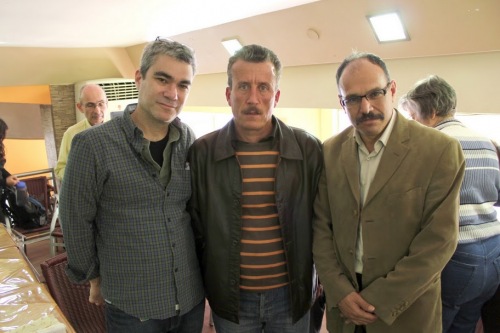
I had the honor of meeting Bassem in Ramallah this past December (that’s him above center, with Iyad Morrar, leader of the Popular Committee in the village of Budrus). As I commented at the time, Palestinian leaders such as Bassem and Iyad are eminently deserving of our attention and support – especially since their struggles are largely ignored by the mainstream media.

As the JVP statement states, “(any) act of violence, especially one against civilians, marks a profound failure of human imagination and causes a deep and abiding trauma for all involved.”

Amen. I can think of no better antidote to the tragedy of violence than to champion the cause of Palestinian leaders such as Bassem Tamimi.

Report from Beit Ommar

14 year-old Mohammed Awad arrested by an Israeli soldier in Beit Ommar, 11/20/2010. Picture: Anne Paq/ActiveStills

As promised, here is a report from my good friend Father Cotton Fite, who is currently visiting Israel/Palestine. In this post, he personally testifies to the issue of child arrests/detentions in the West Bank village of Beit Ommar:

Continue reading

JRC Israel-Palestine Trip Featured on Chicago Public Radio

Our JRC Israel/Palestine Study Tour was featured today on the Chicago Public Radio program, “Worldview.” I was interviewed along with trip participants Marge Frank and Michael Deheeger for an extensive and quite wide-ranging conversation about our experiences.

The first half of the program featured an powerful interview with Israeli Palestinian solidarity activist Joseph Dana, whose important work I’ve cited on this blog on several occasions. All told, a pretty important hour of radio.

Click here to give a listen. I strongly encourage you to tune in for the entire program; if you choose to listen to our interview alone, click here.