Category Archives: Palestine

Solidarity in Hevron: Occupation is Not Our Judaism

415beafb-862e-47b8-8363-673fa969cc27

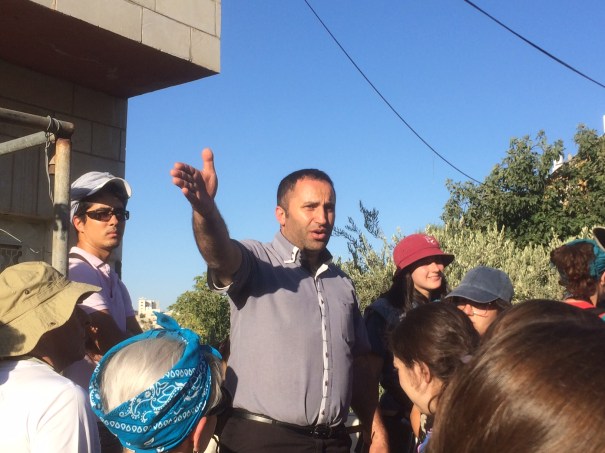
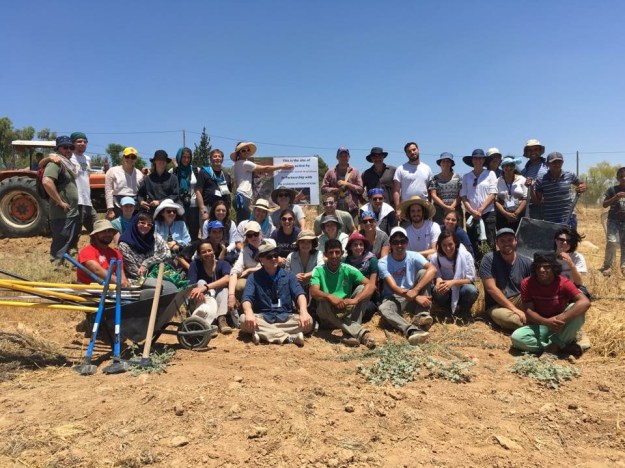
I’ll soon be traveling Israel/Palestine this weekend with 40 other Jews from around the world as part of a solidarity delegation to Hebron and the South Hebron Hills sponsored by the Center for Jewish Nonviolence. CJNV is a relatively new organization that has been doing important work bringing Diaspora Jews to Israel/Palestine to stand in solidarity with Palestinians in nonviolent actions against the occupation. Last year, CJNV traveled to Tent of Nations (a very special place about which I’ve written many times before) to plant trees to replace the 1,500 fruit bearing trees that had been destroyed by the IDF. More recently the CJNV participated in an action at the World Zionist Congress to protest the complete absence of the occupation from the World Zionist Organization’s agenda.

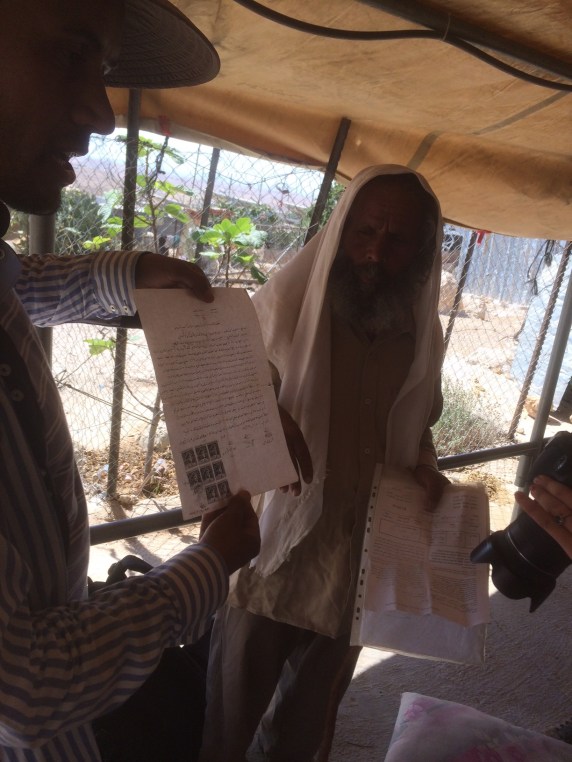
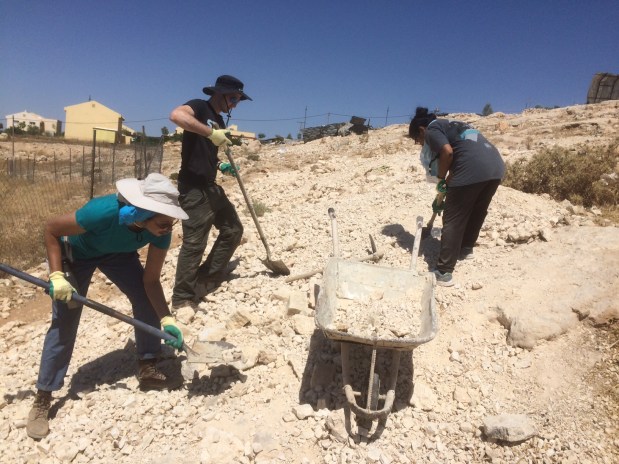
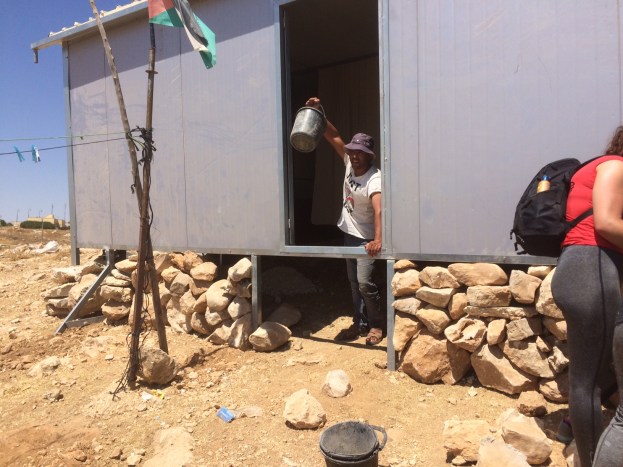
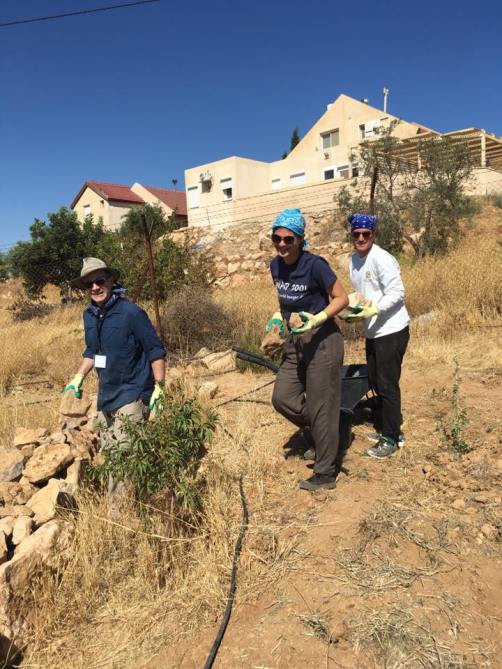
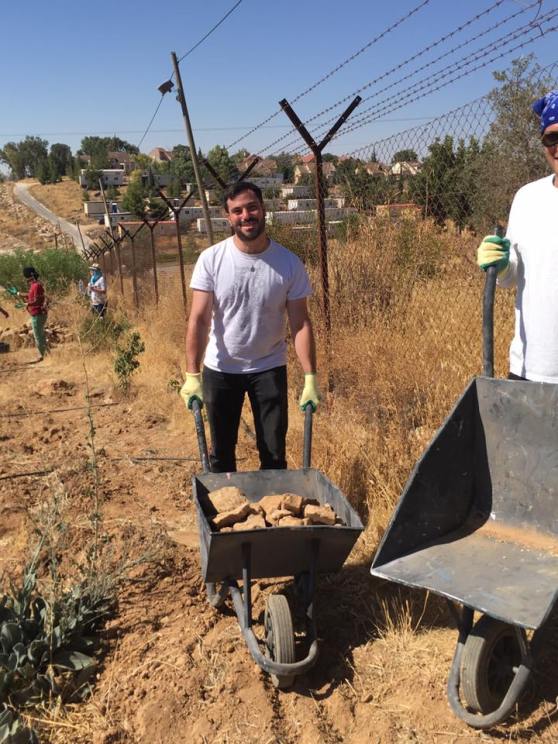
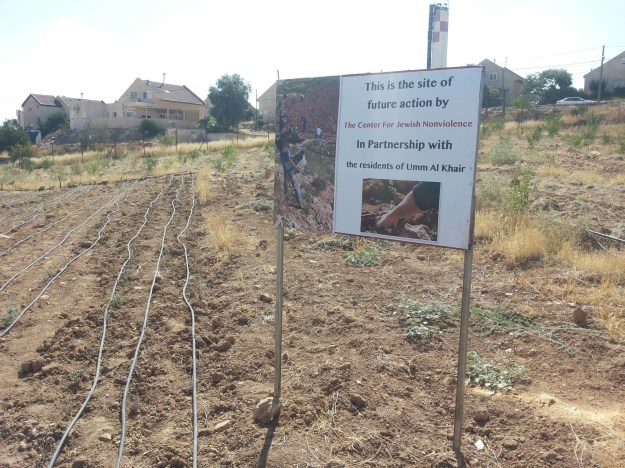
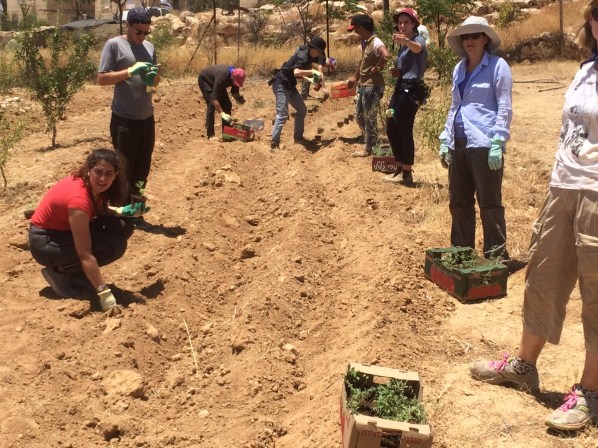
The name of this new campaign is entitled “Occupation is not our Judaism” and will include work in the village of Susiya (which recently experienced home demolitions that left 26 Palestinians homeless) and planting in the nearby village of Umm Al Khair (see photo above). We’ll also be standing in solidarity with Palestinian residents of the city of Hebron – I’ll be writing more about this aspect of our work in the coming days.

I’ve visited and written about the injustices wrought upon Hevron in posts from past visits – and since that time the situation has only grown more dire. You may have read about the recent visit to Hevron by authors Michael Chabon and Ayelet Waldman. After their experience there the clearly shaken Chabon was quoted as saying:

(This is) the most grievous injustice I have ever seen in my life … this is the worst thing I have ever seen, just purely in terms of injustice. If saying that is going to lose me readers, I don’t want those readers. They can go away and never come back.

For more on the daily reality faced by Palestinians in Susiya and the South Hevron Hills, check out the clip below:

Finally, like everyone else in our country I’m following recent events in Louisiana, Minnesota and Dallas, and am mindful that racist state violence is all too brutally real right here at home as well. As I leave, I’m taking to heart the very wise words that my friend, the historian/writer/activist Barbara Ransby has just posted on her Facebook page:

In these difficult and trying times, as we grieve the horrible murders of our people, suffer the skewed media coverage that attempts to relegate our work to the gutter, and witness the backlash that has already begun, our response must be sober and strategic. Fear is understandable. But a fierce fortitude is what is required. And a principled unity is necessary today more than ever.

Whether it’s here or anywhere else in the world, I’m more convinced than ever that my place is to be accountable to those affected by this violence and take our cue from their “fierce fortitude.”

I look forward to sharing my experiences with you in the coming days.

For Shavuot: They Saw the Thunder

A Palestinian farmer harvests barley on a farm near the border of southern Gaza Strip with Israel

Photo: Reuters/Ibraheem Abu Mustafa

Looking up from the barley harvest
they heard the sounds, like the blaring of trumpets
echoing across the hills.

Thick smoke rose up like smoke from a kiln
and then they saw the thunder,
fire sparking and flashing
as mortar shells fell from the sky.

The orders came in:
we have set bounds for the village
take care not to cross it
lest you be put to death.

They were sent out on the third day
and headed east into the hills
to the place where the Moabites once lived.

While back home, the unharvested barley
scattered like dry grass in the wind
and homes toppled into piles of stone.

Those were the days
the judges ceased to judge.

On Passover, Israel and Demographic Threats

2016_0427rrisr_

(Image: Jared Rodriguez / Truthout)

Crossposted with Truthout

The weeklong Jewish festival of Passover is coming to a close, but like many Jews around the world I’m still digesting the myriad questions, answers and discussions that ensued as we retold the biblical story of the Exodus at our seder. While it’s a story our community returns to over and over again, I’m continually astonished at the ways it provides a frame for understanding struggles for liberation past and present.

This year, I’ve been contemplating one aspect of the story in particular: when a new pharaoh arises over Egypt “who did not know Joseph.” We immediately learn in no uncertain terms that this new ruler was considerably more xenophobic than his predecessor:

And (Pharaoh) said to his people, “Look, the Israelite people are much too numerous for us. Let us deal shrewdly with them, so that they may not increase; otherwise in the event of war they may join our enemies in fighting against us.” (Exodus 1:8-9)

To use contemporary parlance, Pharaoh clearly views the Israelites as a “demographic threat” to the Egyptians.

The demographic threat meme, of course, has been played out countless times since the age of the pharaohs. It has certainly been a deeply woven thread in the fabric of American culture from our very origins. To cite but one example: Centuries before Donald Trump started railing against Mexican “criminals” and “rapists,” Benjamin Franklin wrote a 1751 essay in which he bemoaned the influx of “Palatine Boors” into the colonies who would “shortly be so numerous as to Germanize us instead of our Anglifying them, and will never adopt our language or customs, any more than they can acquire our complexion.”

So yes, as an American, I can’t read these words from the Exodus story without connecting it to an ignoble aspect of my own country’s legacy — one that is all too real even today.

And as an American Jew, I can’t help but connect it to another country that also purports to act in my name.

Indeed, ever since Israel’s establishment, Zionist leaders knew well that the future Jewish state would only be “viable” if it could create and maintain a demographic Jewish majority in historic Palestine. In the late 19th century, this must surely have seemed like a tall order, since Jews constituted but 2 to 5 percent of the population. By 1947, following decades of Zionist colonization and Jewish immigration, their number had swelled to 32 percent. Under the UN-sponsored partition plan, the percentage of Jews allotted to the new Jewish state would have been 55 percent.

During the 1948 war — known as the War of Independence by Zionists and the Nakba (“catastrophe”) by Palestinians — the issue of demographics was solved through the forced expulsion of Palestinians from their homes and Israel’s refusal to allow them to return. However, the demographic stakes were raised once again in 1967, when Israel conquered the West Bank and Gaza and began a military occupation that exists to this day.

In 2010, Jews officially become a minority population from the Jordan River to the Mediterranean Sea; around the same time, it was determined that the Jewish majority in Israel proper was slowly diminishing. For some time now, Zionists have been warning that the Palestinians’ birth rate poses a “demographic threat” to the future of the Jewish state.

Perhaps the most surprising aspect of this rhetoric is that it doesn’t only come from Israel’s far right, but from liberal Zionists, who use the demographic argument to advocate for a two-state solution. Witness, for instance, the words of J Street executive director Jeremy Ben-Ami:

When it comes to Israeli-Palestinian peace, the two-state solution and the inexorable demographic threat to Israel’s future as a democratic state that remains the homeland for the Jewish people, our position is the same as that of the Israeli government, the Obama administration and the vast bulk of the American Jewish community.

Leaving aside the issues of whether or not the two-state solution actually is the policyof the Israeli government, let’s unpack this statement for a moment. The liberal Zionist argument for a “democratic Jewish state” is predicated on a view of Palestinians as a “demographic threat.” As an American, if I referred to any other ethnic group in this country with such a term, I would surely be viewed as a bigot or a racist. But as a Jew, I can refer to Palestinians with this epithet and still remain a member in good standing of the liberal peace camp.

Thus the inherent contradiction of liberal Zionism: democracy and demographic engineering simply do not go hand in hand. At the end of the day, there is nothing liberal about supporting an ethno-national project predicated upon the identity of one group over another. The late Meir Kahane, revered by Israel’s ultra right, loved to make liberal Zionists squirm by repeatedly articulating this point: “A western democracy and Zionism are not compatible. You can’t have both.”

Kahane’s solution, of course, was “forced transfer” of the Palestinian population. The current government of Israel is accomplishing this goal through more subtle means:home demolitions, land expropriation and the revocation of Palestinians’ residency and citizenship. In truth, Israel has been dealing with its demographic threat under cover of US support for years, all the while claiming the mantle of “the only democracy in the Middle East.”

This, along with its massive settlement expansion has brought Israel’s demographic problem home to roost. The real decision before them is not between a one-state or two-state solution, but between two one-state solutions: an apartheid Jewish state or one state of all its citizens, regardless of religion or ethnicity.

As I watch this tragic process unfold this Passover, I find myself returning to the universal lesson this festival imparts on the corrupt abuse of state power. Although the Exodus story is considered sacred in Jewish tradition, it would be a mistake to assume that the contemporary state of Israel must be seen as equivalent to the biblical Israelites.

On the contrary, any people who suffer under oppressive government policies are, in a sense, Israelites. And any state — even a Jewish state — that views a people in its midst as a demographic threat can become a Pharaoh.

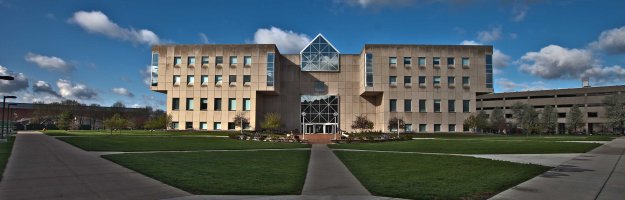
Campus Update: Hateful Islamophobia at IUPUI

iupui-university-library

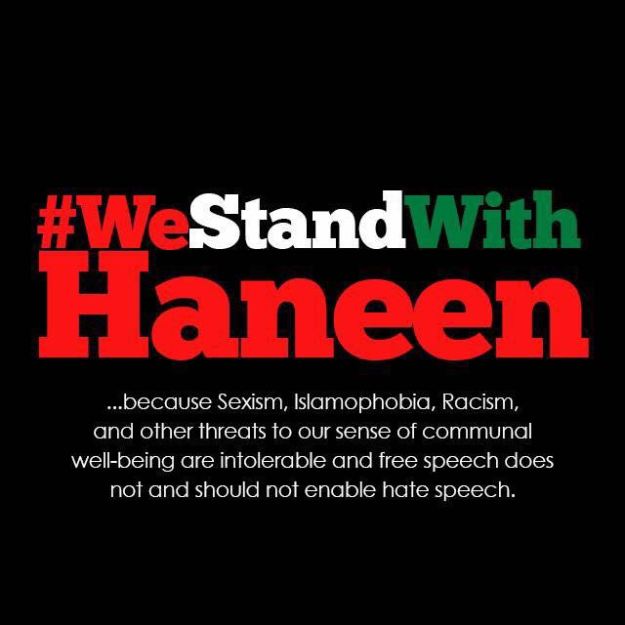
Students for Justice in Palestine (SJP) has done important and inspirational work on colleges around the country – often in the face of death threats, harassment and personal attack. The latest example: just this past week, a student leader of the SJP at University of Indiana – Purdue University Indianapolis (UIPUI) named Haneen (I’ve been asked to not use her last name out of concern for her safety) has been subject to threats, harassment and defamation through anonymous blog posts and flyers left on campus.

Among other things, this hate campaign characterized her as an advocate and supporter of terrorism, made sexist comments about her appearance, urged “authorities to look into her history of violence and investigate whether or not she is an immediate threat to…the nation’s capital.” One post attacked her for partnering with Black Lives Matter , calling it “a group that is also prone to acts of violence.” She has also received harassing phone calls at her home.

Haneen has received heartening support from a variety of corners, including a group of seventy five UIPUI faculty members and student who have signed a letter that calls upon UIPUI Chancellor Nasser Paydar to:

(1) to issue a strong public statement condemning these attacks and (2) to make clear the status of the University’s investigation of these heinous acts.

We encourage the Deans of each IUPUI school to educate their communities on sexism, Islamophobia, racism, and other threats to our sense of communal well-being.

We ask every IUPUI community member to challenge sexism, racism, Islamophobia, and all other forms of discrimination in their everyday interactions both on and off campus.

Making clear our university community’s values and mission in the face of fear and intimidation is necessary to creating a welcoming campus for all. Courage, hope, and love can defeat the hatred that has shown its face among us. We pledge to help in whatever ways we can.

I was encouraged to learn that the Indianapolis Jewish Community Relations Council has written Haneen a letter of support as well. Despite the appropriate demands that the University administration take immediate and meaningful action, however, the only response to date has been a bland, general statement from Chancellor Paydar that IUPUI “abhors all forms of racism, bigotry and discrimination, including discrimination based on religious beliefs or political views.” 

Representing the faculty letter signers, lecturer Lindsay Lettrell rightly and eloquently responded:

Dear Chancellor Paydar,

While we welcome your statement affirming that “the university abhors all forms of racism, bigotry and discrimination, including discrimination based on religious beliefs or political views,” we, faculty, staff and student supporters of Haneen, believe that these immediate, specific problems of racism, sexism, and Islamophobia need to named and condemned explicitly. Our student’s safety and future is on the line, and Haneen has asked that her University speak publicly about her right to safety as a part of our campus community. While the generalities in your message are relevant, we still ask you to address this specifically. After all, as the team of her supporters has reminded us, “She is a real person, not an idea. Her name is Haneen. She is Palestinian. She is a Muslim. She is a woman. (And, I add, she is our student.) She has a face. She has a voice. And her voice is our voice.”

Click here to contact Chancellor Paydar and demand that IUPUI denounce this act of hatred and move swiftly to investigate it.

12987033_448742761996059_3715131622213391113_n


Yes, Zionism is Settler Colonialism

20090927

Is Zionism “settler colonialism?” It’s an important question that is increasingly invoked in public debates over Israel/Palestine – and BDS in particular.

While I personally do believe Israel to be a settler colonial state, I think it’s critical to understand what we mean when we use this term, what it means in the context of Israel/Palestine, and its implications for the wider struggle against systems of oppression in the US and throughout the world.

Let’s start with the definition itself. Many people use the term “settler colonialism” and “colonialism” interchangeably, but they are not in fact the same thing. Colonialism is defined by the Collins Dictionary as “the policy and practice of a power in extending control over weaker peoples or areas.” Historically speaking, it generally refers to specific European imperial powers during a period that lasted from the 16th to mid-20th centuries.

“Settler colonialism,” is a different concept, as Professor of Anthropology Tate A. LeFevre explains:

Though often conflated with colonialism more generally, settler colonialism is a distinct imperial formation. Both colonialism and settler colonialism are premised on exogenous domination, but only settler colonialism seeks to replace the original population of the colonized territory with a new society of settlers (usually from the colonial metropole). This new society needs land, and so settler colonialism depends primarily on access to territory. Britain, for example, implemented the doctrine of “terra nullius” (“land belonging to no one”) to claim sovereignty over Australia. The entire continent was thereby declared legally uninhabited, despite millennia of Aboriginal occupation.

In other words, while colonialism typically refers to events, settler-colonialism is viewed as an ongoing process. Professor LeFevre puts it this way: “Settler colonialism is premised on occupation and the elimination of the native population, while colonialism is primarily about conquest.”

Given this definition, the claim that Zionism is a form of settler colonialism it is not at all inappropriate and certainly not anti-Semitic (as some of the more vociferous Israel advocates will often claim).

There is, for instance, a striking similarity between the British colonial concept of “terra nullius” and the early Zionist slogan, “a land without a people for a people without a land.” This is not say that Zionists viewed the land as literally empty – they most certainly recognized the existence of an Arab population in Palestine. It does mean, however, that they did not always factor its indigenous inhabitants into their equations – and when they did, it was invariably as a problem to be dealt with.

The father of modern Zionism made this clear in his diary when he wrote of Palestinian Arabs:

We shall try to spirit the penniless population across the border by procuring employment for it in the transit countries whilst denying it any employment in our own country.

David Ben-Gurion expressed similar intentions in a 1937 letter to his son Amos (who was critical of his father’s intention to support the 1937 Peel Commission partition plan):

My assumption (which is why I am a fervent proponent of a state, even though it is now linked to partition) is that a Jewish state on only part of the land is not the end but the beginning…

The establishment of a state, even if only on a portion of the land, is the maximal reinforcement of our strength at the present time and a powerful boost to our historical endeavors to liberate the entire country.

We shall admit into the state all the Jews we can. We firmly believe that we can admit more than two million Jews. We shall build a multi-faceted Jewish economy– agricultural, industrial, and maritime. We shall organize an advanced defense force—a superior army which I have no doubt will be one of the best  armies in the world. At that point I am confident that we would not fail in settling in the remaining parts of the country, through agreement and understanding with our Arab neighbors, or through some other means.

Thanks to Israeli historians such as Benny Morris, Avi Shlaim, Tom Segev and Ilan Pappe, we now know that the creation of Israel was accomplished through “some other means.”  More recently, journalist Avi Shavit recently made reference to this ignoble history in his book, “My Promised Land.” The most chilling chapter (which was reprinted in the New Yorker magazine) describes in detail the depopulation of the Palestinian village of Lydda.

Even more chilling are Shavit’s musings on the meaning of this tragic event:

Looking straight ahead at Lydda, I wonder if peace is possible. Our side is clear: we had to come into the Lydda Valley and we had to take the Lydda Valley. There is no other home for us, and there was no other way. But the Arabs’ side, the Palestinian side, is equally clear: they cannot forget Lydda and they cannot forgive us for Lydda. You can argue that it is not the occupation of 1967 that is at the core of the Israeli-Palestinian conflict but the tragedy of 1948. It’s not only the settlements that are an obstacle to peace but the Palestinians’ yearning to return, one way or another, to Lydda and to dozens of other towns and villages that vanished during one cataclysmic year. But the Jewish State cannot let them return.

Many who reject the “Zionism as Settler Colonialism” label often argue that this claim ignores the historic and Biblical connection of the Jewish people to the land – and that Jews are its “true indigenous people” who have been longing for a return and restoration to their ancient homeland for centuries.

Leaving aside the use of a profoundly ahistorical document such as the Bible as justification for the establishment for a modern Jewish nation state, let’s look more closely at the Zionist claim of Jewish indigeneity to the land.

It is certainly true following the destruction of the Temple in 73 CE and the spread of the Jewish people throughout the diaspora, Jewish tradition continued to maintain an important attachment to the land of Israel. Eretz Yisrael (“the Land of Israel”) is a central subject in many sacred Jewish texts and numerous traditional Jewish prayers express a longing for a return of the Jewish people to the land. It is also true that there have been small Jewish communities in historic Palestine throughout the ages and that pilgrimage to Eretz Yisrael was considered to be a mitzvah  (“or sacred commandment”.)

However, it is important to note that the Jewish attachment to this land has traditionally been expressed as an inherently religious connection. From its very beginnings, Judaism has spiritualized the concept of the land. Moreover, throughout the centuries, rabbinical authorities strictly prohibited an en masse return to the land in order to establish a Third Jewish Commonwealth. Such an act was viewed as an anathema – a profane forcing of God’s hand. The restoration of the Jewish People to the land would only occur with the coming of the Messiah and the onset of the Messianic Era.

It is against this context that we must understand Zionism as a modern political movement, arising in the 19th century as an explicit rejection of Jewish tradition. While Judaism was a diaspora-based religion that taught God could be found anywhere in the world, Zionism preached “shlilat hagalut” (“negation of the diaspora”), advocating for a literal return to the land in order to establish a modern Jewish nation state. Influenced by the European nationalisms of its day, Zionism sought to create a new kind of Judaism and indeed, a new kind of Jew.

This radical revisioning of Jewish life and culture in many ways represents the exact opposite of indigeneity. Indigenous peoples by definition maintain unique cultural and linguistic practices distinctive to their presence in a particular land. Zionism created a completely new Hebraic Jewish culture – one that was deeply influenced by a European Ashkenazic ethos and transplanted into the Middle East. To be clear: this is not to say that Jews have no connection to this land and no right to live there, only that the claim of Jewish indigeneity is ideological, rather than factual – and that this claim has had a devastating impact on the actual indigenous people of this land.

Other critics of the settler colonialist label point out that there is no such thing as a discrete “Zionism;” that this movement was historically made up of many different Zionisms, not all of which shared the same political goals. There were, for instance, cultural Zionists such as Ahad Ha’am who did not share Herzl’s desire of a Jewish political state but rather advocated for a gradual colonization of Palestine that would make it the center of a Jewish cultural renaissance. There also Zionists such as Judah Magnes and Hannah Arendt, who believed in the creation of a bi-national Jewish/Arab state in Palestine.

These variants of Zionism represent an important fact of history. But it is also true that they are precisely that: part of the historical past. If Magnes or Arendt were living today, they would surely be considered “anti-Zionist”. In the end, the form of Zionism that ultimately triumphed was the political Zionism advocated by those who sought to create a sovereign Jewish state in historic Palestine. And it was this Zionism that aimed to solve the problem of Palestine’s indigenous population “through some other means” – that is, by means of settler colonialism.

In one of the most comprehensive treatments I’ve yet read on this subject, Bennett Muraskin writes:

Zionism is described by its supporters as the national liberation movement of the Jewish people, but it must be recognized that until the 1947 UN Partition Plan, the land it sought to liberate had a minority of Jews, consisting mainly of recent Europeans immigrants living under the protection of an imperial power. When the British turned against the Jewish colony, the Zionists succeeded in liberating themselves, but in the war it fought with the Palestinian Arabs and Arab armies, the Zionists dispossessed the native population.

In this sense, Israel is a colonial settler state.

Muraskin, however, then goes on to list the ways that make Israel different from other settler colonial states.  His intention, I assume, is to leave open the possibility that it somehow isn’t. This equivocal attitude is obvious from the outset – Muraskin’s article is actually entitled “Is Israel a Colonial Settler State? Perhaps but with Lots of Provisos.”

In the end, however, I believe these “provisos” only demonstrate that Zionism represents but one form of settler colonialism. One obvious difference is that Israel was created by what began as a small movement, not an existing colonial power such as Great Britain, France or Belgium. However it is also true that Israel could never have been created without the help of great world powers (Britain and later the US) who supported the creation of the Jewish state because it advanced their own imperial agendas. James Baldwin put it very aptly in 1979: “The state of Israel was not created for the salvation of the Jews; it was created for the salvation of the Western interests.”

In the end, this insight explains why the debate over this term is more than just academic or semantical. Israel’s oppressive policies against the Palestinians do not exist in a vacuum. They are but part of a larger hegemonic system of white supremacy and institutionalized racism that exists in the US and throughout the world.

As Professor LeFevre writes, “Settler colonialism does not really ever ‘end.’”  Perhaps the first step in that direction is to call it out for what it really and truly is.

What is Really Behind the UC’s Statement on Anti-Semitism?

University of California Intolerance

(AP Photo/Eric Risberg)

The regents of the University of California have spoken and has voted unanimously to adopt its working group’s “Principles Against Intolerance.” As I wrote last week, it is a report that dangerously conflates anti-Zionism with anti-Semitism in ways that make the report muddled, unenforceable, and a very real threat to the free speech of pro-Palestinian student groups on campus.

While most of the public debate over this report has focused on the challenge of balancing the UC’s desire to combat intolerance with the need to protect freedom of speech, it seems to me that one critical aspect of this issue has gone largely unaddressed: the fact that this report which purports to address the issue of intolerance on campus frames the issue almost exclusively in terms of anti-Semitism.

To be sure, if this report was intended to be a comprehensive statement on intolerance, wouldn’t the UC’s working group have consulted with a wide variety of experts on the campus intolerance currently faced by Muslim students, students of color, LGBTQ students, etc?  Tellingly, the report states that the working group “invited four recognized scholars and/or leaders on the subjects of discrimination, with a particular focus on anti-Semitism, and on free speech.” (Among these four expert/scholars were Rabbi Marvin Hier, of the Simon Wiesenthal Center, a high profile Israel advocate whose organization is currently building its”Museum of Tolerance” on top of an ancient Muslim cemetery in Jerusalem.)

Even more troubling, the opening “Contextual Statement” of the report states that the working group was formed in response to”public comment and concern from a variety of sources that there has been an increase in incidents reflecting anti-Semitism on UC campuses.”  The regents offer nothing more than this anecdotal statement to justify the formation of a working group and a months-long deliberation and debate on this issue. There is, however, no real evidence to support the claim that campus anti-Semitism is on the rise. Quite the contrary, as the Anti-Defamation League itself recently reported:

While (anti-Semitic) inci­dents are cer­tainly dis­turb­ing, it is important to note that these inci­dents are rel­a­tively rare, and the vast major­ity of Jew­ish stu­dents report feeling safe on their cam­puses.

This all begs the obvious question: why did the regents of UC feel the need to form a working group and hold a long public debate over a report such as this? I would submit it has nothing to do with genuine concern about intolerance on campus and everything to do with politics. This report is but a part of a much larger effort that seeks to stem the growing tide of the Boycott, Divestment and Sanctions movement on college campuses.

As the LA Times just reported:

The drive for the UC statement was led by the Amcha Initiative, a group that combats anti-Jewish bias on college campuses. Tammi Rossman-Benjamin, the group’s director and a lecturer at UC Santa Cruz, said campus demonstrations against Israeli policies and calls for the university to divest from firms with financial ties to Israel’s military have created blowback for Jewish students.

The involvement of the AMCHA Initiative with this “drive” tells you everything you need to know about the motivation behind the UC’s statement. AMCHA is a zealous Israel advocacy organization that fights campus “anti-Semitism” by monitoring college classes, spying on students and publishing names of “anti-Israel”professors. It bears noting that AMCHA was publicly admonished in 2014 by San Francisco State University (along with, you guessed it, the Simon Wiesenthal Center) for making false accusations against a professor. That same year, a group of forty Jewish studies professors from across North America wrote a public letter condemning AMCHA and its tactics.

Here’s an excerpt:

It goes without saying that we, as students of antisemitism, are unequivocally opposed to any and all traces of this scourge. That said, we find the actions of AMCHA deplorable.

Its technique of monitoring lectures, symposia and conferences strains the basic principle of academic freedom on which the American university is built. Moreover, its definition of antisemitism is so undiscriminating as to be meaningless. Instead of encouraging openness through its efforts, AMCHA’s approach closes off all but the most narrow intellectual directions and has a chilling effect on research and teaching.

Given the involvement of groups such as AMCHA, it is difficult to view the regents’ statement as anything other than a caving in to the pressure of professional advocacy groups determined to quash BDS and shut down pro-Palestinian advocacy on college campuses. Sadly, by labeling this criticism of Israel and anti-Zionism as anti-Semitic, it only silences students, renders the term meaningless and makes it that much harder to take actual allegations of campus anti-Semitism seriously.

As the ADL has reported, the vast major­ity of Jew­ish stu­dents report they feel safe on their cam­puses. Some of them may be made to feel uncomfortable by Palestinian activism and divestment resolutions, but uncomfortable is a far cry from unsafe. And it is shameful that UC has allowed itself to be pressured into issuing an unnecessary and downright dangerous statement such as this.

Given the current climate in our nation, I’d wager if there was a group of students who might well feel justifiably unsafe, it is Muslim students. By all reports, college campuses are feeling the impact of anti-Muslim hatred that began with 9/11, and is currently being fanned yet further during this horrid election cycle. For more this particular subject, I highly recommend this powerful article by Nasreen Mohamed, an administrator at the University of Minnesota. I’ll end with her words:

After the ending of a successful program to welcome new international students, I noticed one of the students who attended the program struggling to figure out the bus route to get home. I stopped to assist her, and we ended up walking together as I happened to be going in the same direction. We struck up a conversation about walking on campus. She is a Lebanese Muslim woman who wears a hijab.  She asked me how safe it was for her to walk on campus. I gave her my administrative cautionary tale about taking safety precautions and avoiding walking alone late in the evening. After a pause, she asked me how safe it was to walk on campus as a Muslim woman, wearing a hijab. I realized in her pause and clarification that there was very little I could offer her in terms of a sense of safety. All I could do was to give her a realistic picture. I told her that there had been violence in the Twin Cities  and in Greater Minnesota, but nothing violent had occurred on campus. After I walked away, I realized that she will be met with the same micro aggressions that I had experienced post 9/11, and that our campus was still not equipped to protect her spirit.

Anti-Zionism Isn’t a ‘Form of Discrimination,’ and It’s Not anti-Semitism

2261882899

Cross-posted with Ha’aretz

As an alum of UCLA, I was particularly interested when I learned that the working group for the Regents of the University of California Board had released their draft “Statement of Principles Against Intolerance.”  Having followed the news at my alma mater I knew that despite its title, this report wasn’t going to be merely a general statement about the importance of tolerance on campus. It was written in response to allegations of rising anti-Semitism at UCLA and other UC campuses.

On the face of it, there is much to admire about the report, particularly its strong support of campus environments “in which all are included, all are given an equal opportunity to learn and explore, in which differences as well as commonalities are celebrated, and in which dissenting viewpoints are not only tolerated but encouraged.”

In the end, however, this “Statement of Tolerance” actually achieves the exact opposite of its stated goals. If heeded, it would serve to silence dissent and open debate on college campuses.

At the beginning of the draft report, it states:

Fundamentally, commenters noted that historic manifestations of anti‐Semitism have changed and that expressions of anti‐Semitism are more coded and difficult to identify.In particular, opposition to Zionism often is expressed in ways that are not simply statements of disagreement over politics and policy, but also assertions of prejudice and intolerance toward Jewish people and culture.

The statement thus concludes that “anti‐Semitism, anti‐Zionism and other forms of discrimination have no place at the University of California.”

It is certainly important to state unequivocally that anti-Semitism will not be tolerated on UC campuses. But it is incorrect and even disingenuous of the report to make the unsupported claim that anti-Zionism is “often expressed (as) assertions of prejudice and intolerance toward Jewish people and culture,” and blithely conflate anti-Semitism with anti-Zionism as a “form of discrimination”.

It is true that some anti-Semites lurk behind the label of anti-Zionism – and when they do they should rightly be exposed and condemned. But it is deeply problematic to label anti-Zionism as a form of discrimination.

In fact, growing numbers of Jews and others identify as anti-Zionists for legitimate ideological reasons. Many profess anti-Zionism because they do not believe Israel can be both a Jewish and democratic state. Some don’t believe that the identity of a nation should be dependent upon the demographic majority of one people over another. Others choose not to put this highly militarized ethnic nation-state at the center of their Jewish identity.  Far from being discriminatory, their beliefs are motivated by values of equality and human rights for all human beings.

Blurring the distinction between anti-Zionism and anti-Semitism muddles the definition of anti-Semitism to the point that it becomes meaningless.This conflation is irresponsible and harmful and invariably draws our attention away from real anti-Semitism, whether it be the targeting of Jews, the vandalization of synagogues and cemeteries or the proliferation of hate groups at home and abroad.

Certainly all forms of racism should be called out in no uncertain terms. But erasing the lines between anti-Semitism and anti-Zionism only makes this task more difficult.

I can’t help but notice that this report’s broadside on anti-Zionism strongly evokes the right-wing agenda of groups such as the AMCHA initiative. Tammi Rossman-Benjamin, Director of AMCHA has long made it clear that tarring anti-Zionists as anti-Semites is part of a larger strategy to ban Palestinian solidarity groups from campuses across the country.

Such a policy would have a devastating impact on Palestinian activists and their allies. It would prevent many Palestinian and Israeli human rights advocates from speaking on college campuses. It would prevent students from displaying a model of Israel’s separation wall to demonstrate to the oppressive effects of Israel’s occupation. And it would forbid student efforts to hold Israel accountable through economic pressure, through campaigns to boycott and divest from settlements or from corporations that profit from the abusive policies of the state of Israel.

Having long worked in the Jewish community, I know that some Jewish organizations equate anti-Zionism with anti-Semitism because they seek to protect Israel’s image or because they do not want Jewish college students to have to tolerate criticism of Israel and Zionism.Those who believe in a one state solution are accused of seeking “the destruction of the Jewish state” when they actually hold their position as a result of honest political analysis and a genuine concern for all who live in the land, regardless of their religion or ethnicity.

Yes, critics of Israel and Zionism can sometimes be harsh and their tactics confrontational, but I do believe we do our young people no favors when we attempt to silence them. Though I have come a long way since my UCLA days, I still remember all too well how uncomfortable it was to have one’s beliefs and opinions challenged.But we should not confuse “uncomfortable” with “unsafe.” Forbidding debate and free speech will not create more comfortable campus environments – it will only marginalize students for legitimately expressing their beliefs.

The UC Regents claims to support the open exchange of ideas on their campuses. But they will never accomplish this if they teach students that their ideas only matter if they pass a political litmus test.

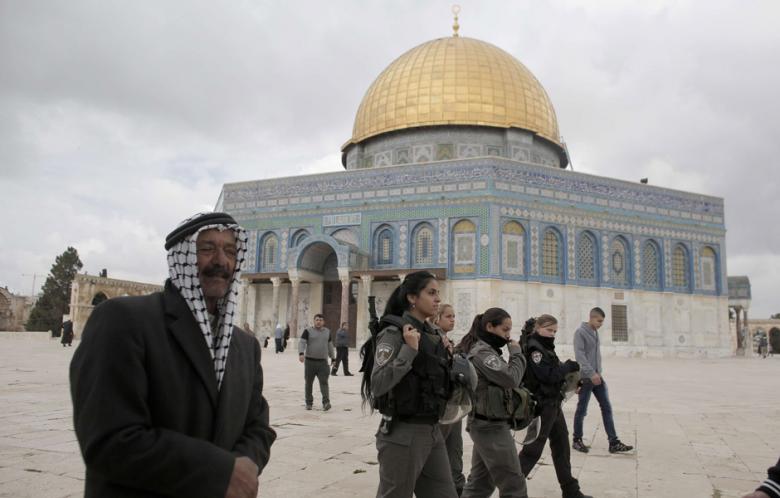
The “Religious Roots” of Palestinian Violence: A Self-Fulfilling Prophecy?

al

Benjamin Netanyahu’s recent comment at the World Zionist Congress attributing the Final Solution to the Grand Mufti of Jerusalem was stupid and ignorant – and he has been justifiably ridiculed around the world for making it. But those who think these kinds of crazy comments will somehow prove his downfall should think twice. Netanyahu has long been willing to take his lumps for his silly behavior as long as it ultimately serves his political purpose. In this case, his purpose is clear: he is attempting frame Palestinian violence as the result of religious (read “Muslim”) intolerance of Jews.

And those of us who delight in ridiculing Bibi the Clown should take heed: there is every indication that his attempts to shift this particular narrative are starting to gain traction.

Just a few days before Netanyahu’s comments, for instance, Jeffrey Goldberg, a well-known mainstream media journalist, published an article in The Atlantic entitled “The Paranoid, Supremacist Roots of the Stabbing Intifada.” His conclusion?

One of the tragedies of the settlement movement is that it obscures what might be the actual root cause of the Middle East conflict: the unwillingness of many Muslim Palestinians to accept the notion that Jews are a people who are indigenous to the land Palestinians believe to be exclusively their own…

In his piece, Goldberg traces this “root cause” as far back as the 1920s. Like Netanyahu, he casually portrays the wretched Mufti of Jerusalem, Haj Amin al-Husseini as a surrogate for the Palestinian people writ large, conveniently neglecting to point out that al-Husseini was not in fact chosen by Muslim Palestinians, but was actually appointed by the British High Commissioner Herbert Samuel in 1921 – and that he was dismissed as Mufti in 1936, five years before he famously met with Hitler. Even more crucially, treating a colonially-appointed Muslim leader as representative of the entire Palestinian people conveniently ignores the presence of Palestinian Christians, who in the 1920s made up one tenth of the population of Palestine.

In its way, his post was even more dangerous than Netanyahu’s silly remark, as it put a legitimate face on the claim that the Israel-Palestine conflict can essentially be reduced to Muslim intolerance of Jews. In contrast to Netanyahu’s remarks, Goldberg’s article was widely respected and went viral across the social media. Much to my dismay, many of my liberal rabbinic colleagues approvingly posted it on their Facebook pages.

In his article, Goldberg also pointed to recent “harsh” statements by Palestinian Authority President Mahmoud Abbas, suggesting that “these sorts of comments…suggest a tragic continuity between the 1920s and today.” Abbas’ comments were odious to be sure, but it is ludicrous in the extreme to somehow characterize him as a wide-eyed Muslim extremist. And it is even more ludicrous to suggest that the majority of young Palestinians engaging in the current violence have been “incited” by his words.

As Israeli journalist Mya Guarnieri has rightly observed:

Those who call this a religious war, and who point to Abbas’ words as incitement, have got it backwards. Abbas — whose term expired in 2009 and has little legitimacy on the Palestinian street — is trying to insert himself into recent events in a bid to regain popularity.

But the Palestinian youth who are protesting and carrying out attacks on Israelis care little what he or other politicians say. Indeed, their actions can also be understood as moves against the current state of politics, including the Palestinian Authority itself. The young people are calling for something new, for something more than endless negotiations that go nowhere or that buy Israel the time to build more settlements and deepen the occupation. After all, this is the generation that was born and raised after the Oslo Accords were signed in 1993 — their difficult lives are a testimony to what negotiations will get the Palestinian people. That is to say, little.

That’s right: the true “roots” of this tragedy are not religious but political. If we are to draw a direct from the violence of the 1920s until today, it should more accurately be traced from a collision between a Jewish ethno-nationalist enterprise and an indigenous population resisting displacement and occupation.

I find it notable that Goldberg does not track his “religious intolerance” narrative further back than the 1920s. In fact, while there has always been a Jewish presence in this land, there was relatively little tension between the religious communities of Palestine before the 19th century – when the Zionist movement began colonizing it with the express purpose of creating an exclusively Jewish state in a historically multi-religious and multi-ethnic land.

Having said this, however, I do fear that the longer this political injustice is allowed to continue – the longer Israel’s oppression of Palestinians is allowed to continue with impunity – the more likely we will witness the rise of religious extremists on both sides. This is clearly Netanyahu’s strategy of course: to “manage the conflict” until the religious extremist meme invariably becomes a reality.

Just yesterday, for example, the Israeli Prime Minister was quoted as saying that although he does not want a bi-national state, “at this time we need to control all of the territory for the foreseeable future…I’m asked if we will forever live by the sword – yes.” Then most tellingly, he added this all-too-familiar analysis: “half of the Palestinians are ruled by an extreme Islam that wants to destroy us.”

Yes, on the one hand it’s just more Bibi-bombast. But don’t dismiss his words too easily. As long as Israel seeks to “control all of the territory,” the more likely the chances that his cynical narrative will tragically become a self-fulfilling prophecy.

Stop the Killing, End the Occupation: A Statement from the Global Jewish Network for Justice

f04da2db14840f3a1d9033

Please read and share this statement, which was initiated by an international Jewish network of groups and individuals working for justice in Palestine. We reclaim Jewish identity not as a nationalist identity but as one that celebrates our diverse roots, traditions & communities wherever we are around the world. We believe that it is essential for there to be a global Jewish voice to challenge Israel’s destructive policies, in solidarity with the Palestinian struggle. This international Jewish network aims to become that voice.

If you would like to sign on to this statement as an individual or a group, click here.

As members of Jewish communities around the world, we are horrified by the violence that is sweeping the streets of Palestine/Israel, costing the lives of over 30 people, both Palestinians and Israelis in the past two weeks alone. A 2 year old girl in Gaza was the youngest of 4 Palestinian children who were killed in the past two weeks. A 13 year-old Israeli boy is in critical condition after being stabbed nearly a dozen times. Over a thousand people were injured in the same period. Fear has completely taken over the streets of Jerusalem, the center of this violence. Israelis shooting Palestinian protesters in and around East Jerusalem. Palestinians stabbing and shooting Israeli civilians and policemen in the middle of the streets. Israeli forces killing Palestinian suspects when they are clearly not a threat and without trial. Palestinians throwing stones at passing cars. Israeli mobs beating up Palestinians or calling on police to shoot them. Humiliating strip searches of Palestinians in the streets – all of these have become a daily occurrence in the city in which we are raised to pray for peace, as well as other places in Israel, Gaza and the West Bank.

While violence is visible on the streets, it is also occupying people’s minds and hearts. Fear is bringing out the worst of people, and the demand for more blood to be shed, as if this will repair the damage done. Fear and racist rhetoric are escalating the situation. The Israeli government is once again responding in a militarised way: there have been hundreds of arrests; Palestinian access to the Al-Aqsa mosque compound has been limited; parts of the Muslim quarter of the Old City of Jerusalem have been closed to Palestinians; open-fire regulations have been changed to allow the use of sniper fire against children; a minimum sentence for stone throwing has been introduced, including for over 150 children arrested in East Jerusalem alone in the past few weeks; and now there are talks of enforcing a curfew, or even a closure, of East Jerusalem.

All these constitute collective punishment on the entire population of East Jerusalem with over 300,000 people. In the past, these measures have proven themselves ineffective at ending violence. Decades of dispossession, occupation and discrimination are the main reasons for Palestinian resistance. Further Israeli military repression and ongoing occupation and siege will never end the Palestinian desire for freedom nor will it address the root causes of violence. Indeed, the current actions by the Israeli government and army are likely to create further violence, destruction, and the entrenchment of division. Only justice and equality for all will bring peace and quiet to the residents of Israel and Palestine.

As a group of Jews from around the world we believe that immediate change needs to come from the Israeli government and Israeli people. It is incumbent on all Jews around the world to pressure the Israeli government – and those who follow and support its words and deeds – to change its approach. The military crackdown must cease immediately, Palestinians must be allowed complete freedom of movement. It is also a responsibility of Jewish people worldwide to obligate the countries in which we live to immediately cease the economic and military support of the ongoing Israeli occupation in Palestine and siege of Gaza.

We call on our Jewish communities, and our broader communities, to publicly insist on an end to the violence, occupation, siege and military response and instead demand equality and freedom for the Palestinian people and justice for all.

“Who will be Next?” Max Blumenthal’s Yom Kippur Presentation at Tzedek Chicago

Max and BrantOn Yom Kippur, journalist Max Blumenthal delivered this powerful presentation during the afternoon program at Tzedek Chicago, where he discussed what he witnessed in Gaza during Israel’s military onslaught last summer. He wrote about his experiences at length in his recent book, “The 51 Day War: Ruin and Resistance in Gaza.”

Max attended our services for the duration of Yom Kippur and remarked to me on more than one occasion how important it was for him to be invited to speak in a Jewish congregation for the first time.

For my part, I could not think of a more appropriate presentation for the Jewish Day of Atonement.

Please watch and share…