Category Archives: War

Khaled Meshaal’s Speech: Actions Speak Louder

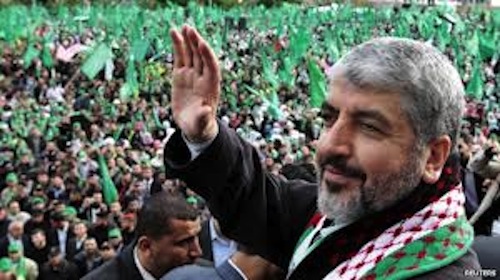
Khaled-Meshaal

I’ve just finished reading Hussein Ibish’s excoriation of Hamas leader Khaled Meshaal’s victory speech in Gaza last week, in which he accuses Meshaal of “unhelpful escalating rhetoric” against Israel. Along the way, Ibish dishes out a fair amount of rhetorical hyperbole himself, calling Meshaal’s speech “one of the most cynical, damaging and dangerous speeches in the history of the Palestinian national movement” and “profoundly toxic from every perspective.”

It’s certainly true that Meshaal’s speech, which he delivered as he made his first-ever visit to Gaza on the occasion of the 25th anniversary of Hamas and the end of Israel’s latest military campaign, Operation Pillar of Defense, struck a note of resolute defiance.

Here’s a translated excerpt from an Al Jazeera report:

“Palestine is our land and nation from the [Mediterranean] sea to the [Jordan] river, from north to south, and we cannot cede an inch or any part of it,” he said. “We fight Zionists, not Jews. We fight whoever occupied our land, regardless of religion … Statehood will be the fruit of resistance, not negotiations,” Meshaal told cheering fans.

Hamas does not belong to the PLO, but Meshaal said a year ago that it and other factions were “on the path to joining” it.

While this is certainly strong – even incendiary – stuff, are we really to believe it was “one of the most cynical, damaging and dangerous speeches in the history of the Palestinian national movement?”

First of all, let’s take a closer look at the context in which this speech occurred. Shortly before Meshaal’s visit, Israel had leveled a devastating military assault against Hamas in Gaza. During two weeks of fighting, Hamas sent numerous missles into Israel – some of which landed close to major population centers in Tel Aviv and Jerusalem. The violence was eventually quelled through a US/Egypt brokered ceasefire. 

In other words, this is what it took to elicit the US’s active engagement with Israel and Palestine. Years of IDF crushing of Palestinian non-violent demonstrators have garnered nothing but silence. The PA’s attempt to gain recourse through the UN was met with active opposition from the Obama administration. It was only the armed resistance of Hamas in Gaza that managed to bring Hilary Clinton to the region and actively engage with the Israelis and Palestinians. In the end, what kind of message does that send to the Palestinian people?

So yes, Khaled Meshaal, told a cheering crowd that “statehood will be the fruit of resistance, not negotiations.” But should we really be so surprised? While negotiations have proved disastrous for the Palestinian people, armed resistance seems to be the only way they ever catch the attention of the international community.  Did Ibish really think Meshaal was going to get up on the podium and call for a resumption of the peace process?

Although those who consider Hamas to be an unrepentant “Islamist” terror organization would likely scoff, Meshaal and other Hamas leaders have in the past made noteworthy overtures that indicated a willingness to engage in a US-led peace process (albeit fundamentally different than the one embodied by the follies of Oslo.)  Most notably, following President Obama’s Cairo speech (which signaled at the time, a different American attitude toward the Muslim world), Meshaal responded with an important 2009 policy speech in which he welcomed a “change of tone” from Obama.  He went on to attribute this new American tone as the fruit of the “stubborn steadfastness of the people of the region, while resisting in Palestine, Lebanon, Iraq and Afghanistan” and stressed that it was not merely a change of tone but a change of policy that was needed to make progress in the region.

Meshaal added that Palestinians would judge the US not by its words but by its actions, which would have to “begin with reconstruction of Gaza and the lifting of the blockade, lifting the oppression and security pressure in the West Bank, and allowing Palestinian reconciliation to take its course without external pressures or interference.”

Whether or not one believes these overtures were genuine, we’ll never really know. Meshaal’s opening went utterly unregarded by the Obama administration, who refused to deal with Hamas and chose to maintain its support of Israel’s crippling siege of Gaza.

Given this history, are we really to believe, as Ibish would have it, that Meshaal’s recent speech is one of the most “cynical, damaging and dangerous speeches” Palestinian history?  Or is it merely a reflection of its time – a moment in which the Obama administration has thoroughly squandered its own stated desire to usher in a new era of engagement in the Middle East?

In the end, Meshaal’s speech was simply that – a political speech. And history (particularly Middle East history) has shown us time and again that parsing a politicians words are a notoriously bad way to predict what he/she will eventually agree to. In the words of the very insightful Israeli blogger Noam Sheizaf:

The bottom line is that none of this matters. It’s all a huge red herring. Nothing a leader says now determines the way he will act in the future. Public statements are important only to a limited extent and agreements depend on the continued willingness of both sides to uphold them. As long as both parties feel that they benefit from a certain status quo, or that their interests are better served than by any alternative, the deal they reach could hold. If one party is coerced into signing but doesn’t have its interests and desires addressed, all the nice declarations won’t matter. Twenty years after the historic peace deal that should have ended the Israeli-Palestinian conflict but didn’t, you’d think that people would get it.

The arguments about the meaning and importance of the Hamas charter are all but identical to the decade-long debate over the PLO charter. How much effort and time was put into forcing Arafat to change it, and how little did it matter when negotiations collapsed in Camp David and violence returned. The same goes for today: Given the right pressure, a certain Palestinian leadership could be made to promise Israel anything. Yet none of it would matter if you don’t address the fundamentals of the conflict: The occupation, the refugees, the holy sites, the settlements, the access to land and to water. The leaders would change their minds and if they don’t new leaders (“more extreme”) will come. Reality will prevail over rhetoric.

So let’s be honest. Meshaal didn’t mince his words –  but in the end it is actions that ultimately matter.  And in this regard, Meshaal’s words were considerably less damaging to the cause of the Palestinian national movement than the Netanyahu government’s announcement that it would build 3,000 more units in the E1 region, which would successfully cut the West Bank in half and cut it off completely from East Jerusalem, ending any reasonable hope for a viable two state solution. Sadly, the only response this deeply damaging action elicited from the Obama administration were words such as “counterproductive” and “we urge restraint.”

To my mind these kinds of words are considerably more dangerous to the cause of a just peace in Israel/Palestine.

Outrage in Gaza Redux

Israel’s military assault on Gaza in 2008-09 represented an important turning point in my own relationship with Israel. I recall experiencing a new and previously unfamiliar feeling of anguish as Israel bombarded the people living in that tiny, besieged strip of land over and over, day after day after day. While I certainly felt a sense of tribal loyalty to the Israelis who withstood Qassam rocket fire from Gaza, I felt a newfound sense of concern and solidarity with Gazans who I believed were experiencing nothing short of oppression during this massive military onslaught.

And now it’s happening again. Only this time I don’t think the term “anguish” quite fits my mindset. Now it’s something much closer to rage.

It’s happening again. Once again 1.7 million people, mostly refugees, who have been living in what amounts to the world’s largest open air prison, are being subjected to a massive military assault at the hands of the world’s most militarized nation, using mostly US-made weapons. And our President is not only looking on – he is defending Israel’s onslaught by saying it has a right to “self-defense in light of the barrage of rocket attacks being launched from Gaza against Israeli civilians.”

Let’s be clear: this tragedy didn’t start with the Qassams.  It didn’t start with the election of Hamas. And it didn’t start with the “instability” that followed Israel’s withdrawal from Gaza.

No, this is just the latest chapter of a much longer saga that began in 1947-48, when scores of Palestinians were ethnically cleansed from their cities and villages in the coastal plain and lower Galilee and warehoused in a tiny strip of land on the edge of the Mediterranean. By all accounts, most were simply too overwhelmed to realize what was happening. The ones who tried to return to their homes were termed “infiltrators” and were killed on sight. Others resisted by staging raids in the newly declared state of Israel. Sometimes they succeeded, more often they did not. Either way, Israel decided early on that it would respond to each of these reprisals with a overwhelming military show of force.  And those reprisals and that show of force have essentially been ongoing until this very day.

I realize, of course, there is plenty of political subtext to this latest go-around.  I’ve read the timelines and have formed my own opinions on the latest “who started it?” debate. I’ve also read plenty of analyses by Israeli observers who believe that this was not a response to Qassam fire at all but was very much a “war of choice” waged by an Israeli administration looking to shore up political support in an election season.

I’ve also read a widely circulated article from Ha’aretz about Israel’s recent execution of Ahmed Jabari (the head of Hamas’ military wing). I learned that up until now, Jabari was “Israel’s subcontractor” for security in the Gaza Strip, that Israel has been literally funding Hamas through intermediaries in exchange for peace and quiet on their southern border, and that when Jabari failed to deliver of late, the decision came down to take him out. Another article, written by the Israeli who negotiated with Jabari for the release of Gilad Shalit, revealed that negotiations were still ongoing with Jabari when the Israeli military assassinated him with a drone strike.

Yes, the wonky side of me has been avidly reading all these analyses. And while I do believe they provide an important counterbalance to the mythic statements by Israel’s Foreign Ministry and the US State Department, the more I read the cynical political subtext for this war, the sicker I get. No, this isn’t about Qassams, but don’t be fooled into thinking it’s about elections either. It’s really just the most recent chapter in a much longer litany of injustice – the latest attempt by Israel bring the Palestinians to their knees through the sheer force of their formidable military might.

Of all the analyses I’ve yet read, one of the very few that truly seemed to grasp this truth came from Yousef Munayyer, of The Jerusalem Fund/Palestine Center:

The problem Gaza presents for Israel is that it won’t go away—though Israel would love it if it would. It is a constant reminder of the depopulation of Palestine in 1948, the folly of the 1967 occupation, and the many massacres which have happened since them. It also places the Israelis in an uncomfortable position because it presents a problem (in the form of projectiles) which cannot be solved by force…

Israel has tried assassinating Palestinian leaders for decades but the resistance persists. Israel launched a devastating and brutal war on Gaza from 2008 to 2009 killing 1,400 people, mostly civilians, but the resistance persists.

Why, then, would Israel choose to revert to a failed strategy that will undoubtedly only escalate the situation? Because it is far easier for politicians to lie to voters, vilify their adversaries, and tell them ‘we will hit them hard’ than to come clean and say instead, ‘we’ve failed and there is no military solution to this problem.’

Like last time, I know many in the Jewish community will say it is unseemly of me to criticize Israel this way while Israelis live in fear of Qassam fire out of Gaza. I know there are those who believe that by writing these words, I’m turning my back on my own people in their time of need. But I know in my heart that my outrage at Israel’s actions goes hand in hand with compassion for Israelis – particularly those who know that their leaders’ devotion to the sword is leading them into the abyss.

Additionally, as I wrote under tragically similar circumstances in 2009:

I believe Israel’s response to Hamas’ missile attacks have been disproportionate and outrageous. I believe their actions only further endanger the security of  Israelis while inflicting collective punishment and a severe humanitarian crisis upon Gazans. Indeed, just as I cannot understand what it must be like to be a citizen of Sderot, I cannot even begin to imagine what it must be like to be a Gazan citizen at the moment, living under constant air attack, with no running water or electricity and dwindling food, as hospitals fill up with wounded and corpses lie rotting in the streets because relief workers are unable to reach them.

When will we be ready to accept that this is not a “balanced” conflict or even a “war” by any reasonable definition – and that it never was?  When will we face the painful truth that this is not a story about one side versus the other but about one side oppressing the other?  Frankly, all the well-meaning liberal comments about “praying for peace on both sides” and leave me cold. Worse, I find them insidious because they simply serve to support the myth that this is a conflict between two equal parties. It is not. And peace will not come until we admit this – until we admit that there is an essential injustice at the heart of this tragedy and that try as it might, Israel will never be able to make it go away through the sheer force of its increasingly massive military might.

Beyond the rage, I’m heartened that this time around there is a growing community of conscience that is speaking out publicly and in no uncertain terms to protest Israel’s latest outrage in Gaza. I am so deeply grateful for my friends and colleagues at Jewish Voice for Peace, who is alone in the Jewish world in condemning this latest assault.  I urge you to read JVP’s courageous statement, which I know gives voice to increasing numbers of Jews and non-Jews, young and old, religious and secular, who are coming together through the courage of their conscience.

At this point in my posts I would typically write “click here” to lend your voice to some kind of collective statement.  I’m going resist that temptation and urge you instead to take to the streets.

I’ll see you there.

An Open Letter to the President

Please, please read this recent blog post by my friend Abby Okrent. I will have more to write about Israel’s most recent outrages in Gaza very soon.

Dear Mr. President,

My younger brother was an early believer in you. He worked for your Senate campaign. At the age of 25, he ran the GOTV campaign in North Carolina, delivering an improbable victory for you in a Southern state that helped give you your first term. This year, slightly less bright-eyed but nonetheless a believer, he was working on your campaign again when he died suddenly, a brilliant, energetic 29 year old, dead in his tracks. You know this. You called my parents. Your campaign, to my greatest appreciation and respect, brought grief counselors for his coworkers, dedicated a corner of the office and much of your fundraising efforts to him, and bussed his coworkers to join the hundreds of others at his funeral.

You may not know that after his sudden passing, many of his friends quit their jobs, moved, changed their lives to continue working on your campaign in his memory. One of these friends ran your GOTV effort in Ohio, delivering a close swing state that resulted in the race being called for you early. My mom and I joined these efforts in Ohio, door-knocking until right before the polls closed, pounding the pavement in Alex’s memory and in hopes of your next presidency. Despite my disappointment in some of your stances, I proudly kept my Ohio for Obama sticker on my jacket.

Until yesterday. Mr. President, when the bombs began raining on Gaza again and you reiterated Israel’s “right to defend itself”, I took that sticker off my jacket. Later, you called Prime Minister Netanyahu and asked him to “use restraint,” as though he were a glutton at a feast, rather than an elected official of a powerful military nation, using your own country’s weaponry to engage in a one-sided assault. Mr. President, you are the most powerful man in the world. You do not need to politely request anything of Mr. Netanyahu; you can stop him by ending U.S. military aid to Israel until Israel complies with international and U.S. law. Mr. Netanyahu and his right-wing allies in the U.S. actively campaigned against your re-election, assuming that Governor Romney would be better positioned to give them carte blanche to violate Palestinian human rights and start regional wars. It is not to them that you now need to prove your allegiance, but to we the people who knocked doors for you, who made phone calls for you, who died getting you this 4 years more of opportunity.

My brother was an early believer in you. He knew, but disliked, that you would have to sway to right-wing Israeli interests. We watched you walk away from your Palestinian colleagues in Chicago. It became a painful issue in our Jewish family as we tried to support my brother all the while wondering how far you would go in continuing the charade that the American people and our interests, and not American money and its interests, really drove your Middle East policy. Mr. President, AIPAC’s star is fading. Not in your final term, maybe, but soon, politicians who hitch their ambitions to this tainted money will fall. You saw this at the DNC when Mayor Villaraigosa failed to get his 2/3 vote for an AIPAC-sponsored resolution but proceeded to pretend the support was still there; it’s not. My brother was an early American Jewish voice for Palestinians, but he was not alone and there are more of us than ever. And there are also Arabs now in your coalition; you saw them at the DNC in their “Yalla Vote!” t-shirts. You have a rainbow of supporters who worked to re-elect you. We voted for you. We fund-raised for you. We do not want to watch you pretend like it is for us that you allow these massacres to continue with our money.

My brother would be disappointed to see your impotence in the face of continuing Israeli aggression shortly after such a sweeping re-election victory. I am still proud of him. I am still proud of all of the Americans that worked so hard to deliver you this re-election. But I am so hurt and ashamed to watch you use restraint when you are the only person with the power to stop this massacre. Mr. President, I am barely over 5 feet tall and I am not afraid of AIPAC; why are you?

Sincerely,

A bereaved sister

My “Wrestling” Interview with Truthout

Check out my wide-ranging and freewheeling conversation with Truthout’s Mark Karlin, which focuses on my book, but also touches on subjects such as Zionism, BDS, the two-state solution and Palestinian solidarity, among others.

Here’s a taste, below. Click here for the full interview.

Mark Karlin: Stereotyping any group of people is dangerous. In polls during peaceful periods, most Palestinians and Israelis appear to support peace. A lot of what Netanyahu appears to do is stir up the pot so that there will never be a long enough period to negotiate a peace. That’s not to excuse those in Hamas and Hezbollah who have their own motives in heating up the conflict now and then, along with other parties who have vested interests in stalling peace. When you talk of your Palestinian solidarity, some critics accuse you of abandoning Jewish solidarity and not sufficiently condemning those Arab extremists who are in the “destroy Israel” industry as much as Netanyahu is in the suppression-of-Palestinian-rights industry. How do you respond?

Brant Rosen: At the end of my book I addressed this issue directly:

As a Jew, I will also say without hesitation that I reject the view that I must choose between standing with Jews or standing with Palestinians. This is a zero-sum outlook that only serves to promote division, enmity and fear.

For me, the bottom line is this: the cornerstone value of my religious tradition commands me to stand in solidarity with all who are oppressed. It would thus be a profound betrayal of my own Jewish heritage if I consciously choose not to stand with the Palestinian people.

In other words, I believe my Jewish liberation to be intrinsically bound up with Palestinian liberation. It’s really that simple.

I’ve come to believe that solidarity should ultimately be driven by values, not tribal allegiances. It should be motivated by the prophetic vision that demands that we stand with the powerless and call out the powerful. Of course, in the case of Israel, this form of solidarity presents a very painful challenge to many Jews. I understand that. But at the very least, shouldn’t we be talking about this challenge and what it represents for us?

Does my solidarity mean that I agree with everything that is done by Palestinians in furtherance of their liberation? Of course not. When you stand in solidarity with a people, it is inevitable that you will find yourself standing next to some people whose actions and beliefs you will find odious. That comes with the territory when you choose to take a stand. And I might add that this is the case for liberal Zionists who stand in solidarity with Israel as well.

American Heroes: Code Pink’s Anti-Drone Delegation to Pakistan

Medea Benjamin is a true American hero.

The Code Pink founder and nonviolence activist is currently leading a delegation of 31 American peace activists through Pakistan to protest the tragic damage wrought by US drone attacks.  Traveling with popular Pakistani politican, Imran Khan, the delegation recently attempted to hold a rally in the tribal regions that have been hardest hit by the US drone campaign.  On October 9, the delegation will publicly fast from sunrise to sunset at a vigil in front of the Islamabad Press Club, where they will display pictures of the more than 160 Pakistani children who have been killed by American drones. (Jews who have only recently completed a fast of atonement should appreciate the spiritual power of such an act…)

From a recent WashPo feature:

The majority-female delegation — in their early 20s to late 70s — traveled with no security guards despite announced militant threats against them and Khan, head of the Pakistan Justice Movement political party. They fell in line behind Khan’s procession as legions joyously waved party flags atop trucks.

By late Saturday, when the Codepink delegates finally reached a large farm belonging to a regional party official, they were mobbed by an admiring Pakistani media and given a hero’s welcome by hundreds of the candidate’s fans.

Anti-American sentiment runs extremely high in Pakistan, but the delegation focused on a simple message: “We are against drones” was emblazed in Urdu in green fluorescent script, outlined with glitter, on the oversize white bibs they wore.

“You hit people with these drones and you create instant enemies,” said JoAnne Lingle, a silver-haired Mennonite from Indianapolis. “It’s supposed to be increasing our national security and it’s doing the opposite.”

The US drone wars are our national shame. If there had previously been any doubt, I’d say they’ve been put to rest by the NYU School of Law and Stanford University Law School, who released a deeply damning report entitled “Living Under Drones: Death, Injury and Trauma to Civilians From US Drone Practices in Pakistan” late last month.

From the report’s Executive Summary:

In the United States, the dominant narrative about the use of drones in Pakistan is of a surgically precise and effective tool that makes the US safer by enabling “targeted killing” of terrorists, with minimal downsides or collateral impacts.

This narrative is false.

Following nine months of intensive research—including two investigations in Pakistan, more than 130 interviews with victims, witnesses, and experts, and review of thousands of pages of documentation and media reporting—this report presents evidence of the damaging and counterproductive effects of current US drone strike policies. Based on extensive interviews with Pakistanis living in the regions directly affected, as well as humanitarian and medical workers, this report provides new and firsthand testimony about the negative impacts US policies are having on the civilians living under drones…

(While) civilian casualties are rarely acknowledged by the US government, there is significant evidence that US drone strikes have injured and killed civilians. In public statements, the US states that there have been “no” or “single digit” civilian casualties.”2 It is difficult to obtain data on strike casualties because of US efforts to shield the drone program from democratic accountability, compounded by the obstacles to independent investigation of strikes in North Waziristan. The best currently available public aggregate data on drone strikes are provided by The Bureau of Investigative Journalism (TBIJ), an independent journalist organization. TBIJ reports that from June 2004 through mid- September 2012, available data indicate that drone strikes killed 2,562-3,325 people in Pakistan, of whom 474-881 were civilians, including 176 children.

Shortly after this report was issued, Obama had the temerity to stand before the UN and decry the “killing of innocents” in the US mission in Benghazi.  This, while his administration continues to kill innocents in a secrecy-shrouded military program that blatantly undermines the US Constitution and international law – and is most surely inflaming further Mideast rage toward the US.  In the face of such hypocrisy, all I can say is thank God for truth-tellers like Medea Benjamin.

You can follow the progress of the Code Pink delegation here.  For further reading, I highly recommend reading Benjamin’s excellent new book, “Drone Warfare: Killing by Remote Control” and this recent piece by journalist Glenn Greenwald, who has been indefatigably writing shining a bright light on Obama’s drone wars since their inception.

“Jews in Solidarity with Palestinians” – My Upcoming Conversations with Miko Peled

To those who live in or around Chicago: I’ll be appearing twice with the courageous Israeli peace activist Miko Peled (author of “The General’s Son: Journey of an Israeli in Palestine.“) Both Miko and I have books published by Just World Books – both of which chart the our respective (and unlikely) journeys to Palestinian solidarity work. I’ve admired Miko’s work enormously and am delighted we have the opportunity to engage in two public conversations.

If you’re closer to the South Side, you can catch us at Saturday, October 13, 7:00 pm at Hyde Park Union Church (where our conversation will moderated by Palestinian activist/journalist Ali Abunimah.)  For all you North Siders, we’ll be appearing Sunday, October 14, 7:00 pm at Evanston Quaker Meeting.

Please join the conversation!

Diplomacy, Not “Red Lines,” this Rosh Hashanah

Source: Ha’aretz

As the Jewish New Year beckons, Bibi Netanyahu is cravenly criticizing the US President for not drawing a “red line” in the sand that would give the US the go-ahead to militarily attack Iran.  I’m tempted to vent my gall, but thank goodness for MJ Rosenberg, who hits the nail right on the head in a blog post with the awesome title, “My Rosh Hashanah Greeting to Netanyahu: Butt the Hell Out of Our Election”:

For the last three weeks, Netanyahu has been openly attacking our president and has made clear his determination to defeat him. He is demanding that the president draw a red line in the sand, one dictated by Netanyahu, and tell the Iranians that if they cross it, we, the United States, will go to war. In short, he is demanding that the United States allow a foreign country to make our decision to commit our forces on his behalf.  (Not even Winston Churchill demanded that and his country was fighting for its life against Nazi Germany not some imagined threat).

Obama is not going to risk American lives because Bibi wants him to. And I don’t think Romney would either. There are limits, not even Adelson’s campaign contributions are likely to buy a war that would destroy Romney’s  presidency.  He is, after all, an American politician  – just like Obama. American.

Right on. I’m heartened that so far Obama has resisted Bibi’s cynical attempts to use our election season for his own political benefit. As Nicholas Kristof put it so aptly in today’s NY Times, “I think Obama should indeed set a red line — warning Netanyahu to stop interfering in American elections.”

This New Year, as I listen to these kinds of threats bandied about, I can’t help but think back to a sermon I gave to my congregation during the High Holidays four years ago – on the eve of my trip to Iran with the Fellowship of Reconciliation. This is what I had to say back then (still all too relevant today):

If we Jews truly want to avoid a “second Holocaust,” I would suggest the first step would be to stop comparing every provocation against Israel and the Jewish people in the most extreme terms possible.  Iran is not the Third Reich and Ahmadinejad is not Hitler. This is not to say we shouldn’t take Ahmadinejad’s hateful rhetoric seriously, but it does mean that this is a thorny, difficult and complex crisis. And we would do well to respond to it with intelligence and understanding, not by drawing lines in the sand and increasing even further the likelihood of yet another tragic military conflict in the Middle East.

You can click here to read the entire sermon. I also blogged extensively during my trip – you can dig up those posts by going to the Categories menu on the right and clicking on “Iran Trip 2008.”

Let us all pray and work for peace in 5773.

After 11 Years, Nationalism is Still Our Preferred Expression of Grief

Immediately after September 11, I was so struck by the predominant collective response: the ubiquitous display of flags everywhere you looked; the knee-jerk “U-S-A! U-S-A!” chant whenever the tragedies were invoked; the widespread desire for retributive justice, wherever, however possible.

Now eleven years later, even after all that’s happened since, I’m just so saddened that nationalistic displays seem to be the only way we know how to commemorate our dead. Maybe I’m naive, but it’s difficult for me to accept that we still haven’t found a healthier national outlet for our grief.  Call me naive, but I was genuinely surprised – and quite honestly mortified – that the loudest cheers at the DNC last week (always accompanied by the still ubiquitous “U-S-A! U-S-A!”) were saved for references to 9/11 and the killing of Osama Bin Laden.

If you found yourself disturbed as well, I highly recommend that you read this recent piece by Glenn Greenwald, who sorrowfully identifies all that was wrong with the bloodlust on unabashed display during the DNC:

Americans once found national purpose – justification for their belief in their own exceptionalism – from inventing new life-improving technologies, or putting a man on the moon, or advancing the cause of equality, or vanquishing the mighty Nazi military machine, or enshrining unparalleled protections for core liberties in the constitution. Now, many Americans find it in the heroic ability to hunt someone down who is in hiding, pummel his skull full of bullets even as he lay dying on the ground, and then dump his corpse into the ocean…

The premise seems to be that – aside from this specific corpse and the others the president has piled up – there is little else for ordinary Americans to celebrate now when it comes to the search for nationalistic achievement, purpose and greatness among their political leadership. That this dark premise appears valid is what is most disturbing of all.

In the meantime, for me the most moving, compassionate and morally honest tribute to the 9/11 fallen – and all who have fallen by our hands since – is this spoken word piece by Palestinian-American Suheir Hammad (above) entitled “First Writing Since.”

i cried when i saw those buildings collapse on themselves like a broken
heart. i have never owned pain that needs to spread like that.

there is no poetry in this. there are causes and effects. there are
symbols and ideologies. mad conspiracy here, and information we will
never know. there is death here, and there are promises of more.

there is life here. anyone reading this is breathing, maybe hurting,
but breathing for sure. and if there is any light to come, it will
shine from the eyes of those who look for peace and justice after the
rubble and rhetoric are cleared and the phoenix has risen.

affirm life.
affirm life.
we got to carry each other now.
you are either with life, or against it.
affirm life.

Syrians Pay the Price in a Sick Proxy War

An injured civilian is evacuated after shelling by government forces in Aleppo. (Zohra Bensemra/Reuters)

Now that UN Secretary General Kofi Annan has resigned and is no longer leading the effort to find a diplomatic solution to the horrors unfolding in Syria, the prospect for a peaceful conclusion to this conflict look bleaker than ever – if it’s even possible to suggest such a thing:

(Kofi Annan) cited the Syrian government’s “intransigence” and the opposition’s “escalating military campaign” as major impediments to his peace efforts, along with a lack of unity in the international community on how to deal with the crisis.

I’m thinking “lack of unity in the international community” was just Annan’s polite way of saying this tragic mess in Syria has devolved into a sickening proxy war in which no one’s hands are clean and the only losers are the Syrian people themselves.

If you dare, I recommend you read this blisteringly bitter analysis by journalist Robert Fisk, who excoriates the cynical interests – from the US, to Russia and China, to Qatar and Saudi Arabia, to Hezbollah, to the media, to “our dear liberal selves – who are allowing Syria to be used as a bloody chess board, even as they speak out against the daily atrocities that are occurring there:

Has there ever been a Middle Eastern war of such hypocrisy? A war of such cowardice and such mean morality, of such false rhetoric and such public humiliation? I’m not talking about the physical victims of the Syrian tragedy. I’m referring to the utter lies and mendacity of our masters and our own public opinion – eastern as well as western – in response to the slaughter, a vicious pantomime more worthy of Swiftian satire than Tolstoy or Shakespeare.

What could possibly be the outcome of a cowardly proxy war in a sectarian Middle Eastern country? Samia Nakhoul, in a lengthy piece for Reuters, offered this dismal – if most likely – answer:

With no Western appetite for military intervention and no prospect of an internationally mediated political resolution, many see the civil war spreading and tearing the country apart.

“Disintegration of Syria is a possibility and the problem is it won’t work. It would create a power vacuum in which others get dragged in just like Iraq. It is a very frightening scenario,” (Cambridge University analyst George) Joffe said.

Lebanese columnist Rajeh Khoury predicted: “Syria could plunge into a long protracted civil war that could last years. The civil war in Lebanon, with its much smaller population of five million, lasted 15 years due to foreign interference so Syria would be much more complicated.

“The Syrian crisis is so inflammatory that its flames will affect the region in one way or another.”

A prayer for the people of Syria – and a pox on all our houses…

Talking to Iran in Moscow – Pray for Success

Talks began today in Moscow between Iran and the “P5 +1” (the five permanent member nations of the UN Security Council plus Germany). I’m hoping against hope for a breakthrough, but it’s certainly not looking good.

For a sane and balanced take on Iran, I’ve long turned to Trita Parsi, founder and president of the National Iranian American Council, and one of our foremost experts on US-Iranian relations. In a recent NY Times op-ed, Parsi identified precisely why Obama has precious little room to maneuver going into the Moscow talks. In a word: Congress.

Congress is actively seeking to make a deal on the nuclear issue impossible by imposing unfeasible red lines, setting unachievable objectives — and depriving the executive branch of the freedom to bargain.

Just before last month’s talks in Baghdad, Congress passed a resolution that endorsed the Israeli prime minister Benjamin Netanyahu’s red line on the nuclear issue (Iran can’t have a uranium-enrichment capability), as opposed to the red line adopted by the Pentagon and the president (Iran can’t have a nuclear weapon).  The problem is, Mr. Netanyahu’s red line isn’t feasible and doesn’t leave any room for negotiations…

If Iran agrees in Moscow to accept the American demand that it halt uranium enrichment at the 20 percent level — too low a level to quickly create a nuclear weapon — this would effectively obstruct any Iranian shortcut to a bomb. Congress must then give Mr. Obama the political space to be able to take yes for an answer.

Congress must make up its mind. Does it want to prevent an Iranian nuclear bomb or does it want to maintain its sanctions? Going forward, it can’t have both.

As if to put a period on Parsi’s analysis, last Friday 44 senators (23 of whom were Democrats) sent a letter to President Obama demanding that he insist upon three “absolute minimum steps” for continuation of talks: shutting down the Fordow nuclear enrichment facility, freezing all uranium enrichment above 5%, and shipping all uranium enriched above 5% out of the country.

The letter concludes:

If the sessions in Moscow produce no substantive agreement, we urge you to reevaluate the utility of further talks at this time and instead focus on significantly increasing the pressure on the Iranian government through sanctions and making clear that a credible military option exists. As you have rightly noted, ‘the window for diplomacy is closing. Iran’s leaders must realize that you mean precisely that.

If you needed any evidence of Parsi’s claim that Congress is “actively seeking to make a deal on the nuclear issue impossible by imposing unfeasible red lines, setting unachievable objectives — and depriving the executive branch of the freedom to bargain,” this letter provides it.  The writers and signers of this letter clearly know full well that these demands will be a non-starter for Iran.

Even more disturbing is the role of the Israel lobby in these cynical maneuvers. Mideast analyst MJ Rosenberg revealed, in a piece posted four days before the letter was released, that the letter was drafted by AIPAC staffers, pointing out that it was essentially

an AIPAC device for scoring senators in an election year. Those who sign will be rewarded or left alone. Those who don’t will hear from AIPAC and its friends. Not a pretty possibility.

OK, I’ll say it: the role of the Israel lobby in the Iran issue has been nothing short of shameful.  And at times openly, brazenly disingenuous.  Among the more odious examples: the Emergency Committee for Israel, (what you might call the more “zealous” wing of the lobby) recently released a 30 second scare-ad that proclaimed, among other things, that “Iran has enough fuel for five nuclear bombs” – a spurious claim which belies that fact that Iran currently has no weapons grade material at all.

Yes, this election year gives Obama precious little room to maneuver – and the lobby is clearly doing everything it can to exploit this.  But since Obama has repeatedly bent over backwards to prove his allegiance to Israel and AIPAC, I don’t see how bowing to these latest salvos will do much to significantly improve his electoral prospects. And since he’s going to be excoriated by his political rivals no matter what he does, why not stick to his own administration’s stated policy, behave like a statesman and push for a diplomatic success? After all, who should be determining Obama administration negotiating strategy – the Obama administration or Congress/AIPAC?

When you consider that the alternative is another ill-advised march to another disastrous Mideast war, the stakes could not possibly be higher.

Pray for a breakthrough in Moscow this week.

PS:  I’m honored to be discussing this issue further in a dialogue with Trita Parsi entitled “Can War with Iran be Averted?” on Thursday, June 28, 7:00 pm at Jewish Reconstructionist Congregation in Evanston, IL. Click here for more details.