The Jews of Iran: Beyond the Rhetoric

p1000298

I was pleased to read two particularly intelligent Iran-related op-eds in the NY Times today: one by columnist Roger Cohen on the Iranian Jewish community and another by Iranian journalist Ali Reza Eshraghi on the importance of engaging diplomatically with Ahmadinejad.

From Cohen’s piece:

Perhaps I have a bias toward facts over words, but I say the reality of Iranian civility toward Jews tells us more about Iran — its sophistication and culture — than all the inflammatory rhetoric.

That may be because I’m a Jew and have seldom been treated with such consistent warmth as in Iran. Or perhaps I was impressed that the fury over Gaza, trumpeted on posters and Iranian TV, never spilled over into insults or violence toward Jews. Or perhaps it’s because I’m convinced the “Mad Mullah” caricature of Iran and likening of any compromise with it to Munich 1938 — a position popular in some American Jewish circles — is misleading and dangerous.

Cohen’s report is very much in line with my own experience. When I attended an interfaith delegation to Iran this past November, we spent considerable time with the Jewish community – and among the many surprising impressions we received was their obvious sense of comfort and safety living as Jews under an Islamic regime.

American Jews are invariably astounded when I tell them that I myself wore a kippah publicly throughout Iran without a moment’s nervousness. (Once we were approached and asked by an Iranian man if we were Jewish – he turned out to be a Jew himself and he promptly invited us to his shul for Shabbat). I’m not being facetious when I say that in retrospect, I realize I actually felt safer as a Jew walking the streets Tehran than I often do in Israel – the only place in the world, frankly, where Jewish lives are under constant threat.

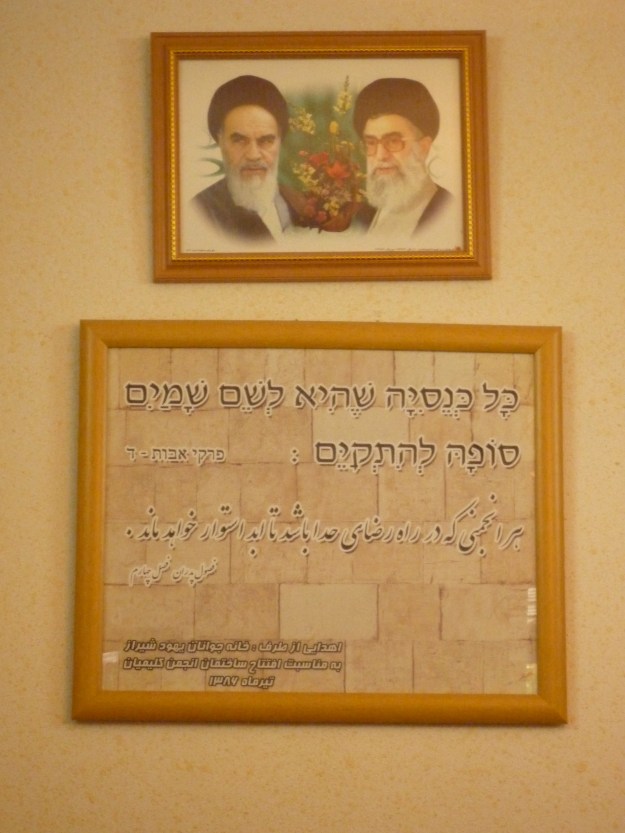
I took the picture above, by the way, at the Jewish community center in Shiraz. Just another assumption-busting Jewish Iranian image: the obligatory Ayatollahs Khomeini and Khamanei hanging on the wall above a classic Jewish quote from Pirkei Avot in Hebrew and Farsi: “Every assembly that is for the sake of heaven will endure.”

(To those who live in the Chicagoland area:  I’ll be speaking about my experiences in Iran tomorrow evening, Tuesday, February 24, 7:00 at the Chicago Chapter of the American Friends Service Committee

Dancing Around Bashir

bashir

Waltz With Bashir” has been racking up the prizes. In addition to a slew of international awards, it was awarded Best Picture by the National Society of Film Ciritics, Best Foreign Film at the Golden Globes, and it seems to have the inside track on the same award at the Oscars this Sunday night.  But as “Bashir” amasses its acclaim, some observers are frankly critiquing the film against Israel’s painful present-day reality.

In a recent Nation article, Israeli author Liel Liebovitz wonders why the Israeli public has so thoroughly embraced this fiercely anti-war statement (enough to vote it as their third-favorite Israeli film of all time) while ignoring its “harrowing lessons” through its strong support of their government’s military actions against Gaza.

Liebovitz concludes that “Bashir’s” popularity not withstanding, Israel is sadly disregarding director Ari Folman’s powerfully moral vision – particularly in light of the recent elections:

Israel of today is not Ari Folman’s. It is Avigdor Lieberman’s and Benjamin Netanyahu’s, the country of the countless men and women crying out for revenge. As we root for Waltz with Bashir, if we want to truly honor that film’s message, let us never forget that. Otherwise, all we have is just a pretty animated film.

Journalist Naira Antoun, writing in the Electronic Intifada comes to a similar conclusion:

(We) are reminded of the psychologist’s comment near the start of the film: “We don’t go to places we don’t want to. Memory takes us where we want to go.” Perhaps this explains how at the same time that Gaza was being decimated, Israel heaped acclaim and awards on Waltz with Bashir; in addition to numerous international awards, the film scooped up six awards at the Israeli Film Academy. Indeed, the same Israelis who flocked to see the film gave their enthusiastic approval to Operation Cast Lead in Gaza. According to a poll released on 14 January by Tel Aviv University, a staggering 94 percent of Israeli Jews supported or strongly supported the operation.

As a Palestinian viewer, however, Antoun goes even farther than Liebovitz: she faults the film for rendering Palestinians essentially invisible:

There is nothing interesting or new in the depiction of Palestinians — they have no names, they don’t speak, they are anonymous. But they are not simply faceless victims. Instead, the victims in the story that Waltz with Bashir tells are Israeli soldiers. Their anguish, their questioning, their confusion, their pain — it is this that is intended to pull us…We don’t see Palestinian facial expressions; only a lingering on dead, anonymous faces. So while Palestinians are never fully human, Israelis are, and indeed are humanized through the course of the film.

Among other things, I think these reviews illuminate the painful difficulties inherent in making an anti-war statement while the war is still raging.  A sad anecdote: a congregant recently told me that when she saw the film, a screaming match erupted in the audience after it ended.  Apparently someone screamed “That’s Gaza!” to which another responded “Shut up!” and on it went…

And on it goes…

Update 2/23/09: Thanks to Eric for forwarding this devastating Ha’aretz piece re “Bashir” by (who else?) Gideon Levy.

Immigration Justice in Illinois

p5300044_2Some rare good news in the quest for compassionate immigration reform out here in Illinois:

Thanks to the unanimous passage of the Access to Religious Ministry Act in both state houses this past December, detained immigrants will now have the same access to clergy as those imprisoned for other crimes.  Up until now, undocumented immigrants awaiting deportation in Illinois jails have been restricted to clergy visits of two hours or less per month.

In addition to representing a clear victory for freedom of religion, this new access will help us shine a brighter light on conditions in ICE detention facilities.  The law is scheduled to go into effect in June and The Trib  has just reported that volunteer lay-clergy training began yesterday in Chicago. Major kudos to bill-sponsor Sen. Iris Martinez and the inspirational, indefatigable Sisters of Mercy (above) who led the fight for the passage of the bill.

Baskin: What the $%#@* Was it All For?

n716645365_5575

Are you ready to throw your head back and scream to the high heavens? Just read Gershon Baskin’s column in today’s J Post, in which he reveals that prior to Israel’s attack on Gaza, he met with a senior Hamas official in Europe to discuss possibilities for renewing the cease-fire. He returned to Israel ten days before Israel began the war and sent a letter to Olmert, Barak and Livni, informing them…

…that Hamas was willing to open a direct secret back channel for a package deal that would include the renewal of the cease-fire, the ending of the economic siege and the prisoner exchange for the release of (Gilad) Schalit. I further indicated that Hamas would be willing to implement the agreement on Rafah which included the stationing of Palestinian Authority personnel loyal to President Mahmoud Abbas in Rafah and a return of the European monitors. I communicated the same message to (Gilad’s father) Noam Schalit and asked him to make sure that Ofer Dekel, who is charged with the Schalit file by the government, received the Hamas “offer.”

Olmert, et al chose to ignore this opportunity, preferring instead to “teach Hamas a lesson.”

Baskin’s final conclusions:

What did this war achieve? What has changed? Has Israel gained its military deterrence? Has Israel changed the security reality in the South? Is Gilad Schalit at home? Has Hamas reduced its basic demands for the release of Schalit? No, no and no! Israel is negotiating now for exactly what could have been achieved without going to war. Israel spent $1 billion on the war, caused some $2 billion worth of damage in Gaza, more than 1000 people have been killed, thousands of lives have been destroyed. Hundreds of thousands of Israelis lived through weeks of terror; millions of Palestinians suffered the bombardment of their towns, cities and refugee camps – what is the result? More hatred, more extremism and more support for fanatics and their ideas – on both sides of the Gaza border.

Read the whole article and weep…

The Contradictions of Ethnic Nationalism

610x

It’s the last day before the Israeli elections, and there seems to be widespread agreement that Yisrael Beiteinu party chairman Avigdor Lieberman is going to win big – perhaps as much as 19-20 seats. They’ve already pulled ahead of the Labor party and by now it’s virtually a foregone conclusion that Lieberman will emerge from these elections with considerable political influence.

It’s also fair to say that those of us who cherish the values of liberal democracy are recoiling at the prospect of a politically ascendant Avigdor Lieberman, whose most notorious campaign promise is a requirement for all Arab citizens of Israel to sign a loyalty oath to the Jewish state:

(Lieberman’s) loyalty oath would require all Israelis to vow allegiance to Israel as a Jewish, democratic state, to accept its symbols, flag and anthem, and to commit to military service or some alternative service. Those who declined to sign such a pledge would be permitted to live here as residents but not as voting citizens.

Currently Israeli Arabs, who constitute 15 percent to 20 percent of the population, are excused from national service. Many would like to shift Israel’s identify from that of a Jewish state to one that is defined by all its citizens, arguing that only then would they feel fully equal.

Mr. Lieberman says that there is no room for such a move and that those who fail to grasp the centrality of Jewish identity to Israel have no real place in it.

These are disturbing ideas to be sure, and it’s even more troubling that they seem to finding traction with increasing numbers of the Israeli electorate.

And yet…

…and yet in the wee hours of the night, I just can’t shake the nagging feeling that the real reason Lieberman makes us squirm is that he shines a bright light on the logical contradictions of political Zionism: an ethnic nationalist movement that has always sought to create a Jewish state in a land that also happens to be populated by millions of non-Jewish inhabitants.

Take, for example, Israel’s Declaration of Independence, which refers specifically to Israel as a “Jewish state” committed to the “ingathering of the exiles” but also promises complete equality of political and social rights for all its citizens, irrespective of race, religion, or sex.  Therein lies the tension: the first principle emphasizes the creation of a state that privileges the Jewish people and the latter promises equal rights for all its citizens.

I don’t say this easily: I’m not sure this is a nut that Israel will ever fully be able to crack.  It is indeed notable that Israel has repeatedly tried and failed to create a constitution that legally guarantees equality for all citizens of this exclusively Jewish state. In the meantime, Israel’s Arab citizens suffer from what we Americans would consider significant institutional discrimination with only limited recourse to the rule of law.

So as a nice liberal American Jew fully prepared to voice my outrage at Lieberman’s likely Tuesday morning success, here are some questions I feel compelled to ponder:

– As proud citizens and beneficiaries of a secular multi-cultural nation, are we ready to face the deeper implications of Israel’s ethnic nationalism?

– Will it ever truly be possible, in a country defined as exclusively Jewish, for its Arab citizens to be considered as anything but second class citizens (or at worst, traitors)?

– If  it does indeed come down to a choice between a Jewish or a democratic state, which will we ultimately support?

I’d love to hear your responses…

One Gaza Testimonial

gazaruin

I’m posting below a testimony by “Nancy,”  a Palestinian living in the Chicago area who is a friend of a member of my congregation. This oral testimony was given during the height of Israel’s military bombardment of Gaza, where most of Nancy’s family lives.

As you read, all I ask is that you resist the temptation to become defensive. Please don’t discount her testimony as mere propaganda (I personally do not doubt the veracity of her account). Please don’t dismiss her pain with “It’s very sad, but Hamas started it.” As difficult as it might be, I believe it is critically important for us to look into our own hearts and consider our responsibility for the staggering human cost borne by Gazan civilians over the past several weeks.

Click below for Nancy’s story – but one of thousands…

Continue reading

Rabbis on the Third Rail

usisraeliflag

Having nothing better to do, I spent a fair amount of time last week trying to spearhead a Rabbinical Statement on Gaza. Sorry to report that after several days of back and forth we had to fold the entire project when it became clear that we wouldn’t find a wording that would satisfy a critical mass of rabbis. (To make matters even worse, an early version of the statement was precipitously posted on the net before we had consensus. I’m fairly sure it’s still floating around out there in cyberland in all its unauthorized glory…)

There were several motivations for the statement. First and foremost, it came from a desire to express a Rabbinical voice of opposition to Israel’s military action in Gaza, which we felt was strategically disastrous and morally outrageous. It was also important to us that Jewish community leaders publicly expressed sorrow not just for the loss of Israeli life but also for the massive devastation experienced by Gazans during the past three weeks:

We condemn the firing of missiles from Gaza that forced so many Israelis to live in fear and we mourn the loss of life that resulted from these attacks. However, we are devastated by Israel’s disproportionate use of force, killing more a myriad of people, including over 450 children. In the wake of such overwhelming civilian bloodshed, we can only ask, in the words of the Talmud, “How do we know that our blood is redder than the blood of our fellow?”

Additionally, since we felt we could not address the tragedy of the war while ignoring the larger political context of the conflict, our statement contained a strong message for the new American administration:

We urge our new President to turn back the policies of previous administrations – policies which have given Israel permission to take numerous measures that we believe are counter to the cause of peace, including the expropriation of Palestinian lands, destruction of Palestinians homes and businesses and the widespread building of settlements in occupied Palestinian territory.

The most controversial aspect of our statement was our call for the new administration to take an assertive diplomatic approach with Israel, and not to rule out the withholding of military aid “as necessary.” As anyone familiar with American Jewish community politics must surely know, withholding aid  is the “third rail” for organized Jewry –  i.e., the line that can never be crossed.

And it was this was the sentence more than any other that confounded of our core group of signers. We tried various different wordings: “if the administration deems it necessary,”  “withholding of aid as a last resort,”  “withholding aid for noncompliance” – but in the end, no wording seemed to suffice. Some felt that this was going to far and others refused to sign unless a strong statement about withholding aid was included.

I can certainly understand why this issue pushes such profound buttons for American Jews. It plays on our deepest fears and as well as our abiding sense of Jewish vulnerability. For many American Jews, the withdrawal of aid would be tantamount to abandonment by Israel’s most significant ally. But there are other Jews – and I believe their ranks are growing – who simply do not want to be party to Israel’s growing militarism and are not afraid to admit it.

For my part, I was less concerned about this particular issue, and perhaps that just reflects my own naivete. While I understand our community’s fears, I also believe that withholding aid is probably the strongest diplomatic “stick” America can wield with Israel – and in the end it may be the only one that will ever really get Israel’s attention. But whatever we might think about this issue, I just don’t agree that it must be ipso facto off the table for mere discussion in our community – and I deeply resent those in our community who reserve the right to excommunicate others who hold this opinion in good faith.

It’s all moot anyhow. No matter how we worded the statement, we couldn’t retain our core of signers. Some asked to have their names removed for various reasons. Many told me they would have loved to have signed, but couldn’t for organizational or professional reasons. After several days we called it quits.

I know there are some decent lessons in all of this, but mostly I’m just frustrated  and very, very sad. I know for a fact that there are many Jews out there who were waiting for rabbis to make a statement of this kind, regardless of the final wording. I still believe  that whatever the political realities, those of us who care about the shared fate of Israelis and Palestinians will have to find the courage of our convictions.

For me it really comes down to this: two of our most sacred Jewish values are Ahavat Yisrael (“Love of the People Israel”) and Ahavat Habriot (“Love for All People”). Should it really be that hard for us to promote both with equal passion?
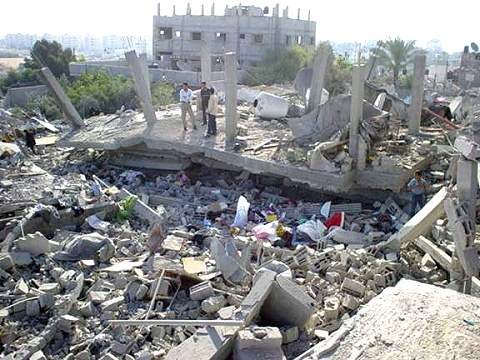
Gaza: The Arrow Cannot Be Taken Back

gaza6

“When an arrow leaves the hand of a warrior he cannot take it back.” (Mechilta of Rabbi Ishmael, Beshallach, Shirah)

From this classic Jewish teaching we learn that violence unleashes a myriad of consequences that we can neither control nor reverse. Apropos of recent events, I take this to mean many things:

…when you loose tons and tons of bombs on a small patch of land inhabited by 1.5 million people, you will invariably kill a myriad civilians.

…we cannot begin to fathom the depths of grief and loss that Israel’s actions have brought upon scores of Gazans, their families and loved ones. Indeed, even in the wake of a fragile ceasefire the death toll continues to rise. (Read this article from today’s NY Times, which documents heartbreaking scenes of victims continuing to be pulled from the rubble weeks after they were killed).

…we cannot comprehend the anger and fury Israel’s actions have inspired in Gazans, Palestinians, and the Arab world at large. Yesterday I spoke with a Palestinian American friend who told me he had never seen the Arab streets so inflamed against Israel – and in many cases, against their own governments. (The anger of Egyptian citizens toward their goverment is frightening to behold).

…it is impossible to underestimate the damage this war has done to the already tenous prospects for peace between Israel and Palestine. Most analysts seem to agree that no matter whoever might be considered the military “victor” in this war, the moderate Fatah (at present Israel’s only Palestinian peace partner) is the heaviest political casualty. Moderate Arab countries are all the queasier about supporting the peace process and the Saudis are now under fire to pull their plan from the table.

This quote from the NY Times article above sums up the tragic new reality on the ground:

In the upper middle-class neighborhood of Tal al-Hawa, Ziad Dardasawi, 40, a wood importer, was trying to process what had happened. As a supporter of Fatah, a political rival of Hamas, Mr. Dardasawi said that he despised Hamas, but that its rocket fire was no justification for Israel’s military response.

“Let’s say someone from Hamas fired a rocket — is it necessary to punish the whole neighborhood for that?” he said, standing in a stairway of his uncle’s house, where furniture had been smashed, and all the windows broken.

He drew on an analogy he thought would strike a chord: “In the U.S., when someone shoots someone, is his entire family punished?”

The Israeli actions made the situation more intractable, he said. “How can I convince my neighbors now for the option of peace? I can’t.”

He added: “Israel is breeding extremists. The feeling you get is that they just want you to leave Gaza.”

(Photo: Tyler Hicks/NY Times)

Israel and Gaza: Speaking About the Unspeakable

gaza

Stayed up until the wee hours last night surfing the web reading report after report about Gaza.  Despite my better judgement, I couldn’t take my eyes off the horrific reports that Israel was using white phosphorous in densely populated civilian areas.  After seeing a picture in the NY Times of a 10 year old boy who had lost his eyesight and most of the skin from his face from phosphorous burns, I turned to reports on B’Tselem and Human Rights Watch. I’m ashamed to report I was reading this stuff well past the time it would have made sense to go to bed…

Needless to say as I read, my mind and emotions reacted a mile a minute, ranging back and forth from defensiveness to righteous anger and everything in between. Is it really true?  Perhaps the reports are mistaken?  Burning children alive in the streets?  Couldn’t there possibly be another explanation?

It’s been all the more upsetting since there has been a near total absence of any honest communal discussion about these kinds of reports. On one end of the spectrum, some can discount upsetting news like this by placing exclusive responsibility upon Hamas for cynically using civilians as human shields. On the other end, others will excoriate Israel for the barbaric genocide it is perpetrating against the Palestinian people. The rest, I imagine, simply bury the news deep down and move on.

This morning upon arriving at work, I read one of the weekly e-briefings that I regularly receive from a well-known American Jewish organization. It purported to give an up-to-date status report/analysis on the situation in Gaza, but it was essentially yet another excuse to dispassionately analyze Israel’s successful military “operation” in Gaza:

Israel acted decisively, despite (ongoing) internal divisions, the approaching elections, and the false image of a hedonistic society. A strong, determined, and high-spirited military, both regulars and reserves, showed up ready to do battle to rid the South of the missile threat.

Hamas’s own tactical designs collapsed, as the IDF put into practice the bitter lessons of 2006: Units were thoroughly equipped, well-trained, informed by intelligence, and ready for battle, anticipating the various tactics (such as booby-trapped houses and the rush of suicide bombers in civilian clothing or even IDF uniforms.

You get the idea. And in the meantime there was nary a hint of the untold civilian suffering and loss that this horrid war has wrought. I don’t know what I expected, really. I shouldn’t underestimate how hard it is for a community to find the werewithal to speak about the unspeakable. Is it too much to hope that we find a way to start?

Who Am I to Criticize?

sderot

You have no idea what it is like to live here. You don’t understand what we live with every day. We are the ones who have to live with the consequences of this war. Who are you to criticize us?

In a very real way, of course, they’re are absolutely right. Though I visit Israel frequently and have spent a significant amount of time there, I have no idea what it is like to live and work and raise a family and makes one’s home in a country that is in a constant state of war against enemies within and without.

And I certainly cannot even begin to imagine what it must be like to live  in Southern Israel during this most current crisis: to try and live a life with some sense of normalcy knowing that at any moment an air-raid siren could go off and afford you and your family mere moments to await the possibility of an incoming missile.

It is true and I must acknowledge it. American Jews do not live with the traumatic reality of this conflict. It is very different to relate to the war in Gaza from the comfort of our homes a world away rather than mere kilometers from the border. At the end of the day, I do admit to my Israeli friends that I cannot and will never understand what it must be like to live there.

But as someone who has identified deeply with Israel for his entire life, someone who has dear friends and family there, I write this with utmost honesty and respect: I reject the suggestion that I have no place speaking out against Israel’s actions simply because I don’t actually live there.

Who am I to criticize? I am a Jew – one of the many millions of diaspora Jews for whom the Jewish state was created. According to the official Zionist narrative, Israel is my Jewish inheritance, my Jewish national home. As a Jew living outside of Israel, I have been given the right to receive instant citizenship if I ever decide to actually move there (something, by the way, that scores of Palestinians whose families have lived in that land for generations cannot do). If Israel purports to relate to me thus, do I not have a voice in the discussion over the actions the Jewish state takes in the name of my people?

Who am I to criticize? I am American. I am a citizen whose country, the world’s largest superpower, supports Israel with significant economic and military aid. My tax dollars thus implicate me in a very real way with Israel’s national decisions – not least of which are its military actions.  I am also the citizen of a nation whose government has essentially given Israel a blank check to take numerous measures that I believe are counter to the cause of peace, including the expropriation of Palestinian lands, destruction of homes, injustice in military courts and widespread building of settlements in occupied Palestinian territory, to name but a few.

As I have written in earlier posts, I believe Israel’s response to Hamas’ missile attacks have been disproportionate and outrageous. I believe their actions only further endanger the security of  Israelis while inflicting collective punishment and a severe humanitarian crisis upon Gazans. Indeed, just as I cannot understand what it must be like to be a citizen of Sderot, I cannot even begin to imagine what it must be like to be a Gazan citizen at the moment, living under constant air attack, with no running water or electricity and dwindling food, as hospitals fill up with wounded and corpses lie rotting in the streets because relief workers are unable to reach them.

Do I believe that Palestinians bear their share of the blame in this crisis? Absolutely. As the cliche goes, there is certainly enough blame to go around. But as a Jew and an American, I am uniquely implicated in the actions Israel takes.  We Jews and Americans must bear our share of responsibility for this crisis. How far are we willing to go to contribute to a solution?