On November 2 I had the pleasure to engage in a public conversation with journalist/author Peter Beinart in a program co-sponsored by Jewish Currents and my congregation Tzedek Chicago, We explored a wide range of issues arising from the current moral-political moment in Israel Palestine.
I was particularly grateful to interrogate the issues raised by Peter in his recent book “Being Jewish After the Destruction of Gaza: A Reckoning:”
• Is the Jewish community currently facing an unbridgeable ethical divide?
• Is it possible to make community with Jews whom we believe support – or remain silent over – the genocide of Palestinian people in Gaza?
• Does Peter identify as a Zionist now? What is his opinion of the growing movement for antizionist Judaism?
I appreciated Peter’s honesty and willingness to engage over these issues – and many others. The entire program is available on the video recording above.
The ambitious intentions of Peter Beinart’s new book are evident from the title: Being Jewish After the Destruction of Gaza: A Reckoning. Responding to the current moment, Beinart has written nothing short of a spiritual manifesto for the future of Judaism.
It’s a tall-order for such a slim volume, but it’s one that Beinart is uniquely positioned to take on. As a well-known journalist, thought leader, and editor-at-large for the journal Jewish Currents, Beinart’s ideas carry a great deal of weight among large swaths of the Jewish establishment. His 2010 article in The New York Review of Books, “The Failure of the American Jewish Establishment” and his subsequent book, The Crisis of Zionism were widely read and debated in the American Jewish community. Since then, he’s continued to push the envelope in the discourse on Israel/Palestine. His 2020 New York Times op-ed, “I No Longer Believe in a Jewish State” and his 2021 Guardian essay, “A Jewish Case for Palestinian Refugee Return” were likewise considered game-changers in the Jewish communal discussion on Israel-Palestine.
Being Jewish, which attempts to reframe the Jewish spiritual narrative itself, is arguably his most dramatic attempt at game-changing. Following October 7 and Israel’s devastating military onslaught on Gaza, Beinart suggests that Judaism and Jewish identity have now reached a critical turning point. As he writes in the Prologue:
Jews have told new stories to answer the horrors we endured. We must now tell a new story to answer the horrors that a Jewish country has perpetrated, with the support of many Jews around the world… [This new Jewish story must be] based on equality rather than supremacy—because the current one doesn’t endanger only Palestinians. It endangers us.
As if this isn’t ambitious enough, Beinart also hopes his book will help heal the widening fractures over Israel/Palestine in the Jewish community. To drive this point home, he begins with a letter to a friend with whom he’s become estranged over the issue of Israel/Palestine. “I know,” he writes, “you believe that my public opposition to this war…constitutes a betrayal of our people…[and] I consider your single-minded focus on Israeli security to be immoral and self-defeating.” He ends his letter with the words: “I hope the rupture is not final, that our journey together is not done.”
While Being Jewish was published by a mass-market publisher and is being promoted to a wide readership, Beinart states at the outset that he’s suggesting a new Jewish narrative to bring the Jewish “family” together; to mend the deep familial rifts that have widened over Israel’s destruction of Gaza. “This book,” he writes, “is for the Jews who are still sitting at that Shabbat table, and for the Jews—sometimes their own children—who have left in disgust. I yearn for us to sit together.”
Beinart thus begins his book with a formidable—perhaps unbridgeable—tension. While he’s clear about his intention to bring Jews together, he also suggests that Israel’s oppression of Palestinians is rooted in a narrative of Jewish supremacy—a view which surely won’t endear him to millions of Jews in Israel and throughout the diaspora who identify deeply with Israel and Zionism. In many ways, this tension is characteristic of Beinart’s pedagogy: he seeks to influence Jewish communal discourse even as he pushes hard on the ideological envelope. It’s a balancing act that’s become increasingly precarious with his writings over the past several years. Given the stakes of the current moment, he sets a profoundly daunting goal for himself with his latest book.
For most of Being Jewish, Beinart does what he does best, expertly dismantling Israel’s hasbara—the propagandistic talking points used to justify Israel’s oppression of the Palestinian people. In chapter one, “They Tried to Kill Us We Survived, Let’s Eat,” for example, he interrogates the ways that Israel and Israel’s Jewish communal advocates, conveniently ignore Zionism’s colonial origins and reframe Israel’s founding to fit a Jewish narrative of victimhood:
The plot goes like this. We have finally achieved what every other people takes for granted: a state of our own. Yet in the case of Jews, and Jews alone, that right is contested. So even with a state, we remain victims.
His repeated willingness to frame political Zionism in a colonial context is a powerful, ongoing theme for Beinart. In another chapter “To Whom Evil is Done,” he considers the ways the violence committed by Hamas and other Palestinian resistance groups on October 7 was compared to the Holocaust by Israelis and Jews around the world. He goes on to assert that such a framing “transforms Palestinians from a subjugated people into the reincarnation of monsters of the Jewish past.” Again, Beinart doesn’t hesitate to reject this comparison in favor of a settler colonial framework. A better analogy, he suggests, would be the violent attacks of colonized Haitians, Creek Indians, or Mau Mau rebels against their colonial oppressors.
In “Ways of Not Seeing,” Beinart systemically eviscerates many other familiar claims wielded by Israeli leaders and Israel advocates: from their rejections of death estimates by the Gazan Health Ministry to the canard of Hamas’ human shields. He also devotes a chapter to the issue of antisemitism, using convincing argumentation along with hard survey data to demonstrate how Israel cynically uses the claim of antisemitism—which is much more prevalent on the Right than the Left—to cudgel Palestinians and their supporters. Taking the claim that anti-Zionism equals antisemitism head on, he writes astutely:
The whole point of conflating anti-Zionism with antisemitism is to depict Palestinians and their supporters as bigots, thus turning a conversation about the oppression of Palestinians into a conversation about the oppression of Jews.
Beinart’s book is strongest when he makes these kinds of expert political arguments. Yet, as critical as they are, as I read Being Jewish I found myself increasingly wishing he would drill deeper into the themes suggested by the title. Beyond promoting a Judaism of equality over conquest, how should Jews respond to the devastating moral reality of this moment? In his final chapter, “Korach’s Children,” he attempts to do precisely this, suggesting that Jewish political nationalism has become a form of Jewish “idolatry,” arguing that the only way toward an equitable future in Israel/Palestine is a single state in Israel that guarantees full citizenship for all.
While it’s a compelling vision, there’s little in his final chapter that he hasn’t already argued for more extensively in his 2020 and 2021 articles, which were written well before Israel’s destruction of Gaza. In this book, as with his earlier articles, Beinart offers examples from Ireland and South Africa to demonstrate how colonizers and colonized have found the political wherewithal—however imperfect—to dismantle systems of oppression and engage in processes of reconciliation.
In the midst of his argument, however, there’s little reckoning with the possibility that anything has fundamentally changed with Israel’s genocide in Gaza. Instead, Beinart simply repeats his talking points, continuing to hold out hope for a better future for Israeli Jews and Palestinians:
Although it won’t look the same, this kind of liberation is possible for us. We can lift the weight that oppressing Palestinians imposes on Jewish Israelis, and indirectly, on Jews around the world.
But who is the “we” in this statement? It’s certainly not in the power (nor is it currently the desire) of American or Diaspora Jews to leverage a socio-political transformation of such a magnitude in Israel/Palestine. The majority of Israelis have, for their part, long rejected a one-state solution—and by all accounts, they’re farther away than ever from embracing such a vision.
Indeed, Israelis post-October 7 are a thoroughly traumatized nation, inured to the carnage their nation is inflicting on Palestinians and according to polls, overwhelmingly supportive of Israel’s genocide in Gaza. As for Palestinians, many, if not most, are undoubtedly less inclined to imagine the realistic possibility of living side by side with Israeli Jews in a single state given the horrific reality of the past 16 months.
It’s notable that, even as Beinart doesn’t flinch from describing Israel’s onslaught in Gaza—often in terrifying detail—he largely avoids using the word “genocide” to describe it. This is more than merely a semantic issue. If we are to truly reckon with what it means to be Jewish after the destruction of Gaza, we must face this central question: what does it mean for the Jewish people that a Jewish state, founded in the wake of the Holocaust, is actively committing a genocide against another people?
Though Beinart writes that he “yearns for us to sit together,” it’s well worth asking: can we truly create Jewish community within such a reality? Can Jews who believe Israel is committing genocide coexist in community with those who are actively supporting it—or rationalizing it away? Is it possible for Jews to pray and study and make Shabbat and celebrate holidays together under such circumstances? If Jewish ethical values are the bedrock of our spiritual life, how do we truly bridge such a massive moral divide?
Although he doesn’t answer this question in his book, Beinart did give a clue to a potential response during a recent appearance at Duke University. Admitting that Israel was no longer a “unifying force” among Jews, he responded:
What I would like people to do is to bring Jews together across the ideological, political and religious spectrum, to study Torah, to study our texts. This is what ultimately unifies us, and I think that it can be a foundation for other kinds of conversations.
This kind of response might make sense to Beinart, an Orthodox Jew who cherishes traditional Jewish study, but it’s doubtful such an approach will bring together Jews in the way he envisions. It’s optimistic, to put it mildly, to assume that Jews will be able to put aside their differences on Israel and find a foundation for fruitful conversation through the study of Torah and Jewish text. It may be time for us to admit that being Jewish after the destruction of Gaza means our community isn’t simply fractured, but separated by a deep moral abyss that may well be unbridgeable.
As I read Beinart’s new book, I couldn’t help but be struck by the significant debt it owes to the landmark work of Jewish scholar and theologian Marc Ellis, who asserted as far back as the 1980s and 90s that post-Holocaust, the fusion of Judaism and Jewish state power had created a conquest-focused “Constantinian Judaism,” even as Israel maintained a collective myth of innocence.
The central question is how to move Jews in Israel and around the world to see that Jews can only be free if Palestinians are free as well. During the Gaza war, we could not be further from this goal. This makes it even more imperative that we begin now.
But while Beinart’s and Ellis’ analyses of the crisis may have been similar, their prescriptions for going forward were dramatically different. As Ellis put it in a 2018 interview, Israel’s state oppression of the Palestinian people represented the “end of ethical Jewish history”:
We Jews, all of us, no matter our various political positions, are responsible for what Israel has done and is doing to the Palestinian people. That is why I believe that we, as Jews, dwell in the abyss of injustice. The injustice we have perpetrated upon Palestinians has brought us to the end of ethical Jewish history. The question for Jews, the only question, is what are we to do at this end?
Marc Ellis died in July 2024, while Israel’s genocide in Gaza was raging in full force. His question, however, offers an important counterpoint to Beinart’s. While Beinart asks how we will come together to write a new Jewish story, Ellis asks how Jews will dwell in the abyss of injustice. In the end, Beinart’s book, for all of its courage, is ultimately unwilling to take this step: to truly reckon with how Jews of conscience should respond to the ongoing moral devastation that is Israel’s genocide in Gaza.
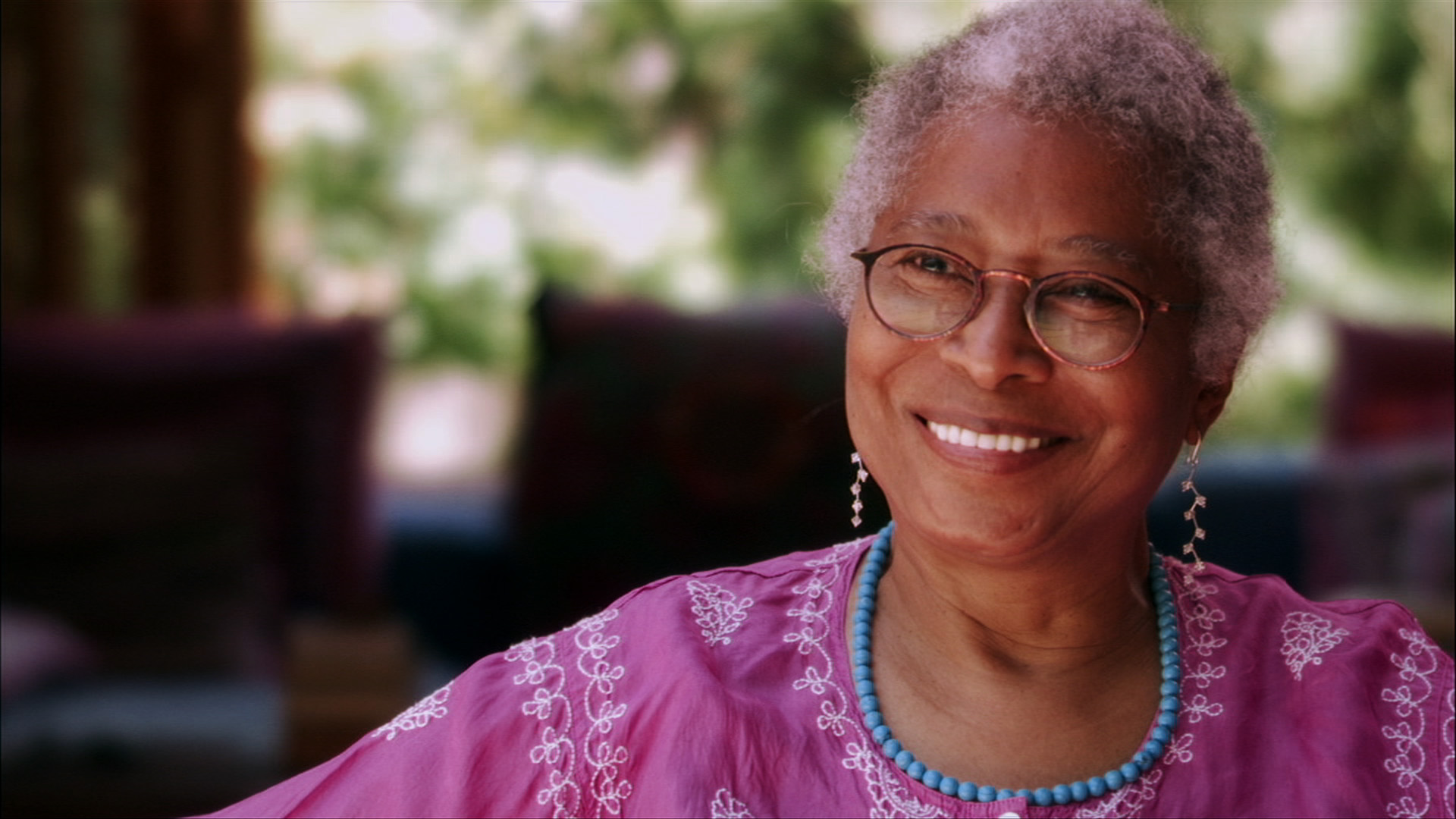
The Jewish interwebs have been abuzz regarding Yair Rosenberg’s December 17 Tablet article in which he criticized the New York Times Book Review for its interview with Alice Walker. In last Sunday’s “By the Book” column, the Times asked Walker what books she had on her nightstand; among those she cited was a book by British antisemitic conspiracy theorist David Icke entitled, “And the Truth Shall Set You Free.” Walker commented, “In (his) books there is the whole of existence, on this planet and several others, to think about. A curious person’s dream come true.”
In his article, Rosenberg listed a litany of odious excerpts from Icke’s book, including his praise of “The Protocols of the Elders of Zion,” his claims that the B’nai B’rith was behind the slave trade and his belief that the Rothschilds bankrolled Adolf Hitler. He also offered a long list of the numerous times Walker has endorsed Ickes’ ideas, including her posting of his video interview (now blocked by YouTube) with Infowars’ Alex Jones, of which she wrote:
I like these two because they’re real, and sometimes Alex Jones is a bit crazy; many Aquarians are. Icke only appears crazy to people who don’t appreciate the stubbornness required when one is called to a duty it is impossible to evade.
Rosenberg also posted in full, a deeply disturbing poem written by Walker in 2017 entitled “It is Our (Frightful) Duty to Study the Talmud.” This excerpt should give you a good idea about the tone and substance of Walker’s piece:
For a more in depth study
I recommend starting with YouTube. Simply follow the trail of “The
Talmud” as its poison belatedly winds its way
Into our collective consciousness.
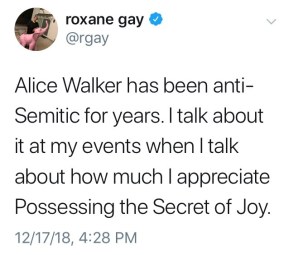
I will sadly confess that I was unaware of Alice Walker’s history of antisemitic attitudes, even though this was apparently common knowledge among many on the left. During the Twitter eruption that followed Rosenberg’s piece for instance, Roxane Gay commented:
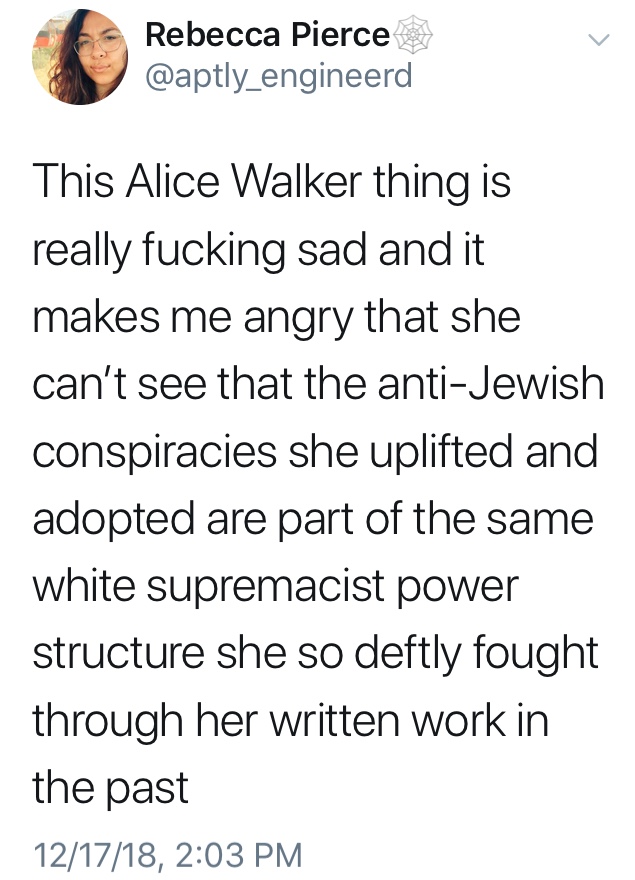
Those of us who were hearing of Walker’s antisemitic proclivities for the first time were particularly saddened to learn that this eloquent champion of anti-racism had been expressing such poisonous ideas toward Jews and Judaism. Journalist/filmmaker Rebecca Pierce spoke for many of us when she tweeted this response:
In his article, Rosenberg made mention of Walker’s anti-Israel politics, challenging “the progressive left” to call out antisemitism that is “presented in the righteous guise of ‘anti-Zionism.’” Although I don’t share Rosenberg’s conservative Israel politics, I accept his challenge. And yes, it’s painfully true that Walker’s Talmud poem egregiously cites Jewish religious tradition as the root cause of Israel’s oppression of Palestinians (as well as American police brutality, mass incarceration and “war in general”):
For the study of Israel, of Gaza, of Palestine,
Of the bombed out cities of the Middle East,
Of the creeping Palestination
Of our police, streets, and prisons
In America,
Of war in general,
It is our duty, I believe, to study The Talmud.
It is within this book that,
I believe, we will find answers
To some of the questions
That most perplex us.
Walker’s claim that the Talmud is “evil” and “poisonous” – a common antisemitic trope – is worth unpacking here. First of all, what is referred to as “The Talmud” is actually a vast corpus of Jewish civil and ritual law mixed with freewheeling legend and Biblical commentary composed between 200 and 500 CE. Though it is one of Jewish tradition’s foundational texts, Talmudic literature is not, to put it mildly, immediately accessible to the untrained reader. It’s typically studied by traditional Jews in the rarified world of schools known as yeshivot, where students’ primary focus is on the unique pedagogy of Talmudic argumentation.
Like all forms of religious literature, Talmudic tradition expresses a wide spectrum of ideas and attitudes. The contemporary reader would likely find its content to be alternately inscrutable, inspiring, challenging, archaic – and yes, at times even repugnant. It contains passages for example, that are profoundly misogynistic. And as Walker pointed out in her poem, it also contains occasional material that is decidedly anti-Gentile, including a notorious passage that depicts Jesus condemned to suffer in hell in a vat of burning excrement. (Yep, it’s true.) There are also texts that unabashedly claim Jewish lives must take precedence over non-Jewish lives – an idea that was also advocated centuries later by Moses Maimonides.
These texts are undeniably, inexcusably offensive and they must be called out, full stop. At the same time however, it is exceedingly disingenuous to judge a religion on the basis of its most problematic pronouncements. This attitude simplistically accepts these texts at face value, devoid of any context or historical background. It also ignores the fact that almost all faith traditions address the offensive, archaic or inconsistent elements in their sacred literature through the use of hermeneutics – that is, principles and methods that help readers understand their meaning in ever-changing societal contexts.
How for instance, might a contemporary religious feminist read and understand a blatantly misogynist Talmudic text? In an article entitled “When Sages are Wrong: Misogyny in Talmud,” Dr, Ruhama Weiss, of Hebrew Union College offers one hermeneutical approach:
(These Talmudic traditions) caused me a powerful disturbance. They forced me to think and react; to think about mechanisms of power and control and about the ability to be free from them. To make an effort to find and highlight additional voices, earlier voices, buried and hidden in misogynist rabbinic discussions.
Most importantly, these difficult sources teach me a lesson in modesty; from them I learn that unequally talented and wise people with good intentions can bequeath to subsequent generations difficult and bad traditions. I see the moral blind spots of my ancestors, and I am obligated to examine my own moral blind spots. Bad and disturbing sources make me think.
Indeed, this same hermeneutic method can be applied to Talmud’s xenophobic, anti-Gentile content as well. That is to say, these texts can challenge us to see “the moral blind spots of our ancestors and thus to examine our own moral blind spots.” They can help us confront “mechanisms of power and control” and contemplate the ways we might be able to “free ourselves of them.” These bad and disturbing sources can “make us think.”
Of course there are those who will read the texts of their faith through a more literal, fundamentalist hermeneutic. In such cases, it is up to those who cherish their religious tradition and the value of human rights for all to challenge such interpretations, particularly when the lines between church and state power become increasingly blurred.
On the subject of state power, I must add that I find it exceedingly problematic when folks criticize Talmudic tradition for its xenophobic attitudes without acknowledging the fundamentally anti-Jewish attitudes that are embedded deep within Christian religious tradition. It’s also important to note that antisemitic church teachings were historically used to inspire centuries of anti-Jewish persecution throughout Christian Europe, while the Talmud was written and compiled in a context of Jewish political powerlessness.
Today, in this relatively new era of Jewish power, it is certainly important to remain vigilant over the ways Jewish tradition is used to justify the oppression of Palestinians. Indeed, since the establishment of the State of Israel, this subject has been intensely debated throughout Israel and the Jewish Diaspora. As I write these words in fact, I’m recalling a blog post I wrote back in 2009 about then Chief Rabbi of the Israeli Defense Forces Avichai Rontzki, who made a comment, based on Jewish religious texts, that soldiers who “show mercy” toward the enemy in wartime will be “damned”:
How will we, as Jews, respond to the potential growth of Jewish Holy War ideology within the ranks of the Israeli military? How do we feel about Israeli military generals holding forth on the religious laws of warfare? Most Americans would likely agree that in general, mixing religion and war is a profoundly perilous endeavor. Should we really be so surprised that things are now coming to this?
I do not ask these questions out of a desire to be inflammatory. I ask them only because I believe we need to discuss them honestly and openly – and because these kinds of painful questions have for too long been dismissed and marginalized by the “mainstream” Jewish establishment.
In the end, every faith tradition has its good, bad and ugly. And in the end, I would submit that the proper way to confront these toxic texts is for people of faith to own the all of their religious heritage – and to grapple with it seriously, honestly and openly. And while we’re at it, it’s generally a good rule of thumb to avoid using the bad, ugly stuff in any religion’s textual tradition to make sweeping historical or political claims about that religion and/or the folks who adhere to it.
What is not at all helpful is for people such as Alice Walker to cherry-pick and decontextualize quotes from one particular religious tradition and warn that its “poison” is “winding its way into our collective consciousness.”
Like many of my friends who are just now learning about her adherence to antisemitic tropes, I fervently hope she will come to understand, as Rebecca Pierce put it, that the attitudes she endorses “are part of the same white supremacist power structure she so deftly fought through her written work in the past.”
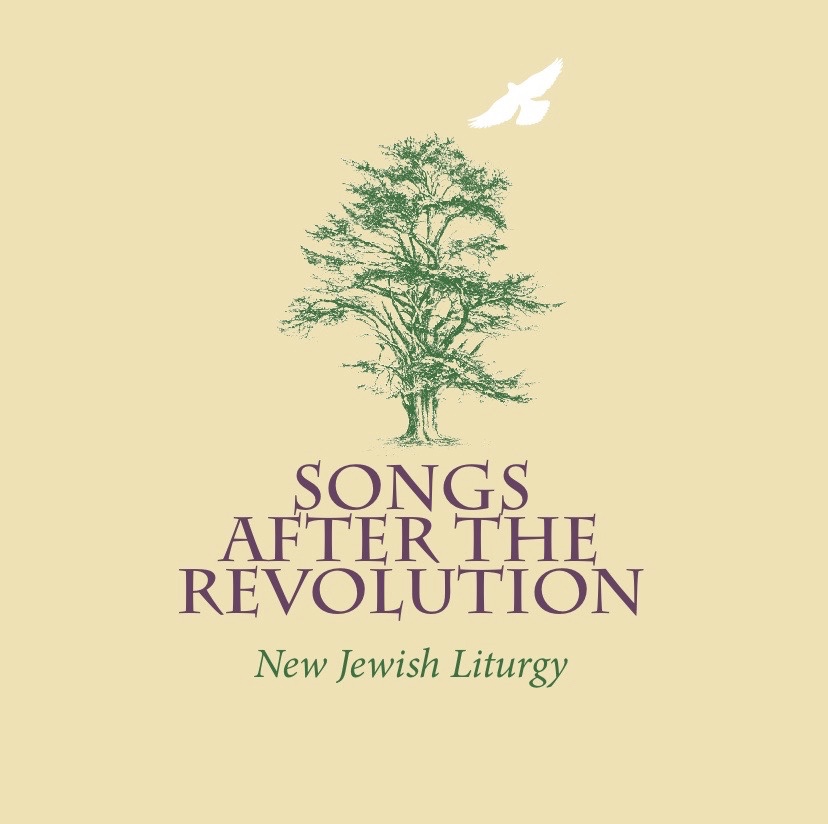
I’m thrilled to announce that my new chapbook, “Songs After the Revolution: New Jewish Liturgy” has just been published by my congregation, Tzedek Chicago.
I’ve been writing original prayers for some time now and I’ve used many of my prayers in a variety of worship settings. This new collection offers a sample of my efforts: new versions of traditional prayers for holidays, re-imagined Psalms and wholly original prayers for new occasions (such as my “Jewish Confession for Nakba Day”). It also includes “A Lamentation for Gaza,” a prayer I wrote for the festival of Tisha B’Av 2014, which occurred during Israel’s devastating military assault of that year.
I fervently believe that the function of prayer is not simply to worship but to challenge, to provoke, to motivate action and to transform the world around us. To this end, I’ve purposely designed this anthology to be read and appreciated by a wide readership. I hope and trust you will find this collection meaningful – even if you are not Jewish or do not not consider yourself a particularly “prayer-ful” person.
At the moment, “Songs After the Revolution” is available exclusively through the Tzedek Chicago website. 100% of the proceeds from sales will benefit the congregation.
I’m very happy to announce that the 2nd edition of my book, Wrestling in the Daylight, has just been published by Just World Books. This new edition changes the overall context of the book considerably: while the first edition of Wrestling is a record of a congregational rabbi who charted a path into Palestinian solidarity, the second edition includes two new chapters that bring the book up to date, reflecting my decision to leave full-time congregational work. You can purchase the book here. For a sneak preview, I’ve posted the new Preface below.
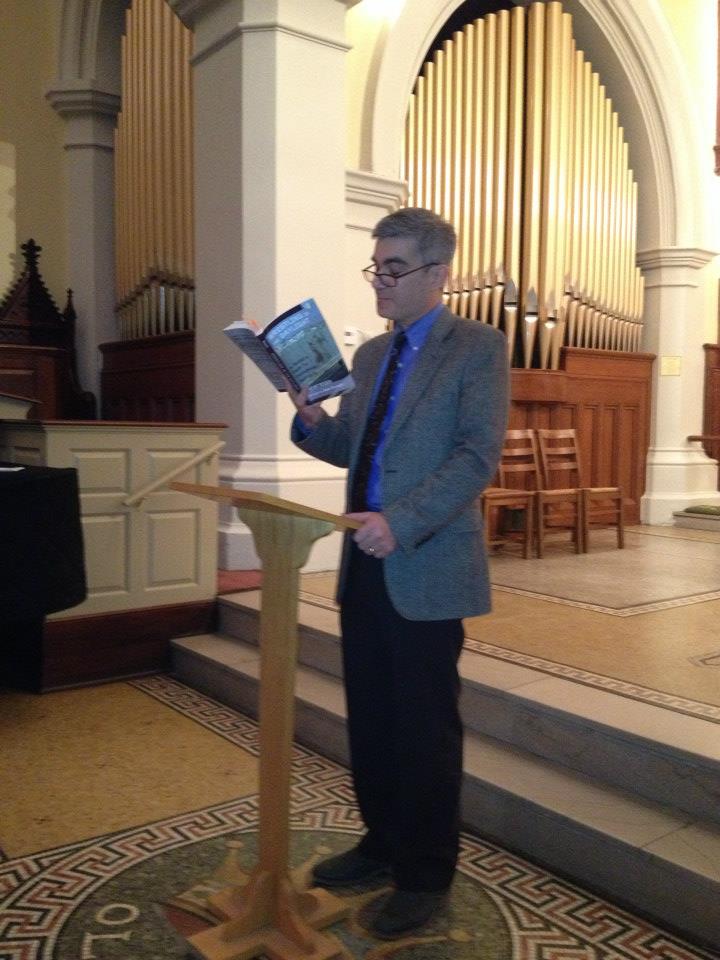
As always I’m enormously grateful to Helena Cobban and the good folks at Just World Books for their encouragement and support. I’ll be doing book readings around Chicago and the US, so please check the JWB event calendar over the next few weeks to see if/when I’ll be coming to your town.
When I wrote the posts presented in the first edition of Wrestling in the Daylight, I hoped they might somehow help widen the discourse on Israel/Palestine in the American Jewish community. In the five years since that edition was published, I’m encouraged to be able to say this discourse has indeed widened in significant ways.
To cite just a few examples: Jewish Voice for Peace, an organization that openly supports Palestinian human rights and endorses the Palestinian civil society call for boycott, divestment and sanctions (BDS), has experienced explosive growth in the past several years and has become a force to be reckoned with by the Jewish community. Open Hillel, an initiative initiated by Jewish college students to “promote pluralism and open discourse on Israel/Palestine and beyond” is increasingly active in campuses across the country. Another rapidly growing organization created by young Jews, IfNotNow, is challenging American Jewish communal support of Israel’s occupation through public acts of civil disobedience.
I do believe we are witnessing the growth of a very real Jewish movement of resistance to the status quo in the American Jewish community and Israel. Led largely by a younger generation, it is openly challenging Israel’s brutal occupation and in some cases, even the very premise of Zionism itself. Notably, it is growing and thriving outside the mainstream Jewish institutional world, finding common cause with other movements (i.e. Black Lives Matter) that struggle against systems of oppression.
As I write these words, Israel is currently ruled by the most right wing government in its history and is doubling down on its brutal occupation. In Europe, extreme nationalist parties are on the rise, and in the United States, the so-called “alt-right” has become politically normalized following the election of Donald Trump. White liberal Americans have suddenly been forced to confront the reality of institutional oppression that has been long familiar to black and brown people, gay, lesbian, queer and trans people, undocumented people and First Nation peoples – as well those who live at the intersection of those identities.
If my participation in the Palestine solidarity movement has taught me anything over the past several years, it is that the fight for justice in Palestine is inseparable from the fight for justice in Chicago, Ferguson, Baltimore, Standing Rock and too many other places around the world. If I have any hope at all in this fearful political moment, it comes from all that I’ve learned from those who live every day with the reality of institutional oppression and the allies and accomplices who stand in solidarity with them. I take heart in the knowledge that there is an active Jewish presence within this new movement of resistance – and I’m immensely proud to be part of it.
This second edition of Wrestling in the Daylight contains a few editorial changes and updates the book with two new chapters: “Toward a New Model of Interfaith Relations” and “Tzedek Chicago.” The former chapter also contains some posts and comments that were written during “Operation Protective Edge,” Israel’s military assault on Gaza during the summer of 2014. Later that year I decided to resign from my congregation to devote myself to activism full time. In 2015, I founded a new non-Zionist congregation, Tzedek Chicago.
As it has turned out, Wrestling in the Daylight is now bookended by two ruinous “operations” waged by Israel against Gaza. Nearly ten years since the first words of this book were written, two million Palestinians (the majority of them children) remain imprisoned in a tiny strip of land, subjected to increasingly subhuman conditions and regular onslaughts at the hands of the Israeli military. If the past is any indication, it is only a matter of time before Israel launches its next assault.
It is our collective shame that the world allows this outrage to continue—and it is to the people of Gaza that I now dedicate this book.
In my previous post, I explored how Zionism has historically fed off of anti-Semites and anti-Semitic regimes to justify the need for a Jewish state. In this post, I’d like to discuss a phenomenon that has even more ominous resonance for the current political moment: the willingness of political Zionists, Israeli politicians and right wing Israel advocates to court the support of Christian millenarians and apocalyptic extremists.
Some history: In the century after the Protestant reformation, the religious ideology of millenarianism began to spread throughout Europe. Millenarianism took many forms, most of which were rooted in the belief that the physical restoration of the Jews to the land would be a necessary precursor to the apocalypse and the eventual second coming of the Messiah. This religious dogma was eventually brought by English Puritan colonists to North America, where it evolved into present-day Christian Zionism.
It is safe to say that Jewish political Zionism could not have succeeded without the support of Christian millenarians. Reverend William Hechler, a prominent English clergyman who ascribed to eschatological theology and the restoration of the Jews to the land of Israel, was a close friend and colleague of Theodor Herzl, the founder of the political Zionist movement. Lord Arthur Balfour, who issued the historic Balfour Declaration in 1917 was likewise a Christian Zionist, motivated as much by his religious convictions as by British imperial designs in the Middle East.
Today of course, Christian Zionists are most famously represented by Pastor John Hagee and Christians United for Israel (CUFI), the largest coalition of Evangelical Zionists in the world. Hagee has never made a secret of his apocalyptic religious views. In his 2007 book “Jerusalem Countdown,” he wrote that Armageddon might begin “before this book gets published.” He also claimed The Antichrist “will be the head of the European Union,” and that during the final battle, Israel will be covered in “a sea of human blood.” The Jews, however, will survive long enough to have “the opportunity to receive Messiah, who is a rabbi known to the world as Jesus of Nazareth.” In Hagee’s more recent book, “Four Blood Moons,” he wrote: “In these next two years, we’re going to see something dramatic happen in the Middle East involving Israel that will change the course of history in the Middle East and impact the whole world.”
While one might expect Jewish leaders to keep their distance from a popular Christian pastor with extremist views such as these, Hagee has been closely embraced by Israeli governments (Netanyahu is a fixture at CUFI conventions), Jewish American politicians (Former Senator Joseph Lieberman has referred to Hagee as a modern-day Moses) and prominent American Jewish leaders (Elie Wiesel once called Hagee “my pastor.”)
CUFI’s Jewish Executive Director, David Brog, clearly serves to give cover to Christian Zionists, painting them as “mainstream” and not nearly as scary as their beliefs would indicate. Following the outcome of the recent election, however, Brog seems to smell blood in the water; he recently announced CUFI’s plans to get “a little more aggressive” in pushing its policies with the Trump administration, where it has clout and connections, particularly with evangelical Vice President Mike Pence.
To put it mildly, Jews should be among the least of those who would seek to find common cause with one such as Mike Pence. In an extremely important piece for the Intercept, last November, reporter Jeremy Scahill convincingly argued that Pence is “the most powerful Christian supremacist in US history,” concluding:
The implications of a Pence vice presidency are vast. Pence combines the most horrid aspects of Dick Cheney’s worldview with a belief that Tim LaHaye’s “Left Behind” novels are not fiction, but an omniscient crystal ball.
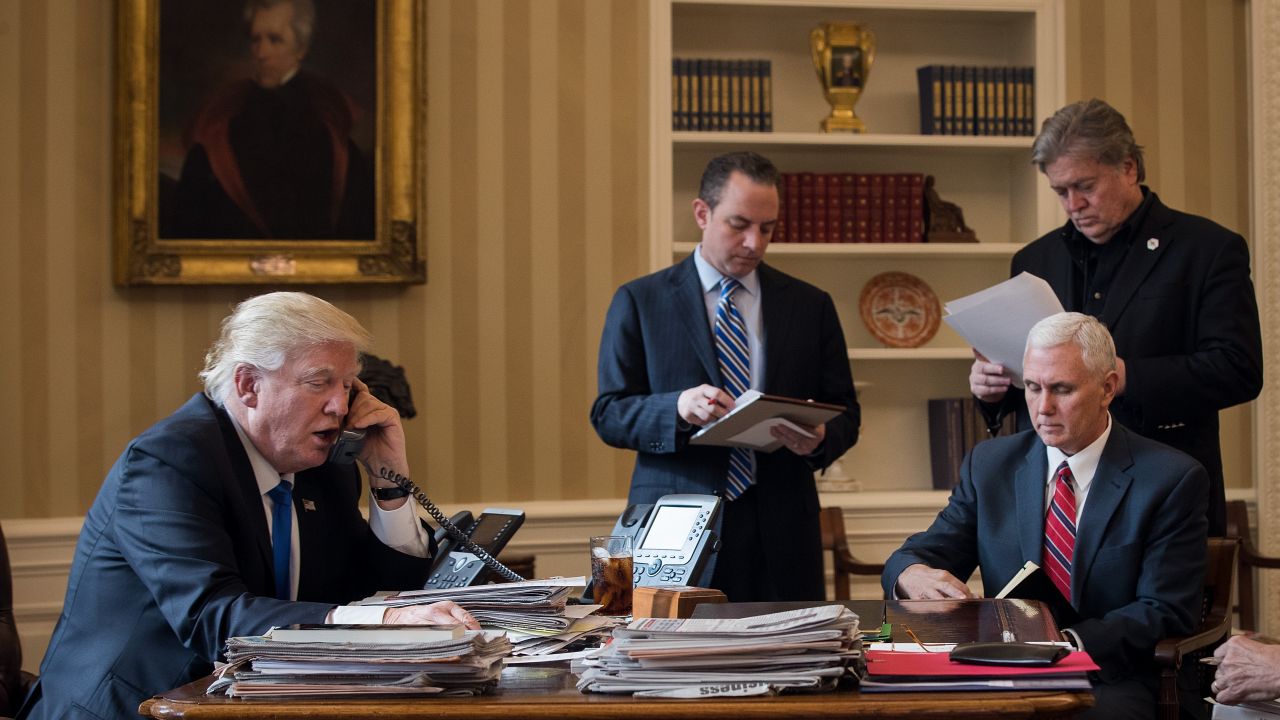
It should not come as a surprise that Pence family’s last trip to Israel was funded by, you guessed it, John Hagee. Pence, who was then the governor of Indiana, took the time to meet with Netanyahu during his visit. Now connect those dots to Pence’s meeting with Israeli prime minister during his recent visit to DC. Both Pence and Netanyahu later commented that they met to discuss, among other things, the creation of a “mechanism” that would help the White House and Israel better coordinate construction in the settlements on the West Bank.
When it comes to the Trump administration of course, most of the attention has been directed toward his chief strategist, former Breitbart editor Stephen Bannon. When Bannon’s appointment was announced, there were a variety of responses from the Jewish community, ranging from outrage to support. For his part, when Netanyahu was asked on 60 Minutes whether or not he was concerned about Bannon, he responded blithely, “I think Mr. Trump and his associates are going to be very strong, not merely in support for the Jewish state, but also in support for the Jewish people.”
According to the book, the last two Fourth Turnings that America experienced were the Civil War and the Reconstruction, and then the Great Depression and World War II. Before that, it was the Revolutionary War.
All these were marked by periods of dread and decay in which the American people were forced to unite to rebuild a new future, but only after a massive conflict in which many lives were lost. It all starts with a catalyst event, then there’s a period of regeneracy, after that there is a defining climax in which a war for the old order is fought, and then finally there is a resolution in which a new world order is stabilized.
This is where Bannon’s obsession with this book should cause concern. He believes that, for the new world order to rise, there must be a massive reckoning. That we will soon reach our climax conflict. In the White House, he has shown that he is willing to advise Trump to enact policies that will disrupt our current order to bring about what he perceives as a necessary new one. He encourages breaking down political and economic alliances and turning away from traditional American principles to cause chaos.
Indeed, Bannon expresses his Fourth Turning-influenced ideas unabashedly. During a 2011 presentation to the Liberty Restoration Foundation, a conservative non-profit, he said:
This is the fourth great crisis in American history. We had the Revolution. We had the Civil War. We had the Great Depression and World War II. This is the great Fourth Turning in American history, and we’re going to be one thing on the other side.
We’re at the very beginning stages of a very brutal and bloody conflict … to fight for our beliefs against this new barbarity that’s starting, that will completely eradicate everything that we’ve been bequeathed over the last 2,000, 2,500 years.
In more recent statements Bannon openly posits that this new war will be fought between “the Judeo-Christian West” and a coalition of “jihadist Islamic fascists,” “expansionist China” and “the aristocratic Washington class.”
According to Strauss and Howe’s book, once the defining climax takes place, America will coalesces under one leader — a boomer “Gray Warrior” — who will “urgently resist the idea that a second consecutive generation might be denied the American Dream. No matter how shattered the economy … ” As frightening as it may sound, Bannon seems to have the perfect “Gray Warrior” figure in Donald Trump – a man who he once described as “a blunt instrument for us,” adding,”I don’t know if he really gets it or not.”
While it’s easy to giggle when, Israeli politicians, rabbis and evangelical pastors publicly call Trump the Messiah, it is far less funny when we consider that the chief advisor to the President is a man who may well view him as a “useful idiot Gray Warrior.” Either way, this is what a century-long willingness to collaborate with apocalyptic extremists has wrought. We are now one terrorist attack away from a truly unthinkable scenario. As journalist Murtza Hussain put it: “As tensions rise, Steve Bannon and ISIS get closer to their common goal: civilizational war.”
In the end it is all too easy to accept the support of religious zealots while we patronizingly dismiss their views as harmless. Now that these zealots are literally in the halls of very real power however, I think it’s finally time to take them at their word.
Here’s a great quality video of my entire speaking appearance at University Friend’s Meeting in Seattle this past Monday night. I attended series of wonderful – and at times inspiring – events during my short stay in the Northwest and will be reporting on them in due course. In the meantime here’s a taste:
I’ve just finished Chicago hip-hop poet Kevin Coval’s soon-to-be-released book, “Schtick” (Haymarket Books) – a collection of poems that takes aim and fires at the sensitive edge of every nerve ending in the American Jewish psyche. It’s a new take-no-prisoners Jewish classic.
Coval has long been known here in Chicago as one of our great local treasures. He’s probably best-known as the founder of “Louder Than a Bomb: The Chicago Youth Poetry Festival,” which was recently the subject of an award-winning documentary of the same name. He’s also the author of numerous poetry collections, serves as Artistic Director of Young Chicago Authors, and offers youth writing workshops throughout Chicago and beyond.
While Coval has explored Jewish identity through his writing before, “Schtick” is his most extensive published collection of Jewish-themed poems thus far. It includes previously released poems such as “what i will tell my jewish kids” and “why i stopped going to shul” together with more recently written pieces – en masse, they serve to dissect the post-modern American Jewish experience in as devastating a fashion as you are ever likely to read.
Although I’m a longtime Kevin Coval fan, I will confess that there were more than few times in which I flinched at this unabashed, occasionally venomous assault on the hottest of Jewish hot buttons. I will also say without hesitation that these poems deserve to be read and discussed by the widest possible audience.
At heart, Coval’s work places him in long and venerable tradition of Jewish dissident writers – a legacy he very consciously celebrates. Indeed, this dissident tradition is palpable throughout virtually every poem in this collection. In “what will i tell my jewish kids,” for instance, he writes:
we are a bridge people. red sea parters. translators
between the warring. we see connections. the i in i
the i in thou. Buber taught us that or was it Haile Selassie
or Freud? and what was it Marx demanded, we live as Moses
bent and davening toward justice. a radical equity where everything is
sacred or nothing is. Einstein to unify the chaos.
Emma Goldman to arrange the pieces.
Though there will inevitably be those who find Coval’s writing to be the work of a “self-hating Jew” (he confronts this very issue in a poem entitled, you guessed it, “self-hating jew”), I’d suggest the poems in “Schtick” are quintessentially Jewish. Coval walks proudly in the “self-hating” Jewish steps of Abbie Hoffman, Philip Roth, Howard Zinn and Groucho Marx – a path trod by generations leading all the way back to the young Abraham, the Jewish upstart who one day grabbed a stick and smashed his father’s icons to shards.
As the title of his book implies, Coval’s counts the edgiest of the edgy Jewish comedians among his favorite iconoclasts. His clearest hero and spiritual ancestor is the great Lenny Bruce (“Lenny the Prophet!/Elijah, opening doors”). Coval also pays loving homage to Don Rickles, Sid Casear, Roseanne and Joan Rivers, with particular appreciation for the way they habitually skewer the goyishe power elite – and get away with it. (In “Don Rickles Roasts Ronald Reagan” Coval portrays Rickles as a sacrilegious Jewish court jester, peppering the poem with excerpts from his routine at Reagan’s Second Inaugural Ball.)
Of course, Coval finds equal inspiration from rappers, poets, freedom fighters and truth tellers as diverse as Public Enemy’s Chuck D, Allen Ginsburg, Fred Hampton and (in a choice certain to stick in many a Jewish craw) Louis Farrakhan. His target of choice is the American majority culture of power, privilege and empire – and the Jews who make their bed in it. He rails against racists of various shapes and sizes, including anti-Semitic icons Mel Gibson and Henry Ford as well as the recently resigned Pope Benedict (“the pope is a nazi/and this is the truth.”)
In poem after poem, he delves deeply into the adventures and follies of Jewish assimilation into the white American establishment – an act that he paints as the ultimate betrayal of our minority Jewish heritage. In one notable series, he explores this complex, often absurd process through poetic profiles of show biz figures Irving “White Christmas” Berlin, Al Jolson (“the confused horrible hope of this new country”) and Jennifer Grey (a third generation Jewish performer whose nose job successfully derailed her film career.)
His poem, “how the jews became white” – a meditation on the tragic events that unfolded during the Springfield race riots of 1908 – unpacks the most extreme example of Jewish “assimilation” imaginable. Among the more infamous moments during the riots occurred when Abraham Raymer, a poor Jewish delivery man, was accused of participating in the murder and lynching of of William Donnegan, an elderly, relatively wealthy (and intermarried) African-American man in front of his wife and neighbors:
Donnegan is not isaac
Donnegan is the lamb
abraham sacrifices to the white
g-d of america
slit throat and strung up
front lawn of a house they’d burn
like temples.
abraham raymer
the yiddisher lyncher
the jury of peers
the acquitted
the freshly born
and baptized
american
white man
After reading this poem, I couldn’t help but think that while the lynching of Leo Frank has entered deeply into Jewish mythic consciousness, the name Abraham Raymer remains utterly unknown to most American Jews. And that, of course, is precisely Coval’s point.
Coval’s forte has always been poems that seamlessly mix the personal with the political – and in the chapter entitled “the family business,” he explores Jewish identity politics through his own personal family history. While I doubt his family members will kvell at some of his revelations, his remembrances of his 1980s Bar Mitzvah (by turns mortifying, hilarious and heartbreaking), family seders and Thanksgiving dinners resonates with a deep truth and the kind of love that refuses to profane his memories with shallow nostalgia.
While American Jews of a certain generation will likely nod in recognition with many of his family reminiscences, Coval’s family poems manage to be both brilliantly universal and nakedly specific at the same time. He shines a particularly unflinching light on the painful dissonance he experienced growing up in an economically struggling Jewish family living in the Chicago suburb of Highland Park. Among other things, these profoundly personal reflections go a long way to explain his own deep identification with the Jews as a “bridge people.”
The chapter entitled “all the pharaoh’s must fall” contains his most directly political pieces, most of them centering on the subject of Israel/Palestine. And for all of his deeply edgy poems, I have no doubt that it is from here that “Schtick” will almost certainly receive the most venomous reception from the Jewish establishment.
While Coval has long addressed the issue of Israel in his work, he took on these themes on in earnest in 2009, when he publicly declared himself to be “a Jewish-American man in solidarity with the Palestinian people.” In a widely read article for the Huffington Post, Coval wrote:
I am in solidarity with Israeli and American and all people who work and risk their lives and livelihood for justice. I am not restricted to working within the confines of the Jewish-American community. Justice and the resistance to imperialism is a global, human concern for all people down to struggle. For Jews, yes, but not Jews alone. For Palestinians, yes, but not Palestinians alone. It will take us all to push and demand governments and corporate interests to create fair, equitable living conditions. It will take all people to hold history accountable for the atrocities that occur.
Coval has expressed these convictions in numerous poems he has written since then, many of which are included in this latest collection. The poignant “explaining myself[1]” is written as a plea for understanding to his father. The title poem of the chapter, a stirring call to action written in response to the Arab Spring, deserves to become a seder table staple. And in his final poem, appropriately entitled, “post-schtick,” Coval uses an attempted lynching of Palestinian youths by Israeli teenagers as a frame for understanding the sorrows of Jewish empire: “you don’t ask the mouth/from which the rope hangs/to explain the reasons/it’s being lynched.”
In “on becoming a man,” Coval recalls that before his Bar Mitzvah service began, his rabbi made him promise that he would not return to be confirmed. By standing so firmly on the third rail of Israel/Palestine, Coval is virtually ensuring that he will remain outside the proclaimed borders of the American Jewish establishment. No matter. In the meantime he continues to carve out an authentically Jewish place in the borderlands – a place where Jews have always made their most productive homes.
But make no mistake, Kevin Coval is not simply interested in tossing spitballs from the back of Hebrew school class. On the contrary, he’s knocking loudly at the door. His Jewish vision is carefully and mindfully cultivated, his grasp of Jewish cultural memory undeniable, his respect for his spiritual Jewish ancestors deep and palpably real. And he is among the leaders of an eloquent generation that seeks to find a genuinely Jewish voice to sound a universal message of liberation:
wake in this new day
we will all die soon
let us live while we have the chance while we have this day
to build and plot and devise
to create and make the world
just
this time for us
this time for all
this time the pharaohs must fall
I’ve been pointing out for some time now that Israel has been increasingly building settlements in Area C of the West Bank, while evicting Palestinians from their homes there and moving them to far reaching sections of Areas A and B. The intention? To eventually annex Area C to Israel and warehouse the Palestinian population of the West Bank in disconnected, isolated, bantustans.
Now it’s come to this: Israeli coalition leaders are unabashedly bandying about this plan in public:
Israeli annexation of the West Bank’s Area C – where all settlements are located – received public support from two high-ranking Likud politicians on Tuesday evening, Public Diplomacy Minister Yuli Edelstein and MK Ze’ev Elkin.
“Lack of Israeli sovereignty over Area C means the continuation of the status quo,” said Edelstein, as he spoke about an area of the country that is now under Israeli military control. “It strengthens the international community’s demand for a withdrawal to the pre-1967 lines.”
But Edelstein and Elkin cautioned that annexation was a process that should happen slowly, not immediately.
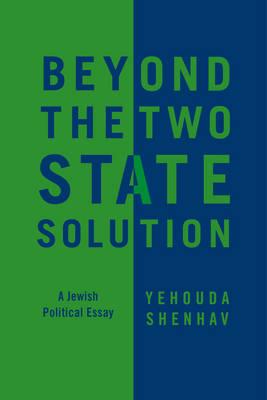
I’ve also come to believe that its high time for those who are interested in a truly just peace between Israelis and Palestinians to come forth with some new creative thinking that might provide alternatives to an obsolete two-state model. In this regard, I was happy to learn that “Beyond the Two State Solution: A Jewish Political Essay” by the great Israeli academic Yehouda Shenhav, has finally been published in English. Shenhav has long been providing precisely the kind of innovative thinking that I believe is so very lacking in political circles – and I’m delighted his work on this subject will now find a wider audience.
Using post-colonial political and critical theory, Shenhav challenges many of the fundamental paradigms and assumptions that have delineated the Israeli political “left” and “right,” while suggesting new and exciting models that might well help us to envision a better future for Palestinians and Jews in the land.
Here’s an excerpt, from his Introduction:
I am deeply concerned with the violation of the political rights of the Palestinians, but no less so with the future political rights of the Jews themselves. I believe that the combination of a persistent foundational state of emergency and blatantly racist legislation – which grows restrictive and bare-faced day by day – poses a threat not only to Palestinians, but to Jews in the Middle East. For this reason, I wish to unpack the Jewish-Israeli discourse on the conflict, to highlight the dangerous political zones within which it roams, and offer an alternative political vision in which the rights of both Jews and Palestinians are intertwined and co-determined…
In particular, I argue that the so-called “two-state solution” in the form proposed by the Israeli liberal left no only is unrealistic but in essence is based on false assumptions that sustain and reinforce the non-democratic Israeli regime and mask the essence of the conflict. Instead, I offer a different vision for political thought, which is not based on state terror or Jewish supremacy.
Shenhav is a well known thinker in Israel, but less familiar to American audiences. Whether or not you agree with his ideas, I hope you will at least be open to this sort of new thinking. I personally find it liberating – I do believe that these kinds of outside the box ideas serve to provide us with a ray of hope along what is otherwise a very dark road…
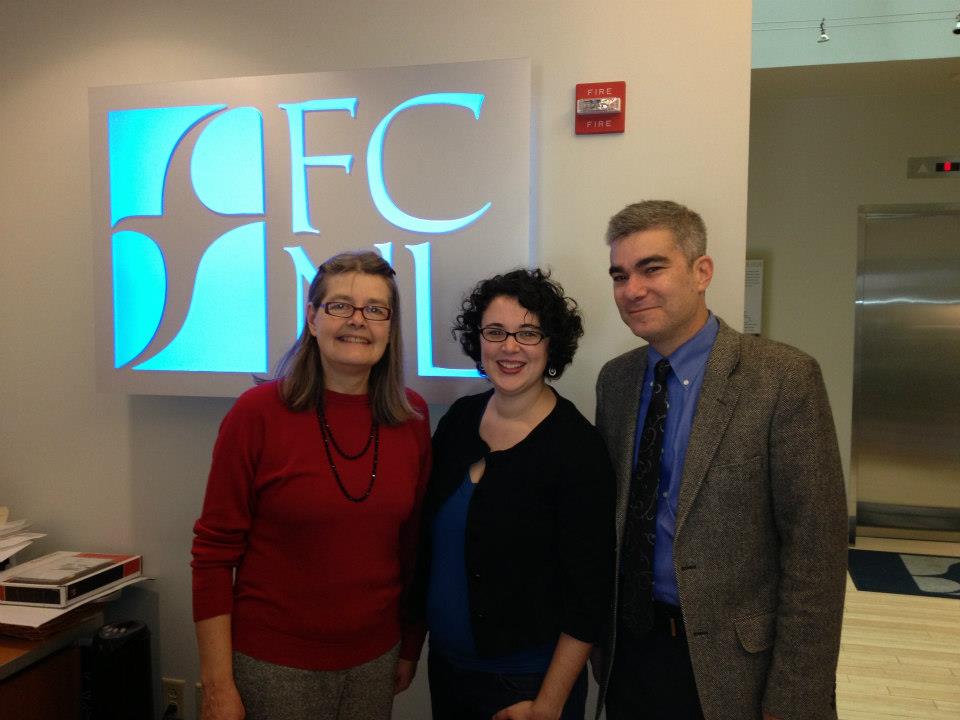
Helena Cobban (left), Sarah Grey and me at the FCNL office
Had a wonderful whirlwind visit in Baltimore/DC, highlights included book readings in Baltimore, DC and Georgetown and a visit with the National Friends Legislative Committee to Senator Dick Durbin’s office to encourage him not to support a Senate defense authorization bill that sought to punish Palestinians for seeking non-member observer status at the United Nations. Thankfully, the amendment never came up for a vote.
To create political power, leveraging people power is the best method, and historically, this has been shown to be the case. The fact that Israel is reacting so harshly against it shows its potential. When Hillary Clinton says 3000 new settlements are “not helpful,” that doesn’t get Israel’s attention. But when (Jewish Voice for Peace), (Students for Justice in Palestine) and church groups move to get corporations and holding companies to divest from Israel, that’s front page news in Israel. That is a sign that this has a great impact, when used in a smart and concerted way.
One of the big pleasures of the trip was finally getting the chance to meet Just World Books publisher Helena Cobban and my editor, Sarah Grey, both of whom have thoroughly become my kindred spirits.
Some more pix from my trip:
Book reading at Busboys and Poets, Washington DC (under the watchful gaze of Angela Davis)
Book Reading at St. John’s Episcopal, Georgetown
With Kate Gould, Legislative Associate for Middle East Policy at FCNL
 I’m thrilled to announce that my new chapbook, “Songs After the Revolution: New Jewish Liturgy” has just been published by my congregation,




 Shalom Rav