Category Archives: Judaism

AOC is Right: Trump is Running Concentration Camps on the Border

20190131_homestead-11_wide-2f9d1002d1d10763527686889b78ca23f279325b-s1500-c85

Insider the Homestead Concentration Camp, Homestead, FL.

(Cross-posted with Newsweek)

Last December, I was arrested on the border in San Diego while standing with faith leaders to protest, among other things, Trump’s unlawful incarceration of immigrants. My experiences on the border and at immigrant detention centers in my home state of Illinois have left me with no doubt whatsoever that our nation is warehousing humanity in concentration camps—and that Rep. Alexandria Ocasio-Cortez is correct when she refers to them by this term.

As a rabbi, I am compelled to act on behalf of immigrants because my religious faith and historical legacy demands that I do so. And I’m not alone: most American Jews embrace progressive values of social justice—and understand that we ourselves have a history of oppression at the hands of state violence.

Yesterday, AOC stirred something of a hornet’s nest when she retweeted an article in Esquire by an expert on immigrant detention who characterized Trump’s immigrant detention centers as “concentration camps.” Almost immediately, some Republican politicians, the Anti-Defamation League and the Jewish Community Relations Council of New York pounced, claiming AOC’s “regrettable use of Holocaust terminology to describe these contemporary concerns diminishes the evil intent of the Nazis to eradicate the Jewish people.”

It is deeply problematic, highly partisan—and historically incorrect—to declare that the use of “concentration camps” is to be constrained to the limits of “Holocaust terminology” (itself hardly an academic term.) As scholar Jonathan Katz recently pointed out in the LA Times, the term “was invented by a Spanish official …during Cuba’s 1895 independence war.” FDR, notably, also used the term in reference to his Executive Order to incarcerate Japanese Americans during World War II. And enough people have pointed out in recent days the usage of the term by the British suppressing the Boer rebellion in South Africa for it to be elaborated on here.

We Jews do not own this term. But in fact, I would argue it is imperative that we Jews use this term whenever these dreadful facilities are imposed on groups of people other than ourselves. History has shown us that the concentration of humanity into forced detention invariably leads entire societies to exceedingly dark places. This practice did not begin with Nazi policies against European Jewry—nor did it end there.

The same is true of AOC’s impassioned and all-too familiar call, “Never again.” As a rabbi, a Jew and a person of conscience, allow me to put it as plainly as I can: AOC’s use of this phrase was altogether appropriate. I do not and cannot view this call as “Holocaust terminology.” On the contrary: “Never Again” means never again for anyone, or else it doesn’t mean anything at all.

The fact that we are even debating these terms shows just how twisted the conversation has become. Rather than parsing the words of a human rights champion like AOC for petty political gain, these politicians and Jewish leaders should be directing their criticism where it truly belongs: at a morally depraved national policy that parses out access to human rights according to origin and ethnicity, tears apart families, and cages children in, yes, concentration camps.

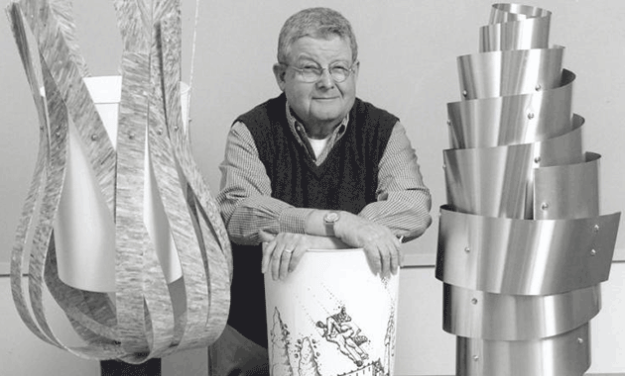
Remembering Stanley Tigerman

Tigerman

(Photo: WTTW)

Below: an excerpt from a eulogy I gave today at the funeral of celebrated Chicago architect Stanley Tigerman. As this Tribune obituary notes, “Stanley Tigerman (was) the most influential Chicago architect of his generation and the ringleader of a group of rebels who opened the way for a more inclusive view of Chicago architecture and changed the course of the city’s design.”

As I note below, it was a truly an honor for me to officiate at his funeral. 

Given that Stanley made no secret of his antipathy for organized religion, some of you might be wondering why a rabbi is leading his service. Stanley actually reached out to me several months ago through my wife – whom he knew professionally – and personally asked me to officiate at this funeral. Somehow, Stanley found out that Hallie’s  husband was a rabbi and when he asked her about me, she related to him that I had my own issues with organized religion myself.  I was humbled and honored that he reached out to me the way that he did – and that he trusted me enough to ask me to help lead this tribute to his life and work.

My wife and I spent a wonderful evening recently with Stanley and Margaret. It was clear that he wanted to share certain parts of his story with me and most importantly, to make sure I knew about the formative influences his life. In particular, he spoke to me at length about his childhood and his experiences growing up in grandfather’s Edgewater rooming house during the Great Depression. His grandfather Max was an immigrant tailor from Hungary who, after arriving in America, devoted his life to traditional Jewish Talmud study.  Stanley’s parents, Sam and Emma, like so many of their generation, were hit hard by the Depression and struggled economically – and eventually had to move in with Stanley’s grandfather, where he spent his formative years.

Stanley’s stories about growing up as an only child in the rooming house, as you might expect, were colorful and filled of characters that could easily fit into a Damon Runyon novel. The central character in his childhood was clearly Max, who Stanley described as “the most significant individual in my young life.” His grandfather was clearly his most important early teacher, teaching him English and Hebrew and enrolling him in the Hebrew school at Agudas Achim, an orthodox synagogue in Uptown.

Of these years, Stanley wrote in his memoir:

My grandpa and I were together constantly. He was a role model of some consequence, and if he had lived somewhat longer than he did there is the distinct likelihood that my life would have taken an entirely different turn. Conceivably, I can imagine studying to become a rabbi. But, given my notoriously short attention span combined with excruciating memories of difficult Hebrew lessons at Agudas Achim, where knuckles bloodied by baton-wielding rabbis were a daily occurrence, I have serious doubts about my ability for such a noble calling with its attendant discipline.

Stanley told me that he only realized later what a profound influence his grandfather had on his life during those early years. As he grew older, he came to believe that his schooling in the interpretive traditions of the Jewish religion and his devotion to the field of architecture were inextricably linked. In particular, he felt a deep kinship to Judaism’s culture of inquiry and debate – of contrarianism. Of course Stanley was nothing, if not a contrarian – and he told me he was sure this aspect of his makeup was due in no small way to his childhood education in yeshiva.

When Stanley was eight years old his grandfather died and his yeshiva days came to an end. His mother enrolled him in very different Jewish school: the Reform Temple Shalom on Lake Shore Drive. Stanley told me that as a child from a poor home, he never fully fit in at the high-end Temple Shalom. This experience only exacerbated his sense of being an outsider. It also left him with a lifelong antipathy to organized religion, although his own personal sense of connection to Jewish spiritual tradition remained an important influence on him and his work for the remainder of his life.

There are those who are far more equipped than I to discuss Stanley Tigerman’s architectural achievements and the monumental legacy he has left behind: his years as a leader in the post-modernist movement, his role in the so-called “Chicago Seven.” There is also so much more to say about Stanley’s formative days in the Navy, his love of progressive jazz music, his deep commitment to social justice, his famously irascible sense of humor, his professional partnerships so many important colleagues – and his personal/professional relationship with his beloved wife Margaret. And there is even more than that – much more than we could ever cover in one short service. And I am confident that these tributes and stories will be shared at length as his legacy is discussed and shared by those who were touched by his life and his genius.

For now, I’d like to offer just a few brief thoughts based on Stanley’s words to me during that memorable evening we spent together. It was clear to me from the beginning that he didn’t need to tell me details of his biography or to recount his specific accomplishments. Rather, he wanted me to understand the essence of his philosophy of life that clearly animated everything he did – indeed, everything he stood for.

Stanley gifted me two books that he had written, and he urged me to read them in order to understand him more thoroughly. One was his memoir, appropriately titled “Designing Bridges to Burn,” and the other was an astonishing scholarly work entitled “The Architecture of Exile,” that he dedicated to the memory of his grandfather. His ideas, I believe are quintessentially Jewish, quintessentially American, and quintessentially Stanley Tigerman.

In “The Architecture of Exile,” he wrote,

We are in a state of exile. Post-modern Americans, like their Renaissance predecessors, yearn for another, simpler, time. America is a land of foundlings and orphans, who are detached from their proper parenthood and wander in search of legitimacy in a world of other histories of longer periods of time. Americans, collectively displaced from the many lands of their separate origins, are torn between the desire to gain their roots and the knowledge that this information, once attained, will do them little good.

When you hear these words, you understand the essence of Stanley’s identification as an outsider. You can also plainly see his understanding of conflict as an essential fact of our existence. Throughout his life it seems to me, Stanley embraced these essential contradictions in a brave and beautiful way. Of course we must know and understand our past. But we cannot and must be imprisoned by it, which for Stanley would mean to descend into shallow nostalgia. As Stanley wrote, “While it is common practice to predict where we are going by where we have come from, there is no assurance that memory will help us to ascertain where we are going.” The only true way forward, Stanley seems to be telling us, is to simultaneously honor and challenge convention. To be acknowledge the status quo even as we show no hesitation in upending it.

I believe this ideal explains so much about Stanley Tigerman. It certainly explains his fierce devotion to social justice and solidarity with the outsiders, the downtrodden and the oppressed of our world. It also explains why he did not suffer fools – or those whom he considered to be fools – and why he was ready to take the hits for ideas and principles he deeply believed in. When I think of one of his most iconic artistic works, the collage of Mies Van Der Rohe’s Crown Hall sinking into the sea like the Titanic, I can’t help but think of the Biblical midrash of Abraham destroying his father’s idols. There are few in the world such as Stanley, who at once could honor those who blazed trails before him, even as he sent their work sinking into the watery depths.

So let us honor Stanley’s legacy. Let us honor his legacy by embodying his courage, his principled iconoclasm, his understanding that conflict is an essential building block of creativity and justice in our world. If we are indeed brave enough to embody these ideals, then the sacred narrative of his remarkable life will live on, perhaps even longer than the buildings he built while he was alive. And I have no doubt that Stanley would have wanted it this way.

Zichrono Livracha – may his memory be for a blessing.

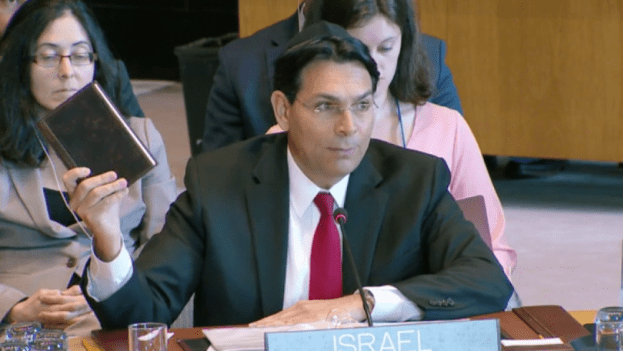
When Secular Israelis Claim “God Gave This Land to Us”

danonbible

(photo: AP video)

Israeli Ambassador to the UN, Danny Danon, created something of viral sensation last week when, during a speech in the Security Council, he dramatically brandished a Bible and declared “This is the deed to our land.”

He then continued:

From the book of Genesis; to the Jewish exodus from Egypt; to receiving the Torah on Mount Sinai; to the gates of Canaan; and to the realization of God’s covenant in the Holy Land of Israel; the Bible paints a consistent picture. The entire history of our people, and our connection to Eretz Yisrael, begins right here.

Danon’s use of an ancient religious text as justification for the State of Israel’s right to the land was likely an astonishing moment for many. What on earth was a secular Israeli doing lecturing the UN on “God’s covenant in the Holy Land of Israel?” For those familiar with Zionist pedagogy however, his comments were neither unusual nor unprecedented.

When I heard about Danon’s Biblical tutorial, I immediately recalled a famous story about a 1937 meeting between David Ben-Gurion and Lord Peel, who was then heading the British Royal Peel Commission of Inquiry into the potential partition of Mandate Palestine. According to the story, Lord Peel asked Ben-Gurion where he was born and Ben-Gurion replied that he was from Plonsk, Poland. Lord Peel responded that the Arab leaders with whom he had met were all born in Palestine and most of the Jewish leaders were from Eastern Europe. Peel noted that the Arab people had a kushan (Ottoman land deed) that entitled them to the land – and asked Ben-Gurion if he also had a document that proved the land belonged to him.

At that point, Ben-Gurion became aware of the Bible upon which he had just sworn as a commission witness. He grabbed it, held it up and exclaimed, “Here is your kushan. It is the world’s most highly respected book and I believe that you British regard it with much respect too. We must have this land!”

This phenomenon – that of otherwise secular Israeli Jews proclaiming “God gave this land to us” – is not particularly uncommon. It is actually rooted in the unique form of nationalist ideology that gave rise the state of Israel. If we are to grasp this mentality properly then, we must first understand the early ideological trends that motivated Israel’s original settlers and eventual founders.

Many scholars have pointed out that Zionists – particularly those from Russia and Poland – were markedly influenced by the ideas of European Romantic nationalism (also known as “ethnic nationalism,” “organic nationalism” or “integral nationalism”) an intellectual movement that spread across Europe in the mid-19th century. The early seeds of this ideology were planted in the ideas of Rousseau, Hegel and particularly the German philosopher Johann Gottfried von Herder, who posited that “each nation is separate, distinguished by climate, education, custom, tradition, and heredity.”

These ideas were a powerful part of the ideological fabric of 19th century Europe from which Zionism emerged. In his book “The Founding Myths of Israel,” Israeli historian Zeev Sternhell notes that “Herder’s thinking had tremendous importance in Eastern Europe” during the 19th century and that these ideas were formative for important Labor Zionists such as A.D. Gordon, Berl Katznelson and David Ben-Gurion. Sternhell’s work compellingly demonstrates how otherwise secular socialists could espouse an ideology that articulated a deeply spiritual – and at times almost mystical connection of the Jewish people to land, history, language and ritual:

A cultural-organic conception of the nation necessarily included religion, which it saw as an inseparable part of national identity. This was the case in Eastern Europe, but also in Western Europe, in France and Spain. French integral nationalism was no less Catholic than Polish nationalism, and religion played the same role in it as it did in Poland or Romania. It was a focus of unity and identity, over and beyond social divisions. In integral nationalism religion had a social function, unconnected with its metaphysical content. Generally, it was a religion without God; in order to fulfill its function as a unifying force, religion required only external symbols, not inner content (p. 56, emphasis mine.)

In other words, the settlers and eventual founders of the Jewish state instrumentalized religion, emphasizing its social function to unify the people under one national identity. Indeed, the idea of a “religion without God” can be clearly discerned in the words of many pivotal Zionists. Thus Gordon, the father of Labor Zionism, could in one breath excoriate traditional Judaism with incredible vehemence while claiming that “the greatness of nationalism is its cosmic dimension” (p. 62). Sternhell also describes the venerable Labor Zionist figure, Berl Katznelson, as “a kind of secular rabbi whose strength lay in a direct contact with a sect of believers” (p. 135).

As my anecdote above demonstrates, Ben-Gurion’s world view was also deeply motivated by this mindset. Decades after lifting a Bible before Lord Peel, Ben-Gurion famously convened a study group of archeologists, academics and military officers to read and discuss the Biblical book of Joshua. It was well known that Joshua, which describes the Israelite conquest of Canaan in vivid detail, was Ben-Gurion’s favorite book of the Bible. In keeping with the ways of Romantic nationalists, he considered the Bible to be the Jewish people’s “national epic,” connecting them to a glorious ancient past as well as the a justification for their contemporary settlement of the land.

As American scholar Rachel Haverlock has noted:

Similar to other national movements, Zionism appealed to the glories of an ancient past and brought biblical words and phrases into spoken Hebrew. The Hebrew Bible served as a linguistic source and literary template in the prestate Yishuv and early decades of the State of Israel…

Ben-Gurion saw the biblical war narrative as constituting an ideal basis for a unifying myth of national identity. Not only could modern Israelis relate to the processes of conquest and settlement, but through the prism of Joshua they could also understand them as reenactments of the biblical past (“The Joshua Generation: Conquest and the Promised Land ” p. 309.)

The use of the Bible as national epic was not the exclusive provenance of Labor Zionists. Zeev Jabotinsky, the founder of Revisionist Zionism (the ideology of the present-day Likud party) wrote the 1927 novel, “Samson the Nazirite,” which portrays Samson as a Jewish national hero. Though Jabotinsky was a passionate opponent of Labor Zionism, he and his socialist Zionist compatriots clearly shared a deep attachment to the trappings of Romantic nationalism.

Since the founding of the state (when the Bible was invoked in its Declaration of Independence), these romantic mythic narratives have since exerted an indelible hold over Israeli socio-political culture. Well before Danon’s UN pronouncement one could choose from a myriad of examples. To offer but one more: Netanyahu’s 2015 speech before Congress, in which invoked the Biblical book of Esther to drive home the “threat” of present day Iran to the state of Israel. (“Today the Jewish people face another attempt by yet another Persian potentate to destroy us.”)

With the political ascendency of the settler movement, it might be said that the Romantic nationalism Israel’s of socialist founders has found common cause with religious Zionists who use the Bible to make unabashedly fundamentalist claims on the land. Thus, an extreme nationalist Israeli politician like Ayelet Shaked can be accurately described as “a secular woman from left-leaning Tel Aviv (who has) become the most successful spokesperson for the religious-nationalist party and the settlement movement it strongly supports.” In a sense, we might say that the trajectory of contemporary Zionism has hopelessly conflated secular nationalism and religious ideology into one Biblically-based claim to historic Palestine.

In the end, however, whether it is used by Labor Zionists, Revisionist Zionists or right wing West Bank settlers, the use of the Bible as the “Jewish people’s deed of sale” to the land of Israel represents a radical break with Jewish history, throughout which Jews regarded this text as a religious – not a political – document. It is also a profoundly fraught enterprise, particularly when you consider that the Zionist national epic includes God’s command in the book of Joshua for the Israelites to take the land by force and dispossess its Canaanite residents.

In an era that is currently witnessing the rise of romantic/ethnic (read “white”) nationalism throughout the world once more, it is critical that nations honestly assess what it is that truly binds them together. Is it one people’s “organic right” to a particular land or a commitment to the individual rights of all who dwell upon it?


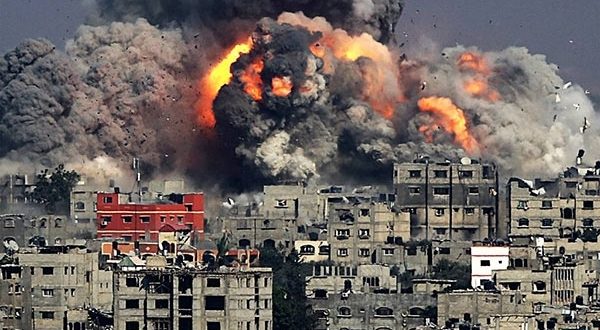
psalm 140: deliver me

israel-bombs

oh lord deliver me from my people
who wield their weapons with impunity
whose armies rain bombs on the imprisoned
whose apologists equate oppressor and oppressed
who punish resistance without mercy.

keep me from those who speak so easily of two sides
of dual narratives of complexities and coexistence
those who call submission peace and lawless laws justice
who never tire of intoning never again
even as they commit crimes again and again
who have forsaken every lesson they’ve learned
from their own history and their
own sacred heritage.

like jacob i have dreamed fearful dreams
i have struggled in the night
i have limped pitifully across the river
and now like jacob in my last dying breath
i have nothing left but to curse my own
whose tools are tools of lawlessness
who maim refugees who dare dream of return
and send bombs upon the desperate
for the crime of fighting back.

so send me away from this people
this tortured fallen assembly
keep me far from their council
count me not among their ranks
i can abide them no longer.

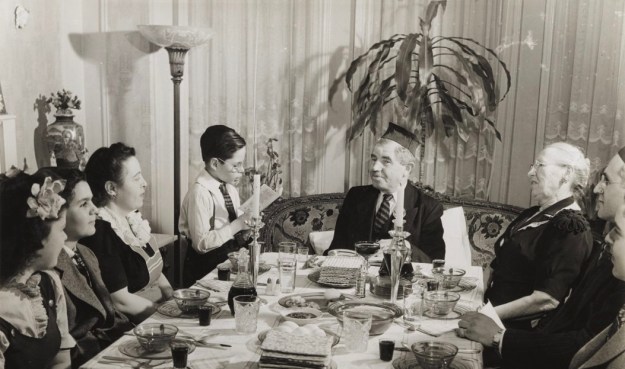
Confessions of a Wicked Child: A Passover Reflection by Jay Stanton

1930sArnold Eagle.jpegHere are the remarks that Jay Stanton offered at Tzedek Chicago’s Passover seder last night. Jay was formerly Tzedek’s rabbinical intern – and I’m delighted to announce we’ve just hired him to be part of our staff for the coming year:
In a traditional seder, four children are described: a wise child, who likes learning all the ins and outs of Jewish law, a wicked child, who pokes fun at the whole idea of a seder, a simple child who seeks basic information, and a child who does not know how to ask.  These archetypical children help us explore what it means to fulfill the mitzvah of telling our children about the Exodus from Egypt.

I have a confession to make; I am a wicked child.  Of course, there are the ways society and the Jewish community in general have cast me as the wicked child: being queer and trans and supporting Palestinian rights not least among them.  But I’m also a self-identified wicked child. I am personality-wise and ethically the kind of person that voices my disapproval of standard approaches and doesn’t care what you think of me in response.  I’m a contrarian by nature, and I like asking difficult questions. Last year at this time, I asked all of us what we were doing here when we could be somewhere else doing something to make the world better.  And here we are this year, doing this peculiar ritual yet again.

I’m a wicked child.  I want to know what this means to you and why you think this is the way we should celebrate liberation.  Wouldn’t it be better to hear directly from people who have escaped modern slavery and to have real conversations about global abolition of slavery and how to establish reparations to address the ongoing legacies of slavery in America?  Plus, the Exodus never happened; the seder is an exercise in remembering alternative facts, which is to say lies.

I told you I’m a wicked child.  And I’m guessing I’m not the only one here.  Despair not! Wicked children are valued by Jewish tradition.  Because the Talmud values contrarians. Because the seder itself values the wicked child.  After their question, “What does this ritual mean to you?”, the wicked child is not sent to bed without their supper.  Instead, the parent responds in kind.

“This is because of what God did for me when I went free from Egypt.  For me, and not for you, because if you had been there, you would not have gone free.”  It’s a contrarian response, not a real argument. In our Exodus narrative, more people than the Israelites left Egypt together.  In Hebrew this is called ‘erev rav, translated as a very diverse group or coalition.  I imagine the wicked children marched out of Egypt as part of the liberation coalition, where they found ample opportunity to critique the choices of the liberatory leaders, like leading the group directly to a body of water while being chased by the Egyptian military.  Maybe a frustrated wicked child yelled at Moses, “What are you going to do now? Hold up your staff and just wait for God?!”

Voices of critique and dissent have pushed our conversation toward progress, inclusion, and more ethical behavior for thousands of years.  They are enshrined in Talmud and indeed in the Haggadah. Judaism is enriched, not threatened, by a multiplicity of opinions and approaches.

To put it differently, the vital role of wicked children in our Passover seder exemplifies spiritual freedom.  Spiritual freedom, one of Tzedek Chicago’s core values, is more than active inclusion of atheists, agnostics, and non-Jews in our midst.  It is an affirmation of the ‘erev rav as a diverse, universalist community, and it is an elevation of critique from an obstacle to overcome to a necessary part of collective liberation.  We not only allow the wicked child to derail the Passover seder, we need them. Judaism needs its wicked children.

Just as political freedom provides a check against political tyranny, spiritual freedom provides a check against spiritual tyranny.  Both human and so-called divine spiritual authority have tendencies toward the coercive and oppressive. We could dismiss this problem as one that only affects the religious right. However, we are also at risk of spiritual tyranny here at Tzedek Chicago. We could give too much power to our spiritual leader and follow Brant even if and when he’s wrong, but spiritual freedom gives every one of us the tools to speak up if Brant starts leading us down the wrong path.  We are a community for people who share Tzedek’s specific values, and we say freely that people who object to them can find other Jewish communities. There’s not much distance between that and establishing some kind of review committee to determine whether you faithfully adhere to every line of each of our core values in every aspect of your life. Don’t worry; we’re not going to establish an Inquisition. Spiritual freedom ensures we are universalist not only in our outcomes but also in our process. When our leaders are wrong or when we feel excluded, we get to speak up and remain wicked children at the table.

As a wicked child, I wonder how the rest of the wicked child Passover conversation goes.  If I were continuing it, I would caution the parent, saying “Now you sound like the oppressor.  Do you want to be like Pharaoh?!”

Mah ha’avodah hazot lakhem?  What does this ritual mean to you?

Olives and Maror: A Seder Supplement in Honor of the Great Return March

636604238221814980-AFP-AFP-14D8ER

photo: AP

Here is an excerpt from my new Passover seder supplement, “Olives and Maror – The Great Return March:”

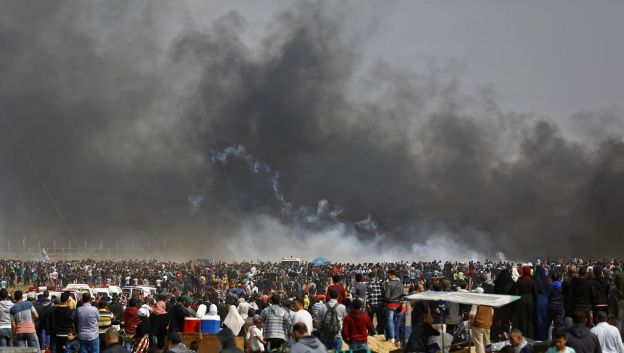
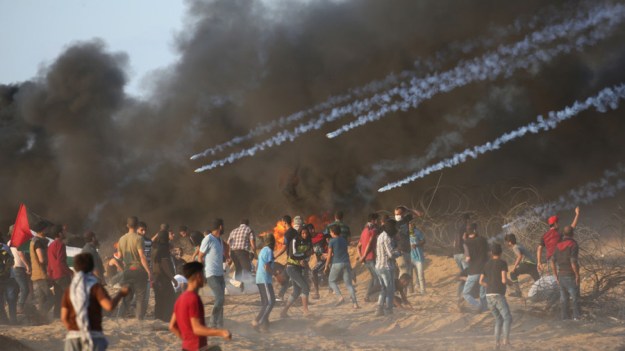
And so, on this night of Passover we affirm: we cannot gather to tell the Exodus story without acknowledging the liberation narrative that is currently unfolding at the Gaza border. We affirm further: if we remember our own persecution yet fail to call out Israel’s persecution of the Palestinian people, our seder will not be complete.

We now combine maror and olives, to acknowledge the bitterness of lives lost and dreams denied – together with the eternal hope of justice and return. Let us redouble our resolve to do our part to make these hopes and dreams a reality bimeirah be’yamneinu – speedily and in our own day.

Click here for the entire supplement to print out and read at your seder table this year. (Click here, here, here and here for supplements I’ve written in previous years.)

Psalm 126: A Dream of Return

5bd2158bfc7e933f228b45e5

photo credit Ibraheem Abu Mustafa/Reuters

March 30, 2019

Even as bullets pierced the barrier
their dream of return rose
up to the heavens
like black tire smoke curling
dancing then disappearing
into a warm spring sky.

And in that instant
their cries of pain transformed
into songs of joy and peals of laughter
yes in one fleeting moment
the tear gas lifted and they knew
they were going home.

They will return.
Like water flowing back
down parched river beds
like seeds blossoming into life
out of the hard dry ground
like rusted locks
clicked open by ancient keys
they will return.

To Safad to Hifa to Lydda
to al-Majdal to Ashdud
to al-Ramla and Bir Saba
they will return.

Though the thick dark smoke
obscures our vision today
we who have known dreaming
must surely know
that those who choke on their own tears
will return to harvest their fields
once again.

Toward Shabbat Solidarity with Gaza

IMG_0230

Tzedakah saves from death. (Proverbs 10:2)

For religious Jews, Friday is typically devoted to spiritual and practical preparation for the Sabbath. Those who are traditionally observant will spend the morning and afternoon doing their shopping, housecleaning and cooking for Shabbat before sundown. Before Shabbat worship, there is a preliminary service known as Kabbalat Shabbat: a series of Psalms and prayers of welcome that serve as a spiritual precursor to the onset of the Jewish Sabbath. As any Shabbat observant Jew will attest, the sense of spiritual preparation and anticipation that takes place on Friday is deeply imbedded in the sacred rhythm of the Jewish week.

Speaking personally, this sacred rhythm has been disrupted – perhaps even profaned – for me for almost a year now. That is because every Friday afternoon, my news feed is regularly filled with reports of Palestinian civilians killed and maimed by the Israeli military during the protests taking place during the Great March of Return.

Every Erev Shabbat, as I prepare for the most sacred day of the week, I invariably learn that Gazans – including young adults and children – have been shot down by Israeli bullets as they protest hundreds of meters from the Gaza border fences. As of January 2019, Israeli soldiers have killed over 250 people and injured 23,000. Among the injured, many are grievously wounded; the Washington Post recently reported that doctors in Gaza are often unable to deal with such traumatic injuries because  Israel’s crushing blockade has left hospitals “overwhelmed and understaffed.”

Of course there is rarely a mention of these weekly events in the mainstream media – and when there is, news reports often treat the Palestinian demonstrators as the instigators of “violent clashes.” For its part, the Jewish communal establishment greets these crimes with silence at best and justification at worst – as if it is perfectly justifiable to regularly shoot down unarmed protesters with live gunfire.

I sometimes wonder if there are other Jews out there like me, whose personal preparation for Shabbat is regularly violated by the events transpiring every Friday afternoon along the Gaza border. Who approach Shabbat with an increasing sense of dread, often followed by anguish at the news of Gazans killed and injured by a military that acts in the name of the Jewish people. Who ask: how can we possibly prepare for this sacred weekly occasion as a Jewish army shoots down unarmed civilians for their “crime” of protesting for their human rights?

I have to believe there are other Jews for whom these weekly massacres at the Gaza border represent not only a human rights concern by an inherently spiritual violation and a profound moral/religious challenge. I would go as far as to say it is an aveirah – a religious transgression – for Jews to greet Shabbat without some kind of meaningful acknowledgement of what has been transpiring every week at the Gaza border.

What might this acknowledgement look like? A few thoughts occur to me: Since mourning rituals are traditionally lifted on Shabbat, we might pause before Shabbat candle lighting and mention the names of those who may have been killed or wounded in that week’s protest. Another idea: as it is traditional to give tzedekah before Friday night candle lighting by placing coins in a pushke – a tzedakah collection box – we could make giving tzedakah to a Gazan relief organization part of our weekly preparation for Shabbat. Such organizations might include the UN Relief and Works Agency for Palestine (UNRWA), Doctors with Borders, or American Near East Refugee Aid (ANERA).

In the Talmud, there is a famous rabbinic discussion of the line from Proverbs, “Tzedakah saves from death.” According to the plainest meaning of this verse, this means simply that charity has the very real potential to save lives. This kind of attitude, however, represents the noblesse oblige approach to giving: i.e., that those who have more have the responsibility to give to those who are less fortunate than they.

Such a view betrays the very meaning of the word “tzedakah,” which comes from the Hebrew root meaning “justice.” Indeed, if tzedakah has the force of justice behind it, then it cannot simply be left to the whims and choices of those who might be feeling “charitable.” It is rather, an obligation for all people to right the wrongs that abound in our world. All the more so in the case of Gaza, which is not so much humanitarian crisis as an injustice created by one powerful nation state that seeks to control a population by blockading it inside a virtual open air prison.

I have no illusions that giving tzedakah at the onset of Shabbat will on its own save the people of Gaza. And I do not want to endorse it as a kind of “indulgence” to assuage the guilt of those who don’t want to enter into Shabbat burdened by the thought of this terrible and ongoing human tragedy. Rather, I’m suggesting this new weekly practice as a way to do the work of justice as a regular discipline – and to make our final act of the week an act of solidarity with a people who are suffering from injustice committed by those purporting to be acting in our name.

So here’s my suggestion: let’s make justice for Gaza part of our weekly regimen as we prepare for Shabbat. May this act of conscience contribute all the more to Kedushat Hayom (“the holiness of the day”). And may we emerge from this day of renewal that much more inspired to fight for a world in which justice is extended to all who dwell upon it.

On Alice Walker and Antisemitism

American Masters - Alice Walker: Beauty in Truth

The Jewish interwebs have been abuzz regarding Yair Rosenberg’s December 17 Tablet article in which he criticized the New York Times Book Review for its interview with Alice Walker. In last Sunday’s “By the Book” column, the Times asked Walker what books she had on her nightstand; among those she cited was a book by British antisemitic conspiracy theorist David Icke entitled, “And the Truth Shall Set You Free.” Walker commented, “In (his) books there is the whole of existence, on this planet and several others, to think about. A curious person’s dream come true.”

In his article, Rosenberg listed a litany of odious excerpts from Icke’s book, including his praise of “The Protocols of the Elders of Zion,” his claims that the B’nai B’rith was behind the slave trade and his belief that the Rothschilds bankrolled Adolf Hitler. He also offered a long list of the numerous times Walker has endorsed Ickes’ ideas, including her posting of his video interview (now blocked by YouTube) with Infowars’ Alex Jones, of which she wrote:

I like these two because they’re real, and sometimes Alex Jones is a bit crazy; many Aquarians are. Icke only appears crazy to people who don’t appreciate the stubbornness required when one is called to a duty it is impossible to evade.

Rosenberg also posted in full, a deeply disturbing poem written by Walker in 2017 entitled “It is Our (Frightful) Duty to Study the Talmud.” This excerpt should give you a good idea about the tone and substance of Walker’s piece:

For a more in depth study
I recommend starting with YouTube. Simply follow the trail of “The
Talmud” as its poison belatedly winds its way
Into our collective consciousness.

I will sadly confess that I was unaware of Alice Walker’s history of antisemitic attitudes, even though this was apparently common knowledge among many on the left. During the Twitter eruption that followed Rosenberg’s piece for instance, Roxane Gay commented:

IMG_5155

Those of us who were hearing of Walker’s antisemitic proclivities for the first time were particularly saddened to learn that this eloquent champion of anti-racism had been expressing such poisonous ideas toward Jews and Judaism. Journalist/filmmaker Rebecca Pierce spoke for many of us when she tweeted this response:

IMG_5152

In his article, Rosenberg made mention of Walker’s anti-Israel politics, challenging “the progressive left” to call out antisemitism that is “presented in the righteous guise of ‘anti-Zionism.’” Although I don’t share Rosenberg’s conservative Israel politics, I accept his challenge. And yes, it’s painfully true that Walker’s Talmud poem egregiously cites Jewish religious tradition as the root cause of Israel’s oppression of Palestinians (as well as American police brutality, mass incarceration and “war in general”):

For the study of Israel, of Gaza, of Palestine,
Of the bombed out cities of the Middle East,
Of the creeping Palestination
Of our police, streets, and prisons
In America,
Of war in general,
It is our duty, I believe, to study The Talmud.
It is within this book that,
I believe, we will find answers
To some of the questions
That most perplex us.

Walker’s claim that the Talmud is “evil” and “poisonous” – a common antisemitic trope – is worth unpacking here. First of all, what is referred to as “The Talmud” is actually a vast corpus of Jewish civil and ritual law mixed with freewheeling legend and Biblical commentary composed between 200 and 500 CE. Though it is one of Jewish tradition’s foundational texts, Talmudic literature is not, to put it mildly, immediately accessible to the untrained reader. It’s typically studied by traditional Jews in the rarified world of schools known as yeshivot, where students’ primary focus is on the unique pedagogy of Talmudic argumentation.

Like all forms of religious literature, Talmudic tradition expresses a wide spectrum of ideas and attitudes. The contemporary reader would likely find its content to be alternately inscrutable, inspiring, challenging, archaic – and yes, at times even repugnant. It contains passages for example, that are profoundly misogynistic. And as Walker pointed out in her poem, it also contains occasional material that is decidedly anti-Gentile, including a notorious passage that depicts Jesus condemned to suffer in hell in a vat of burning excrement. (Yep, it’s true.) There are also texts that unabashedly claim Jewish lives must take precedence over non-Jewish lives – an idea that was also advocated centuries later by Moses Maimonides.

These texts are undeniably, inexcusably offensive and they must be called out, full stop. At the same time however, it is exceedingly disingenuous to judge a religion on the basis of its most problematic pronouncements. This attitude simplistically accepts these texts at face value, devoid of any context or historical background. It also ignores the fact that almost all faith traditions address the offensive, archaic or inconsistent elements in their sacred literature through the use of hermeneutics – that is, principles and methods that help readers understand their meaning in ever-changing societal contexts.

How for instance, might a contemporary religious feminist read and understand a blatantly misogynist Talmudic text? In an article entitled “When Sages are Wrong: Misogyny in Talmud,” Dr, Ruhama Weiss, of Hebrew Union College offers one hermeneutical approach:

(These Talmudic traditions) caused me a powerful disturbance. They forced me to think and react; to think about mechanisms of power and control and about the ability to be free from them. To make an effort to find and highlight additional voices, earlier voices, buried and hidden in misogynist rabbinic discussions.

Most importantly, these difficult sources teach me a lesson in modesty; from them I learn that unequally talented and wise people with good intentions can bequeath to subsequent generations difficult and bad traditions. I see the moral blind spots of my ancestors, and I am obligated to examine my own moral blind spots. Bad and disturbing sources make me think.

Indeed, this same hermeneutic method can be applied to Talmud’s xenophobic, anti-Gentile content as well. That is to say, these texts can challenge us to see “the moral blind spots of our ancestors and thus to examine our own moral blind spots.” They can help us confront “mechanisms of power and control” and contemplate the ways we might be able to “free ourselves of them.” These bad and disturbing sources can “make us think.”

Of course there are those who will read the texts of their faith through a more literal, fundamentalist hermeneutic. In such cases, it is up to those who cherish their religious tradition and the value of human rights for all to challenge such interpretations, particularly when the lines between church and state power become increasingly blurred.

On the subject of state power, I must add that I find it exceedingly problematic when folks criticize Talmudic tradition for its xenophobic attitudes without acknowledging the fundamentally anti-Jewish attitudes that are embedded deep within Christian religious tradition. It’s also important to note that antisemitic church teachings were historically used to inspire centuries of anti-Jewish persecution throughout Christian Europe, while the Talmud was written and compiled in a context of Jewish political powerlessness.

Today, in this relatively new era of Jewish power, it is certainly important to remain vigilant over the ways Jewish tradition is used to justify the oppression of Palestinians. Indeed, since the establishment of the State of Israel, this subject has been intensely debated throughout Israel and the Jewish Diaspora. As I write these words in fact, I’m recalling a blog post I wrote back in 2009 about then Chief Rabbi of the Israeli Defense Forces Avichai Rontzki, who made a comment, based on Jewish religious texts, that soldiers who “show mercy” toward the enemy in wartime will be “damned”:

How will we, as Jews, respond to the potential growth of Jewish Holy War ideology within the ranks of the Israeli military?  How do we  feel about Israeli military generals holding forth on the religious laws of warfare? Most Americans would likely agree that in general, mixing religion and war is a profoundly perilous endeavor.  Should we really be so surprised that things are now coming to this?

I do not ask these questions out of a desire to be inflammatory. I ask them only because I believe we need to discuss them honestly and openly – and because these kinds of painful questions have for too long been dismissed and marginalized by the “mainstream” Jewish establishment.

In the end, every faith tradition has its good, bad and ugly. And in the end, I would submit that the proper way to confront these toxic texts is for people of faith to own the all of their religious heritage – and to grapple with it seriously, honestly and openly. And while we’re at it, it’s generally a good rule of thumb to avoid using the bad, ugly stuff in any religion’s textual tradition to make sweeping historical or political claims about that religion and/or the folks who adhere to it.

What is not at all helpful is for people such as Alice Walker to cherry-pick and decontextualize quotes from one particular religious tradition and warn that its “poison” is “winding its way into our collective consciousness.”

Like many of my friends who are just now learning about her adherence to antisemitic tropes, I fervently hope she will come to understand, as Rebecca Pierce put it, that the attitudes she endorses “are part of the same white supremacist power structure she so deftly fought through her written work in the past.”


On Hanukkah, Let’s Challenge Militarized Security Responses to Anti-Semitism

Cross-posted with Truthout

synagogues-considering-security-increase-after-pittsburgh-shooting

(photo credit: Newsweek)

Amid the swirl of responses to the deadly Pittsburgh synagogue shooting in October was the New York Post report of a Colorado gun shop owner named Mel “Dragonman,” who publicly offered free guns, ammo and firearms training to congregational rabbis. According to the report, responses to his offer were “mixed.” One congregant appreciated the dealer’s intentions but added “arming people is … not part of the solution.” Another answered that while she was fine with the idea, she drew the line at the prospect of her rabbi carrying an AR-15 during services.

While this story is obviously a cheap tabloid throwaway on the surface, it does reflect a serious and increasing intra-communal conversation over the security of synagogues and Jewish institutions post-Pittsburgh. Indeed, it would not be an overstatement to suggest that the Tree of Life massacre is causing an American Jewish reckoning over the threat of anti-Semitic violence with a gravity we have not seen in generations.

According to press reports, increasing numbers of synagogues have already hired armed guards or are seriously considering doing so. The New York Post reports, “Rabbi Gary Moskowitz, a former cop who founded a group called the International Security Coalition of Clergy, said he has been inundated with more than 150 calls from ‘scared’ rabbis, congregants and non-Jews who want guns or self-defense training, which includes learning how to hurl weights and tomahawk axes.” The rabbi of a prominent Kansas City congregation explained his decision to hire an armed guard thus: “You have to be vigilant all the time, unfortunately. That’s just part of what it means to be a congregation at this moment in history.”

Other synagogues and organizations, however, are resisting the urge to resort to armed security, citing an unwillingness to let “fear-mongering” and “trauma-triggering” (embodied by Trump’s commentthat an armed guard could have prevented the tragedy) dictate their approach to their own communal security. As New York-based organization Jews For Economic and Racial Justice (JFREJ) responded in its statement:

We know that antisemitism is a pillar of white supremacy, and that as white supremacy rears its head more brazenly, so does antisemitism. In recognizing the very real need for safety in synagogues and Jewish communal spaces, we must be skeptical of calls made by Trump and others to increase police presence in our community spaces.

This issue is also fraught because the American Jewish community is more diverse than many often assume — and vulnerable minority groups within the Jewish community members are openly expressing their fears that an increased police presence or hired security would cause them to feel unsafe and unwelcome in their own houses of worship. This fall — even before the Tree of Life tragedy — one synagogue president wrote about this very issue after his synagogue board discussed congregational security during the High Holidays:

Not only do we believe that public or private police won’t keep us safe, we decided that these kinds of security measures could very possibly hurt our community in grave ways. Our congregants include people of color, trans and gender non-conforming folk, queers and their families, peace activists and others who have all been targets of police and state violence…. The risk to individuals and the fabric of our congregation outweighs any potential benefit.

In a widely read article following the attack, Bentley Addison expressed his personal feelings about the impact an armed police presence would have on him as a Black American Jew, pointing out that “with police officers in synagogues, Black Jews and Jews of Color won’t feel safer at all.” Addison concluded forcefully that, following Pittsburgh, congregations should “prioritize the safety of all Jews.”

As a result, some congregations and Jewish organizations are promoting decidedly different models of communal security. For instance, JFREJ, in partnership with Jewish congregations and organizations and allies in the New York City police accountability movement, recently released a “Commit to the Community Safety Pledge” in which Jewish institutions can commit to “develop a community safety plan that aims to honor all who come through our doors.” The text of the pledge further notes:

People targeted by state-enforced violence in our country have had to do this work for centuries, and we are grateful to learn from the wisdom they’ve developed. The strategies include interfaith collaboration and crisis de-escalation, as well as long-term interventions such as creating alternative safety teams, rapid response networks, and broader cultural education around antisemitism and white supremacy.

In a similar vein, Jewish Voice for Peace’s Deputy Director Stefanie Fox has stated that the organization is exploring the possibility of establishing an “interfaith security coalition” in which different faith communities would band together to protect each other’s worship spaces. “If we’re doing the work to deepen our practice and skills around safety outside of policing, that capacity can and should serve not only our Jewish communities but also our interfaith partners in the crosshairs of white nationalist and state violence,” Fox said.

On a strictly practical level, Jewish institutions are actively considering institutional safety strategies such as evacuation plans that have the potential to save lives more effectively than police or armed guards. They also stress the need for these plans to be collectively developed and shared and not simply left to “trained professionals.” As one Jewish organizational consultant recently put it, Jewish synagogue security functions should be “de-siloed,” advising that “safety and security needs to be shared by clergy, operations staff, those responsible for community engagement as well as lay leaders.”

For contemporary Jews of course, this conversation is nothing new. In the post-Holocaust world, the issue of Jewish safety and security is complex and fraught — particularly with the establishment of a Jewish nation-state whose very raison d’etre is to safeguard Jewish lives. In many ways, it might be claimed that Israel itself embodies Trump’s response to the Pittsburgh shooting: that the only true form of protection comes from the barrel of a gun.

However, the 70-year history of the state of Israel has demonstrated the fatal fallacy of this response. In the 21st century, the state founded with the ostensible mission of ensuring Jewish security has ironically become the one place in the world where Jews feel the most unsafe: an over-militarized garrison state that is literally building higher and higher walls between itself and its “enemies.” And of course, the establishment and maintenance of an ethnically Jewish nation state has created an even more unsafe environment for the millions of non-Jews who happen to live there.

On a final note, it’s worth noting that this current conversation is taking place as the Jewish festival of Hanukkah approaches. For many, this holiday is a celebration of Jewish armed might against the anti-Semitic persecution of the Assyrian Seleucid Empire in 168 BCE. This is largely due to the influence of its observance in Israel, where this relatively minor Jewish festival has been transformed into a celebration of military might by Zionist founders who identified with the Hanukkah story’s central characters, the Maccabees — the priestly Jewish clan whose military victory over the Assyrians resulted in the rededication of the Temple in Jerusalem and a brief period of Jewish independence.

However, while many might reflexively accept Israel’s framing of the Maccabee narrative, the history of Hanukkah is not nearly as simple as this version might indicate. As it would turn out, the Jewish commonwealth established by the Maccabees (known as the Hasmonean Kingdom) quickly became corrupt, oppressing its own Jewish citizens and waging ill-advised wars of conquest against surrounding nations. In the end, it didn’t take long for the Romans to move in and mop up. All in all, the last period of Jewish political sovereignty in the land lasted less than 100 years.

The Talmudic rabbis who developed classical Jewish tradition as we know it were not, to put it mildly, huge fans of Judah Maccabee and his followers, and they were loath to glorify the Books of the Maccabees (which was never canonized as part of the Hebrew Bible). In fact, the festival of Hanukkah is scarcely mentioned in the Talmud beyond a brief debate about how to light a menorah and a legend about a miraculous vial of oil that burned for eight days. Notably, the words of the prophet Zechariah, “Not by might and not by power, but by my spirit, says the Lord of Hosts,” was chosen to be recited as the prophetic portion for the festival.

In the end, it’s altogether appropriate that this current Jewish communal conversation about the true nature of Jewish safety and security is taking place as the holiday of Hanukkah approaches. In the aftermath of Pittsburgh, American Jews find themselves considering these age-old questions anew: How will we respond to those who seek to do us harm? Can we depend upon the physical force of state security to save us? Or will we answer with a deeper vision of communal security — that none of us will be safe until all of us are safe?