Category Archives: Palestine

An Anniversary of Popular Struggle in Al-Ma’asra

IMG_0883

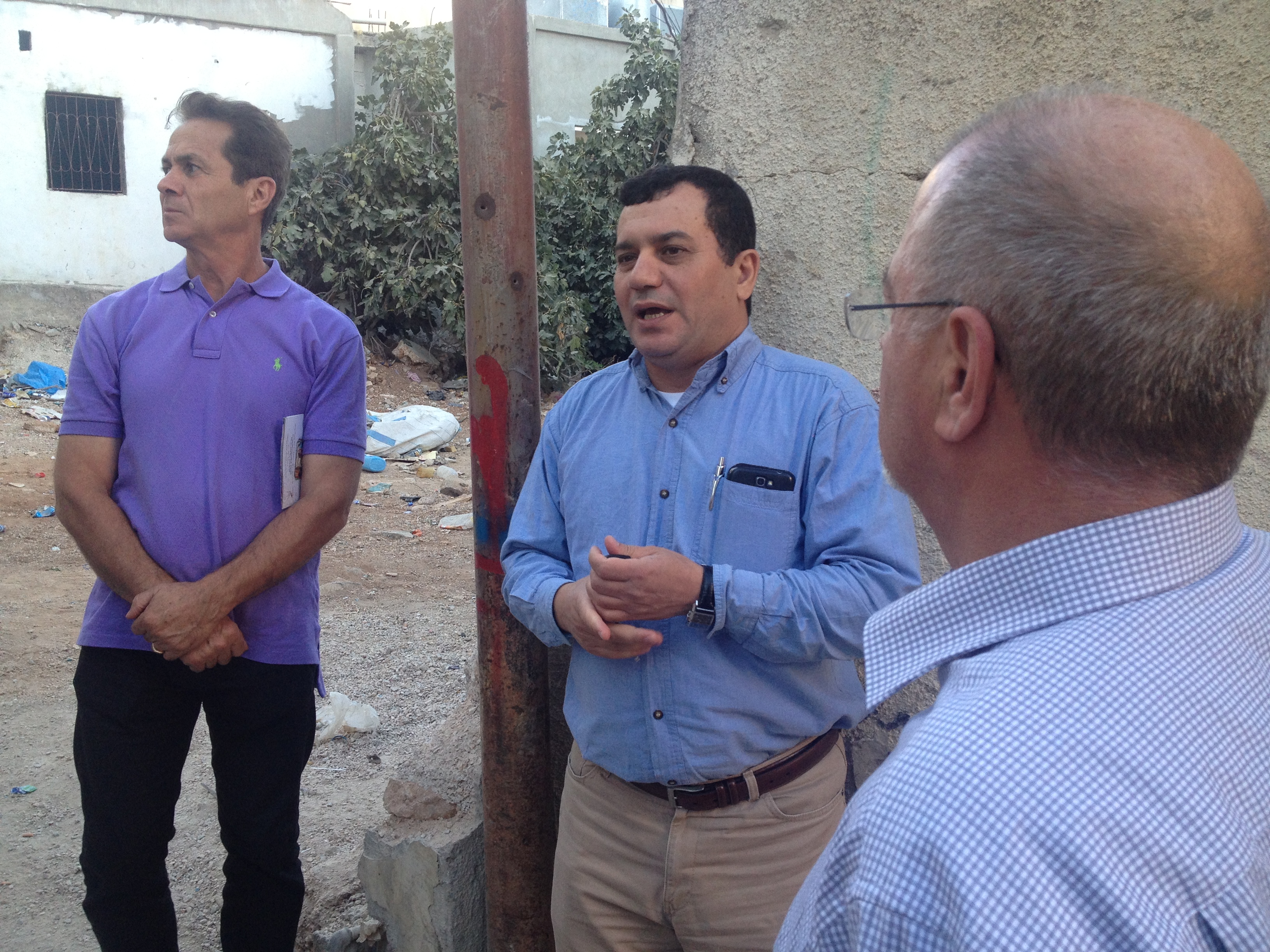
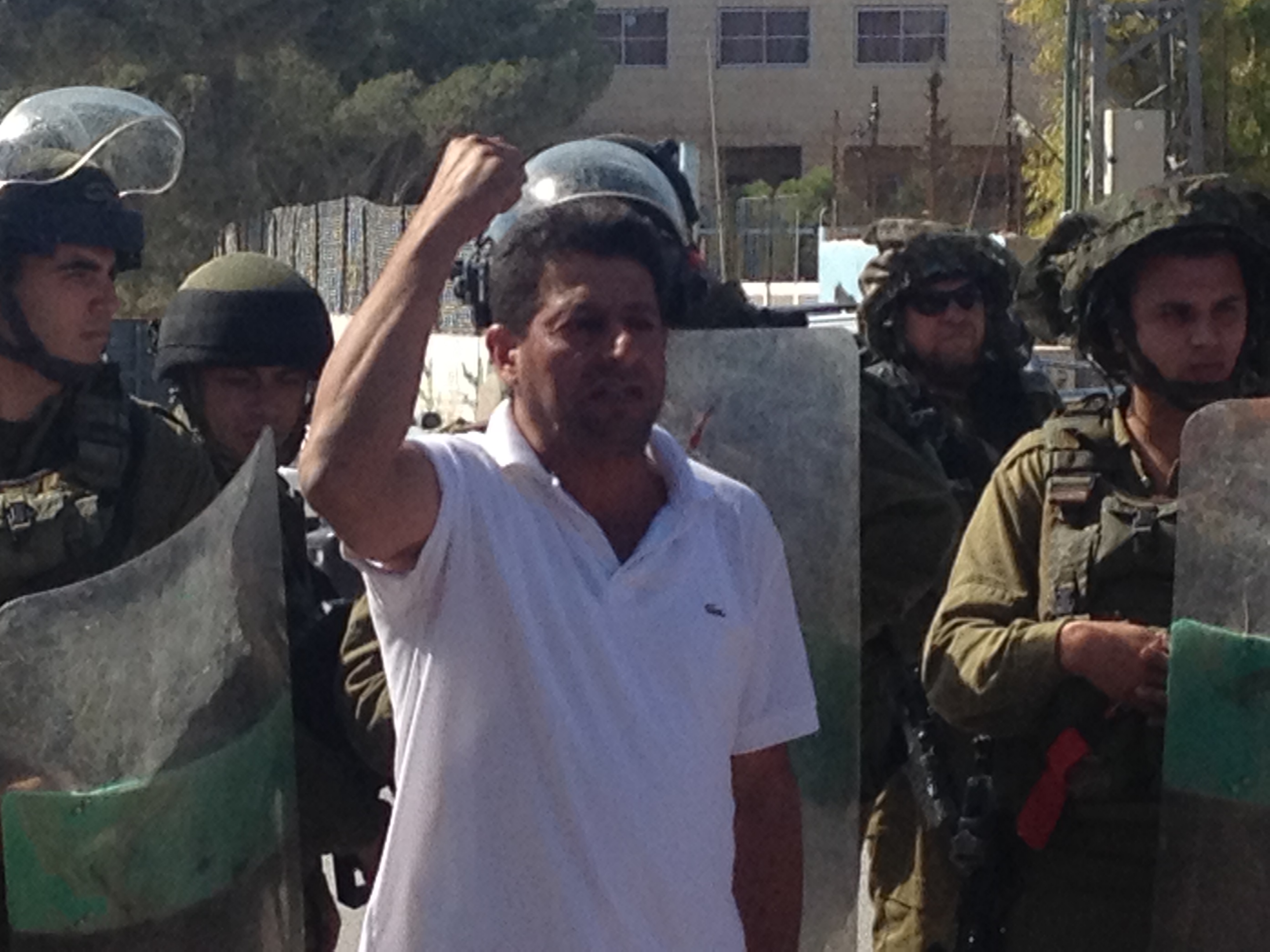
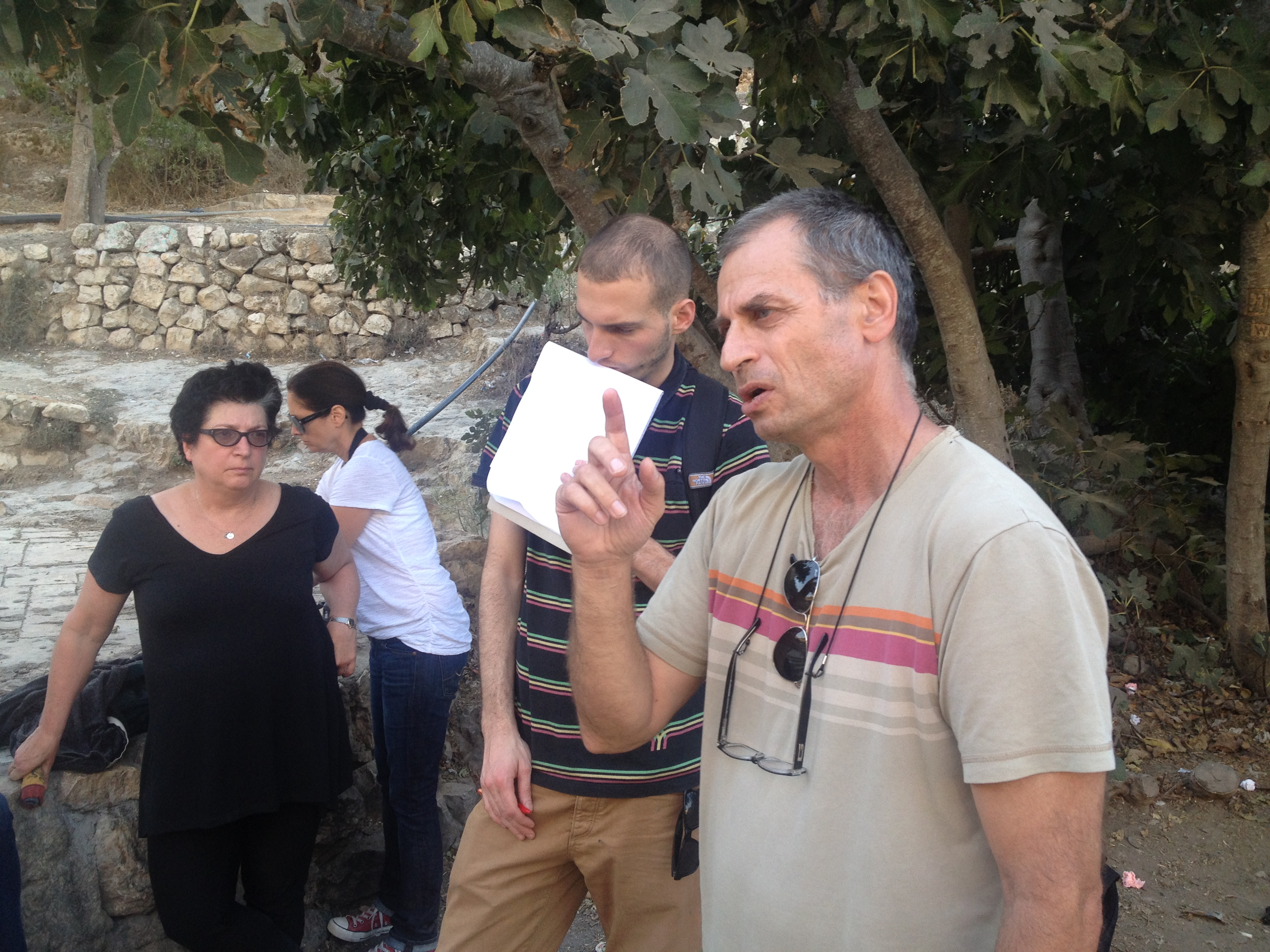
Al-Ma’asra Popular Committee Leader Hassan Brijeh

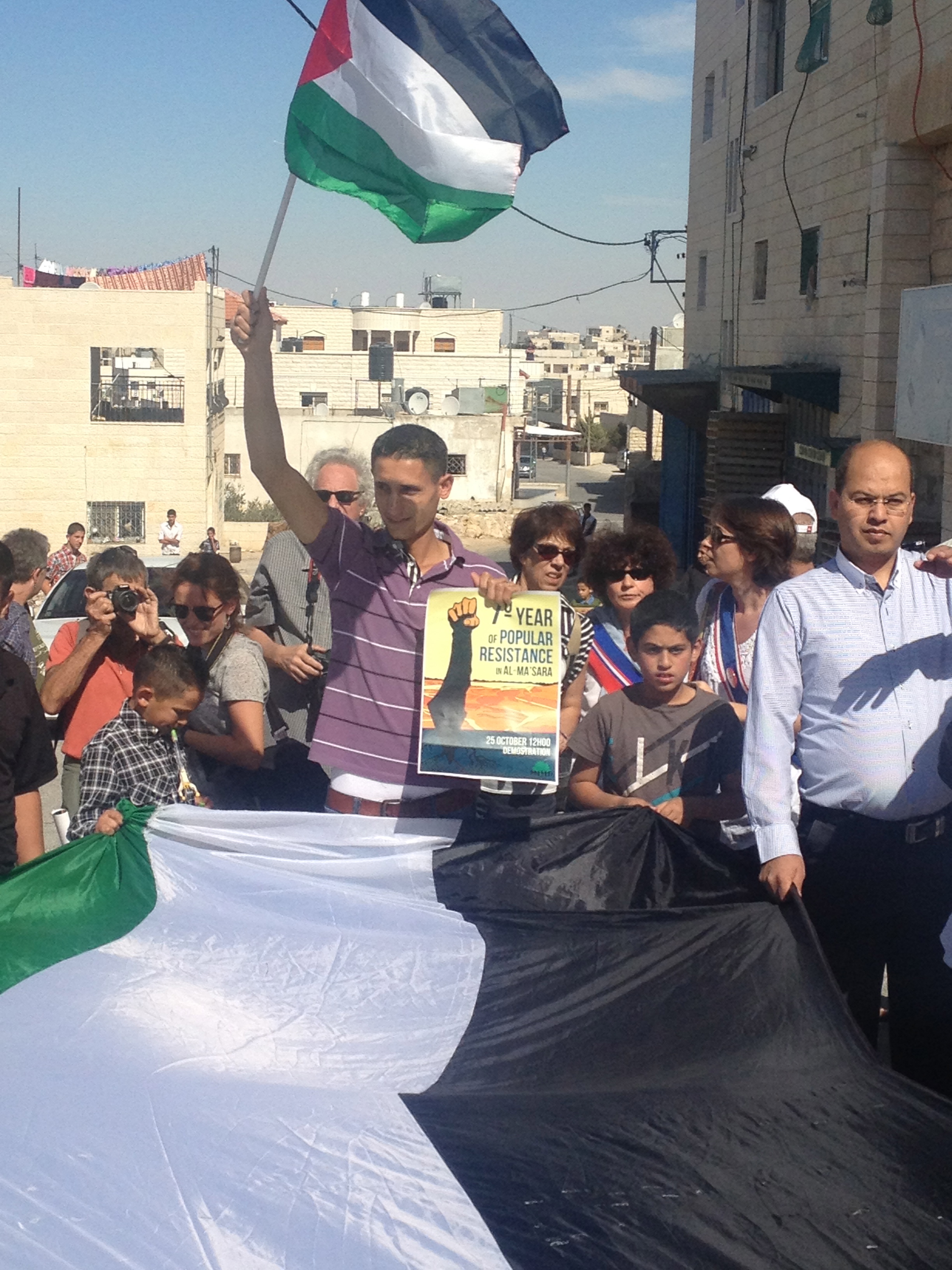
Earlier in the week, our Bil’in host Iyad Burnat told us that a neighboring village, Al-Ma’sara, was celebrating the 7th anniversary of its popular resistance against the occupation – and was inviting other village communities involved in the movement to march join them for their weekly Friday demonstration. Although our original plan was to march in the weekly demonstration in Bil’in, this turned out to be a rare opportunity to see the wider movement in action. So on Friday, our delegation traveled with Iyad to show solidarity with the people of Al-Ma’asra.

Al-Ma’asra is located in the Southern Bethlehem area, with a population of approximately 950 residents, 50 of whom are between the ages of 6 and 18. Like many villages in this location – near Israel’s coveted Gush Etzion settlement region – the construction of the separation wall is cutting off Al-Ma’asra from accessing more than half of their land and the main water supply.

About 90% of the houses in Al-Ma’asra are located in Area C – a region in which Israel is rapidly demolishing houses and moving out its Palestinian residents. (I’ve written extensively about this issue here, among other places).  Like Bil’in, Nabi Saleh and so many other villages, Al-Ma’asra has turned to popular resistance – including weekly nonviolence demonstrations – to protest the theft of their land and devastation of their livelihood. And like these other villages, they have been subject to the Israeli military’s devastating use of tear gas, sound bombs, coated steel bullets etc. Since the beginning of their demonstrations, more than 30 of their inhabitants have been arrested.

IMG_0886

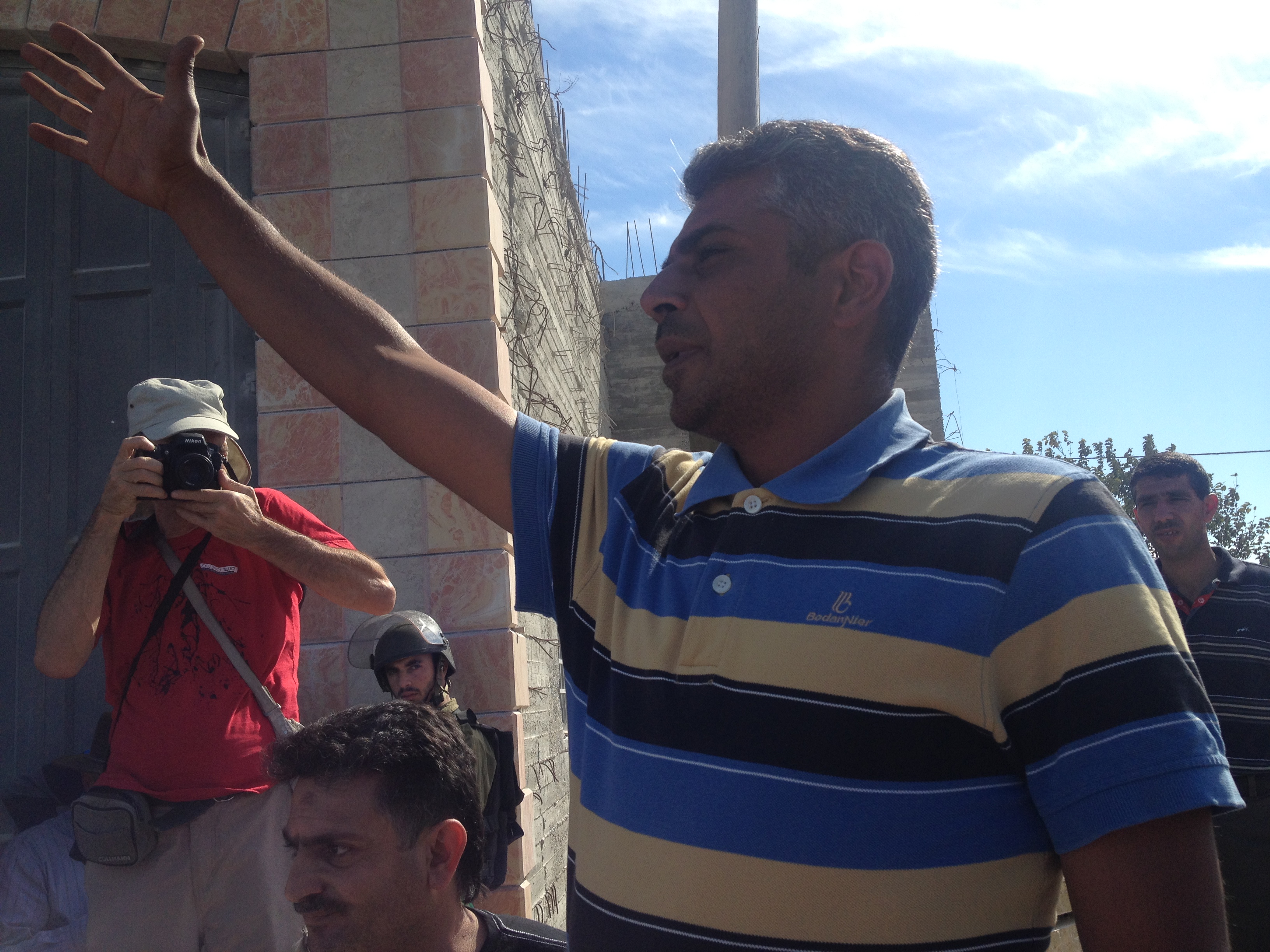
After we arrived in Al-Ma’asra, we received a briefing/update from Mohammed Brijeh (above, later at the rally), after which we joined the growing ranks of villagers, Israeli solidarity activists and internationals who were quickly pouring into the village’s main street.  Then at 12:00 pm we gathered together and began marching. The street was filled with approximately 300 individuals: young and old, representing a myriad of nationalities and ethnicities. But it was clearly the people of Al-Ma’asra who were leading the way: leading us in chants, singing songs and waving to their neighbors,

IMG_0874

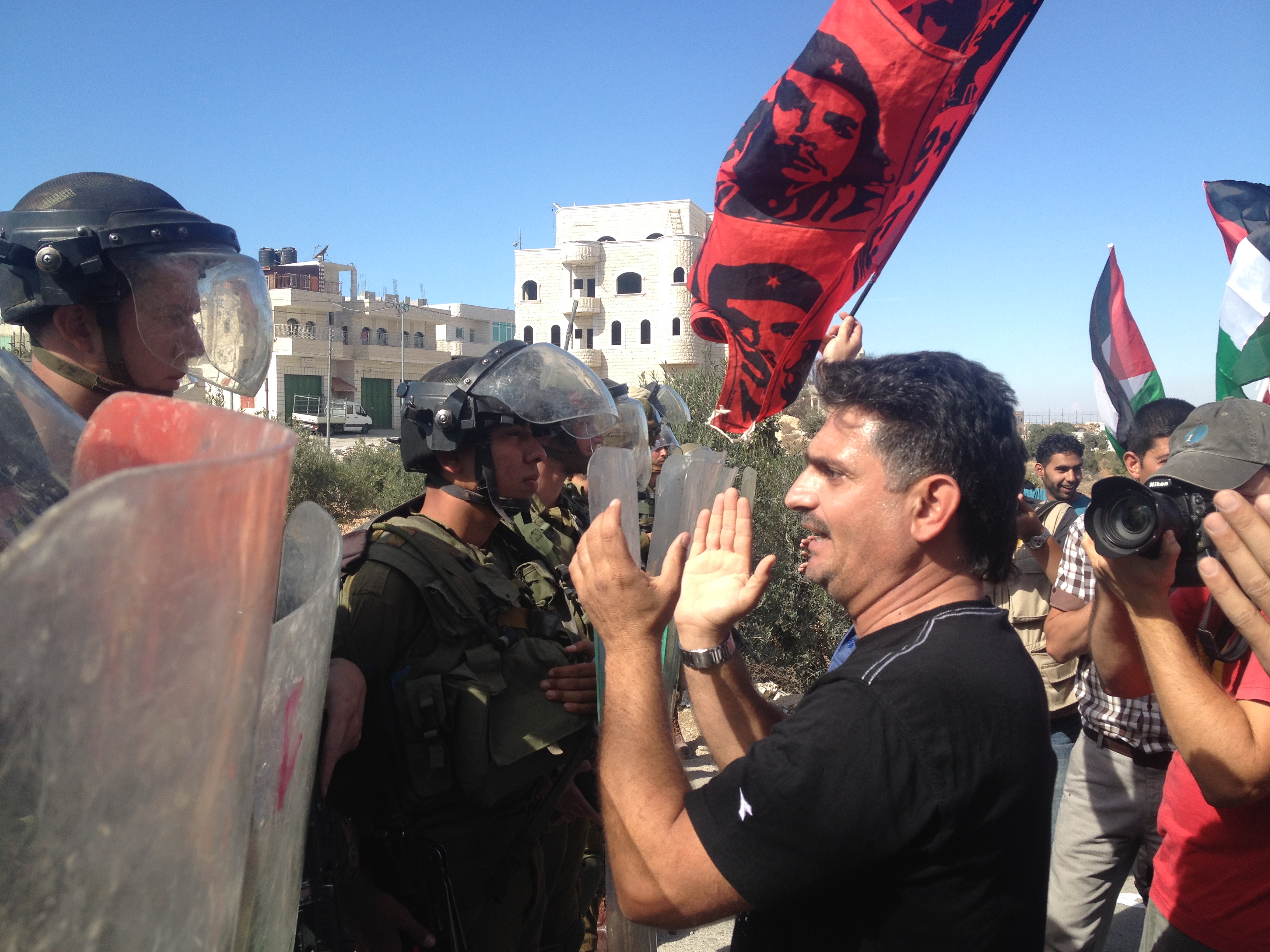
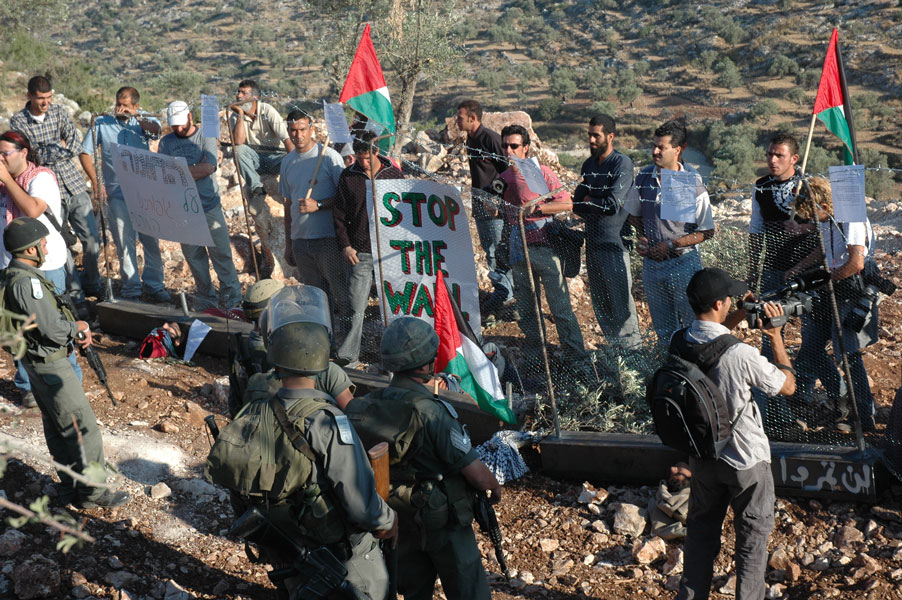
After 15 minutes or so, we noticed a long line of Israeli soldiers in riot gear, standing in formation across the street, blocking our way to the wall. The crowd pressed up close against the soldiers and standoff commenced. When the villagers were told they were denied passage, Mahmoud stepped forward and starting chastising the soldiers in English. Careful not to use any physical violence or overly incendiary rhetoric, he asked the soldiers why they were not allowed the right to live and assemble freely in their own village.

He explained to them they could oppress them all the wanted, but that one day, like all oppressed people, they would be free. Pointing to their extensive riot gear, their bullet-proof vests, their M-16s, their helmets, he told them that none of this expensive equipment would ever bring them peace – then pointing to his head, he said “it’s not what you wear, it’s what’s in here that you need to change.”

Perhaps the most powerful moment for me came when he said to one soldier, “What would your mother think – would she want you to bully the people of this village, to oppress them, to take their land away from them? Shame on you!” The chant spread quickly through the crowd: “Shame on you! Shame on you!”

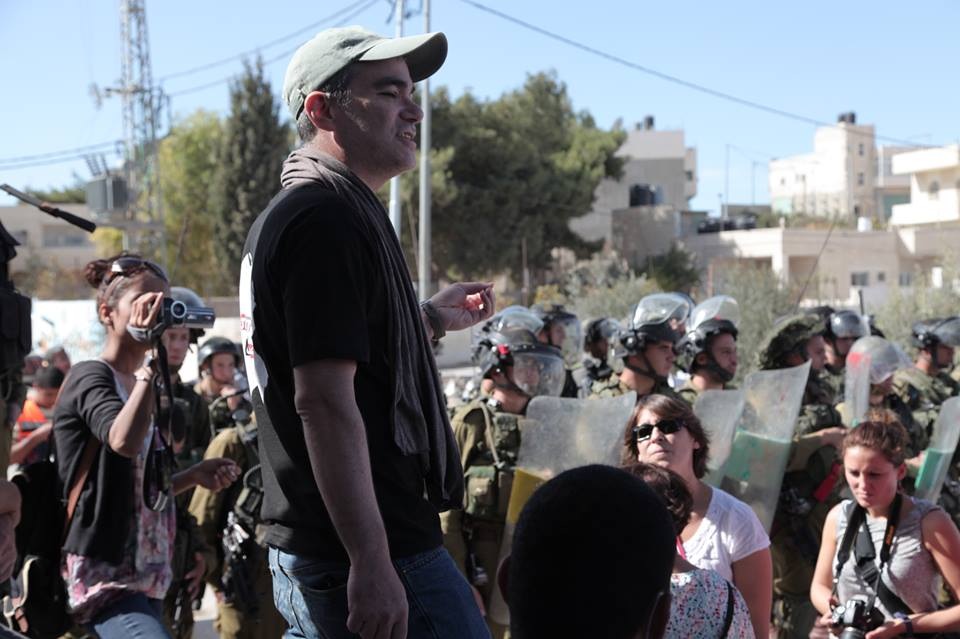
About 20 minutes or so into the standoff, there was a roll call of participants, a myriad of countries were called out with the obligatory hometown cheers. (Among those represented: the US, Great Britain, Ireland, Germany, Scandinavia, France, Spain, and more). A succession of speakers then got up on a raised area to the right of the soldiers to give speeches. They introduced Iyad, and he offered greetings (below) from their brothers and sisters in Bil’in.

IMG_0882

After Iyad spoke, one of our delegation participants, Estee Chandler, called out “We have a rabbi here!” Then one of the organizers shouted, “We have a rabbi here! Let’s here from the rabbi!”  And before I could even think about what I might possibly say, I got up and started to address the crowd (below).

I told them that the Torah teaches us – as all spiritual traditions do – that God stands with the oppressed and demands that we do the same. Thus, I said, this demonstration was a sacred act for all of us – a mitzvah. And that it was all the more sacred because it contained such a diversity of nationalities and religions. I told them we were honored to stand together with our Palestinian brothers and sisters who were struggling for justice and dignity and that we would take this message back with us when we returned home to the US.

IMG_0895

After the speakers, something of a waiting game began. The demonstrators sat down in the street in front of the solders, singing and chanting as the soldiers were obviously conferring on their next move. Eventually, the commander told us we have 5 minutes to disperse before they opened fire on us. Little by little, the crowd got up and walked back down the street. Some of the younger villagers went to another main street where we later could see some kind of skirmish in the distance.

In the end, all the demonstrators dispersed; I felt a myriad of emotions at that moment. I had no doubt that the decision to disperse came from the organizers, who understandably wanted to avoid violence in the streets. Still, I admit it felt galling that in the eyes of the IDF, this was a just another “successful” job of unruly crowd control . On the other hand, the message of solidarity and defiance had been delivered – as it had been every week for the previous seven years in Al-Ma’asra and would for many more years to come. And in so doing, new relationships were created, new coalitions built – and the movement was that much stronger for having come together that day.

During our standoff in the street with the IDF, it occurred to me that this was precisely the same circumstance that occurred on the Edmund Pettus Bridge in Selma in 1965. The demand for justice was the same, the solidarity was the same, the message of nonviolence was the same, as was the  show of force by a brutal and overmiltarized gauntlet. Though that particular standoff ended violently, I was all too mindful that, in a sense, there is a reenactment of Bloody Sunday every week in villages throughout the West Bank.

PS: Upon our return, we learned to our dismay that the village of Bil’in was tear-gassed during their demonstration that day.  We were told that several canisters actually landed near Iyad’s house and at one point most of the village was shrouded in choking white smoke.

This is life on the front lines of the Palestinian popular resistance – just a small sample of the regular crimes committed against a people who are literally choking on an unjust and illegal occupation.

Remembrance as Palestinian Resistance

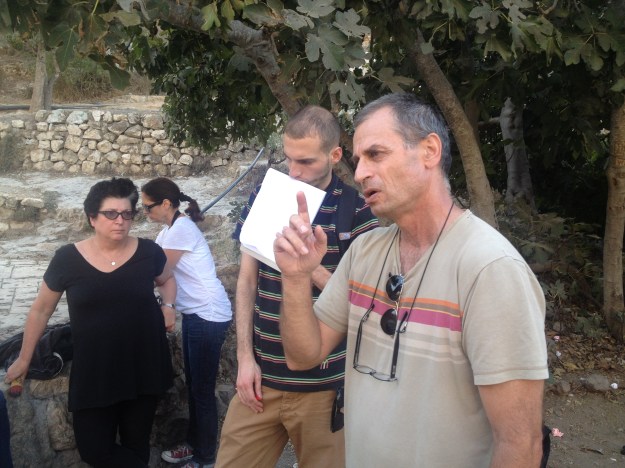
Zochrot's Eitan Bronstein leading a tour of Lifta

Zochrot’s Eitan Bronstein leading a tour of Lifta

There are many forms of resistance to oppression. One is memory itself.

On Tuesday our delegation visited the village of Lifta, a Palestinian village on the outskirts of Jerusalem that was depopulated of its residents by Jewish militias early in 1948. Our tour was led by Eitan Bronstein, director of Zochrot, an Israeli organization that educates Israelis about the Nakba, actively advocating for the Palestinian Right of Return. It’s truly one of the bravest, most important Israeli organizations I know.

Zochrot’s tours of destroyed Palestinian villages are an critical aspect of their educational work. They are, of course, not your typical tours – in most cases they do not show you what is, but rather what is no more. Most Palestinian villages destroyed during the Nakba were razed to the ground, leaving little behind but the shell of a building or the occasional foundations of homes.  Zochrot keeps the culture life of these communities alive through their tours, underscoring the profound enormity – and collective tragedy – of what was lost.
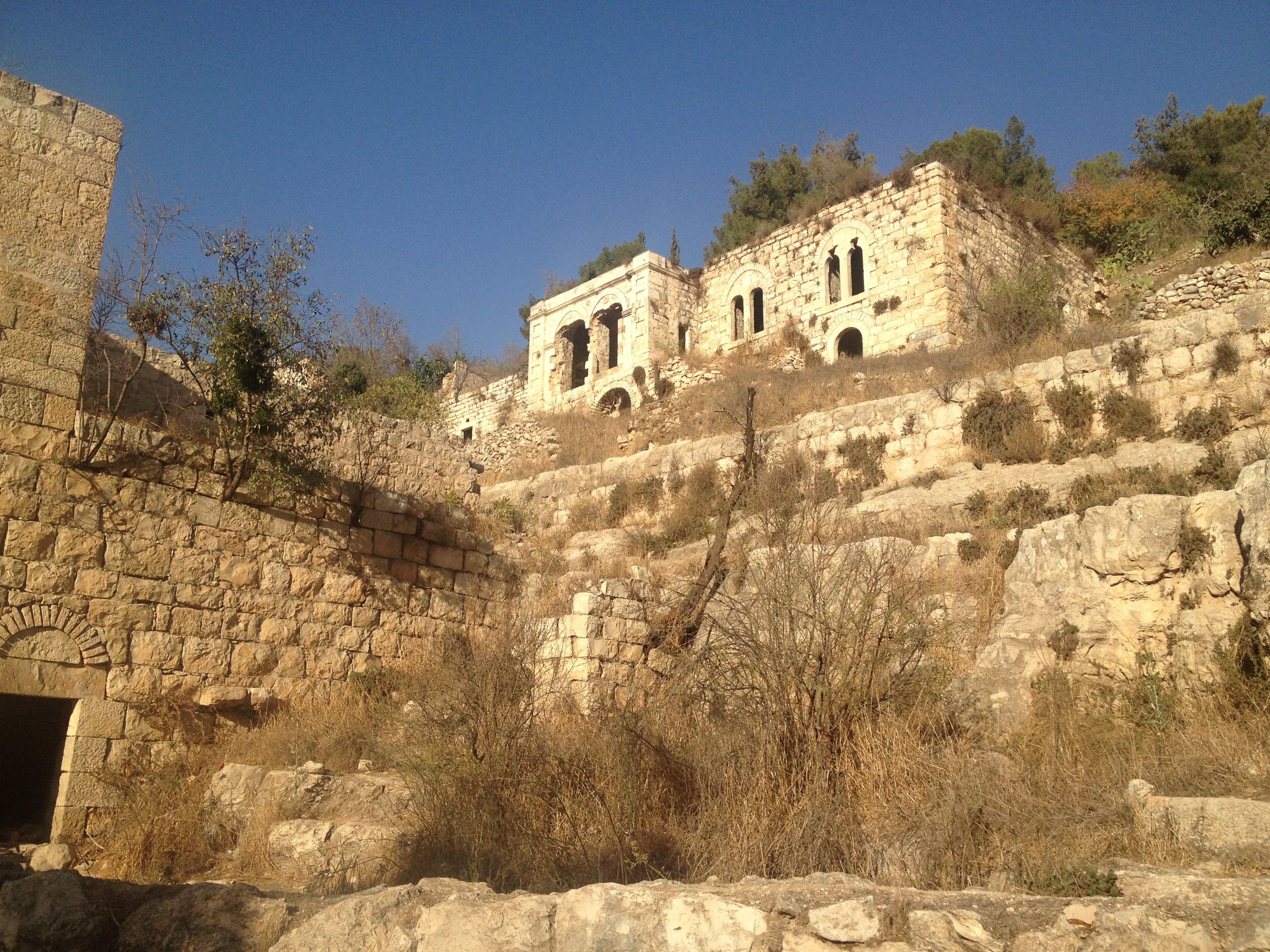
IMG_0789

Lifta

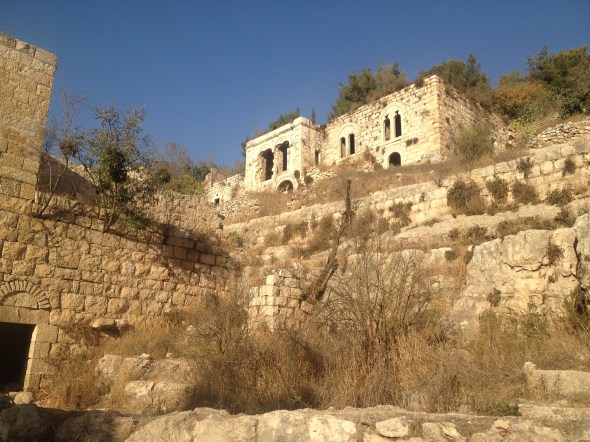
Lifta is somewhat unique among these villages in that it is the only Nakba-era village that still remains largely intact. In its day it was a fairly well-to-do community, with a population of 2,550.

In the years leading up to the 1948, the village fell under attack by Jewish militias in the area. On the December 28, 1947 six people were gunned down in the village coffeehouse, by members of two Jewish militias, the Stern Gang and the Irgun. In late January or early February, the militias attacked and seized the neighboring village of Qaluba and then invaded Lifta from the West. They occupied Lifta’s new town and the remaining residents took refuge in the old town in the valley. The village was cut-off from the west and anyone trying to leave was killed. The villagers resisted but were defeated after several hours of fighting.

By the time the entire village was occupied, most of the people had already left Lifta and fled into the West Bank, the rest were taken by truck and dumped in East Jerusalem. By February 1948, Lifta had been completely depopulated.  It’s not completely clear why the Jewish forces did not raze Lifta to the ground as it had so many other villages. For a time it allowed newly-immigrated Yemenite Jews to occupy the houses, but when the homes proved uninhabitable, they were eventually abandoned
IMG_0791

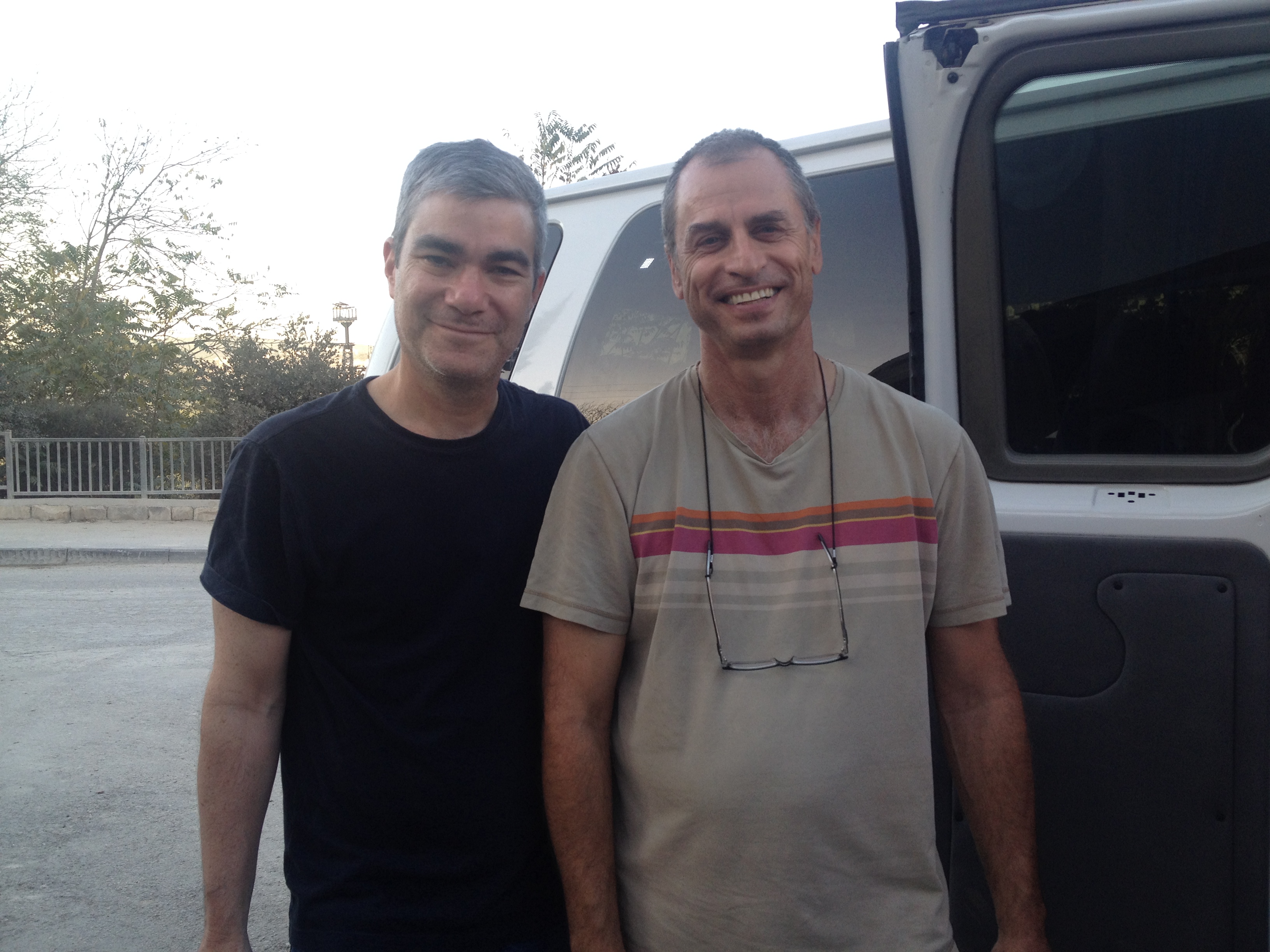
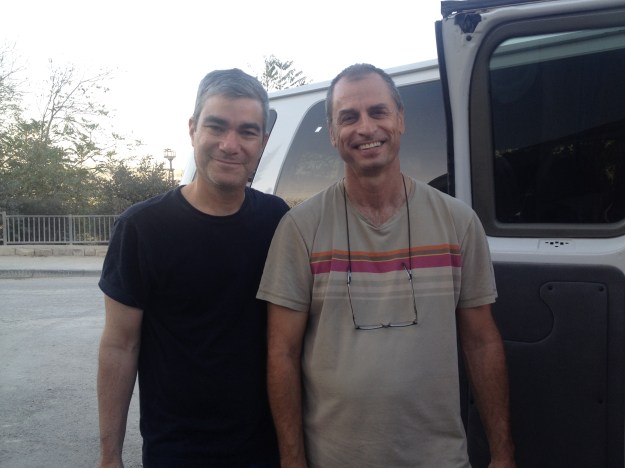
with Eitan Bronstein

Lifta was the object of some controversy when the Jerusalem municipality announced plans to redevelop the area as a luxury area for Israelis. The plans were dropped after an outcry from former residents and progressive Israeli activists. In the meantime, the remnants of this remains, a testament to the legacy of a rich communal life that was lost during the Nakba.

I can see why Lifta is such a popular spot for Israeli tourists – the town ls nestled in a long valley, with homes and buildings built into either side. The mosque and the Muktar’s house are still in decent condition, testifying to what clearly once was a beautiful, desirable town. At the bottom of the valley is a natural spring that still attracts swimmers, particularly ultra-orthodox who attribute spiritual significance to it. As Eitan showed us the area, the swimmers glared at us as if we were interloping in their own “sacred territory.”  They clearly had no comprehension of the actual profanity that had occurred here in 1948.

On Wednesday evening, we visited another Nakba site: El Ghabsiya, located in the upper Galilee (where were visiting members of delegation members Shafic and and Dima Budron’s family – more on this later). Our tour of El Ghabsiya was led by Muhammad Kaial of the Association for the Defense of the Rights of the Internally Displaced Persons in Israel, and Daoud Bader, an original survivor of the original village.

The story of El Ghabsiya, like Lifta, is an example of how the Nakba is not only a historical event of the past, but an injustice and a struggle that occurs even in our very day. In March 1948, fearful that uncertainty in Palestine’s future could endanger the people of the village, prominent members of El Ghabsiya made an agreement with Jewish militia leaders. In exchange for his cooperation, the militia promised not to invade the village. (At that time, the population of the village numbered about 700 people.)
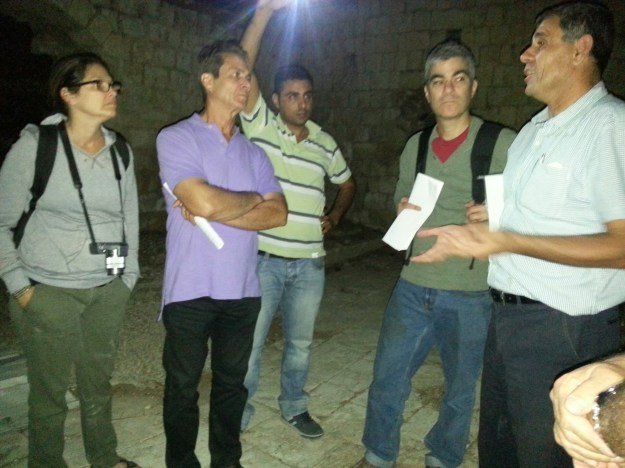
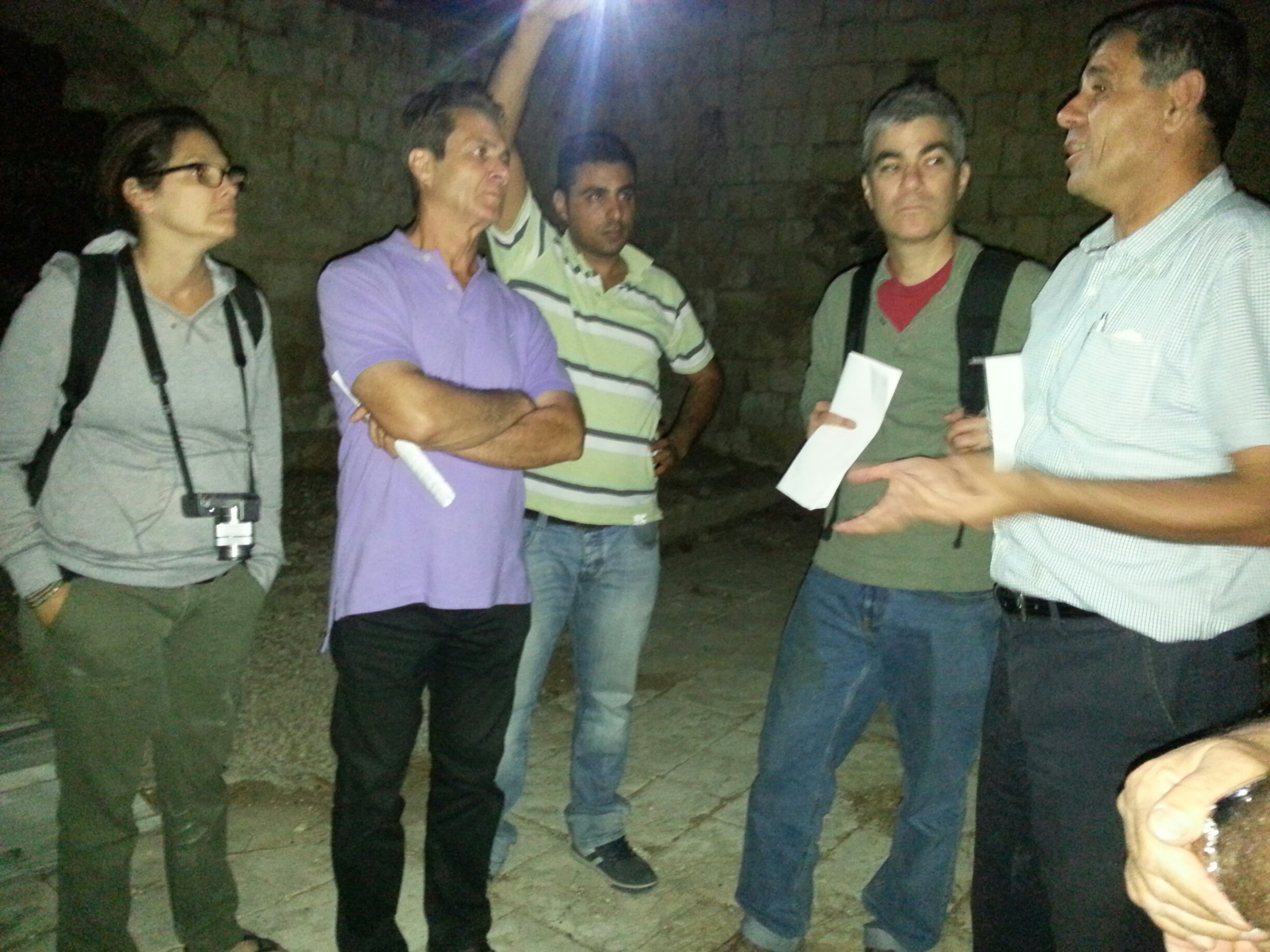
Inside El Ghabsiya mosque (far right: Muhammad Kaial)

Inside El Ghabsiya mosque (far right: Muhammad Kaial)

The agreement was not to be honored. In May 1948, Jewish militias surrounded and entered the village. Families living near entrance to the village greeted the soldiers with coffee; in return father and his son were taken out into the nearby woods – Daoud told us that they have never been heard from to this day. When the soldiers entered El Ghabsiya, a community leader named Daoud Zainl climbed to the roof of the mosque and raised a white flag. The militia ignored his act of surrender, opened fire, and killed him on the spot. In  all, eleven Palestinians were killed during the attack on El Ghabsiya and the subsequent expulsion of its residents, despite the fact that there was no local resistance.

The inhabitants of the village escaped to surrounding villages, becoming “internally displaced refugees.” Unlike other internally displaced Palestinians, the people of El Ghabsiya were allowed to return to their homes less than twelves months later – but two years later, on August 2, 1951, then Prime Minister David Ben-Gurion declared the village a “closed military zone” and the villagers were again forced to leave their homes.

The people of El Ghabsiya fought for their right of return all the way to the Israeli Supreme Court and on November 1951, the court ruled that they did indeed have the legal right of return to their village. Armed with this ruling, the villages gathered and headed back to their homes – and were met by Israel military forces the blocked their way and refused to recognize the decision of the court.  In succeeding years, government bulldozers destroyed all of the houses in the village – the only building left standing was the village mosque.

For the next forty five years, the Israeli Land Authority allowed the mosque to sit in disrepair and desecration, used as a stable for horses and other animals. Finally, in 1995 residents and descendents of residents of El Ghabsiya initiated a clean-up project and began weekly attempts to pray at their mosque. In response, the Israeli Land Authority sealed the windows and doors and ringed the mosque with barbed wire.
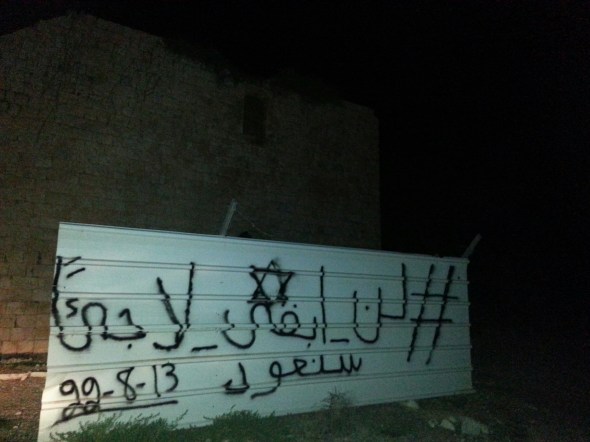
Outside El Ghabsiya mosque: “I will not remain a refugee – we will return.”

Still, the people of El Ghabsiya have not given up. Most live in villages near their ancestral village and they still make regular attempts to gather to pray at their mosque. Above you can see the sign villagers have placed in front of the mosque: “I will not remain a refugee – we will return.” (You can also see that the sign has been vandalized, sadly enough, with a Jewish star.)

After hearing this story, our group toured the mosque and gathered in the courtyard. On of our members Kalman Resnick said that as a member of the Jewish community and a man whose own family fled persecution, he felt shame at hearing this story of dispossession, that continues to this day. I then led the Jewish members of our delegation in the recitation of Kaddish for those who were killed on this site in 1948.  In return, Daoud, the original resident of the village, emotionally expressed his appreciation for our presence and our solidarity – a profoundly moving moment for us all.

After our visit, our group discussed ways we might help support the people of El Ghabsiya in their quest for justice – and their simple desire to pray in their ancestral mosque. More info on this effort will be forthcoming.

We’ve just returned from our Friday demonstration. It was, quite simply, an indescribable experience –  I’ll do my best to describe it in my next post…
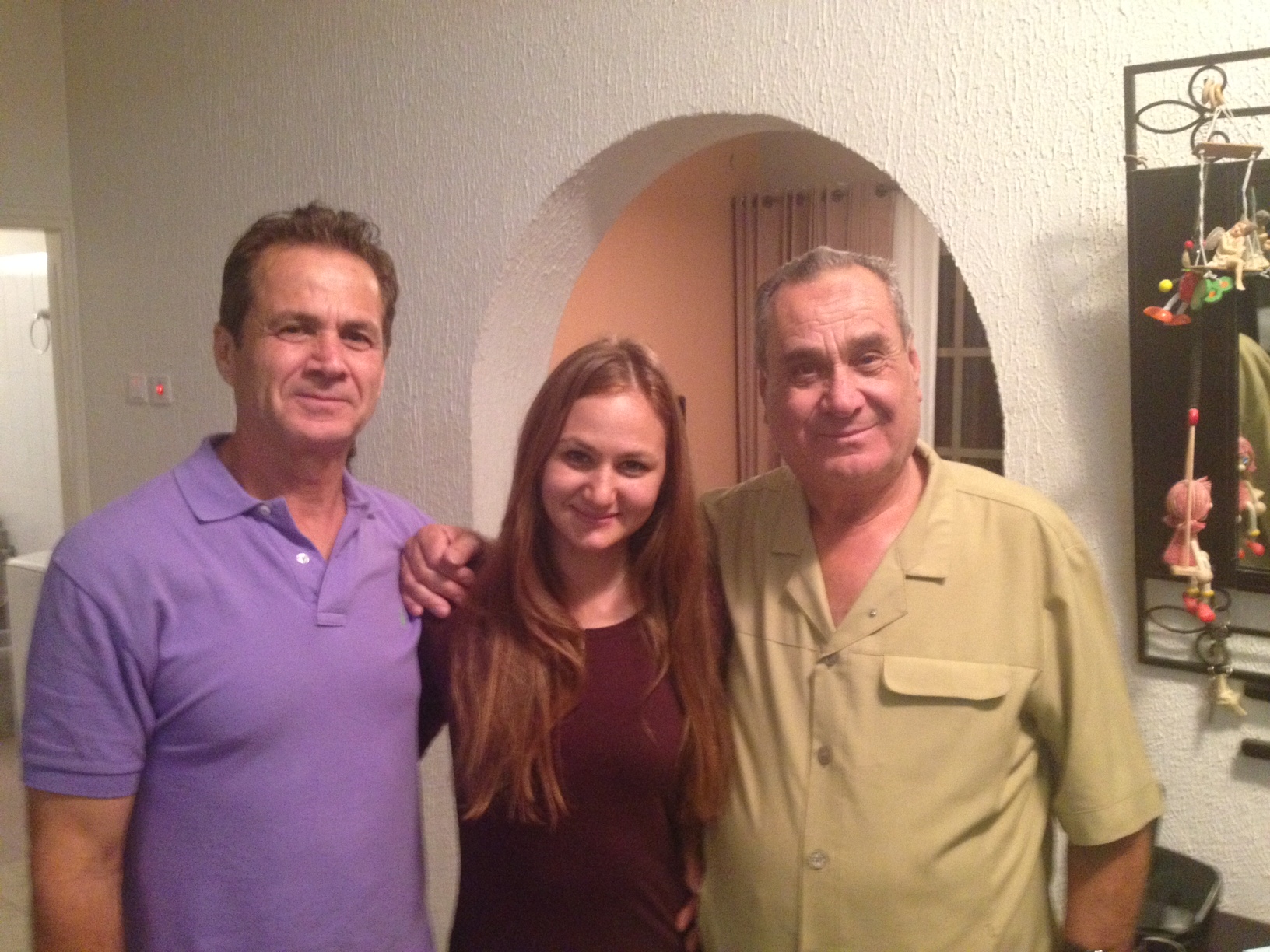
Morning in Nabi Saleh

IMG_0767

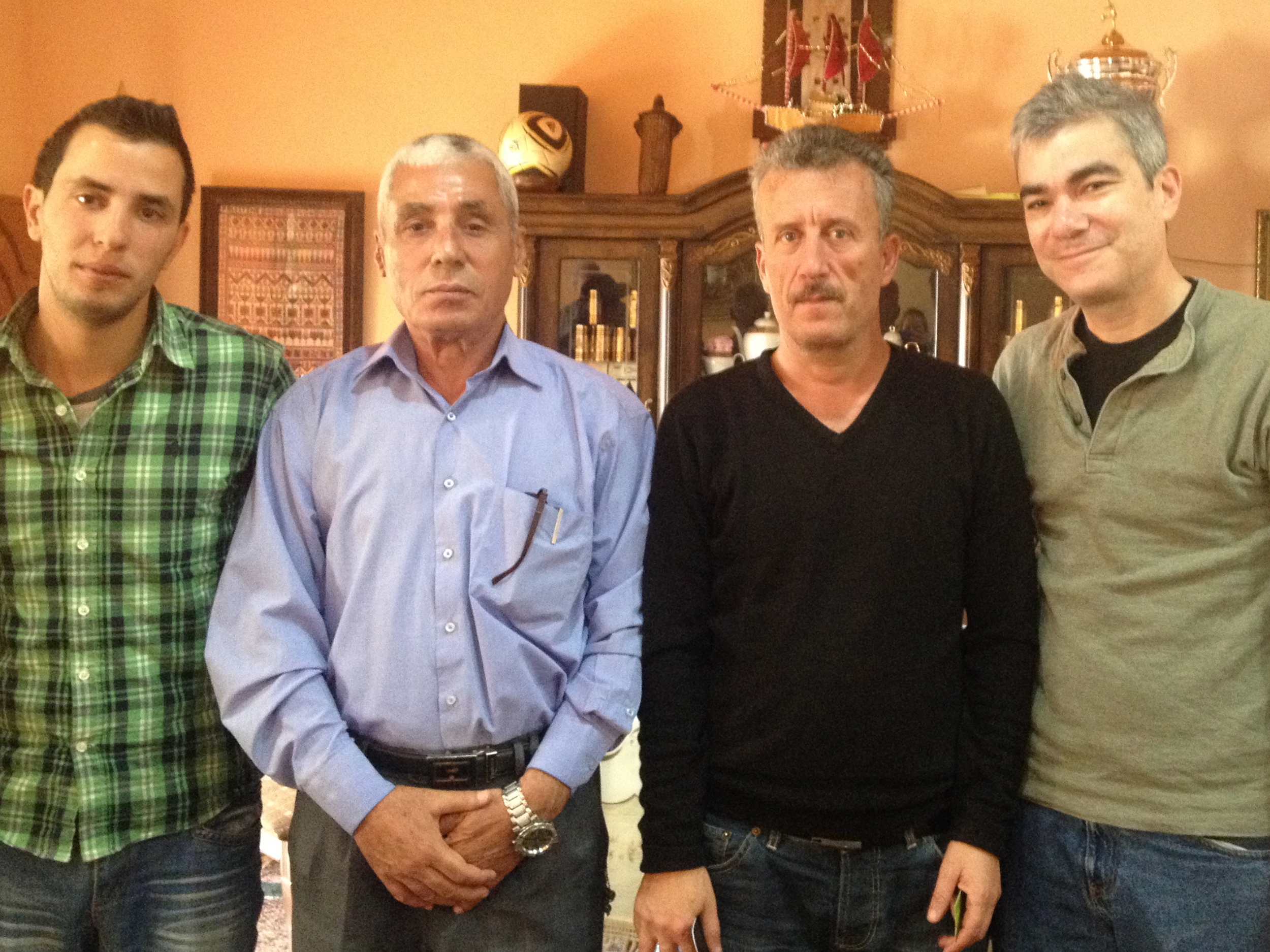
Mohammed Tamimi, Abu Hussam Tamimi, Bassem Tamimi, me (left to right)

On Monday morning our group traveled to the nearby village of Nabi Saleh, another prominent community in the Palestinian nonviolence resistance movement. You may have heard recently about Nabi Saleh from this New York Times Magazine cover story by Ben Ehrenreich last March. If you haven’t read it, I highly recommend it – I believe it is by far the most thoughtful consideration of this movement by the mainstream media.

Although this was my first time in Nabi Saleh, I met Bassem Tamimi, one of its most prominent leaders briefly in Ramallah on our congregational trip to the West Bank in 2010. That’s me above with Bassem, his cousin Abu Hussam Tamimi and nephew Mohammed Tamimi.

Our group spent several hours in Abu Hussam’s home learning about the history of Nabi Saleh and its place in the greater popular movement. Bassem explained to us that unlike other villages, Nabi Saleh’s protest is not directed toward the separation wall, but rather the confiscation of the village’s lands and the takeover of its spring by the nearby Israeli settlement Halamish.

The protest movement in Nabi Saleh began when Bassem and other village members met with and learned from leaders of similar demonstrations in Budrus and Bil’in. Rejecting the violent resistance of suicide bombers in the Second Intifada, they consciously sought a return to the approach of the First Intifada – a nonviolent popular grassroots resistance that evolved into a coordinated mass movement.  The village leaders of Nabi Saleh studied the work of Ghandi, King and Mandela – knowing at the same time that the Palestinian nonviolent movement had its own unique context and would have to have its own unique characteristics as well.

Nabi Saleh launched its first demonstration on December 9, 2009 – the anniversary of the First Intifada – and since that time, it has been an critical link the chain of the Palestinian popular resistance. Like Bil’in and other villages that hold weekly demonstrations, their protests have been met with visceral force from the Israeli military. Protesters have been regularly met with tear gas, shot with coated steel bullets and sound grenades and sprayed with skunk water. These “crowd-dispersal” weapons invariably cause painful, often grievous, physical distress – and almost all of these armaments are manufactured in the US.

Bassem and the other leaders of the Nabi Saleh resistance have suffered profoundly for their efforts. Bassem has been arrested twelve times by the Israeli military – at one point spending more than three years in administration detention without trial. His most recent arrest took place on March 2011 and led to a year-long prison term. He was released one year later. Tragically, like other villages Nabi Saleh now has its own martyrs: Mustafa Tamimi was killed when he was shot in the face with a tear gas canister at point blank range in December 2011. And on November 2012, Rushdi Tamimi was killed after being shot in the head while protesting the Israel’s military attacks on Gaza in November 2012.

When I asked Bassem about the status of the Palestinian popular movement, he responded that while it is still growing, and despite the ongoing weekly demonstrations of ten to fifteen villages every week and the proliferation of popular committees, they are still far from the “Third Global Intifada” that he and other Palestinian nonviolence are advocating. Bassem and his fellow leaders seek nothing less than a worldwide movement that seeks to leverage the power of nonviolent resistance – including Boycott, Divestment and Sanctions – to eventually shift this unjust balance of power. Still it is clear that they these leaders are settling in for the long haul. And the fact that Israel reacts so strongly and violently to these efforts that it takes such a prospect very seriously indeed.

During our visit, enjoyed a sumptuous lunch graciously served to us by the Tamimi family. They also showed us several YouTube videos of significant Nabi Saleh demonstrations over the past few years. Our consensus favorite was the video, below, of Bassem’s thirteen year old daughter Ahed and her young friends confronting the Israeli military after the arrest of her mother, Neriman. By the end of the video, this little amazing girl was, quite simply, our hero. Please watch and see for yourself (Ahed is the little blond girl with the red pants):

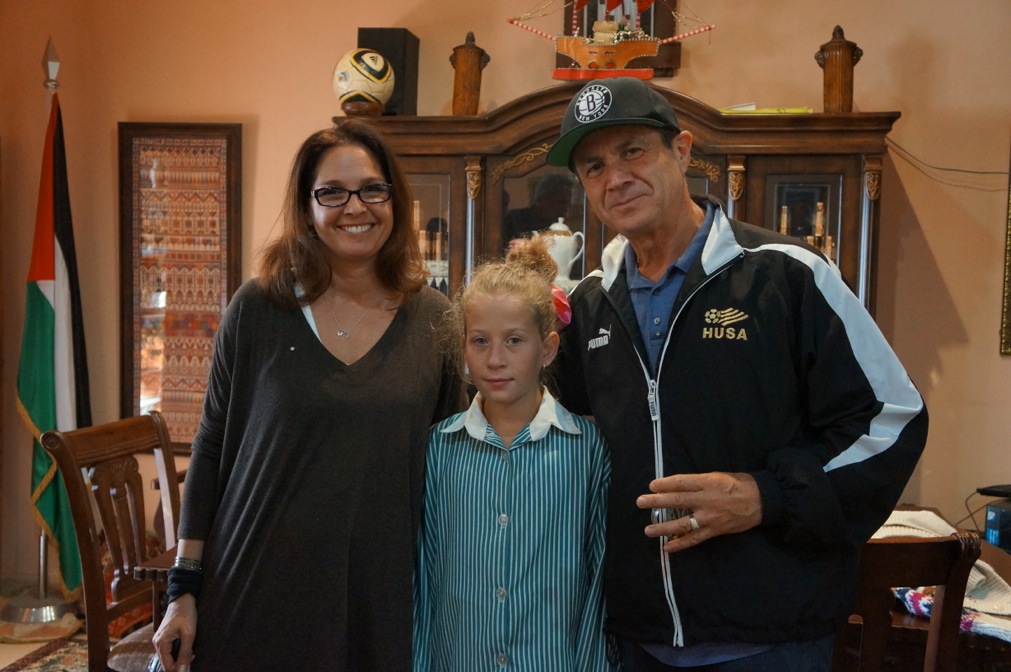
We were so thrilled to actually get to meet Ahed when she came home from school.  Somehow, the quiet, shy girl we met seemed to bear little resemblance to the ferocious, courageous girl speaking her truth to overwhelming military power – yet another example of how the battle for justice is being waged by ordinary people and families who find themselves living in extraordinary times. (That’s her below, with delegation participants Estee Chandler (left) and Shafic Budron (right):

DSC01639

We’re actually meeting and spending time with many amazing children growing up in activist families during our stay here. I will be writing more about this subject – among many others – in upcoming posts. Please stay tuned.

American Jews and Palestinians Showing Soliarity with Bil’in

IMG_0752

Just finished my first full day with our delegation to Bil’in – I think I speak for all our participants when I say we are honored and thrilled to be here.

As I mentioned in my previous post, our group is made up of Chicago-area Jews and Palestinians, with one participant from Los Angeles. We are longtime friends and fellow activists for a just peace in Palestine and we organized this trip to show solidarity with the Palestinian nonviolence resistance movement on the West Bank.  While individual members of the delegation have different personal opinions on the politics of the Israeli/Palestinian conflict and might differ on how a solution should politically be achieved, we are united in the conviction that full equality and civil rights should be enjoyed by all the people – Jews and Palestinians alike.

IMG_0753

With Iyad Burnat

Our “home base” for the trip is Bil’in; our host is Iyad Burnat, a prominent leader in this movement. Iyad serves as the head of the Bil’in Popular Committee Against the Wall, which has led weekly demonstrations against Israel’s separation barrier for the past nine years and has been one of the leading communities in the Palestinian popular resistance. I’ve written a great deal about Bil’in over the years and I’ve closely followed the news out of this small but mighty West Bank village. And like many, I was transfixed by the Oscar nominated documentary, “5 Broken Cameras,” directed by Iyad’s brother Emad, which movingly documented Bil’in’s ongoing struggle.

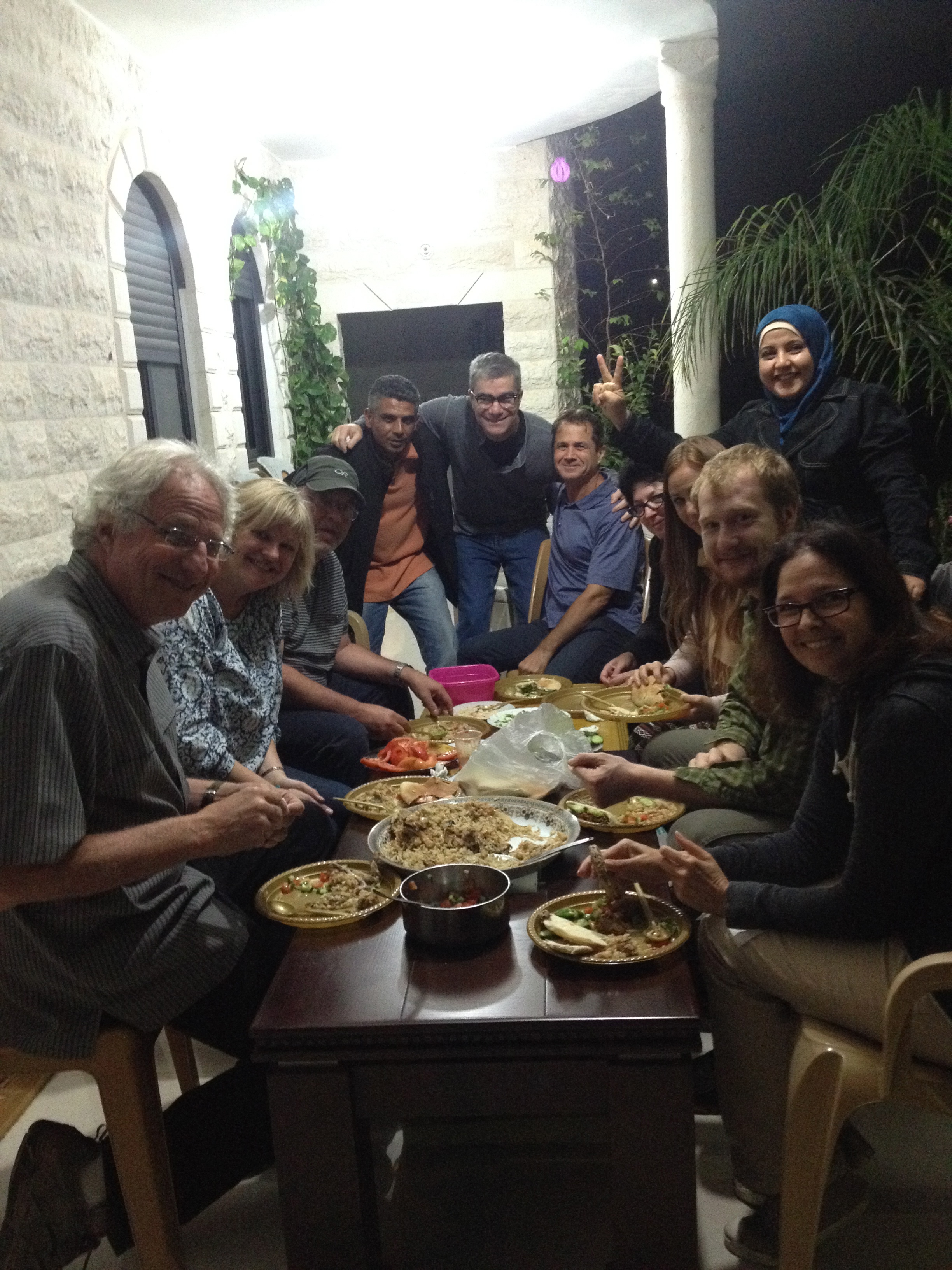
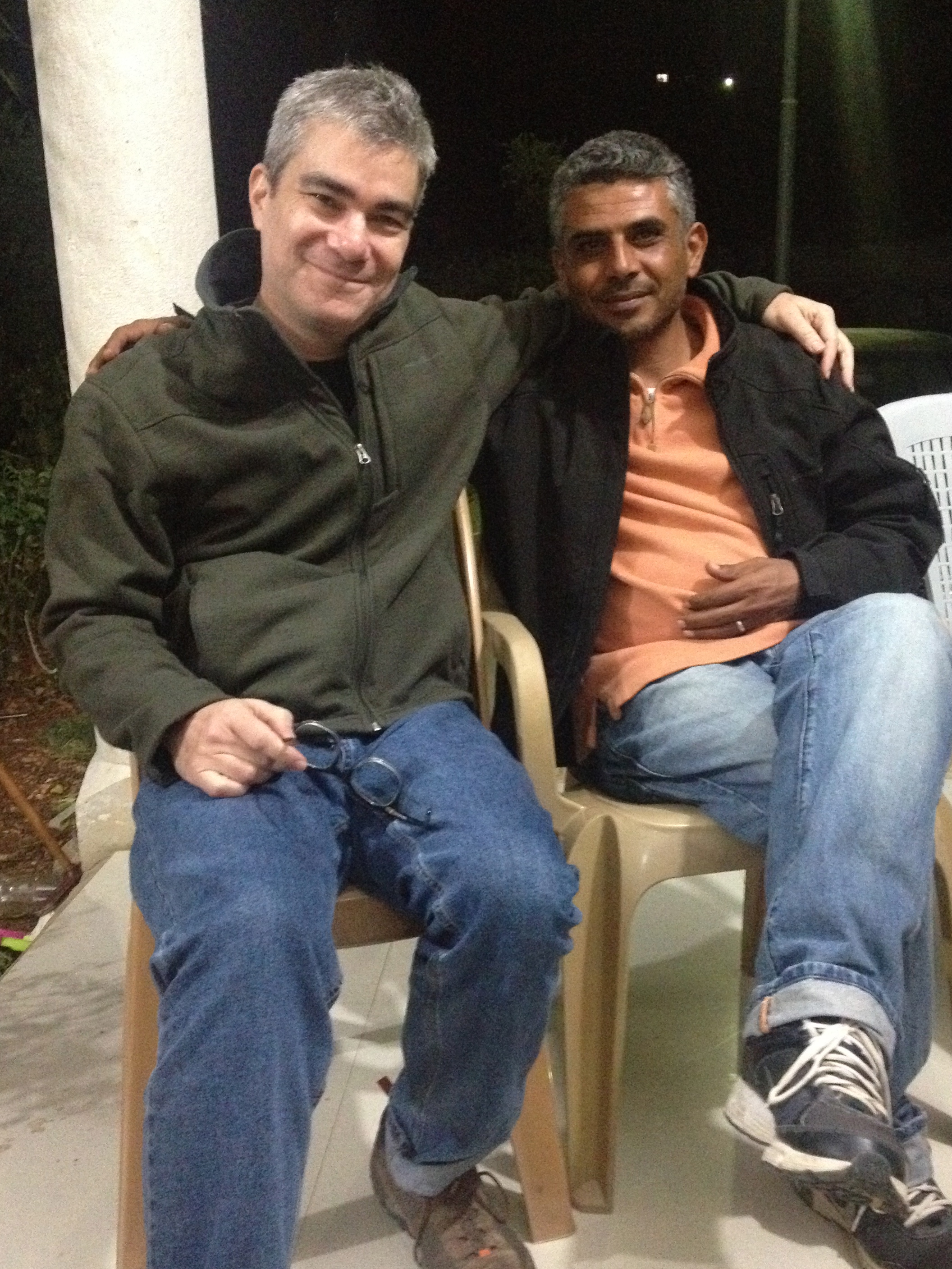
Our hosts here have been gracious and wonderful – Iyad (in the orange shirt, top pic) and his wife Tasaheel (in the blue hijab)  and his cousin Mustafa and his wife Sabrin have joyfully welcomed us into their homes and their families. This is clearly much more than a chance to learn about a movement – it is an opportunity to share in a way of life, to forge new relationships, to make dear new friends.

In our introductory tour, Iyad explained that Bil’in was one of the early West Bank villages to organize regular nonviolent demonstrations against the wall that was cutting the village off from a significant portion of agricultural land in order to create a buffer around the nearby settlement of Mod’in Ilit. Bil’in’s efforts have borne fruit – in September 2007, the Israeli Supreme Court ruled that the wall should be moved back 500 meters. The ruling was finally carried out by the military on June 2011, which restored 1,100 dunams of farmland back to the village (almost half of their of their originally confiscated land.)

And yet the struggle continues: the wall continues to choke off the people of Bil’in from their livelihood and the occupation continues to take a major toll on the life of the village. Our group will be participating the demonstration at the wall at Bil’in’s weekly demonstration this Friday – at which time similar demonstrations will take place in villages across the West Bank. This act of solidarity will be, without question, the most important aspect of our itinerary.

IMG_0764

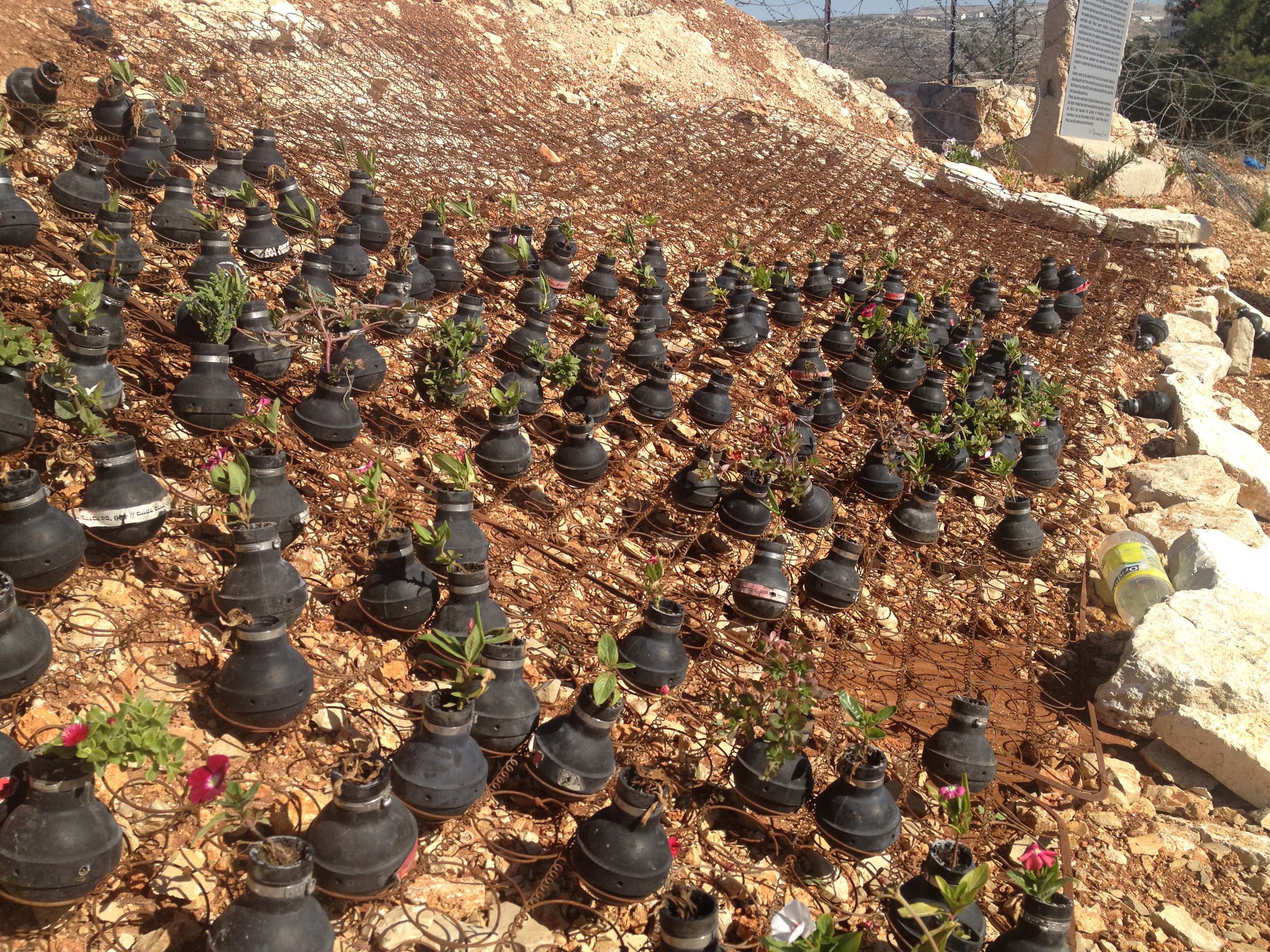
One of the newest additions to the village is a new garden dedicated to the memory of Bassem (“Pheel”) Abu Rachme, a much beloved and very charismatic leader in Bil’in who was killed in 2009 when a tear gas canister struck him in the torso. His killing was captured on camera in “5 Broken Cameras” in one particularly heart-rending moment.

Last month, the IDF officially announced it was closing the investigation into his death. According to a report in +972:

The military prosecution claims it was unable to determine the identity of the Israeli soldiers and border policemen involved or whether open-fire regulations were breached. This, despite the fact that as B’Tselem and Yesh Din pointed out in a joint press release condemning the decision, three video segments filmed during the demonstration show that Abu Rahmeh was situated to the east of the barrier, did not act violently and did not endanger the soldiers in any way…

Late last year, a soldier who served in the same unit that killed Abu Rahme gave testimony about the incident to Breaking the Silence. “…(T)his one time, one of the soldiers simply aimed at someone directly, and [the tear gas canister] hit his chest and he got killed. .. The guy who shot him … was kind of pleased with the whole thing, he had an X on his launcher,” the former soldier continued. An X on a weapon indicates a “kill.”

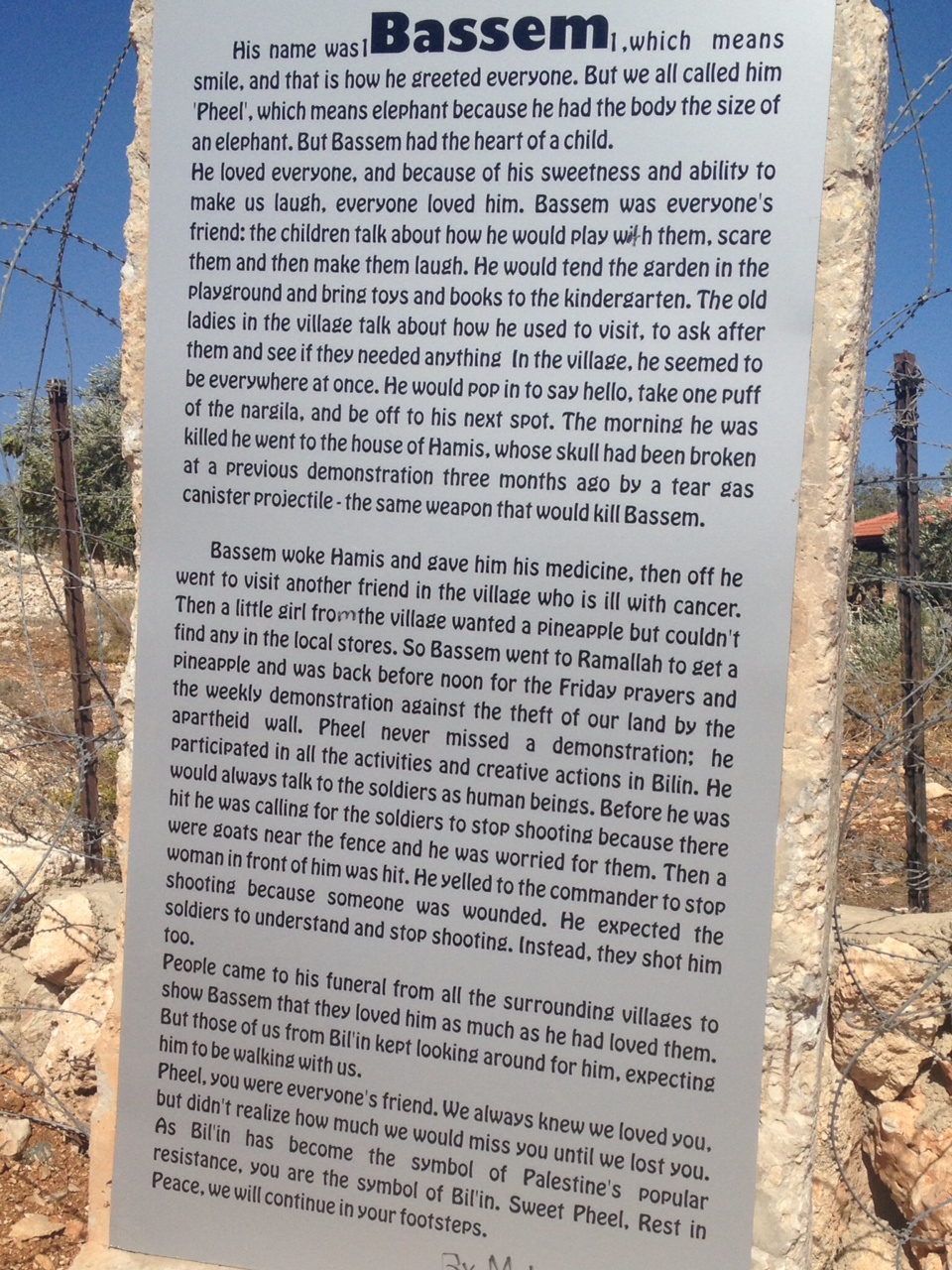
Bassem’s memorial garden (above) lies in the land that was recently reclaimed from the relocation of the wall. The myriad of small black planters are made of tear gas canisters. Please read the long tribute from the plaque at the garden, below, to get a sense of this man who will always occupy a dear place in the hearts of the villagers of Bil’in.

In my next post I’ll write about our memorable visit to Nabi Saleh, another prominent village involved in the Palestinian nonviolent resistance. Back soon.

photo

Coming Soon: A Solidarity Delegation to Bil’in

bilin

My next several posts will come from the West Bank, where I will be traveling as part of a group of Chicago-area Jews and Palestinians to learn from and show solidarity with Palestinians who are engaged in nonviolent resistance to the Israeli occupation. Our delegation will be hosted in the village of Bil’in, where, for the past several years, residents have been protesting the construction of the Separation Wall that has separated the village from its farming land – land that Israel is using to expand its settlement of Modi’in Illit, which lies immediately to the west. (You may recall the story of Bil’in is the subject of the great documentary, “5 Broken Cameras.”)

Our group will also be traveling to sites throughout the West Bank and Israel to visit with leaders of the Palestinian nonviolent movement and Israelis who show solidarity with them. I am thrilled to be taking this trip together with dear friends who I have long known though our activism for a just peace in Israel and Palestine.

I will blog as much as I can about my experiences from the ground and upon my return. Please stay tuned!

Demand Justice for Alex Odeh: 28 Years Later

I remember well the murder of Alex Odeh.

It occurred exactly 28 years ago today in Orange County, CA. I was living in Los Angeles at the time, and I followed the case closely. Odeh, a young Palestinian American who served as the West Coast director of the American-Arab Anti-Discrimination Committee was killed when a bomb ripped through his second story office in Santa Ana. I recall reading that Odeh was a gentle family man and political moderate who called for peace between Palestinians and Israelis. I also remember reading that the FBI suspected three members of the Jewish Defense League, a radical Jewish hate group – and that all three had fled to Israel.

It is now 28 year years later and no one has been arrested for the murder of Alex Odeh – even though the FBI has long suspected the identity of his killers.  Sad to say, I admit I wouldn’t be thinking of Alex Odeh today had I not received this petition just sent out by Jewish Voice for Peace, calling on Attorney General Eric Holder to hold his murderers accountable.

For more information about the Alex Odeh case, click on the clip above. I also recommend this extensive piece by Erik Skindrud from 2006 which, among other things, points out the hypocrisy of our nation’s selective “War on Terror:”

According to an internal FBI memo made public in 1987, the agency made multiple requests to Israel for cooperation in solving Odeh’s murder. Israel has refused repeatedly, although the details of the behind-doors discussions have never been released. This is despite the fact that (the suspects) have been tried and convicted of other bombings and shootings in the U.S. and the West Bank.

The contradiction is more than boggling in the post-9/11 world, where the U.S. government’s vow to take action against states that harbor terrorists is repeated regularly. Writing in 2003 about the Odeh killing and several similar incidents, George Washington University law professor Jonathan Turley called the failure “a glaring double standard applied to Arab Americans and Muslims that can be neither denied nor defended.”

On Naim Ateek and the Sabeel Institute: A Conversation Between a Rabbi and Congregant

naimateek

Rev, Naim Ateek, Sabeel Institute

I’ve posted below an email exchange between myself and a congregant regarding my participation in the upcoming Friends of Sabeel – North American conference in Chicago.  My congregant has given me permission to post it as one small but hopeful example of how the Jewish community might debate such a painful religious/political issue with respect and honesty.

Dear Brant,

As I hope you know, I am a pretty skeptical guy in general, and I do not assume that others’ reporting of their adversaries’ statements is accurate.  But this statement comes right from Sabeel’s own website.  Has Naim Ateek since disavowed it?  If not, please explain how you can allow yourself, very publicly, to be seen as supporting his work?

L’shalom (literally), XXX

Dear XXX,

Obviously this is a long and complex issue – and I’m happy talk with you directly about it if you like. But for now I’ll just say I fully understand how and why some find his rhetoric hateful. I do not. Through my own study of his work and my personal dialogue with Naim, I have come to understand that as a Christian he refracts his personal experience among other things, through the crucifixion narrative.  And as a Palestinian, it has very real relevance to his peoples’ experience in Israel/Palestine. I do not believe he invokes this narrative in order to make an accusation of deicide/blood libel against the Jews. He is using it in a genuinely faithful way, as part of a theology of liberation, to understand/frame a very real oppression against his people.

Again, I know he treads on very tender theological and political issues when he does this – but I do believe the proper way to respond is to engage him in dialogue on these tension points.  It grieves me deeply that members of the Jewish establishment only seem to want to respond by publicly tarring him as an anti-Semite and to pressure/threaten all Christians or Jews who associate with him.

I have learned a great deal from Naim – from his many books and essays and from my own personal relationship with him. I consider him to be a decent and honorable man who challenges us in important if often painful ways. As far as “disavowing” this particular statement, I don’t believe he needs to, quite frankly.  I think it is important that people read his work thoroughly and give it its due before jumping to conclusions from cherry-picked statements.

While it is not a disavowal per se, you might find this piece helpful, in which he responds to many of the accusations that have been historically leveled at him – and addresses an excerpt from statement you cited.

Again, I’m happy to talk with you further about Naim, Sabeel, and my work with them if you like.

In Shalom as well,

Brant

Dear Brant,

I just read the Huffington Post piece you sent (thanks) and thought it was well written.  (Did Jewish Voice for Peace help write it? — you don’t need to answer that question.)

One problem I have (and perhaps you are not minimizing it) is that, precisely on the assumption that Naim Ateek has something important to teach me, and other open-minded Jews like me, he will never succeed unless he changes his rhetorical approach.

Dear XXX,

I understand what you say. I imagine Naim feels his first priority is to respond faithfully to his experience of his people’s oppression – and not necessarily to frame his remarks to be acceptable to liberal Jews. Having said that, I do think that as a result of his increasing dialogue with Jews (ie JVP), he is becoming more sensitive in his rhetoric.

Anyhow – thank you for engaging with me so thoughtfully on this. It means a great deal to me.

Best,

Brant

Sukkot Activism: Young Jews Protest the Prawer Plan in Chicago


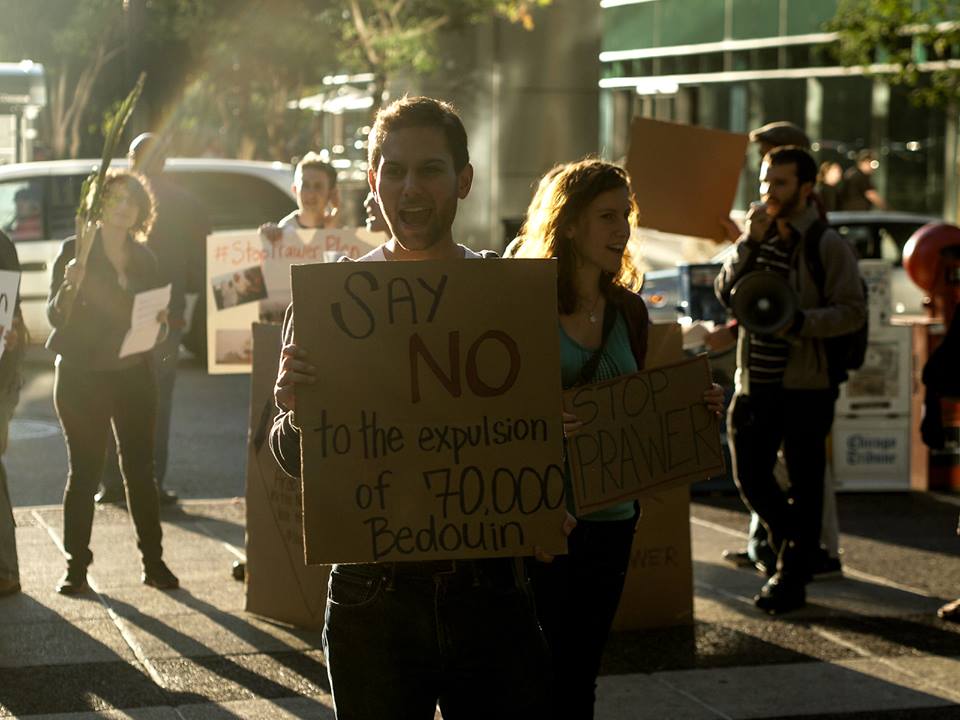
This past Wednesday there was a powerful action in front of the Israeli Consulate in Chicago: a Sukkot protest against the Israeli government’s Prawer Plan, which is currently poised to evict up to 40,000 Bedouin citizens of Israel from their homes in the Negev desert.

As you can see from the clip above, this action was organized by a community of young Chicago Jews inspired by the Sukkot festival’s message of shelter and salvation to stand in solidarity with Bedouin who are on the verge of devastating displacement. An inspiring example of spiritual activism at its finest – bravo to Young, Jewish Proud/Jewish Voice for Peace for spearheading this action in Chicago (as well as a simultaneous event in Boston!)

As I wrote last June, the Prawer Plan has already passed its first reading in the Knesset – and there are already disturbing indications that the plan has already begun to be implemented. If you live in the Midwest, please join us this Monday, September 30, for a collective “Call in to Stop Prawer!” (Details here.) And if you haven’t yet, please sign this Avaaz petition that urges Knesset members to follow their conscience “support a solution coordinated in cooperation with local residents instead of this discriminative bill.”

601589_10101081122069727_1933659252_n

Why I’m Participting in the Sabeel – North America Conference in Chicago

With Rev. Dr. Naim Ateek (Dec. 2010)

With Rev. Dr. Naim Ateek (Dec. 2010)

It is truly my honor to be included in the program of the upcoming conference, “A Wide Tent for Justice: Next Steps for Peace in Palestine/Israel,” sponsored by Friends of Sabeel – North America and the Chicago Faith Coalition on Middle East Policy.  And I’m particularly honored to be participating on a panel and leading a workshop together with Rev. Dr. Naim Ateek, founder of the Sabeel Insititute and one of the most important purveyors of Palestinian Christian liberation theology.

I can safely say my own spiritual understanding of the Israel/Palestine conflict has been profoundly influenced and challenged by the work of Rev. Dr. Ateek.  I do believe religious Jews have a great deal to learn from liberation theology in general and Palestinian liberation theology in particular.  I’ve long admired Ateek for his willingness to shine a light on the theological problems that come with the land-centric nature of Zionist ideology.  I believe his criticism of Zionism as a “retrogression” to a Biblically-based nationalist Jewish expression is a critical one for us to consider – painful though it may be for many in my community.

Responding to the challenge of Rev. Dr. Ateek and his colleagues, I’ve been working over the past year on developing a potential framework toward a theology of Jewish liberation that reclaims the universal vision of the Prophets and provides a progressive spiritual alternative to the fusing of religion and state power. I’ve been encouraged by the response to my initial efforts thus far – from Jews and Christians alike – and am increasingly coming to believe that there is a critical place for such ideas in the post-modern Jewish theological world.

Alas, much to my sadness and dismay, many in the Jewish establishment world continues to vilify Rev. Dr. Ateek and the Sabeel Institute. While I certainly understand that many are challenged – often profoundly – by Palestinian liberation theology, it grieves me that the “official” Jewish communal response to this movement has been to publicly excoriate its leaders as anti-Semitic rather than to engage them in real and honest dialogue.

I do believe this kind of posturing has everything to do with politics and very little to do with actual interfaith dialogue.  True dialogue occurs when respective communities agree to explore the hard places – the tension points – no matter how painful. In my own dialogue with Palestinian Christians (and those in the Protestant church who stand in solidarity with them), my own sensibilities have been challenged and broadened – but I’ve also found that my participation allows me to have a similar kind of impact on my Christian partners. And while we might not agree on every issue, we ultimately emerge from our encounter strengthened by our common commitment to universal prophetic values of justice.

Back in 2010, when I visited the Sabeel Institute in Jerusalem with members of my congregation, I wrote the following:

Whether or members of the Jewish community agree with him or not, I believe it would greatly behoove us to enter in dialogue with Ateek and others in the Palestinian Christian community – and I told him as much during our meeting. At the very least, it is my sincere hope that there might be Jewish leaders actively participating rather than protesting during the next American Friends of Sabeel conference.

I sincerely hope that will be the case at the upcoming conference here in Chicago (hosted by St. James Cathedral from Oct. 3 – 5).  In the past, Friends of Sabeel – North America conferences have occasioned fierce political pushback from the Jewish communal establishment. Sad to say, last year, Jewish leaders in Albuquerque pressured a local Episcopal church into canceling its sponsorship of the the Sabeel – NA conference there.  While I have every confidence that this will not occur in Chicago, I fully expect that some members of the Jewish communal establishment here will publicly tar organizers and co-sponsors of the event with the tired accusations of “anti-Semitism.”

Still, I am hoping against hope that members of my community will see fit to attend the conference in the spirit of openness and with a willingness to be challenged. I do believe this is nothing less than the most critical Jewish-Christian dialogue of our time.

Stand in Sacred Solidarity with Imprisoned Hunger Strikers

This year, the Islamic fast of Ramadan (which began Monday night and will last until August 7) will serendipitously coincide with the Jewish fast of Tisha B’Av (Monday night July 15 to Tuesday, July 16). Given this harmonic interfaith convergence, I’ve been thinking more about the function of fasting as a time honored tactic of sacred protest – and in particular as a powerful act of civil disobedience. And so in honor of both of these sacred fasting festivals, I’d like to spotlight several ongoing fasts/hunger strikes that I believe are profoundly worthy of our attention and solidarity:

At Guantanamo Bay, many prisoners have been engaged in a longtime hunger strike to protest their conditions and their indefinite confinement. Lawyers for prisoners say the most recent strike began in February; according to the military, 106 of the 166 detainees met criteria to be declared hunger strikers (a definition that includes missing nine consecutive meals):

Prison medical officials have determined that 45 of the prisoners have lost enough weight that they can be fed liquid nutrients, by force if necessary, with a nasogastric tube to prevent them from starving themselves to death. The U.S. military intends to feed all prisoners, including those on hunger strike, before dawn and after sunset during the Muslim holy period of Ramadan to accommodate the men’s religious practices. Military officials have said the feeding process is not painful and only done to prevent any of the men from dying, not as punishment.

A recently released video (above) certainly belies the military’s claims.  In an act of what can only be called deeply courageous solidarity, rapper/actor/activist Yasiin Bey (aka Mos Def) subjected himself to the force-feeding to demonstrate the grievous nature of this procedure. I will warn you that it’s not at all easy to watch. I’ll let you judge for yourself as to whether this act constitutes torture or cruel/unusual punishment, but as far as I’m concerned, this video is worth a thousand words.  On this point, it’s worth nothing that a US federal judge ruled yesterday the practice appears to violate international law – and that President Obama can resolve the issue.

Click here to sign a petition that condemns the use of force-feeding, and demand that President Obama help end the hunger strike by addressing the legitimate grievances of detainees.

Here at home, 30,000 prisoners in California prisons began a hunger strike yesterday in what has been described as possibly “the largest prison protest in state history.”  The protest, organized by a group of inmates held in segregation at Pelican Bay State Prison demands an end to state policies that allow inmates to be held in isolation indefinitely, in some cases for decades.  While the UN has determined solitary confinement for longer that 15 days constitutes torture, many prisoners in California state prisons have languished in solitary for 10 to 40 years.

In California, there are nearly 12,000 prisoners who spend 23 of 24 hours living in a concrete cell smaller than a large bathroom. The cells have no windows, no access to fresh air or sunlight. People in solitary confinement exercise an hour a day in a cage the size of a dog run. They are not allowed to make any phone calls to their loved ones or talk to other prisoners.  They are denied all educational programs, and their reading materials are censored.

Yesterday, the Prisoner Hunger Strike Solidarity Coalition released a lengthy statement that details the history of this issue and explains why the decision was made to begin a hunger strike:

Family members, advocates, and lawyers will announce their support for the peaceful hunger strike and job actions beginning today throughout the California prisons starting on Monday July 8.   Prisoners have been clear since January that they are willing to starve themselves unless the California Department of Corrections and Rehabilitation (CDCR) agrees to negotiate honestly about their demands.

Click here to support the California prison hunger strikers and to sign a personal “Pledge of Resistance.”

I’ve also written extensively in the past about Palestinian prison hunger strikers who have long been engaged in nonviolent resistance to Israel’s illegal practice of administrative detention. While these protests consistently and egregiously fly under the radar of the mainstream media, they demand our attention – particularly as a response to the chronic question “where are the Palestinian Ghandis?”

Click here to learn more about the most current Palestinian hunger strikers. This link also includes the names/addresses of Israeli government, military and legal authorities to whom you can write to protest the prisoners’ treatment and demand their release.

May our respective fasts bring us closer to empathy and solidarity. As we say in my spiritual tradition: Baruch matir asurim – Blessed is the One who liberates the imprisoned.