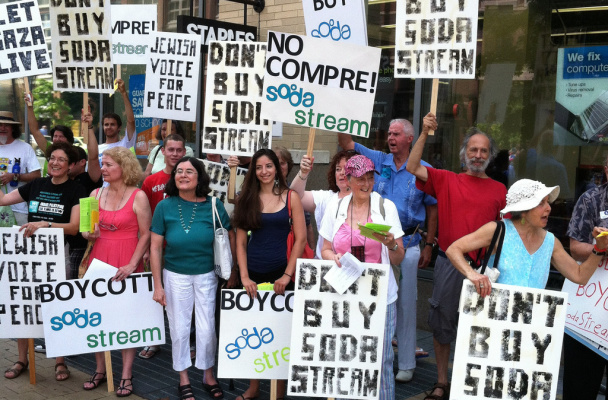
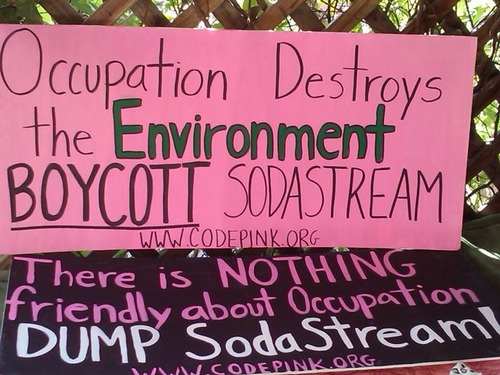
Since my previous post on the SodaStream boycott, I’ve received a number of questions regarding which specific campaign/s to support. While there have been a number of great local actions around the country, I’m happy to announce that a new interfaith coalition has just launched a national boycott effort that includes a petition as well as a spoof ad contest. I hope you will join me in signing on to this important campaign.
For more information on SodaStream, here is an excellent point by point response to the claims made by the company, courtesy of Stop SodaStream – Italy:
1. “SodaStream is headquartered in Tel Aviv, Israel, and manufactures its products in 12 production plants distributed in many countries, including factories in China (2), Germany, Sweden, New Zealand, Australia, South Africa, Netherlands, the US and two in Israel, one of which is Mishor Adumim … “
Even if there were hundreds of “production facilities” all over the world, it would not change the fact that the factory in Mishor Adumim is built on land stolen from the Palestinians and thus violates human rights and international law.
In any event, Sodastream’s annual report clearly demonstrates that the factory in Mishor Adumim is also the company’s main production facilities:
- At 15,256 m2, the plant is four times larger than the headquarters in Tel Aviv, and eight times that of the other Israeli plant at Ashkelon, which produces only flavors for soft drinks.
- The plant in China produces only “certain components”.
- The “production facilities” in Germany, Sweden, New Zealand, Australia, South Africa, the Netherlands and the USA are mere sales and marketing offices and refill stations for CO2 cylinders.
Source: Sodastream International Ltd. Annual Report for the Fiscal Year Ended December 31, 2010, “Manufacturing and Production,” p. 37 and “Facilities,” p. 40.
2. “… where approximately 160 Palestinians receive full social and health services in accordance with, and exceeding, Israeli law, including pension contributions and insurance. Labor law in Israel requires an employer to pay wages and contributions 4 times higher than those required by the Palestinian Authority. If you consider that, on average, each employee is responsible for 10 Palestinian dependents, considering the rate of unemployment in the Palestinian Authority (estimated at 30%), the company provides food and shelter to 1,600 people. In addition, SodaStream also provides benefits that include: daily hot meals, clothing, transportation and overtime pay for up to 200% as required by Israeli law. “
The fact that a company such as SodaStream, which profits from the Israeli occupation regime, considers itself a benefactor of the Palestinians is downright bizarre. Even if working conditions for the Palestinians at the Mishor Adumim factory were as described (something that has been proven false in the past by the Israeli organization Kav LaOved), the fact remains that, as subjects an occupation regime, these workers do not enjoy civil rights (including the right of workers to organize) and are under constant threat of having their permits to work in the settlement revoked by the company at any moment.
Palestinian workers often have no choice but to work in the settlements, with high unemployment rates that are a direct result of the Israeli occupation. The 2011 United Nations Conference on Trade and Development report explicitly links the decline in Palestinian agricultural and industrial sectors and the dire humanitarian conditions with Israeli government policies, in particular the confiscation of land and natural resources, restrictions on movement of people and goods, and isolation from international markets. Only a colonial mindset could claim to provide jobs to the very same people whose land and freedom have been stolen.
Sources:
– Kav LaOved, “Palestinian Workers in Israeli West Bank Settlements – 2009”; “Employees at Soda Club fired without wages (follow up report)”
– Report on UNCTAD assistance to the Palestinian people: Developments in the economy of the occupied Palestinian territory3. “Among the 700 employees at the Mishor Adumim factory are Jews, Palestinians, Christians, Russians, Ethiopians, Bedouins, and Americans. In SodaStream’s view, this is a splendid example of peaceful coexistence that will lead to economic prosperity on which everyone benefits. The company regularly celebrates the holidays of all and has fostered cultural exchange.”
To speak of “peaceful coexistence” between people who do not have equal rights and equal social, economic and political opportunities is absurd. Among Sodastream employees, there is a marked difference between the conditions of the occupiers and those who suffer under occupation. For example, just as in Apartheid South Africa the black majority was allowed to enter areas reserved for whites only in order to work, so do the Palestinians depend on the occupying power for work permits.
Furthermore, the Jahalin Bedouin, who had already been driven from their lands in the Negev in the 1950s, were then expelled from the very area where the Sodastream has its factory.
Sources:
– Kav LaOved, “Palestinian Workers in Israeli West Bank Settlements – 2009”;
– Human Rights Watch, Separate and Unequal, “Jahalin Bedouin and Ma’ale Adumim”4. “As you know, Sodastream recently decided not to expand the factory at Mishor Adumim, but rather to build one inside the Green Line. The construction is already underway, as decided by the Board of Directors.”
Committing to not to expand an illegal activity, which according to the company website, Sodastream has been carrying out since 1996, counts for very little. The fact remains that the main production facilities are located in an illegal Israeli settlement in violation of international law.
Source: Sodastream web site, History of the Sodastream Group
5. “SodaStream does not currently benefit from low rents and could rent other facilities in the uncontested territories of Israel for much less. The same applies to incentives, the company enjoys the same tax incentives as any other industrial area of Israel, regardless of whether it is located in the disputed territories or not.”
Sodastream’s annual report lists among its “risk factors” the possibility, due to negative publicity and boycotts, of having “to transfer a significant portion of manufacturing activities to a location outside of the West Bank” that would “limit certain of the tax benefits for which we are currently eligible”.
In fact, according to the web site for the Mishor Adomim Industrial Park, it is designated as “Development Zone ‘A'”, which enjoys the highest tax incentives from the Israeli state.
And finally, the Palestinian territories are occupied, not “disputed”, as recognized by the International Court of Justice, the International Committee of the Red Cross and the Conference of High Contracting Parties to the Fourth Geneva Convention, among others.
Sources:
– Sodastream International Ltd. Annual Report for the Fiscal Year Ended December 31, 2010, “Risks related to our Location in Israel,” p. 17
– Adumim Industrial Park, Business Benefits
– International Court of Justice: Legal Consequences of the Construction of a Wall in the Occupied Palestinian Territory; International Committee of the Red Cross; Conference of High Contracting Parties to the Fourth Geneva Convention: Declaration,6. “With regards to Coop Sweden, yes it is true that on July 19 they decided to suspend sales of these products, however it is also true that, after a brief investigation, they then decided to put them back on the shelves.”
Swedish activists inform us that COOP Sweden claims to have the results of an investigation that justify, in their view, the marketing of Sodastream products. COOP Sweden has refused, however, to share the report with the Swedish activists. If Sodastream would like to provide us with the report, we would be happy to comment on it.
7. “SodaStream is also under tight control by the Office for Environmental Protection of Israel, leading to surprise inspections, and the company adheres to the highest environmental standards.”
It is well known that Israeli and international companies consider Israeli laws on environmental protection inapplicable with regard to factories in the occupied West Bank. According to 2009 report by the Israeli organization B’Tselem, Israel does not enforce environmental laws in the settlements and industrial areas in the occupied West Bank.
As for surprise inspections, according to Bloomberg Businessweek and the Corporate Watch website, the Sodastream Factory in Mishor Adumim is “the most heavily protected in the area, with multilevel electric fencing protecting its perimeters and cameras monitoring everything going on outside of them.”
Sources:
– B’Tselem, “Foul Play: Neglect of wastewater treatment in the West Bank”
– Corporate Watch, “Occupation Industries: The Israeli industrial zones”
– Bloomberg Businessweek, “EU Eyes Exports from Israeli Settlements”8. “Following the publication of false reports, the company also decided to host visits and inspections, in particular social audits, including the internationally accepted BSCI (Business Social Compliance Initiative) audit, with the conclusion that they no corrective actions are necessary.”
Clearly, an auditing organization that certifies a factory located in the occupied Palestinian territories has no credibility whatsoever.
The Stop Sodastream campaign will continue to challenge the deceptions of Sodastream, organizing initiatives to reveal the truth that the company wants to hides and promoting a boycott of its products.





 Shalom Rav