Monthly Archives: December 2008

Israel and Gaza: In Search of a New Moral Calculus

59ae8b54-d4eb-11dd-b967-000077b07658

I knew my last post would generate passionate comments – and I confess that I did hesitate before posting something so patently emotional. I went ahead though, because as I read the increasingly tragic news about the Israel-Gaza conflict, I’m consciously resisting the knee-jerk impulse to paper over my emotions with dispassionate analysis. It’s becoming clear to me that our attempts to be “rational” keep us from facing the inherent irrationality of this conflict.

Of course the Qassam attacks against Southern Israel have been intolerable. Of course Hamas bears its share of responsibility for this conflict. But beyond the rhetorical “well, he started it” arguments (which could stretch well back to 1948 and beyond) there remains the central question: what will bring safety, security and ultimately peace to this tortured region? I realize there are no easy answers, but I believe to my marrow that it will not come by sending in the war planes and reducing what’s left of Gaza to rubble.

Does anyone in their right mind truly think this abject destruction will ultimately bring safety and security to Southern Israel?  In the end, Every Gazan killed equals that many more family members and friends who will now be forever enraged and inflamed against the Jewish state. If peace depends largely on cultivating moderates on the other side, what does blowing them to smithereens accomplish? Believe me, if Israel ultimately thinks their attacks will turn Gazans against Hamas, they will be sorely disappointed. If forced to choose between Israel and Hamas, who do we really think they will choose now?

But even more than the strategic considerations, I am infinitely more troubled by the deeper moral implications of Israel’s military actions. Yes, it is true that Hamas chose to end the ceasefire and yes, Israel has few good options. But it was ultimately Israel who made the decision to bombard Gaza with a massive air attack, loosing many several hundreds of bombs into densely populated city center, virtually guaranteeing widespread civilian carnage and death.

As I write these words, I can already predict the standard moral calculus: “Yes, but Hamas purposely launches Qassams into civilian areas while Israel tries to minimize civilian casualties whenever possible.”  I’m coming to realize that pat rhetorical equations like these might serve to help us sleep better at night, but they don’t change some basic unavoidable truths: that in the Israeli-Palestinian conflict, the military power dynamic is heavily weighted in Israel’s favor, that Hamas’ Qassams are but peashooters against Israel’s armed might and ultimately, as traumatic as it undoubtedly is to live in Sderot, Palestinian civilian casualties vastly outnumber Israel’s. And in the end, it matters little to the loved one of a dead civilian whether or not his/her death was caused intentionally or by “collateral damage.”

From what I can tell, Israel’s response to this latest bloody go-round amounts to: “We regret if civilians are killed, but they started it and anyhow that’s what happens in war.”  I certainly understand how Israel, a nation that has been in a constant state of war and conflict since its inception might develop such a moral trope. But whatever comfort it might afford us in the short term, it will not ultimately provide us with a path to peace – only a rationalization for prolonging the bloody status quo.

That’s all for now. Thank you for your comments and please keep them coming. And let’s pray for better news tomorrow.

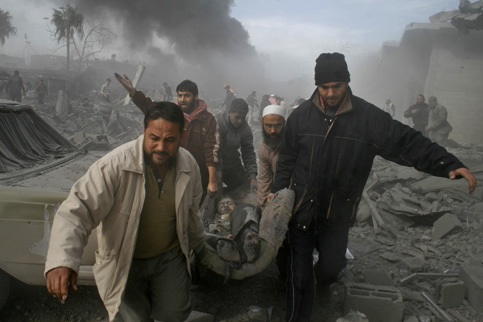
Outrage in Gaza: No More Apologies

gaza
(picture by Hatem Omar/Maan Images)

The news today out of Israel and Gaza makes me just sick to my stomach.

I know, I can already hear the responses: every nation has a responsibility to ensure the safety of its citizens. If the Qassams stopped, Israel wouldn’t be forced to take military action. Hamas also bears responsibility for this tragic situation…

I could answer each and every one of these claims in turn, but I’m ready to stop this perverse game of rhetorical ping-pong. I don’t buy the rationalizations any more. I’m so tired of the apologetics. How on earth will squeezing the life out of Gaza, not to mention bombing the living hell out of it, ensure the safety of Israeli citizens?

We good liberal Jews are ready to protest oppression and human-rights abuse anywhere in the world, but are all too willing to give Israel a pass. It’s a fascinating double-standard, and one I understand all too well. I understand it  because I’ve been just as responsible as anyone else for perpetrating it.

So no more rationalizations. What Israel has been doing to the people of Gaza is an outrage. It has brought neither safety nor security to the people of Israel and it has wrought nothing but misery and tragedy upon the people of Gaza.

There, I’ve said it. Now what do I do?

Theater of Crisis in Israel/Palestine

It seems that two remarkable, powerfully self-reflective theater productions are currently being staged in the same little patch of land: “Gaza-Ramallah,” a Palestinian play produced by The Haya Theater in Ramallah; and “Bat-Yam-Tykocin,” staged jointly by The Habima Theater and the Contemporary Theater of Wroclaw in Tel Aviv.

For its part, “Gaza-Ramallah” appears to skewer Gazan and West Bank culture with equal opportunity satire. Interestingly, Palestinian actor/playwright Imad Farajin chooses not to dwell on the humanitarian crisis in Gaza but instead turns his sights on Gaza’s materialistic consumer culture. He seems to be just as unsparing in his portayal of Palestinian Authority corruption in the West Bank.  From an Amira Hass feature in Ha’aretz:

It is a culture where Palestinian businessmen, politicians, dialogue and research institution directors associate with Israeli counterparts and former senior military officers and the Shin Bet security service. A culture that allows a few individuals to accumulate wealth at the expense of the struggle against occupation. It is the “Oslo culture,” which has given peace, dialogue and coexistence a bad name.

“Bat-Yam-Tykocin” appears to be equally as emotionally/politically raw.  The pair of plays, written by an Israeli playwrignt and a Polish playwright respectively, is performed in Polish and Hebrew and takes head-on some of the common assumptions Jews and Poles harbor about the Holocaust.  The results seem to be, understandably enough, fairly challenging and painful – you can read more about the production in another newsy Ha’aretz piece.

I’m consistently struck by the ways theater can address the inner truths of complex issues in ways that far transcend media reports and history books. And I’m heartened that in the midst of this tragic crisis, there are still Palestinians and Jews who are ready to plumb their respective experiences with unflinching honesty…

The clip up top features “Bat Yam” in rehearsal; below you can see an excerpt from “Gaza-Ramallah.” (No subtitles, however – you may have to find an Arabic-speaking friend to translate).

Rabbi Arnold Jacob Wolf, z”l

rabbi-wolfe1I was so saddened to read of the passing of the great Rabbi Arnold Jacob Wolf of Chicago at the age of 83. From his obituary:

Rabbi Wolf served as a Navy chaplain during the Korean War. In 1957, he returned to Chicago and became the founding rabbi of Congregation Solel in Highland Park. In 1972, he went on to teach philosophy at Yale University and was the school’s Jewish chaplain. Rabbi Wolf returned to Chicago in 1980, where he served as the rabbi of KAM for 20 years.

But truly Rabbi Wolf’s most lasting legacy will be as a stubborn, indefatigable advocate for social justice in this country and in Israel/Palestine. Just two examples among many: as the founding chair of Breira in 1973, he spearheaded the American Jewish call for justice for Palestinians long before it was fashionable. And just several months ago he publicly exhorted the Jewish community in support of Barack Obama’s presidential campaign.

Zichrono Livracha – May the memory of this fearless tzadik be for a blessing…

Dreidel I’m Gon’ Play…

This year’s big Hanukkah release: “Songs in the Key of Hanukkah” – an eclectic anthology compiled by Erran Baron Cohen and featuring songs performed by Cohen, Idan Raichel, Jules Brookes, Yasmin Levy and Orthodox African-American rapper, Y-Love.

Cohen has been fairly visible promoting his disc. He was recently interviewed by Scott Simon on NPR’s Weekend Edition, where he had this to say:

I remember from my childhood, listening to Hanukkah songs at home and listening to these children singing slightly out of key and some wonky old piano player to make a terrible record. The idea was to create a new concept in Jewish holiday music, something that everybody would enjoy listening to.

Click above for a taste: Cohen and Y-Love (along with some other unidentified hasidic-looking folk) performing “Dreidel” on Conan O’Brien.

End of the Machers?

539wWith every passing day it becomes abundantly clear that the Madoff scandal is having seismic financial reverberations for the Jewish community at large. The Jerusalem Report recently reported that at least $600 million in Jewish charitable funds has been lost by the collapse of Madoff’s investment firm. However, this doesn’t include billions of dollars in losses to individual and family investors who have been the primary donors to Jewish institutions.

For the Jewish community the scale of this financial crisis is staggering and almost incomprehensible to contemplate. Though it is much to early to predict what the long term implications will be, it is clear the impact will be significant. The JPost article included an interesting analysis by American Jewish historian Jonathan Sarna, from Brandeis, who suggests that the era of the “big macher” may now be officially over:

Sarna predicted that the wholesale destruction of fortunes and endowments would prove to be a turning point in American Jewish institutional life, which over the past 20 years has moved from a model of community funding – collecting small donations from a broad swath of donors – to focusing on a handful of “cowboy” mega-donors who launched hugely successful programs like birthright Israel outside of the traditional federation system.

“The reduction of billions – not millions but billions – in the Jewish economy means that there is just not going to be enough money to sustain all the institutions and initiatives that have been created,” Sarna told the Post.

“We will be a poorer community for that. What’s been wiped out is an infrastructure that was particularly important in sustaining these institutions. The people who were invested with Madoff were the generation that not only supported institutions like Yeshiva University or the Holocaust museums, but that created them,” Sarna said.

Older donors from Florida’s Palm Beach community, where Madoff found many of his investors, might be replaced by a younger generation of Jews whose wealth was invested elsewhere, Sarna speculated.

“It’s a different group of people who will be called on to step in. It’s almost impossible to imagine that the group that has lost so much money will regain it,” he said.

The challenge facing American Jewry will be saving programs and institutions that provide “the most bang for the buck,” a task complicated by the absence of a unifying organization to take the lead.

“Are these decisions going to be made by the market… or are we going to ask for a communal bailout?” Sarna asked. “We don’t have anybody who can act with the speed and the authority of the federal government, and it’s going to take time to sort this out and figure out how to make these decisions professionally.”

Whatever else happens, it looks like the new Jewish economy will be leaner and meaner. That’s not all bad, but the prognosis for the foreseeable future looks grim indeed…

Pretty Please With a Swastika on Top?

stupidcakePrepare for the latest entry in the “you can’t make this stuff up” hit parade:

The father of 3-year-old Adolf Hitler Campbell, denied a birthday cake with the child’s full name on it by one New Jersey supermarket, is asking for a little tolerance.

Whaaaa? According to the AP, the disappointed parents claim they gave little Adolf the name because “no one else in the world would have that name.” (Yeah, right…)

There’s so much post-post-post-modern irony to respond to in this story, where oh where to begin? My favorite tidbit:

The Campbells ultimately got their cake decorated at a Wal-Mart in Pennsylvania…

Too Late for Two States?

When a level headed analyst such as Gershon Baskin, CEO of the Israel/Palestine Center for Research and Information publicly states that time may have run out on the two state solution, I’d say it’s time to pay attention. I strongly encourage you to read this recent piece in the Jerusalem Post, in which Baskin suggests that the unmitigated growth of settlements has already created a bi-national reality in the territories:

Perhaps it is already too late. Perhaps the events of Hebron, of the forced removal of the settlers from the building that they claim and the riots that broke out afterwards when they went on the rampage against Palestinians in Hebron demonstrates in the most bloody terms that these two communities might be too locked into a entanglement that is already beyond the possibility to untangle.

Baskin concludes with these sad and ominous words:

The end is in sight brought to us by the very hands that created the bi-national reality on the ground in the name of Zionism.

If you aren’t disturbed enough by now, click above to see the recent Hevron evacuation incident of which Baskin is referring. (And if you truly have the stomach for it, you can log into YouTube as an adult to view footage of the ensuing settler rampage – or “pogrom” to use Olmert’s term…)

Beneath the Blindfold

img_0182
Last night, JRC was honored to host an important program in recognition of Human Rights Week. We were joined by Dr. Mary Fabri, Senior Director of the Marjorie Kovler Center for the Treatment of Survivors of Torture, along with documentary filmakers Ines Sommer and Kathy Berger, who presented the first public showing of the trailer for their new film, “Beneath the Blindfold.” That’s Dr. Fabri above on the right, next to Ines, Kathy and JRC member Ellen Rosen Kaplan, who organized the program for our congregation.

Though torture is now infamously on the political radar screen of most Americans, the one dimension of this issue that is too often neglected is the profoundly traumatic effect of torture on torture survivors themselves. The film sensitively but powerfully presented the stories of several survivors, each of whom have been forever transformed and are responding differently to the reality of their experiences. Even at just eight minutes, the “Beneath the Blindfold” demo reel offered a profound insight into the human cost of torture, on survivors, their families, and on society itself.  Perhaps most important, the film gives a real, human face to the human beings behind this political issue.

The brief taste of the film was sometimes painful, but in the end, deeply inspiring. After the showing, Dr. Fabri, Ines and Kathy led an extended conversation on the film and the complex, critical issues it raises. By evening’s end, we were motivated all the more to work to end the sacrilege of torture once and for all.

Ines and Kathy are currently editing “Beneath the Blindfold” and continue to raise the funds they need to finish the film. I believe this is a movie that must be completed and seen by as many people as possible. If you would like to contribute, contact the filmakers at kdocumen@yahoo.com or ines@panaceapictures.com.

Human Rights and the Road to Efratah

udhr60english2

In
 this week’s portion, Parashat Vayishlach, we read:

Thus Rachel died. She was buried on the road to Efratah – now Beit
 Lechem. Over her grave Jacob set up a pillar; it is the pillar  at Rachel’s grave to this day. (Genesis 35:19-20)

Jeremiah famously expanded upon these verses to introduce the tragic, iconic 
image of Rachel weeping over the exiled children of Israel:

Thus said the Lord: A cry is heard in Ramah – wailing, bitter weeping – Rachel weeping for her children. She refuses to be comforted for her
 children, who are gone. Thus said the Lord: restrain your voice from 
weeping, your eyes from shedding tears. For there is a reward for your labor, declares the Lord.  They shall return from the enemy’s land.
 And there is hope for your future, declares the Lord.  Your children 
shall return to their country. (Jeremiah
 31:15­)

While these words have been a comfort to the exiled Jewish people for centuries, we know all to well that we are not the only people to suffer the pain of exile. Given that Jews are now global citizens in the 21st century world, might we apply these sacred words to all who have been forcibly dislocated from their lands?  I am particularly mindful of this question this week, as we mark the 60th anniversary of the Universal Declaration of Human Rights. (Note in particular Article 9: “No one shall be subjected to arbitrary arrest, detention or exile.”)

In honor of this important anniversary, Rabbis for Human Rights – North America has designated this Shabbat to be “Human Rights Shabbat.”  I encourage you to study and utilize their extensive new web resources to commorate this sacred milestone. This Shabbat Vayishlach, may we strengthen our resolve that we might make the vision of the Universal Declaration a reality for all who dwell on earth…