Here’s a nice piece that ran on Chicago’s ABC affiliate last January: a feature on JRC’s green building as well as a local mosque that incorporated energy-saving features into their recent renovation. Especially nice that they highlighted two “Abrahamic environmental efforts.” (One snarky correction: it’s Jewish Reconstructionist Congregation, not Center).
Category Archives: Religion
Jewish Brits Organize for Fair Trade
Kudos to the British Jewish community for mobilizing big time in support of Fair Trade!
Check out their impressive new Jewish Guide to Fair Trade – it has to be the most comprehensive resource of its kind. It’s even more remarkable when you consider that it is the product of a wide-ranging coalition that includes every major British-Jewish denomination.
This campaign is but one project of Tzedek, a British org that self-describes itself as
…a voluntarily led Non-Governmental Organisation that draws upon the skills and resources of the Jewish Community to better the lives of those less fortunate. Tzedek aims to nurture and empower open-minded Jewish community leaders to promote the fight against extreme poverty.
Their new guide is much more than just Jewish lip-service to Fair Trade. It’s filled with lots of substantive info, including Jewish sources and curricula.
Any chance that the large Jewish community on the other side of the pond might follow their lead?
The Jews of Iran: Beyond the Rhetoric

I was pleased to read two particularly intelligent Iran-related op-eds in the NY Times today: one by columnist Roger Cohen on the Iranian Jewish community and another by Iranian journalist Ali Reza Eshraghi on the importance of engaging diplomatically with Ahmadinejad.
From Cohen’s piece:
Perhaps I have a bias toward facts over words, but I say the reality of Iranian civility toward Jews tells us more about Iran — its sophistication and culture — than all the inflammatory rhetoric.
That may be because I’m a Jew and have seldom been treated with such consistent warmth as in Iran. Or perhaps I was impressed that the fury over Gaza, trumpeted on posters and Iranian TV, never spilled over into insults or violence toward Jews. Or perhaps it’s because I’m convinced the “Mad Mullah” caricature of Iran and likening of any compromise with it to Munich 1938 — a position popular in some American Jewish circles — is misleading and dangerous.
Cohen’s report is very much in line with my own experience. When I attended an interfaith delegation to Iran this past November, we spent considerable time with the Jewish community – and among the many surprising impressions we received was their obvious sense of comfort and safety living as Jews under an Islamic regime.
American Jews are invariably astounded when I tell them that I myself wore a kippah publicly throughout Iran without a moment’s nervousness. (Once we were approached and asked by an Iranian man if we were Jewish – he turned out to be a Jew himself and he promptly invited us to his shul for Shabbat). I’m not being facetious when I say that in retrospect, I realize I actually felt safer as a Jew walking the streets Tehran than I often do in Israel – the only place in the world, frankly, where Jewish lives are under constant threat.
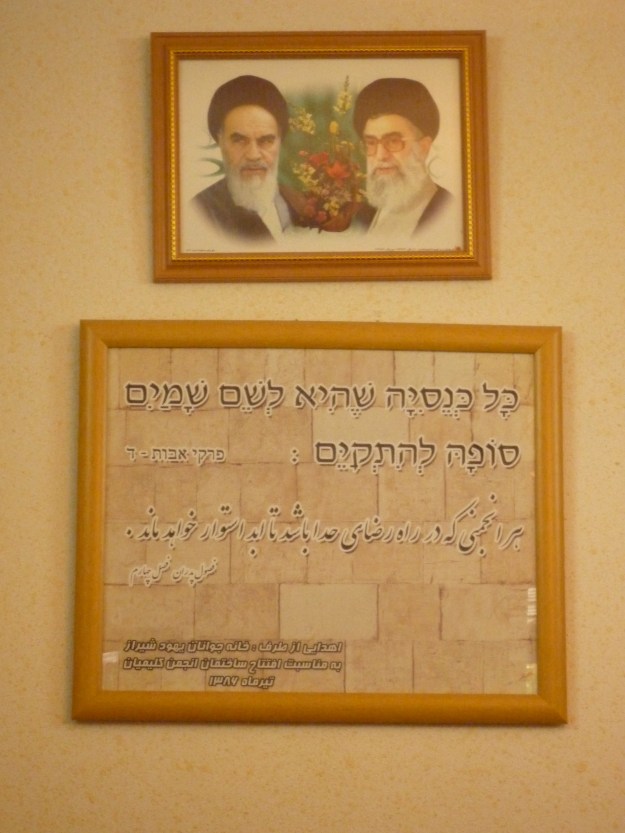
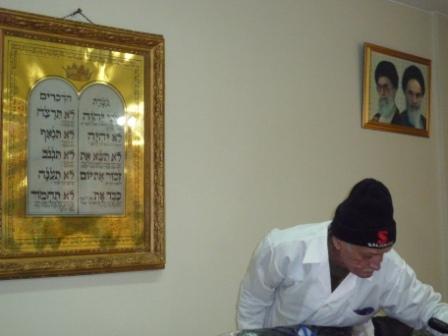
I took the picture above, by the way, at the Jewish community center in Shiraz. Just another assumption-busting Jewish Iranian image: the obligatory Ayatollahs Khomeini and Khamanei hanging on the wall above a classic Jewish quote from Pirkei Avot in Hebrew and Farsi: “Every assembly that is for the sake of heaven will endure.”
(To those who live in the Chicagoland area: I’ll be speaking about my experiences in Iran tomorrow evening, Tuesday, February 24, 7:00 at the Chicago Chapter of the American Friends Service Committee
Immigration Justice in Illinois
Some rare good news in the quest for compassionate immigration reform out here in Illinois:
Thanks to the unanimous passage of the Access to Religious Ministry Act in both state houses this past December, detained immigrants will now have the same access to clergy as those imprisoned for other crimes. Up until now, undocumented immigrants awaiting deportation in Illinois jails have been restricted to clergy visits of two hours or less per month.
In addition to representing a clear victory for freedom of religion, this new access will help us shine a brighter light on conditions in ICE detention facilities. The law is scheduled to go into effect in June and The Trib has just reported that volunteer lay-clergy training began yesterday in Chicago. Major kudos to bill-sponsor Sen. Iris Martinez and the inspirational, indefatigable Sisters of Mercy (above) who led the fight for the passage of the bill.
Home From Iran, Final Thoughts
During our final night in Iran, I was interviewed at length by two reporters from a Tehran newspaper. I mentioned to them that during my High Holiday sermon to my congregation, I noted that Americans (and especially American Jews) chronically misunderstand Iran. I told the reporters that ironically enough, I learned on this trip that I really hadn’t understood Iran nearly as well as I had thought myself.
The most essential thing I’ve learned is in some ways the most basic: Iran is a beautiful country with a venerable history and wonderful, gracious people. It is also a powerfully complicated country, marked by a myriad of cultural/political/religious/historical layers. I am now more convinced than ever that we in the West harbor egregiously stereotypical assumptions about this country – and that we harbor them at our mutual peril.

We spoke to many Iranian citizens during this trip and probably the most common comment we heard was that they had no problems with Americans – and that the real problem lay with our respective governments. (On more than one occasion, I heard this said in regard to Israel as well.) While I realize that statements like these probably reflect characteristically Iranian t’aarof, (“graciousness”), I don’t underestimate their abiding truth. I do believe that we ultimately have more in common than not. I do believe that our respective governments continually misunderstand and misuse one another. And I do believe that true communication and reconciliation between our two nations is not only possible, but utterly essential.
The challenge of communication was driven home to us over and over during the course of our formal meetings and dialogues. It became fairly clear to us fairly soon that even with direct face to face conversation, even with decent interpreters, miscommunication was virtually inevitable. And though these kinds of miscues might have seemed to us to be fairly benign at the time, we came to appreciate that even subtle misunderstandings had important implications.
More often than not, these barriers were due to cultural differences where words/idioms could not be simply translated literally in a single rendering. And I can’t help but believe that many of the more ominous assumptions we hold about Iran and Iranians are due less to substance than to cultural misunderstanding. While I prefer not to weigh in on the rhetorical hairsplitting debate on Ahmadinejad’s notorious 2005 “threat” to “wipe Israel off the map,” I’ll only suggest that our attitudes (not to mention our foreign policy) must be based on real intelligence and understanding, and not fear-based, knee-jerk assumptions.

None of this is to sugar-coat the more disturbing aspects of the Islamic Republic. If our delegation was ever tempted to do so, we received a hard dose of reality when we read in the Tehran Times about a public hanging of two men convicted of bombing a mosque that was scheduled to take place in Shiraz shortly after we were there. Yes, we are justified in recoiling from reports such as these – and we’d be foolish to deny that there are troubling human rights issues that Iran would do well to address. But at the end of the day, the solutions to these problems are certainly not ours to impose.
As a matter of fact, the Iranian human rights community has been confronting these issues for some time. And it is worth noting that their fight for peace and justice serves as a challenge to us as well. On the final night of our stay in Iran several women from our delegation met with members of Iranian Mothers for Peace, an anti-war NGO founded by courageous women, many of whom have done time in Iranian prisons for speaking out against the injustices of the Islamic Republic. But they have also gone on record against the US war in Iraq and in particular against a potential US attack on Iran.
From one of their public letters:
To all peace-loving mothers of America,
We are addressing you from the Middle East. Our motherly instincts compel us to share a common pain with those of you whose children are fighting in the Iraq war. Iranian Mothers for Peace is an independent organization that was established in October 2007 to object the war and warmongers both in Iran and the United States of America. We are diverse in terms of ethnicity, religion, and ideology. Iranian Mothers for Peace opposes war, human rights abuses, injustice, and poverty…
The wars in Iraq and Afghanistan are costing each American family $25,000 a year during a time in which the United States is in an economic crisis, with many citizens still lacking health care and economic stability. Once again American Government officials are singing the ominous song of war – this time against Iran. It is unjust for our children to be killed and murdered while the weapons manufacturers and oil monopolies collect blood money.
Therefore, we are asking all of you peace-loving American mothers to oppose the war and those who are inciting the war in order to prevent this mistake from happening again. Please do not let our children draw weapons against each other. Please do not allow the decision makers to force Iranian, American, Iraqi, and Afghani mothers to suffer from pain and heartbreak for their children forced into fighting unjust wars.
As I read these words, I’m reminded of the many remarkable, inspired individuals we met on our journey: Dr. Raffi, committed to serving a Jewish community that makes its home in an Islamic Republic; Habib, who seeks peace by bearing witness through his art; Dr. Rasoulipour, who devotes his life to religious understanding and tolerance, but to name a few.
So in the end I find myself returning to the subject of understanding – a concept that seems to be in such painfully short supply these days. If anything, I believe our trip highlighted for us the critical need for mutual understanding. Such a simple thing, yet somehow still so tragically elusive in our world.
There’s so much more to say, and perhaps I’ll have the opportunity to say it somehow down the line. For now, these are the impressions that will live with me forever: a beautiful country with an exquisite heritage. A gracious, poetic people who showed us the true meaning of honor and hospitality. And perhaps the most important: a reminder, despite all reports to the contrary, of our common humanity.
I can only hope that our experience can, in its small way, help bring this blessing to a world that needs it now more than ever. Inshallah…
Pickup at Hafez’s Tomb

We’ve spent the last two days in Shiraz – and among other things our experience in this beautiful city gave us a still deeper into to Persia’s soul.
We’ve been told that while Esfahan is generally considered to represent Iran’s historical spirit, Shiraz reflects Iran’s cultural spirit. Indeed, while Iran is an Islamic Republic, Islam is not the only defining aspect of Iranian identity.
Among our many visits in Shiraz was a visit to Zoastrian Fire Temple. Zoastrianism was the religion of the ancient Persian empire and remained so until the Arab conquest converted Persia to Islam in the 7th century. Today, although the active Zoastrian community of Iran is extremely small (there are approximately 1,000 in the country) it continues to occupy an important place in Persian culture. All Iranians regardless of their religion identify with the traditions of Zoastrianism, which is in a sense regarded to be their “native religious culture.” The festival of Yalda, which occurs during the Winter Solstice and Noruz, the two week spring celebration of the Zoastrian New Year, are universally popular national holidays.

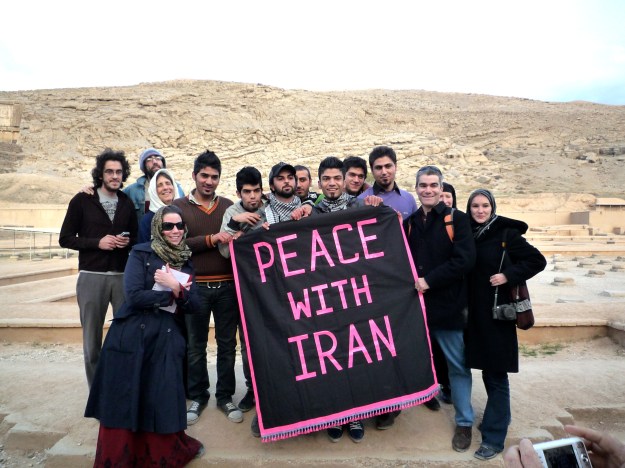
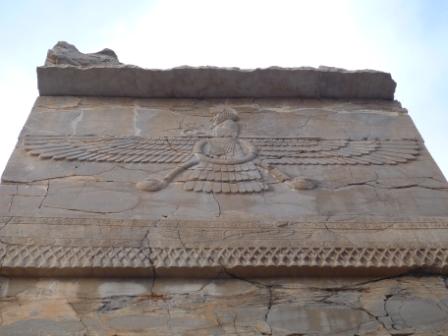
It would have been extremely interesting to dialogue with members of the Zoastrian community, but alas, we learned at the last minute that they were not available to meet us at the Temple. Still, it has been impossible for us to ignore the impact of this ancient religion upon present day Iran. The image of Ahura Mazda, the Zoastrian God, is ubiquitous throughout the country, not only at the ancient ruins of Persepolis (above), but on travel signs, office buildings and souvenir stands.
An interesting anecdote in this regard: when we were at Mofid University in Qom, one young student of Islam proudly showed me his Ahura Mazda necklace, and told me this image was an important part of his history. When I asked if any of his clerical teachers objected, he emphatically shook his head. “It is an important part of our history,” he said. To be sure, more than one person has told us that the Islamic regime is lenient about such things because it understands the importance role Zoastrianism plays in the cultural life of Persia
Another central aspect of the Iranian collective soul, of course, is their poetry. Iranians are justifiably proud of their literary tradition; every Iranian child is read Ferdowsi’s epic “Shahnameh” as well as national poets such as Hafez, Saadi and Rumi. The more time we spend here, the more I realize we can never underestimate the depth of pride that Iranians have in their national/cultural traditions. It is a modern-day nation can literally experience its own history back across thousands and thousands of years. And though they have been dominated by countless empires over the centuries, they have never surrendered their unique connection their culture, their heritage, their history, their language.
This is something that is very difficult for Americans in particular to grasp – our national history goes back little more than 200 years and most of us ultimately originate from somewhere else. While we study American history, our connection to it is nowhere near as profound at that of Iranians to theirs’. At the same time, for most Americans, Iran is just another Islamic nation in the Middle East. However, you have only to spend a small amount of time here to understand that this country is much, much more.
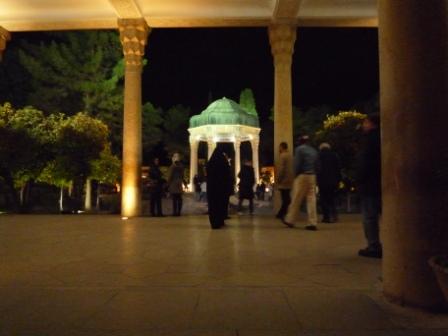
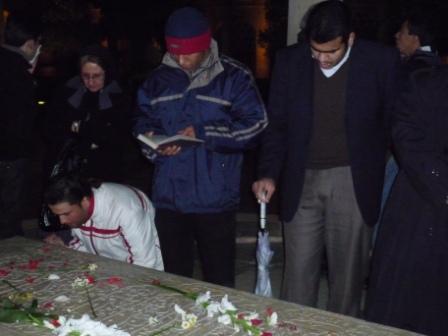
I’m sure this sounds like a cliché, but it’s true: in order to understand Iranians, you must understand their poetry. Or at the very least, to their deep connection to their poetry that truly sings in their soul. For example, among the most important cultural landmarks in Iran are the tombs of their poets, which serve as almost quasi-sacred sites. Last night we went to two of the most important in Shiraz: the Tomb of Saadi and of Hafez. I’m still at bit mind-blown by our experience at Hafez’s tomb in particular (top pic), which was unlike anything I’ve ever experienced. It’s an immensely popular site for Iranians, particularly young Iranian young people, whose idea of a great evening is to visit Hafez’s tomb and read his spiritually passionate poems of wine, longing and romance (see below). It’s also something of a romantic hot spot, where young people can mingle, meet and (I imagine) maybe even get lucky…

We’ve heard that the social atmosphere in Shiraz is a bit looser than in other Iranian cities, and that the regime’s “Morality Police” tend to let things go there a bit more easily. And apparently the Tomb of Hafez is one of the few places in Iran where young people of the opposite sex can mingle together publically without few of official harassment.
This certainly seemed to be the case last night. Throngs gathered near and around the crypt, reading poems, laughing and chatting. We spent a fair amount of time meeting and talking to folks and wouldn’t you know it, inevitably someone from our group got hit upon. Sarah Bassin reported later that a young man approached her, asked her where she was from, told her about how bad his marriage was, then proclaimed to her: “Your face is delicious.”
After teasing Sarah mercilessly about her quintessentially Persian encounter, we all agreed that our brief sojourn at Hafez’s tomb was unexpectedly and deeply moving. I’d say there is much we Americans can learn from a culture as profound as this one.
Farewell to Esfahan

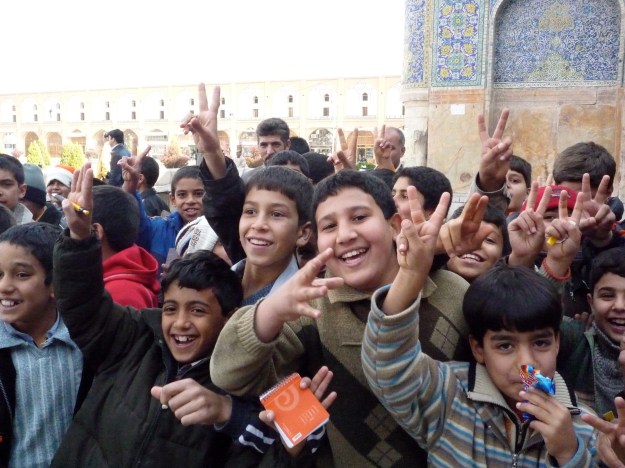
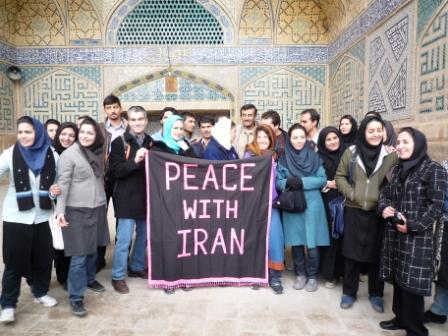
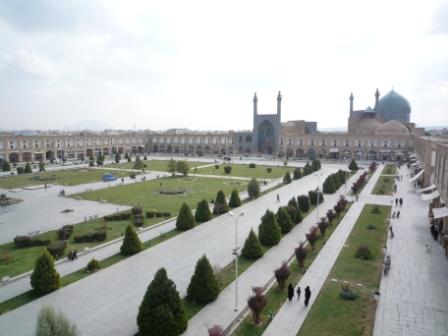
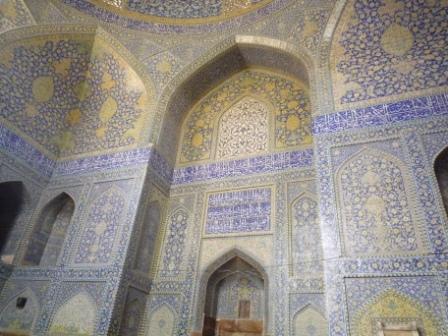
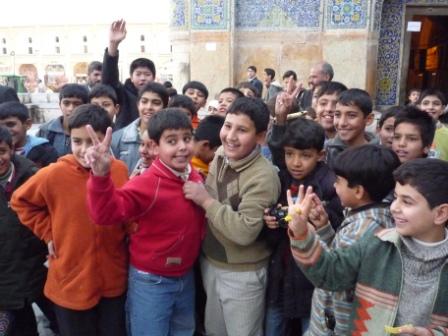
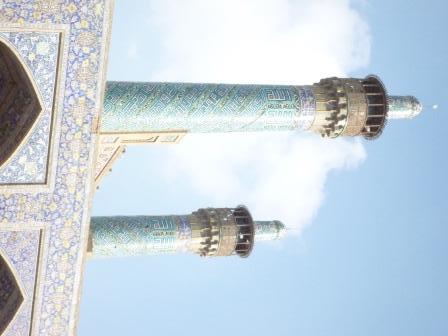
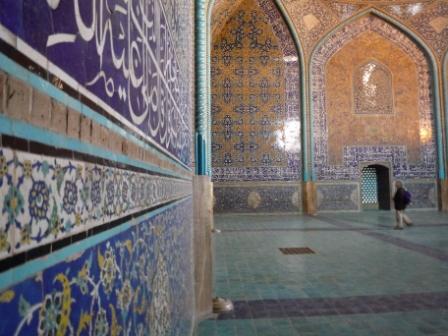
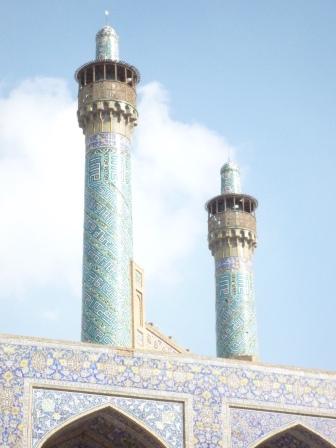
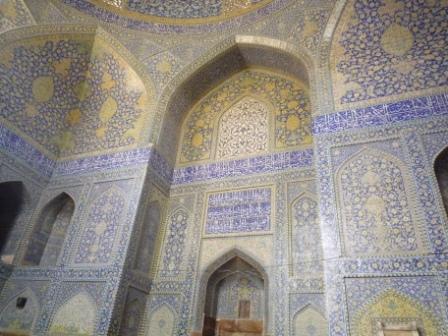
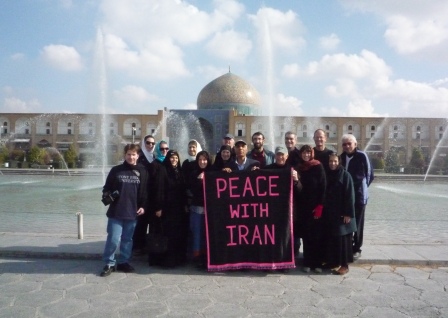
We’ve spent the last two days in Esfahan and we’re leaving for Shiraz early tomrrow morning. There is much to say about our stay in this gorgeous historic city – most of our time has been spent touring exquite 17th century mosques, hiking about massive, majestic Imam Square which stretches out for more than 80,000 square meters and is one of the largest city squares in the world. Have also been speaking extensively with the locals. All of the above has been richly and profoundly rewarding.
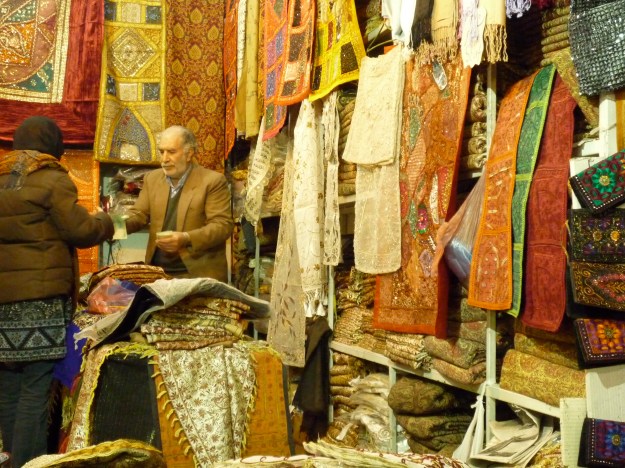
For this one, I’ll just let the pictures do the talking…


Dialogue in Qom
We’re in Esfahan now (unquestionably one of the most stunning cities I’ve ever visited) but I want to tell you first about our day yesterday, which we spent at Mofid University in the city of Qom.
Qom is considered a holy city for Shia Islam and is the largest center for Shia scholarship in the world. In addition to traditional Islam, most of the seminaries also offer courses in social sciences, Western thought and comparative religion. Mofid is considered one of the more liberal universities in Qom and is notable in particular for its interfaith research.
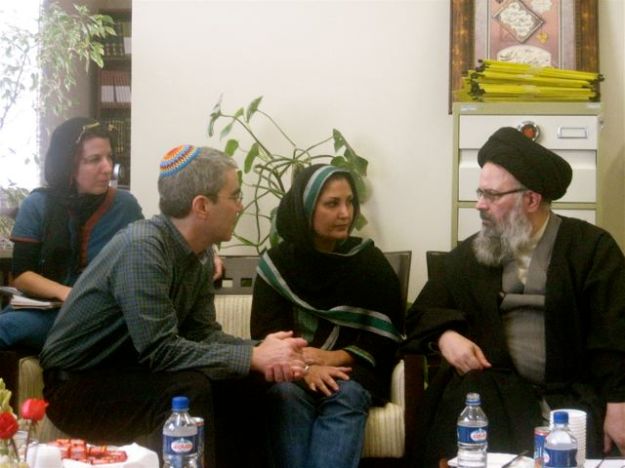
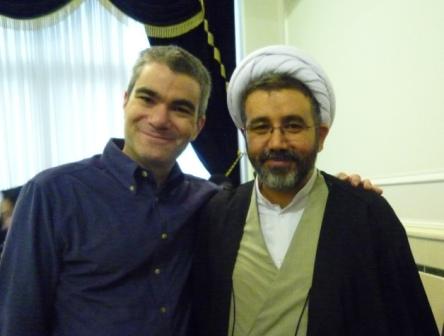
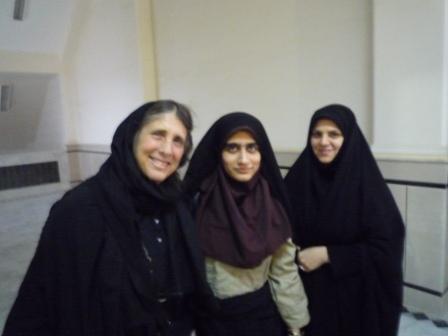
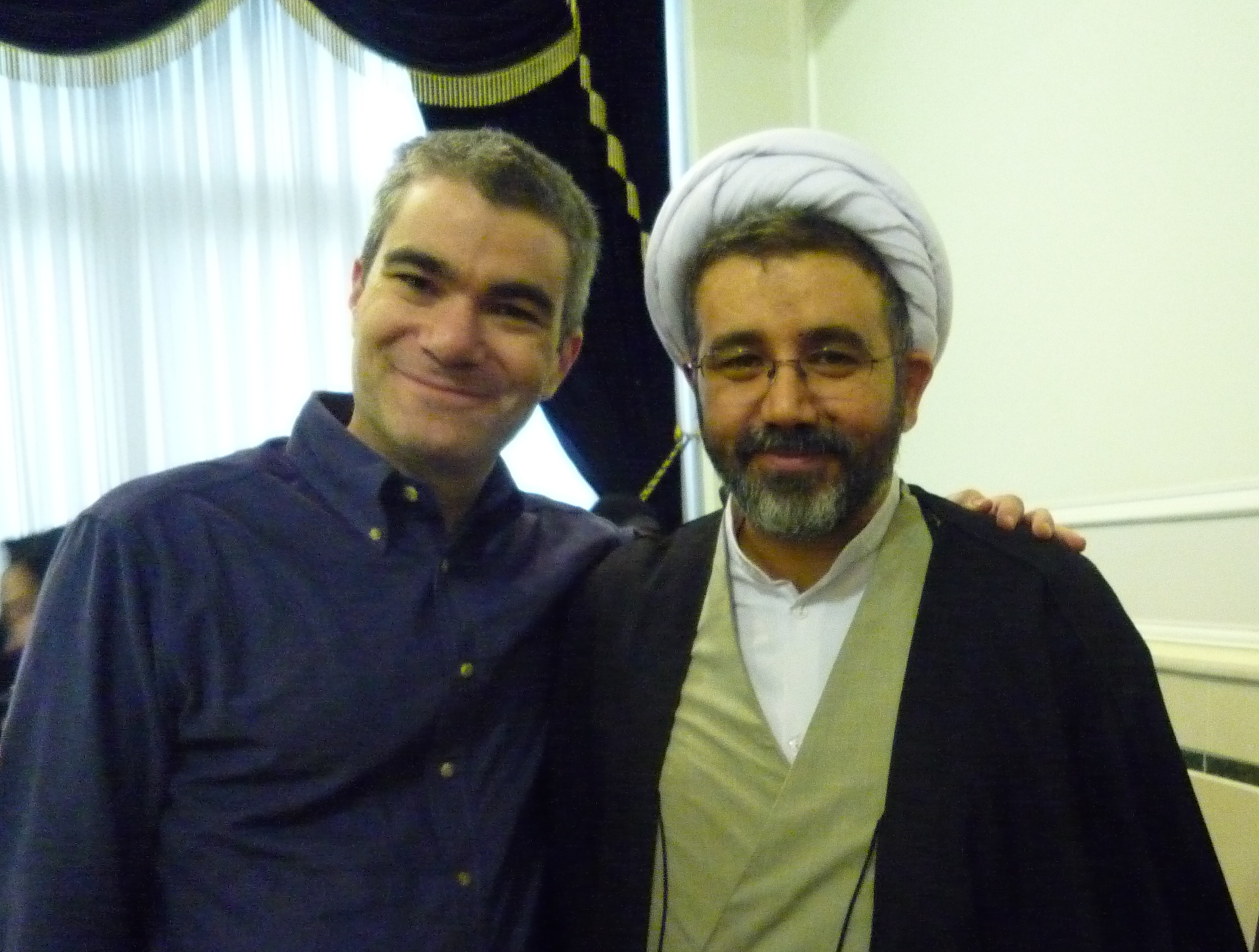
We spent the better part of the day at Mofid, visiting and dialoguing with professors and students. Any preconceptions we may have had about an Islamic university in Iran went out of the window almost immediately. We introduced ourselves to our host and the professors introduced themselves to us – they included scholars who were versed in a remarkable variety of subjects including Jewish law, contemporary feminism and Western philosophy. That’s me above with Dr. Masoud Adib, who among other things has translated a book by Dr. Jacob Neusner (a prominent American Jewish scholar) into Farsi. In the pic below Rabbi Lynn (left) poses with Fatima (center) a graduate student who is currently studying Rashi’s commentary on the Torah and has translated the Book of Mormon into Farsi. On the right is Haydeh Rostam Abadi, who works with the Center for Interreligious Dialogue and has been traveling with us for the past few days. Her research, among other things, focuses on a comparison of the Catholic and Islamic concepts of revelation.
Our discussion took the better part of two hours. The professors discussed their study of the relationsip between Islam and the other religious traditions and their research in the fields of comparative religious philosophy and law. The theological validity and spiritual worth of all Abrahamic religions was a common and recurring theme . Members of our group also spoke about Jewish and Christian attitudes toward Islam. Our discussion was relatively brief in the scheme of things, but it was enough to give us all the sense that these Islamic scholars were deeply engaged in a wide spectrum of religious and philosophical ideas and that they had an abiding desire to meet and learn from others.
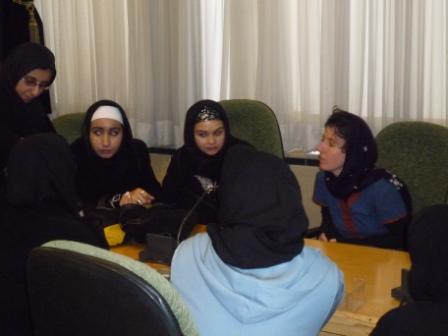
After our meeting we shared lunch with teachers and students and continued our conversation in a more informal manner. This was followed by a longer conversation with the thoughtful and enthusiastic students of Mofid. In the pic below, one of our younger delegation members, Ariel Vegosen (right) is chatting up a group of young students.
What can I say? Another day for smashing assumptions and preconceived notions to smithereens. I’m off to sleep now, but I’ll come back soon and tell you about our first day in ravishing Esfahan…
Rainy Day in Tehran
Our last day in Tehran was a rainy one, beginning with a visit to the headquarters of the Tehran Jewish Committee (roughly the equivalent of the Iranian Jewish Federation). We spoke at length with Committee President Rahmat ollah Raffi, who gave us a thorough tutorial on the Iranian Jewish community. In short: there are roughly 20 – 22,000 Jews in Iran. The majority live in Tehran, followed by Shiraz and Esfahan. Jews have had a long and noble presence in Persia – they have lived there for almost 3000 years, making them the oldest Diaspora Jewish community in the world.
Before 1979, there were over 100,000 Jews in Iran. As many were royalist supporters of the Shah, tens of thousands of Jews emigrated following the Islamic revolution. Most now live in the United States – there are approximately 40,000 Iranian Jews living in Los Angeles alone. The Jews who chose to remain in Iran, however, are fiercely proud of their Persian Jewish heritage and those with whom we spoke told us they feel very comfortable living as Jews in an Islamic nation. Judaism, along with Christianity and Zoastrianism, are officially recognized religions, which allows them to get significant subsidies from the government as well as Parliamentary representation. (It was pointed out to us that while the Iranian Constitution stipulates one member for every community of 500,000, the Jewish community has been granted a representative even though they only number 20,000).
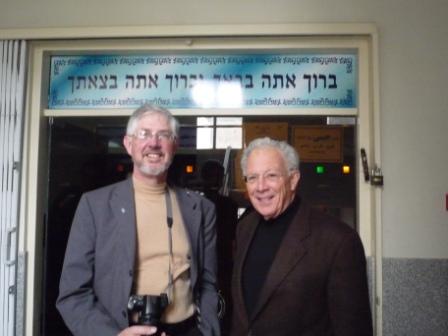
The Tehran Jewish Committee (and other Jewish centers in smaller Jewish communities) supports a variety of community institutions, including synagogues, religious schools, kosher butchers and restaurants, and Jewish cemeteries. They also support major Jewish medical center in Tehran about which they spoke with particular pride. The Dr. Sapir Hospital was founded 60 years ago and was originally the only hospital serving the Jewish community in Iran. It now has 120 beds and only 5% or so of their patients are Jewish. Most of the physicians, however, are Jewish and many of them have received awards from the government. Remarkably, Sapir Hospital receives no money from outside Iran. (Pic below: Alan Gratch and FOR Executive Director Mark Johnson at the entrance to the Center office).
The Center is also extremely active in Jewish cultural projects: they publish a Jewish magazine called “Bima,” and have begun publishing cultural/religious books in Farsi. All told, the activities of the Iranian Jewish Committee point to a strong Jewish community. One leader told us that they considered themselves to be Iranian Jews rather than Jewish Iranians – their strong connection to Persian heritage is in many ways the primary and driving aspect of their Jewish identities.
The Jewish leaders with whom we met stressed repeatedly that they have good relations with the Islamic government and said that they strive to remain apolitical in all their dealings. In certain ways, however, it seemed to me that for them, “apolitical” meant toeing the Iranian political party line. Their attitude toward Israel is the most primary example – whenever they spoke of Israel, it was invariably in a disparaging manner characteristic of official Iranian government pronouncements. Although they insist they live well as Jews in Iran, it seemed clear to me that they’re extremely careful not to make waves.
Though it’s hard to imagine that Iranian Jews don’t feel their existence in the Islamic Republic isn’t precarious to some extent, we still came away from our meeting with the impression that this was a vital community with a strong sense of itself and its heritage. One man we spoke to said that religious Jews generally welcome the opportunity to live in a religious nation. He added with sadness that Iranian Jews who emigrate to America tend to assimilate into secular American culture. Here in Iran, he said, Muslim religiosity tends to dovetail with Jewish religiosity, especially with those customs that are similar to Islamic customs like head covering or regular daily prayer. (Check out the interesting pic at the top: our meeting room at the Jewish Committee’s office: note the wall with the Jewish Ten Commandments next to the pictures of Ayatollahs Khomeini and Khameini…)
Even with all the complexities involved, I can’t help but feel that we American Jews are missing out on a huge opportunity by failing to learn about and forge greater ties with Iranian Jewry. This is truly an exciting and vibrant community and we clearly have a lot to learn from each other. I’m excited with the prospect of building upon the relationships that we’re creating here.
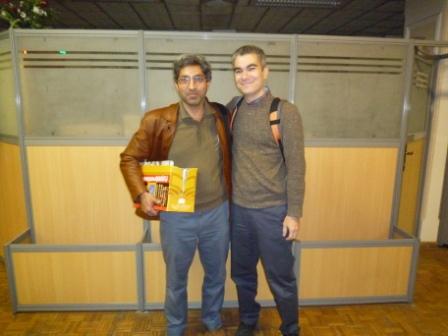
The other highlight of our day was a visit with Habib Ahmadzadeh, an Iranian writer, filmmaker and peace activist. Habib, who we met through Leila, is a veteran of the Iran-Iraq war. He was sixteen years old and living in a West Iranian border town when the Iraqi army invaded and he spent the next eight years defending his home town. Most of Habib’s creative work deals with war – and with the Iran-Iraq war in particular. One of his novels was recently translated into English and he wrote the screenplay for the acclaimed Iranian feature film, “Night Bus,” based on one of his short stories. (That’s me and Habib in the pic below):
We met Habib in his Tehran office, where he screened the film for us. It’s a powerful war drama about a teenage Iranian soldier who is given the job of escorting 38 Iraqi POWs on a bus to prison camp. In our conversation afterwards, we learned that the majority of the events in the movie were based on his own war experiences.
We in the West know very little about this eight year war, but it for Iranians it continues to be a traumatic and transformative event. Almost an entire generation of young Iraqis were decimated by the Iran-Iraq war, in which hundreds of thousands of young, ill-equipped Iranian men were sent in human wave attacks to almost certain death. Many, including Habib, are living with the terrible after affects of chemical weapons poisoning.
In addition to his creative work, Habib is a committed anti-war activist. His production company recently took “Night Bus” to the western border towns to screen for young people in the small western communities where the war was fought. He hopes to show the film to greater numbers of Iraqis as well, to help raise consciousness about war and its tragic after affects.
Habib has also worked considerably to raise awareness about the downing of an Iranian passenger plane by an American warship, the USS Vincennes, in 1988. 290 Iranian civilians died in this tragedy, which the US government originally covered up and for which it has never apologized. (Adding insult to tragedy, some officers of the Vincennes were actually awarded medals in the wake of the disaster). Again, most Americans barely remember this event, if they remember it at all. But as Habib and others have told us, Flight 655 is Iran’s 9/11 – and it remains as yet one more painful obstacle to Iranian-American reconciliation.
Habib has gained some fame for a public letter he wrote to the Captain of the Vincennes, Will Rogers III, who remains implacably unrepentant to this day. It’s a remarkable document, filled with pain, but also a powerful palpable desire for reconciliation. In its way, I think, it seems to speak for many in this country.
Tommorow we’re off to Qom to dialogue with Muslim scholars at Mofid University.

The Ayatollah and the Archbishop
Our first full day in Iran was devoted largely to religious destinations – our first stop was a visit to the office of Ayatollah Bojnoordi, a prominent religious leader who teaches Islamic law at Tehran and Qom Universities.
Ayatollahs are clerics of the highest order in Shia Islamic communities and they exercise enormous authority over their respective flocks. They are educated in seminaries, the most prominent of which are located in Najaf, Iraq and Qom, Iran (we will be traveling to Qom on Monday). Ayatollahs are awarded their titles after attending many years of rigorous training, which include such subjects on theology, jurisprudence, literature, as well as grounding in Western as well as Islamic philosophy. The status of an Ayatollah depends largely upon his scholarship and publication as well as the breadth of his patronage over his congregation. In Iran, of course, Ayatollahs can be political as well as religious leaders. Though the country is governed by a parliamentary democracy, no political decisions can be made without the ultimate approval of Iran’s Supreme Council of Ayatollahs and the Iran’s Supreme Leader, the Ayatollah Khameini.
Like all of our Iranian hosts, Ayatollah Bojnoordi received us with the requisite Persian hospitality. (At every meeting we attend, we are invariably served with a generous spread of cakes, fruit, coffee, tea, juice etc.) He spoke to us for the better part of an hour, with Leila serving as interpreter. His message was largely one of religious tolerance and reconciliation: he said emphatically that he believes Islam teaches all Abrahamic religions ultimately have the same aim: to promote peace and coexistence. Quoting the Koran, he said that peace is the ultimate goodness and war is the ultimate evil. (Interestingly, he also cited Hobbes’ assertion that war represents the animal aspect of humanity). He condemned all who used violence to achieve their aims – adding that all Muslims who act violently act counter to the way of Islam.
The Ayatollah also did not flinch from addressing politics head on. He underlined Imam Khomeini’s statement that Iran is a peaceful nation that doesn’t want war with anyone. He mentioned that in the past two hundred years, Iran has never invaded another country. The eight year war with Iraq, he said, was a defensive war against a country that aggressively sought to seize Iranian territory. He made a point of saying that Iran is surrounded directly by fourteen countries and it must constantly be on its guard, especially against the US, who has a significant military presence in the region and has made periodic threats to invade their country. He made no bones about his loathing of George Bush in this regard and he expressed his hope that our new President will pursue a path of peace.
After we spoke, our group peppered him with questions, most of which he answered with what I believed was genuine thoughtfulness. While I agreed with much of what he said, I was eager to engage him more on the political front – and since he was so candid in opening the door on political issues, I decided to press him a bit. He had mentioned earlier that he thought Hezbollah was a force for good and unity in Lebanon. I asked him, given his condemnation of the use of violence, what he thought about Hezbollah’s claim of responsibility for numerous suicide bombing attacks.
To my surprise, he thanked me for my question. He responded that he believed these bombings were wrong and that he condemned them. But he added that since Hassan Nasrallah has assumed leadership of Hezbollah he believed the organization was making important strides in changing their approach and that he hoped/expected them to convert from a primarily military force to a political party.
In the end, I realized that as much as our trip is focused on interfaith dialogue, you can never completely divorce religion from politics, especially in a nation such as Iran (which is, after all, governed by clerics). As regards this particular conversation, I can only say that while I didn’t always agree with his political assertions, I never once felt that he was speaking to us in a disingenuous or cynical way. I saw something authentic about the way in which he received us and I did indeed believe him when he told us finally, that everything he said to us came from the bottom of his own heart.
For our part, we must constantly bear in mind that we have not come here to debate or coerce. The goal of our delegation is to learn, to share, and to create connections within what is currently a terribly poisoned atmosphere between our two countries. And at the end of the day, I genuinely believe that meetings such as this, in a small but critical way, contribute to that goal.
Our next stop was a visit with the Armenian Archbishop Sebouh Sarkissian at the Armenian Apostolic and Orthodox Church. Christianity, like Judaism, is an officially recognized religion in Iran and the Archbishop stressed to us that there have been Armenians in Persia even before the era of Jesus. Among other things, he stressed to us that the Islamic Republic is a religiously tolerant nation, and whatever difficulties there might be to live as a Christian in a Muslim nation, they were far outweighed by the benefits. (I am eager to explore the role of religious minorities in Iran further when we visit Jewish communal leaders on Sunday.
Like the Ayatollah, Archbishop Sarkissian addressed politics unabashedly, and he made no bones about his disgust that the US and Israeli governments refuse to officially recognize the Armenian genocide. But also like the Ayatollah, he espoused a tolerant and universal religious world view. I was especially taken by one comment: when asked of his opinion of evangelism, he emphatically rejected religious coercion, stating that in his view, “dialogue is a new kind of evangelism.”
Our final visit of the day was with our hosts at the Center for Interreligious Dialogue. The Center is technically affiliated with the Iranian government (through the Department of Education and Research) but it operates in a sphere that ranges far beyond the government, conducting academic research and dialogue with a wide spectrum of faiths. The Center’s Director, Dr. Rasoul Rasoulipour, is a Professor of Philosophy and is clearly committed to religion as a force for uniting peoples. He also been the guiding presence for these eight FOR delegations from the Iranian side and his commitment to the power of dialogue and relationship is immediately obvious. We were all immediately taken by his warmth and humor, even as exhausted as we were by our first full day in Iran.
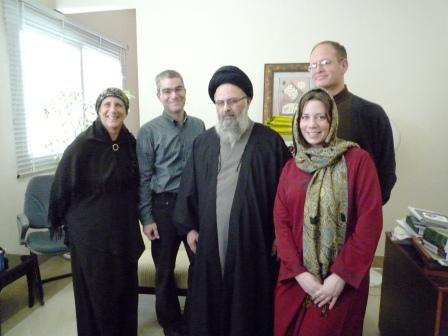
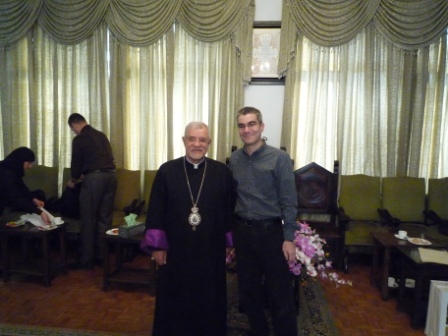
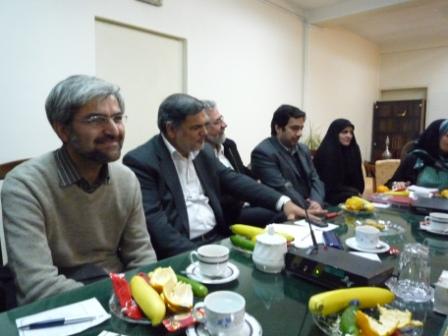
(Top pic: Rabbi Lynn Gottlieb, me, Ayatollah Bojnoordi, (HUC Rabbinical Student) Sarah Bassin, Brother Clark Berge (Franciscan); middle pic: me with Archbishop Sarkissian; Bottom pic: leadership of the Center for Interreligious Dialogue, Dr. Rasoulipour is on far left)