 I’m sure there are many who watch Israel’s Jewish settlement policy unfold in the West Bank and East Jerusalem and ask themselves: is there actually a method to this madness? Among the most compelling answers to this question comes from veteran Israeli peace activist Jeff Halper, co-founder and coordinator of the Israeli Committee Against House Demolitions.
One of the truly great Israeli peace organizations, ICAHD has been indefatigably tracking the demolition of homes and evictions of Palestinians in the Occupied Territories since 2007. Even more critically, Halper and Co. have been exposing Israel’s institutionalized displacement of Palestinians and their resettlement in concentrated areas throughout the West Bank.
In an interview last week, Halper offered a detailed – and profoundly troubling – picture of Israel’s resettlement of Palestinians throughout the Occupied Territories:
(Area C of the West Bank) contains less than 5 per cent of the Palestinian population. In 1967 the Jordan valley contained about 250,000 people. Today it’s less than 50,000. So the Palestinians have either been driven out of the country, especially the middle class, or they have been driven to areas A and B. That’s where 96 or 97 per cent of them are. The Palestinian population has been brought down low enough, there is probably somewhere around 125,000 Palestinians in area C, so Israel could annex area C and give them full citizenship.
Basically, Israel can absorb 125,000 Palestinians without upsetting the demographic balance. And then, what is the world going to say? It’s not apartheid, Israel has given them full citizenship. So I think Israel feels it could get away with that. No one cares about what’s happening in areas A and B. If they want to declare a state, they can…
In other words, we’re finished. Israel is now from the Mediterranean to the Jordan River, the Palestinians have been confined in areas A and B or in small enclaves in East Jerusalem, and that’s it.
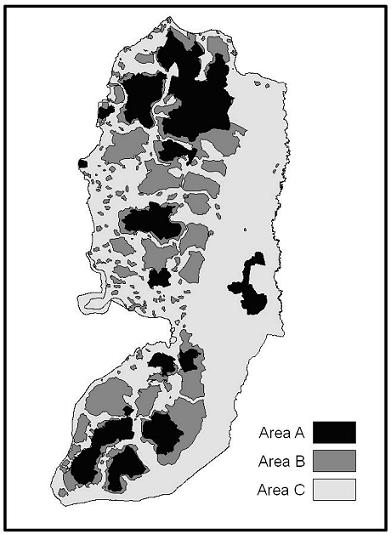
To better understand Halper’s point, look carefully at the map on the top right of this post. Areas A, B and C refer to regions that were created through the terms of the 1993 Oslo Accords. According to the agreement, Palestinians are responsible for security and for the civil administration of Area A; Area B is under Israeli military control and Palestinian civil authority; and Area C is under total Israeli military and civil control. (In reality, however, the Israeli military has ultimate control over all three areas – for over a decade the IDF regularly has made incursions into Areas A and B with impunity).
According to the terms of the Oslo Accords, these three regions were intended to be temporary until 1998; today they have become permanent facts on the ground. As you can see from white portions of the map, Area C comprises the strong majority of the West Bank. It contains nearly all Israeli settlements; it is crisscrossed by Israeli-only access roads that connect the settlements to each other and to Israel proper; it includes large buffer zones and almost all of the Jordan Valley and the Judean Desert (the large swath of white on the east).
As Halper points out, Israel is pursing policies that are systematically driving Palestinians out of Area C, to the extent that these regions now contain less than 5% of the population. The overwhelming majority of West Bank Palestinians now live in Areas A and B (on the map, grey and black) – which are essentially concentrated, disconnected cantons separated by checkpoints and choked off from Israel by the Separation Wall.
Bottom line? Israel has succeeded extending its control over the majority of the West Bank by moving Palestinian residents into what amount to “legal” open-air prisons – or as Halper calls it,”warehousing.”
(Warehousing) captures what’s going on better than apartheid. Warehousing is permanent. Apartheid recognizes that there is another side. With warehousing it’s like prison. There is no other side. There is us, and then there are these people that we control, they have no rights, they have no identity, they’re inmates. It’s not political, it’s permanent, static. Apartheid you can resist. The whole brilliance of warehousing is that you can’t resist because you’re a prisoner.
Prisoners can rise up in the prison yards but prison guards have all the rights in the world to put them down. That’s what Israel has come to. They are terrorists and we have the right to put them down. In a sense Israel has succeeded with the international community, and the US especially, in taking out of this situation the political. It’s now solely an issue of security, just like in prisons.
Halper actually predicted the warehousing phenomenon as long ago as 2008, in an important piece that offered an in depth analysis of Israel’s practices throughout the West Bank. Among other things, he compared Israel’s practice to South Africa’s creation of Bantustans, in which 3.5 million black South Africans were forced from their homes from the 1960s through the 1980s:
Warehousing…is in many ways worse than the Bantustans of apartheid-era South Africa. The ten non-viable “homelands” established by South Africa for the black African majority on only 11% of the country’s land were, to be sure, a type of warehouse. They were intended to supply South Africa with cheap labor while relieving it of its black population, thus making possible a European dominated “democracy.” This is precisely what Israel is intending – its Palestinian Bantustan encompassing around 15% of historic Palestine – but with a crucial caveat: Palestinian workers will not be allowed into Israel. Having discovered a cheaper source of labor, some 300,000 foreign workers imported from China, the Philippines, Thailand, Rumania and West Africa, augmented by its own Arab, Mizrahi, Ethiopian, Russian and Eastern European citizens, Israel can afford to lock them out even while withholding from them a viable economy of their own with unfettered ties to the surrounding Arab countries. From every point of view, historically, culturally, politically and economically, the Palestinians have been defined as “surplus humanity;” nothing remains to do with them except warehousing, which the concerned international community appears willing to allow Israel to do.
Perhaps most crucially, Halper places Israel’s policies and practices within a larger global context. He refers to a “Global Palestine”: a new 21st century reality in which political considerations and human rights are jettisoned in favor of a corporate-military model that seeks to control, manage, contain (and profit from) “surplus populations.”
Again, from last week’s interview:
(Warehousing) does not have any legal reference today but we’d like to put that in because warehousing is not only in Israel. Warehousing exists all over the capitalist world. Two-thirds of the people have been warehoused. That’s why I’m writing about Global Palestine. I’m saying that Palestine is a microcosm of what’s happening around the world.
Even though Jeff Halper may be a secular Israeli anthropologist, I believe him to be a prophetic figure of the highest order. He has long been speaking hard truths on the wages of corrupt power in his country. Do we have the courage to listen to his message?
 I recently had the pleasure of being interviewed on WBAI radio’s “Beyond the Pale” to discuss Peter Beinart’s (much-discussed) new book “The Crisis of Zionism” with hosts Lizzy Ratner and Adam Horowitz.



 Shalom Rav