Category Archives: Poetry

For Passover: “Your Child Will Ask”

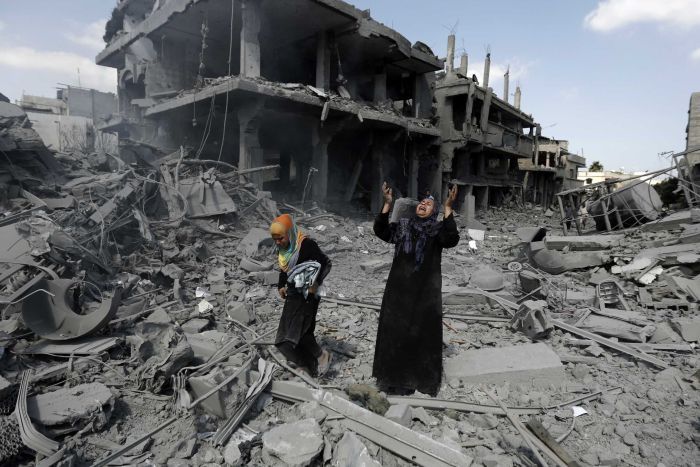
europe-migrants-hungary

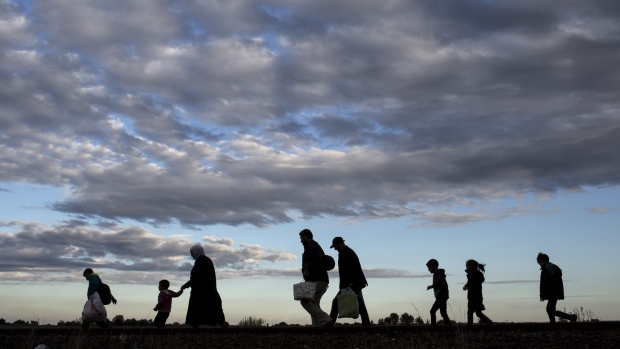
Photo:Marko Djurica/Reuters

Your child will ask
why do we observe this festival?

And you will answer
it is because of what God did for us
when we were set free from the land of Egypt.

Your child will ask
were we set free from the land of Egypt
that we might hold tightly
to the pain of our enslavement
with a mighty hand?

And you will answer
we were set free from Egypt
that we might release our pain
by reaching with an outstretched arm
to all who struggle for freedom.

Your child will ask
were we set free from the land of Egypt
because we are God’s chosen people?

And you will answer
we were set free from the land of Egypt
so that we will finally come to learn
all who are oppressed
are God’s chosen.

Your child will ask
were we set free from the land of Egypt
that we might conquer and settle
a land inhabited by others?

And you will answer
we were set free from the land of Egypt
that we might open wide the doors
to proclaim:

Let all who are dispossessed return home.
Let all who wander find welcome at the table.
Let all who hunger for liberation
come and eat.

Kevin Coval Rewrites the Haftarah for Yom Kippur – Chicago Style

Jeffrey_Conroy_mosaic_2

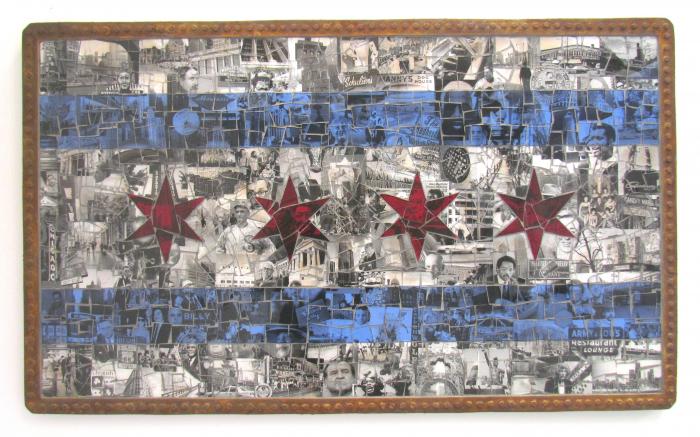
mosaic by Jeffrey Conroy

Written and read by Chicago poet Kevin Coval as the Haftarah for Tzedek Chicago’s Yom Kippur service yesterday:


atoning for the neo-liberal in all or rahm emmanuel as the chicken on Kapparot

written on the eve and day of Yom Kippur

Do you call that a fast,
A day when the Lord is favorable?
No, this is the fast I desire:
To unlock the fetters of wickedness,
And untie the cords of the yoke
To let the oppressed go free;
Isaiah 58: 5-6

you are the first jewish mayor of Chicago
but have not yet lit one yahrzeit candle
for constituents murdered by the police.

you vacation in montana with the governor
bring your family to Chile on a whim
and never worry about crossing borders
or encountering their patrolmen
or the rent upon return.

your grandparents sought refuge here.
escaping those trying to end them.
they came, worked, learned, created
a life that enabled your parents to raise you
in the suburbs: the immigrant face of the american dream.

when your parents took you
to visit sick children in Israel
you cried. now you clothe
feed, care and ensure
your children’s safe passage
and university of Chicago
lab school tuition, $30000
per year, but you have closed
over fifty public schools
in neighborhoods your family
used to live in. neighborhoods
you no longer live in or love
or allow your children to visit.
neighborhoods bustling with Black
and Brown bodies, whose children
must cross borders called gang lines
you are well aware of, yet wonder
why the murder rates rises.

you dismantle the same system in which your family benefited:
union pay, livable wages, park space safe enough to play outside
arts funding to take ballet, a decent well-rounded public education.

the same ladder your family climbed
you kick the rungs from.

if the schools, housing, health care
trauma centers and corners that cause trauma
are fair across this flat, segregated land-
then eat today. every day there is a harvest
on the carcass of this city for sale. the satiated
carve at a distance, plan and map and redistrict

with careless indifference. how many times
have you been to Kenwood, Woodlawn
Lawndale. what are the names of the people
you know there. what homes have you sat in.

how can you fast
this week, when food
was refused by grandmothers
and educators and organizers
in your back yard, in the front
lawn of a school Chief Keef attended
in a neighborhood you militarize;
more guns and police your solution
to poverty or an extermination strategy.

how can you fast
when those on hunger
strike you couldn’t stand
with in the same room
in a public forum
which is your job by the way:
to listen. you are the antithetical
Studs Terkel.

this not the city he loved
to listen to, not the city
your grandparents were promised

where is your apology
for sending so many jobs elsewhere
for privileging your childrens’ future
and pillaging others’

what do you know of labor
and no savings account and counting
pennies for a pass, for permission to move
or see a movie or museum in this city
of no access and grand canyons of inequity.

your middle name is Israel
it’s come to mean apartheid
in the city, you are mayor
and in Palestine, the city
your family colonized.

there is no safety
said my G-d
for the wicked (1)

for the divvier of cities
for the divider of nations
for the ignorer of horror
for the builder of walls

atone for the smug assuredness
atone for the maintenance of two cities
stratified and unrecognizable to the other
atone for the bounty of the north side
the scarcity of the south
the want of the west
atone for the erasure of the public
school, space, housing, parking
atone for the centrism, the move right
the cow-tow to corporations
atone for the inconceivable income disparity
between those funding your campaign
and those over which you reign
atone for the city’s change
it’s white wash and removable
workers who used to make it
work by working
in jobs with pensions
and benefits
atone for the benefits we have
by merely being white
on the north side of the city
country where that is enough
to make you safe and not think
about driving a car or going
for a jog or walk outside
atone for the rite to the city
that’s for some, not for all
not for real

israel means may G-d prevail

and we pray that’s real, for real
amen
____________________________
Isaiah 57:21 (1)

For Tisha B’Av: A Lamentation for Gaza

5626830-3x2-700x467

This Monday night begins the Jewish fast of Tisha B’Av: a day of mourning for the calamities that have befallen the Jewish people over the centuries. Among other things, the traditional Tisha B’Av liturgy includes the chanting Biblical book of  Lamentations.

Given the profoundly tragic events currently unfolding in Gaza, I offer this reworking of the first chapter of Lamentations.  I share it with the hope that on this day of mourning we might also mourn the mounting dead in Gaza – along with what Israel has become…

A Lamentation for Gaza

Gaza weeps alone.
Bombs falling without end
her cheeks wet with tears.
A widow abandoned
imprisoned on all sides
with none willing to save her.

We who once knew oppression
have become the oppressors.
Those who have been pursued
are now the pursuers.
We have uprooted families
from their homes, we have
driven them deep into
this desolate place,
this narrow strip of exile.

All along the roads there is mourning.
The teeming marketplaces
have been bombed into emptiness.
The only sounds we hear
are cries of pain
sirens blaring
drones buzzing
bitterness echoing
into the black vacuum
of homes destroyed
and dreams denied.

We have become Gaza’s master
leveling neighborhoods
with the mere touch of a button
for her transgression of resistance.
Her children are born into captivity
they know us only as occupiers
enemies to be feared
and hated.

We have lost all
that once was precious to us.
This fatal attachment to our own might
has become our downfall.
This idolatrous veneration of the land
has sent us wandering into
a wilderness of our own making.

We have robbed Gaza of
her deepest dignity
plunged her into sorrow and darkness.
Her people crowd into refugee camps
held captive by fences and buffer zones
gunboats, mortar rounds
and Apache missles.

We sing of Jerusalem,
to “a free people in their own land”
but our song has become a mockery.
How can we sing a song of freedom
imprisoned inside behind walls we have built
with our own fear and dread?

Here we sit clinging to our illusions
of comfort and security
while we unleash hell on earth
on the other side of the border.
We sit on hillsides and cheer
as our explosions light up the sky
while far below, whole neighborhoods
are reduced to rubble.

For these things I weep:
for the toxic fear we have unleashed
from the dark place of our hearts
for the endless grief
we are inflicting
on the people of Gaza.

Shalom Rav Now On Sabbatical!

indexYou may have noted that my posts on Shalom Rav have gotten fewer and more far between of late. There are many reasons for this, but the long and short of it is that I’ve decided to take a brief hiatus from my Shalom Rav postings – at least until after the Jewish High Holidays.

But don’t fret – in the remote possibility that you absolutely need to read my writing on a regular basis, you should know that I’m still posting daily poetry on my other blog, Yedid Nefesh (yes, my “Psalm a Day” project is still going strong!)  So please feel free to check in and, as always, to add your thoughts and comments.

All the best for a restful and renewing summer.

Annoucing: A Psalm a Day!

Sefer Tehillimx506

I’ve just taken on the ambitious goal of writing poetic renderings of the Biblical Psalms – one every day.

Those of you who have read my other blog, Yedid Nefesh, know that I enjoy writing my own version of “Biblical free verse.”  It’s my own way of commenting on these texts  – by shaping them into a poetic format that broadens (and often subverts) their literal meaning.  I’ve done new versions of several Psalms in the past and have often flirted with the idea of taking on all 150. So here I go!

I’m going to do my level best to hold to my one a day quota (except for Shabbat/Saturday). For maximum impact, I recommend reading them together with a more traditional translation (or if you read Hebrew, obviously, the original text.)  They will all be posted on Yedid Nefesh – I hope you enjoy reading them and would love to hear your thoughts and responses!

Click here for Psalm 1.

Kevin Coval’s “Schtick” – A Take-No-Prisoners Jewish Classic

602968_489173091137490_436884167_n

I’ve just finished Chicago hip-hop poet Kevin Coval’s soon-to-be-released book, “Schtick” (Haymarket Books) – a collection of poems that takes aim and fires at the sensitive edge of every nerve ending in the American Jewish psyche. It’s a new take-no-prisoners Jewish classic.

Coval has long been known here in Chicago as one of our great local treasures. He’s probably best-known as the founder of “Louder Than a Bomb: The Chicago Youth Poetry Festival,” which was recently the subject of an award-winning documentary of the same name. He’s also the author of numerous poetry collections, serves as Artistic Director of Young Chicago Authors, and offers youth writing workshops throughout Chicago and beyond.

While Coval has explored Jewish identity through his writing before, “Schtick” is his most extensive published collection of Jewish-themed poems thus far. It includes previously released poems such as “what i will tell my jewish kids” and “why i stopped going to shul” together with more recently written pieces – en masse, they serve to dissect the post-modern American Jewish experience in as devastating a fashion as you are ever likely to read.

Although I’m a longtime Kevin Coval fan, I will confess that there were more than few times in which I flinched at this unabashed, occasionally venomous assault on the hottest of Jewish hot buttons. I will also say without hesitation that these poems deserve to be read and discussed by the widest possible audience.

At heart, Coval’s work places him in long and venerable tradition of Jewish dissident writers – a legacy he very consciously celebrates. Indeed, this dissident tradition is palpable throughout virtually every poem in this collection. In “what will i tell my jewish kids,” for instance, he writes:

we are a bridge people. red sea parters. translators
between the warring. we see connections. the i in i
the i in thou. Buber taught us that or was it Haile Selassie
or Freud? and what was it Marx demanded, we live as Moses
bent and davening toward justice. a radical equity where everything is
sacred or nothing is. Einstein to unify the chaos.
Emma Goldman to arrange the pieces.

Though there will inevitably be those who find Coval’s writing to be the work of a “self-hating Jew” (he confronts this very issue in a poem entitled, you guessed it, “self-hating jew”), I’d suggest the poems in “Schtick” are quintessentially Jewish. Coval walks proudly in the “self-hating” Jewish steps of Abbie Hoffman, Philip Roth, Howard Zinn and Groucho Marx – a path trod by generations leading all the way back to the young Abraham, the Jewish upstart who one day grabbed a stick and smashed his father’s icons to shards.

As the title of his book implies, Coval’s counts the edgiest of the edgy Jewish comedians among his favorite iconoclasts. His clearest hero and spiritual ancestor is the great Lenny Bruce (“Lenny the Prophet!/Elijah, opening doors”). Coval also pays loving homage to Don Rickles, Sid Casear, Roseanne and Joan Rivers, with particular appreciation for the way they habitually skewer the goyishe power elite – and get away with it. (In “Don Rickles Roasts Ronald Reagan” Coval portrays Rickles as a sacrilegious Jewish court jester, peppering the poem with excerpts from his routine at Reagan’s Second Inaugural Ball.)

Of course, Coval finds equal inspiration from rappers, poets, freedom fighters and truth tellers as diverse as Public Enemy’s Chuck D, Allen Ginsburg, Fred Hampton and (in a choice certain to stick in many a Jewish craw) Louis Farrakhan. His target of choice is the American majority culture of power, privilege and empire  – and the Jews who make their bed in it. He rails against racists of various shapes and sizes, including anti-Semitic icons Mel Gibson and Henry Ford as well as the recently resigned Pope Benedict (“the pope is a nazi/and this is the truth.”)
cityroom_20091230_mtownsend_143567_From_largeIn poem after poem, he delves deeply into the adventures and follies of Jewish assimilation into the white American establishment – an act that he paints as the ultimate betrayal of our minority Jewish heritage. In one notable series, he explores this complex, often absurd process through poetic profiles of show biz figures Irving “White Christmas” Berlin, Al Jolson (“the confused horrible hope of this new country”) and Jennifer Grey (a third generation Jewish performer whose nose job successfully derailed her film career.)

His poem, “how the jews became white” – a meditation on the tragic events that unfolded during the Springfield race riots of 1908 – unpacks the most extreme example of Jewish “assimilation” imaginable. Among the more infamous moments during the riots occurred when Abraham Raymer, a poor Jewish delivery man, was accused of participating in the murder and lynching of of William Donnegan, an elderly, relatively wealthy (and intermarried) African-American man in front of his wife and neighbors:

Donnegan is not isaac
Donnegan is the lamb
abraham sacrifices to the white
g-d of america
slit throat and strung up
front lawn of a house they’d burn
like temples.
abraham raymer
the yiddisher lyncher
the jury of peers
the acquitted
the freshly born
and baptized
american
white man

After reading this poem, I couldn’t help but think that while the lynching of Leo Frank has entered  deeply into Jewish mythic consciousness, the name Abraham Raymer remains utterly unknown to most American Jews. And that, of course, is precisely Coval’s point.

Coval’s forte has always been poems that seamlessly mix the personal with the political – and in the chapter entitled “the family business,” he explores Jewish identity politics through his own personal family history. While I doubt his family members will kvell at some of his revelations, his remembrances of his 1980s Bar Mitzvah (by turns mortifying, hilarious and heartbreaking), family seders and Thanksgiving dinners resonates with a deep truth and the kind of love that refuses to profane his memories with shallow nostalgia.

While American Jews of a certain generation will likely nod in recognition with many of his family reminiscences, Coval’s family poems manage to be both brilliantly universal and nakedly specific at the same time. He shines a particularly unflinching light on the painful dissonance he experienced growing up in an economically struggling Jewish family living in the Chicago suburb of Highland Park. Among other things, these profoundly personal reflections go a long way to explain his own deep identification with the Jews as a “bridge people.”

The chapter entitled “all the pharaoh’s must fall” contains his most directly political pieces, most of them centering on the subject of Israel/Palestine. And for all of his deeply edgy poems, I have no doubt that it is from here that “Schtick” will almost certainly receive the most venomous reception from the Jewish establishment.

While Coval has long addressed the issue of Israel in his work, he took on these themes on in earnest in 2009, when he publicly declared himself to be “a Jewish-American man in solidarity with the Palestinian people.” In a widely read article for the Huffington Post, Coval wrote:

I am in solidarity with Israeli and American and all people who work and risk their lives and livelihood for justice. I am not restricted to working within the confines of the Jewish-American community. Justice and the resistance to imperialism is a global, human concern for all people down to struggle. For Jews, yes, but not Jews alone. For Palestinians, yes, but not Palestinians alone. It will take us all to push and demand governments and corporate interests to create fair, equitable living conditions. It will take all people to hold history accountable for the atrocities that occur.

Coval has expressed these convictions in numerous poems he has written since then, many of which are included in this latest collection. The poignant “explaining myself[1]” is written as a plea for understanding to his father. The title poem of the chapter, a stirring call to action written in response to the Arab Spring, deserves to become a seder table staple.  And in his final poem, appropriately entitled, “post-schtick,” Coval uses an attempted lynching of Palestinian youths by Israeli teenagers as a frame for understanding the sorrows of Jewish empire: “you don’t ask the mouth/from which the rope hangs/to explain the reasons/it’s being lynched.”

In “on becoming a man,” Coval recalls that before his Bar Mitzvah service began, his rabbi made him promise that he would not return to be confirmed.  By standing so firmly on the third rail of Israel/Palestine, Coval is virtually ensuring that he will remain outside the proclaimed borders of the American Jewish establishment. No matter. In the meantime he continues to carve out an authentically Jewish place in the borderlands – a place where Jews have always made their most productive homes.

But make no mistake, Kevin Coval is not simply interested in tossing spitballs from the back of Hebrew school class. On the contrary, he’s knocking loudly at the door. His Jewish vision is carefully and mindfully cultivated, his grasp of Jewish cultural memory undeniable, his respect for his spiritual Jewish ancestors deep and palpably real. And he is among the leaders of an eloquent generation that seeks to find a genuinely Jewish voice to sound a universal message of liberation:

wake in this new day
we will all die soon
let us live while we have the chance while we have this day
to build and plot and devise
to create and make the world
just
this time for us
this time for all
this time the pharaohs must fall
After 11 Years, Nationalism is Still Our Preferred Expression of Grief

Immediately after September 11, I was so struck by the predominant collective response: the ubiquitous display of flags everywhere you looked; the knee-jerk “U-S-A! U-S-A!” chant whenever the tragedies were invoked; the widespread desire for retributive justice, wherever, however possible.

Now eleven years later, even after all that’s happened since, I’m just so saddened that nationalistic displays seem to be the only way we know how to commemorate our dead. Maybe I’m naive, but it’s difficult for me to accept that we still haven’t found a healthier national outlet for our grief.  Call me naive, but I was genuinely surprised – and quite honestly mortified – that the loudest cheers at the DNC last week (always accompanied by the still ubiquitous “U-S-A! U-S-A!”) were saved for references to 9/11 and the killing of Osama Bin Laden.

If you found yourself disturbed as well, I highly recommend that you read this recent piece by Glenn Greenwald, who sorrowfully identifies all that was wrong with the bloodlust on unabashed display during the DNC:

Americans once found national purpose – justification for their belief in their own exceptionalism – from inventing new life-improving technologies, or putting a man on the moon, or advancing the cause of equality, or vanquishing the mighty Nazi military machine, or enshrining unparalleled protections for core liberties in the constitution. Now, many Americans find it in the heroic ability to hunt someone down who is in hiding, pummel his skull full of bullets even as he lay dying on the ground, and then dump his corpse into the ocean…

The premise seems to be that – aside from this specific corpse and the others the president has piled up – there is little else for ordinary Americans to celebrate now when it comes to the search for nationalistic achievement, purpose and greatness among their political leadership. That this dark premise appears valid is what is most disturbing of all.

In the meantime, for me the most moving, compassionate and morally honest tribute to the 9/11 fallen – and all who have fallen by our hands since – is this spoken word piece by Palestinian-American Suheir Hammad (above) entitled “First Writing Since.”

i cried when i saw those buildings collapse on themselves like a broken
heart. i have never owned pain that needs to spread like that.

there is no poetry in this. there are causes and effects. there are
symbols and ideologies. mad conspiracy here, and information we will
never know. there is death here, and there are promises of more.

there is life here. anyone reading this is breathing, maybe hurting,
but breathing for sure. and if there is any light to come, it will
shine from the eyes of those who look for peace and justice after the
rubble and rhetoric are cleared and the phoenix has risen.

affirm life.
affirm life.
we got to carry each other now.
you are either with life, or against it.
affirm life.

The Voice of Reason and Honest Hearts in Dark Times

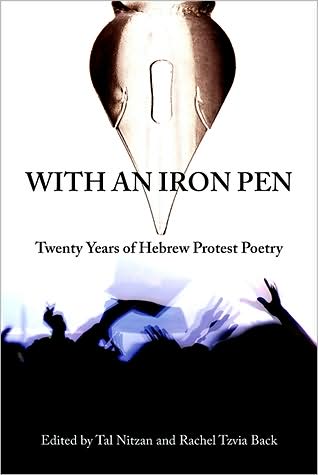
I’ve been reading With an Iron Pen, a newly translated anthology of Israeli protest poetry from the past two decades.  I can’t recommend it enough – especially for those prefer poetry that goes straight to the heart and the gut.

Though I’d heard of some of these poets, I was unfamiliar with the remarkable depth and breadth of this particular genre.  It’s a diverse collection with one critical aspect in common: all these poems express a powerful voice of protest against Israel’s oppressive treatment of Palestinians dating back to the days of the First Intifada. The collection felt to me like nothing other than forty-two poets letting loose one singular prophetic howl of rage and sorrow over what their nation has wrought.

And like all protest poetry, this is art that clearly seeks to transform. As the editors write in introduction:

The ethical stand taken by the poets and poems of this anthology represents today the minority position – a minority that is seen by the majority of the Jewish Israeli public as “self-hating” and as desecrators of sacred ideals. And still, throughout history, literary creations have expressed  the forbidden and revolutionary and have preceded – in fact precipitated – changes in attitudes and societal norms. The day will come when the poems collected in With an Iron Pen will be read as the voice of reason and of honest hearts in dark times.

I see something quintessentially Jewish in the inner struggle reflected these poems – and at the same time, the tradition of protest they draw upon is so clearly universal.  I can’t help but think that these works represent, in their way, a contemporary form of sacred text.

Check out Richard Silverstein’s wonderful review for Tikkun. Click below for two of my particular favorites from the collection:

Continue reading

E1: End of the Two State Solution?

e1-map-11

From today’s Ha’aretz:

Prime Minister-designate Benjamin Netanyahu has struck a secret deal with Yisrael Beiteinu leader Avigdor Lieberman for highly contentious construction on West Bank land known as E1, Army Radio reported Wednesday.

While this might not seem like major news to some, this report, if true, would be devastating to the peace process (such as it is…)  In fact, settling E1 might well constitute the final nail in the coffin of the two state solution.

“E1” stands for East 1 – it is the administrative title given to the area east of Jerusalem and west of the West Bank development Ma’ale Adumim (see map above). Israeli settlement monitors such as Ir Amim and Peace Now have long cautioned against the dire consequences of settling this critical strip of land:

Construction of E-1 would jeopardize the hopes for a two-state solution.  It would, by design, block off the narrow undeveloped land corridor which runs east of Jerusalem and which is necessary for any meaningful future connection between the southern and the northern parts of the West Bank.  It would thus break the West Bank into two parts – north and south.  It would also sever access to East Jerusalem for Palestinians in the West Bank, and sever access to the West Bank for Palestinian residents of East Jerusalem. Both of these situations are antithetical to the achievement of any real, durable peace agreement and the establishment of a viable, contiguous Palestinian state.

The expansion of Ma’ale Adumim, as with the expansion of any other settlement, is a unilateral act which undermines and jeopardizes efforts to resume negotiations which are based on the principal of two states living side by side with peace and security.

It’s not such a stretch to imagine Netanyahu blithely giving E1 away to Lieberman as a political bargaining chip – he’s been hankering after this piece of earth of some time now. In fact, back in 2005 he choose a barren hilltop in E1 upon which to announce his candidacy for Prime Minister. This is what he had to say at the time:

This is Jerusalem, it’s our capital…Nobody can tell us to freeze building in our capital. What we need to do is to break this siege by building here.

You can see all of E1 quite easily from the top of Mt. Scopus. It’s beyond sobering to think the fate of the peace process might well hand upon a mere 12 square kilometers.

Trust me, this will be one to follow…

PS: Click here to send a letter to Secretary of State Clinton to ask her to make a settlement freeze a necessary part of the peace process going forward.

Pickup at Hafez’s Tomb

iran7-003

We’ve spent the last two days in Shiraz – and among other things our experience in this beautiful city gave us a still deeper into to Persia’s soul.

We’ve been told that while Esfahan is generally considered to represent Iran’s historical spirit, Shiraz reflects Iran’s cultural spirit. Indeed, while Iran is an Islamic Republic, Islam is not the only defining aspect of Iranian identity.

Among our many visits in Shiraz was a visit to Zoastrian Fire Temple. Zoastrianism was the religion of the ancient Persian empire and remained so until the Arab conquest converted Persia to Islam in the 7th century. Today, although the active Zoastrian community of Iran is extremely small (there are approximately 1,000 in the country) it continues to occupy an important place in Persian culture. All Iranians regardless of their religion identify with the traditions of Zoastrianism, which is in a sense regarded to be their “native religious culture.” The festival of Yalda, which occurs during the Winter Solstice and Noruz, the two week spring celebration of the Zoastrian New Year, are universally popular national holidays.

iran7-002

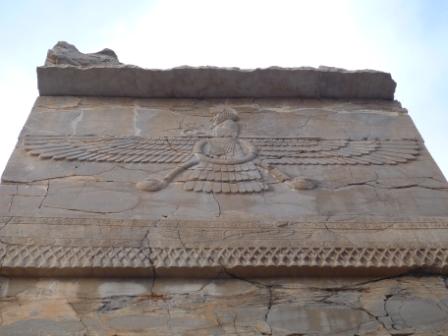
It would have been extremely interesting to dialogue with members of the Zoastrian community, but alas, we learned at the last minute that they were not available to meet us at the Temple. Still, it has been impossible for us to ignore the impact of this ancient religion upon present day Iran. The image of Ahura Mazda, the Zoastrian God, is ubiquitous throughout the country, not only at the ancient ruins of Persepolis (above), but on travel signs, office buildings and souvenir stands.

An interesting anecdote in this regard: when we were at Mofid University in Qom, one young student of Islam proudly showed me his Ahura Mazda necklace, and told me this image was an important part of his history. When I asked if any of his clerical teachers objected, he emphatically shook his head. “It is an important part of our history,” he said. To be sure, more than one person has told us that the Islamic regime is lenient about such things because it understands the importance role Zoastrianism plays in the cultural life of Persia

Another central aspect of the Iranian collective soul, of course, is their poetry. Iranians are justifiably proud of their literary tradition; every Iranian child is read Ferdowsi’s epic “Shahnameh” as well as national poets such as Hafez, Saadi and Rumi.  The more time we spend here, the more I realize we can never underestimate the depth of pride that Iranians have in their national/cultural traditions. It is a modern-day nation can literally experience its own history back across thousands and thousands of years. And though they have been dominated by countless empires over the centuries, they have never surrendered their unique connection their culture, their heritage, their history, their language.

This is something that is very difficult for Americans in particular to grasp – our national history goes back little more than 200 years and most of us ultimately originate from somewhere else. While we study American history, our connection to it is nowhere near as profound at that of Iranians to theirs’.  At the same time, for most Americans, Iran is just another Islamic nation in the Middle East. However, you have only to spend a small amount of time here to understand that this country is much, much more.

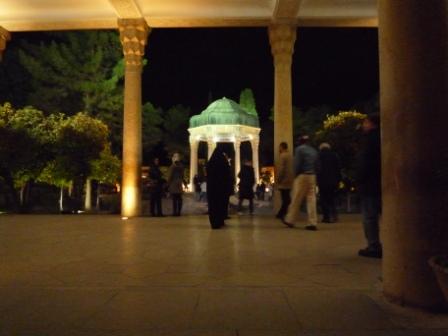
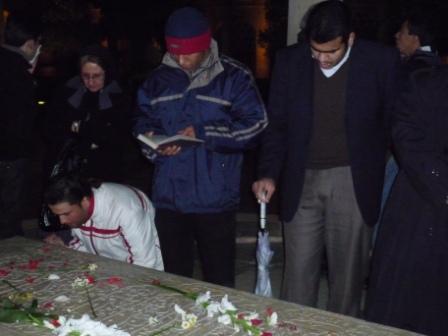
I’m sure this sounds like a cliché, but it’s true: in order to understand Iranians, you must understand their poetry. Or at the very least, to their deep connection to their poetry that truly sings in their soul. For example, among the most important cultural landmarks in Iran are the tombs of their poets, which serve as almost quasi-sacred sites. Last night we went to two of the most important in Shiraz: the Tomb of Saadi and of Hafez. I’m still at bit mind-blown by our experience at Hafez’s tomb in particular (top pic), which was unlike anything I’ve ever experienced. It’s an immensely popular site for Iranians, particularly young Iranian young people, whose idea of a great evening is to visit Hafez’s tomb and read his spiritually passionate poems of wine, longing and romance (see below). It’s also something of a romantic hot spot, where young people can mingle, meet and (I imagine) maybe even get lucky…

iran7-0041

We’ve heard that the social atmosphere in Shiraz is a bit looser than in other Iranian cities, and that the regime’s “Morality Police” tend to let things go there a bit more easily. And apparently the Tomb of Hafez is one of the few places in Iran where young people of the opposite sex can mingle together publically without few of official harassment.

This certainly seemed to be the case last night. Throngs gathered near and around the crypt, reading poems, laughing and chatting. We spent a fair amount of time meeting and talking to folks and wouldn’t you know it, inevitably someone from our group got hit upon. Sarah Bassin reported later that a young man approached her, asked her where she was from, told her about how bad his marriage was, then proclaimed to her: “Your face is delicious.”

After teasing Sarah mercilessly about her quintessentially Persian encounter, we all agreed that our brief sojourn at Hafez’s tomb was unexpectedly and deeply moving. I’d say there is much we Americans can learn from a culture as profound as this one.